|
(11) | EP 3 215 489 B1 |

| (12) | EUROPEAN PATENT SPECIFICATION |
|
|
| (54) |
METHOD FOR THE PREPARATION OF 1-(2-HALOGEN-ETHYL)-4 PIPERIDINE-CARBOXYLIC ACID ETHYL ESTERS VERFAHREN ZUR HERSTELLUNG VON 1-(2-HALOGEN-ETHYL)-4-PIPERIDIN-CARBONSÄURE ETHYL ESTERN PROCÉDÉ DE PRÉPARATION DE L'ESTER 1-(2-HALOGÈNE-ÉTHYL)-4-PIPÉRIDIN-CARBOXYLATE D'ÉTHYLE |
|
|
|||||||||||||||||||||||||||||||
| Note: Within nine months from the publication of the mention of the grant of the European patent, any person may give notice to the European Patent Office of opposition to the European patent granted. Notice of opposition shall be filed in a written reasoned statement. It shall not be deemed to have been filed until the opposition fee has been paid. (Art. 99(1) European Patent Convention). |
Technical Field
[0001] Umeclidinium, in particular umeclidinium bromide, is a compound used in the therapy of individuals suffering from chronic obstructive pulmonary disease.
[0002] A key intermediate in its synthesis is 1-(2-chloroethyl)-4 piperidinecarboxylic acid ethyl ester, of formula (I)
of which some synthesis are described in the literature.
[0003] In particular, WO2005/104745 describes a process for the preparation of compound of formula (I) comprising reacting 1-bromo-2-chloroethane and ethyl-isonipecotate as follows:
[0004] However, such a reaction provides very low yields (about 38%), due to the simultaneous dimerization reaction leading to the 1,1'-(ethane-1,2-diyl)bis(piperidine-4-carboxylate) compound. In addition, the compound obtained by this process is significantly impure and must be necessarily purified by chromatography, a purification process which is not particularly suitable for an industrial synthesis.
[0005] In order to overcome the dimerization problem and the resulting low yields, WO2014/027045 describes a two-steps process for the preparation of compound of formula (I), in particular by the following reactions:
[0006] It is clear that such a synthesis, although leading to better yields with respect to those described in WO2005/104745, requires two reaction steps and the separation of the hydroxylated intermediate by distillation of the reaction solvents, prior to the reaction with the chlorinating agent.
[0007] US2006/223792 discloses reductive aminations on various amines, including ethyl isonipecotate, with various benzaldehydes. Such reactions however do not involve the presence of water and the benzaldehydes used do not contain any further reactive groups which could compete with the reductive amination reaction.
[0008] J. Org. Chem. 61(11), 1996-05-01, discloses reductive aminations on various amines different from isonipecotate, with aldehydes that do not contain reactive groups and reports the use of aqueous solutions of aldehydes is not suitable for large-scale industrial production.
[0009] WO2005/087764 discloses the alkylation of a different amine using dichloroethane (see Preparation 1) and states that poor yields are obtained by using this reaction.
Brief Description of the Drawings
Objects of the Invention
[0011] It is an object of the invention to provide a process for the preparation of a derivative of 1-(2-ethyl)-4 piperidinecarboxylic acid ethyl ester, in particular of 1-(2-chloroethyl)-4 piperidinecarboxylic acid ethyl ester, which is fast, provides good yields and excellent purity and is industrially convenient.
Description of the Invention
[0012] According to one of its aspects, the invention is directed to a process for the preparation of a compound of formula (I)
wherein X is a leaving group selected from chlorine and bromine, comprising carrying out a reductive amination of ethyl-isonipecotate with a X-acetaldehyde, wherein X is as defined above, in the presence of water, in a solvent system which consists of methanol and optionally a weak acid, in the presence, or with subsequent addition, of a reducing agent which is sodium cyanoborohydride, according to scheme (I) below:
[0013] According to a preferred embodiment, the reductive amination reaction of the invention is carried out under acidic catalysis, and in this case the solvent system also comprises an acid, advantageously a weak acid, such as, e.g., a carboxylic acid. Suitable acids include acetic acid and formic acid, with acetic acid being preferred. According to a most preferred embodiment, the solvent system is a mixture comprising a methanol and acetic acid, advantageously in a methanol/acetic acid ratio of at least 8-10/1 (v/v) or higher, for example 12-15/1 or even higher. Preferably, the ethyl-isonipecotate/X-acetaldehyde molar ratio is at least equimolar, preferably X-acetaldehyde is used in excess, e.g. the ratio is about 1/1-2, e.g. 1/1 or 1/1.5.
[0014] According to a preferred embodiment, the X-acetaldehyde is chloroacetaldehyde and it is used in an aqueous solution, e.g. in a 50% (w/w) solution. The possibility of using an aqueous solution of X-acetaldehyde is surprising, since the reductive amination reactions are usually carried out in stringently anhydrous conditions. In this case, however, it has been observed that the process of the invention results in good yields also in the presence of water, provided that the reducing agent is added to the reaction mixture from the beginning. The compound is directly obtained in an extremely pure form and such a result is unexpected and surprising. It is known that the use of chloroacetaldehyde for the reductive amination reaction is not expected for the skilled in the art, since such a reagent can chemically behave either as an aldehyde and as a chloride. If it would behave as a chloride it would be an alkylating agent, in particular for the amines. Moreover, since the reaction is carried out in the presence of water (which usually inhibits the formation of the Schiff base), it is expected that the alkylating function would be dominant. On the other hand and unexpectedly, the reaction leads to a high-purity single product, showing that the unfavorable reactivity of the reaction environment is, on the contrary, unexpectedly favored. In other words, the result of the reaction is opposite to expectations of the skilled in the art and leads to the desired compound with significant yield and purity. As an alternative to X-acetaldehyde it is also possible to use hydrated forms, acetals or hemiacetals thereof.
[0015] The amounts of reducing agent depend upon the agent employed and the skilled in the art is certainly able to calculate them. As an example, it is possible to use nearly equimolar amounts of sodium cyanoborohydride relative to the starting compound or even lower amounts. Molar amounts of ethyl-isonipecotate/X-acetaldehyde/sodium cyanoborohydride can be, e.g., 1/1-1.5/0.3-1.5, advantageously about 1/1-1.5/0.5-1, more preferably 1/1-1.5/1.
[0016] It has been observed that by adding a halogen salt to the reaction mixture, e.g. an alkali metal or an alkali earth metal chloride, e.g. lithium chloride or similar compounds, when using the chloroacetaldehyde, it is possible to obtain the desired compound with higher yields and lower impurities. The amount of said salt is not critical, as an example it can be added in an amount of 10-50% (w/w) or even up to equimolar amounts relative to the starting isonipecotate.
[0017] When the process of the invention occurs in the presence of water, e.g., but not exclusively, when working with aqueous X-acetaldehyde, the presence of some reducing agents (such as NaCNBH3 and other listed above), aids the completion of the reaction and increases the purity of the obtained product.
[0018] However, working in an environment poor of water, it is possible to form the imine and later reduce it by any reaction known in the art for this kind of reaction.
[0019] Therefore, the expression "in presence, or with later addition, of a reducing agent" means that, when working in an aqueous environment, it is preferable to add the reducing agent from the beginning of the amination reaction in order to favor its completion.
[0020] The process of scheme (I) can occur at room temperature and it is completed in few hours (usually, the reaction is complete within 4 hours). It is possible to cool down the reaction mixture, e.g. in an ice bath, when adding the reducing agent in order to avoid an excessive increase of the internal temperature. The skilled in the art can control the development according to known techniques, e.g. by UPLC (ultra-performance liquid chromatography).
[0021] At the end of the reaction the solvents are evaporated and compound of formula (I) is usually obtained already at high purity and it can be directly used without the need of further processing, opposite to what is described in the prior art. However, if desired and needed, the compound can be purified according to conventional techniques, e.g. by simple filtration on silica or by precipitation as a salt, e.g. as hydrochloride. Examples of the process of the invention are provided in the "Experimental section" below with a merely illustrative and not-limiting purpose.
[0022] It will be clear that the process of the invention provides compound of formula (I) with excellent yields and high purity and by means of a simple reductive amination reaction without the need of intermediate isolation and/or purification steps, and therefore represents a significant improvement in the industrial field and a valuable alternative to the processes of the prior art.
Experimental Section
Example 1
[0023] A single-neck flask is charged with ethyl-isonipecotate (369.6 mg; 2.3 mmoles), 6.7 ml of a methanol/acetic acid mixture (10/1) are added and the 50% chloroacetaldehyde aqueous solution (180.5 mg; 2.3 mmoles) is added dropwise. The solution is cooled to 0°C in an ice bath and NaCNBH3 (144.5 mg; 2.3 mmoles) is added portionwise. It is stirred at room temperature for 2 hrs and the development of the reaction is checked by UPLC. The solvent is evaporated at 40°C under reduced pressure, the aqueous phase is made basic with K2CO3, extracted with AcOEt and dried on Na2SO4. The solvent is evaporated at 40°C under reduced pressure and 456.7 mg of compound of formula (I) are thus obtained wherein X is chlorine (90% yield).
1H-NMR analysis
The product obtained in example 1 has been analyzed by 1H-NMR in DMSO. The spectrum, reported in Figure 1, only present signals related to the structure of the desired compound, thus showing that the compound is pure (1H-NMR, 400MHz).
Example 2 (not according to the invention)
[0024] A single-neck flask is charged with ethyl-isonipecotate (443 mg; 2.8 mmoles), 8 ml of an acetonitrile/acetic acid mixture (10/1) are added and the 50% chloroacetaldehyde aqueous solution (219.8 mg; 2.8 mmoles) is added dropwise. The solution is cooled to 0°C in an ice bath and NaBH(OAC)3 (2.4 mg; 11.3 mmoles) is added portionwise. It is stirred at room temperature for 2 hrs and the development of the reaction is checked by UPLC. The solvent is evaporated at 40°C under reduced pressure, the aqueous phase is made basic with K2CO3, extracted with AcOEt and dried on Na2SO4. The solvent is evaporated at 40°C under reduced pressure and compound of formula (I) is thus obtained wherein X is chlorine.
Example 3 (not according to the invention)
[0025] A single-neck flask is charged with ethyl-isonipecotate (468.2 mg; 3 mmoles), 8.6 ml of a methanol/acetic acid mixture (10/1) are added and the 50% chloroacetaldehyde aqueous solution (235.5 mg; 3 mmoles) is added dropwise. The solution is cooled to 0°C in an ice bath and NaBH(OAc)3 (2.5 mg; 12 mmoles) is added portionwise. It is stirred at room temperature for 2 hrs and the development of the reaction is checked by UPLC. The solvent is evaporated at 40°C under reduced pressure, the aqueous phase is made basic with K2CO3, extracted with AcOEt and dried on Na2SO4. The solvent is evaporated at 40°C under reduced pressure and compound of formula (I) is thus obtained wherein X is chlorine.
Example 4
[0026] A single-neck flask is charged with ethyl-isonipecotate (349.7 mg; 2.2 mmoles), 6.3 ml of methanol/acetic acid (10/1) are added and the 50% chloroacetaldehyde aqueous solution (172.7 mg; 2.2 mmoles) is added dropwise. The solution is cooled to 0°C in an ice bath and NaCNBH3 (69.1 mg; 1.1 mmoles) is added portionwise. It is stirred at room temperature for 2 hrs and the development of the reaction is checked by UPLC. The solvent is evaporated at 40°C under reduced pressure, the aqueous phase is made basic with K2CO3, extracted with AcOEt and dried on Na2SO4. The solvent is evaporated at 40°C under reduced pressure and compound of formula (I) is thus obtained wherein X is chlorine.
Example 5
[0027] A single-neck flask is charged with ethyl-isonipecotate (927.8 mg; 5.9 mmoles), 16.8 ml (0.35 M) of methanol/acetic acid (10/1) are added and the 50% chloroacetaldehyde aqueous solution (463.1 mg; 5.9 mmoles) is added dropwise. The solution is cooled to 0°C in an ice bath and NaCNBH3 (370.9 mg; 5.9 mmoles) is added portionwise. It is stirred at room temperature for 2 hrs and the development of the reaction is checked by UPLC. The solvent is evaporated at 40°C under reduced pressure, the residue is taken up with 2N HCl (10 ml) and left under stirring for 30 min. It is extracted with AcOEt (2x20 ml), the aqueous phase is made basic with K2CO3, extracted with AcOEt and dried on Na2SO4. The solvent is evaporated at 40°C under reduced pressure and compound of formula (I) is thus obtained wherein X is chlorine. The compound is further purified by silica gel chromatography: 3 cm column diameter, 7 cm silica, elution with DCM/AcOEt=6/4.
Example 6
[0028] A single-neck flask is charged with ethyl-isonipecotate (515.6 mg; 3.28 mmoles), 9.37 ml (0.35 M) of methanol/acetic acid (9/1), LiCl (139 mg, 3.28 mmoles) are added and the 50% chloroacetaldehyde aqueous solution (386.2 mg; 4.92 mmoles) is added dropwise. The solution is cooled to 0°C in an ice bath and NaCNBH3 (206.1 mg; 3.28 mmoles) is added portionwise. It is stirred at room temperature for 2 hrs and the development of the reaction is checked by UPLC. The solvent is evaporated at 40°C under reduced pressure, the residue is taken up with 2N HCl (10 ml) and left under stirring for 30 min. It is extracted with AcOEt (2x20 ml), the aqueous phase is made basic with K2CO3, extracted with AcOEt and dried on Na2SO4. The solvent is evaporated at 40°C under reduced pressure and 544.2 mg of compound of formula (I) are thus obtained wherein X is chlorine.
1. A process for the preparation of a compound of formula (I)
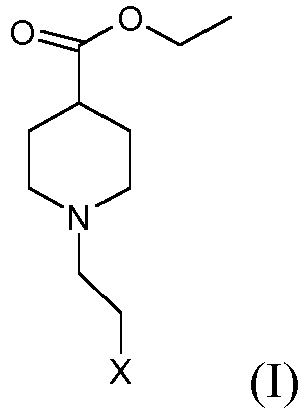
wherein X is a leaving group selected from a chlorine or a bromine atom, comprising carrying out a reductive amination of ethyl-isonipecotate with a X-acetaldehyde (X-CH2-CHO) or acetals, hemiacetals or hydrated forms thereof in the presence of water, wherein X is as defined above, in a solvent system which consists of methanol and optionally comprises a weak acid, in the presence, or with subsequent addition, of a reducing agent which is sodium cyanoborohydride (NaCNBH3).
wherein X is a leaving group selected from a chlorine or a bromine atom, comprising carrying out a reductive amination of ethyl-isonipecotate with a X-acetaldehyde (X-CH2-CHO) or acetals, hemiacetals or hydrated forms thereof in the presence of water, wherein X is as defined above, in a solvent system which consists of methanol and optionally comprises a weak acid, in the presence, or with subsequent addition, of a reducing agent which is sodium cyanoborohydride (NaCNBH3).
2. The process according to claim 1, characterized in that X is a chlorine atom.
3. The process according to claim 1 or 2, characterized in that said weak acid is acetic acid.
4. Process according to any one of the preceding claims, characterized in that said solvent system is a mixture of methanol/acetic acid = 8-10/1 (v/v) or higher.
5. The process according to any one of the preceding claims, characterized in that the ethyl-isonipecotate/X-acetaldehyde ratio is 1/1-1.5.
6. The process according to any one of the preceding claims, characterized in that the molar ratios of ethyl-isonipecotate/X-acetaldehyde/sodium cyanoborohydride are
1/1-1.5/0.3-1.5.
7. The process according to any one of the preceding claims, characterized in that the reaction occurs in the presence of halogen salts.
8. The process according to claim 7, characterized in that the reaction occurs in the presence of an alkali metal or an alkali earth metal chloride.
1. Ein Verfahren zur Herstellung einer Verbindung der Formel (I)
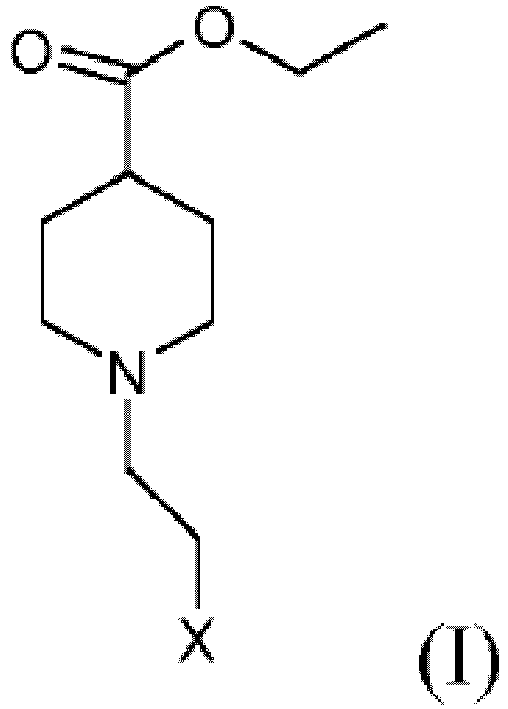
worin X eine Abgangsgruppe ist ausgewählt aus einem Chloratom oder einem Bromatom, umfassend die Durchführung einer reduktiven Aminierung von Ethylisonipecotat mit einem X-Acetaldehyd (X-CH2-CHO) oder Acetalen, Halbacetalen oder hydratisierten Formen davon bei Anwesenheit von Wasser, worin X wie oben definiert ist, in einem Lösungsmittelsystem, das aus Methanol besteht und optional eine schwache Säure enthält, in Gegenwart oder mit anschließender Zugabe eines Reduktionsmittels, das Natriumcyanoborhydrid (NaCNBH3) ist.
worin X eine Abgangsgruppe ist ausgewählt aus einem Chloratom oder einem Bromatom, umfassend die Durchführung einer reduktiven Aminierung von Ethylisonipecotat mit einem X-Acetaldehyd (X-CH2-CHO) oder Acetalen, Halbacetalen oder hydratisierten Formen davon bei Anwesenheit von Wasser, worin X wie oben definiert ist, in einem Lösungsmittelsystem, das aus Methanol besteht und optional eine schwache Säure enthält, in Gegenwart oder mit anschließender Zugabe eines Reduktionsmittels, das Natriumcyanoborhydrid (NaCNBH3) ist.
2. Das Verfahren gemäß Anspruch 1, dadurch gekennzeichnet, dass X ein Chloratom ist.
3. Das Verfahren gemäß Anspruch 1 oder 2, dadurch gekennzeichnet, dass die schwache Säure Essigsäure ist.
4. Das Verfahren gemäß irgendeinem der vorhergehenden Ansprüche, dadurch gekennzeichnet, dass das Lösungsmittel eine Mischung von Methanol/Essigsäure in einem Verhältnis von 8-10/1
(v/v) oder höher ist.
5. Das Verfahren gemäß irgendeinem der vorhergehenden Ansprüche, dadurch gekennzeichnet, dass das Verhältnis von Ethylisonipecotat zu X-Acetaldehyd 1/1-1,5 beträgt.
6. Das Verfahren gemäß irgendeinem der vorhergehenden Ansprüche, dadurch gekennzeichnet, dass die molaren Verhältnisse von Ethylisonipecotat zu X-Acetaldehyd zu Natriumcyanoborhydrid
1/1-1,5/0,3-1,5 betragen.
7. Das Verfahren gemäß irgendeinem der vorhergehenden Ansprüche, dadurch gekennzeichnet, dass die Umsetzung in Gegenwart von Halogensalzen erfolgt.
8. Das Verfahren gemäß Anspruch 7, dadurch gekennzeichnet, dass die Umsetzung in Gegenwart eines Alkalimetalls oder eines Erdalkalimetallchlorids
erfolgt.
1. Procédé pour la préparation d'un composé de formule (I)
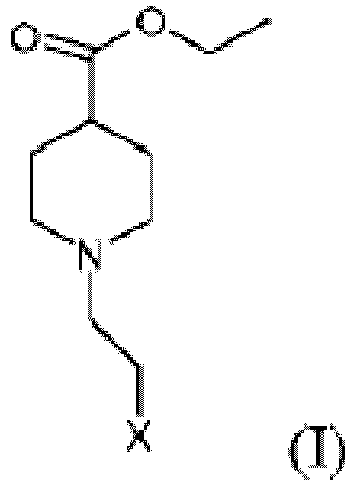
dans laquelle X est un groupe partant sélectionné à partir d'un atome de chlore ou de brome, comprenant la mise en oeuvre d'une amination réductrice de l'isonipécotate d'éthyle avec un X-acétaldéhyde (X-CH2-CHO) ou des acétals, des hémiacétals ou des formes hydratées de celui-ci en présence d'eau, dans lequel X est tel que défini ci-dessus, dans un système de solvant qui consiste en du méthanol et comprend facultativement un acide faible, en présence, ou avec l'ajout ultérieur, d'un agent réducteur qui est le cyanoborohydrure de sodium (NaCNBH3).
dans laquelle X est un groupe partant sélectionné à partir d'un atome de chlore ou de brome, comprenant la mise en oeuvre d'une amination réductrice de l'isonipécotate d'éthyle avec un X-acétaldéhyde (X-CH2-CHO) ou des acétals, des hémiacétals ou des formes hydratées de celui-ci en présence d'eau, dans lequel X est tel que défini ci-dessus, dans un système de solvant qui consiste en du méthanol et comprend facultativement un acide faible, en présence, ou avec l'ajout ultérieur, d'un agent réducteur qui est le cyanoborohydrure de sodium (NaCNBH3).
2. Procédé selon la revendication 1, caractérisé en ce que X est un atome de chlore.
3. Procédé selon la revendication 1 ou 2, caractérisé en ce que ledit acide faible est l'acide acétique.
4. Procédé selon l'une quelconque des revendications précédentes, caractérisé en ce que ledit système de solvant est un mélange de méthanol/acide acétique = 8 à 10/1 (en
volume/volume) ou plus
5. Procédé selon l'une quelconque des revendications précédentes, caractérisé en ce que le rapport isonipécotate d'éthyle/X-acétaldéhyde est de 1/1 à 1,5.
6. Procédé selon l'une quelconque des revendications précédentes, caractérisé en ce que les rapports molaires de l'isonipécotate d'éthyle/X-acétaldéhyde/cyanoborohydrure
de sodium sont de 1/1 à 1,5/0,3 à 1,5.
7. Procédé selon l'une quelconque des revendications précédentes, caractérisé en ce que la réaction a lieu en présence de sels d'halogène.
8. Procédé selon la revendication 7, caractérisé en ce que la réaction a lieu en présence d'un chlorure de métal alcalin ou de métal alcalino-terreux.
REFERENCES CITED IN THE DESCRIPTION
This list of references cited by the applicant is for the reader's convenience only. It does not form part of the European patent document. Even though great care has been taken in compiling the references, errors or omissions cannot be excluded and the EPO disclaims all liability in this regard.
Patent documents cited in the description
Non-patent literature cited in the description
- J. Org. Chem., 1996, vol. 61, 11 [0008]