| (19) |
 |
|
(11) |
EP 3 298 314 B1 |
| (12) |
EUROPEAN PATENT SPECIFICATION |
| (45) |
Mention of the grant of the patent: |
|
27.03.2019 Bulletin 2019/13 |
| (22) |
Date of filing: 10.05.2016 |
|
| (51) |
International Patent Classification (IPC):
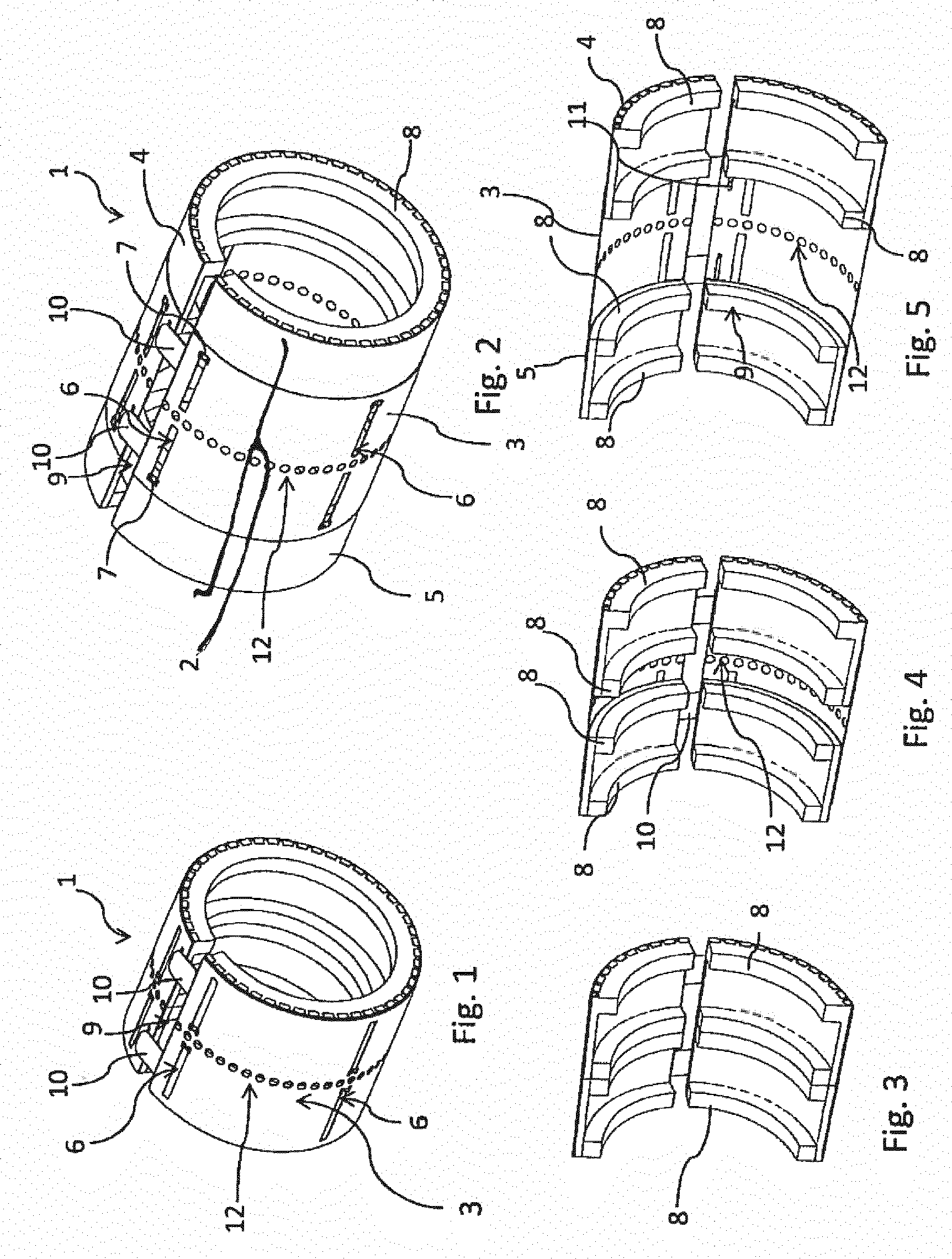
|
| (86) |
International application number: |
|
PCT/NL2016/050331 |
| (87) |
International publication number: |
|
WO 2016/186486 (24.11.2016 Gazette 2016/47) |
|
| (54) |
ADJUSTABLE FIRE STOP COLLAR
VERSTELLBARE BRANDSCHUTZHÜLSE
DOUILLE COUPE-FEU AJUSTABLE
|
| (84) |
Designated Contracting States: |
|
AL AT BE BG CH CY CZ DE DK EE ES FI FR GB GR HR HU IE IS IT LI LT LU LV MC MK MT NL
NO PL PT RO RS SE SI SK SM TR |
| (30) |
Priority: |
20.05.2015 NL 2014831
|
| (43) |
Date of publication of application: |
|
28.03.2018 Bulletin 2018/13 |
| (73) |
Proprietor: J. van Walraven Holding B.V. |
|
3641 RK Mijdrecht (NL) |
|
| (72) |
Inventors: |
|
- NIJDAM, Frank
3893 BA Zeewolde (NL)
- VERMEULEN, Constantinus Paulinus Johannes Maria
3053 ZN Rotterdam (NL)
|
| (74) |
Representative: EP&C |
|
P.O. Box 3241
2280 GE Rijswijk
2280 GE Rijswijk (NL) |
| (56) |
References cited: :
EP-A2- 1 780 456
DE-U1- 9 418 172
US-B2- 7 581 362
|
WO-A1-01/09538
DE-U1-202007 000 727
|
|
| |
|
|
|
|
| |
|
| Note: Within nine months from the publication of the mention of the grant of the European
patent, any person may give notice to the European Patent Office of opposition to
the European patent
granted. Notice of opposition shall be filed in a written reasoned statement. It shall
not be deemed to
have been filed until the opposition fee has been paid. (Art. 99(1) European Patent
Convention).
|
[0001] The present invention relates to a fire stop sleeve for arrangement in a passage
for a conduit or cable or the like in a partition such as a wall or a ceiling, the
fire stop sleeve comprising an outer casing, preferably made of metal, and intumescent
material arranged on a radially inner side of the outer casing, wherein the casing
comprises at least two interconnected coaxial casing portions which have at least
overlapping end portions and which are slidable with respect to each other to extend
or reduce the length of the sleeve to adjust the length to a thickness of the partition.
[0002] US 7.581.362 discloses a telescoping tube comprising two collinear tubular sections which are
enabled for sliding extension so that the tube is able to adjusted in length to the
desired size of walls of varying thickness. The known tube has end flanges in particular
used for being fastened to the forms prior to concrete pour to form the wall. One
or more coils of intumescent material are placed within the tube adjacent one of the
open ends of the tube. In the resulting structure the tube is integral with the concrete
wall and receives utility pipes or conduits such that conductors may be easily placed
between compartments separated by the wall.
[0003] EP 1 780 456 discloses a passage assembly for conduits which can be fixed to a formwork for pouring
concrete. In one embodiment the assembly comprises a central tube with on the outer
side a male thread and two base portions having a tubular portion with a female thread
cooperating with the male thread of the hollow tube. The base portion have a flange
which can be fixed to the formwork. The base portions have an accommodation space
in which intumescent material is accommodated. The length of assembly can be modified
to the thickness of the concrete wall or floor to be poured, by cutting the central
tube to length. Next the base portions can be screwed on the ends of the central tube.
[0004] The invention has for an object to provide an improved fire stop sleeve.
[0005] This object is achieved by a fire stop sleeve according to claim 1.
[0006] Because the fire stop sleeve according to the invention has at least two strips of
intumescent material, one on each end, a quick closing of the passage through the
partition is ensured at either side of the partition in case of a fire. This provides
a better fire safety.
[0007] According to invention the casing portions are interconnected by an axially extending
guiding structure which includes a stop that determines the maximal extension of the
sleeve. This ensures that the sleeve portions are not separated from each other when
extended. In particular the guiding structure includes at least an axial guiding slot
in one of the casing portions and a guiding protrusion provided on another casing
portion which protrusion is slidingly arranged in the guiding slot.
[0008] In a preferred embodiment the at least one circumferentially extending strip of intumescent
material is arranged at an axial end of said axially outer casing portion remote from
the overlapping end portion. By this feature the intumescent material is located as
close as possible to the location where a fire hazard may come from.
[0009] In a possible embodiment the casing comprises one central casing portion and two
axially outer casing portions which are arranged coaxially and at least partially
within the central casing portion.
[0010] In a preferred embodiment the casing comprises one central casing portion and two
axially outer casing portions which are arranged coaxially and at least partially
within the central casing portion, wherein the central casing portion is provided
with at least one guiding slot, and wherein the outer casing portions are each provided
with a guiding protrusion slidingly arranged in a corresponding guiding slot in the
central casing portion. The guiding slot may be an axial guiding slot, but may also
be a slot that extends in both the axial and the circumferential direction, such as
a helix.
[0011] The outer casing portions are provided at the axially outer ends thereof with a circumferentially
extending strip of intumescent material. There may however also be more strips of
intumescent material. The advantage is that the end portions of the sleeve have the
intumescent material on the inner side, whereas the intermediate portions can be made
without intumescent material, which is a cost saving structure. In the prior art there
are known one piece sleeves, which are entirely covered on the inner side with intumescent
material. These are expensive with respect to the sleeve according to the present
invention because of the great amount of the expensive intumescent material applied
in them.
[0012] The casing that according to the invention exist of two or more casing portions limits
the thermal conductivity of the casing which improves the fire safety. However, also
additional thermally isolating measures can be provided. For example in the embodiment
with the central casing the central casing may be provided with a line of perforations
which extends in the circumferential direction, whereby the surface through which
heat is conducted in the axial direction is reduced.
[0013] In a particular embodiment of the sleeve according to the invention the casing has
a longitudinal slit where the casing can be opened such that the sleeve can be arranged
around the conduit or cable, and the casing has retaining elements to keep the casing
closed when it is arranged around the conduit or cable. This has the advantage that
the fire stop sleeve can be retrofitted around an existing pipe or conduit and then
be arranged in the passage through the partition.
[0014] The invention also relates to a method wherein the fire stop sleeve as is described
in the above is arranged in an existing passage for a conduit or cable or the like
in a partition such as a wall or a ceiling, wherein the length of the fire stop sleeve
is extended or reduced by slidingly moving the sleeve parts with respect to each other
so as to make the length of the sleeve corresponding substantially to the thickness
of the partition.
[0015] In particular in the method the sleeve may be arranged around an existing pipe which
extends through said passage in the partition.
[0016] The invention will be elucidated in the following detailed description of a preferred
embodiment with reference to the drawing, wherein:
Fig. 1 shows a view in perspective of a preferred embodiment of a fire stop sleeve
according to the invention in a short state;
Fig. 2 shows a view in perspective of the fire stop sleeve of Fig. 1 in a fully extended
state;
Fig. 3 shows a cutaway view in perspective of the sleeve of Fig. 1 in the short state
corresponding to Fig. 1;
Fig. 4 shows a cutaway view in perspective of the sleeve of Fig. 1 in a more extended
state;
Fig. 5 shows a cutaway view in perspective of the sleeve of Fig. 1 in a most extended
state corresponding to Fig. 2.
[0017] Figs. 1 - 5 shows a fire stop sleeve 1 comprising a metal casing 2. The metal casing
2 comprises one central metal casing portion 3 and two axially outer metal casing
portions 4, 5. The axially outer casing portions 4, 5 are arranged coaxially and at
least partially within the central casing portion 3.
[0018] The central casing portion 3 is provided with pairs of axial guiding slots 6. The
guiding slots 6 extend in a axial direction and the slots 6 of each pair are aligned.
The outer casing portions 4, 5 are each provided on the outer side with a guiding
protrusion 7 slidingly arranged in a corresponding guiding slot 6 in the central casing
portion 3. The central casing portion 6 may be provided with four pairs of axial slots
6 distributed over the circumference of the central casing portion 3. The resulting
axially extending guiding structure includes a stop when the protrusion 7 abuts the
end of the slot 6 which determines the maximal extension of the sleeve 1 (cf. Fig.
2).
[0019] In a possible alternative embodiment according to the invention, it is conceivable
that the axially extending guiding structure comprises helical slots instead of pure
axial slots.
[0020] Each of the outer casing portions 4 and 5 is provided with strips 8, in this case
two strips, of intumescent material on the inner side. The strips 8 are mutually spaced
apart and one is on the axial outer end of the outer casing portion 4, 5 and one is
on the axial inner end of the outer casing portion 4, 5. The strips 8 extend in the
circumferential direction on the inner circumference of the casing portion 4, 5.
[0021] The central casing portion 3 and the outer casing portions each have a longitudinal
slit 9 which are aligned with each other, whereby the casing 2 as a whole can be opened
such that the sleeve 1 can be arranged around the conduit or cable. The central casing
portion 3 is provided with retaining lips 10 and retaining slots 11 which can cooperate
with each other to keep the casing 2 in a closed state around a pipe, conduit or the
like.
[0022] The fire stop sleeve 1 may be transported in the compact state that is shown in Fig.
1. The length may for example be 100mm. The two outer casing portions abut each other
within the central casing portion 3. If the wall through which the sleeve is to be
arranged is thicker tan 100mm, the sleeve can be extended by moving the outer casing
portions 4, 5 apart. In Fig. 4 is indicated that the casing portions 4 and 5 are moved
apart and the total length would be about 125mm. In Fig. 5 is shown the state in which
the sleeve is fully extended to about 180mm.
[0023] It is noted that the lengths dimension mentioned are only given as an indication
of practical dimensions and must not be considered as limiting or essential.
[0024] The central casing portion is in the axial centre thereof provided with a circumferentially
extending perforation line 12, which provides a reduction of the heat conductivity
of the metal casing in the axial direction, because it reduces the total area through
which heat can be conducted in the metal casing.
1. Fire stop sleeve (1) for arrangement in a passage for a conduit or cable or the like
in a partition such as a wall or a ceiling, the fire stop sleeve (1) comprising an
outer casing (2) and intumescent material (8) arranged on a radially inner side of
the outer casing, wherein the casing comprises at least two interconnected coaxial
casing portions (3, 4, 5) which have at least overlapping end portions and which are
slidable with respect to each other to extend or reduce the length of the sleeve (1)
to adjust the length to a thickness of the partition, at least one circumferentially
extending strip (8) of intumescent material being arranged on the inner side of each
of the casing portions (4, 5) that are axially most outwardly located, characterised in that the casing portions (3, 4, 5) are interconnected by an axially extending guiding
structure which includes a stop that determines the maximal extension of the sleeve
(1), said guiding structure including at least an axial guiding slot (6) in one of
the casing portions (3) and a guiding protrusion (7) provided on another casing portion
(4, 5) which protrusion (7) is slidingly arranged in the guiding slot (6).
2. Fire stop sleeve according to claim 1, wherein said at least one circumferentially
extending strip (8) of intumescent material is arranged at an axial end of said axially
outer casing portion (4, 5) remote from the overlapping end portion.
3. Fire stop sleeve according to any one of the claims 1 - 2, wherein the casing comprises
one central casing portion (3) and two axially outer casing portions (4, 5) which
are arranged coaxially and at least partially within the central casing portion (3).
4. Fire stop sleeve according to claim 3, wherein the central casing portion (3) is provided
with at least one of the axial guiding slots (6), and wherein the outer casing portions
(4, 5) are each provided with a guiding protrusion (7) slidingly arranged in a corresponding
guiding slot (6) in the central casing portion (3).
5. Fire stop sleeve according to any one of the preceding claims, wherein the casing
has a longitudinal slit (9) where the casing (2) can be opened such that the sleeve
(1) can be arranged around the conduit or cable, and the casing (2) has retaining
elements (10) to keep the casing (2) closed when it is arranged around the conduit
or cable.
6. Fire stop sleeve according to any one of the preceding claims, wherein the casing
(2) is made of metal.
7. Fire stop sleeve (1) for arrangement in a passage for a conduit or cable or the like
in a partition such as a wall or a ceiling, the fire stop sleeve (1) comprising an
outer casing (2) and intumescent material (8) arranged on a radially inner side of
the outer casing, wherein the casing comprises at least two interconnected coaxial
casing portions (3, 4, 5) which have at least overlapping end portions and which are
slidable with respect to each other to extend or reduce the length of the sleeve (1)
to adjust the length to a thickness of the partition, at least one circumferentially
extending strip (8) of intumescent material being arranged on the inner side of each
of the casing portions (4, 5) that are axially most outwardly located, wherein the
casing comprises one central casing portion (3) and two axially outer casing portions
(4, 5) which are arranged coaxially and at least partially within the central casing
portion (3), wherein the casing portions (3, 4, 5) are interconnected by an axially
and circumferentially extending guiding structure which includes a stop that determines
the maximal extension of the sleeve (1), said guiding structure including at least
a guiding slot (6) in the central casing portion (3) and a guiding protrusion (7)
provided on each of the outer casing portions (4, 5) which protrusions (7) are slidingly
arranged in the guiding slot (6), wherein the guiding slot (6) extends in both the
axial and the circumferential direction.
8. Method for installation of a fire stop sleeve (1) according to any of the preceding
claims, wherein the fire stop sleeve (1) is arranged in an existing passage for a
conduit or cable or the like in a partition such as a wall or a ceiling, wherein the
length of the fire stop sleeve (1) is extended or reduced by slidingly moving the
sleeve parts (3, 4, 5) with respect to each other so as to make the length of the
sleeve (1) corresponding substantially to the thickness of the partition.
1. Brandschutzhülse (1) zur Anordnung in einem Durchgang für eine Leitung oder ein Kabel
oder dergleichen in einer Abtrennung, wie etwa einer Wand oder einer Decke, wobei
die Brandschutzhülse (1) einen Außenmantel (2) und intumeszentes Material (8) umfasst,
das auf einer radial inneren Seite des Außenmantels angeordnet ist, wobei der Mantel
mindestens zwei miteinander verbundene koaxiale Mantelabschnitte (3, 4, 5) umfasst,
die zumindest überlappende Endabschnitte haben, und die in Bezug aufeinander gleitbeweglich
sind, um die Länge der Hülse (1) zu verlängern oder zu verkürzen, um die Länge an
eine Dicke der Abtrennung anzupassen, wobei mindestens ein sich umfänglich erstreckender
Streifen (8) aus intumeszentem Material auf der Innenseite jeweils der Mantelabschnitte
(4, 5) angeordnet ist, die sich axial am weitesten außen befinden, dadurch gekennzeichnet, dass die Mantelabschnitte (3, 4, 5) durch eine sich axial erstreckende Führungsstruktur
miteinander verbunden sind, die einen Anschlag enthält, der die maximale Verlängerung
der Hülse (1) bestimmt, wobei die Führungsstruktur mindestens einen axialen Führungsschlitz
(6) in einem der Mantelabschnitte (3) und einen Führungsvorsprung (7) enthält, der
am anderen Mantelabschnitt (4, 5) vorgesehen ist, welcher Vorsprung (7) gleitbeweglich
im Führungsschlitz (6) angeordnet ist.
2. Brandschutzhülse nach Anspruch 1, wobei der sich umfänglich erstreckende Streifen
(8) aus intumeszentem Material an einem axialen Ende des axial äußeren Mantelabschnitts
(4, 5) beabstandet vom überlappenden Endabschnitt angeordnet ist.
3. Brandschutzhülse nach einem der Ansprüche 1 bis 2, wobei der Mantel einen zentralen
Mantelabschnitt (3) und zwei axial äußere Mantelabschnitte (4, 5) umfasst, die koaxial
und zumindest teilweise in dem zentralen Mantelabschnitt (3) angeordnet sind.
4. Brandschutzhülse nach Anspruch 3, wobei der zentrale Mantelabschnitt (3) mit mindestens
einem der axialen Führungsschlitze (6) versehen ist, und wobei die äußeren Mantelabschnitte
(4, 5) jeweils mit einem Führungsvorsprung (7) versehen sind, der gleitbeweglich in
einem entsprechenden Führungsschlitz (6) im zentralen Mantelabschnitt (3) angeordnet
ist.
5. Brandschutzhülse nach einem der vorhergehenden Ansprüche, wobei der Mantel einen Längsschlitz
(9) hat, an dem der Mantel (2) geöffnet werden kann, so dass die Hülse (1) um die
Leitung oder das Kabel herum angeordnet werden kann, und der Mantel Rückhalteelemente
(10) hat, um den Mantel (2) geschlossen zu halten, wenn er um die Leitung oder das
Kabel herum angeordnet ist.
6. Brandschutzhülse nach einem der vorhergehenden Ansprüche, wobei der Mantel (2) aus
Metall hergestellt ist.
7. Brandschutzhülse (1) zur Anordnung in einem Durchgang für eine Leitung oder ein Kabel
oder dergleichen in einer Abtrennung, wie etwa einer Wand oder einer Decke, wobei
die Brandschutzhülse (1) einen Außenmantel (2) und intumeszentes Material (8) umfasst,
das auf einer radial inneren Seite des Außenmantels angeordnet ist, wobei der Mantel
mindestens zwei miteinander verbundene koaxiale Mantelabschnitte (3, 4, 5) umfasst,
die zumindest überlappende Endabschnitte haben, und die in Bezug aufeinander gleitbeweglich
sind, um die Länge der Hülse (1) zu verlängern oder zu reduzieren, um die Länge an
eine Dicke der Abtrennung anzupassen, wobei mindestens ein sich umfänglich erstreckender
Streifen (8) aus intumeszentem Material auf der Innenseite jeweils der Mantelabschnitte
(4, 5) angeordnet ist, die sich axial am weitesten außen befinden, wobei der Mantel
einen zentralen Mantelabschnitt (3) und zwei axial äußere Mantelabschnitte (4, 5)
umfasst, die koaxial und zumindest teilweise in dem zentralen Mantelabschnitt (3)
angeordnet sind, wobei die Mantelabschnitte (3, 4, 5) durch eine sich axial und umfänglich
erstreckende Führungsstruktur miteinander verbunden sind, die einen Anschlag enthält,
der die maximale Verlängerung der Hülse (1) bestimmt, wobei die Führungsstruktur zumindest
einen Führungsschlitz (6) im zentralen Mantelabschnitt (3) und einen Führungsvorsprung
(7) enthält, der an jedem der äußeren Mantelabschnitte (4, 5) vorgesehen ist, welche
Vorsprünge (7) gleitbeweglich im Führungsschlitz (6) angeordnet sind, wobei sich der
Führungsschlitz (6) sowohl in der axialen als auch der umfänglichen Richtung erstreckt.
8. Verfahren zum Installieren einer Brandschutzhülse (1) nach einem der vorhergehenden
Ansprüche, wobei die Brandschutzhülse (1) in einem bestehenden Durchgang für eine
Leitung oder ein Kabel oder dergleichen in einer Abtrennung, wie etwa einer Decke
oder Wand, angeordnet wird, wobei die Länge der Brandschutzhülse (1) verlängert oder
verkürzt wird, indem die Hülsenteile (3, 4, 5) in Bezug aufeinander gleitend bewegt
werden, um zu bewirken, dass die Länge der Hülse (1) im Wesentlichen der Dicke der
Abtrennung entspricht.
1. Manchon (1) coupe-feu destiné à être disposé dans un passage pour un conduit, un câble
ou similaire dans une cloison telle qu'un mur ou un plafond, le manchon coupe-feu
(1) comprenant un boîtier (2) extérieur et du matériau intumescent (8) disposé sur
un côté radialement intérieur du boîtier extérieur, dans lequel le boîtier comprend
au moins deux parties (3, 4, 5) de boîtier coaxiales interconnectées qui comportent
au moins des parties d'extrémités qui se chevauchent et qui peuvent coulisser l'une
par rapport à l'autre pour augmenter ou réduire la longueur du manchon (1) afin d'ajuster
la longueur à une épaisseur de la cloison, au moins une bande (8) de matériau intumescent
s'étendant de manière circonférentielle étant disposée sur le côté intérieur de chacune
des parties (4, 5) de boîtier situées axialement le plus à l'extérieur, caractérisé en ce que les parties (3, 4, 5) de boîtier sont interconnectées par une structure de guidage
s'étendant axialement qui comprend une butée qui détermine l'extension maximale du
manchon (1), ladite structure de guidage incluant au moins une fente (6) de guidage
axial dans l'une des parties (3) de boîtier et une saillie (7) de guidage prévue sur
une autre partie (4, 5) de boîtier, laquelle saillie (7) est agencée de manière coulissante
dans la fente (6) de guidage.
2. Manchon coupe-feu selon la revendication 1, dans lequel ladite au moins une bande
(8) de matériau intumescent s'étendant de manière circonférentielle est disposée à
une extrémité axiale de ladite partie (4, 5) de boîtier axialement extérieure et à
distance de la partie d'extrémité chevauchante.
3. Manchon coupe-feu selon l'une quelconque des revendications 1 et 2, dans lequel le
boîtier comprend une partie (3) centrale de boîtier et deux parties (4, 5) de boîtier
axialement extérieures qui sont disposées de manière coaxiale et au moins partiellement
à l'intérieur de la partie (3) centrale de boîtier.
4. Manchon coupe-feu selon la revendication 3, dans lequel la partie (3) centrale de
boîtier est munie d'au moins l'une des fentes (6) de guidage axial, et dans lequel
les parties (4, 5) de boîtier extérieures sont chacune pourvues d'une saillie (7)
de guidage agencée de manière coulissante dans une fente (6) de guidage correspondante
dans la partie (3) centrale de boîtier.
5. Manchon coupe-feu selon l'une quelconque des revendications précédentes, dans lequel
le boîtier présente une fente (9) longitudinale dans laquelle le boîtier (2) peut
être ouvert de telle sorte que le manchon (1) puisse être disposé autour du conduit
ou du câble, et le boîtier (2) comporte des éléments (10) de retenue pour maintenir
le boîtier (2) fermé lorsqu'il est disposé autour du conduit ou du câble.
6. Manchon coupe-feu selon l'une quelconque des revendications précédentes, dans lequel
le boîtier (2) est en métal.
7. Manchon (1) coupe-feu destiné à être disposé dans un passage pour un conduit ou un
câble ou similaire dans une cloison telle qu'un mur ou un plafond, le manchon coupe-feu
(1) comprenant un boîtier (2) extérieur et du matériau intumescent (8) disposé sur
un côté radialement intérieur du boîtier extérieur, dans lequel le boîtier comprend
au moins deux parties (3, 4, 5) de boîtier coaxiales interconnectées qui comportent
au moins des parties d'extrémités qui se chevauchent et qui peuvent coulisser l'une
par rapport à l'autre pour augmenter ou réduire la longueur du manchon (1) afin d'ajuster
la longueur à une épaisseur de la cloison, au moins une bande (8) de matériau intumescent
s'étendant de manière circonférentielle étant disposée sur le côté intérieur de chacune
des parties (4, 5) de boîtier situées axialement le plus à l'extérieur, dans lequel
le boîtier comprend une partie (3) centrale de boîtier et deux parties (4, 5) de boîtier
axialement extérieures qui sont disposées de manière coaxiale et au moins partiellement
à l'intérieur de la partie (3) centrale de boîtier, dans lequel les parties (3, 4,
5) de boîtier sont interconnectées par une structure de guidage s'étendant axialement
et de manière circonférentielle, qui comprend une butée qui détermine l'extension
maximale du manchon (1), ladite structure de guidage incluant au moins une fente (6)
de guidage dans la partie (3) centrale de boîtier et une saillie (7) de guidage prévue
sur chacune des parties (4, 5) de boîtier extérieures, lesquelles saillies sont agencées
de manière coulissante dans la fente (6) de guidage, dans lequel la fente (6) de guidage
s'étend à la fois dans la direction axiale et dans la direction circonférentielle.
8. Procédé d'installation d'un manchon (1) coupe-feu selon l'une quelconque des revendications
précédentes, dans lequel le manchon (1) coupe-feu est agencé dans un passage existant
pour un conduit, un câble ou similaire dans une cloison telle qu'un mur ou un plafond,
dans lequel la longueur du manchon (1) coupe-feu est augmentée ou réduite en déplaçant
de manière coulissante les parties (3, 4, 5) du manchon les unes par rapport aux autres
de manière à ce que la longueur du manchon (1) corresponde sensiblement à l'épaisseur
de la cloison.
REFERENCES CITED IN THE DESCRIPTION
This list of references cited by the applicant is for the reader's convenience only.
It does not form part of the European patent document. Even though great care has
been taken in compiling the references, errors or omissions cannot be excluded and
the EPO disclaims all liability in this regard.
Patent documents cited in the description