(19)
(11) EP 3 343 753 A3

(12) EUROPEAN PATENT APPLICATION

(88) Date of publication A3:
31.10.2018 Bulletin 2018/44

(43) Date of publication A2:
04.07.2018 Bulletin 2018/27

(21) Application number: 18154234.1

(22) Date of filing: 01.04.2009
(51) International Patent Classification (IPC): 
H02P 6/18(2016.01)
H02P 6/20(2016.01)
H02P 6/185(2016.01)
H02P 21/00(2016.01)
B66B 1/30(2006.01)
(84) Designated Contracting States:
AT BE BG CH CY CZ DE DK EE ES FI FR GB GR HR HU IE IS IT LI LT LU LV MC MK MT NL NO PL PT RO SE SI SK TR
Designated Extension States:
AL BA RS

(30) Priority: 24.04.2008 FI 20080318

(62) Application number of the earlier application in accordance with Art. 76 EPC:
09733858.6 / 2269297

(71) Applicant: KONE Corporation
00330 Helsinki (FI)

(72) Inventors:
  • KAUPPINEN, Tuukka
    00330 Helsinki (FI)
  • STOLT, Lauri
    00330 Helsinki (FI)

(74) Representative: Glück Kritzenberger Patentanwälte PartGmbB 
Hermann-Köhl-Strasse 2a
93049 Regensburg
93049 Regensburg (DE)


(54) DETERMINATION OF THE POSITION OF THE ROTOR OF AN ELECTRIC MACHINE


(57) The invention relates to a frequency converter (1), comprising a load bridge (2) and also a control (3) of the load bridge, for supplying electricity between the load bridge (2) and an electric machine (4) connected to the load bridge; which frequency converter comprises a determination (5) for at least one electrical parameter of the aforementioned electric machine, and which frequency converter comprises a determination (6) for the position of the rotor of the electric machine.
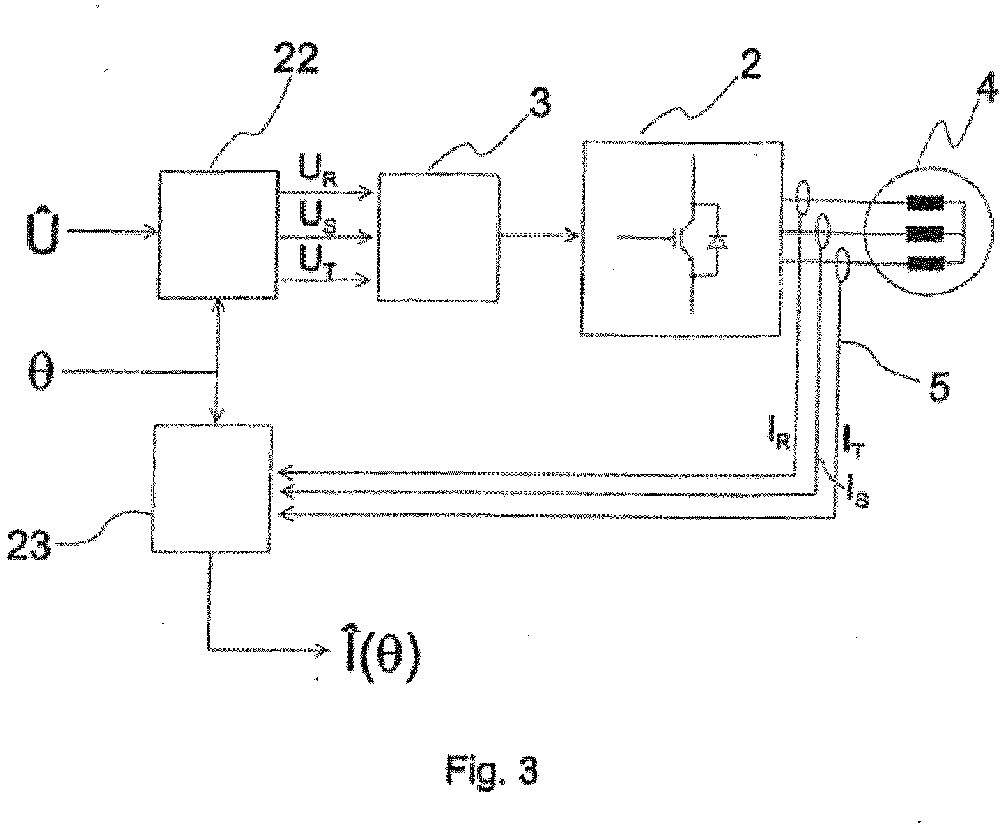
According to the invention a load bridge (2) is fitted to supply a first alternating electricity excitation signal (7) to the aforementioned electric machine (4), which first alternating electricity excitation signal is formed in relation to the electrical angle (18) of the electric machine. The frequency converter is fitted to determine a first alternating electricity response signal (9,16) corresponding to the aforementioned first alternating electricity excitation signal (7), and the position of the rotor is determined on the basis of the first alternating electricity response signal (9,16).


Search report


Search report