|
(11) | EP 3 421 478 A1 |

| (12) | EUROPEAN PATENT APPLICATION |
|
|
|
|
||||||||||||||||||||
| (54) | MARKOVNIKOV-SELECTIVE PALLADIUM CATALYST FOR CARBONYLATION OF ALKYNES WITH HETEROARENES |
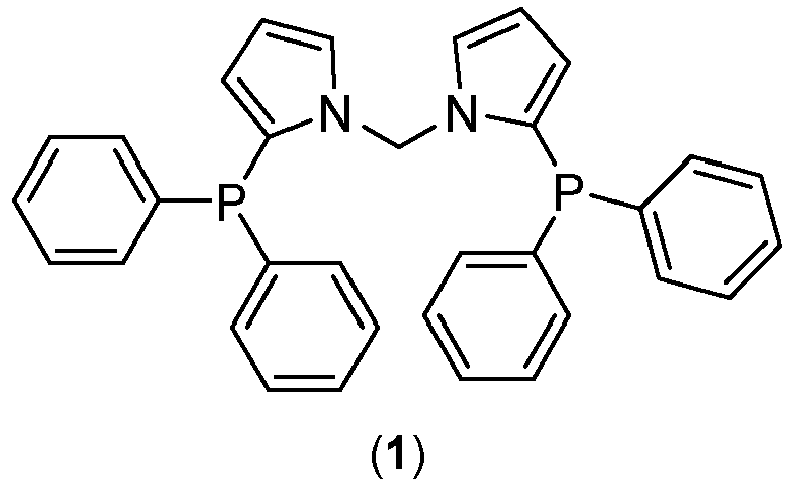
| (57) Markovnikov-selective palladium catalyst for carbonylation of alkynes with heteroarenes,
and where the catalyst is formed from bisphosphite of formula (1).
Also claimed is a process of carbonylating alkynes involving this catalyst. |
[0001] The invention relates to Markovnikov-selective palladium catalyst for carbonylation of alkynes with heteroarenes.
[0002] The development of ligands plays a key role and provides significant innovations in homogenous catalysis and organic synthesis. Illustrative examples include polymerizations, organometallic coupling reactions, carbonylations, hydrogenations and metathesis. Although a plethora of nitrogen- and phosphorous-based ligands have been developed over the last decades, their rational design to afford highly active catalyst systems, which can easily be prepared and modified, continues to be an important topic in this area.
Among the privileged ligand classes known, especially bi- and multidentate derivatives create highly stable and selective organometallic complexes.
[0003] The problem addressed by the invention was that of providing a compound which is to have good properties as ligands in palladium catalyst for carbonylation of alkynes and reaches a good result regarding the yield of the carbonylation reaction.
[0006] Additionally claimed is the use of the compound as ligand in a ligand-metal complex for catalysis of a carbonylation reaction.
[0007] Use of a compound described above in a ligand-metal complex for catalysis of a carbonylation reaction.
[0008] The process in which the compound is used as ligand in a ligand-metal complex for conversion of an olefin to an aldehyde is likewise claimed.
[0009] A process comprising the following process steps:
- a) initially charging an alkyne,
- b) adding an above-described compound and a substance including Pd,
- c) feeding in N-methylpyrrole and CO,
- d) heating the reaction mixture, with conversion of the alkyne to the product.
Ligand synthesis
Synthesis of N,N'-dipyrrolylmethane
[0014] Pyrrole (9.00 ml, 130 mmol) was added to a stirred suspension of powdered potassium hydroxide (24 g, 0.43 mol, 3.31 equiv.) in DMSO (100 ml) at room temperature. After 1 h, the mixture was heated to 40 °C and DCM (6.32 ml, 98.6 mmol, 0.76 equiv.) was added slowly. The solution was heated at 40 °C for a further 4 h. Once cool, ether (100 ml) and water (100 ml) were added and the layers separated. The aqueous layer was extracted with ether three times, the combined organic extracts were washed with water three times, then brine, and dried with MgSO4 and the solvent removed under reduced pressure to afford a pale yellow solid. Recrystallisation from chloroform gave 1,2-di(pyrrol-1-yl)methane in 72% yield.
Synthesis of N,N'-diimidazolmethane
analogues to N,N'-dipyrrolylmethane
Synthesis of (1) and (2):
[0015] In a three nacked 100 ml round bottom flask, N,N'-dipyrrolylmethane (5 mmol) was dissolved in 15 ml of freshly distilled Et2O under argon. TMEDA (15 mmol) was added followed by n-BuLi (10.5 mmol, 1.6 M in hexane) at room temperature. The reaction mixture was stirring for 1 h at room temperature, a yellow suspension was obtained. Then the yellow suspension was slowly added via syringe to a solution of ClPR2 (10 mmol in 15 ml Et2O, R = Ph or Cy). The mixture was further stirring for 1 h, then degassed water (10 ml) was added and the mixture was stirred to get a clear solution. The aqueous layer was extracted with Et2O (2x 15 ml) and the combined organic layers were washed with degassed water (10 ml). The solution was dried over Na2SO4 and concentrated to get a yellow viscous liquid which was recrystallized from ethanol. For yield and characterizations please see below.
Characterizations:
[0017] 1.0 g, 39% yield (5 mmol scale, 97% purity), white solid.
1H NMR (300 MHz, CD2Cl2) δ 7.23-7.18 (m, 20H), 6.85-6.83 (m, 2H), 6.17 (t, J = 2.8 Hz, 2H), 6.00 (dd, J = 3.6, 2.8 Hz, 2H), 5.83 (dd, J = 3.6, 1.6 Hz, 2H);
13C NMR (75 MHz, CD2Cl2) δ 137.1, 133.7, 129.1, 128.9, 127.8, 125.7, 119.8, 110.5, 58.1
31P NMR (122 MHz, CD2Cl2) δ -33.0.
[0020] 1H NMR (300 MHz, d8-Toluene) δ 7.18-7.15 (m, 2H), 6.53-6.51 (m, 2H), 6.40-6.38 (m, 2H), 6.31-6.29 (m, 2H), 1.86-1.56 (m, 24H), 1.25-1.06 (m, 20 H);
13C NMR (75 MHz, d8-Toluene) δ 126.1, 124.3, 116.7, 109.6, 57.0, 34.2, 30.4, 29.1, 27.1;
31P NMR (122 MHz, d8-Toluene) δ -31.0.
Synthesis of (3):
analogues to (1) and (2)
Catalyst experiments
Catalyst results
[0024] The results of the catalyst experiments are summarized in Tables 1:
Table 1:
| Ligand | p (bar) | T(°C) | t (h) | Pd(acac)2 (mol) | Yield (%) |
| 1* | 40 | 70 | 12 | 2 | 88 |
| 2 | 40 | 70 | 12 | 2 | 0 |
| 3 | 40 | 70 | 12 | 2 | 0 |
| * inventive compound alkyne = 1-octyne |
[0025] Reaction conditions: (Ia) (1.0 mmol), (IIa) (0.5 mmol), Pd(acac)2 (2.0 mol%), Ligand (4.0 mol%), p-TsOH (10.0 mol%), CO (40 bar), Toluene (1.0 mL), 70 °C, 12 h.
[0026] Further results of carbonylation experiments with different alkynes (I) are summarized in Table 2:
[0027] Reaction condition: alkyne (I) (1.0 mmol), N-methylpyrrole (II) (0.5 mmol), Pd(acac)2 (1.0 mol%), (1) (2.0 mol%), p-TsOH (5.0 mol%), CO (40 bar), Toluene (1.0 mL), 70 °C, 12 h.
1. Compound having the structure (1):
2. Use of a compound according to Claim 1,
for catalysing a carbonylation reaction.
for catalysing a carbonylation reaction.
3. A process comprising the following process steps:
a) initially charging an alkyne,
b) adding a compound according to Claim 1 and a substance including Pd,
c) feeding in N-methylpyrrole and CO,
d) heating the reaction mixture, with conversion of the alkyne to the product.