|
(11) | EP 3 518 138 A1 |

| (12) | EUROPEAN PATENT APPLICATION |
| published in accordance with Art. 153(4) EPC |
|
|
|
|
|||||||||||||||||||||||||||
| (54) | SHEET AND OPTICAL FINGERPRINT RECOGNITION DEVICE |
| (57) The present application relates to a sheet used for optical fingerprint recognition
or input, and a device comprising the same. According to one example of the present
application, it is possible to provide a sheet which can detect fingerprint information
having high contrast with a simple structure and can be applied to a large area display
device to recognize a plurality of fingerprint patterns without being influenced by
each other, and a device thereof. |
Technical Field
Cross-Reference to Related Applications
[0001] This application claims the benefit of priority based on Korean Patent Application No. 10-2016-0162148 filed on November 30, 2016 and Korean Patent Application No. 10-2017-0145403 filed on November 2, 2017, the disclosures of which are incorporated herein by reference in their entirety.
Technical Field
[0002] The present application relates to a sheet usable for optical fingerprint recognition and a device comprising the same.
Background Art
[0003] Depending on generalization and use frequency increase of portable mobile devices such as smartphones and tablet PCs, security of these devices is becoming more important. Especially, it is more important to maintain security in electronic commerce and banking fields using these devices. Biological information of a user, for example, fingerprint, iris, face, or voice, can be used to identify or authenticate a device user for security maintenance. In recent years, portable mobile devices to which a user authentication technology through the fingerprint is applied have also been commercialized.
[0004] On the other hand, fingerprint recognition methods can be classified into an optical method, an ultrasonic method, an electrostatic capacity method, an electric field measurement method and a heat sensing method, and the like. Among these, the optical fingerprint recognition method can be divided into a so-called scattering method for detecting light scattered in a ridge portion of a fingerprint in direct contact with a transparent fingerprint contact portion of the device, and a so-called total reflection method for detecting light totally reflected from the surface of a fingerprint contact portion corresponding to a valley portion of a fingerprint. In the former case, since light to be scattered must be detected, it may be difficult to provide a light quantity sufficient to identify the fingerprint pattern to the sensor, and the path of the scattered light may overlap the light path of the original light source, so that the contrast may be lowered. And, in the scattering method, a trapezoidal distortion caused by the light path difference also occurs. Devices having various structures have been proposed to solve the above problems through various papers and patents, but it cannot be said that the scattering method is not suitable for portable mobile devices because of the use of bulky prisms or the like. Also, in the latter case, there is an advantage that a greater light quantity can be secured than a method of detecting scattered light, but if the total reflection path is long in the process in which the totally reflected light toward the sensor repeats the total reflection along the waveguide, the lights totally reflected from adjacent fingerprints may interfere with each other to lower the contrast. In addition, when the conventional total reflection method is used, the size of the device can be increased due to the necessity of separately installing a sensor or a prism, and the like, and there is a problem that compatibility with the portable mobile device having a large area display is also poor, because input and output structures of the fingerprint recognition device are very limited, as the sensor is positioned at the opposite end of one end of the waveguide where the light source is positioned.
Disclosure
Technical Problem
[0005] It is one object of the present application to provide a sheet for optical fingerprint recognition capable of detecting fingerprint information with high contrast and a device comprising the same.
[0006] It is another object of the present application to provide a sheet for optical fingerprint recognition which has a simple structure and is capable of simultaneously recognizing a plurality of fingerprints in a large area, and a device comprising the same.
[0007] The above objects of the present application and other objects can be all solved by the present application which is described in detail below.
Technical Solution
[0008] In order to solve the problems of the prior art described above and to achieve the above objects, the present application provides a sheet comprising, in a single layer, a first light control part capable of providing light always totally reflected from a surface layer of the sheet; and a second light control part capable of providing light whose total reflection is determined according to a fingerprint pattern in contact with the surface layer of the sheet to the surface layer of the sheet by changing a part of the light provided from the first light control part and totally reflected from the surface layer of the sheet at a predetermined angle and emitting it, and a device thereof.
Advantageous Effects
[0009] The present application can provide a sheet for optical fingerprint recognition that can provide fingerprint information with high contrast and recognize a plurality of fingerprint patterns without any influence on each other. In addition, the present application can provide a device capable of having a large-area sensor and a screen display device without being restricted by incidence and emission structures.
Brief Description of Drawings
[0010]
Figure 1 schematically shows a cross-section of a sheet for optical fingerprint recognition according to one embodiment of the present application and a device comprising the same.
Figure 2 is an image of a fingerprint photographed using a sheet according to one embodiment of the present application.
[0011] Hereinafter, a sheet according to one embodiment of the present application and a device comprising the same will be described in detail with reference to the accompanying drawings. For ease of explanation, the size or shape of each configuration shown may be exaggerated or reduced.
Mode for Invention
[0012] In one example related to the present application, the present application relates to a sheet for optical fingerprint recognition or a sheet for fingerprint input. As described below, the sheet of the present application can be configured so that light derived from an external light source can be present (incident) on the sheet surface layer with two lights (rays) with different angles. One of the lights (rays) can be always totally reflected in the sheet, and the other can be identified by the sensor positioned on the lower part of the sheet, by being determined for total reflection at the surface layer of the sheet depending on a pattern of a material contacting the outside of the sheet, and reaching the lower part of the sheet or penetrating the sheet after being totally reflected.
[0013] In this regard, Figure 1 schematically shows a cross-section of a sheet for optical fingerprint recognition (or input) according to one embodiment of the present application and a device comprising the same. The present application will be described with reference to Figure 1 as follows.
[0014] The sheet of the present application may comprise a lower base layer and a light control layer positioned on the lower base layer. In the present application, the term "on" or "above" used in connection with the interlayer lamination position may mean including not only the case where a configuration is formed directly on another configuration but also the case where a third configuration is interposed between these configurations.
[0015] The light control layer comprises a first light control part and a second light control part. The light control parts may be configurations provided so as to perform a predetermined function only on light incident at a specific angle. Accordingly, as described below, the first light control part can provide light that always totally reflects to the surface layer of the sheet. Furthermore, the second light control part can provide to the surface layer of the sheet light in which the total reflection is determined depending on a fingerprint pattern in contact with the sheet surface layer.
[0016] As shown in Figure 1, the first light control part can emit the light incident at a first incident angle (θ0) with respect to the lower surface of the first light control part as the light (A) with a second incident angle (θA) different from the first incident angle (θ0). In one example, the exit surface or the exit region of the first light control part, from which the light with the second incident angle (θA) is emitted, may be any other surface or any inside region other than the lower surface of the first light control part. More specifically, the sheet of the present application can be configured so that the light with the second incident angle (θA) can be emitted from the side surface and/or upper surface of the first light control part or any region and/or point inside the first light control part. In addition, the second light control part can emit the light incident at a second incident angle (θA) with respect to the upper surface of the second light control part as the light (A) with a third incident angle (θA) and the light (B) with a third incident angle (θB) different from the second incident angle (θA). In one example, the exit surface or the exit region of the second light control part, from which the light with the second incident angle (θA) and the light with the third incident angle (θB) are emitted, may be any other surface or any inside region other than the lower surface of the second light control part. More specifically, the sheet of the present application can be configured so that the light (A) with the second incident angle (θA) and the light (B) with the third incident angle (θB) can be emitted from the side surface and/or upper surface of the second light control part or any region and/or point inside the second light control part. In the present application, the unit of angle is ° (degree), and the term "incident angle" is an angle formed by the traveling direction of light from the normal to the sheet (or light-entering layer or light-entering surface) placed on the horizontal plane, which may have more than 0° to less than 90°. The term incident angle may also be referred to as an exit angle depending on the relative position of each configuration along the traveling direction of light. In the present application, the "lower surface" may mean one surface of a transparent base layer, a light control layer or a light control part which faces or contacts the lower base layer, and the "upper surface" may mean the opposite one surface of a transparent base layer, a light control layer or a light control part, having the relevant lower surface. The lower surface or the upper surface may be referred to as a light-entering surface or an incident surface, and a light-emitting surface or an exit surface, depending on the traveling path of light.
[0017] Since the light control layer of the present application can be divided into two parts in which the angle or path of light, and the like can be controlled differently from each other as above, two lights (A and B) having different angles toward the transparent base layer positioned on the light control layer, specifically, with respect to the transparent base layer, and more specifically, with respect to the surface layer of the sheet, can be provided (emitted), as in Figure 1. In the present application, the surface layer of the sheet may mean, for example, the upper surface of the transparent base layer in contact with air, or the upper surface of the transparent base layer in direct or indirect contact with an object having a pattern such as a fingerprint.
[0018] In one example, the sheet of the present application may further comprise a transparent base layer that a fingerprint can contact directly or indirectly. When the sheet comprises a transparent base layer, the transparent base layer may be located on the light control layer. That is, the sheet may sequentially comprise a lower base layer, a light control layer and a transparent base layer. In the present application, the term "transparent" used in relation to the properties of a configuration such as the layer may mean a case where the lower limit of the transmittance to visible light having a wavelength of 380 nm to 780 nm is 65% or more, 70% or more, 75% or more, 80% or more, 85% or more, 90% or more, or 95% or more, and the upper limit is about 100%, which is in a range of less than 100%.
[0019] In the case of comprising the transparent base layer, the first light control part can emit the light incident on the lower surface of the first light control part at the first incident angle (θ0) through the lower base layer as the light with the second incident angle (θA) different from the first incident angle (θ0) toward the transparent base layer. That is, the first light control part can convert light incident at the first incident angle (θ0) with respect to the lower surface thereof into light with the second angle (θA) to provide totally reflected light in the sheet. In one example, the light with the second incident angle (θA) can be emitted from the upper surface and/or the side surface of the first light control part. Furthermore, when the transparent base layer is directly positioned on the light control layer, the lower surface of the transparent base layer can be the light incident surface with respect to the light with the second incident angle (θA).
[0020] In the case of comprising the transparent base layer, the second light control part can emit the light incident on the upper surface of the second light control part at the second incident angle (θA) through the transparent base layer after being totally reflected as the light (A) with the second incident angle (θA) and the light (B) with the third incident angle (θB) different from the second incident angle (θA) toward the transparent base layer. In one example, the light with the second incident angle (θA) and the light with the third incident angle (θB) can be emitted from the upper surface and/or the side surface of the second light control part. That is, the second light control part can convert a part of the light (A) having an incident angle of θA into the light (B) having an incident angle of θB. The conversion degree, that is, the ratio, in which the light (A) incident at the angle θA is converted to the light (B) with the angle θB, is not particularly limited, which may be suitably adjusted in a range of more than 0% to less than 100%. At this time, θA and θB may be an (incident) angle that the light emitted from the first light control part and the light emitted from the second light control part have each in the inside of the transparent base layer.
[0021] The information of the fingerprint in contact with the transparent base layer can be read by the above configuration. Specifically, a path of light for allowing the fingerprint information to be read according to one example of the present application will be described as follows. That is, the light incident on the first light control part from the light source via the lower base layer is emitted as the light with the angle θA that can be always totally reflected from the upper surface of the transparent base layer into the inside of the sheet by the first light control part, and the light with the angle θA emitted from the first light control part is totally reflected from the upper surface of the transparent base layer irrespective of whether or not the fingerprint and the transparent base layer contact, and is incident on the second light control part. And, the second light control part converts a part of the light incident at the angle θA into the light with the angle θB and emits the light to the transparent base layer, and the remaining unconverted light is totally reflected from the upper surface of the lower base layer, for example, the interface between the light control layer and the lower base layer. Thereafter, the light with the angle θB emitted to the transparent base layer is transmitted from the ridge of the fingerprint, which is a contact portion of the transparent base layer and the fingerprint, and is totally reflected from the valley of the fingerprint, which is a non-contact portion of the transparent base layer and the fingerprint. The light with the angle θB totally reflected from the valley portion of the fingerprint and the transparent base layer and the fingerprint can pass through the light control layer, reach the lower base layer or penetrate it, and reach the sensor to be identified. In the present application, the term "interface" may mean a boundary surface between two adjacent layers, or a boundary surface between heterogeneous media placed on a path through which light passes. In addition, when the light with the angle θB penetrates the upper surface of the transparent base layer from the ridge of the fingerprint, scattering and/or reflection may occur together with transmission.
[0022] According to one embodiment of the present application, in order to perform functions as above, the sheet of the present application may be constituted or provided as follows.
[0023] In one example, the first light control part and the second light control part may comprise each a diffractive optical element or a refractive optical element.
[0024] The refractive optical element may mean an element having a characteristic in which the traveling direction or angle of light is determined by the refractive index difference with the adjacent medium. When the light control part of the present application is a refractive optical element, the light control part may be configured in consideration of refractive indexes between the respective layers so as to satisfy the optical path described in the present application.
[0025] The diffractive optical element may mean an element having a characteristic in which the traveling direction or angle of light is determined by the shape of the pattern and the spacing between the patterns. When the light control part of the present application is a diffractive optical element, the light control part may be configured in consideration of refractive indexes between the respective layers and diffraction patterns so as to satisfy the optical path described in the present application.
[0026] In one example, the light control layer of the present application may comprise a diffractive optical element. Specifically, the first light control part and the second light control part may comprise diffractive optical elements having different functions from each other, where the diffractive optical element may be a holographic optical element (HOE) in the form of a film. The holography is a technique for recording an interference pattern in a photosensitive medium to reproduce a three-dimensional image called a hologram. Also, the holographic film may mean a film on which a holographic recording is recorded, and may mean a film capable of recording an interference pattern on a film having very small photosensitive particles using recording light and reproducing it using reproduction light. Since the holographic film may perform the function only for the recorded light and may not perform the required function for light other than the recorded light, when the holographic film is used for the first light control part and the second light control part, it is particularly advantageous to adjust the angle, the optical path and/or the light quantity of light required in the present application.
[0027] The holographic film may comprise a photosensitive material as a recording medium. As the photosensitive material, a photopolymer, a photoresist, a silver halide emulsion, a dichromated gelatin, a photographic emulsion, a photothermoplastic or a photorefractive material, and the like can be used. In one example, the holographic film may comprise a photopolymer as a photosensitive material, and may be, specifically, a film consisting only of a photopolymer, or a film with a double-layered structure comprising a photopolymer layer and a substrate for the layer together. In this case, the substrate used together with the photopolymer may be a transparent substrate and may be, for example, a substrate comprising polycarbonate (PC), polypropylene (PP), polyamide (PA), polyethylene terephthalate (PET) or triacetyl cellulose (TAC), and the like, but is not particularly limited.
[0028] In one example, the diffraction efficiencies of the first light control part and the second light control part may be the same or different from each other. Specifically, the first light control part may have the same diffraction efficiency in its entire area and the second light control part may also have the same diffraction efficiency in its entire area, where the diffraction efficiencies of the light control parts may be the same or different from each other.
[0029] In one example, the first light control part and the second light control part may be some regions formed by changing only angles or diffraction patterns of recording light on one layer, respectively. Alternatively, the light control layer may also be formed by directly attaching the first light control part and the second light control part or by attaching them via another medium, so that the first light control part and the second light control part, which are separately manufacture, may form a single layer.
[0030] When the transmittance described above is satisfied, the kind of the transparent base layer is not particularly limited. For example, it may comprise glass or a polymer resin. As the polymer resin, a polyester film such as PC (polycarbonate), PEN (poly(ethylene naphthalate)) or PET (poly(ethylene terephthalate)), an acrylic film such as PMMA (poly(methyl methacrylate)) or a polyolefin film such as PE (polyethylene) or PP (polypropylene) may be used, without being limited thereto. In one example, the transparent base layer may have a configuration in which a number of glass or polymer resins are laminated. Even in the case of having such a laminated structure, the transparent base layer may be provided so as to perform the functions required in the present application and satisfy the following relational expressions.
[0031] In one example, the lower base layer may be a pressure-sensitive adhesive layer satisfying refractive indexes to be described below and relational expressions to be defined in the present application. The kind or composition of the pressure-sensitive adhesive layer is not particularly limited and may be, for example, an acrylic pressure-sensitive adhesive layer or a silicone pressure-sensitive adhesive layer. In another example, the lower base layer may further comprise, in addition to the pressure-sensitive adhesive material, the above-described transparent resin film, where these may function as a substrate for the pressure-sensitive adhesive material, or may be used for the purpose of imparting other functions. Even in the case of having such a configuration, the lower base layer may be provided so as to perform the function required in the present application and satisfy the following relational expressions.
[0032] In the present application, the lower base layer, the light control layer and the transparent base layer may have the same or different refractive indexes. In one example, the layers may each independently have a refractive index in a range of more than 1 to 5 or less, or more than 1 to 3 or less, and the interlayer refractive index difference may be 0.0001 to 2 or less. In the case of the light control layer, the refractive indexes of the first light control part and the second light control part can be adjusted to be the same or different in a range that can perform the functions required in the present application.
[0033] In one example, the refractive index of the lower base layer may be less than the refractive index of the light control layer and/or the refractive index of the transparent base layer. That is, the lower base layer may be a low refractive layer. Although not particularly limited, when the refractive index relationship is satisfied, the refractive index difference between the lower base layer and the light control layer may be 0.1 or less.
[0034] In one example, the transparent base layer may have a higher refractive index than the light control layer. Although not particularly limited, when the refractive index relationship is satisfied, the refractive index difference between the transparent base layer and the light control layer may be 0.05 or less.
[0035] In the present application, the thicknesses of the lower base layer, the light control layer, the transparent base layer, or other constituents that may be contained therein is not particularly limited. For example, if the function of the sheet described in the present application is exerted, the thickness of the structure is not limited, where for example, the lower limit may be 0.1 µm or more, or 1 µm or more and the upper limit may be 1,000 µm or less or 500 µm or less.
[0036] The sheet of the present application may be configured such that the light with the angle θA always totally reflected in the sheet may be present. That is, the light with θA can be always totally reflected from the upper surface of the transparent base layer, and the light with θA can also be totally reflected from the upper surface of the transparent base layer, can pass through the light control layer from the transparent base layer and can be totally reflected from the upper surface of the lower base layer, for example, the interface between the light control layer and the lower base layer.
[0037] Specifically, the sheet of the present application can be configured so that the light with the angle θA emitted from the first light control part toward the transparent base layer satisfies the following relational expressions 1 and 2. The relational expressions described below can be obtained using Snell's law.
[0038] Relational Expression 1 above exemplarily defines the condition that the light with the angle θA traveling from the transparent base layer to the air side is totally reflected from the upper surface of the transparent base layer, for example, the interface between the transparent base layer and the air layer. In Relational Expression 1 above, n0 is 1 as the refractive index of air, and n1 is the refractive index of the transparent base layer.
[0039] Relational Expression 2 above exemplarily defines the condition that the light with the angle θA totally reflected from the upper surface of the transparent base layer passes through the light control layer from the transparent base layer and is totally reflected from the upper surface of the lower base layer such as the interface between the light control layer and the lower base layer. In Relational Expression 2 above, n1 is the refractive index of the transparent base layer, and n3 is the refractive index of the lower base layer.
[0040] In one example, in order to satisfy Relational Expression 2 above, the light with the angle θA totally reflected from the upper surface of the transparent base layer must penetrate the transparent base layer and/or the upper surface of the light control layer. For example, when the refractive index of the transparent base layer is larger than the refractive index of the light control layer, the total reflection should not occur at the upper surface of the light control layer, for example, the interface between the transparent base layer and the light control layer, and thus θA must satisfy the following relational expression 3.
[0041] Relational Expression 3 above exemplarily defines the condition that the total reflection does not occur at the interface between the transparent base layer and the light control layer. In Relational Expression 3 above, n1 is the refractive index of the transparent base layer, n2 is the refractive index of the first light control part or the second light control part in the light control layer, and n1 is larger than n2.
[0042] In the present application, the light with the angle θA may be light totally reflected from the upper surface (contact surface) of the transparent base layer where the transparent base layer and an object contact directly, even when the object having a pattern with a different height contacts the transparent base layer. In order to satisfy this, the angle θA of the light emitted from the first light control part may satisfy, for example, the following relational expression 4.
[0043] In Relational Expression 4 above, n1 is the refractive index of the transparent base layer, and nh is the refractive index of the portion whose the object having a pattern with a different height is in direct contact with the transparent base layer. At this time, the object having a pattern with a different height may be a fingerprint and the portion whose the object having a pattern with a different height is in direct contact with the transparent base layer may be a ridge of the fingerprint. On the other hand, the non-contact portion of the object having a pattern with a different height with the transparent base layer may be a valley of the fingerprint, and since the valley portion is occupied by the air, the refractive index of the valley portion can be regarded as 1 (= n0).
[0044] As described above, in the present application, the sheet is provided so as to be capable of providing the totally reflected light always totally reflected in the sheet so that the light with the angle (θA) provided from the first light control part satisfies the predetermined relational expressions. On the other hand, in the present application, the light with the angle (θA) is light in which the total reflection is performed irrespective of whether or not the fingerprint contacts, so that the light quantity in the sheet can be maintained at a certain level. And, as described below, since the light with the angle (θB) used for fingerprint recognition originates from the light with the angle (θA), the light with the angle (θB) for generating the fingerprint image can also have a light quantity kept constant in the sheet irrespective of whether or not the fingerprint contacts.
[0045] In the present application, the second light control part may be a configuration to provide light (B) generated regardless of whether or not the fingerprint contacts.
[0046] Specifically, the second light control part may be a configuration to provide light with an angle (θB) at which the total reflection on the upper surface of the transparent base layer is determined depending on the presence or absence of an object existing on the transparent base layer. That is, the light with the angle (θB) may be light that when the object does not exist on the transparent base layer, it is totally reflected from the upper surface of the transparent base layer, for example, the interface between the transparent base layer and the air, but when the object having a pattern with a different height contacts the transparent base layer, it is transmitted (or transmission, scattering, and reflection can occur at the same time) from a direct contact portion (ridge) of the object with respect to the transparent base layer.
[0047] In one example, the sheet of the present application may be provided so that the light with the angle (θB) may be totally reflected from the upper surface of the transparent base layer, for example, the interface between the transparent base layer and the air, by satisfying the following relational expression 5. And, when the object having a pattern with a different height contacts the transparent base layer, it may be configured so that the light with the angle (θB) may be transmitted (or transmission, scattering, and reflection can occur at the same time) from the upper face portion of the transparent base layer in direct contact with the object, by satisfying the following relational expression 6.
[0048] In Relational Expressions 5 and 6 above, n0 is 1 as the refractive index of air, n1 is the refractive index of the transparent base layer, and nh is a refractive index of a ridge portion in direct contact with the transparent base layer in the object having a pattern with a different height. As described above, since the valley portion in the object having a pattern with a different height, which is a non-contact portion with the transparent base layer, is occupied by the air, the refractive index of the non-contact portion can be regarded as 1 (= n0).
[0049] Furthermore, in the present application, the sheet may be provided such that the light with the angle (θB) emitted from the second light control part and incident on the transparent base layer may be totally reflected from the upper surface of the transparent base layer and then penetrate the upper surface of the light control layer. When the refractive index of the transparent base layer is larger than the refractive index of the light control layer, the total reflection must not occur at the interface between the transparent base layer and the light control layer, so that the angle θB can satisfy the following relational expression 7.
[0050] Relational Expression 7 above exemplarily defines a condition in which the total reflection does not occur at the interface between the transparent base layer and the light control layer. In Relational Expression 7 above, n1 is the refractive index of the transparent base layer, n2 is the refractive index of the first light control part or the second light control part in the light control layer, and n1 is larger than n2.
[0051] In addition, the sheet of the present application may be provided so that when the light with the angle θB emitted from the second light control part is totally reflected from the upper surface of the transparent base layer, it can reach the lower base layer or penetrate the lower base layer. The light reaching the lower base layer or penetrating the lower base layer can be recognized by the sensor. In order that the light capable of being recognized by the sensor is present in the sheet, when the light with θB is totally reflected from the surface layer of the transparent base layer and enters the upper surface of the lower base layer via the transparent base layer and the light control layer, the total reflection should not occur at the interface between the light control layer and the lower base layer. In this connection, θB can satisfy the following relational expression 8.
[0052] Relational Expression 8 above exemplarily defines a condition that the light reaching the lower surface of the lower base layer is present. In Relational Expression 8 above, n1 is the refractive index of the transparent base layer, and n3 is the refractive index of the lower base layer.
[0053] When the angle θB of the light totally reflected from the upper surface of the transparent base layer as above satisfies Relational Expressions 7 and 8 above, the sensor existing in the lower part of the sheet can recognize the light reaching the lower base layer or penetrating the lower base layer, as shown in Figure 1. That is, the sheet of the present application allows the user's fingerprint to be recognized using a method of identifying a difference in light quantity between the light totally reflected from the upper surface of the transparent base layer in contact with air and the light transmitted (or transmission, scattering and reflection can occur at the same time) from the contact portion of the transparent base layer and the object among the light with an angle (θB) emitted from the second light control part.
[0054] As such, the present application does not directly use the light always totally reflected in the sheet for fingerprint identification. Specifically, when a part of the light with the angle θA provided from the first light control part is converted into the light with the angle θB different from θA by the second light control part and emitted toward the transparent base layer, so that the always totally reflected light may exist, and the light emitted toward the transparent base layer at the incident angle θB is totally reflected from the upper surface of the transparent base layer in contact with an external object to the inside of the sheet and transmitted (or transmission, scattering and reflection can occur at the same time) to the outside of the sheet, the present application uses the light quantity difference of these lights for fingerprint identification. That is, the difference between the light quantity of the light totally reflected from the non-contact portion with the fingerprint and traveling to the sensor and the light quantity of the light transmitted (or transmission, scattering and reflection can occur at the same time) from the contact portion with the fingerprint and reduced, among the lights at the angle θB, is used for fingerprint identification.
[0055] Furthermore, in the present application, the light with the angle θB is generated from the light always totally reflected in the sheet regardless of the presence or absence of the fingerprint. Therefore, in the present application, the light quantity of the light used for identifying the fingerprint can be kept constant by using the light always totally reflecting the inside of the sheet, and consequently, the light quantity difference between the light totally reflected from the interface of the transparent base layer and the air, and the light transmitted (or transmission, scattering and reflection can occur at the same time) from the direct contact portion of the transparent base layer and the object, among the lights with the angle (θB), can be more clearly recognized by the sensor. Besides, in the present application, the light totally reflected from the interface between the transparent base layer and the air and the light transmitted (or transmission, scattering and reflection can occur at the same time) from the contact portion of the transparent base layer and the object, among the lights with the angle (θB) generated regardless of the presence or absence of the fingerprint, are used for fingerprint identification, so that even if a number of fingerprint patterns are in contact with the transparent base layer, they can be identified without being influenced by each other.
[0056] In one example, a projected area (S1) of the first light control part may be smaller than a projected area (S2) of the second light control part. In the present application, the term "projected area" may mean, on observing the sheet from the upper part or the lower part in a direction parallel to the normal direction of its surface, an area in which the relevant configuration is viewed, and for example, an orthogonal projection area. Therefore, the increase or decrease of the actual area due to the unevenness of the area comparison target configuration or the like is not considered. Although not particularly limited, S1: S2 may be in a range of 5 to 40: 60 to 95.
[0057] In another example related to the present application, the present application relates to an optical fingerprint recognition device (fingerprint scanner) or a fingerprint input device.
[0058] In one example, the device may further comprise a light source part. The light source part means a configuration capable of radiating light toward the sheet. The specific configuration of the light source part is not particularly limited as long as the above function can be performed. As in Figure 1, the light source part may be located on one surface of the sheet lower base layer, more specifically, on the opposite one surface of one surface of the lower base layer where the first light control part contacts. The light incident from the light source part is incident on the first light control part of the light control layer via the lower base layer, whereby the light that can be always totally reflected in the sheet can be provided to the sheet. In one example, the light incident on the first light control part may be vertical to the bottom surface of the first light control part. In the present application, the term "vertical" means a substantial verticalness in a range that does not impair the desired effect, which is used, for example, in consideration of manufacturing error or variation, and the like. At this time, the error or variation may be within ±10°, within ±8°, within ±6°, within ±4°, within ±2°, within ±1°, within ±0.5°, within ±0.2°, or within ±0.1°. In the case of the device comprising the sheet having the above configuration, even if a light source of a small area is used, the above-described fingerprint recognition function can be sufficiently performed. In one example, the small area may be an area corresponding to or smaller than the first light control part.
[0059] In one example, the device may further comprise a sensor part. The sensor part may mean a configuration for sensing the light penetrating the lower base layer. The configuration of the sensor part is not particularly limited as long as the above function can be performed, where a known sensor can be used. As in Figure 1, the sensor part may be located on one surface of the sheet lower base layer, more specifically, on the opposite one surface of one surface of the lower base layer in which the second light control part contacts. As described above, the light totally reflected in the transparent base layer portion that directly contacts the fingerprint, except for the totally reflected light in the sheet, can penetrate the lower base layer to reach the sensor part, where the sensor part can recognize the pattern of the object contacting the transparent base layer, that is, the fingerprint, based on the light quantity difference of the reached lights. In one example, the sensor part may be provided to have a transparent property. In another example, the sensor part may have an area corresponding to the second light control part.
[0060] In one example, the device may further comprise a screen display part. The screen display part may be, for example, a configuration such that an image or a moving image reproduced by the device can be viewed by the user. As in Figure 1, the screen display part may be positioned on one surface of the sheet lower base layer, more specifically, the opposite one surface of one surface of the lower base layer where the second light control part contacts. In one example, the screen display part may have an area corresponding to the second light control part.
[0061] In another example, the device may simultaneously comprise a screen display part and a sensor part. In this case, the device may sequentially comprise a screen display part, a sensor part and a sheet, or may sequentially comprise a sensor part, a screen display part and a sheet. In addition, any one of the screen display part and the sensor part may also form one layer with the light source part.
[0062] In another example, the device may further comprise one part for performing a display function and a sensor function at the same time. In this case, the one part may also form one layer with the light source part.
[0063] Figure 2 is an image of a fingerprint photographed using a sheet according to one embodiment of the present application. As the sheet used for photographing, a laminate sequentially comprising a lower base layer having a refractive index of 1.41 for light having a wavelength of 532 nm, a light control layer including a holographic film having a refractive index of 1.50 for light having a wavelength of 532 nm and a glass base layer (cover glass) having a refractive index of 1.51 for light having a wavelength of 532 nm was used. In the case of the light control layer, it was produced using a known photopolymer film. Specifically, a diffraction pattern was recorded on the light control layer, so that the first light control part could emit the incident light with 73° based on the normal to the sheet (transparent base layer) and the second light control part could emit some of the incident light with an angle of 45° based on the normal to the sheet (transparent base layer. Thereafter, the sheet was irradiated with an external light with 0° based on the normal to the sheet (transparent base layer), and the image appearing at the bottom of the lower base layer by contacting a fingerprint with the surface of the transparent base layer was photographed with a CCD (charge-coupled device).
[0064] As described above, the invention of the present application has been described with reference to Figures 1 and 2 which are exemplary embodiments of the present application, but the scope of protection of the present invention is not limited to the above-described specific embodiments and drawings. In addition, it will be understood by those having ordinary knowledge in the technical field to which the present technical field pertains that the inventions described in the claims can be changed or modified variously within the technical spirit and scope of the present invention as filed.
1. A sheet comprising a lower base layer; and a light control layer positioned on the
lower base layer and having a first light control part and a second light control
part,
wherein the first light control part is provided so as to emit light incident on the lower surface of the first light control part at a first incident angle (θ0) as light with a second incident angle (θA) different from the first incident angle (θ0), and
the second light control part is provided so as to emit light incident on the upper surface of the second light control part at the second incident angle (θA) as light with the second incident angle (θA) and light with a third incident angle (θB) different from the second incident angle (θA).
wherein the first light control part is provided so as to emit light incident on the lower surface of the first light control part at a first incident angle (θ0) as light with a second incident angle (θA) different from the first incident angle (θ0), and
the second light control part is provided so as to emit light incident on the upper surface of the second light control part at the second incident angle (θA) as light with the second incident angle (θA) and light with a third incident angle (θB) different from the second incident angle (θA).
2. The sheet according to claim 1, further comprising a transparent base layer,
wherein the sheet comprises the lower base layer, the light control layer and the transparent base layer sequentially.
wherein the sheet comprises the lower base layer, the light control layer and the transparent base layer sequentially.
3. The sheet according to claim 2,
wherein the first light control part is provided so as to emit the light incident on the lower surface of the first light control part at the first incident angle (θ0) through the lower base layer as the light with the second incident angle (θA) different from the first incident angle (θ0) toward the transparent base layer, and
the second light control part is provided so as to emit the light incident on the upper surface of the second light control part at the second incident angle (θA) through the transparent base layer as the light with the second incident angle (θA) and the light with the third incident angle (θB) different from the second incident angle (θA) toward the transparent base layer.
wherein the first light control part is provided so as to emit the light incident on the lower surface of the first light control part at the first incident angle (θ0) through the lower base layer as the light with the second incident angle (θA) different from the first incident angle (θ0) toward the transparent base layer, and
the second light control part is provided so as to emit the light incident on the upper surface of the second light control part at the second incident angle (θA) through the transparent base layer as the light with the second incident angle (θA) and the light with the third incident angle (θB) different from the second incident angle (θA) toward the transparent base layer.
4. The sheet according to claim 3, wherein the first light control part and the second
light control part comprise each a diffractive optical element or a refractive optical
element.
5. The sheet according to claim 4, wherein the first light control part and the second
light control part comprise each a holographic film.
6. The sheet according to claim 4, wherein the lower base layer has a refractive index
smaller than the refractive index of the light control layer.
7. The sheet according to claim 6, wherein a difference between the refractive index
of the lower base layer and the refractive index of the light control layer is 0.1
or less.
8. The sheet according to claim 6, wherein the lower base layer comprises an acrylic
transparent pressure-sensitive adhesive layer or a silicone transparent pressure-sensitive
adhesive layer.
9. The sheet according to claim 6, wherein the transparent base layer has a refractive
index larger than the refractive index of the light control layer.
10. The sheet according to claim 9, wherein a difference between the refractive index
of the transparent base layer and the refractive index of the light control layer
is 0.05 or less.
11. The sheet according to claim 9, wherein the transparent substrate layer comprises
glass or a polymer resin.
12. The sheet according to claim 3, wherein the sheet is provided such that the light
with the angle (θA) emitted from the first light control part can be totally reflected from both of
the upper surface of the transparent base layer and the upper surface of the lower
base layer by satisfying the following relational expressions 1 and 2:
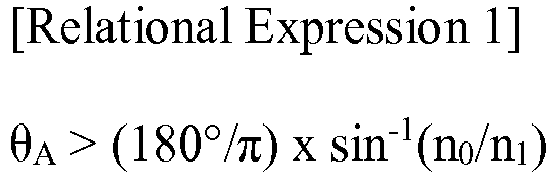
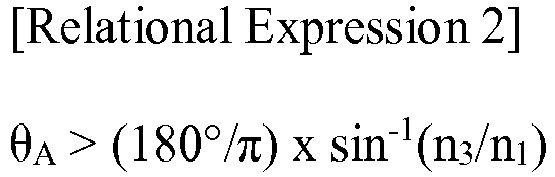
(wherein, n0 is 1 as the refractive index of air, n1 is the refractive index of the transparent base layer and n3 is the refractive index of the lower base layer).
(wherein, n0 is 1 as the refractive index of air, n1 is the refractive index of the transparent base layer and n3 is the refractive index of the lower base layer).
13. The sheet according to claim 12, wherein the sheet is provided such that the light
with the angle (θA) emitted from the first light control part can be totally reflected from the upper
surface of the transparent base layer and then penetrate the upper surface of the
light control layer by satisfying the following relational expression 3:
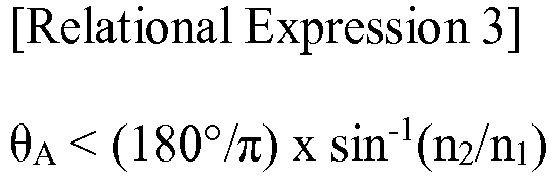
(wherein, n1 is the refractive index of the transparent base layer, n2 is the refractive index of the first light control part or the second light control part in the light control layer, and n1 is larger than n2).
(wherein, n1 is the refractive index of the transparent base layer, n2 is the refractive index of the first light control part or the second light control part in the light control layer, and n1 is larger than n2).
14. The sheet according to claim 13, wherein when an object having a pattern with a different
height contacts the transparent base layer, the sheet is provided such that the light
with the angle (θA) emitted from the first light control part is totally reflected from the upper surface
of the transparent base layer that the transparent base layer and the object contact
directly by satisfying the following relational expression 4:
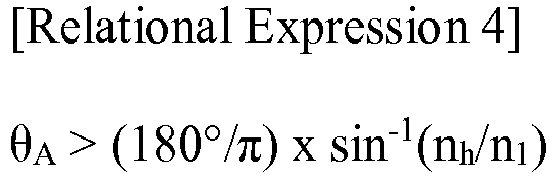
(wherein, n1 is the refractive index of the transparent base layer and nh is the refractive index of the portion whose the object having a pattern with a different height is in direct contact with the transparent base layer).
(wherein, n1 is the refractive index of the transparent base layer and nh is the refractive index of the portion whose the object having a pattern with a different height is in direct contact with the transparent base layer).
15. The sheet according to claim 14, wherein when the object having a pattern with a different
height contacts the transparent base layer, the sheet is provided such that the light
with the angle (θB) emitted from the second light control part can be totally reflected from the upper
surface of the transparent base layer in contact with air by satisfying the following
relational expression 5 and the light with the angle (θB) emitted from the second light control part can be transmitted from the upper surface
of the transparent base layer that the transparent base layer and the object contact
directly by satisfying the following relational expression 6:
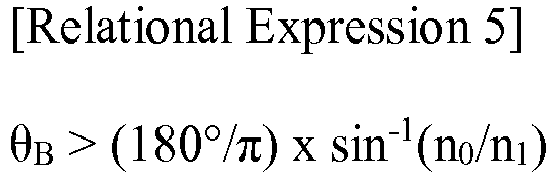
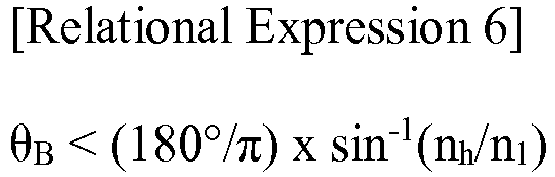
(wherein, n0 is 1 as the refractive index of air, n1 is the refractive index of the transparent base layer and nh is the refractive index of the portion whose the object having a pattern with a different height is in direct contact with the transparent base layer).
(wherein, n0 is 1 as the refractive index of air, n1 is the refractive index of the transparent base layer and nh is the refractive index of the portion whose the object having a pattern with a different height is in direct contact with the transparent base layer).
16. The sheet according to claim 1, wherein the sheet is provided such that the light
with the angle (θB) emitted from the second light control part can be totally reflected from the upper
surface of the transparent base layer and then penetrate the upper surface of the
light control layer by satisfying the following relational expression 7:
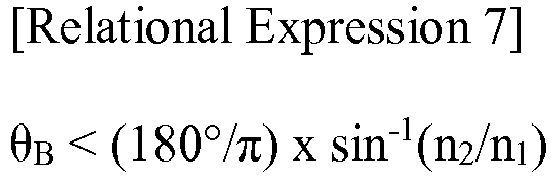
(wherein, n1 is the refractive index of the transparent base layer, n2 is the refractive index of the first light control part or the second light control part in the light control layer and n1 is larger than n2).
(wherein, n1 is the refractive index of the transparent base layer, n2 is the refractive index of the first light control part or the second light control part in the light control layer and n1 is larger than n2).
17. The sheet according to claim 16, wherein the sheet is provided such that the light
with the angle (θB) emitted from the second light control part can be totally reflected from the upper
surface of the transparent base layer, pass through the light control layer and reach
the lower surface of the lower base layer by satisfying the following relational expression
8:
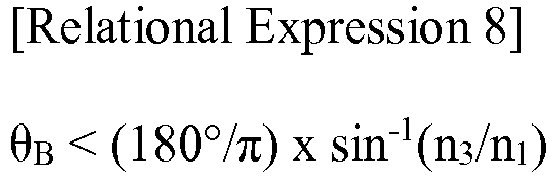
(wherein, n1 is the refractive index of the transparent base layer and n3 is the refractive index of the lower base layer).
(wherein, n1 is the refractive index of the transparent base layer and n3 is the refractive index of the lower base layer).
18. The sheet according to any one of claims 1 to 17, wherein the sheet is used for optical
fingerprint recognition or optical fingerprint input.
19. An optical fingerprint recognition or input device comprising the sheet according
to any one of claims 1 to 17.
20. The optical fingerprint recognition or input device according to claim 19, further
comprising a light source part, wherein the light source part is located on the opposite
one surface of one surface of the lower base layer where the first light control part
contacts.
21. The optical fingerprint recognition or input device according to claim 20, wherein
the light source part emits vertical light to the first light control part.
22. The optical fingerprint recognition or input device according to claim 21, further
comprising one or more of a screen display part and a sensor part.
REFERENCES CITED IN THE DESCRIPTION
This list of references cited by the applicant is for the reader's convenience only. It does not form part of the European patent document. Even though great care has been taken in compiling the references, errors or omissions cannot be excluded and the EPO disclaims all liability in this regard.
Patent documents cited in the description