|
(11) | EP 3 554 197 A1 |

| (12) | EUROPEAN PATENT APPLICATION |
|
|
|
|
|||||||||||||||||||||||||||
| (54) | METHOD AND DEVICE FOR DRIVING A LIGHT SOURCE |
| (57) The present invention relates to a method for driving a light source by means of
at least one switching driver, wherein said switching driver is driven by a pulse-type
periodic dimming signal, e.g., a PWM signal. The method envisages calculating, on
the basis of the switching signal, a modified duration (t'on) of the dimming signal pulse such that said pulse never ends in an instant of time
in which the switching signal is equal to zero.
|
[0001] The present invention relates to a method and a device for driving a light source, e.g., an LED source.
[0002] Methods and devices for driving a light source are already known using an electronic device, known as a switching driver, which generates a substantially constant driving current controlled by a square wave switching signal having a frequency usually between 50 KHz and 1 MHHz. The switching driver is driven by a pulse-type periodic dimming signal, typically a pulse-width modulation signal (known as a "PWM" signal). The duration of the dimming pulse with respect to the duration of the period, also known by the English term "duty cycle", can be modulated to obtain a desired luminosity value lower than a maximum luminosity value obtainable with a duration of the dimming pulse equal to the duration of the period of the dimming signal.
[0003] The driving devices described above, due to the very nature of the switching driver, do not offer a luminosity that can be represented by a rising monotonic function of the duty cycle applied, but alternate rising monotonic sections with sections in which the luminosity does not vary. The effect obtained, when, for example, a fade effect is desired (gradual switching on or off of the light source), is not fluid but proceeds in jerks. The effect is particularly visible at low intensities (low duty cycles).
[0004] Usually the dimming signal has a frequency greater than 100 Hz and is at least one order of magnitude lower than the operating frequency of the switching driver.
[0005] As mentioned, in the "on" phase of the duty cycle the switching driver is active and ensures that the output current is relatively constant over time. The instant the dimming signal goes into the active state, the output current is zero, the switching driver is in its active phase and begins to rise in an almost linear manner over time. With certain criteria depending on the type of driver, beyond a certain current threshold, the driver switches off and goes into its idle phase, and the output current falls in a linear manner over time, to then return to the active phase and repeat the cycle until the dimming signal in input goes into the idle state.
[0006] Figure 1 illustrates an example of the time trend of the dimming signal and the switching signal.
[0007] It may be observed that, although the switching signal depends, in terms of frequency and duty cycle, on the driver used and the LED load, it repeats itself substantially identically at each dimming signal period (except for a gradual change largely dependent on the temperature of the system components, including LEDs).
[0008] From the graphic representation in Figure 2 it may also be observed that a duty cycle dimming signal equal to d1 produces an output luminosity exactly equal to the duty cycle dimming signal equal to d2.
[0009] This implies that by gradually increasing the duty cycle to obtain an increase in luminosity, the latter does not increase in an equally gradual manner, since the luminosity does not increase in the inactive phases of the switching signal.
[0010] The effect is negligible for high values of the duty cycle of the switching signal. Not so with low values, for which the length of the active part of the dimming produces a number of switching cycles of few units.
[0011] The visual effect obtained when gradually increasing or decreasing the dimming signal is a relatively unpleasant increase/decrease in light, which proceeds in seemingly discrete jerks instead of gradually changing.
[0012] In an RGB system (or RGBW, or in any case in a system with multiple colour components), in which 3 or 4 separate drivers are used, in addition to the problem just described, another is added. The activity and inactivity times of the various switching drivers do not exactly correspond; it follows that by imposing a certain proportion between the components and multiplying them all by a factor k(t) in order to maintain the colour while varying the luminosity, the non-linearity described produces, especially at low intensities, a deviation of the resulting chromatic coordinates, resulting from the non-linear behaviour described above.
[0013] The object of the present invention is to propose a method and a driving device of a light source able to overcome the above-mentioned drawbacks and in particular able to improve the dimming fluidity and precision of LED circuits driven by switching driver PWM signals.
[0014] Such purpose is achieved by a driving method according to claim 1 and with a driving device according to claim 6. The dependent claims describe preferred embodiments of the invention.
[0015] The characteristics and advantages of the driving method and the device according to the invention will, in any case, be evident from the description given below of its preferred embodiments, made by way of a nonlimiting example with reference to the appended drawings, wherein:
- figure 1 illustrates an example of a dimming signal and the corresponding switching signal;
- figure 2 shows an example of two different dimming signals producing an exactly identical signal in output;
- figure 3 shows a comparison between the luminosity curve according to the prior art and the luminosity curve obtained by the driving method according to the invention;
- figure 4 illustrates an example of a driving current of a light source and relative switching signal; and
- figure 5 is a block diagram of a driving device of a light source according to the invention.
[0016] For simplicity and clarity of exposure, the following description refers to the concept of PWM modulation; however, it will be clear to a person skilled in the art that the teaching provided by the present invention can be applied to any type of modulation signal using pulses of a certain duration.
[0017] Let Lmax be the luminosity of the light source obtained by setting the duty cycle of the dimming signal to 100%; T the period of the dimming signal and Ltarget the desired luminosity.
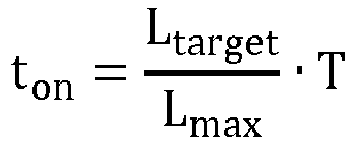
[0018] Let ton be the duration of the "on" part of the PWM dimming signal, calculated assuming that there is direct proportionality between the desired luminosity and the duty cycle. Let L(t) be the function that relates t to the luminosity.
[0020] As explained above, however, with the switching driver the assumption made is incorrect due to the non-linearity inherent to the switching signal.
[0021] The idea behind the present invention is to make the L(t)function rising monotonic by "skipping" the "off" parts of the switching signal and "mapping" the "on" part of the switching signal over the entire period containing it.
[0022] Let ton be given, the dimming signal pulse time calculated by the equation (1). Let fswitching (t) be the function that describes the switching signal between t = 0 and t = T:
where t1 is a tuple, the equal elements of which are the start times of the "on"parts of the switching signal ("rising edges ") and the odd elements are the end times ("falling edges") of the switching signal, as shown in Figures 1 and 2.
[0023] According to one aspect of the invention, the driving method involves calculating, on the basis of the switching signal, a modified duration t'on of the of the dimming signal pulse such that said pulse never ends in an instant of time in which the switching signal is equal to zero.
[0026] In fact when t=t1, t'on is t1; as soon as t>t1, t'on is just over t2 and thus increases in a linear manner up to t3 where t'on corresponds to t3.
[0027] The switching signal is suitably measured so that the software implementing the driving method has the necessary data to perform this deformation.
[0028] It is to be noted that it has been experimentally verified that the dimming signal remains almost unchanged between one period of the dimming signal and the next. Any variations (mainly due to thermal deviations) are taken into account by measuring the switching signal at each cycle, applying a low-pass filter on the data obtained to compensate for any episodic signal reading errors.
[0029] As can be seen from the graph in Figure 3, which shows, as a function of the required luminosity, a comparison between a luminosity curve obtained with the conventional driving method based on equation (1) and the luminosity curve obtained with the proposed driving method based on equation (3), the advantage in terms of dimming quality is evident and, except for the first section, the behaviour is linear.
[0030] The proposed solution therefore makes significantly more fluid and pleasant to the eye gradual increases and/or decreases in luminosity.
[0031] However, after applying the driving method described above, the luminosity obtained is not a linear function of the input variable.
[0032] This is due to the fact that the driver current ILED of the light source reaches the setpoint value in a non-negligible time. At the instant to in which the dimming signal pulse begins, the current is 0 and then begins to rise, for example in a linear manner due to the inductance usually used in this type of driver.
[0034] This does not cause particular problems in a monochromatic system: with the naked eye this slight imperfection is not perceptible. In RGB or RGBW systems, at low intensities (low duty cycles) this effect is visible because the current rise times may differ from one driver stage to another.
[0035] This factor means that while at duty cycle levels such that the rise time is negligible, the ratios between luminosity (and therefore colour) will also have negligible deviations, at low duty cycle levels there may be variations between these ratios, which are markedly perceptible. Note that the human eye is much more sensitive to colour deviations than it is to variations in intensity, for example.
[0036] According to another aspect of the invention, the information given by the switching signal is used to reconstruct the time trend of the driving current and therefore the luminosity obtained as a function of a certain input duty cycle value. After which, the duty cycle, i.e. the duration of the dimming pulse ton, is "deformed" over time to make it linear with respect to the desired input intensity.
[0037] As mentioned above, even making the luminosity trend increasingly monotonic as a function of the duty cycle, the problem of the current rise time remains when the dimming pulse begins its "on" phase .
[0038] Taking into account that, with more than sufficient approximation, the luminosity obtained is a function of the area underlying the product of the function ILED(t), current on LEDs as a function of time, multiplied by the function fswitching (t) which describes the switching signal and which is 1 when the driver is in the "on" phase and 0 when it is in the "off" phase (see equation (2)), the luminosity as a function of the duration ton of the dimming pulse is adjusted by the following equation:
[0039] where K is a proportionality constant that can be ignored and is set at 1. The function ILED(t) can be approximated with a break which is 0 in t=0 and rises up to the setpoint in a time equal to t1, as shown in Figure 4. This time has a duration subject to component tolerances and thermal deviation as explained above, but can be accurately identified by measuring the switching signal.
[0040] From the measurement of the switching signal it is also possible to measure the average duty cycle of the switching signal, defined dswitch. The current ILED(t) can then be written in the following approximate form:
[0041] From which it follows that the underlying area LLED(t), developed according to the equation (4) is:
[0042] The maximum luminosity Lmax is calculated by setting t=T, i.e. the period of the dimming PWM:
[0043] Wishing to obtain a fraction dlight (with 0 < dlight < 1) of the maximum luminosity, the target luminosity Ltarget will be:
[0046] In the event that the period T of the dimming PMW is less than t1, the calculations should be adjusted as described below.
[0051] The practical application of this technique may require minor corrections to the equation (6), which take into account various aspects, for example:
- the efficiency of the driver, slightly different between the rise and constant current phases;
- the average current of the "on" phase of switching, which is less than Isetpoint, as can be seen in Figure 4;
- the fact that the LED's luminous efficiency as a function of current is not linear, and especially at very low currents this factor may not be negligible.
[0052] Consequently, in one embodiment, in equation (6) in the first part with t≤t1 a term in t is added, in addition to that in t2, and a dswitch multiplication factor is added in the second part:
[0054] In a preferred embodiment, the two calculation methods of the duration ton of the dimming pulse described above are applied in succession.
[0055] In particular, first the duty cycle is deformed to make it linear and then the luminosity trend is made increasingly monotonic as a function of the duty cycle.
[0056] Consequently, in an advantageous embodiment, the modified duration ton of the dimming signal pulse is given by
where the functions f3 and f10 refer to equations (3) and (10) respectively, while ti is the sequence of times obtained by measuring the switching signal, represented by the function fswitching(t) (equation (2)), generated by the switching driver.
[0057] The driving method described above can be implemented with a driving device 1 of a light source 2, in the block diagram of Figure 5 identified as a LED, comprising at least one switching driver 10 suitable for generating a substantially constant driving current controlled by a switching signal (fswitchingt)) definable by the function
[0058] The switching driver is driven by a pulse-type periodic dimming signal generated by a controller 12, such as a microcontroller unit. The duration of the dimming pulse ton with respect to the duration T of the period can be modulated to obtain a desired luminosity to obtain a desired luminosity value Ltarget lower than a maximum luminosity value Lmax obtainable with a duration of the dimming pulse equal to the duration of the period T of the dimming signal.
[0059] The control unit has a switching signal reading input suitable for receiving a signal representative of the switching signal (fswitching(t)), for example the signal ti representing the sequence of switching signal rise and fall times. In addition, the desired luminosity value Ltarget, the maximum luminosity value Lmax and the duration of the period T of the dimming signal are stored in the control unit.
[0060] The control unit is then programmed, based on such input data, to calculate a modified duration t'on of the dimming signal pulse according to the driving method as described above in its possible embodiments.
[0061] It is to be noted that, in one embodiment, the sequence ti could be obtained prior to actual calculation of the modified duration of the pulse dimming signal, by means of a test dimming function fdimming(t) of sufficient duration to collect information about the sequence ti. Conversely, the fdimming (t) value could not be calculated since it depends on ti itself, thus creating a circular dependency. After this first test cycle, the ti measured at the previous cycle is used to calculate fdimming (t) for the next PWM cycle.
[0062] It should also be noted that the maximum luminosity Lmax is not always the same but is a function of the frequency f of the PWM, since the initial rise has a fixed duration and therefore a different incidence on the maximum underlying area. To prevent luminosity deviations when moving between frequencies, it is possible to calculate the minimum luminosity value Lmax(f), obtained with the highest PWM dimming frequency value, fmax. This value can be considered in the calculations, thus setting Lmax as a function of the dimming frequency, making sure that Ltarget is always lower than Lmax(fmax).
[0063] A person skilled in the art may make modifications and adaptations to the embodiments of the driving method and device of a light source according to the invention, replacing elements with others functionally equivalent so as to satisfy contingent requirements while remaining within the sphere of protection of the following claims. Each of the features described as belonging to a possible embodiment may be implemented independently by the other described embodiments.
1. Method for driving a light source by means of at least one switching driver, wherein
said switching driver is driven by a pulse-type periodic dimming signal, where the
duration of the dimming pulse (ton) with respect to the duration (T) of the period can be modulated to obtain a desired
luminosity value (Ltarget) lower than a maximum luminosity value (Lmax) obtainable with a dimming pulse duration equal to the duration of the dimming signal
period (T), and where, during the period of time defined by the duration of the pulse,
the switching driver is in an active state in which it generates a substantially constant
driving current controlled by a switching signal (fswitching(t)) which may be defined by the function

the method being characterized by the fact of calculating, on the basis of the switching signal, a modified duration (t'on) of the dimming signal pulse such that said pulse never ends in an instant of time in which the switching signal is equal to zero.
the method being characterized by the fact of calculating, on the basis of the switching signal, a modified duration (t'on) of the dimming signal pulse such that said pulse never ends in an instant of time in which the switching signal is equal to zero.
2. Method according to claim 1, wherein the modified duration (t'on) of the dimming signal pulse is equal to

3. Method according to claim 1 or 2, wherein the duration of the dimming pulse (ton) used for the calculation of the modified duration (t'on) is equal to
4. Method according to claim 1 or 2, wherein, having defined:
Isetpoint the value of the desired driving current;
t1 the instant of time in which the driving current reaches the Isetpoint value starting from zero;
dswitch the average duration of the time intervals in which the switching signal (fswitching(t)) is equal to 1;
Lrise the luminosity at the instant t1,
the duration of the dimming pulse (ton) used for calculating the modified duration (t'on) is equal to
5. Method according to the preceding claim, wherein the luminosity Lrise at the instant t1 is given by:

where
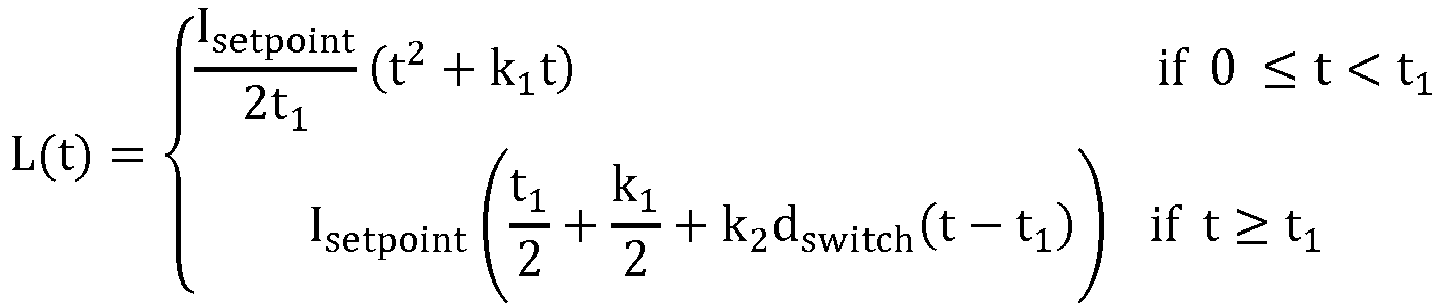
k1 and k2 are constant values ≥ 0.
where
k1 and k2 are constant values ≥ 0.
6. Device for driving a light source, comprising at least one switching driver suitable
for generating a substantially constant driving current controlled by a switching
signal (fswitching(t) which may be defined by the function

and a control unit suitable to drive the switching driver with a pulse-type periodic dimming signal, where the duration of the dimming pulse (ton) with respect to the duration (T) of the period may be modulated to obtain a desired brightness value (Ltarget) lower than a maximum brightness value (Lmax) obtainable with a duration of the dimming pulse equal to the duration of the period (T) of the dimming signal, the device being characterized in that the control unit has a switching signal read input suitable to receive a signal representative of the switching signal (fswitching(t)) and, knowing the desired brightness value (Ltarget), the maximum brightness value (Lmax) and the duration of the period (T) of the dimming signal, is programmed to calculate a modified duration (t'on) of the pulse of the dimming signal in accordance with the driving method according to any one of the preceding claims.
and a control unit suitable to drive the switching driver with a pulse-type periodic dimming signal, where the duration of the dimming pulse (ton) with respect to the duration (T) of the period may be modulated to obtain a desired brightness value (Ltarget) lower than a maximum brightness value (Lmax) obtainable with a duration of the dimming pulse equal to the duration of the period (T) of the dimming signal, the device being characterized in that the control unit has a switching signal read input suitable to receive a signal representative of the switching signal (fswitching(t)) and, knowing the desired brightness value (Ltarget), the maximum brightness value (Lmax) and the duration of the period (T) of the dimming signal, is programmed to calculate a modified duration (t'on) of the pulse of the dimming signal in accordance with the driving method according to any one of the preceding claims.