|
(11) | EP 3 583 094 B1 |

| (12) | EUROPEAN PATENT SPECIFICATION |
|
|
| (54) |
PROCESS FOR THE PREPARATION OF 2-CYANOIMIDAZOLE COMPOUNDS VERFAHREN ZUR HERSTELLUNG VON 2-CYANOIMIDAZOL-VERBINDUNGEN PROCÉDÉ DE PRÉPARATION DE COMPOSÉS 2-CYANOIMIDAZOLE |
|
|
|||||||||||||||||||||||||||||||
| Note: Within nine months from the publication of the mention of the grant of the European patent, any person may give notice to the European Patent Office of opposition to the European patent granted. Notice of opposition shall be filed in a written reasoned statement. It shall not be deemed to have been filed until the opposition fee has been paid. (Art. 99(1) European Patent Convention). |
FIELD OF THE INVENTION:
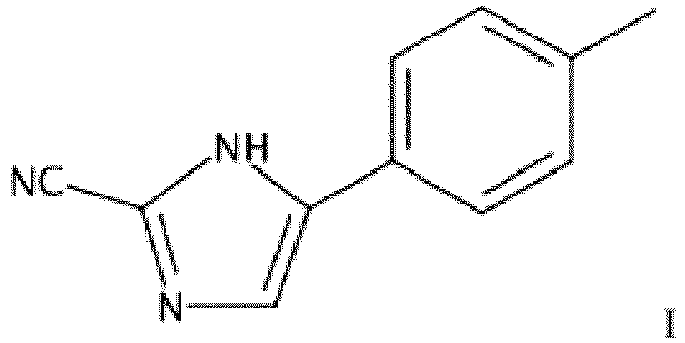
[0001] The present invention concerns an improved process for preparation of 5-(4-methylphenyl)-1H-imidazole-2-carbonitrile represented as compound of formula (I), an important intermediate for preparing the fungicide cyazofamid.
BACKGROUND OF THE INVENTION:
[0002] The compound 5-(4-methylphenyl)-1H-imidazole-2-carbonitrile represented as compound of formula (I), is an important intermediate for preparing the fungicide cyazofamid.
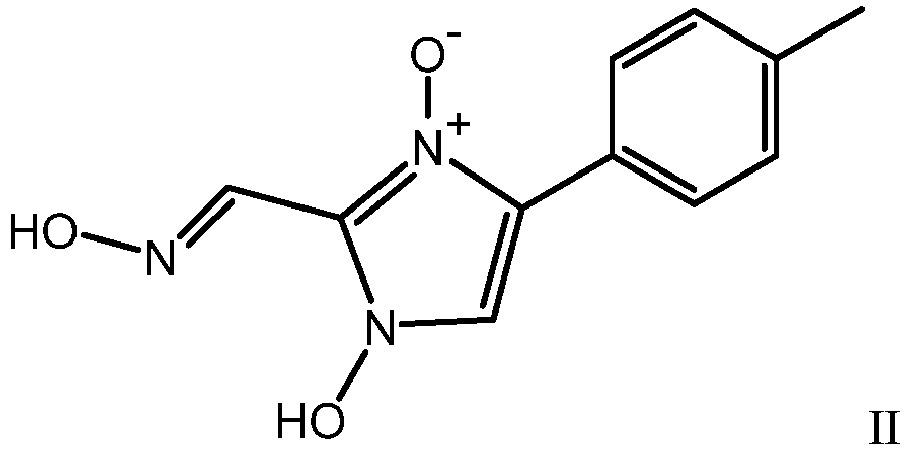
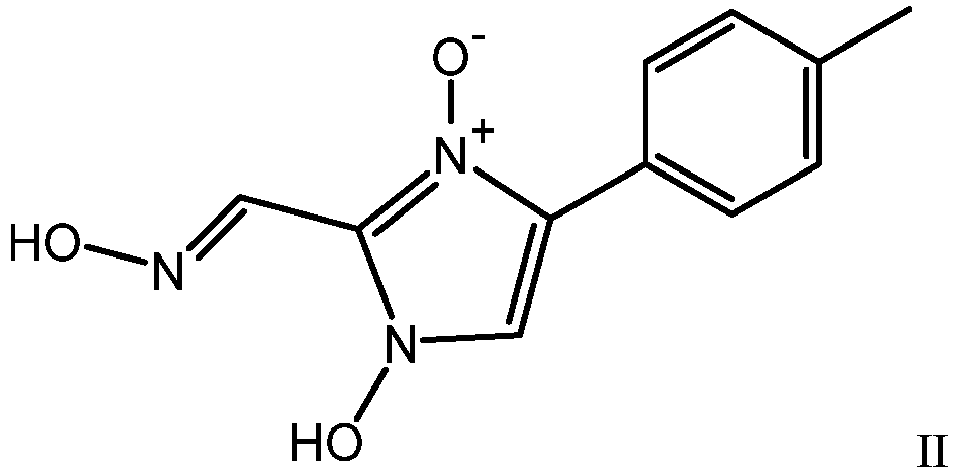
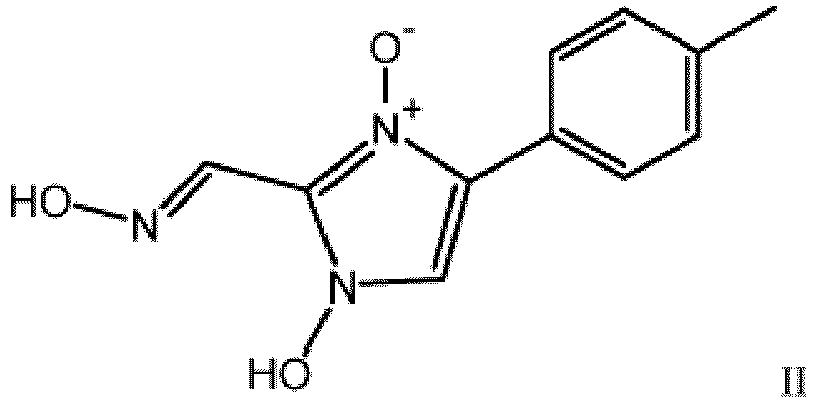
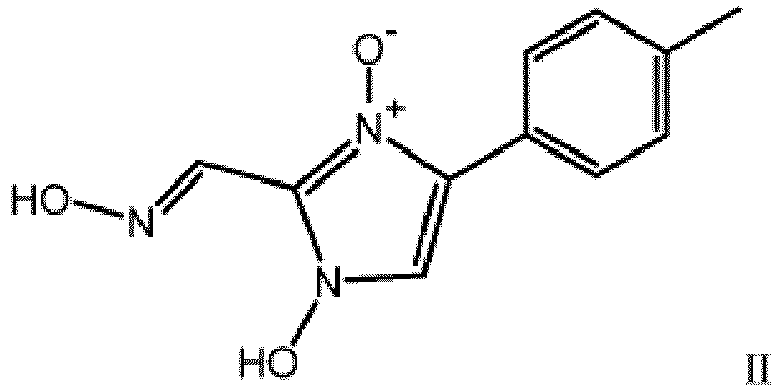
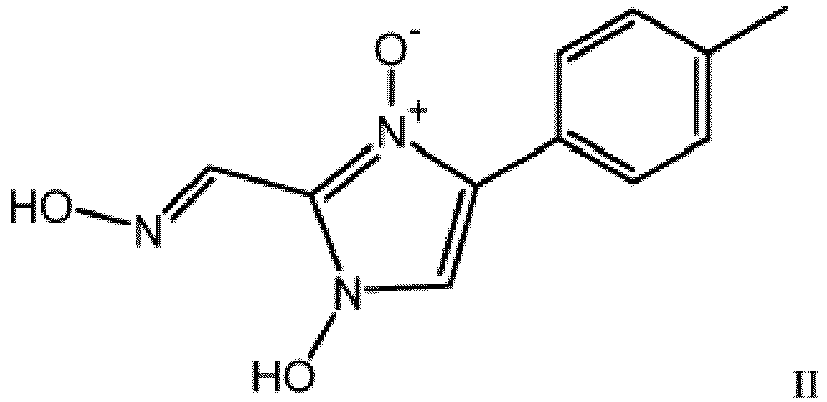
[0003] It is previously disclosed in the literature that the compound of formula (I) could be prepared by conversion of its aldoxime N-oxide precursor 1-hydroxy-4-(4-methylphenyl)-3-oxide-1H-imidazole-2-carboxaldehyde oxime represented as formula (II) to the corresponding cyano derivative and subsequent reduction of N-oxide group of the imidazole ring.
[0004] Conversion of aldoxime to the corresponding cyano-derivative using appropriate dehydrating agents such as phosphorus chloride, phosphorus pentoxide, thionyl chloride and the like have been developed and previously described in the literature. Namely, thionyl chloride is described in the literature as a common dehydration agent for conversion of aldoxime intermediate of cyazofamid to its cyano-derivative.
[0005] European patent application EP 0705823 describes the process of preparation of cyazofamid which includes the step of dehydration of aldoxime group of the intermediate represented as formula (II) using thionyl chloride in the presence of N,N-dialkylamide and further addition of sulfur chloride to produce a 2-cyanoimidazole intermediate represented as formula (I).
[0006] Japanese patent JP 2879164 describes the process of preparation of cyazofamid which includes the step of dehydration of aldoxime group of the intermediate represented as formula (II) using phosphorus or sulfur chloride or oxychloride preferably in the presence of a base to produce a 2-cyanoimidazole intermediate represented as formula (I).
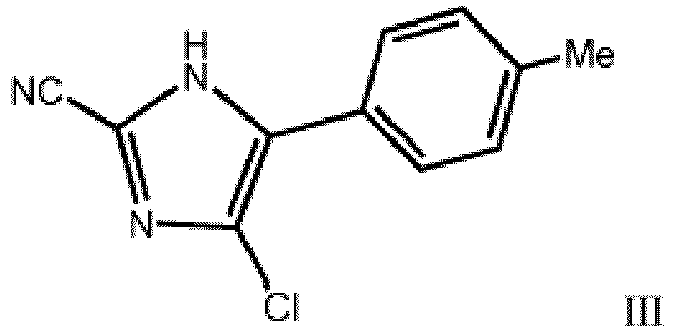
[0007] Chinese patent CN 102424671 describes the process of preparation of cyazofamid which includes the step of dehydration of aldoxime group of the intermediate represented as formula (II) using thionyl chloride, and subsequent addition of a) a chlorinating agent N-chlorosuccinimide and b) of reducing agent such as sodium dithionite, sodium sulfite or sodium hydrogen sulfite to produce a 2-cyanoimidazole intermediate represented as formula (III).
[0008] The aforementioned dehydration reagents, however, have limitations in some respects such as harsh reaction conditions, long reaction time, low yields, use of toxic, expensive or less readily available reagents and tedious workup.
[0009] Thionyl chloride is a severe lachrymator which should be freshly distilled before use in chemical processes. In addition, due to its slow reaction rate and long reaction times, elevated reaction temperatures and large excess of thionyl chloride must be used to achieve a convenient rate of dehydration of aldoxime group.
[0010] The use of large excesses of thionyl chloride in dehydration reactions is undesirable, since any unreacted thionyl chloride must be removed before the product is isolated and recovered.
[0011] In addition, as already known and recited in US 4605521, the use of an excess amount of thionyl chloride in combination with high reaction temperatures and long stripping times at elevated temperatures greater than 60° C will rapidly darken organic nitriles and increase residual sulfur content which is also undesirable.
[0012] In view of the aforementioned, there is a need for an improved process for commercially preparing of 5-(p-tolyl)-1H-imidazole-2-carbonitrile represented as a compound of formula (I), an important intermediate for preparing the fungicide cyazofamid, which process is suitable for industrial use, highly efficient, low-cost, environmentally friendly, and provides a higher yield and easy workup, thereby overcoming the deficiencies of the prior art.
[0013] It has been surprisingly found that reducing agent selected from the group consisting of metal salts of sulfur-containing derivatives such as sodium metabisulfite, sodium bisulfite, sodium sulfite, potassium bisulfite, potassium metabisulfite, potassium sulfite, potassium dithionite, sodium dithionite and/or the mixtures thereof perform the successful conversion of aldoxime substituent of the imidazole ring of the compound of formula (II) to the corresponding cyano group and, at the same time reduce the oxygenated nitrogens of imidazole moiety to produce the corresponding 2-cyanoimidazole represented as formula (I). The aforementioned inventive process produces less organic waste, higher product yields and avoids the use of toxic and corrosive dehydration agents reported in prior art.
SUMMARY OF THE INVENTION:
[0014] The present invention provides a process for preparation of 2-cyanoimidazole compound represented by the following formula (I):
which process comprises reacting of a compound represented by the following formula (II):
with the reducing agent selected from the group consisting of metal salts of sulfur-containing derivatives in the presence of a polar organic solvent.
[0015] Metal salts of sulfur-containing derivatives are selected from the group consisting of alkali and earth alkali metals salts and mixtures thereof; preferably from sodium metabisulfite, sodium bisulfite, sodium sulfite, potassium bisulfite, potassium metabisulfite, potassium sulfite, potassium dithionite, sodium dithionite and/or the mixtures thereof.
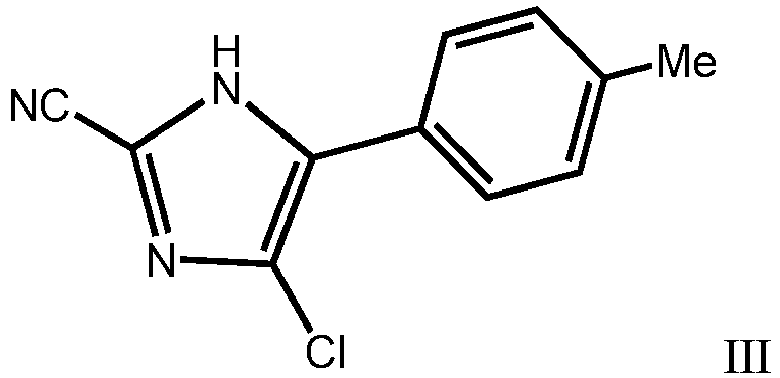
[0016] In another embodiment, the present invention provides a process for preparation of 4-chloro- 2-cyano-imidazole compound represented by the following formula (III):
which process comprises: a) reacting of compound represented by the following formula (II):
[0017] With the reducing agent selected from the group consisting of metal salts of sulfur-containing derivatives in the presence of a polar organic solvent and b) reacting the product obtained in step a) with a chlorinating agent.
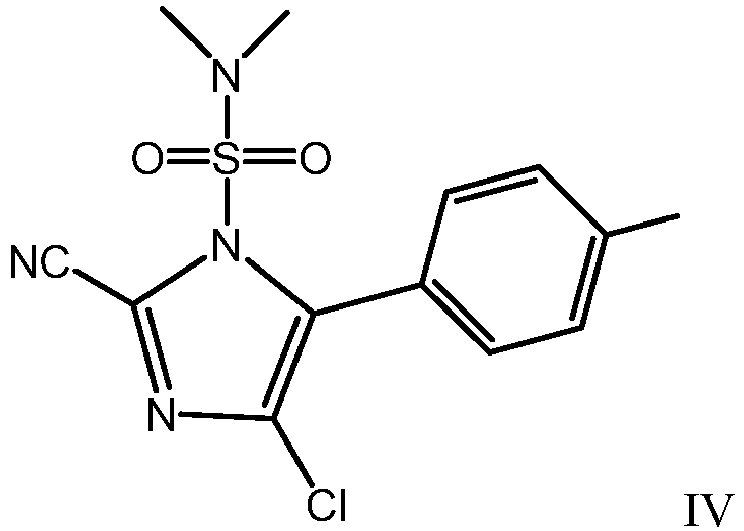
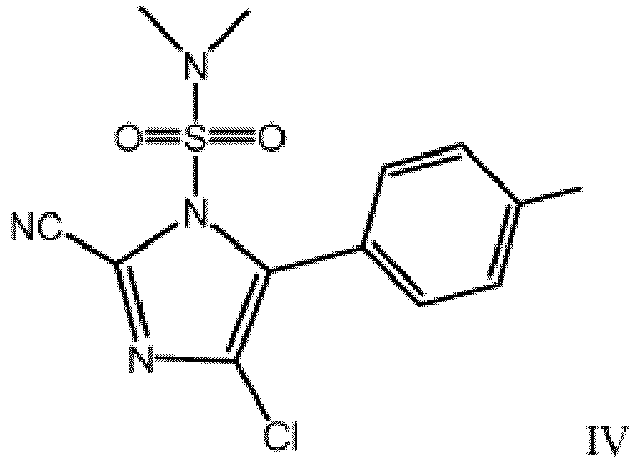
[0018] In another embodiment, the present invention provides a process for the preparation of the 2-cyanoimidazole known as cyazofamid, represented by formula (IV):
by: a) reacting of compound represented by the following formula (II):
with the reducing agent selected from the group consisting of metal salts of sulfur-containing derivatives in the presence of a polar organic solvent; b) reacting the product obtained in step a) with chlorination agent to obtain 4-chloro- 2-cyano-imidazole compound of formula (III) and c) reacting the compound of formula (III) with N,N-dimethylsulfamoyl chloride in the presence of a base and a polar organic solvent.
DETAILED DESCRIPTION OF THE INVENTION:
Definitions:
[0019] Prior to setting forth the present subject matter in detail, it may be helpful to provide definitions of certain terms to be used herein. Unless defined otherwise, all technical and scientific terms used herein have the same meaning as is commonly understood by one of skill in the art to which this subject matter pertains.
[0020] The term "a" or "an" as used herein includes the singular and the plural, unless specifically stated otherwise. Therefore, the terms "a," "an," or "at least one" can be used interchangeably in this application.
[0021] Throughout the application, descriptions of various embodiments use the term "comprising"; however, it will be understood by one skilled in the art, that in some specific instances, an embodiment can alternatively be described using the language "consisting essentially of' or "consisting of".
[0022] For purposes of better understanding the present teachings and in no way limiting the scope of the teachings, unless otherwise indicated, all numbers expressing quantities, percentages, or proportions, and other numerical values used in the specification and claims, are to be understood as being modified in all instances by the term "about." Accordingly, unless indicated to the contrary, the numerical parameters set forth in the following specification and attached claims are approximations that may vary depending upon the desired properties sought to be obtained. At the very least, each numerical parameter should at least be construed in light of the number of reported significant digits and by applying ordinary rounding techniques. In this regard, use of the term "about" herein specifically includes ±10% from the indicated values in the range. In addition, the endpoints of all ranges directed to the same component or property herein are inclusive of the endpoints, are independently combinable, and include all intermediate points and ranges.
Preparation of 2-cvanoimidazole compounds:
[0023] The present invention provides a process for preparation of 2-cyanoimidazole compound represented by the following formula (I):
which process comprises reacting of compound represented by the following formula (II):
with the reducing agent selected from the group consisting of metal salts of sulfur-containing derivatives in the presence of a polar organic solvent.
[0024] According to an embodiment, metal salts of sulfur-containing derivatives are selected from the group consisting of alkali and earth alkali metals salts and mixtures thereof; preferably from sodium metabisulfite, sodium bisulfite, sodium sulfite, potassium bisulfite, potassium metabisulfite, potassium sulfite, potassium dithionite, sodium dithionite and/or the mixtures thereof.
[0025] According to an embodiment, any polar organic solvent which has no adverse effects on the reaction can be used.
[0026] Non limiting examples of a polar organic solvent include N,N-dimethylacetamide, N,N-dimethylformamide, N-methylpyrrolidone, acetonitrile and/or the mixtures thereof.
[0027] According to an embodiment, an additional organic solvent which has no adverse effects on the reaction can be included.
[0028] Non limiting examples of such additional organic solvent include ethyl acetate, isopropyl acetate, butyl acetate and the like.
[0029] According to an embodiment, the process of preparation of compound represented as formula (I) may be carried out at a temperature of from about 40 °C to 150 °C, preferably of from about 70 °C to 120 °C.
[0030] According to an embodiment, the mole ratio of the compound of formula (II) to the reducing agent is from about 1:1 to 1:6, preferably from about 1:1 to about 1:3, more preferable from about 1: 1 to about 1: 1.5.
[0031] In another embodiment, the present invention provides a process for preparation of 4-chloro- 2-cyano-imidazole compound represented by the following formula (III):
which process comprises: a) reacting of compound represented by the following formula (II):
with the reducing agent selected from the group consisting of metal salts of sulfur-containing derivatives in the presence of a polar organic solvent and b) reacting of the product of a) with chlorinating agent.
[0032] According to an embodiment, the chlorination step is carried out in the presence of a chlorination agent selected from the group consisting of but not limited to N-chlorosuccinimide, sulfuryl chloride and the like known in the art.
[0033] In an embodiment, the chlorination reaction is carried out at a temperature of from 0 °C to 40 °C.
[0034] In another embodiment, the present invention provides a process for the preparation of the 2-cyanoimidazole known as cyazofamid, represented by formula (IV):
by: a) reacting of compound represented by the following formula (II)
with the reducing agent selected from the group consisting of metal salts of sulfur-containing derivatives in the presence of a polar organic solvent; b) reacting of the product formed in step a) with chlorination agent to obtain a compound of formula (III) and c) reacting the compound of formula (III) with dimethylsulfamoyl chloride in the presence of a base and a polar organic solvent.
[0035] In an embodiment, a base is preferably selected from a group consisting of alkali metal hydroxides, alkali metal carbonates, hydrides, alkaline earth metal hydroxides and alkaline earth metal carbonates. Among these, carbonates of alkali metals are preferred, and potassium carbonate is particularly preferred.
[0036] According to an embodiment, any polar organic solvent which has no adverse effects on the reaction can be used.
[0037] In a preferred embodiment, a polar organic solvent may be selected from N,N-dimethylacetamide, N,N-dimethylformamide, N-methylpyrrolidone, acetonitrile and/ or the mixtures thereof.
[0038] According to an embodiment, the compound of formula (IV) known as cyazofamid is prepared in-situ without isolation of intermediates represented as formula (II) and/or of formula (III).
[0039] The progress of the reactions involved in the processes enclosed by the invention can be monitored using any suitable method, which can include, for example, chromatographic methods such as, e.g., high performance liquid chromatography (HPLC), thin layer chromatography (TLC), and the like.
[0040] In yet another embodiment, the compounds of formula (I), (III) and (IV) can be isolated from the reaction mixture by any conventional techniques well-known in the art. Such isolation techniques can be selected, without limitation, from the group consisting of concentration, extraction, precipitation, cooling, filtration, crystallization, centrifugation, and a combination thereof, followed by drying.
[0041] According to an embodiment, the resultant compound of formula (I) is present at a purity of at least 80%, at least 85%, at least 88%, at least 89%, at least 90%, at least 91%, at least 92%, at least 93%, at least 94%, at least 95%, at least 96%, at least 97%, at least 98%, or at least 99%. In particular, the use of reducing agents selected from the group consisting of metal salts of sulfur-containing derivatives instead of thionyl chloride or other corrosive dehydration agents reported in prior art, reduces the cost of production, simplifies work-up, and minimizes any toxic waste and further disposal problems.
[0042] The following examples are presented in order to illustrate certain embodiments of the invention. They should in no way, however, be construed as limiting the broad scope of the invention. One skilled in the art can readily devise many variations and modifications of the principles disclosed herein without departing from the spirit and scope of the invention.
EXAMPLE 1: Preparation of (4-methylphenyl)-1H-imidazole-2-carbonitrile:
[0043] 250 g of 1-hydroxy-4-(4-methylphenyl)-3-oxide-1H-imidazole-2-carboxaldehyde oxime (0.95 mole) and 750 ml N,N-dimethylacetamide were mixed in a 5 liter flask and heated to 100°C. Sodium metabisulfite (235g, 1.2 moles) was charged in portions. The mixture was held at 100°C for 8 hours. The mixture was cooled to room temperature and 2000ml water was added to precipitate the product. The solid was filtered off and washed with water and toluene, and dried. 139 g of crude(4-methylphenyl)-1H-imidazole-2-carbonitrile was obtained, purity 94.6%.
EXAMPLE 2: Preparation of (4-methylphenyl)-1H-imidazole-2-carbonitrile:
[0044] 250 g of 1-hydroxy-4-(4-methylphenyl)-3-oxide-1H-imidazole-2-carboxaldehyde oxime (0.95 mole), 625 ml N,N-dimethylacetamide and 125 ml acetonitrile were mixed in a 5 liter flask and heated to 80°C. Sodium bisulfite (255 g, 2.4 moles) was charged in portions. The mixture was heated slowly to 105°C and held for 4 hours. The mixture was cooled to room temperature and 1500 ml water was added to precipitate the product. The solid was filtered off and washed, cleaned and dried as described in Example 1, to obtain 140 g of (4-methylphenyl)-1H-imidazole-2-carbonitrile, purity 95.3%.
EXAMPLE 3: Preparation of 5-chloro-4-(4-methylphenyl)-1H-imidazole-2-carbonitrile:
[0045] 110 g of the product from Example 1 was mixed in a 500 ml flask with 55 ml N,N-dimethylacetamide and 55 ml acetonitrile. 86 g of sulfuryl chloride was added dropwise, maintaining the temperature below 25°C. After the addition was complete the mixture was stirred for a further hour at 20°C. The reaction mass was neutralized with 10% sodium hydroxide, and stirred for a further hour. The crude product was filtered off, washed with water, re-slurried in toluene, filtered, and dried in a vacuum oven to obtain 104 g of 5-chloro-4-(4-methylphenyl)-1H-imidazole-2-carbonitrile.
EXAMPLE 4: Preparation of 4-chloro-2-cyano-N,N-dimethyl-5-(4-methylphenyl)-1H-imidazole-1-sulfonamide:
[0046] 90 g of product from Example 3 was mixed with 117 g of potassium carbonate and 100 ml of ethyl acetate in a 500 ml flask. The mixture was heated to 75°C, and 87 g N,N-dimethylsulfamoyl chloride was added dropwise over 30 minutes. The temperature was maintained for 10 hours. After cooling, ethyl acetate and water were added, and the mixture was filtered. The solid was washed with water and with ethyl acetate, and dried to obtain 68 g of 4-chloro-2-cyano-N,N-dimethyl-5-(4-methylphenyl)-1H-imidazole-1-sulfonamide, purity 96.1%.
1. A process for preparation of 2-cyanoimidazole compound represented by the following
formula (I):
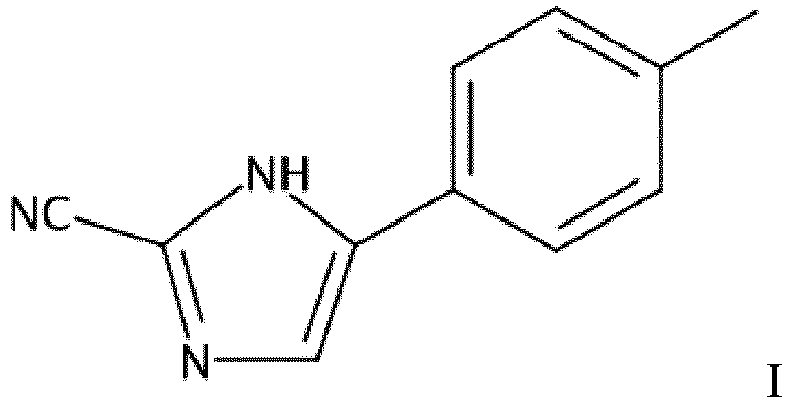
which process comprises reacting of compound represented by the following formula (II):
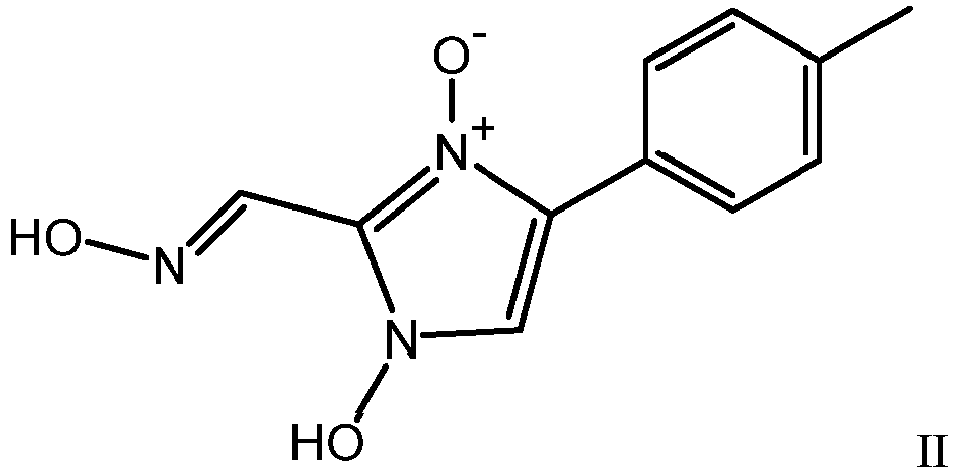
with a reducing agent selected from the group consisting of metal salts of sulfur-containing derivatives in the presence of a polar organic solvent.
which process comprises reacting of compound represented by the following formula (II):
with a reducing agent selected from the group consisting of metal salts of sulfur-containing derivatives in the presence of a polar organic solvent.
2. The process according to claim 1, wherein the metal salts of sulfur-containing derivatives
are selected from the group consisting of alkali and earth alkali metals salts and
mixtures thereof.
3. The process according to claim 2, wherein a reducing agent is selected from the group
consisting of sodium metabisulfite, sodium bisulfite, sodium sulfite, potassium bisulfite,
potassium metabisulfite, potassium sulfite, potassium dithionite, sodium dithionite
and/or the mixtures thereof.
4. The process according to claim 1, wherein the polar organic solvent is selected from
N,N-dimethylacetamide, N,N-dimethylformamide, N-methylpyrrolidone, acetonitrile and/
or the mixtures thereof.
5. The process according to claim 1, wherein the reaction is carried out at a temperature
of from 40 °C to 150 °C.
6. The process according to claim 1, wherein the reaction is carried out at a temperature
of from 70°C to 120°C.
7. The process according to claim 1, wherein the molar ratio of the compound of formula
(II) to the reducing agent is from 1: 1 to 1: 6.
8. The process according to claim 1, wherein the molar ratio of the compound of formula
(II) to the reducing agent is from 1: 1 to 1: 3.
9. The process according to claim 1, wherein the molar ratio of the compound of formula
(II) to the reducing agent is from 1: 1 to 1: 1.5.
10. A process for preparation of 4-chloro-2-cyano-imidazole compound represented by the
following formula (III):
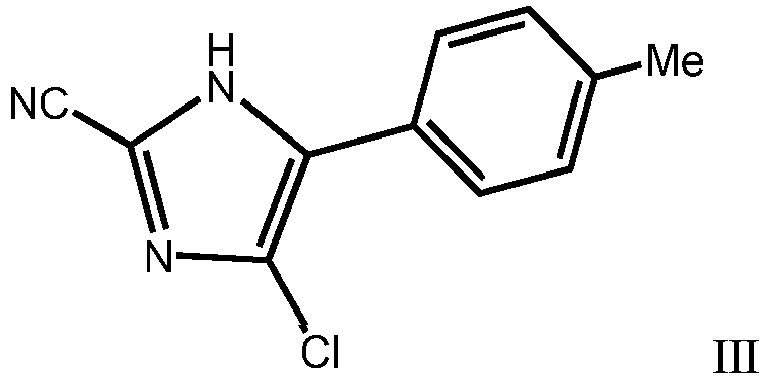
which process comprises: a) reacting of compound represented by the following formula (II):
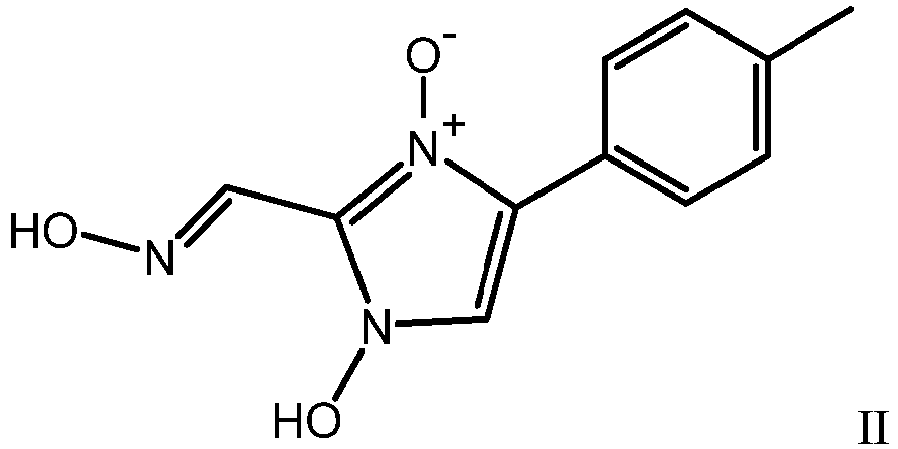
with the reducing agent selected from the group consisting of metal salts of sulfur-containing derivatives and b) reacting of the product of a) with chlorinating agent.
which process comprises: a) reacting of compound represented by the following formula (II):
with the reducing agent selected from the group consisting of metal salts of sulfur-containing derivatives and b) reacting of the product of a) with chlorinating agent.
11. The process according to claim 10, wherein the chlorinating agent is selected from
a group consisting of N-chlorosuccinimide and/or sulfuryl chloride.
12. The process according to claim 10, wherein the chlorination reaction is carried out
at a temperature of from 0 °C to 40 °C.
13. A process for preparation of 2-cyanoimidazole compound represented by the following
formula (IV):
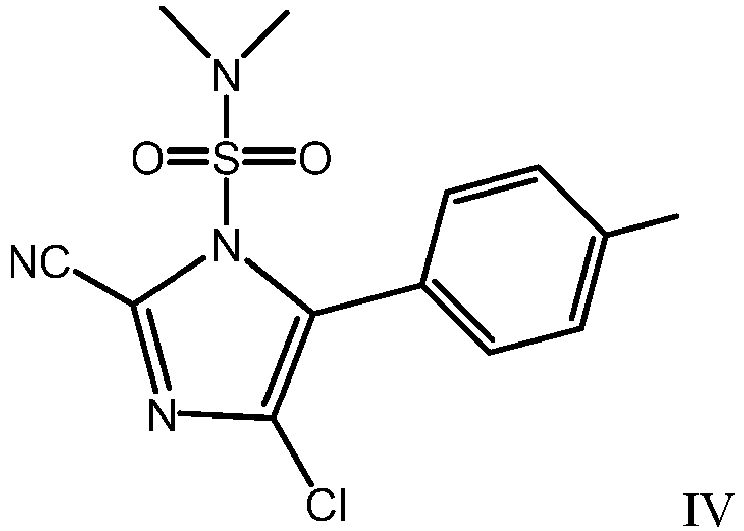
which process comprises: a) reacting of compound represented by the following formula (II):
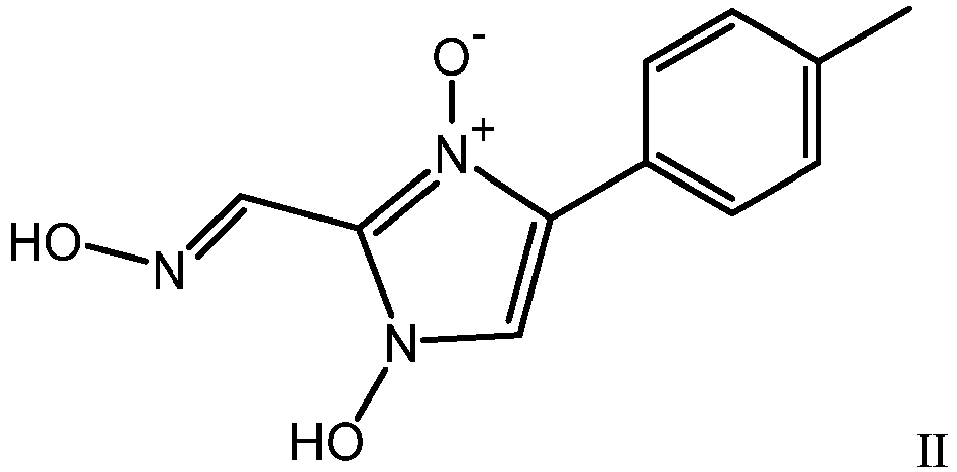
with the reducing agent selected from the group consisting of metal salts of sulfur-containing derivatives and b) reacting of the product of a) with chlorinating agent and c) reacting of the product of b) with N,N-Dimethylsulfamoyl chloride in the presence of base and a polar organic solvent.
which process comprises: a) reacting of compound represented by the following formula (II):
with the reducing agent selected from the group consisting of metal salts of sulfur-containing derivatives and b) reacting of the product of a) with chlorinating agent and c) reacting of the product of b) with N,N-Dimethylsulfamoyl chloride in the presence of base and a polar organic solvent.
14. The process according to claim 13, wherein the base is selected from a group consisting
of alkali metal hydroxides, alkali metal carbonates, hydrides, alkaline earth metal
hydroxides and alkaline earth metal carbonates.
15. The process according to claim 13, which comprises in-situ preparation of the compound represented by formula (IV).
1. Verfahren zur Herstellung einer 2-Cyanoimidazol-Verbindung, die durch die folgende
Formel (I) dargestellt wird
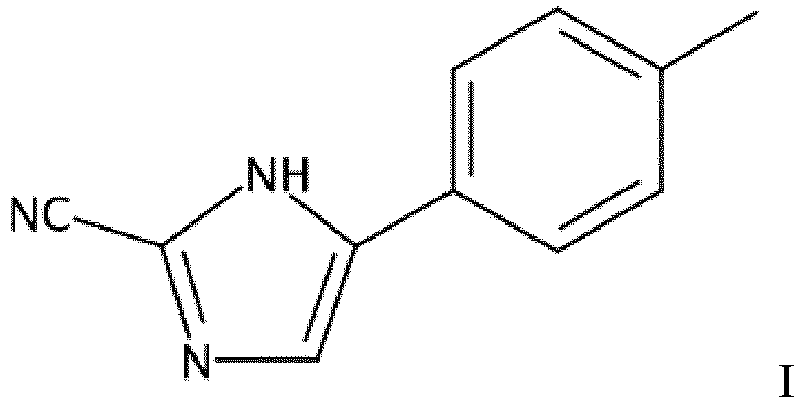
wobei das Verfahren die Umsetzung einer Verbindung, dargestellt durch die folgende Formel (II), umfasst:
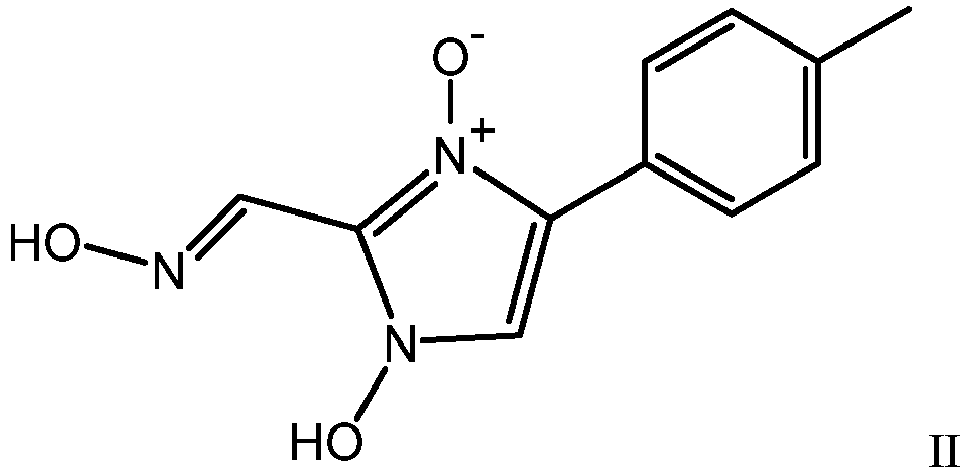
mit einem Reduktionsmittel, ausgewählt aus der Gruppe bestehend aus Metallsalzen von schwefelhaltigen Derivaten, in Gegenwart eines polaren organischen Lösungsmittels.
wobei das Verfahren die Umsetzung einer Verbindung, dargestellt durch die folgende Formel (II), umfasst:
mit einem Reduktionsmittel, ausgewählt aus der Gruppe bestehend aus Metallsalzen von schwefelhaltigen Derivaten, in Gegenwart eines polaren organischen Lösungsmittels.
2. Verfahren nach Anspruch 1, wobei die Metallsalze von schwefelhaltigen Derivaten ausgewählt
sind aus der Gruppe bestehend aus Alkali- und Erdalkalimetallsalzen und Mischungen
davon.
3. Verfahren nach Anspruch 2, wobei ein Reduktionsmittel ausgewählt ist aus der Gruppe
bestehend aus Natriummetabisulfit, Natriumbisulfit, Natriumsulfit, Kaliumbisulfit,
Kaliummetabisulfit, Kaliumsulfit, Kaliumdithionit, Natriumdithionit und/oder den Mischungen
davon.
4. Verfahren nach Anspruch 1, wobei das polare organische Lösungsmittel ausgewählt ist
aus N,N-Dimethylacetamid, N,N-Dimethylformamid, N-Methylpyrrolidon, Acetonitril und/oder
den Mischungen davon.
5. Verfahren nach Anspruch 1, wobei die Reaktion bei einer Temperatur von 40 °C bis 150
°C durchgeführt wird.
6. Verfahren nach Anspruch 1, wobei die Reaktion bei einer Temperatur von 70 °C bis 120
°C durchgeführt wird.
7. Verfahren nach Anspruch 1, wobei das molare Verhältnis der Verbindung der Formel (II)
zum Reduktionsmittel 1: 1 bis 1: 6 beträgt.
8. Verfahren nach Anspruch 1, wobei das molare Verhältnis der Verbindung der Formel (II)
zum Reduktionsmittel 1: 1 bis 1: 3 beträgt.
9. Verfahren nach Anspruch 1, wobei das molare Verhältnis der Verbindung der Formel (II)
zum Reduktionsmittel 1: 1 bis 1: 1,5 beträgt.
10. Verfahren zur Herstellung einer 4-Chlor-2-cyano-imidazol-Verbindung, dargestellt durch
die folgende Formel (III):
wobei das Verfahren umfasst: a) Umsetzen einer Verbindung, dargestellt durch die folgende Formel (II)
mit dem Reduktionsmittel, ausgewählt aus der Gruppe bestehend aus Metallsalzen von schwefelhaltigen Derivaten, und b) Umsetzen des Produkts von a) mit Chlorierungsmittel.
wobei das Verfahren umfasst: a) Umsetzen einer Verbindung, dargestellt durch die folgende Formel (II)
mit dem Reduktionsmittel, ausgewählt aus der Gruppe bestehend aus Metallsalzen von schwefelhaltigen Derivaten, und b) Umsetzen des Produkts von a) mit Chlorierungsmittel.
11. Verfahren nach Anspruch 10, wobei das Chlorierungsmittel ausgewählt ist aus einer
Gruppe bestehend aus N-Chlorsuccinimid und/oder Sulfurylchlorid.
12. Verfahren nach Anspruch 10, wobei die Chlorierungsreaktion bei einer Temperatur von
0 °C bis 40 °C durchgeführt wird.
13. Verfahren zur Herstellung einer 2-Cyanoimidazol-Verbindung, dargestellt durch die
folgende Formel (IV):
wobei das Verfahren umfasst: a) Umsetzen einer Verbindung, dargestellt durch die folgende Formel (II)
mit dem Reduktionsmittel, ausgewählt aus der Gruppe bestehend aus Metallsalzen von schwefelhaltigen Derivaten, und b) Umsetzen des Produkts von a) mit Chlorierungsmittel und c) Umsetzen des Produkts von b) mit N,N-Dimethylsulfamoylchlorid in Gegenwart von Base und einem polaren organischen Lösungsmittel.
wobei das Verfahren umfasst: a) Umsetzen einer Verbindung, dargestellt durch die folgende Formel (II)
mit dem Reduktionsmittel, ausgewählt aus der Gruppe bestehend aus Metallsalzen von schwefelhaltigen Derivaten, und b) Umsetzen des Produkts von a) mit Chlorierungsmittel und c) Umsetzen des Produkts von b) mit N,N-Dimethylsulfamoylchlorid in Gegenwart von Base und einem polaren organischen Lösungsmittel.
14. Verfahren nach Anspruch 13, wobei die Base ausgewählt ist aus einer Gruppe bestehend
aus Alkalimetallhydroxiden, Alkalimetallcarbonaten, Hydriden, Erdalkalimetallhydroxiden
und Erdalkalimetallcarbonaten.
15. Verfahren nach Anspruch 13, das die in-situ-Herstellung der durch Formel (IV) dargestellten
Verbindung umfasst.
1. Procédé de préparation d'un composé 2-cyanoimidazole représenté par la formule (I)
suivante :
lequel procédé comprend la réaction du composé représenté par la formule (II) suivante :
avec un agent de réduction choisi dans le groupe constitué de sels métalliques de dérivés contenant du soufre en présence d'un solvant organique polaire.
lequel procédé comprend la réaction du composé représenté par la formule (II) suivante :
avec un agent de réduction choisi dans le groupe constitué de sels métalliques de dérivés contenant du soufre en présence d'un solvant organique polaire.
2. Procédé selon la revendication 1, dans lequel les sels métalliques de dérivés contenant
du soufre sont choisis dans le groupe constitué de sels de métaux alcalins et alcalino-terreux
et de mélanges de ceux-ci.
3. Procédé selon la revendication 2, dans lequel un agent de réduction est choisi dans
le groupe constitué de métabisulfite de sodium, de bisulfite de sodium, de sulfite
de sodium, de bisulfite de potassium, de métabisulfite de potassium, de sulfite de
potassium, de dithionite de potassium, de dithionite de sodium et/ou de mélanges de
ceux-ci.
4. Procédé selon la revendication 1, dans lequel le solvant organique polaire est choisi
parmi le N,N-diméthylacétamide, le N,N-diméthylformamide, la N-méthylpyrrolidone,
l'acétonitrile et/ou les mélanges de ceux-ci.
5. Procédé selon la revendication 1, dans lequel la réaction est réalisée à une température
de 40°C à 150°C.
6. Procédé selon la revendication 1, dans lequel la réaction est réalisée à une température
de 70°C à 120°C.
7. Procédé selon la revendication 1, dans lequel le rapport molaire du composé de formule
(II) à l'agent de réduction est de 1:1 à 1:6.
8. Procédé selon la revendication 1, dans lequel le rapport molaire du composé de formule
(II) à l'agent de réduction est de 1:1 à 1:3.
9. Procédé selon la revendication 1, dans lequel le rapport molaire du composé de formule
(II) à l'agent de réduction est de 1:1 à 1 :1,5.
10. Procédé de préparation d'un composé 4-chloro-2-cyano-imidazole représenté par la formule
(III) suivante :
lequel procédé comprend : a) la réaction du composé représenté par la formule (II) suivante :
avec l'agent de réduction choisi dans le groupe constitué de sels métalliques de dérivés contenant du soufre et b) la réaction du produit de a) avec un agent de chloration.
lequel procédé comprend : a) la réaction du composé représenté par la formule (II) suivante :
avec l'agent de réduction choisi dans le groupe constitué de sels métalliques de dérivés contenant du soufre et b) la réaction du produit de a) avec un agent de chloration.
11. Procédé selon la revendication 10, dans lequel l'agent de chloration est choisi dans
un groupe constitué de N-chlorosuccinimide et/ou de chlorure de sulfuryle.
12. Procédé selon la revendication 10, dans lequel la réaction de chloration est réalisée
à une température de 0 °C à 40 °C.
13. Procédé de préparation d'un composé 2-cyanoimidazole représenté par la formule (IV)
suivante :
lequel procédé comprend : a) la réaction du composé représenté par la formule (II) suivante :
avec l'agent de réduction choisi dans le groupe constitué de sels métalliques de dérivés contenant du soufre et b) la réaction du produit de a) avec un agent de chloration et c) la réaction du produit de b) avec du chlorure de N,N-diméthylsulfamoyle en présence d'une base et d'un solvant organique polaire.
lequel procédé comprend : a) la réaction du composé représenté par la formule (II) suivante :
avec l'agent de réduction choisi dans le groupe constitué de sels métalliques de dérivés contenant du soufre et b) la réaction du produit de a) avec un agent de chloration et c) la réaction du produit de b) avec du chlorure de N,N-diméthylsulfamoyle en présence d'une base et d'un solvant organique polaire.
14. Procédé selon la revendication 13, dans lequel la base est choisie dans un groupe
constitué d'hydroxydes de métaux alcalins, de carbonates de métaux alcalins, d'hydrures,
d'hydroxydes de métaux alcalino-terreux et de carbonates de métaux alcalino-terreux.
15. Procédé selon la revendication 13, lequel comprend la préparation in situ du composé représenté par la formule (IV).
REFERENCES CITED IN THE DESCRIPTION
This list of references cited by the applicant is for the reader's convenience only. It does not form part of the European patent document. Even though great care has been taken in compiling the references, errors or omissions cannot be excluded and the EPO disclaims all liability in this regard.
Patent documents cited in the description