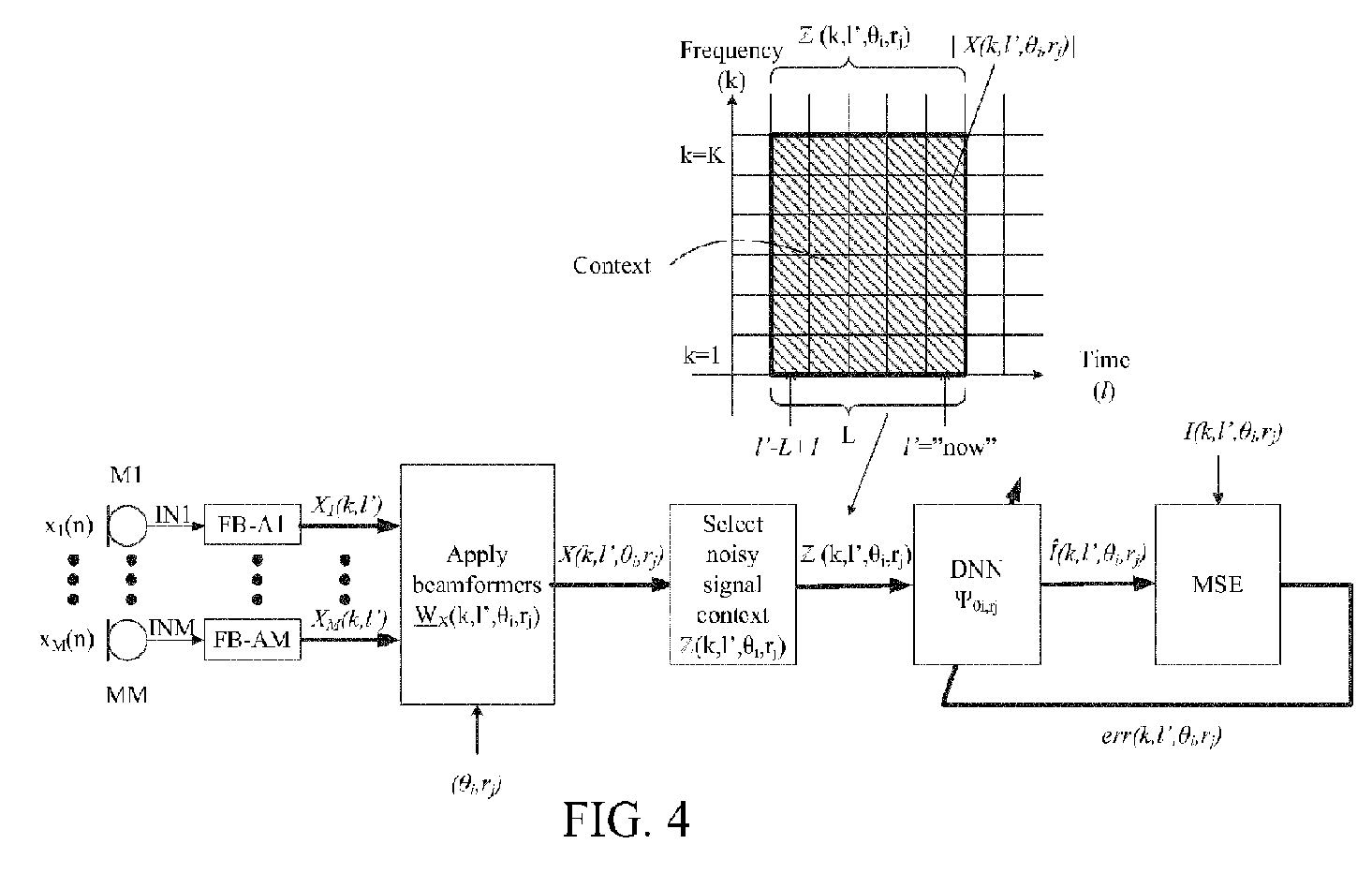
(57) A hearing device, e.g. a hearing aid, comprises a) a multitude of input units, each
providing an electric input signal representing sound in the environment of the user
in a time-frequency representation, wherein the sound is a mixture of speech and additive
noise or other distortions, e.g. reverberation, b) a multitude of beamformer filtering
units, each being configured to receive at least two, e.g. all, of said multitude
of electric input signals, each of said multitude of beamformer filtering units being
configured to provide a beamformed signal representative of the sound in a different
one of a multitude of spatial segments, e.g. spatial cells, around the user, c) a
multitude of speech probability estimators each configured to receive the beamformed
signal for a particular spatial segment and to estimate a probability that said particular
spatial segment contains speech at a given point in time and frequency, wherein at
least one, e.g. all, of the multitude of speech probability estimators is/are implemented
as a trained neural network, e.g. a deep neural network. The invention may e.g. be
used in hearing aids or communication devices, such as headsets, or telephones, or
speaker phones.
|
|
