| (19) |
 |
|
(11) |
EP 3 649 008 B1 |
| (12) |
EUROPEAN PATENT SPECIFICATION |
| (45) |
Mention of the grant of the patent: |
|
20.10.2021 Bulletin 2021/42 |
| (22) |
Date of filing: 09.04.2018 |
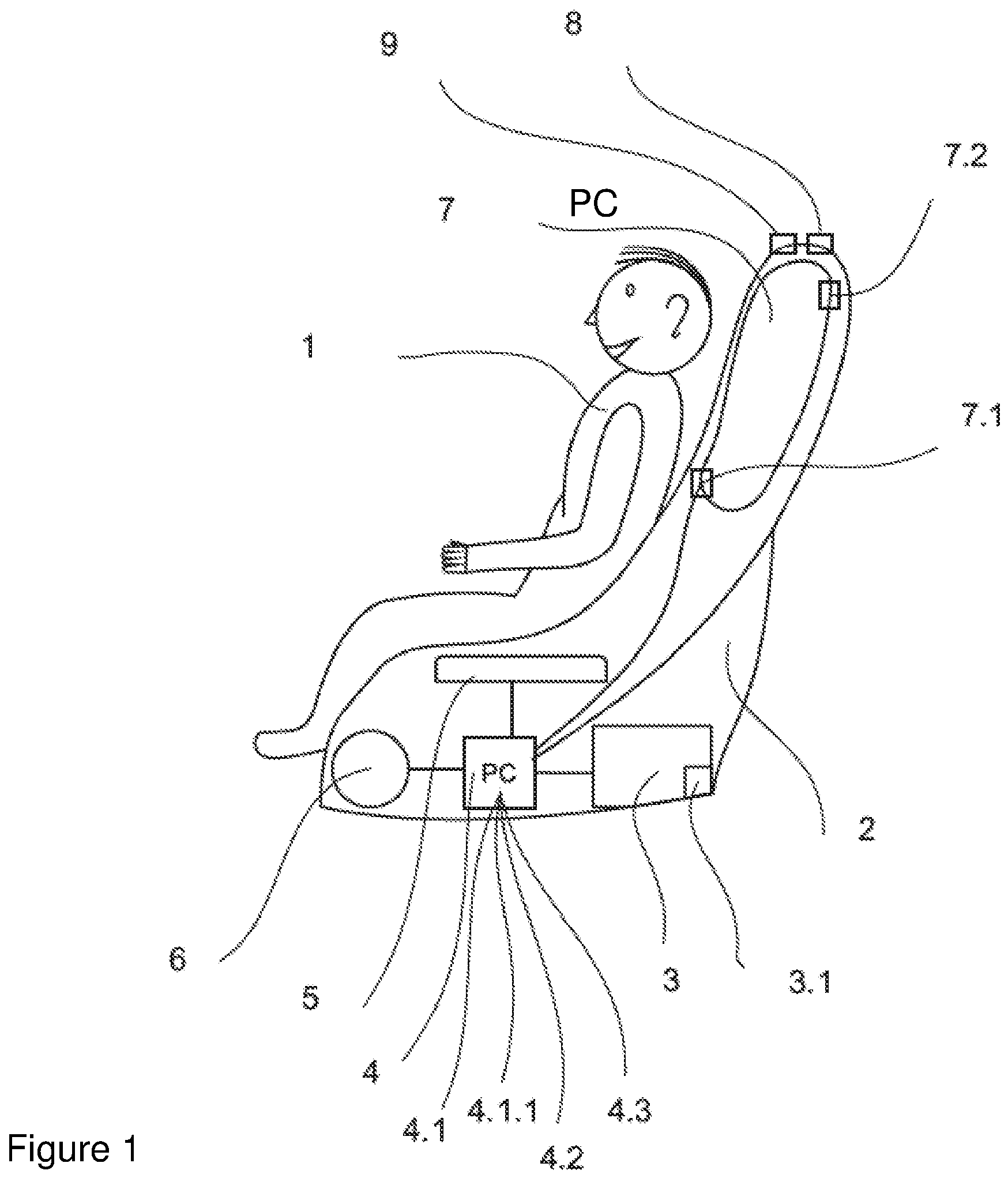
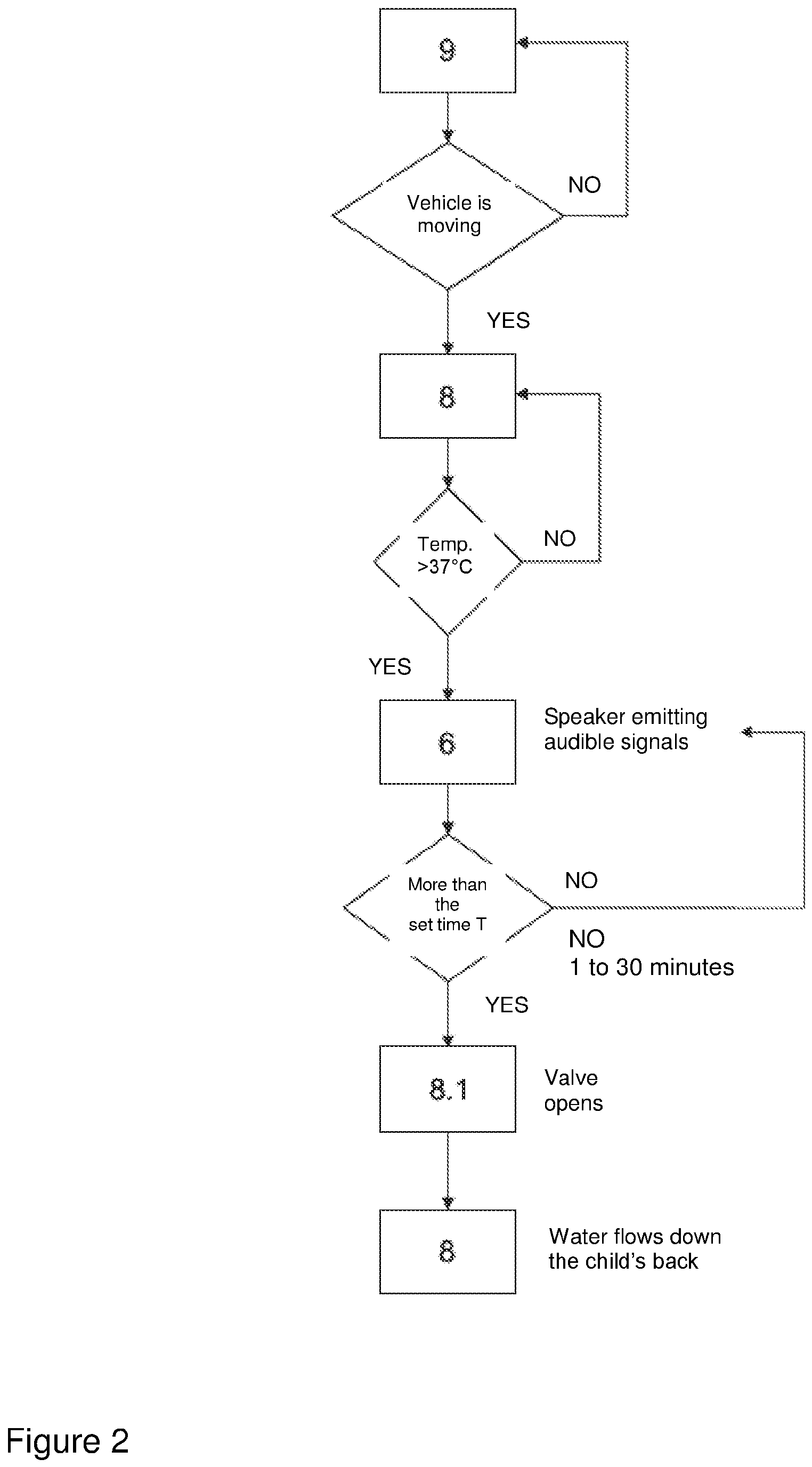
|
| (51) |
International Patent Classification (IPC):
|
| (86) |
International application number: |
|
PCT/IB2018/052452 |
| (87) |
International publication number: |
|
WO 2019/030580 (14.02.2019 Gazette 2019/07) |
|
| (54) |
A CHILD CAR SEAT WITH AN INTEGRATED ANTI-OVERHEATING SAFETY SYSTEM
KINDERAUTOSITZ MIT INTEGRIERTEM ÜBERHITZUNGSSCHUTZSYSTEM
SIÈGE AUTO POUR ENFANT COMPRENANT UN SYSTÈME DE SÉCURITÉ ANTI-COUP DE CHALEUR INTÉGRÉ
|
| (84) |
Designated Contracting States: |
|
AL AT BE BG CH CY CZ DE DK EE ES FI FR GB GR HR HU IE IS IT LI LT LU LV MC MK MT NL
NO PL PT RO RS SE SI SK SM TR |
| (30) |
Priority: |
11.08.2017 SI 201700232
|
| (43) |
Date of publication of application: |
|
13.05.2020 Bulletin 2020/20 |
| (73) |
Proprietor: ANIG d.o.o. |
|
8000 Novo mesto (SI) |
|
| (72) |
Inventor: |
|
- SPES, Andrej
8000
Novo mesto (SI)
|
| (74) |
Representative: Marks & Clerk (Luxembourg) LLP |
|
44, rue de la Vallée
2661 Luxembourg
2661 Luxembourg (LU) |
| (56) |
References cited: :
US-A- 5 833 309
US-A1- 2008 004 774
|
US-A- 5 949 340
|
|
| |
|
|
|
|
| |
|
| Note: Within nine months from the publication of the mention of the grant of the European
patent, any person may give notice to the European Patent Office of opposition to
the European patent
granted. Notice of opposition shall be filed in a written reasoned statement. It shall
not be deemed to
have been filed until the opposition fee has been paid. (Art. 99(1) European Patent
Convention).
|
BACGROUND
[0001] The subject matter of the invention is a child car seat with a technical system of
elements integrated into the child car seat, which alerts you if the child is overheating
and provides cooling, if necessary.
BRIEF SUMMARY OF THE INVENTION AND RELATED ART
[0002] The problem that the invention is trying to solve is to prevent children from overheating
when left in a car etc., which gets heated through solar radiation. Through the closed
windows of the car in which the child is sitting. The presented technical system is
also capable of cooling the child down in case the audible alarm warning, which is
triggered at elevated temperatures, does not reach its primary goal of alerting the
parents, who would remove the child from the car.
[0003] There are several known cases where parents had forgotten their child in the car
and went on errands. During the summer months, when the car is exposed to strong sunlight,
the temperatures inside the car can reach more than 90 degrees Celsius. According
to media reports, there have unfortunately been many cases where a child has died
due to overheating, which was the result of the circumstances described above.
[0004] Because nowadays many children's parents are more and more mentally burdened, which,
sadly, is the developing trend of our society, the number of such cases, where a child
is forgotten in a car, is increasing. While the children are in the car, they sleep
most of the time and don't draw any special attention to themselves, and so it can
very easily happen that the increasingly stressed out and mentally fatigued parents
forget their child in the car. If such an thing happens in the summer, when the temperatures
are very high, it can have fatal consequences for the child.
[0005] The technical invention described below suggests a technical way for preventing leaving
a child alone in the child seat, which is installed in the rear of your car, and additionally
proposes
Description
[0006] a technical solution for cooling the child in case the parents don't respond to the
warning signal of the child car seat, which is designed to prevent parents from forgetting
their children in the car.
[0007] The current technical knowledge is, unfortunately, still unable to anticipate such
events and provide similar solutions and warnings.
[0008] The technical knowledge to date is primarily focused on providing safety for the
child seated in a child car seat, installed in the car, in the event of a collision,
rollover or similar mechanical stresses on the body, which could affect the child
in the child car seat.
[0009] What is common to all known technical solutions is that their designers did not consider
the possibility that a child might be forgotten and left in an overheated car, therefore
they don't suggest any solutions to provide safety for the children in case of such
an event.
[0010] US 5 949 340 discloses a car child seat which includes an occupant detection mechanism, an ignition
detection mechanism and a control unit for generating an alarm signal and therefore
provide a warning when a child has been left in the child seat and the vehicle has
been turned off. However, even though a temperature sensor can be provided to sense
the temperature within the vehicle and when it exceeds a predetermined limit, the
control unit can activate the power windows and/or turn on a cooling fan and/or control
the air conditioning and the heater units, there remains the need to provide an effective
and immediate technical solution for cooling the child in case the occupants do not
respond to the warning signal of the child car seat.
DETAILED DESCRIPTION OF THE INVENTION AND BRIEF DESCRIPTION OF THE DRAWINGS
[0011] This invention proposes a technical solution to this problem with an integrated warning
speaker/sound alarm, which is triggered when the vehicle is stationary and when the
temperature inside rises above 37 degrees Celsius. The system can also trigger other
applications, such as a phone call to the parents, the opening of car windows, etc.
Description
[0012] The proposed invention also includes a technical invention of a system for cooling
the child, which is activated after a certain period of time after the sound alarm
warning has been triggered, if the child has not been removed from the car.
[0013] Description of the figures:
Figure 1 shows a schematic view of the child car seat with the child and all the related
technical elements which are necessary to protect the child from overheating
Figure 2 shows a diagram of signal paths between the elements in the event of an increased
temperature.
[0014] The child car seat is a movable device, which is fitted into the car with belts,
specific technical fittings, called ISOFIX, or similar attachment systems.
[0015] Our technical invention does not describe these technical solutions, since they are
known technical knowledge and have no impact on the problem the technical invention
is trying to solve.
[0016] According to our invention, the child car seat with an integrated overheating protection
for children (2) has the following internally installed technical elements:
A battery (3), which powers the child car seat with an integrated overheating protection
for children (2) even when it is not connected to the power supply of the vehicle.
[0017] A plug (3.1), which is designed for a 12V electric car socket.
[0018] A PC or is henceforth called a processor (4), which connects all the technical elements
and with its programmed logic, which is described below, controls all the technical
elements built-in into the child car seat, with an integrated overheating protection
for children (2), ensuring the protection of the child (1) against overheating.
[0019] A scale (5) with a weighing or child (1) detection function, installed in the child
car seat with the integrated overheating protection for children (2).
[0020] An audible alarm (6), which has the function of producing an audible warning in case
of elevated temperatures in the car, when a child (1) is seated in the child car seat
with the integrated overheating protection for children (2).
[0021] A water storage container (7), which has the function of cooling down the child (1),
if after a certain amount of time, after the audible alarm (6) warning has been triggered,
the child (1) was not removed from the child car seat with the integrated overheating
protection for children (2).
[0022] A valve (7.1), which the processor (4) opens up in case the child (1) was not removed
from the child car seat with the integrated overheating protection for children (2)
after a certain amount of time has passed since the first audible alarm warning (6).
[0023] A valve (7.2) through which the water storage container (7) can be refilled.
[0024] A temperature sensor (8), which constantly measures the temperature near the child's
(1) head and is electrically connected to the processor (4).
[0025] A motion sensor (9), which monitors whether the vehicle is stationary or driving
and is electrically connected to the processor (4).
[0026] The battery (3) is electrically connected with the plug (3.1), whose purpose is to
charge the battery (3) through the car socket and give the processor (4) the signal
that the system is connected to the 12V car power network. The processor (4) is electrically
connected to the battery, which gives it the necessary power for the controlling function
it performs.
[0027] The temperature sensor (8) and the motion sensor (9) are both electrically connected
to and powered by the processor (4).
[0028] The scale (5) and the valve (7.1) are both electrically connected to and powered
by the processor (4).
[0029] The audible alarm warning (6) is electrically connected to and powered by the processor
(4).
[0030] The processor (4) powers all the described elements via the battery (3), which has
a built-in time relay (4.1), a delay button (4.1.1), a temperature button (4.2) and
a timer (4.3).
[0031] The water storage container (7) is designed to hold 1-5 litres of water, which is
filled during the production process of the child car seat with an integrated overheating
protection for children (2) and contains ingredients which prevent water oxidation
or the formation of toxic substances in the water. All the ingredients added to the
water are carefully selected, so they have no harmful effects on the child (1) in
case it comes into contact with them. All the ingredients added to the water are chosen
in such a way, that small quantities of this water, which may accidentally be ingested
by the child, are considered drinkable.
[0032] The triggering of the system is depicted in Figure 2 and described in the text below:
If the scale (5), which detects the weight of the child (1), measures a weight above
100 grams the whole system activates and remains active for the duration of T1, which
is from 15 minutes to 5 hours. With this mechanism we prevented the scale (5) from
being constantly turned on and turned off through the movements of the child (1),
which could cause the failure of the whole system or a the failure of the processor
(4).
[0033] In case the scale (5) does not detect any weight higher than 100 grams for the duration
of T1, the safety system remains inactive or is turned off, since in this case the
child car seat with the integrated overheating protection for children (2) is empty
or no child (1) is seated in it. The time T1 can be adjusted via the delay button
(4.1.1), which controls the time relay (4.1), which in turn signals the processor
(4) to shut the system down.
[0034] When the vehicle is in motion and the scale (5) detects the minimal required weight
of the child (1), elevated temperatures are not anticipated, since it is expected
that the driver will regulate the temperature inside the vehicle in such a way, that
it does not exceed the limit at which the lives of the passengers would be in danger.
[0035] Therefore, if the motion sensor (9) signals the processor (4) that the vehicle is
moving, regardless of whether the child (1) is seated in the child car seat with the
integrated overheating protection for children (2) or not, the whole system is deactivated.
[0036] As soon as the vehicle stops - comes to a standstill, the motion sensor (9) stops
sending signals, which results in the whole safety system being activated through
the processor (4), which, thanks to the built-in time relay (4.1), remains turned
on for the time T1, which can be adjusted through the delay button (4.1.1) from 15
minutes to 5 hours. This setting method and the time are exactly the same as the ones
described previously in the deactivation process, when the child's (1) weight is not
detected by the scale (5) for more than the specified time Tl. In this way we prevent
the system from triggering when there is no child seated in the child car seat with
the integrated overheating protection for children (2).
[0037] With it we also prevent the system from turning off when the vehicle is stationary
and an external force like the wind or similar forces may rock the vehicle from time
to time.
[0038] If there was no integrated time relay (4.1) and delay button (4.1.1), the system
would uncontrollably turn on and off, which could lead to technical problems of the
system or a system failure.
[0039] With the added time relay (4.1) we have cancelled out the occasional rocking of the
vehicle, which could be caused by external influences and made sure the system receives
reliable data that the vehicle or the child car seat with the integrated overheating
protection for children (2) is stationary.
[0040] The temperature sensor (8) operates constantly, and continually sends signals or
temperature data to the processor (4). With the temperature button (4.2) we can adjust
the temperature at which we want the safety system to activate. This temperature button
(4.2) is integrated into the processor (4) or located in a prominent position of the
child car seat with the integrated overheating protection for children (2) and is
electrically connected to the processor (4).
[0041] The safety system is designed in such a way that the temperature cannot be set higher
than 37 degrees Celsius with the temperature button (4.2), since the child's (1) life
might be in danger by doing so.
[0042] With the temperature button (4.2) we can only adjust the temperature at which the
safety system is activated, that is lower than 37 degrees Celsius.
[0043] When the temperature sensor (8) signals the processor (4) that the temperature is
higher than the temperature value set with the temperature button (4.2), the safety
system is activated by first turning on the audible alarm warning (6), which begins
producing different audible sounds, but can also transmit a message, which can be
entered into the processor (4). The message can contain information about the licence
plate number of the car, the type of car or a message such as "Rescue me from the
car" or something similar.
[0044] The processor (4) can have a function where any owner/user/parent may enter the message
they wish to appear.
[0045] If no specific message is entered into the processor (4), the processor (4) will
begin to play the standard pre-set audible alarm warning (6) through the speaker,
which ranges from various sounds to an audible warning with or without a meaning.
[0046] The processor (4) also has an output for communicating with the car, through which
it can open the car windows, turn on the hazard lights, the car alarm, etc., if the
car can be connected in such a way.
[0047] The processor (4) is also equipped with an output for a phone application for the
child car seat with the integrated overheating protection for children (2), which
can send messages, notify or call the owner/user/parent in case the safety system
is activated.
[0048] In case the audible alarm warning (6) of the speaker is not answered and the child's
(1) weight is still detected by the scale (5) and the time signals for the deactivation
of the system through the scale and the motion sensor are set for a period from 15
minutes to 5 hours, which is described at the beginning of the description of the
safety system, the following happens:
After a certain period of time, which can be adjusted with the timer (4.3) from 1
minute to a maximum of 30 minutes after the activation of the audible alarm warning
(6), the valve (7.1) is opened through the processor (4) and begins to controllably
release water from the water storage container (7).
[0049] In such a case the processor (4) opens the valve (7.1) according to the threshold
values set with the timer (4.3).
[0050] Water from the water storage container (7) flows through the valve (7.1) with a relatively
low and controlled flow rate, which is intended to be between 0.1 and 1 litre every
10 minutes.
[0051] In this way the pads of the child car seat with the integrated overheating protection
for children (2) get wet. The water then passes through the child's clothing onto
the child (1) or onto the back of the child.
[0052] When in contact with the child's (1) skin, the water evaporates and in doing so the
so called latent heat, which is needed for the water to evaporate, is consumed, which
in turn cools the child down (1).
[0053] The child car seat with the integrated overheating protection for children (2) activated
in this way prevents the overheating of the child (1), because with the amount of
1-5 litres of water, with a very high specific energy, in the water storage container
(7) a great deal of the heat energy can be consumed.
[0054] When at least one of the following measurement devices:
- 1. Scale (5)
- 2. Temperature sensor (8)
- 3. Motion sensor (9)
- 4. Temperature button (4.2)
reaches values below the threshold, the safety system is shut off through the processor
(4).
[0055] The safety system is turned back on again when one of the threshold parameter values
is exceeded again.
[0056] The activated child car seat with the integrated overheating protection for children
(2) can be dried after being used and filled again with water through the valve (7.2).
[0057] The child car seat dried and refilled with water, together with the integrated overheating
protection for children (2) and its safety system are now ready to be used again.
[0058] Cooling the child (1) with water cannot cause hypothermia, because it is only activated
if the temperature inside the car is greater or equal to the temperature set with
the temperature button (4.2), which has an option to set the temperature between 33
and 37 degrees Celsius. If the temperature of the temperature sensor (8) exceeds 37
degrees Celsius, the safety system activates, regardless of what the temperature button
(4.2) is set to.
[0059] Since the temperature in the car heats the water in the water storage container (7)
up to the same temperature, the child (1) cannot experience hypothermia.
[0060] The presented invention also offers an option with an empty water storage container
(7), which would mean that the activated valve (7.1) wouldn't let any water through
from the water storage container (7), because there would be no water in it.
[0061] Therefore the valve (7.1) also has the function of a pressure switch, which measures
the hydrostatic pressure of water in the water storage container (7), which should
be in the range between 0.01 and 0.02 bar. The water storage container (7) is 10 to
20cm in height, this is why the pressure of the water on the valve (7.1) installed
below is between 0.01 and 0.02 bar. The valve (7.2) through which the water storage
container (7) has a built-in pinhole, which helps to regulate the pressure difference
in the water storage container (7), which arises due to the differences in the temperature
of the water and air in the container (7).
[0062] The storage water container (7) is only filled to 90% of the maximum volume to prevent
water from spilling over through the pinhole in the valve (7.2), which could happen
due to the expansion of the water caused by the rise in temperature. With an increased
temperature we mean a temperature in the range around 33 degrees Celsius. At higher
temperatures, depending on the temperature button (4.2) settings, the safety system
is activated as described above.
[0063] The child car seat with the integrated overheating protection for children (2) is
also available without the storage water container (7) and thus without the cooling-off
function for the child (1). Therefore, it is only equipped with the safety system
that alerts the user in case the child (1) is overheating.
[0064] The child car seat with the integrated overheating protection for children (2) is
continuously connected to the 12V car power supply via the standard car plug (3.1),
which is plugged into the standard car socket.
[0065] In most cars, the 12V power socket only becomes active if the car's ignition system
is switched on. If we turn off the car or remove the ignition key of the car, the
12V power socket will lose its power supply.
[0066] Therefore the processor (4) of the child car seat with the integrated overheating
protection (2) also has an option where it is able to trigger the safety system even
if the plug (3.1) is not plugged into the car socket or if it has no power supply
and the temperature sensor (8) detects a temperature equal or higher than the temperature
set to activate the safety system.
[0067] This function of the child car seat with the integrated overheating protection for
children (2) represents an additional level of protection against overheating for
the child (1).
1. A child car seat with an integrated overheating protection for children (2) comprising
the following elements installed:
a battery (3) with a plug (3.1),
a processor (4) electrically connected to the battery (3),
a scale (5), and
a temperature sensor (8) which at elevated temperatures inside the car triggers an
audible alarm warning (6)
characterized in that it further comprises a water storage container (7) with valves (7.1, 7.2) and a motion
sensor (9) and that the processor (4) which controls the scale (5), the audible alarm
warning (6), the valve (7.1), the temperature sensor (8) and the motion sensor (9)
also powers all of
these elements via the battery (3) and has a built-in time relay (4.1), a delay button
(4.1.1),
a temperature button (4.2) and a time controller (4.3).
2. The child car seat with an integrated overheating protection for children (2) according
to claim 1 is characterized in that the power supply or the complementary power supply of the battery (3) is possible
by connecting a plug (3.1) to the standard 12V electrical car system socket.
3. The child car seat with the integrated overheating protection for children (2) according
to claim 2 is characterized in that the processor (4) is powered by the battery (3).
4. The child car seat with the integrated overheating protection for children (2) according
to claim 3 is characterized in that the processor (4) powers, retrieves data and controls the following elements: scale
(5), audible alarm warning (6), valve (7.1), temperature sensor (8) and motion sensor
(9).
5. The child car seat with the integrated overheating protection for children (2) according
to claim 4 is characterized in that the processor (4) is connected to all the elements described in claim 4 via electrical
conductors (9).
6. The child car seat with the integrated overheating protection for children (2) according
to claim 1 is characterized in that the valve (7.1) at the height of the child's (1) loins is releasing water from the
pinhole opening from the water storage container (7), which has a volume of 1 to 5
litres, onto the pad of the child car seat with the integrated overheating protection
for children (2) and the water also spreads through the child's (1) clothing and begins
to evaporate when it comes into contact with the child's (1) skin, where it consumes
the so-called latent heat for evaporation, which cools the child (1).
7. The child car seat with the integrated overheating protection for children (2) according
to claim 1 is characterized in that the temperature sensor (8) is embedded on top of the rest near the child's (1) head.
8. The child car seat with the integrated overheating protection for children (2) according
to claim 1 is characterized in that the valve (7.1) is installed at the bottom of the water storage container (7) and
at the height of the child's (1) shoulder blades, where it performs two functions:
measuring the hydrostatic pressure of the water in the water storage container (7)
and the opening of the water storage container (7).
9. The child car seat with an integrated overheating protection for children (2) according
to claim 5 is characterized in that the processor (4) has a built-in time relay (4.1), a delay button (4.1.1), temperature
dial (4.2) and a timer (4.3).
10. The child car seat with the integrated overheating protection for children (2) according
to claim 9 is characterized in that the time relay (4.1) defines the operational time (T1) of the system, regardless
of whether the scale (5) detects the weight of the child (1) or not and a turn-on
time of the time relay (4.1) is defined with the delay button (4.1.1) in the range
between 15 minutes to 5 hours.
11. The child car seat with an integrated overheating protection for children (2) according
to claim 1 is characterized in that the scale (5) installed on the seating part of the child car seat with an integrated
overheating protection for children (2), just under the centre of gravity of the child
(1) and carries the weight of the child (1).
12. The procedure of the child car seat with the integrated overheating protection for
children (2) according to claim 11 is characterized in that the scale (5) is constantly sending data about the weight of the child (1) greater
than 100 grams to the processor (4), which, based on the information that the weight
is higher than 100 grams, activates the functions of the child car seat with the integrated
overheating protection for children (2).
13. The procedure of the child car seat with the integrated overheating protection for
children (2) according to claim 12 is characterized in that if the scale (5) does not send a signal about detecting a weight of 100g or more,
for longer than the specified time (T1), which can be set with the delay button (4.1.1)
and which controls the time relay (4.1) and is in the range between 15 minutes to
5 hours, to the processor (4), the system shuts off.
14. The procedure of the child car seat with the integrated overheating protection for
children (2) according to claim 12 is characterized in that the motion sensor (9) is constantly sending motion data to the processor (4), which
based on the settings of the time relay (4.1), adjustable through the delay button
(4.1.1), activates the system, if the stationary time measured by the motion sensor
(9) is higher than the set time (T1), which can be set in a range from 15 minutes
to 5 hours.
15. The procedure of the child car seat with the integrated overheating protection (2)
according to claim 12 is characterized in that the temperature sensor (8) is constantly sending data about the temperature on the
child car seat with the integrated overheating protection (2) to the processor (4),
which constantly compares the data with the set temperature, which can be set through
the temperature button (4.2) and the set maximum temperature, which is 37 degrees
Celsius and as soon as the temperature sensor (8) detects a temperature equal or higher
than the temperature set by the temperature button (4.2) or the system-set temperature
of 37 degrees Celsius, it triggers the audible alarm warning (6).
16. The procedure of the child car seat with the integrated overheating protection (2)
according to claim 15 is characterized in that the activated audible alarm warning (6) can also send certain messages, play different
melodies, etc., which were pre-recorded and stored in the processor (4).
17. The procedure of the child car seat with the integrated overheating protection for
children (2) according to claim 15 is characterized in that the processor (4) is further suitable to activate
simultaneously with the activated audible alarm warning (6) an application which sends
a telephone message to the parents/user of the child car seat with the integrated
overheating protection for children (2) or connects to the car processor, which opens
the car windows, activates the car alarm or turns on the hazard lights, if the car
has this feature built in.
18. The procedure of the child car seat with the integrated overheating protection for
children (2) according to claim 15 is characterized in that when the processor (4) activates the audible alarm warning (6) the timer (4.3) starts
a timer, which can be set from 1 to 30 minutes, and when this time is reached, the
processor (4) opens the valve (7.1) through which water begins to controllably flow
from the storage water container (7) with a flow rate of 0.1 and 1 litre per 10 minutes
and runs through the seat pads onto the back of the child (1), where it begins to
evaporate, consuming the so-called latent heat energy of the evaporating water and
thus cooling the child (1).
19. The procedure of the child car seat with the integrated overheating protection for
children (2) according to claim 15 is characterized in that the system can activate even if the plug (3.1) is not plugged into the 12V car socket
or if the plug (3.1) is not receiving any power from the 12V car socket, when the
temperature sensor (8) detects a temperature higher than the user- or system-set temperature,
which is 37 degrees Celsius.
1. Auto-Kindersitz mit einem integrierten Überhitzungsschutz für Kinder (2), der die
folgenden installierten Elemente umfasst:
eine Batterie (3) mit einem Stecker (3.1),
einen Prozessor (4), der elektrisch mit der Batterie (3) verbunden ist,
eine Waage (5), und
einen Temperatursensor (8), der bei erhöhten Temperauren innerhalb des Autos eine
hörbare Alarmwarnung (6) auslöst,
dadurch gekennzeichnet, dass er ferner einen Wasserspeicherbehälter (7) mit Ventilen (7.1, 7.2) und einen Bewegungssensor
(9) umfasst und dass der Prozessor (4), der die Waage (5), die hörbare Alarmwarnung
(6), das Ventil (7.1), den Temperatursensor (8) und den Bewegungssensor (9) steuert,
alle diese Elemente über die Batterie (3) speist und ein eingebautes Zeitrelais (4.1),
eine Verzögerungstaste (4.1.1), eine Temperaturtaste (4.2) und eine Zeitsteuerung
(4.3) aufweist.
2. Auto-Kindersitz mit einem integrierten Überhitzungsschutz für Kinder (2) nach Anspruch
1, dadurch gekennzeichnet, dass die Energieversorgung oder die ergänzende Energieversorgung der Batterie (3) durch
Verbinden eines Steckers (3.1) mit der standardmäßigen 12V-Auto-Elektroanlagenbuchse
möglich ist.
3. Auto-Kindersitz mit dem integrierten Überhitzungsschutz für Kinder (2) nach Anspruch
2, dadurch gekennzeichnet, dass der Prozessor (4) durch die Batterie (3) gespeist wird.
4. Auto-Kindersitz mit dem integrierten Überhitzungsschutz für Kinder (2) nach Anspruch
3, dadurch gekennzeichnet, dass der Prozessor (4) die folgenden Elemente speist, Daten abruft und steuert: Waage
(5), hörbare Alarmwarnung (6), Ventil (7.1), Temperatursensor (8) und Bewegungssensor
(9).
5. Auto-Kindersitz mit dem integrierten Überhitzungsschutz für Kinder (2) nach Anspruch
4, dadurch gekennzeichnet, dass der Prozessor (4) mit allen den in Anspruch 4 beschriebenen Elementen über elektrische
Leiter (9) verbunden ist.
6. Auto-Kindersitz mit dem integrierten Überhitzungsschutz für Kinder (2) nach Anspruch
1, dadurch gekennzeichnet, dass das Ventil (7.1) auf der Höhe der Lenden des Kindes (1) Wasser aus der Nadellochöffnung
aus dem Wasserspeicherbehälter (7), der ein Volumen von 1 bis 5 Liter aufweist, auf
das Polster des Auto-Kindersitzes mit dem integrierten Überhitzungsschutz für Kinder
(2) freisetzt und sich das Wasser ebenfalls durch die Kleidung des Kindes (1) ausbreitet
und zu verdunsten beginnt, wenn es in Berührung mit der Haut des Kindes (1) kommt,
wo es die sogenannte latente Wärme zur Verdunstung verbraucht, was das Kind (1) kühlt.
7. Auto-Kindersitz mit dem integrierten Überhitzungsschutz für Kinder (2) nach Anspruch
1, dadurch gekennzeichnet, dass der Temperatursensor (8) oben auf der Lehne nahe dem Kopf des Kindes (1) eingebettet
ist.
8. Auto-Kindersitz mit dem integrierten Überhitzungsschutz für Kinder (2) nach Anspruch
1, dadurch gekennzeichnet, dass das Ventil (7.1) am Boden des Wasserspeicherbehälters (7) und auf der Höhe der Schulterblätter
des Kindes (1) installiert ist, wo es zwei Funktionen ausführt: Messen des hydrostatischen
Drucks des Wassers in dem Wasserspeicherbehälter (7) und das Öffnen des Wasserspeicherbehälters
(7).
9. Auto-Kindersitz mit einem integrierten Überhitzungsschutz für Kinder (2) nach Anspruch
5, dadurch gekennzeichnet, dass der Prozessor (4) ein eingebautes Zeitrelais (4.1), eine Verzögerungstaste (4.1.1),
eine Temperaturwählscheibe (4.2) und eine Schaltuhr (4.3) aufweist.
10. Auto-Kindersitz mit dem integrierten Überhitzungsschutz für Kinder (2) nach Anspruch
9, dadurch gekennzeichnet, dass das Zeitrelais (4.1) die Betriebszeit (T1) des Systems definiert, ungeachtet dessen,
ob die Waage (5) das Gewicht des Kindes (1) erfasst oder nicht, und eine Einschaltzeit
des Zeitrelais (4.1) mit der Verzögerungstaste (4.1.1) in dem Bereich zwischen 15
Minuten und 5 Stunden definiert wird.
11. Auto-Kindersitz mit einem integrierten Überhitzungsschutz für Kinder (2) nach Anspruch
1, dadurch gekennzeichnet, dass die Waage (5), die an dem Sitzteil des Auto-Kindersitzes mit einem integrierten Überhitzungsschutz
für Kinder (2), gerade unter dem Schwerpunkt des Kindes (1), installiert ist, und
das Gewicht des Kindes (1) trägt.
12. Verfahren des Auto-Kindersitzes mit dem integrierten Überhitzungsschutz für Kinder
(2) nach Anspruch 11, dadurch gekennzeichnet, dass die Waage (5) konstant Daten über das Gewicht des Kindes (1), größer als 100 Gramm,
an den Prozessor (4) sendet, der, auf Grundlage der Information, dass das Gewicht
größer als 100 Gramm ist, die Funktionen des Auto-Kindersitzes mit dem integrierten
Überhitzungsschutz für Kinder (2) aktiviert.
13. Verfahren des Auto-Kindersitzes mit dem integrierten Überhitzungsschutz für Kinder
(2) nach Anspruch 12, dadurch gekennzeichnet, dass, falls die Waage (5) nicht ein Signal über das Erfassen eines Gewichts von 100 g
oder mehr, für länger als die spezifizierte Zeit (T1), die mit der Verzögerungstaste
(4.1.1) festgesetzt werden kann und die das Zeitrelais (4.1) steuert und in dem Bereich
zwischen 15 Minuten und 5 Stunden liegt, an den Prozessor (4) sendet, das System abschaltet.
14. Verfahren des Auto-Kindersitzes mit dem integrierten Überhitzungsschutz für Kinder
(2) nach Anspruch 12, dadurch gekennzeichnet, dass der Bewegungssensor (9) konstant Bewegungsdaten an den Prozessor (4) sendet, der
auf Grundlage der Einstellungen des Zeitrelais (4.1), die durch die Verzögerungstaste
(4.1.1) einstellbar sind, das System aktiviert, falls die durch den Bewegungssensor
(9) gemessene Stillstandszeit höher ist als die Sollzeit (T1), die in einem Bereich
von 15 Minuten bis 5 Stunden festgesetzt werden kann.
15. Verfahren des Auto-Kindersitzes mit dem integrierten Überhitzungsschutz für Kinder
(2) nach Anspruch 12, dadurch gekennzeichnet, dass der Temperatursensor (8) konstant Daten über die Temperatur auf dem Auto-Kindersitz
mit dem integrierten Überhitzungsschutz für Kinder (2) an den Prozessor (4) sendet,
der konstant die Daten mit der Solltemperatur, die durch die Temperaturtaste (4.2)
festgesetzt werden kann, und der Sollhöchsttemperatur, die 37 Grad Celsius beträgt,
vergleicht, und sobald der Temperatursensor (8) eine Temperatur, die gleich der durch
die Temperaturtaste (4.2) festgesetzten Temperatur oder der System-Solltemperatur
von 37 Grad Celsius oder höher als dieselben ist, erfasst, die hörbare Alarmwarnung
(6) auslöst.
16. Verfahren des Auto-Kindersitzes mit dem integrierten Überhitzungsschutz für Kinder
(2) nach Anspruch 15, dadurch gekennzeichnet, dass die aktivierte hörbare Alarmwarnung (6) ebenfalls bestimmte Nachrichten senden, unterschiedliche
Melodien spielen kann, usw., die voraufgezeichnet und in dem Prozessor (4) gespeichert
wurden.
17. Verfahren des Auto-Kindersitzes mit dem integrierten Überhitzungsschutz für Kinder
(2) nach Anspruch 15, dadurch gekennzeichnet, dass der Prozessor (4) ferner geeignet ist, um gleichzeitig mit der aktivierten hörbaren
Alarmwarnung (6) ebenfalls eine Anwendung zu aktivieren, die eine Telefonnachricht
an die Eltern/den Benutzer des Auto-Kindersitzes mit dem integrierten Überhitzungsschutz
für Kinder (2) sendet oder sich mit dem Autoprozessor verbindet, der die Autofenster
öffnet, den Autoalarm aktiviert oder die Warnblinker einschaltet, falls das Auto dieses
Merkmal eingebaut hat.
18. Verfahren des Auto-Kindersitzes mit dem integrierten Überhitzungsschutz für Kinder
(2) nach Anspruch 15, dadurch gekennzeichnet, dass, wenn der Prozessor (4) die hörbare Alarmwarnung (6) aktiviert, die Schaltuhr (4.3)
eine Schaltuhr startet, die von 1 bis 30 Minuten eingestellt werden kann, und wenn
diese Zeit erreicht ist, der Prozessor (4) das Ventil (7.1) öffnet, durch das Wasser
regelbar mit einer Fließgeschwindigkeit von 0,1 und 1 Liter pro 10 Minuten aus dem
Wasserspeicherbehälter (7) zu fließen beginnt und durch die Sitzpolster auf den Rücken
des Kindes (1) läuft, wo es zu verdunsten beginnt, wobei es die sogenannte latente
Wärmeenergie des verdunstenden Wassers verbraucht und folglich das Kind (1) kühlt.
19. Verfahren des Auto-Kindersitzes mit dem integrierten Überhitzungsschutz für Kinder
(2) nach Anspruch 15, dadurch gekennzeichnet, dass sich das System selbst dann aktivieren kann, selbst wenn der Stecker (3.1) nicht
in die 12V-Autobuchse gesteckt ist oder wenn der Stecker (3.1) keinerlei Energie aus
der12V-Autobuchse erhält, wenn der Temperatursensor (8) eine Temperatur, höher als
die Benutzer- oder System-Solltemperatur, die 37 Grad Celsius beträgt, erfasst.
1. Siège auto pour enfant comportant une protection contre une surchauffe pour enfants
intégrée (2), comprenant les éléments suivants qui y sont installés :
une batterie (3) avec une fiche (3.1),
un processeur (4) connecté électriquement à la batterie (3),
une balance (5), et
un capteur de température (8) qui, en présence de températures élevées à l'intérieur
de la voiture, déclenche un avertissement par alarme sonore (6),
caractérisé en ce qu'il comprend en outre un récipient de stockage d'eau (7) avec des soupapes (7.1, 7.2)
et un capteur de mouvement (9), et en ce que le processeur (4), qui contrôle la balance (5), l'avertissement par alarme sonore
(6), la soupape(7.1), le capteur de température (8) et le capteur de mouvement (9),
alimente tous ces éléments par l'intermédiaire de la batterie (3) et comporte un relais
temporisé intégré (4.1), un bouton de temporisation (4.1.1), un bouton de température
(4.2) et un contrôleur de temps (4.3).
2. Siège auto pour enfant comportant une protection contre une surchauffe pour enfants
intégrée (2) selon la revendication 1, caractérisé en ce que l'alimentation électrique ou l'alimentation électrique complémentaire de la batterie
(3) est possible en connectant une fiche (1.3) à la prise électrique de 12V standard
du système de la voiture.
3. Siège auto pour enfant comportant la protection contre une surchauffe pour enfants
intégrée (2) selon la revendication 2, caractérisé en ce que le processeur (4) est alimenté par la batterie (3).
4. Siège auto pour enfant comportant la protection contre une surchauffe pour enfants
intégrée (2) selon la revendication 3, caractérisé en ce que le processeur (4) alimente, extrait des données et contrôle les éléments suivants
: la balance (5), l'avertissement par alarme sonore (6), la soupape (7.1), le capteur
de température (8) et le capteur de mouvement (9).
5. Siège auto pour enfant comportant la protection contre une surchauffe pour enfants
intégrée (2) selon la revendication 4, caractérisé en ce que le processeur (4) est connecté à tous les éléments décrits dans la revendication
4 par l'intermédiaire de conducteurs électriques (9).
6. Siège auto pour enfant comportant la protection contre une surchauffe pour enfants
intégrée (2) selon la revendication 1, caractérisé en ce que la soupape (7.1) au niveau de la hauteur de la région lombaire de l'enfant (1) libère
de l'eau à partir de l'ouverture en trou d'épingle provenant du récipient de stockage
d'eau (7), qui a un volume compris entre 1 et 5 litres, sur le coussin du siège auto
pour enfant comportant la protection contre une surchauffe pour enfant intégrée (2)
et l'eau se répand également à travers les vêtements de l'enfant (1) et commence à
s'évaporer lorsqu'elle entre en contact avec la peau de l'enfant (1), où elle consomme
la chaleur dite latente en vue d'une évaporation, refroidissant ainsi l'enfant (1).
7. Siège auto pour enfant comportant la protection contre une surchauffe pour enfants
intégrée (2) selon la revendication 1, caractérisé en ce que le capteur de température (8) est encastré au-dessus du support près de la tête de
l'enfant (1).
8. Siège auto pour enfant comportant la protection contre une surchauffe pour enfants
intégrée (2) selon la revendication 1, caractérisé en ce que la soupape (7.1) est installée au niveau du fond du récipient de stockage d'eau (2)
et au niveau de la hauteur des omoplates de l'enfant (1), où elle assure deux fonctions
: la mesure de la pression hydrostatique de l'eau dans le récipient de stockage d'eau
(7) et l'ouverture du récipient de stockage d'eau (7).
9. Siège auto pour enfant comportant une protection contre une surchauffe pour enfants
intégrée (2) selon la revendication 5, caractérisé en ce que le processeur (4) comporte un relais temporisé intégré (4.1), un bouton de temporisation
(4.1.1), un cadran des températures (4.2) et une minuterie (4.3).
10. Siège auto pour enfant comportant la protection contre une surchauffe pour enfants
intégrée (2) selon la revendication 9, caractérisé en ce que le relais temporisé (4.1) définit la durée de fonctionnement du système, indépendamment
du fait que la balance (5) détecte ou non le poids de l'enfant (1), et un temps d'activation
du relais temporisé (4.1) est défini avec le bouton de temporisation (4.1.1) dans
l'intervalle compris entre 15 minutes et 5 heures.
11. Siège auto pour enfant comportant une protection contre une surchauffe pour enfants
intégrée (2) selon la revendication 1, caractérisé en ce que la balance (5) installée sur la partie d'assise du siège auto pour enfant comportant
une protection contre une surchauffe pour enfants intégrée (2), juste au-dessous du
centre de gravité de l'enfant (1) et supporte le poids de l'enfant (1).
12. Procédure du siège auto pour enfant comportant la protection contre une surchauffe
pour enfants intégrée (2) selon la revendication 11, caractérisé en ce que la balance (5) transmet de manière constante des données concernant le poids de l'enfant
(1), supérieur à 100 grammes, au processeur (4), qui, sur la base de l'information
indiquant que le poids est supérieur à 100 grammes, active les fonctions du siège
auto pour enfant comportant la protection contre une surchauffe pour enfants intégrée
(2).
13. Procédure du siège auto pour enfant comportant la protection contre une surchauffe
pour enfants intégrée (2) selon la revendication 12, caractérisé en ce que, si la balance (5) ne transmet pas un signal concernant la détection d'un poids de
100 g ou plus pendant une durée supérieure au temps spécifié (T1), qui peut être ajusté
avec le bouton de temporisation (4.1) et contrôle le relais temporisé, et est compris
dans l'intervalle allant de 15 minutes à 5 heures, au processeur (4), le système s'éteint.
14. Procédure du siège auto pour enfant comportant la protection contre une surchauffe
pour enfants intégrée (2) selon la revendication 12, caractérisé en ce que le capteur de mouvement (9) transmet de manière constante des données concernant
le mouvement au processeur (4), qui, sur la base des réglages du relais temporisé
(4.1), ajustable par l'intermédiaire du bouton de temporisation (4.1), active le système
si le temps stationnaire mesuré par le capteur de mouvement (9) est supérieur au temps
réglé (T1), qui peut être ajusté dans un intervalle allant de 15 minutes à 5 heures.
15. Procédure du siège auto pour enfant comportant la protection contre une surchauffe
pour enfants intégrée (2) selon la revendication 12, caractérisé en ce que le capteur de température (8) transmet de manière constante des données concernant
la température sur le siège auto pour enfant comportant la protection contre une surchauffe
pour enfants intégrée (2) au processeur (4), qui compare de manière constante les
données avec la température réglée, qui peut être ajustée par l'intermédiaire du bouton
de température (4.2), et la température maximale de réglage, correspondant à 37 degrés
Celsius, et dès que le capteur de température (8) détecte une température égale ou
supérieure à la température réglée par le bouton de température (4.2) ou à la température
réglée par le système de 37 degrés Celsius, il déclenche l'avertissement par alarme
sonore (6).
16. Procédure du siège auto pour enfant comportant la protection contre une surchauffe
pour enfants intégrée (2) selon la revendication 15, caractérisé en ce que l'avertissement par alarme sonore activé (6) peut aussi transmettre certains messages,
jouer différentes mélodies, etc., préenregistrées et stockées dans le processeur (4).
17. Procédure du siège auto pour enfant comportant la protection contre une surchauffe
pour enfants intégrée (2) selon la revendication 15, caractérisé en ce que le processeur (4) est en outre approprié pour activer, de manière simultanée à l'avertissement
par alarme sonore (6), une application qui transmet un message téléphonique aux parents/à
l'utilisateur du siège auto pour enfant comportant la protection contre une surchauffe
pour enfants intégrée (2) ou se connecte au processeur de la voiture qui ouvre les
vitres de la voiture, active l'alarme de la voiture ou allume les feux de détresse,
si la voiture est équipée de cette fonction.
18. Procédure du siège auto pour enfant comportant la protection contre une surchauffe
pour enfants intégrée (2) selon la revendication 15, caractérisé en ce que, lorsque le processeur (4) active l'avertissement par alarme sonore (6), la minuterie
(4.3) démarre un minuteur, pouvant être réglé entre 1 et 30 minutes, et lorsque ce
temps est atteint, le processeur (4) ouvre la soupape (7.1) à travers laquelle de
l'eau commence à s'écouler de manière contrôlée du récipient de stockage d'eau (7)
à un débit de 0,1 et 1 litre par 10 minutes, et s'écoule à travers les coussins de
siège sur le dos de l'enfant (1), où elle commence à s'évaporer, consommant l'énergie
thermique dite latente de l'eau évaporée, et refroidissant ainsi l'enfant (1).
19. Procédure du siège auto pour enfant comportant la protection contre une surchauffe
pour enfants intégrée (2) selon la revendication 15, caractérisé en ce que le système peut s'activer, même si la fiche (3.1) n'est pas insérée dans la prise
de 12V de la voiture ou si la fiche (3.1) ne reçoit aucune énergie de la prise de
12V de la voiture, lorsque le capteur de température (8) détecte une température supérieure
à la température réglée par l'utilisateur ou le système, qui correspond à 37 degrés
Celsius.
REFERENCES CITED IN THE DESCRIPTION
This list of references cited by the applicant is for the reader's convenience only.
It does not form part of the European patent document. Even though great care has
been taken in compiling the references, errors or omissions cannot be excluded and
the EPO disclaims all liability in this regard.
Patent documents cited in the description