|
(11) | EP 3 649 134 B1 |

| (12) | EUROPEAN PATENT SPECIFICATION |
|
|
| (54) |
PROCESS FOR PREPARING BICYCLIC ENOLETHER VERFAHREN ZUR HERSTELLUNG VON BICYCLISCHEM ENOLETHER PROCÉDÉ DE PRÉPARATION D'ÉNOLÉTHER BICYCLIQUE |
|
|
|||||||||||||||||||||||||||||||
| Note: Within nine months from the publication of the mention of the grant of the European patent, any person may give notice to the European Patent Office of opposition to the European patent granted. Notice of opposition shall be filed in a written reasoned statement. It shall not be deemed to have been filed until the opposition fee has been paid. (Art. 99(1) European Patent Convention). |
Technical field
[0001] The present invention relates to the field of organic synthesis and more specifically it concerns a process for preparing compound of formula (I) catalyzed by a Ruthenium complex.
Background
[0002] The bicyclic enol ether derivative of formula (I) is typical intermediate toward more valuable compound, such as saturated or unsaturated cyclic ketone. For examples, 16-oxabicyclo[10.3.1]hexadec-12-ene or 14-methyl-16-oxabicyclo[10.3.1]hexadec-12-ene are key intermediates toward highly appreciated perfumery ingredients such as Exaltenone or Muscenone® (trademark from Firmenich SA). Said intermediates have been obtained since decades thanks to the direduction of a macrocyclic dione; e.g. 1,5-cyclopentadecanedione or 3-methylcyclopentadecane-1,5-dione, into the corresponding macrocyclic diol; e.g. 1,5-cyclopentadecanediol or 3-methylcyclopentadecane-1,5-diol, followed by dehydrogenation and dehydration to form a macrocyclic enol ether. The direct enol ether formation from the dione starting material has never been reported.
[0003] So there is still a need to develop such a more straightforward approach toward bicyclic enolether.
[0004] The present invention allows obtaining compound of formula (I) starting from cyclic diketone of formula (II) under transfer hydrogenation conditions using a secondary alcohol as a source of hydrogen.
Summary of the Invention
[0005] The invention relates to a novel process allowing the preparation of compound of formula (I) starting from compound of formula (II) while avoiding the formation and isolation step of the corresponding diol.
[0006] So, a first object of the present invention is a process for the preparation of a compound of formula (I)
in a form of any one of its stereoisomers or a mixture thereof and wherein R1 represents a linear or branched C1-5 alkanediyl or alkenediyl group, optionally substituted by a phenyl group and R2 represents a linear or branched C1-10 alkanediyl or alkenediyl group, optionally substituted by a phenyl group;
comprising the reaction of a compound of the formula (II)
in a form of any one of its stereoisomers and wherein R1 and R2 have the same meaning as defined in formula (I);
with a ruthenium catalyst and in the presence of a base and a hydrogen source.
Description of the invention
[0007] Surprisingly, it has now been discovered that the compound of formula (I) can be produced in an advantageous manner by means of an one-pot reduction and cyclisation-dehydration type reaction of compound of formula (II) under transfer hydrogenation conditions. The invention's conditions allow avoiding the difficult handling of the corresponding diol and are highly selective toward monoreduction and lead to the formation of a bicyclic enol ether.
[0008] Therefore, a first object of the present invention is process for the preparation of a compound of formula (I)
in a form of any one of its stereoisomers or a mixture thereof and wherein R1 represents a linear or branched C1-5 alkanediyl or alkenediyl group, optionally substituted by a phenyl group and R2 represents a linear or branched C1-10 alkanediyl or alkenediyl group, optionally substituted by a phenyl group;
comprising the reaction of a compound of the formula (II)
in a form of any one of its stereoisomers and wherein R1 and R2 have the same meaning as defined in formula (I);
with a ruthenium catalyst and in the presence of a base and a hydrogen source.
[0009] According to any embodiments of the invention, and independently of the specific aspects, the compound (I) as well as the corresponding compound (II) can be in the form of any one of its stereoisomers or mixture thereof. For the sake of clarity by the term stereoisomer it is intended any diastereoisomer, enantiomer, racemate.
[0010] Indeed, the compound (I) or (II) may have at least one stereogenic center which can have different stereochemistry (i.e. when two stereogenic centers are present, compound (I) or (II) can have (R,R) or (R,S) configuration). Each of said stereogenic centers can be in a relative configuration R or S or a mixture thereof or in other words said compound of formula (II) or (I) can be in a form of pure enantiomer or diastereoisomer, or in a form of a mixture of stereoisomers.
[0011] According to any one of the above embodiments of the invention, said compounds of formula (II) are C7-C20 compounds.
[0012] According to any one of the above embodiments of the invention, compound (I) may be a compound of formula
in a form of any one of its stereoisomers and wherein R2 has the same meaning as defined in formula (I) and R3 represents a hydrogen atom or a methyl group.
[0013] According to any one of the above embodiments of the invention, compound (II) may be a compound of formula
in a form of any one of its stereoisomers and wherein R2 has the same meaning as defined in formula (I) and R3 represents a hydrogen atom or a methyl group.
[0014] According to any embodiments of the invention, R1 represents linear or branched C1-5 alkanediyl or alkenediyl group optionally substituted by a phenyl group. Preferably, R1 represents a linear or branched C1-4 alkanediyl group. Preferably, R1 represents a linear or branched C2-3 alkanediyl group. Even more preferably, R1 represents a 1,2-propanediyl group or a 1,2-ethanediyl group. Even more preferably, R1 represents a 1,2- propanediyl group.
[0015] According to any embodiments of the invention, R2 represents a linear or branched C1-10 alkanediyl or alkenediyl group group optionally substituted by a phenyl group. Preferably, R2 represents a linear or branched C1-10 alkanediyl group. Preferably, R2 represents a linear or branched C4-9 alkanediyl group. Preferably, R2 represents a linear or branched C6-9 alkanediyl group. Even more preferably, R2 represents a 1,8-octanediyl group.
[0016] According to any embodiments of the invention, R3 represents a hydrogen atom or a methyl group. Preferably, R3 may represent a methyl group.
[0017] Non-limiting examples of suitable compounds of formula (I) may include 12-oxabicyclo[6.3.1]dodec-8-ene, 10-methyl-12-oxabicyclo[6.3.1]dodec-8-ene, 13-oxabicyclo[7.3.1]tridec-9-ene, 11-methyl-13-oxabicyclo[7.3.1]tridec-9-ene, 14-oxabicyclo [8.3.1] tetradec-10-ene, 12-methyl-14-oxabicyclo[8.3.1]tetradec-10-ene, 15-oxabicyclo[9.3.1]pentadec-11-ene, 13-methyl-15-oxabicyclo[9.3.1]pentadec-11-ene, 16-oxabicyclo[10.3.1]hexadec-12-ene, 14-methyl-16-oxabicyclo[10.3.1]hexadec-12-ene, 17-oxabicyclo[11.3.1]heptadec-13-ene or 15-methyl-17-oxabicyclo[11.3.1]heptadec-13-ene. Preferably, the compound of formula (I) may be 16-oxabicyclo[10.3.1]hexadec-12-ene, 14-methyl-16-oxabicyclo[10.3.1]hexadec-12-ene, 17-oxabicyclo[11.3.1]heptadec-13-ene or 15-methyl-17-oxabicyclo[11.3.1]heptadec-13-ene. Preferably, the compound of formula (I) may be 16-oxabicyclo[10.3.1]hexadec-12-ene or 14-methyl-16-oxabicyclo[10.3.1]hexadec-12-ene. Even more preferably, the compound of formula (I) may be 14-methyl-16-oxabicyclo[10.3.1]hexadec-12-ene.
[0018] Non-limiting examples of suitable compounds of formula (II) may include cycloundecane-1,5-dione, 3-methylcycloundecane-1,5-dione, cyclododecane-1,5-dione, 3-methylcyclododecane-1,5-dione, cyclotridecane-1,5-dione, 3-methylcyclotridecane-1,5-dione, cyclotetradecane-1,5-dione, 3-methylcyclotetradecane-1,5-dione, cyclopentadecane-1,5-dione, 3-methylcyclopentadecane-1,5-dione, cyclohexadecane-1,5-dione or 3-methylcyclohexadecane-1,5-dione . Preferably, the compound of formula (II) may be cyclopentadecane-1,5-dione, 3-methylcyclopentadecane-1,5-dione, cyclohexadecane-1,5-dione or 3-methylcyclohexadecane-1,5-dione. Preferably, the compound of formula (II) may be cyclopentadecane-1,5-dione or 3-methylcyclopentadecane-1,5-dione. Even more preferably, the compound of formula (II) may be 3-methylcyclopentadecane-1,5-dione.
[0019] The compound of formula (II) is commercially available compound or can be prepared by several methods, such as the one reported in Helvetica Chimica Acta 1967, 50, 705, or in WO2016104474 or in WO2016184948.
[0020] According to any embodiments of the invention, the ruthenium catalyst is of formula
[Ru(X)2Pn] (III)
wherein X represents an anionic ligand; and when n is an integer between 1 to 4, P represents a monophosphine monodendate ligand; or when n is an integer between 1 to 2, P represents a biphosphine bidentate ligand.
[0021] According to any of the above embodiments of the invention, X represents an anionic ligand. A non-limiting list of anionic ligand includes a hydrogen or halogen atom, a hydroxy group, or an alkallyl, alkoxy or carboxylic radical.
[0022] By the term "alkallyl", it is meant the normal meaning in the art; i.e. a ligand comprising C=C-C- moiety.
[0023] According to any of the above embodiments of the invention, in formula (III), each X represents, simultaneously or independently, a hydrogen or chlorine or bromine atom, a hydroxy radical, or a C1 to C6 alkallyl radical, such as a methallyl, a C1 to C6 alkoxy radical, such as a methoxy, ethoxy or isopropoxy radical, or a C1 to C6 carboxylic radical such as a HCOO, CH3COO, CH3CH2COO or phenylCOO radical. Preferably, each X represents, simultaneously or independently, a chlorine or bromine atom, a methoxy, ethoxy or isopropoxy radical. Even more preferably, each X represents, simultaneously or independently, a chlorine or bromine atom.
[0024] According to any of the above embodiments of the invention, P represents a C3-C70 mono-phosphine or a C6-C60 biphosphine bidentate ligand. Preferably, P represents C3-C30 mono-phosphine, and in particular of formula PRd3, wherein Rd is a C1-C12 linear, branched or cyclic alkyl, alkoxy or aryloxy group optionally substituted or a phenyl, diphenyl, furyl, pyridyl, naphthyl or di-naphthyl group optionally substituted; possible substituents being one or two halogen, hydroxy group, C1 to C10 alkoxy groups, halo- or perhalo-hydrocarbon, COOR, NR2, quaternary amine or R groups, wherein R is a C1 to C6 alkyl, or a C5 to C12 cycloalkyl, arylkyl (such as benzyl, phenethyl etc..) or aromatic group, the latter being also optionally substituted by one, two or three halogen, sulfonates groups or C1-C8 alkyl, alkoxy, amino, nitro, sulfonates, halo- or perhalo-hydrocarbon or ester groups. By "halo- or perhalo-hydrocarbon" it is meant groups such as CF3 or CClH2 for instance. Even more preferably, Rd is a phenyl, a tolyl a pyridyl or a furyl or a linear, branched or cyclic C1-8 alkyl group optionally substituted by a hydroxy or N(CH3)2 group. Even more preferably, P may represent a C3-C70 mono-phosphine selected from the group consisting of triphenylphosphine, trimethylphosphine, triethylphosphine, tributylphosphine, tri-tert-butylphosphine, triccylohexylphosphine, tri-ortho-tolylphosphine, dimethylphenylphosphine, tri-2-furylphosphine, (4-(N,N-Dimethylamino)phenyl)di-tert-butyl phosphine, diphenyl-2-pyridylphosphine and tris(hydroxymethyl)phosphine. Even more preferably, P is triphenylphosphine.
[0025] Non-limiting examples of suitable ruthenium catalyst of formula (III) may include [Ru(H)(Cl)(PPh3)3], [Ru(H)2(PPh3)3], [Ru(OAc)2(PPh3)2], [Ru(OPiv)2(PPh3)2], [Ru(Cl)2(PBu3)3].or [Ru(Cl)2(PPh3)3]. Preferably, the ruthenium catalyst may be [Ru(Cl)2(PPh3)3].
[0026] The ruthenium catalyst can be added into the reaction medium of the invention's process in a large range of concentrations. As non-limiting examples, one can cite as metal concentration values those ranging from 10 ppm to 200000 ppm, relative to the total amount of substrate. Preferably, the metal concentration will be comprised between 100 ppm to 10000 ppm, or even between 100 ppm and 500 ppm or 1000 ppm. It goes without saying that the process works also with more catalyst. However the optimum concentration of metal will depend, as the person skilled in the art knows, on the nature of the latter, on the nature of the substrate, on the temperature and on the desired time of reaction.
[0027] According to any embodiments of the invention, the invention process is performed in the presence of a base. Non-limiting examples of suitable base include tertiary amine, such as pyridine, trimethylamine, lutidine, N,N-Diisopropylethylamine or 1,8-Diazabicyclo[5.4.0]undec-7-ene or alkali metal alkoxide, carboxylate, carbonate or hydroxide or a mixture thereof. Preferably, the base may be an alkali metal alkoxide, carboxylate, carbonate or hydroxide or a mixture of tertiary amine and alkali metal carbonate. Even more preferably, base may be an alkali metal carboxylate or carbonate or a mixture of tertiary amine and alkali metal carbonate. Even more preferably, base may be lithium, sodium or potassium acetate, ethanoate, propionate, butyrate, tert-butyrate, pentanoate or hexanoate.
[0028] The base can be added into the reaction medium of the invention's process in a large range of concentrations. As non-limiting examples, one can cite as base concentration values those ranging from 0.01 % to 100 % w/w, or even between 0.1 % to 5 % w/w, relative to the amount of compound of formula (II). It goes without saying that the optimum concentration of base will depend, as the person skilled in the art knows, on the nature of the latter, on the nature of the substrate, of the temperature and on the catalyst used during the process, as well as the desired time of reaction.
[0029] According to any one of the above embodiments of the invention, the hydrogen source is a hydrocarbon comprising at least one secondary alcohol functional group and having a boiling point equal or above to 110°C, preferably above 120°C. Said hydrogen source produces hydrogen while generating ketone. The hydrogen source may be a secondary alcohol. In particular the hydrogen source may be of formula
wherein R4 and R5, independently from each other, represent a C1-10 linear alkyl group optionally substituted by a hydroxy group or an aryl group, a C2-10 linear alkenyl group optionally substituted by a hydroxy group or an aryl group, a C3-10 branched or cyclic alkyl or alkenyl group optionally substituted by a hydroxy group or an aryl group, or a phenyl group optionally substituted by one to five C1-3 alkyl or alkoxy groups, hydroxy groups or halogen atoms; or R4 and R5, when taken together, represent a C2-10 linear or branched alkanediyl or alkenediyl optionally substituted by a hydroxy group or an aryl group. The hydrogen source of formula (IV) is a C4-10 compound.
[0030] The term "aryl group" designates the normal meaning in the art; i.e. an aromatic hydrocarbon group such as phenyl or naphthyl group optionally substituted. Non-limiting examples of the optional substituent of the aryl group may include C1-3 alkyl or alkoxy group, a hydroxy group or a halogen atom.
[0031] According to any one of the above embodiments, R4 may represent a C1-10 linear alkyl group optionally substituted by a hydroxy group or an aryl group or a C3-10 branched or cyclic alkyl group optionally substituted by a hydroxy group or an aryl group, or a phenyl group optionally substituted by one to five C1-3 alkyl or alkoxy group, a hydroxy group or a halogen atom. Preferably, R4 may represent a C1-10 linear alkyl group optionally substituted by a hydroxy group or a C3-10 branched or cyclic alkyl group optionally substituted by a hydroxy group. Preferably, R4 may represent a C3-8 linear or branched alkyl group optionally substituted by a hydroxy group. Even more preferably, R4 may represent a methyl, ethyl, propyl, isopropyl, butyl, octyl group optionally substituted by a hydroxy group.
[0032] According to any one of the above embodiments, R5 may represent a C1-10 linear alkyl group optionally substituted by a hydroxy group or an aryl group or a C3-10 branched or cyclic alkyl group optionally substituted by a hydroxy group or an aryl group. Preferably, R5 may represent a methyl, an ethyl or a propyl group.
[0033] According to any one of the above embodiments, R4 and R5, when taken together, may represent a C4-7 linear, branched alkanediyl or alkenediyl optionally substituted by a hydroxy group. Preferably, R4 and R5, when taken together, may represent a C4-7 linear alkanediyl. Even more preferably, R4 and R5, when taken together, may represent a C4-5 linear alkanediyl.
[0034] Non-limiting example of suitable hydrogen source may include 1-phenylethan-1-ol, 2-methyl-2,4-pentanediol, cyclohexanol, 4-methylpentan-2-ol, cyclopentanol or octan-2-ol. Preferably, the hydrogen source may be 2-methyl-2,4-pentanediol, cyclopentanol, or 4-methylpentan-2-ol.
[0035] The hydrogen source can be added into the reaction medium of the invention's process in a large range of concentrations. As non-limiting examples, one can cite as hydrogen source concentration values those ranging from 1 equivalent to 50 equivalents, or even between 1 equivalent to 5 equivalents, relative to the amount of compound of formula (II). It goes without saying that the optimum concentration of hydrogen source will depend, as the person skilled in the art knows, on the nature of the latter, on the nature of the substrate, of the temperature and on the catalyst used during the process, as well as the desired time of reaction.
[0038] The temperature of the invention's process may be comprised between 120°C and 300°C, more preferably in the range comprised between 150 °C and 250°C. Of course, a person skilled in the art is also able to select the preferred temperature as a function of the melting and boiling point of the hydrogen source and of the starting and final products as well as the desired time of reaction or conversion.
[0039] The invention's process may be performed under atmospheric pressure or under a slight vacuum. The invention's process may be performed under inert atmosphere such as nitrogen or argon.
[0040] According to any one of the above embodiments of the invention, the more volatile compounds generated during the invention's process are removed continuously during the invention's process. The removal of said more volatile compounds such as water and ketone formed during the invention process may be distillated during the invention process.
Examples
[0041] The invention will now be described in further details by way of the following examples, wherein the abbreviations have the usual meaning in the art, the temperatures are indicated in degrees centigrade (°C); the NMR spectral data were recorded in CDCl3 (if not stated otherwise) with a 360 or 400 MHz machine for 1H and 13C, the chemical shifts δ are indicated in ppm with respect to TMS as standard, the coupling constants J are expressed in Hz.
Example 1
Preparation of compound of formula (I) starting from compound of formula (II)
[0042] In 11 glass reactor equipped with a mechanical stirrer, a packed column, a reflux condenser, 250g of 3-methyl-1,5-cyclopentadecanedione (0.99mol), a part or the totality of the hydrogen source (see Table 1), Ruthenium dichloro tris triphenylphosphine (0.92g, 0.00096mol), sodium propionate (0.96g, 0.0099mol) were loaded at atmospheric pressure or under vacuum (see Table 1). The mixture was stirred and heated to reflux (temperature depending on the nature of the solvent, see Table 1) while distilling into a flask the light fraction that was formed during the reaction (water and resulting ketone). After 22h, the reaction mixture was cooled to 100°C and the rest of the solvent was concentrated under vacuum. The residual oil (230g) was flash distilled (170°C, 1mbar) and the distillate was analyzed by GC (see Table 1).
Table 1: Preparation of compound of formula (I) from compound of formula (II)
| Hydrogen source | Amount of hydrogen source (g) | Reaction temperature (°C) | Reaction pressure (mbar) | Compound (I) (%) | Compound (II) (%) | Yield (%) |
| 2-methyl-2,4-pentanediol1) | 500 | 180 | 1000 | 85 | 1.5 | 87 |
| Cyclohexanol1) | 500 | 176 | 800 | 70.5 | 11.9 | 74 |
| 4-Methylpentan 2-ol2) | 500 | 176 | 1000 | 86.1 | 0.2 | 89.6 |
| 4-Methylpentan 2-ol2) | 250 | 176 | 1000 | 86 | 0.85 | 89 |
| Cyclopentanol2) | 500 | 170 | 1000 | 82 | 0.18 | 88 |
| Octan 2-ol1) | 500 | 176 | 750 | 79.7 | 3.1 | 86.5 |
| 1) total loading at the beginning of the process. 2) pre loading of 20% of the total charge then addition of the rest over 16h. |
1. A process for the preparation of a compound of formula (I)
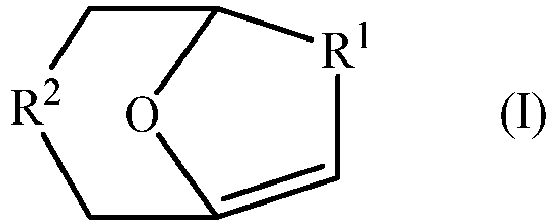
in a form of any one of its stereoisomers or a mixture thereof and wherein R1 represents a linear or branched C1-5 alkanediyl or alkenediyl group, optionally substituted by a phenyl group and R2 represents a linear or branched C1-10 alkanediyl or alkenediyl group, optionally substituted by a phenyl group;
comprising the reaction of a compound of the formula (II)
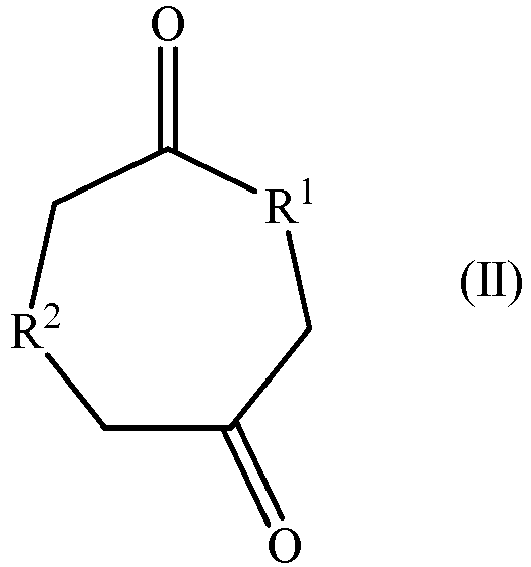
in a form of any one of its stereoisomers and wherein R1 and R2 have the same meaning as defined in formula (I);
with a ruthenium catalyst and in the presence of a base and a hydrogen source.
in a form of any one of its stereoisomers or a mixture thereof and wherein R1 represents a linear or branched C1-5 alkanediyl or alkenediyl group, optionally substituted by a phenyl group and R2 represents a linear or branched C1-10 alkanediyl or alkenediyl group, optionally substituted by a phenyl group;
comprising the reaction of a compound of the formula (II)
in a form of any one of its stereoisomers and wherein R1 and R2 have the same meaning as defined in formula (I);
with a ruthenium catalyst and in the presence of a base and a hydrogen source.
2. The process according to claim 1, characterized in that R1 represents a linear or branched C1-4 alkanediyl group.
3. The process according to claim 1 or 2, characterized in that R1 represents a linear or branched C2-3 alkanediyl group.
4. The process according to according to any one of claims 1 to 3, characterized in that R1 represents a 1,2-propanediyl group or 1,2-ethanediyl group.
5. The process according to any one of claims 1 to 4, characterized in that R2 represents a linear or branched C4-9 alkanediyl group.
6. The process according to any one of claims 1 to 5, characterized in that R2 represents a linear or branched C6-9 alkanediyl group.
7. The process according to any one of claims 1 to 6, characterized in that R2 represents a 1,8-octanediyl group.
8. The process according to any one of claims 1 to 7, characterized in that compound of formula (I) may be selected from the group consisting of 12-oxabicyclo[6.3.1]dodec-8-ene,
10-methyl-12-oxabicyclo[6.3.1]dodec-8-ene, 13-oxabicyclo[7.3.1]tridec-9-ene, 11-methyl-13-oxabicyclo[7.3.1]tridec-9-ene,
14-oxabicyclo[8.3.1]tetradec-10-ene, 12-methyl-14-oxabicyclo[8.3.1]tetradec-10-ene,
15-oxabicyclo[9.3.1]pentadec-11-ene, 13-methyl-15-oxabicyclo[9.3.1]pentadec-11-ene,
16-oxabicyclo[10.3.1]hexadec-12-ene, 14-methyl-16-oxabicyclo[10.3.1]hexadec-12-ene,
17-oxabicyclo[11.3.1]heptadec-13-ene and 15-methyl-17-oxabicyclo[11.3.1]heptadec-13-ene.
9. The process according to any one of claims 1 to 8, characterized in that compound of formula (II) may be selected from the group consisting of cycloundecane-1,5-dione,
3-methylcycloundecane-1,5-dione, cyclododecane-1,5-dione, 3-methylcyclododecane-1,5-dione, cyclotridecane-1,5-dione, 3-methylcyclotridecane-1,5-dione, cyclotetradecane-1,5-dione, 3-methylcyclotetradecane-1,5-dione, cyclopentadecane-1,5-dione, 3-methylcyclopentadecane-1,5-dione, cyclohexadecane-1,5-dione and 3-methylcyclohexadecane-1,5-dione.
10. The process according to any one of claims 1 to 9, characterized in that the ruthenium catalyst is of formula
[Ru(X)2Pn] (III)
wherein X represents an anionic ligand; and when n is an integer between 1 to 4, P represents a monophosphine monodendate ligand; or when n is an integer between 1 to 2, P represents a biphosphine bidentate ligand.
[Ru(X)2Pn] (III)
wherein X represents an anionic ligand; and when n is an integer between 1 to 4, P represents a monophosphine monodendate ligand; or when n is an integer between 1 to 2, P represents a biphosphine bidentate ligand.
11. The process according to any one of claims 1 to 10, characterized in that the ruthenium catalyst is selected from the group consisting of [Ru(H)(Cl)(PPh3)3], [Ru(H)2(PPh3)3], [Ru(OAc)2(PPh3)2], [Ru(OPiv)2(PPh3)2], [Ru(Cl)2(PBu3)3].and [Ru(Cl)2(PPh3)3].
12. The process according to any one of claims 1 to 11, characterized in that the base is selected from the group consisting of pyridine, trimethylamine, lutidine,
N,N-Diisopropylethylamine, 1,8-Diazabicyclo[5.4.0]undec-7-ene, alkali metal alkoxide,
carboxylate, carbonate or hydroxide and a mixture thereof.
13. The process according to any one of claims 1 to 12, characterized in that the hydrogen source is a hydrocarbon comprising at least one secondary alcohol functional
group and having a boiling point equal or above to 110°C.
14. The process according to any one of claims 1 to 13, characterized in that the hydrogen source is of formula
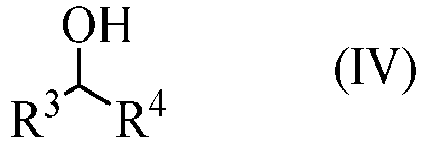
wherein R3 and R4, independently from each other, represent a C1-10 linear alkyl group optionally substituted by a hydroxy group or an aryl group, a C2-10 linear alkenyl group optionally substituted by a hydroxy group or an aryl group, a C3-10 branched or cyclic alkyl or alkenyl group optionally substituted by a hydroxy group or an aryl group, or a phenyl group optionally substituted by one to five C1-3 alkyl or alkoxy groups, hydroxy groups or halogen atoms; or R3 and R4, when taken together, represent a C2-10 linear or branched alkanediyl or alkenediyl optionally substituted by a hydroxy group or an aryl group.
wherein R3 and R4, independently from each other, represent a C1-10 linear alkyl group optionally substituted by a hydroxy group or an aryl group, a C2-10 linear alkenyl group optionally substituted by a hydroxy group or an aryl group, a C3-10 branched or cyclic alkyl or alkenyl group optionally substituted by a hydroxy group or an aryl group, or a phenyl group optionally substituted by one to five C1-3 alkyl or alkoxy groups, hydroxy groups or halogen atoms; or R3 and R4, when taken together, represent a C2-10 linear or branched alkanediyl or alkenediyl optionally substituted by a hydroxy group or an aryl group.
15. The process according to any one of claims 1 to 14, characterized in that the hydrogen source is 1-phenylethan-1-ol, 2-methyl-2,4-pentanediol, cyclohexanol,
4-methylpentan-2-ol, cyclopentanol or octan-2-ol.
1. Verfahren für die Herstellung einer Verbindung der Formel (I)
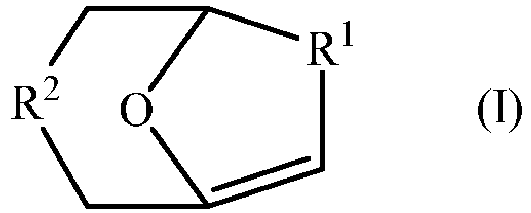
in einer Form eines beliebigen ihrer Stereoisomere oder einer Mischung davon und wobei R1 eine lineare oder verzweigte C1-5-Alkandiyl- oder -Alkendiylgruppe darstellt, die wahlweise durch eine Phenylgruppe substituiert ist, und R2 eine lineare oder verzweigte C1-10-Alkandiyl- oder -Alkendiylgruppe darstellt, die wahlweise durch eine Phenylgruppe substituiert ist;
umfassend die Reaktion einer Verbindung der Formel (II)
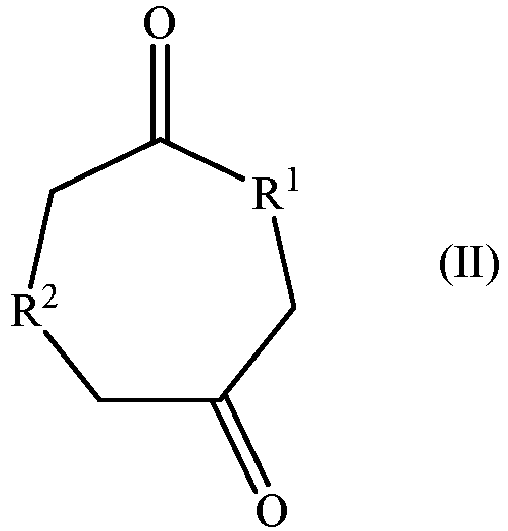
in einer Form eines beliebigen ihrer Stereoisomere und wobei R1 und R2 dieselbe Bedeutung, wie durch die Formel (I) definiert, aufweisen;
mit einem Rutheniumkatalysator und in Gegenwart einer Base und einer Wasserstoffquelle.
in einer Form eines beliebigen ihrer Stereoisomere oder einer Mischung davon und wobei R1 eine lineare oder verzweigte C1-5-Alkandiyl- oder -Alkendiylgruppe darstellt, die wahlweise durch eine Phenylgruppe substituiert ist, und R2 eine lineare oder verzweigte C1-10-Alkandiyl- oder -Alkendiylgruppe darstellt, die wahlweise durch eine Phenylgruppe substituiert ist;
umfassend die Reaktion einer Verbindung der Formel (II)
in einer Form eines beliebigen ihrer Stereoisomere und wobei R1 und R2 dieselbe Bedeutung, wie durch die Formel (I) definiert, aufweisen;
mit einem Rutheniumkatalysator und in Gegenwart einer Base und einer Wasserstoffquelle.
2. Verfahren nach Anspruch 1, dadurch gekennzeichnet, dass R1 eine lineare oder verzweigte C1-4-Alkandiylgruppe darstellt.
3. Verfahren nach Anspruch 1 oder 2, dadurch gekennzeichnet, dass R1 eine lineare oder verzweigte C2-3-Alkandiylgruppe darstellt.
4. Verfahren nach einem der Ansprüche 1 bis 3, dadurch gekennzeichnet, dass R1 eine 1,2-Propandiylgruppe oder 1,2-Ethandiylgruppe darstellt.
5. Verfahren nach einem der Ansprüche 1 bis 4, dadurch gekennzeichnet, dass R2 eine lineare oder verzweigte C4-9-Alkandiylgruppe darstellt.
6. Verfahren nach einem der Ansprüche 1 bis 5, dadurch gekennzeichnet, dass R2 eine lineare oder verzweigte C6-9-Alkandiylgruppe darstellt.
7. Verfahren nach einem der Ansprüche 1 bis 6, dadurch gekennzeichnet, dass R2 eine 1,8-Octandiylgruppe darstellt.
8. Verfahren nach einem der Ansprüche 1 bis 7, dadurch gekennzeichnet, dass die Verbindung der Formel (I) aus der Gruppe ausgewählt werden kann bestehend aus
12-Oxabicyclo[6.3.1]dodec-8-en, 10-Methyl-12-oxabicyclo[6.3.1]dodec-8-en, 13-Oxabicyclo[7.3.1]tridec-9-en,
11-Methyl-13-oxabicyclo[7.3.1]tridec-9-en, 14-Oxabicyclo[8.3.1]tetradec-10-en, 12-Methyl-14-oxabicyclo[8.3.1]tetradec-10-en,
15-Oxabicyclo[9.3.1]pentadec-11-en, 13-Methyl-15-oxabicyclo[9.3.1]pentadec-11-en,
16-Oxabicyclo[10.3.1]hexadec-12-en, 14-Methyl-16-oxabicyclo[10.3.1]hexadec-12-en,
17-Oxabicyclo[11.3.1]heptadec-13-en und 15-Methyl-17-oxabicyclo[11.3.1]heptadec-13-en.
9. Verfahren nach einem der Ansprüche 1 bis 8, dadurch gekennzeichnet, dass die Verbindung der Formel (II) aus der Gruppe ausgewählt werden kann bestehend aus
Cyclocloundecan-1,5-dion, 3-Methylcycloundecan-1,5-dion, Cyclododecan-1,5-dion, 3-Methylcyclododecan-1,5-dion,
Cyclotridecan-1,5-dion, 3-Methylcyclotridecan-1,5-dion, Cyclotetradecan-1,5-dion,
3-Methylcyclotetradecan-1,5-dion, Cyclopentadecan-1,5-dion, 3-Methylcyclopentadecan-1,5-dion,
Cyclohexadecan-1,5-dion und 3-Methylcyclohexadecan-1,5-dion.
10. Verfahren nach einem der Ansprüche 1 bis 9, dadurch gekennzeichnet, dass der Rutheniumkatalysator die Formel
[Ru(X)2Pn] (III)
aufweist, wobei X einen anionischen Liganden darstellt; und wenn n eine ganze Zahl zwischen 1 und 4 ist, P einen einzähnigen Monophosphinliganden darstellt; oder wenn n eine ganze Zahl zwischen 1 und 2 ist, P einen zweizähnigen Biphosphinliganden darstellt.
[Ru(X)2Pn] (III)
aufweist, wobei X einen anionischen Liganden darstellt; und wenn n eine ganze Zahl zwischen 1 und 4 ist, P einen einzähnigen Monophosphinliganden darstellt; oder wenn n eine ganze Zahl zwischen 1 und 2 ist, P einen zweizähnigen Biphosphinliganden darstellt.
11. Verfahren nach einem der Ansprüche 1 bis 10, dadurch gekennzeichnet, dass der Rutheniumkatalysator aus der Gruppe ausgewählt wird bestehend aus [Ru(H)(Cl)(PPh3)3], [Ru(H)2(PPh3)3], [Ru(OAc)2(PPh3)2], [Ru(OPiv)2(PPh3)2], [Ru(Cl)2(PBu3)3] und [Ru(Cl)2(PPh3)3].
12. Verfahren nach einem der Ansprüche 1 bis 11, dadurch gekennzeichnet, dass die Base aus der Gruppe ausgewählt wird bestehend aus Pyridin, Trimethylamin, Lutidin,
N,N-Diisopropylethylamin, 1,8-Diazabicyclo[5.4.0]undec-7-en, Alkalimetallalkoxid, - carboxylat,
-carbonat oder -hydroxid und einer Mischung davon.
13. Verfahren nach einem der Ansprüche 1 bis 12, dadurch gekennzeichnet, dass die Wasserstoffquelle ein Kohlenwasserstoff ist, der mindestens eine sekundäre alkoholfunktionelle
Gruppe umfasst und einen Siedepunkt gleich oder über 110 °C aufweist.
14. Verfahren nach einem der Ansprüche 1 bis 13, dadurch gekennzeichnet, dass die Wasserstoffquelle die Formel
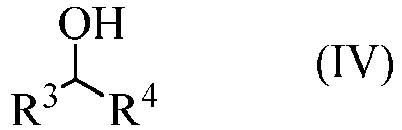
aufweist,
wobei R3 und R4, unabhängig voneinander, eine lineare C1-10-Alkylgruppe, die wahlweise durch eine Hydroxygruppe oder eine Arylgruppe substituiert ist, eine lineare C2-10-Alkenylgruppe, die wahlweise durch eine Hydroxygruppe oder eine Arylgruppe substituiert ist, eine verzweigte oder cyclische C3-10-Alkyl- oder -Alkenylgruppe, die wahlweise durch eine Hydroxygruppe oder eine Arylgruppe substituiert ist, oder eine Phenylgruppe, die wahlweise durch eine bis fünf C1-3-Alkyl- oder -Alkoxygruppen, Hydroxygruppen oder Halogenatome substituiert ist, darstellen; oder R3 und R4, wenn sie zusammengenommen werden, ein lineares oder verzweigtes C2-10-Alkandiyl oder - Alkendiyl darstellen, das wahlweise durch eine Hydroxygruppe oder eine Arylgruppe substituiert ist.
aufweist,
wobei R3 und R4, unabhängig voneinander, eine lineare C1-10-Alkylgruppe, die wahlweise durch eine Hydroxygruppe oder eine Arylgruppe substituiert ist, eine lineare C2-10-Alkenylgruppe, die wahlweise durch eine Hydroxygruppe oder eine Arylgruppe substituiert ist, eine verzweigte oder cyclische C3-10-Alkyl- oder -Alkenylgruppe, die wahlweise durch eine Hydroxygruppe oder eine Arylgruppe substituiert ist, oder eine Phenylgruppe, die wahlweise durch eine bis fünf C1-3-Alkyl- oder -Alkoxygruppen, Hydroxygruppen oder Halogenatome substituiert ist, darstellen; oder R3 und R4, wenn sie zusammengenommen werden, ein lineares oder verzweigtes C2-10-Alkandiyl oder - Alkendiyl darstellen, das wahlweise durch eine Hydroxygruppe oder eine Arylgruppe substituiert ist.
15. Verfahren nach einem der Ansprüche 1 bis 14, dadurch gekennzeichnet, dass die Wasserstoffgruppe 1-Phenylethan-1-ol, 2-Methyl-2,4-pentandiol, Cyclohexanol,
4-Methylpentan-2-ol, Cyclopentanol oder Octan-2-ol ist.
1. Procédé pour la préparation d'un composé de formule (I)
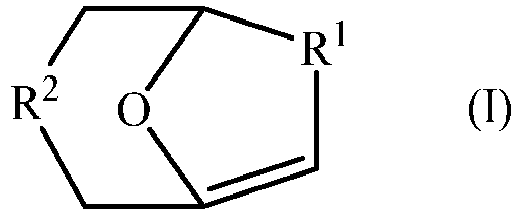
sous la forme de l'un quelconque de ses stéréoisomères ou d'un mélange de ceux-ci et dans lequel R1 représente un groupe alcanediyle ou alcènediyle en C1-5 linéaire ou ramifié, optionnellement substitué par un groupe phényle et R2 représente un groupe alcanediyle ou alcènediyle en C1-10 linéaire ou ramifié, optionnellement substitué par un groupe phényle;
comprenant la réaction d'un composé de formule (II)
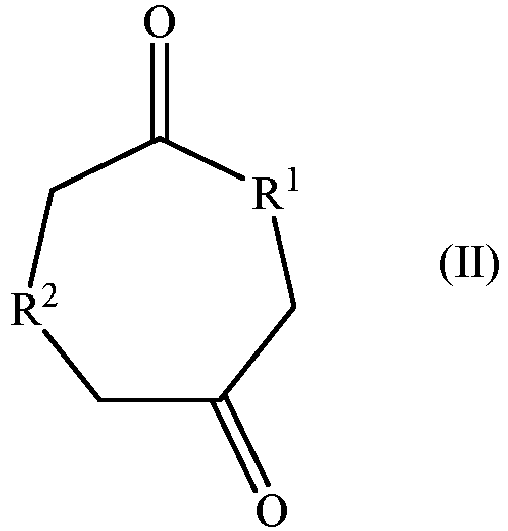
sous la forme de l'un quelconque de ses stéréoisomères et dans lequel R1 et R2 ont la même signification que ce qui est défini dans la formule (I);
avec un catalyseur au ruthénium et en présence d'une base et d'une source d'hydrogène.
sous la forme de l'un quelconque de ses stéréoisomères ou d'un mélange de ceux-ci et dans lequel R1 représente un groupe alcanediyle ou alcènediyle en C1-5 linéaire ou ramifié, optionnellement substitué par un groupe phényle et R2 représente un groupe alcanediyle ou alcènediyle en C1-10 linéaire ou ramifié, optionnellement substitué par un groupe phényle;
comprenant la réaction d'un composé de formule (II)
sous la forme de l'un quelconque de ses stéréoisomères et dans lequel R1 et R2 ont la même signification que ce qui est défini dans la formule (I);
avec un catalyseur au ruthénium et en présence d'une base et d'une source d'hydrogène.
2. Procédé selon la revendication 1, caractérisé en ce que R1 représente un groupe alcanediyle en C1-4 linéaire ou ramifié.
3. Procédé selon la revendication 1 ou 2, caractérisé en ce que R1 représente un groupe alcanediyle en C2-3 linéaire ou ramifié.
4. Procédé selon l'une quelconque des revendications 1 à 3, caractérisé en ce que R1 représente un groupe 1,2-propanediyle ou un groupe 1,2-éthanediyle.
5. Procédé selon l'une quelconque des revendications 1 à 4, caractérisé en ce que R2 représente un groupe alcanediyle en C4-9 linéaire ou ramifié.
6. Procédé selon l'une quelconque des revendications 1 à 5, caractérisé en ce que R2 représente un groupe alcanediyle en C6-9 linéaire ou ramifié.
7. Procédé selon l'une quelconque des revendications 1 à 6, caractérisé en ce que R2 représente un groupe 1,8-octanediyle.
8. Procédé selon l'une quelconque des revendications 1 à 7, caractérisé en ce que le composé de formule (I) peut être sélectionné dans le groupe constitué par le 12-oxabicyclo[6.3.1]dodéc-8-ène,
le 10-méthyl-12-oxabicyclo[6.3.1]dodéc-8-ène, le 13-oxabicyclo[7.3.1]tridéc-9-ène,
le 11-méthyl-13-oxabicyclo[7.3.1]tridéc-9-ène, le 14-oxabicyclo[8.3.1]tétradéc-10-ène,
le 12-méthyl-14-oxabicyclo[8.3.1]tétradéc-10-ène, le 15-oxabicyclo[9.3.1]pentadéc-11-ène,
le 13-méthyl-15-oxabicyclo[9.3.1]pentadéc-11-ène, le 16-oxabicyclo[10.3.1]hexadéc-12-ène,
le 14-méthyl-16-oxabicyclo[10.3.1]hexadéc-12-ène, le 17-oxabicyclo[11.3.1]heptadéc-13-ène
et le 15-méthyl-17-oxabicyclo[11.3.1]heptadéc-13-ène.
9. Procédé selon l'une quelconque des revendications 1 à 8, caractérisé en ce que le composé de formule (II) peut être sélectionné dans le groupe constitué par la
cycloundécane-1,5-dione, la 3-méthylcycloundécane-1,5-dione, la cyclododécane-1,5-dione,
la 3-méthylcyclododécane-1,5-dione, la cyclotridécane-1,5-dione, la 3-méthylcyclotridécane-1,5-dione,
la cyclotétradécane-1,5-dione, la 3-méthylcyclotétradécane-1,5-dione, la cyclopentadécane-1,5-dione,
la 3-méthylcyclopentadécane-1,5-dione, la cyclohexadécane-1,5-dione et la 3-méthylcyclohexadécane-1,5-dione.
10. Procédé selon l'une quelconque des revendications 1 à 9, caractérisé en ce que le catalyseur au ruthénium a pour formule
[Ru(X)2Pn] (III)
où X représente un ligand anionique; et lorsque n est un entier entre 1 et 4, P représente un ligand monophosphine monodenté; ou lorsque n est un entier entre 1 et 2, P représente un ligand biphosphine bidenté.
[Ru(X)2Pn] (III)
où X représente un ligand anionique; et lorsque n est un entier entre 1 et 4, P représente un ligand monophosphine monodenté; ou lorsque n est un entier entre 1 et 2, P représente un ligand biphosphine bidenté.
11. Procédé selon l'une quelconque des revendications 1 à 10, caractérisé en ce que le catalyseur au ruthénium est sélectionné dans le groupe constitué par [Ru(H)(Cl)(PPh3)3], [Ru(H)2(PPh3)3], [Ru(OAc)2(PPh3)2], [Ru(OPiv)2(PPh3)2], [Ru(Cl)2(PBu3)3], et [Ru(Cl)2(PPh3)3].
12. Procédé selon l'une quelconque des revendications 1 à 11, caractérisé en ce que la base est sélectionnée dans le groupe constitué par la pyridine, la triméthylamine,
la lutidine, la N,N-diisopropyléthylamine, le 1,8-diazabicyclo[5.4.0]undéc-7-ène, un alcoxyde de métal
alcalin, carboxylate, carbonate ou hydroxyde de métal alcalin, et un mélange de ceux-ci.
13. Procédé selon l'une quelconque des revendications 1 à 12, caractérisé en ce que la source d'hydrogène est un hydrocarbure comprenant au moins un groupe fonctionnel
alcool secondaire et présentant un point d'ébullition supérieur ou égal à 110°C.
14. Procédé selon l'une quelconque des revendications 1 à 13, caractérisé en ce que la source d'hydrogène a pour formule
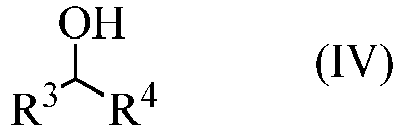
où R3 et R4, indépendamment l'un de l'autre, représentent un groupe alkyle linéaire en C1-10 optionnellement substitué par un groupe hydroxy ou un groupe aryle, un groupe alcényle linéaire en C2-10 optionnellement substitué par un groupe hydroxy ou un groupe aryle, un groupe alkyle ou alcényle ramifié ou cyclique en C3-10 optionnellement substitué par un groupe hydroxy ou un groupe aryle, ou un groupe phényle optionnellement substitué par un à cinq groupes alkyle ou alcoxy en C1-3, groupes hydroxy ou atomes d'halogène; ou R3 et R4, lorsqu'ils sont pris ensemble, représentent un alcanediyle ou alcènediyle linéaire ou ramifié en C2-10 optionnellement substitué par un groupe hydroxy ou un groupe aryle.
où R3 et R4, indépendamment l'un de l'autre, représentent un groupe alkyle linéaire en C1-10 optionnellement substitué par un groupe hydroxy ou un groupe aryle, un groupe alcényle linéaire en C2-10 optionnellement substitué par un groupe hydroxy ou un groupe aryle, un groupe alkyle ou alcényle ramifié ou cyclique en C3-10 optionnellement substitué par un groupe hydroxy ou un groupe aryle, ou un groupe phényle optionnellement substitué par un à cinq groupes alkyle ou alcoxy en C1-3, groupes hydroxy ou atomes d'halogène; ou R3 et R4, lorsqu'ils sont pris ensemble, représentent un alcanediyle ou alcènediyle linéaire ou ramifié en C2-10 optionnellement substitué par un groupe hydroxy ou un groupe aryle.
15. Procédé selon l'une quelconque des revendications 1 à 14, caractérisé en ce que la source d'hydrogène est le 1-phényléthan-1-ol, le 2-méthyl-2,4-pentanediol, le
cyclohexanol, le 4-méthylpentan-2-ol, le cyclopentanol ou l'octan-2-ol.
REFERENCES CITED IN THE DESCRIPTION
This list of references cited by the applicant is for the reader's convenience only. It does not form part of the European patent document. Even though great care has been taken in compiling the references, errors or omissions cannot be excluded and the EPO disclaims all liability in this regard.
Patent documents cited in the description
Non-patent literature cited in the description
- Helvetica Chimica Acta19670000vol. 50, 705- [0019]