(57) The present invention relates to the field of immunotherapy, in particular adoptive
T cell therapy or T cell receptor (TCR) gene therapy of cancer. The invention provides
a nucleic acid encoding at least one T cell receptor alpha chain construct and/or
TCR beta chain construct of a TCR construct capable of specifically binding to an
epitope from NY-ESO-1 (also designated CTAG-1) in complex with a human MHC, wherein
the TCR alpha chain construct and/or the TCR beta chain construct comprises a complementarity
determining region 3 (CDR3) having at least 90% sequence identity to an amino acid
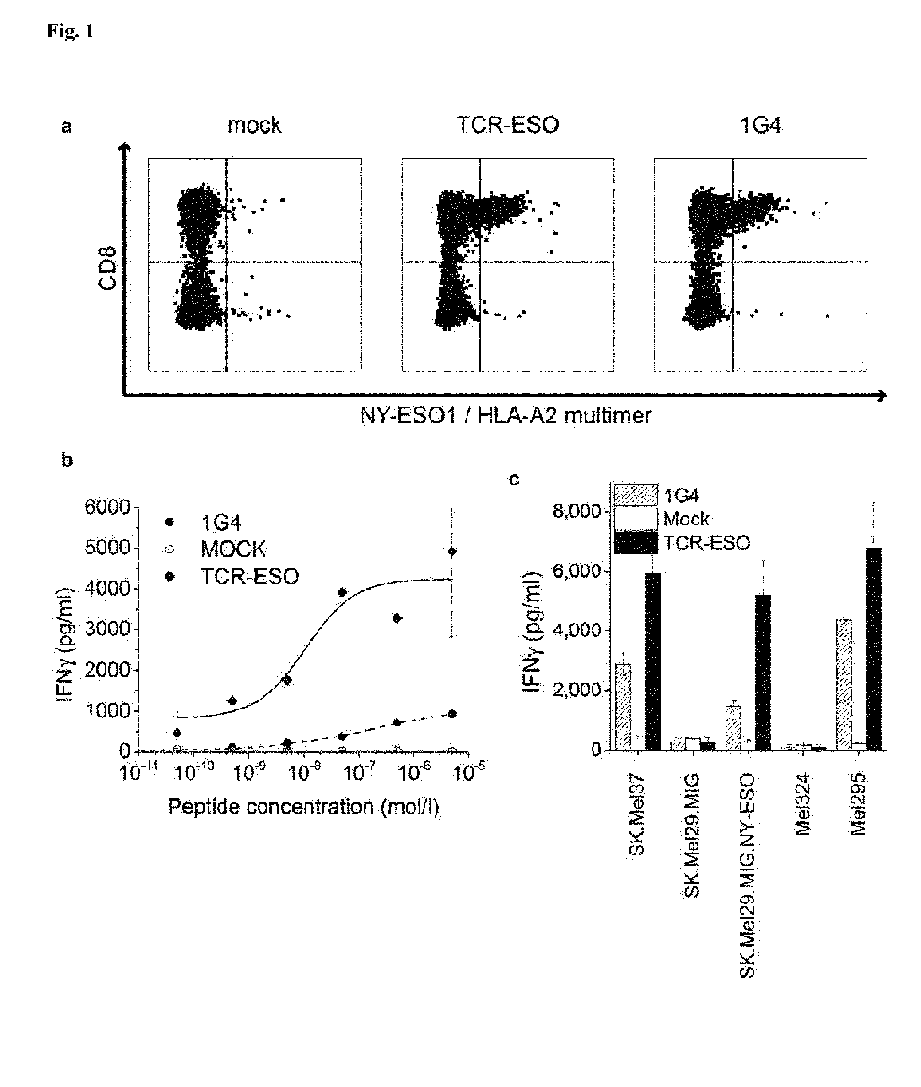
selected from SEQ ID NO: 1-20. The invention provides TCR constructs restricted to
an epitope from NY-ESO-1 presented on MHC I, and, for the first time, TCR constructs
restricted to an epitope from NY-ESO-1 presented on MHC II molecules, and thus enables
a combined adoptive T cell therapy with both recombinant CD4+ and recombinant CD8+
T cells. The invention also provides proteins and host cells corresponding to said
TCR constructs, as well as the medical use of such constructs, in particular, in the
diagnosis, prevention and/or treatment of a proliferative or viral disease, wherein,
preferably, both TCR constructs restricted to MHC I and MHC II molecules are provided
in a kit. The invention also relates to a mouse transgenic for the human TCR loci
and human HLA-DR4, ABabDR4 mouse.
|
|
