|
(11) | EP 3 709 010 B1 |

| (12) | EUROPEAN PATENT SPECIFICATION |
|
|
| (54) |
METAL COMPLEX AS SENSOR COMPOUND FOR DETECTING GAS ANALYTE METALLKOMPLEX ALS SENSORVERBINDUNG ZUR DETEKTION VON GASANALYTEN COMPLEXE MÉTALLIQUE EN TANT QUE COMPOSÉ DE CAPTEUR POUR LA DÉTECTION D'ANALYTES GAZEUX |
|
|
|||||||||||||||||||||||||||||||
| Note: Within nine months from the publication of the mention of the grant of the European patent, any person may give notice to the European Patent Office of opposition to the European patent granted. Notice of opposition shall be filed in a written reasoned statement. It shall not be deemed to have been filed until the opposition fee has been paid. (Art. 99(1) European Patent Convention). |
BACKGROUND
[0002] Volatile compounds with a double bond form an important group of compounds for detection. In particular, volatile alkenes, such as ethylene, are analytes of considerable importance. In particular, the detection of ethylene is important to industries related to produce and agriculture. Due to its small size and limited chemical functionality, however, ethylene is a challenging chemical analyte to detect. More efficient and sensitive methods of detection than those currently available are desired.
Patel et al., Inorganic Chemistry Communications, Vol 9, 2006, p748-750 discloses the synthesis of trinuclear transition metal tris(mercaptoimidazolyl)borate complexes.
Maffett et al., Polyhedron, 26, 2007, p4758-4764 discloses poly(mercaptoimidazolyl)borate derivatives.
White et al., Journal of Chemical Crystallography, Vol. 33, Nos 5/6, 2003, p437-445 discloses 2-mercapto-1-tert-butylimidazole and its Group 12 metal derivatives.
Ping et al., Advanced Functional Materials, 2017, 27, p1605817 discloses 2D transition metal dichalcogenide nanosheets.
BRIEF DESCRIPTION
[0003] Disclosed is a sensor compound comprising a metal atom and a mercaptoimidazolyl multidentate ligand, wherein the mercaptoimidazolyl multidentate ligand comprises a pyrazolyl group or an indolyl group, and wherein the metal atom is Cu(I), Ag(I) or Au(I).
[0004] In addition to one or more of the features described above, or as an alternative to any of the foregoing embodiments, the mercaptoimidazolyl multidentate ligand comprises more than one mercaptoimidazolyl group.
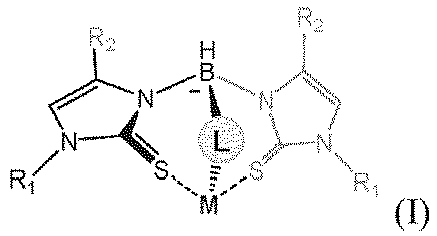
[0005] In addition to one or more of the features described above the compound has formula (I)
where each instance of R1 and R2 can be hydrogen, or a group having one or more carbons, M is Au(I), Ag(I) or Cu(I), and L is a pyrazolyl group or an indolyl group.
[0006] Also disclosed is a sensor composition comprising a sensor compound and a metal dichalcogenide, wherein the sensor compound comprises a metal atom and a mercaptoimidazolyl multidentate ligand, wherein the mercaptoimidazolyl ligand comprises a pyrazolyl group or an indolyl group, and wherein the metal atom is Cu(I), Ag(I) or Au(I).
[0007] In addition to one or more of the features described above, or as an alternative to any of the foregoing embodiments, the mercaptoimidazolyl ligand comprises more than one mercaptoimidazolyl group.
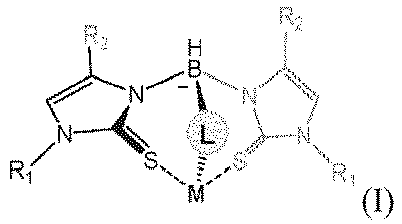
[0008] In addition to one or more of the features described above, or as an alternative to any of the foregoing embodiments, the sensor compound has formula (I)
where each instance of R1 and R2 can be hydrogen, or a group having one or more carbons, M is Au, Ag or Cu, and L is a pyrazolyl group or an indolyl.
[0009] In addition to one or more of the features described above, or as an alternative to any of the foregoing embodiments, the metal dichalcogenide comprises MoS2, WS2, MoSe2, WSe2, MoTe2, WTe2, and combinations thereof.
DETAILED DESCRIPTION
[0010] A detailed description of one or more embodiments of the disclosed apparatus and method are presented herein by way of exemplification and not limitation.
[0011] Volatile compounds with a double or triple bond is a group of important compounds for detecting and monitoring. The term volatile, as used herein, refers to compounds that are in the gas phase at standard temperature and pressure. Exemplary compounds include NO2, CO2, CO, and alkenes such as C2H4 (ethylene). As the hormone responsible for initiating the ripening of fruit as well as other processes in plant development, ethylene is an analyte of considerable importance to industries related to produce and agriculture. Due to its small size and limited chemical functionality, ethylene and other volatile alkenes are challenging chemicals to detect. Disclosed herein is a sensor compound and a sensor composition capable of detecting volatile compounds with a double or triple bond such as ethylene and other volatile alkenes. These compounds can be detected at levels down to 100 parts per billion (ppb).
[0012] The sensor compound comprises a metal atom and a multidentate mercaptoimidazolyl ligand, which combine to form a multidentate metal-ligand coordination complex. The mercaptoimidazolyl ligand comprises at least one mercaptoimidazolyl groups which coordinates to the metal atom through the sulfur atoms. In addition to the mercaptoimidazolyl group(s) the ligand further comprises a pyrazolyl group, an indolyl group, or a combination thereof, which can be referred to as a heteroleptic ligand. The sensor compound may have formula (I)
where each instance of R1 and R2 can be hydrogen or a group containing one more carbon atoms. In some embodiments each instance of R1 and R2 can be hydrogen or an alkyl group having 1 to 5 carbons. L in formula (I) can be a pyrazolyl group or an indolyl group. VOC in formula I is present to show a postulated interaction with the volatile compound having a π bond. Without being bound by theory it is believed that the π bond of the volatile compound coordinates with an empty coordination site on the metal-ligand complex. The coordination alters the electronic configuration of the complex and can impact the electrical properties of the metal-ligand complex.
[0014] The sensor compound (or sensor compounds) may be combined with a metal dichalcogenides to form a sensor composition. Metal dichalcogenides include transition metal dichalcogenides which are compounds formed from a 6B Group metal and a chalcogenide (S, Se, and Te). Exemplary metal dichalcogenides include MoS2, WS2, MoSe2, WSe2, MoTe2, WTe2, and combinations thereof. The metal dichalcogenide is in the form of nanosized particles. "Nanosized" as it applies to the metal dichalcogenides refers to the fact that the particles have at least one dimension that is less than or equal to 100 nanometers. The metal dichalcogenides are typically available in a flake form with a thickness of 100 nanometers or less although other physical forms are not excluded such as few-layer or single-layer materials, with the caveat that the physical form has at least one linear dimension that is less than or equal to 100 nanometers.
[0015] The sensor compound and metal dichalcogenide interact and when the volatile compound is bound to the sensor compound the electrical properties of the sensor composition change - either by increasing the conductivity or the resistivity. The change in electrical property is consistent and predictable, allowing reliable detection of the target volatile compound.
[0016] The terminology used herein is for the purpose of describing particular embodiments only and is not intended to be limiting of the present disclosure. As used herein, the singular forms "a", "an" and "the" are intended to include the plural forms as well, unless the context clearly indicates otherwise. It will be further understood that the terms "comprises" and/or "comprising," when used in this specification, specify the presence of stated features, integers, steps, operations, elements, and/or components, but do not preclude the presence or addition of one or more other features, integers, steps, operations, element components, and/or groups thereof.
[0017] While the present disclosure has been described with reference to an exemplary embodiment or embodiments, it will be understood by those skilled in the art that various changes may be made and equivalents may be substituted for elements thereof without departing from the scope of the present disclosure. In addition, many modifications may be made to adapt a particular situation or material to the teachings of the present disclosure without departing from the essential scope thereof. Therefore, it is intended that the present disclosure not be limited to the particular embodiment disclosed as the best mode contemplated for carrying out this present disclosure, but that the present disclosure will include all embodiments falling within the scope of the claims.
1. A sensor compound comprising a metal atom and a mercaptoimidazolyl multidentate ligand,
wherein the mercaptoimidazolyl multidentate ligand comprises a pyrazolyl group or
an indolyl group, and wherein the metal atom is Cu(I), Ag(I) or Au(I).
2. The sensor compound of claim 1, wherein the compound has formula (I)
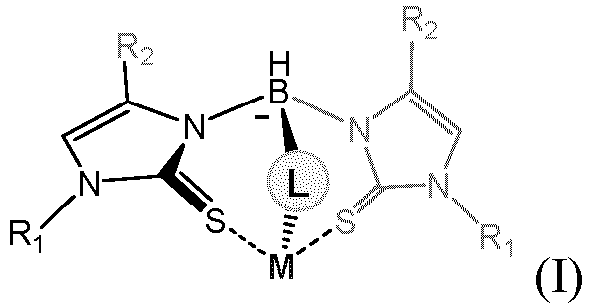
where each instance of R1 and R2 can be hydrogen, or a group having one or more carbons, M is Au(I), Ag(I) or Cu(I), and L is a pyrazolyl group or an indolyl group.
where each instance of R1 and R2 can be hydrogen, or a group having one or more carbons, M is Au(I), Ag(I) or Cu(I), and L is a pyrazolyl group or an indolyl group.
3. A sensor composition comprising a sensor compound and a metal dichalcogenide wherein
the sensor compound comprises a metal atom and a mercaptoimidazolyl multidentate ligand,
wherein the mercaptoimidazolyl ligand comprises a pyrazolyl group or an indolyl group,
and wherein the metal atom is Cu(I), Ag(I) or Au(I).
4. The sensor composition of claim 3, wherein the sensor compound has formula (I)
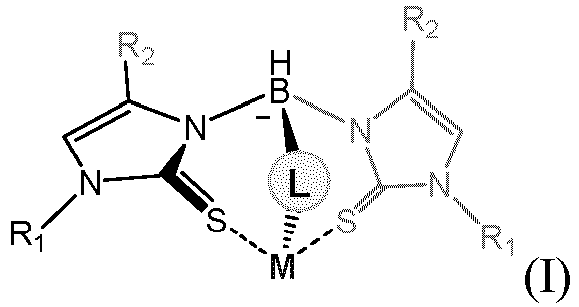
where each instance of R1 and R2 can be hydrogen, or a group having one or more carbons, M is Au, Ag or Cu, and L is a pyrazolyl group or an indolyl group.
where each instance of R1 and R2 can be hydrogen, or a group having one or more carbons, M is Au, Ag or Cu, and L is a pyrazolyl group or an indolyl group.
5. The sensor composition of any one of claims 3-4, wherein the metal dichalcogenide
comprises MoS2, WS2, MoSe2, WSe2, MoTe2, WTe2, and combinations thereof.
1. Sensorverbindung, umfassend ein Metallatom und einen mehrzähnigen Mercaptoimidazolyl-Liganden,
wobei der mehrzähnige Mercaptoimidazolyl-Ligand eine Pyrazolyl-Gruppe oder eine Indolyl-Gruppe
umfasst und wobei das Metallatom Cu(I), Ag(I) oder Au(I) ist.
2. Sensorverbindung nach Anspruch 1, wobei die Verbindung die Formel (I) aufweist
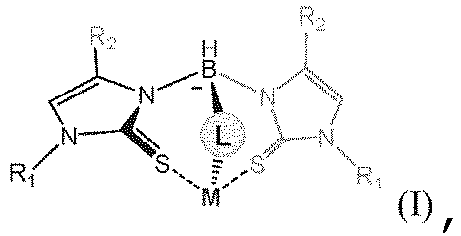
wobei jedes R1 und R2 Wasserstoff oder eine Gruppe sein kann, die einen oder mehrere Kohlenstoffe aufweist, M Au(I), Ag(I) oder Cu(I) ist und L eine Pyrazolyl-Gruppe oder eine Indolyl-Gruppe ist.
wobei jedes R1 und R2 Wasserstoff oder eine Gruppe sein kann, die einen oder mehrere Kohlenstoffe aufweist, M Au(I), Ag(I) oder Cu(I) ist und L eine Pyrazolyl-Gruppe oder eine Indolyl-Gruppe ist.
3. Sensorzusammensetzung, umfassend eine Sensorverbindung und ein Metalldichalkogenid,
wobei die Sensorverbindung ein Metallatom und einen mehrzähnigen Mercaptoimidazolyl-Liganden
umfasst, wobei der Mercaptoimidazolyl-Ligand eine Pyrazolyl-Gruppe oder eine Indolyl-Gruppe
umfasst und wobei das Metallatom Cu(I), Ag(I) oder Au(I) ist.
4. Sensorzusammensetzung nach Anspruch 3, wobei die Sensorverbindung die Formel (I) aufweist
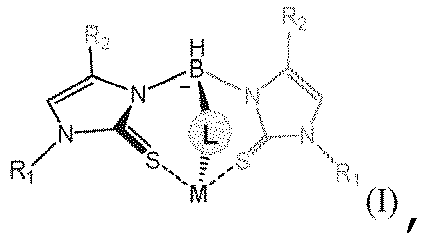
wobei jedes R1 und R2 Wasserstoff oder eine Gruppe sein kann, die einen oder mehrere Kohlenstoffe aufweist, M Au, Ag oder Cu ist und L eine Pyrazolyl-Gruppe oder eine Indolyl-Gruppe ist.
wobei jedes R1 und R2 Wasserstoff oder eine Gruppe sein kann, die einen oder mehrere Kohlenstoffe aufweist, M Au, Ag oder Cu ist und L eine Pyrazolyl-Gruppe oder eine Indolyl-Gruppe ist.
5. Sensorzusammensetzung nach einem der Ansprüche 3-4, wobei das Metalldichalkogenid
MoS2, WS2, MoSe2, WSe2, MoTe2, WTe2 und Kombinationen davon umfasst.
1. Composé de capteur comprenant un atome métallique et un ligand polydenté de mercaptoimidazolyle,
dans lequel le ligand polydenté de mercaptoimidazolyle comprend un groupe pyrazolyle
ou un groupe indolyle, et dans lequel l'atome métallique est Cu(I), Ag(I) ou Au(I).
2. Composé de capteur selon la revendication 1, dans lequel le composé a la formule (I)
où chaque instance de R1 et R2 peut être un hydrogène ou un groupe ayant un ou plusieurs atomes de carbone, M est Au(I), Ag(I) ou Cu(I), et L est un groupe pyrazolyle ou un groupe indolyle.
où chaque instance de R1 et R2 peut être un hydrogène ou un groupe ayant un ou plusieurs atomes de carbone, M est Au(I), Ag(I) ou Cu(I), et L est un groupe pyrazolyle ou un groupe indolyle.
3. Composition de capteur comprenant un composé de capteur et un dichalcogénure métallique,
dans laquelle le composé de capteur comprend un atome métallique et un ligand polydenté
de mercaptoimidazolyle, dans laquelle le ligand de mercaptoimidazolyle comprend un
groupe pyrazolyle ou un groupe indolyle, et dans laquelle l'atome métallique est Cu(I),
Ag(I) ou Au(I).
4. Composition de capteur selon la revendication 3, dans laquelle le composé de capteur
a la formule (I)
où chaque instance de R1 et R2 peut être un hydrogène ou un groupe ayant un ou plusieurs atomes de carbone, M est Au, Ag ou Cu, et L est un groupe pyrazolyle ou un groupe indolyle.
où chaque instance de R1 et R2 peut être un hydrogène ou un groupe ayant un ou plusieurs atomes de carbone, M est Au, Ag ou Cu, et L est un groupe pyrazolyle ou un groupe indolyle.
5. Composition de capteur selon l'une quelconque des revendications 3 et 4, dans laquelle
le dichalcogénure métallique comprend MoS2, WS2, MoSe2, WSe2, MoTe2, WTe2 et des combinaisons de ceux-ci.
REFERENCES CITED IN THE DESCRIPTION
This list of references cited by the applicant is for the reader's convenience only. It does not form part of the European patent document. Even though great care has been taken in compiling the references, errors or omissions cannot be excluded and the EPO disclaims all liability in this regard.
Non-patent literature cited in the description
- PATEL et al.Inorganic Chemistry Communications, 2006, vol. 9, 748-750 [0002]
- MAFFETT et al.Polyhedron, 2007, vol. 26, 4758-4764 [0002]
- WHITE et al.Journal of Chemical Crystallography, 2003, vol. 33, 5/6437-445 [0002]
- PING et al.Advanced Functional Materials, 2017, vol. 27, 1605817- [0002]