|
(11) | EP 3 872 487 B1 |

| (12) | EUROPEAN PATENT SPECIFICATION |
|
|
| (54) |
VOLATILE ALKENE SENSING DEVICE AND METHOD OF USING VORRICHTUNG ZUR DETEKTION VON FLÜCHTIGEM ALKEN UND VERFAHREN ZUR VERWENDUNG DISPOSITIF DE DÉTECTION D'ALCÈNE VOLATIL ET PROCÉDÉ D'UTILISATION |
|
|
|||||||||||||||||||||||||||||||
| Note: Within nine months from the publication of the mention of the grant of the European patent, any person may give notice to the European Patent Office of opposition to the European patent granted. Notice of opposition shall be filed in a written reasoned statement. It shall not be deemed to have been filed until the opposition fee has been paid. (Art. 99(1) European Patent Convention). |
BACKGROUND
[0001] Volatile compounds with a double bond form an important group of compounds for detection. In particular, volatile alkenes, such as ethylene, are analytes of considerable importance. In particular, the detection of ethylene is important to industries related to produce and agriculture. Due to its small size and limited chemical functionality, however, ethylene is a challenging chemical analyte to detect.
[0002] JP H 11148907 describes an ethylene gas measuring apparatus for use in plant cultivation. The apparatus has a test chamber with a semiconductor gas sensor, at upstream side of which, drying chamber filled with desiccant is provided. US2013273665 A1 describes chemiresistor sensors for ethylene based on a basket-like compound comprising a tris-pyrazolyl-borate in combination with SWCNTs, single walled carbon nanotubes. The compounds selectively form a complex with ethylene from a surrounding gas atmosphere, which is accompanied by a rise in their electrical conductivity.
[0003] More efficient and sensitive methods of detection than those currently available are desired.
BRIEF DESCRIPTION
[0004] The present invention relates to a volatile alkene sensing device including a gas pathway having a desiccant area located upstream of a sensor, wherein the sensor is disposed in a housing. The sensor includes a conductive region in electrical communication with two electrodes. The conductive region includes nanosized particles of a metal dichalcogenide, a mercaptoimidazolyl metal-ligand complex, and single-walled carbon nanotubes or metallic nanowires.
[0008] The volatile alkene sensing device further may include a suction device, pressure feeder or both.
[0009] The nanosized particles of a metal dichalcogenide may comprise MoS2, WS2, MoSe2, WSe2, MoTe2, WTe2, and combinations thereof.
[0010] In some embodiments the mercaptoimidazolyl metal-ligand complex comprises a homoleptic ligand with three mercaptoimidazolyl groups.
[0011] In some embodiments the mercaptoimidazolyl metal-ligand complex comprises Cu(I), Ag(I), or Au(I).
[0012] In a specific embodiment the mercaptoimidazolyl metal-ligand complex is a homoleptic complex of formula (II):
where each instance of R1 and R2 can be hydrogen, or a group having up to twenty carbons.
[0013] Furthermore the present invention relates to a method of sensing a volatile alkene including contacting a gaseous sample with a desiccant material to form a treated sample having less than 20% relative humidity, exposing a sensor to the treated sample, and measuring an electrical property of the sensor after exposure to the treated sample. The sensor includes a conductive region in electrical communication with two electrodes. The conductive region includes nanosized particles of a metal dichalcogenide, a mercaptoimidazolyl metal-ligand complex , and single-walled carbon nanotubes or metallic nanowires.
[0014] In some embodiments the desiccant material comprises CaSO4, Al2O3, soda lime, and combinations thereof.
[0017] In some embodiments the method further includes comparing an electrical property value obtained by measuring to a calibration curve to determine the quantity of a volatile compound having a double or triple bond present in the sample.
[0019] The nanosized particles of a metal dichalcogenide may comprise MoS2, WS2, MoSe2, WSe2, MoTe2, WTe2, and combinations thereof.
[0020] In some embodiments the mercaptoimidazolyl metal-ligand complex comprises three mercaptoimidazolyl groups.
[0021] In some embodiments the mercaptoimidazolyl metal-ligand complex comprises Cu(I), Ag(I), or Au(I).
[0022] In a specific embodiment the mercaptoimidazolyl metal-ligand complex is a complex of formula (II):
where each instance of R1 and R2 can be hydrogen, or a group having one or more carbons.
BRIEF DESCRIPTION OF THE DRAWINGS
[0023] The following descriptions should not be considered limiting in any way. With reference to the accompanying drawings, like elements are numbered alike:
FIG. 1 is a schematic view of a volatile alkene sensing device;
FIG. 2 is a graph of the electrode signal after exposure to air samples having differing water content; and
FIG. 3 is a graph of the electrode signal after exposure to air samples after treatment with different desiccants.
DETAILED DESCRIPTION
[0024] A detailed description of one or more embodiments of the disclosed apparatus and method are presented herein by way of exemplification and not limitation with reference to the Figure.
[0025] Volatile compounds with double or triple bonds are a group of important compounds for detecting and monitoring. The term volatile, as used herein, refers to compounds that are in the gas phase at standard temperature and pressure. Exemplary compounds include NO2, CO2, CO, and alkenes such as C2H4 (ethylene). As the hormone responsible for initiating the ripening of fruit as well as other processes in plant development, ethylene is an analyte of considerable importance to industries related to produce and agriculture. Due to its small size and limited chemical functionality, ethylene and other volatile alkenes are challenging chemicals to detect. Disclosed herein is a volatile alkene sensing device and a method that is capable of detecting volatile alkenes such as ethylene at levels down to 100 parts per billion (ppb).
[0026] As shown in FIG. 1 the volatile alkene sensing device 10 includes a desiccant area 30 disposed around a gas flow path 20 and located upstream of the sensor 40. The sensor 40 is located in a housing 50.
[0027] The desiccant area includes one or more desiccant materials (adsorbents) which are capable of adsorbing water but do not adsorb the volatile alkene in any detectable amount. Exemplary desiccant materials include CaSO4, Al2O3, soda lime (CaO/Ca(OH)2) and combinations thereof. The desiccant area may be in the form of a removable cartridge which can be replaced. It is also contemplated that the desiccant in the cartridge can be regenerated or replaced with new desiccant material. The amount of the desiccant can vary depending, at least in part, on aspects of the gaseous samples such as the amount of water present in the sample as well as the ability of the desiccant to remove the water.
[0028] The use of a desiccant removes interference from water when determining the presence or amount of the volatile alkene in the gaseous sample. As shown in FIG 2, the presence of water can interfere with detecting and measuring the volatile alkene. The presence of humidity in an amount greater than 20% relative humidity can interfere with the detection and measurement of a volatile alkene such as ethylene. FIG. 2 shows the resistance of a sensor as described herein when exposed to ambient air (20% relative humidity) over time 110, when exposed to an air sample having a relative humidity level of 40% over time 100, and when exposed to an air sample having an initial relative humidity level of 40% before treatment with a desiccant 120. The electrode exposed to the air sample treated with a desiccant shows a gradual decrease in resistivity of the sample, which indicates decreasing interference from humidity due to its removal from the gas stream prior to entering the housing.
[0029] The use of a desiccant can also be used to remove gaseous carbon dioxide, which may also affect sensor performance depending on the relative humidity. FIG. 3 shows the resistance of a sensor as described herein when exposed to ambient air (20% relative humidity, 0.04% carbon dioxide) over time 130, when exposed to ambient air and treated with soda lime over time 140, and when exposed to ambient air and treated with CaSO4 150. The electrodes exposed to the air treated with either desiccant (soda lime or CaSO4) were again successful in producing lower resistance over time.
[0030] The sensor includes a conductive region composed of nanosized particles of a metal dichalcogenide, a mercaptoimidazolyl metal-ligand complex, and single-walled carbon nanotubes or metallic nanowires.
[0031] Metal dichalcogenides include transition metal dichalcogenides which are compounds formed from a Group 6B metal and a chalcogenide (S, Se, and Te). Exemplary metal dichalcogenides include MoS2, WS2, MoSe2, WSe2, MoTe2, WTe2, and combinations thereof. The metal dichalcogenide is in the form of nanosized particles. "Nanosized" as it applies to the metal dichalcogenides refers to the fact that the material has at least one linear dimension of less than or equal to 100 nanometers. The metal dichalcogenides are typically available in a flake form with a thickness of 100 nanometers or less although other physical forms are not excluded such as fewlayer or single-layer materials, with the caveat that the physical form has at least one linear dimension that is less than or equal to 100 nanometers.
[0032] The mercaptoimidazolyl metal-ligand complex is a multidentate coordination complex comprising one or more mercaptoimidazolyl groups. The arms of the multidentate ligand (groups on the boron atom) can be the same (homoleptic) or different (heteroleptic). For example, one arm can comprise a mercaptoimidazolyl group and a second arm can comprise a pyrazolyl or indolyl group. It is also contemplated that a multidentate ligand may comprise more than one mercaptoimidazolyl group or a combination of mercaptoimidazolyl group(s) and pyrazolyl group(s) or indolyl groups or both. The mercaptoimidazolyl metal-ligand complex may have formula (I)
where each instance of R1 and R2 can be hydrogen or a group having one or more carbons. In some embodiments, each instance of R1 and R2 can be hydrogen or an alkyl group having 1 to 5 carbons. L in formula (I) can be a pyrazolyl group, a mercaptoimidazolyl group, or an indolyl. When L is a mercaptoimidazolyl group the multidentate metal-ligand complex can be described as homoleptic. When L is a group other than a mercaptoimidazolyl group the metal ligand complex can be described as a heteroleptic. VOC in formula I is present to show a postulated interaction with the volatile compound having a π bond. Without being bound by theory it is believed that the π bond of the volatile compound coordinates with an empty coordination site on the metal-ligand complex. The coordination alters the electronic configuration of the complex and can impact the electrical properties of the combination of the metal-ligand complex, nanosized particles of a metal dichalcogenide and metallic nanowires. In the case of a metal complex having formula II shown below, the resistivity of the combination of metal-ligand complex, nanosized particles of a metal dichalcogenide and metallic nanowires increases when the metal complex is bound to ethylene.
[0033] A more specific example of a mercaptoimidazolyl metal complex is shown in formula (II).
In formula (II) there are three mercaptoimidazolyl groups. R1 and R2 are defined as in formula (I).
[0034] The metal in the mercaptoimidazolyl metal complex may include Group 11 elements such as Cu(I), Ag(I), and Au(I).
[0035] Single-walled carbon nanotubes are known materials and are commercially available. Exemplary materials include single-walled nanotubes available from NanoIntegris, US Research Nanomaterials, Inc., Millipore Sigma (formerly Sigma Aldrich), and NanoLab, Inc.
[0036] Metallic nanowires are known materials and are commercially available. Nanowires may have a width of 10 nanometers to 1 micrometer and can have a length of 10 micrometers to 1 or more millimeters. Nanowires may have a length to width ratio greater than 1000. The nanowires can comprise one or more elements from Groups 1 12 as well as Al, Ga, In, Sn, Tl, Pb and Bi. In some embodiments the metallic nanowires comprise one or more of Ni, Cu, Au, Pt, or Ag. Methods for nanowire fabrication are described in US Patent No. 6,843,902.
[0037] The nanosized particles of a metal dichalcogenide , and single-walled carbon nanotubes or metallic nanowires are applied to a substrate. The substrate may be a flexible polymer film or other suitable material. Exemplary flexible polymer films include polyethylene terephthalate, polyethylene, polypropylene, polyamide, and polyvinyl chloride. The electrodes may be deposited on the substrate before the application of the single-walled carbon nanotubes and nanosized particles of metal chalcogenide. The nanosized particles of a metal chalcogenide , and single-walled carbon nanotubes or metallic nanowires may be applied by spray deposition. An example of a formulation that has been used to prepare working sensors is provided as Table 1. These materials are either co-deposited or sequentially deposited. After the nanosized particles of a metal chalcogenide and single-walled carbon nanotubes , or metallic nanowires are applied to the substrate the mercaptoimidazolyl metal-ligand complex is deposited on top of the single-walled carbon nanotubes and nanosized particles of a metal dichalcogenide. The mercaptoimidazolyl metal-ligand complex may be applied by drop casting, dip coating, spray coating, or by electrospray. The layered material is then dried and is ready for use.
Table 1.
| H2O | 91 wt% |
| iPrOH | 9 wt% |
| MoS2 | 1.9 ppm |
| SWCNT | 2.5 ppm |
| sodium deoxycholate (surfactant) | < 1 wt% |
[0038] The sensor may connect to a control module through a direct connection (such as an electrical connection) or wirelessly. The volatile alkene sensing device may further include a suction device, a pressure feeder or both to introduce the gas sample to the volatile alkene sensing device. Use of a suction device, pressure feeder or both allows the volatile alkene sensing device to be attached to the exterior of produce transport container in a removable manner. Electricity for the suction device and/or pressure feeder may be provided through the use of a battery or other appropriate means. It is further contemplated that in some embodiments the evaporative fan of a refrigeration unit could be used as the suction device or pressure feeder.
[0039] The control module may compare an electrical property value obtained by measuring to a calibration curve to determine the quantity of the volatile alkene present in the sample,
[0040] A method of sensing a volatile compound having a double or triple bond includes exposing a sensor as described above to a sample and measuring an electrical property at the electrodes. The electrical property can be conductivity or resistivity. The method can also include comparing the obtained electrical property value to a calibration curve to determine the quantity of the volatile compound present in the sample.
[0041] The terminology used herein is for the purpose of describing particular embodiments only and is not intended to be limiting of the present disclosure. As used herein, the singular forms "a", "an" and "the" are intended to include the plural forms as well, unless the context clearly indicates otherwise. It will be further understood that the terms "comprises" and/or "comprising," when used in this specification, specify the presence of stated features, integers, steps, operations, elements, and/or components, but do not preclude the presence or addition of one or more other features, integers, steps, operations, element components, and/or groups thereof.
EMBODIMENTS OF THE INVENTION
[0042] Embodiment 1. A volatile alkene sensing device comprising a gas pathway having a desiccant area located upstream of a sensor, wherein the sensor is disposed in a housing and the sensor comprises a conductive region in electrical communication with two electrodes and the conductive region comprises nanosized particles of a metal dichalcogenide, a mercaptoimidazolyl metal-ligand complex, and single-walled carbon nanotubes or metallic nanowires.
[0043] Embodiment 2. The volatile alkene sensing device of embodiment 1, wherein the desiccant area comprises a desiccant material.
[0044] Embodiment 3. The volatile alkene sensing device of embodiment 1, wherein the desiccant area is a removable cartridge.
[0045] Embodiment 4. The volatile alkene sensing device of embodiment 1, wherein the sensor is connected to a control module.
[0046] Embodiment 5. The volatile alkene sensing device of embodiment 1, further comprising a suction device, pressure feeder or both.
[0047] Embodiment 6. The volatile alkene sensing device of embodiment 1, wherein the nanosized particles of a metal dichalcogenide comprise MoS2, WS2, MoSe2, WSe2, MoTe2, WTe2, and combinations thereof.
[0048] Embodiment 7. The volatile alkene sensing device of embodiment 1, wherein the mercaptoimidazolyl metal-ligand complex comprises a homoleptic ligand with three mercaptoimidazolyl groups.
[0049] Embodiment 8. The volatile alkene sensing device of embodiment 1, wherein the mercaptoimidazolyl metal-ligand complex comprises Cu(I), Ag(I), or Au(I).
[0050] Embodiment 9. The volatile alkene sensing device of embodiment 1, wherein the mercaptoimidazolyl metal-ligand complex is a homoleptic complex of formula (II):
where each instance of R1 and R2 can be hydrogen, or a group having one or more carbons.
[0051] Embodiment 10. A method of sensing a volatile alkene comprising contacting a gaseous sample with a desiccant material to form a treated sample having less than 20% relative humidity, exposing a sensor to the treated sample, and measuring an electrical property of the sensor after exposure to the treated sample, wherein the sensor comprises a conductive region in electrical communication with two electrodes and the conductive region comprises nanosized particles of a metal dichalcogenide, a mercaptoimidazolyl metal-ligand complex, and single-walled carbon nanotubes or metallic nanowires.
[0052] Embodiment 11. The method of embodiment 10, wherein the desiccant material comprises CaSO4, Al2O3, soda lime, and combinations thereof.
[0053] Embodiment 12. The method of embodiment 10, wherein the treated sample has less than 10% relative humidity.
[0056] Embodiment 15. The method of embodiment 10, further comprising comparing an electrical property value obtained by measuring to a calibration curve to determine the quantity of a volatile compound having a double or triple bond present in the sample.
[0058] Embodiment 17. The method of embodiment 10, wherein the nanosized particles of a metal dichalcogenide comprise MoS2, WS2, MoSe2, WSe2, MoTe2, WTe2, and combinations thereof.
[0059] Embodiment 18. The method of embodiment 10, wherein the mercaptoimidazolyl metal-ligand complex comprises three mercaptoimidazolyl groups.
1. A volatile alkene sensing device (10) comprising a gas pathway (20) having a desiccant
area (30) located upstream of a sensor (40), wherein the sensor is disposed in a housing
(50) and the sensor comprises a conductive region in electrical communication with
two electrodes and the conductive region comprises nanosized particles of a metal
dichalcogenide, a mercaptoimidazolyl metal-ligand complex, and single-walled carbon
nanotubes or metallic nanowires.
2. The volatile alkene sensing device of claim 1, wherein the desiccant area comprises
a desiccant material; and/or wherein the desiccant area is a removable cartridge.
3. The volatile alkene sensing device of claim 1 or 2, wherein the sensor is connected
to a control module.
4. The volatile alkene sensing device of any of claims 1-3, further comprising a suction
device, pressure feeder or both.
5. The volatile alkene sensing device of any of claims 1-4, wherein the mercaptoimidazolyl
metal-ligand complex comprises a homoleptic ligand with three mercaptoimidazolyl groups.
6. A method of sensing a volatile alkene comprising contacting a gaseous sample with
a desiccant material to form a treated sample having less than 20% relative humidity,
exposing a sensor to the treated sample, and measuring an electrical property of the
sensor after exposure to the treated sample, wherein the sensor comprises a conductive
region in electrical communication with two electrodes and the conductive region comprises
nanosized particles of a metal dichalcogenide, a mercaptoimidazolyl metal-ligand complex,
and single-walled carbon nanotubes or metallic nanowires.
7. The method of claim 6, wherein the desiccant material comprises CaSO4, Al2O3, soda lime, and combinations thereof.
8. The method of claim 6 or 7, wherein the treated sample has less than 10% relative
humidity.
9. The method of any of claims 6-8, wherein the electrical property is conductivity;
or wherein the electrical property is resistivity.
10. The method of any of claims 6-9, further comprising comparing an electrical property
value obtained by measuring to a calibration curve to determine the quantity of a
volatile compound having a double or triple bond present in the sample.
11. The method of any of claims 6-10, wherein the volatile alkene is ethylene.
12. The volatile alkene sensing device of any of claims 1-5 or the method of any of claims
6-11, wherein the nanosized particles of a metal dichalcogenide comprise MoS2, WS2, MoSe2, WSe2, MoTe2, WTe2, and combinations thereof.
13. The method of any of claims 6-12, wherein the mercaptoimidazolyl metal-ligand complex
comprises three mercaptoimidazolyl groups.
14. The volatile alkene sensing device of any of claims 1-5 or 12, or the method of any
of claims 6-13, wherein the mercaptoimidazolyl metal-ligand complex comprises Cu(I),
Ag(I), or Au(I).
15. The volatile alkene sensing device of any of claims 1-5, 12 or 14, or the method of
any of claims 6-14, wherein the mercaptoimidazolyl metal-ligand complex is a complex
of formula (II):
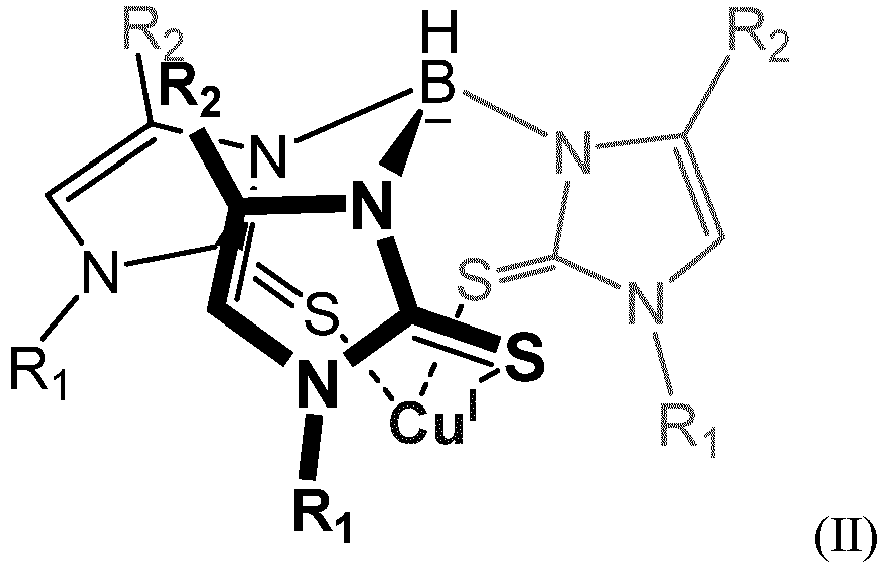
where each instance of R1 and R2 can be hydrogen, or a group having one or more carbons.
where each instance of R1 and R2 can be hydrogen, or a group having one or more carbons.
1. Vorrichtung (10) zur Detektion von flüchtigem Alken, die einen Gasdurchlauf (20) umfasst,
der ein Trocknungsareal (30) aufweist, das stromaufwärts eines Sensors (40) liegt,
wobei der Sensor in einem Gehäuse (50) angeordnet ist und der Sensor einen leitfähigen
Bereich in elektrischer Kommunikation mit zwei Elektroden umfasst und der leitfähige
Bereich nanogroße Partikel eines Metall-Dichalcogenids, einen Mercaptoimidazolyl-Metall-Ligand-Komplex
und einwandige Kohlenstoffnanoröhren oder metallische Nanodrähte umfasst.
2. Vorrichtung zur Detektion von flüchtigem Alken nach Anspruch 1, wobei das Trocknungsareal
ein Trocknungsmaterial umfasst; und/oder wobei das Trocknungsareal eine entfernbare
Kartusche ist.
3. Vorrichtung zur Detektion von flüchtigem Alken nach Anspruch 1 oder 2, wobei der Sensor
mit einem Steuermodul verbunden ist.
4. Vorrichtung zur Detektion von flüchtigem Alken nach einem der Ansprüche 1-3, weiter
umfassend eine Saugvorrichtung, eine Druckzufuhr oder beide.
5. Vorrichtung zur Detektion von flüchtigem Alken nach einem der Ansprüche 1-4, wobei
der Mercaptoimidazolyl-Metall-Ligand-Komplex einen homoleptischen Liganden mit drei
Mercaptoimidazolyl-Gruppen umfasst.
6. Verfahren zur Detektion von flüchtigem Alken, umfassend Kontaktieren einer gasförmigen
Probe mit einem Trocknungsmaterial, um eine behandelte Probe zu bilden, die weniger
als 20% relative Feuchtigkeit aufweist, Aussetzen eines Sensors der behandelten Probe
und Messen einer elektrischen Eigenschaft des Sensors, nachdem dieser der behandelten
Probe ausgesetzt wurde, wobei der Sensor einen leitfähigen Bereich in elektrischer
Kommunikation mit zwei Elektroden umfasst und der leitfähige Bereich nanogroße Partikel
eines Metall-Dichalcogenids, einen Mercaptoimidazolyl-Metall-Ligand-Komplex
und einwandige Kohlenstoffnanoröhren oder metallische Nanodrähte umfasst.
und einwandige Kohlenstoffnanoröhren oder metallische Nanodrähte umfasst.
7. Verfahren nach Anspruch 6, wobei das Trocknungsmaterial CaSO4, Al2O3, Natronkalk und Kombinationen davon umfasst.
8. Verfahren nach Anspruch 6 oder 7, wobei die behandelte Probe weniger als 10% relative
Feuchtigkeit aufweist.
9. Verfahren nach einem der Ansprüche 6-8, wobei die elektrische Eigenschaft Leitfähigkeit
ist; oder wobei die elektrische Eigenschaft Widerstand ist.
10. Verfahren nach einem der Ansprüche 6-9, weiter umfassend Vergleichen eines durch Messen
einer Kalibrierungskurve erhaltenen elektrischen Eigenschaftswerts, um die Menge einer
flüchtigen Verbindung zu bestimmen, die eine Doppel- oder Dreifachbindung in der Probe
aufweist.
11. Verfahren nach einem der Ansprüche 6-10, wobei das flüchtige Alken Ethylen ist.
12. Vorrichtung zur Detektion von flüchtigem Alken nach einem der Ansprüche 1-5 oder das
Verfahren nach einem der Ansprüche 6-11, wobei die nanogroßen Partikel eines Metall-Dichalcogenids
MoS2, WS2, MoSe2, WSe2, MoTe2, WTe2 und Kombinationen davon umfassen.
13. Verfahren nach einem der Ansprüche 6-12, wobei der Mercaptoimidazolyl-Metall-Ligand-Komplex
drei Mercaptoimidazolyl-Gruppen umfasst.
14. Vorrichtung zur Detektion von flüchtigem Alken nach einem der Ansprüche 1-5 oder 12,
oder das Verfahren nach einem der Ansprüche 6-13, wobei der Mercaptoimidazolyl-Metall-Ligand-Komplex
Cu(I), Ag(I) oder Au(I) umfasst.
15. Vorrichtung zur Detektion von flüchtigem Alken nach einem der Ansprüche 1-5, 12 oder
14, oder das Verfahren nach einem der Ansprüche 6-14, wobei der Mercaptoimidazolyl-Metall-Ligand-Komplex
ein Komplex der folgenden Formel (II) ist:
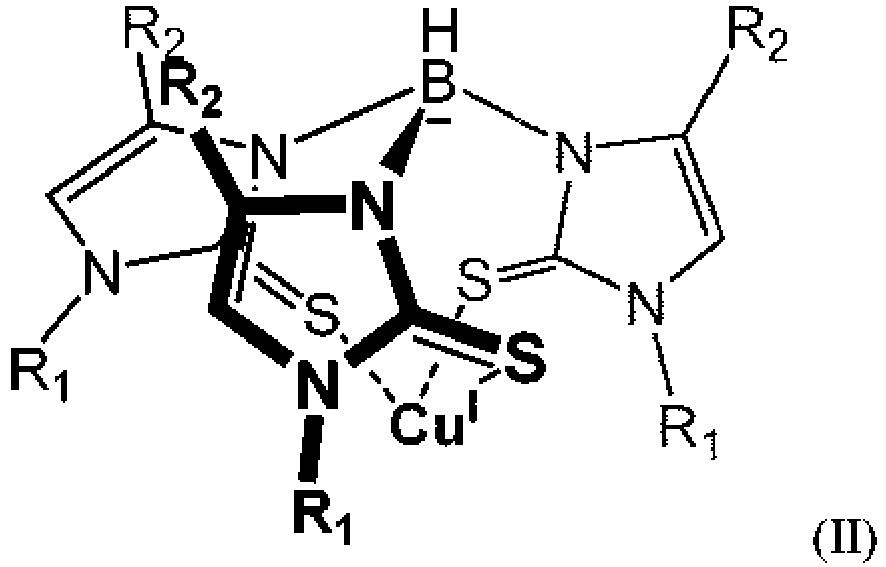
wobei jeder der Reste R1 und R2 Wasserstoff oder eine Gruppe sein kann, die einen oder mehrere Kohlenstoffe aufweist.
wobei jeder der Reste R1 und R2 Wasserstoff oder eine Gruppe sein kann, die einen oder mehrere Kohlenstoffe aufweist.
1. Dispositif de détection d'alcène volatil (10) comprenant un passage de gaz (20) présentant
une zone de dessiccation (30) située en amont d'un capteur (40), dans lequel le capteur
est disposé dans un boîtier (50) et le capteur comprend une région conductrice dans
une communication électrique avec deux électrodes et la région conductrice comprend
des particules nanométriques d'un dichalcogénure de métal, un complexe métal-ligand
mercaptoimidazolyle, et des nanotubes de carbone à paroi unique ou des nanofils métalliques.
2. Dispositif de détection d'alcène volatil selon la revendication 1, dans lequel la
zone de dessiccation comprend un matériel de dessiccation ; et/ou dans lequel la zone
de dessiccation est une cartouche amovible.
3. Dispositif de détection d'alcène volatil selon la revendication 1 ou 2, dans lequel
le capteur est connecté à un module de commande.
4. Dispositif de détection d'alcène volatil selon l'une quelconque des revendications
1-3, comprenant en outre un dispositif d'aspiration, un alimentateur sous pression
ou les deux.
5. Dispositif de détection d'alcène volatil selon l'une quelconque des revendications
1-4, dans lequel le complexe métal-ligand mercaptoimidazolyle comprend un ligand homoleptique
avec trois groupes mercaptoimidazolyle.
6. Procédé de détection d'alcène volatil comprenant la mise en contact d'un échantillon
gazeux avec un matériau de dessiccation pour former un échantillon traité présentant
moins de 20 % d'humidité relative, l'exposition d'un capteur à l'échantillon traité,
et la mesure d'une propriété électrique du capteur après exposition à l'échantillon
traité, dans lequel le capteur comprend une région conductrice en communication électrique
avec deux électrodes et la région conductrice comprend des particules nanométriques
d'un dichalcogénure de métal, un complexe métal-ligand mercaptoimidazolyle, et des
nanotubes de carbone à paroi unique ou des nanofils métalliques.
7. Procédé selon la revendication 6, dans lequel le matériau de dessiccation comprend
du CaSO4, de l'Al2O3, de la chaux sodée et des combinaisons de ceux-ci.
8. Procédé selon la revendication 6 ou 7, dans lequel l'échantillon traité présente moins
de 10 % d'humidité relative.
9. Procédé selon l'une quelconque des revendications 6-8, dans lequel la propriété électrique
est la conductivité ; ou dans lequel la propriété électrique est la résistivité.
10. Procédé selon l'une quelconque des revendications 6-9, comprenant en outre la comparaison
d'une valeur de propriété électrique obtenue par la mesure par rapport à une courbe
d'étalonnage pour déterminer la quantité d'un composé volatil présentant une double
ou triple liaison présente dans l'échantillon.
11. Procédé selon l'une quelconque des revendications 6-10, dans lequel l'alcène volatil
est de l'éthylène.
12. Dispositif de détection d'alcène volatil selon l'une quelconque des revendications
1-5 ou procédé selon l'une quelconque des revendications 6-11, dans lequel les particules
nanométriques d'un dichalcogénure de métal comprend MoS2, WS2, MoSe2, WSe2, MoTe2, WTe2, et des combinaisons de ceux-ci.
13. Procédé selon l'une quelconque des revendications 6-12, dans lequel le complexe métal-ligand
mercaptoimidazolyle comprend trois groupes mercaptoimidazolyle.
14. Dispositif de détection d'alcène volatil selon l'une quelconque des revendications
1-5 ou 12, ou procédé selon l'une quelconque des revendications 6-13, dans lequel
le complexe métal-ligand mercaptoimidazolyle comprend Cu(I), Ag(I) ou Au(I).
15. Dispositif de détection d'alcène volatil selon l'une quelconque des revendications
1-5, 12 ou 14, ou procédé selon l'une quelconque des revendications 6-14, dans lequel
le complexe métal-ligand mercaptoimidazolyle est un complexe de la formule (II) :
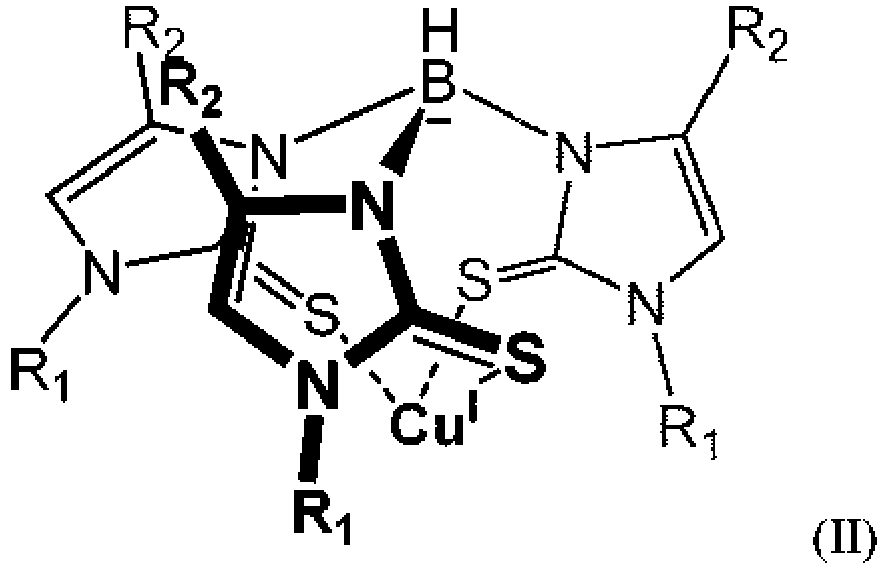
dans lequel chaque instance de R1 et R2 peut être un hydrogène, ou un groupe présentant un ou plusieurs carbones.
dans lequel chaque instance de R1 et R2 peut être un hydrogène, ou un groupe présentant un ou plusieurs carbones.
REFERENCES CITED IN THE DESCRIPTION
This list of references cited by the applicant is for the reader's convenience only. It does not form part of the European patent document. Even though great care has been taken in compiling the references, errors or omissions cannot be excluded and the EPO disclaims all liability in this regard.
Patent documents cited in the description