|
(11) | EP 3 954 695 A1 |

| (12) | EUROPEAN PATENT APPLICATION |
|
|
|
|
|||||||||||||||||||||||||||
| (54) | METHOD FOR THE SYNTHESIS OF ASYMMETRIC POLYSULFIDES |
| (57) A method of making an asymmetric polysulfide is disclosed. The method comprises the
step of simultaneously reacting an olefinically unsaturated organic compound, elemental
sulfur, and a thiol in the presence of a catalytic amount of a base to produce the
asymmetric polysulfide. The asymmetric polysulfide may be used in a tire component. |
Background
[0001] Soybean oil that is silylated through di- or polysulfide connectivity is of interest for use in rubber and tire compounds. The only method available for generating these types of materials is multi-step and not commercially viable, so development an alternative method is desirable.
[0002] Previous methods to produce polysulfides include vulcanization of olefins to create symmetric R-Sx-R polysulfides, using thiols to create symmetric R-Sx-R polysulfides, and using olefins to generate hydropersulfides (or hydropolysulfides). Methods for the synthesis of asymmetric polysulfides are not widely available and those that exist are typically multi-step and/or not commercially-viable.
Summary of the Invention
[0004] It also relates to an asymmetric polysulfide made by this method, a tire component comprising the asymmetric polysulfide and the use of the asymmetric polysulfide made by the method in a tire.
[0006] The present invention is directed to a method of making an asymmetric polysulfide, comprising the step of simultaneously reacting an olefinically unsaturated compound, elemental sulfur, and a thiol in the presence of a catalytic amount of a base to produce the asymmetric polysulfide.
Description of Example Embodiments of the Invention
[0007] There is disclosed a method of making an asymmetric polysulfide, comprising the step of simultaneously reacting an olefinically unsaturated compound, elemental sulfur, and a thiol in the presence of a catalytic amount of a base to produce the asymmetric polysulfide.
[0008] An asymmetric polysulfide is a polysulfide that includes subsitutent groups on opposite ends of the -Sx- polysulfide group that are different from each other, for example, in an asymmetric polysulfide such as Q1-Sx-Q2. The groups Q1 and Q2 are not the same.
[0009] The present invention is directed to a novel reaction that can generate asymmetric polysulfides in high yield and purity in a single step using a "one-pot" method under commercially accessible conditions. It is now found that if a mixture of olefin, elemental sulfur, thiol, and catalytic amount of base is preferably heated at 170 °C for approximately 1 hour, the olefin can be functionalized to give a mixture of mono-and polysulfide products. The utility of this methodology is demonstrated on methyl oleate, high oleic soybean oil, commodity soybean oil, cis-cyclooctene, and squalene. The application to oils gives a new route to a wide variety of previously-unreported soybean oil derivatives. The application to squalene demonstrates the possible use of this method for functionalizing polymer backbones with polysulfides.
[0010] More broadly, the reaction mixture may be preferably heated to a temperature range of 150 to 200°C, for a time ranging from 30 minutes to 2 hours.
[0011] By thiol, it is meant a compound including an -S-H group pendant from the compound. Such compounds may include other functional groups.
[0012] Most broadly then, in one embodiment the method of making an asymmetric polysulfide includes the step of simultaneously reacting an olefinically unsaturated organic compound, elemental sulfur, and a thiol in the presence of a catalytic amount of a base to produce the asymmetric polysulfide.
[0013] The olefinically unsaturated organic compound may be derived from petroleum or from biological sources such as plants or micoorganisms, or synthetically produced.
[0014] In one embodiment, the olefinically unsaturated organic compound is selected from the group consisting of alkenes, cycloalkenes, unsaturated fatty acid alkyl esters, and unsaturated fatty acid triglycerides.
[0017] In one embodiment, the base is an amine. In one embodiment, the base is a tertiary amine, including but not limited to amines substituted with any combination of alkyl or aromatic substituents, amines contained within aromatic heterocycles, and fused ring amines such as bicycles (i.e. 1,4-diazabicyclo[2.2.2]octane). In one embodiment, the base is triethylamine.
[0018] In one embodiment, the asymmetric polysulfide is of formula 1
where R1, R2 and R3 are independently C15-C20 alkenyl, C15-C20 alkyl, and optionally containing aromatic groups; R is - Sx - R4 where x is an integer from 2 to 9, R4 is a monovalent organic group; each R is covalently bonded to a carbon atom of one of R1, R2 or R3; and m is the number of R groups, i. e. an integer such as 2, 3, 4, 5 or > 5. Each of the R4 may be derived from a corresponding thiol R4-S- H and such thiols may be used generally with an olefinically unsaturated organic compound, elemental sulfur in the presence of a catalytic amount of a base to produce the asymmetric polysulfide.
[0019] In one embodiment, R4 is - R5 - Si -(OR6)3 where R5 is C1 to C8 alkane diyl, and R6 are independently C1 to C8 alkyl. In one embodiment, R4 is -CH3-Si-(OCH2CH3)3 derivable from mercaptopropyltriethoxysilane.
[0020] In one embodiment, R4 is selected from the following structures:
where Z is a group that helps control the reactivity of the thiocarbonylthio moiety;
where X = 0-2 carbon atoms; R6, R7 can be independently hydrogen, alkyl chains, or aromatic moieties;
where R8, R9 can be independently alkyl or aromatic functionalities;
R10——
where R10 is a substituted or non-substituted alkyl or aromatic group optionally containing ether, carboxyl, ester, amine, or amide functionalities;
where X = 0-2 carbon atoms; R11, R12 can be symmetric or asymmetric and independently be an alkyl, aromatic, or ethereal substituents;
where X = 0-2 carbon atoms; R13, R14 can be symmetric or asymmetric and are independently hydrogen, an alkyl chain, aromatic containing functional group;
where R15, R16 can be independently hydrogen, alkyl chains, or aromatic moieties; and
where R17, R18, and R19 are independently substituted or non-substituted alkyl or aromatic groups or substituted or non-substituted heteroatom-containing groups and Y is a substituted or non-substituted alkane diyl or aromatic group optionally containing ether, carboxyl, ester, amine, or amide functionalities.
[0021] In a preferred one embodiment, at least one of R17, R18, and R19 is -N(R20)2 where R20 is selected from a C1 to a C8 alkyl.
[0022] In one embodiment, at least one of R17, R18, and R19 is -OR21 where R21 is selected from a C1 to a C8 alkyl.
Examples
General Experimental
[0024] Soybean oil and high oleic soybean oil were generously supplied by Archer Daniels Midland. Elemental sulfur was obtained from Sigma Aldrich. 3-Mercaptopropyltriethoxysilane (MPTES) was purchased from TCI America, and triethylamine was purchased from Sigma Aldrich. Reactions were performed neat. NMR experiments were performed with a 400 MHz Varian instrument.
Example 1: Synthesis of Soy-Silane Polysulfide (Method A)
[0025] Soybean oil (1 eq, 3.0 g), elemental sulfur (2 eq vs olefins, 900 mg), and 3-mercaptopropyltriethoxysilane (1.2 eq vs olefins, 4.3 ml) were added to a 20 ml glass vial. The vial was sealed and stirred vigorously while heating to 170ºC. Time was started when the bath temperature reached 120°C. The reaction was stirred for 40 minutes, at which point a deep red/orange transparent oil was obtained. NMR analysis confirmed the desired product, with a small amount of residual MPTES, which can be removed via vacuum distillation if desired.
Example 2: Synthesis of Sov-Silane Polysulfide (Method B)
[0026] Soybean oil (1 eq of olefins, 3.0 g), elemental sulfur (2 eq vs olefins, 900 mg), 3-mercaptopropyltriethoxysilane (1.2 eq vs olefins, 4.3 mLI), and triethylamine (0.025 eq vs olefins, 47.1 µl) were added to a 20 mLl glass vial. The vial was sealed and stirred vigorously while heating to 170ºC. The reaction was stirred for 40 minutes at 170ºC, at which point a dark red/orange oil was obtained. NMR analysis confirmed the desired product, with no residual MPTES detected.
Example 3: Synthesis of High Oleic Sov-Silane Polysulfide
[0027] High oleic soybean oil (1 eq of olefins, 5.147 g), elemental sulfur (2 eq vs olefins, 1.033 g), 3-mercaptopropyltriethoxysilane (1.2 eq vs olefins, 4.9 mLI), and triethylamine (0.025 eq vs olefins, 55.8 µl) were added to a 20 ml glass vial. The vial was sealed and stirred vigorously while heating to 170ºC. The reaction was stirred for 40 minutes at 170ºC, at which point a bright orange oil was obtained. NMR analysis confirmed the desired product, with no residual MPTES detected.
Example 4: Synthesis of Methyl Oleate-Silane Polysulfide
[0028] Methyl oleate (1 eq, 5.0 g), elemental sulfur (2 eq, 1.033 g), 3-mercaptopropyltriethoxysilane (1.2 eq, 4.9 ml), and triethylamine (0.025 eq, 55.8 µl) were added to a 20 ml glass vial. The vial was sealed and stirred vigorously while heating to 170ºC. Time was started when the bath temperature reached 120°C. The reaction was stirred for 40 minutes, at which point a bright orange oil was obtained. NMR analysis confirmed the desired product, with no residual MPTES detected.
Example 5: Synthesis of Cvclooctene-Silane Polysulfide
[0029] Cis-cyclooctene (1 eq, 1.77 g), elemental sulfur (2 eq, 1.033 g), 3-mercaptopropyltriethoxysilane (1.2 eq, 4.9 ml), and triethylamine (0.025 eq, 55.8 µl) were added to a 20 ml glass vial. The vial was sealed and stirred vigorously while heating to 170ºC. Time was started when the bath temperature reached 120°C. The reaction was stirred for 40 minutes, at which point a bright orange oil was obtained. NMR analysis confirmed the desired product, with no residual MPTES detected.
Example 6: Synthesis of Squalene-Silane Polysulfide
[0030] Squalene (1 eq, 1.10 g), elemental sulfur (2 eq, 1.033 g), 3-mercaptopropyltriethoxysilane (1.2 eq, 4.9 ml), and triethylamine (0.025 eq, 55.8 µl) were added to a 20 ml glass vial. The vial was sealed and stirred vigorously while heating to 170ºC. Time was started when the bath temperature reached 120°C. The reaction was stirred for 40 minutes, at which point a bright orange oil was obtained. NMR analysis confirmed the desired product, with no residual MPTES detected.
1. A method of making an asymmetric polysulfide, the method comprising the step of simultaneously
reacting an olefinically unsaturated organic compound, elemental sulfur, and a thiol
in the presence of a catalytic amount of a base to produce the asymmetric polysulfide.
2. The method of claim 1, wherein the olefinically unsaturated organic compound is selected
from the group consisting of alkenes, cycloalkenes, unsaturated fatty acid alkyl esters,
and unsaturated fatty acid triglycerides.
3. The method of claim 1, wherein the olefinically unsaturated organic compound is a
vegetable oil.
4. The method of claim 1 or 2, wherein the olefinically unsaturated organic compound
is soybean oil.
5. The method of at least one of the previous claims, wherein the thiol is H-S-R5-Si-(OR6)3, where R5 is selected from a C1 to a C8 alkane diyl, and where R6 are independently selected from a C1 to a C8 alkyl.
6. The method of at least one of the previous claims, wherein the thiol is a mercaptopropyltriethoxysilane.
7. The method of at least one of the previous claims, wherein the base is an amine.
8. The method of at least one of the previous claims, wherein the base is a tertiary
amine.
9. The method of at least one of the previous claims, wherein the base is 1,4-diazabicyclo[2.2.2]octane.
10. The method of at least one of the previous claims, wherein the asymmetric polysulfide
is of formula 1
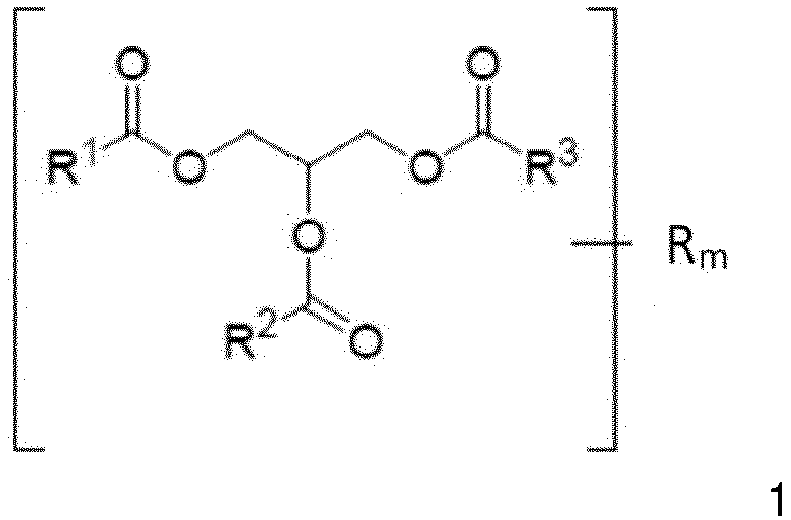
where R1, R2 and R3 are independently selected from a C15 to a C20 alkenyl and a C15 to a C20 alkyl, and optionally contain aromatic groups; R is - Sx - R4 where x is an integer from 2 to 9, R4 is a monovalent organic group; each R is covalently bonded to a carbon atom of one of R1, R2 or R3; and m is the number of R groups.
where R1, R2 and R3 are independently selected from a C15 to a C20 alkenyl and a C15 to a C20 alkyl, and optionally contain aromatic groups; R is - Sx - R4 where x is an integer from 2 to 9, R4 is a monovalent organic group; each R is covalently bonded to a carbon atom of one of R1, R2 or R3; and m is the number of R groups.
11. The method of claim 10, wherein R4 is -R5-Si-(OR6)3 where R5 is a C1 to a C8 alkane diyl, and R6 are independently selected from a C1 to a C8 alkyl.
12. The method of claim 10, where R4 is selected from the following structures:

where Z is a group that helps control the reactivity of the thiocarbonylthio moiety;
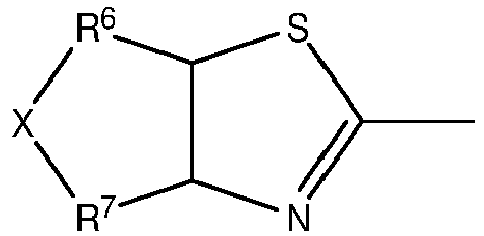
where X = 0-2 carbon atoms; R6, R7 are independently selected from hydrogen, alkyl chains, or aromatic moieties;
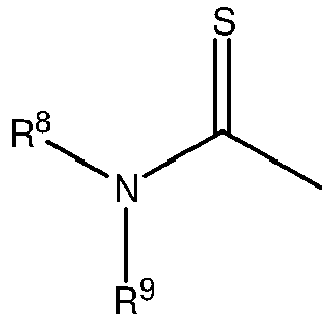
where R8, R9 are independently selected from alkyl or aromatic functionalities;
R10——
where R10 is a substituted or non-substituted alkyl or aromatic group optionally containing ether, carboxyl, ester, amine, or amide functionalities;
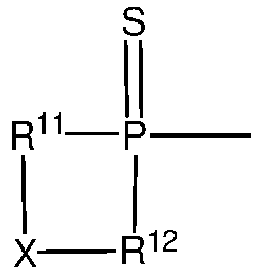
where X = 0-2 carbon atoms; R11, R12 are symmetric or asymmetric and independently selected to be alkyl, aromatic, or ethereal substituents;
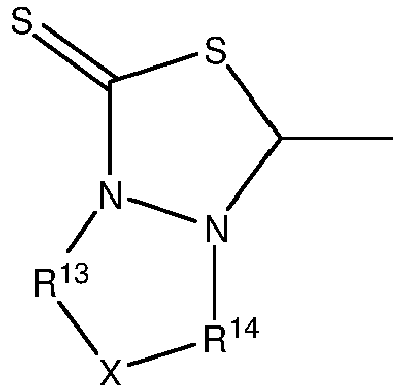
where X = 0-2 carbon atoms; R13, R14 are symmetric or asymmetric and are independently selected to be hydrogen, an alkyl chain, or aromatic containing functional group;
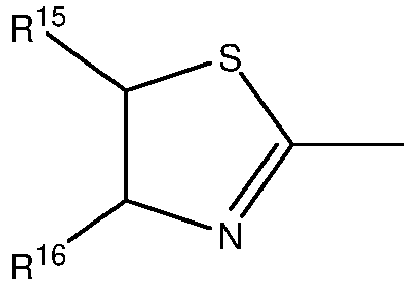
where R15, R16 are independently selected to be hydrogen, alkyl chains, or aromatic moieties; and
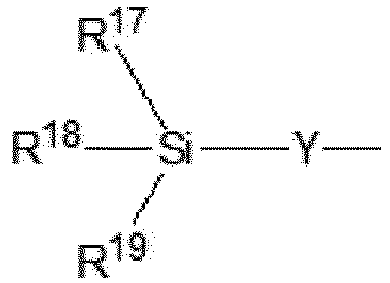
where R17, R18, and R19 are independently selected to be substituted or non-substituted alkyl or aromatic groups or substituted or non-substituted heteroatom-containing groups and Y is a substituted or non-substituted alkane diyl or aromatic group optionally containing ether, carboxyl, ester, amine, or amide functionalities.
where Z is a group that helps control the reactivity of the thiocarbonylthio moiety;
where X = 0-2 carbon atoms; R6, R7 are independently selected from hydrogen, alkyl chains, or aromatic moieties;
where R8, R9 are independently selected from alkyl or aromatic functionalities;
R10——
where R10 is a substituted or non-substituted alkyl or aromatic group optionally containing ether, carboxyl, ester, amine, or amide functionalities;
where X = 0-2 carbon atoms; R11, R12 are symmetric or asymmetric and independently selected to be alkyl, aromatic, or ethereal substituents;
where X = 0-2 carbon atoms; R13, R14 are symmetric or asymmetric and are independently selected to be hydrogen, an alkyl chain, or aromatic containing functional group;
where R15, R16 are independently selected to be hydrogen, alkyl chains, or aromatic moieties; and
where R17, R18, and R19 are independently selected to be substituted or non-substituted alkyl or aromatic groups or substituted or non-substituted heteroatom-containing groups and Y is a substituted or non-substituted alkane diyl or aromatic group optionally containing ether, carboxyl, ester, amine, or amide functionalities.
13. An asymmetric polysulfide made by the method of at least one of the prevuous claims.
14. A tire having a component, the component comprising the asymmetric polysulfide of
claim 13.
15. Use of the asymmetric polysulfide made by the method of at least one of the claims
1 to 12 in a tire.