1. A lipid nanoparticle (LNP) for use in a method of delivering a therapeutic level of
a protein of interest to a subject,
wherein the method comprises administering multiple doses of the LNP to the subject;
wherein the LNP encapsulates an mRNA coding for the protein of interest, wherein the
LNP comprises a cationic lipid, a helper lipid, a structural lipid, and a stabilizer,
wherein the cationic lipid is an ionizable lipid,
wherein the stabilizer is a PEG lipid, and wherein the PEG lipid is a compound of
Formula (V-OH):
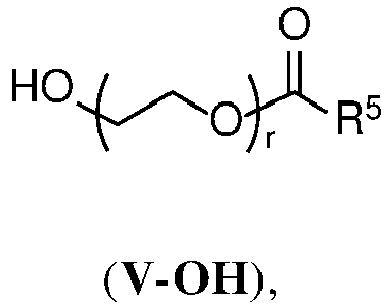
or a pharmaceutically acceptable salt thereof, wherein:
r is an integer between 1 and 100, inclusive; and
R5 is optionally substituted C10-40 alkyl, optionally substituted C10-40 alkenyl, or optionally substituted C10-40 alkynyl; and
wherein the LNP does not induce a drug response associated with an LNP, wherein said
drug response is a CD19(+) mediated immune response, wherein said response is selected
from induction of IgM, induction of IgG, induction of memory B cells, an ABC response,
and/or an anti-drug antibody (ADA) response.
2. The LNP for use of claim 1, wherein the PEG-lipid comprises a PEG molecule of an average
molecular weight of:
(i) 2,000 Da; or
(ii) less than 2,000 Da, optionally around 1,500 Da, around 1,000 Da, or around 500
Da.
3. The LNP for use of claim 1 or claim 2, wherein the compound of Formula (V-OH) is Cmpd452:
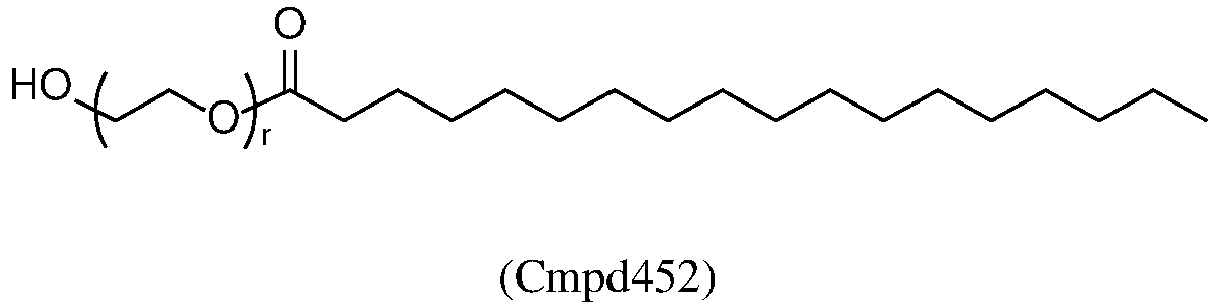
or a pharmaceutically acceptable salt thereof.
4. The LNP for use of claim 1 or claim 2, wherein the PEG-lipid is HO-PEG2000-ester-C18.
5. The LNP for use of claim 1 or claim 2, wherein the compound of Formula
(V-OH) is Cmpd403:
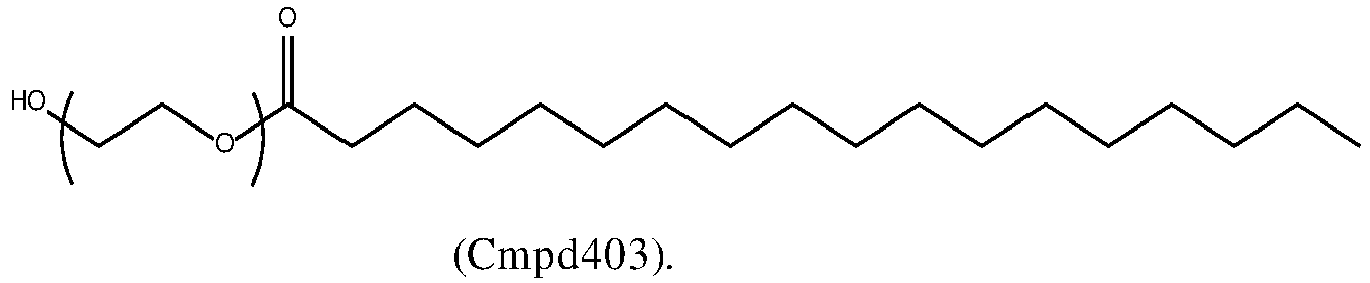
6. The LNP for use of any one of claims 1-5, wherein the helper lipid is:
(i) a non-cationic helper lipid comprising at least one fatty acid chain of at least
8C and at least one polar head group moiety, wherein the structural lipid is a sterol;
(ii) a zwitterionic non-cationic helper lipid; a 1,2-distearoyl-sn-glycero-3-phosphocholine
(DSPC) analog, oleic acid, an oleic acid analog, or a DSPC substitute;
(iii) a lipid that is not a phosphatidyl choline (PC); or
(iv) 1,2-distearoyl-sn-glycero-3-phosphocholine (DSPC).
7. The LNP for use of any one of claims 1-6, wherein the helper lipid is a non-cationic
helper lipid and the structural lipid is cholesterol, and wherein the LNP has a molar
ratio of about 20-60% cationic lipid, about 0.15-15% PEG lipid, about 25-55% cholesterol
and about 5-25% non-cationic helper lipid.
8. The LNP for use of any one of claims 1-7, wherein the LNP comprises less than 0.5
% (w/w) of PEG lipid.
9. The LNP for use of any one of claims 1-8, wherein the LNP is characterized as having
reduced binding to B1a cells and/or reduced B1a cell activation activity.
10. The LNP for use of any one of claims 1-8, wherein administration of the LNP does not
activate CD36, optionally wherein:
(i) the helper lipid competitively inhibits phosphatidylcholine from binding to CD36;
or
(ii) the helper lipid does not bind or has low binding activity to CD36.
11. The LNP for use of any one of claim 1-10, wherein the LNP encapsulating the mRNA encoding
the protein of interest is administered two or more times, three or more times, or
four or more times; and/or wherein administration is repeated once, twice, 3, 4, 5,
6, 7, 8, 9, 10, or more times.
12. The LNP for use of any one of claim 1-11, wherein the interval between the first dose
and the second dose is about 21 days or less; and/or wherein the method further comprises
administering to the subject an additional agent that inhibits immune responses.
