|
(11) | EP 4 311 928 A1 |

| (12) | EUROPEAN PATENT APPLICATION |
|
|
|
|
|||||||||||||||||||||||||||
| (54) | METHOD FOR CONTROLLING THE ELECTRIC SUPPLY OF A BUTTERFLY VALVE OF AN INTERNAL COMBUSTION ENGINE |
| (57) Method for power controlling a butterfly valve of an internal combustion engine,
the valve comprising a rotatable shutter actuating motor and a return spring arranged
to exert a return action to return the shutter to a position rest, the method comprising
a step of limiting a supply voltage of the actuating motor, when an action of the
actuating motor is in accordance with the return action of the return spring.
|
Field of the invention
[0001] The present invention relates to the field of control schemes for feeding a butterfly valve of an internal combustion engine.
State of the art
[0002] Butterfly valve position control is a very important topic in the automotive sector. The valves comprise a shutter fixed on a rotatable shaft which lies substantially in the plane of the shutter. The rotation of the valve is actuated by an electric motor, sometimes by a gear train. Preloaded springs are associated with the shaft, for the return of the shutter to a pre-established position called "limp home".
[0003] The limp home position does not necessarily mean that the valve is completely closed. Sometimes, it is 7 - 12 degrees of rotation from the fully closed position. When the valve is placed on the intake manifold of a positive ignition engine, the limp home position corresponds to an "idle" condition of the engine itself.
[0004] When the limp home position corresponds to the complete closure of the valve, then at least one return spring is required. When, on the other hand, the limp home position differs from the completely closed position, at least two opposing springs are required, which, in conditions of no power supply to the electric motor, tend to bring the shutter back to the limp home position.
[0005] Similar types of valves can also be used to control the flow of exhaust gas to be recirculated at the intake of the internal combustion engine to create the so-called EGR from the acronym "Exhaust Gas Recirculation".
[0006] The power supply and control of the electric motor which defines the position of the shutter is generally realized by an engine control unit ECU by means of a so-called H-bridge. Hereafter the H-bridge is referred to as the "power and control source", in which it is implied that it is a source of electrical power.
[0007] Depending on the direction of actuation, the electric motor can work against a spring or in accordance with the return action of a spring.
[0008] In the second case, i.e. when the actions are in accordance, with the same supply voltage to the electric motor, the circulation of an electric current is induced having a greater intensity than in the case in which the actions are discordant.
[0009] In the second case, in response to sudden variations in the position of the valve, not only are the response times significantly lower but also the intensity of the circulating current is significant, with peaks which can induce the processing unit to reset due to an intrinsic overcurrent protection system.
[0010] Unless specifically excluded in the detailed description that follows, what is described in this chapter is to be considered as an integral part of the detailed description.
Summary of the invention
[0011] The object of the present invention is to avoid the generation of overcurrents in the electrical actuation circuit of a butterfly valve. Contextually, another object of the present invention is to obtain the same dynamic behavior of the butterfly valve when opening and when closing.
[0012] The basic idea of the present invention is to indicate a method for controlling the power supply of a butterfly valve of an internal combustion engine, comprising a step of limiting a power supply voltage of the actuating engine, when an action of the actuating motor is concordant with a return spring action.
[0013] Since there is a gate relationship between supply voltage and current, it is evident that a voltage limitation is reflected in a current limitation.
[0014] More specifically, the limitation consists in reducing the supply voltage by a quantity that is a function of a deviation angle of the shutter with respect to the rest position.
[0015] The dependent claims describe preferred variants of the invention, forming an integral part of the present description.
Brief description of the figures
[0016] Further objects and advantages of the present invention will become clear from the detailed description that follows of an embodiment of the same (and of its variants) and from the annexed drawings given for purely explanatory and non-limiting purposes, in which:
- Fig. 1 shows a diagram for limiting the voltage control signal of the closing of a butterfly valve;
- Fig. 2 shows a saturator which exploits the limitation scheme of Fig.1;
- Fig. 3 shows a saturator which exploits the limitation scheme of Figure 1 both to limit the voltage control signal both when opening and closing the valve;
- Fig. 4 shows a further variant of the saturator of Fig.3;
- Fig. 5 shows a limitation diagram of the voltage control signal of the closing or opening of a butterfly valve in the event of the presence of a non-linearity in the supply circuit of the valve motor or in the valve motor itself, in which the non-linearity can be represented by an odd function.
[0017] The same reference numbers and letters in the figures identify the same elements or components or functions.
[0018] It should also be noted that the terms "first", "second", "third", "superior", "inferior" and the like may be used herein to distinguish various items. These terms do not imply a spatial, sequential, or hierarchical order for the modified items unless specifically indicated or inferred from the text.
[0019] The elements and characteristics illustrated in the various preferred embodiments, including the drawings, can be combined with each other without however departing from the scope of protection of the present application as described below.
Detailed description
[0020] To deal with the aforementioned problems, it is assumed that the rest or limp home position, i.e. the position assumed by the shutter in the absence of the electric motor powering, corresponds to an angular position α of the shaft equal to α = 0. When the valve is open, it is assumed that the angular position is α > 0, that the supply voltage of the electric motor is positive and that the supply current of the circuit is also positive.
[0021] Initially, it is assumed that the valve is fully closed in the limp home position, and that, therefore, it is not possible for the shaft to assume angular positions with α < 0. In other words, it is temporarily assumed that the limp home position corresponds to the mechanical stop position of the shutter.
[0022] The supply voltage v generated by the H-bridge is limited between V_max and -V_max. Evidently, V_max is generated by the H-bridge to suddenly open the valve, while -V_max is generated to suddenly close the valve. The reset problem of the processing unit occurs when applying -V_max, as the closing action of the electric motor is concordant with the closing action of the closing spring.
[0023] The following equation represents the maximum torque τ_openMax generated during the valve opening phase:
Where Kt represents the known torque and voltage constant, Rm is the value of the resistance of the electric circuit controlling the position of the valve shutter, -ωopen is the rotation speed of the valve shaft in the opening direction of the shutter, Ktωopen is the counter-electromotive force generated by the windings of the electric motor, fs(α) is the torque generated by the closing springs as a function of the angular position α of the shaft.
[0024] During opening evidently ωopen > 0 and the generated torque τopenMax > 0. Similarly, also Vmax > 0 by definition and it results that Vmax - Ktωopen > 0 since the closing spring operates against the action of the electric motor generating a torque fs(α) > 0, which being closed is added with the negative sign.
[0025] On the other hand, when the valve is commanded to close, the following equation is obtained:
Where v represents the unknown voltage.
[0026] To avoid the generation of an overcurrent in the circuit, during the closing phase of the valve then proceed to equate the two equations (a) and (b) in order to have the same behaviour of the valve both in opening and in closing and at the time itself by limiting the currents in the closing phase:
[0028] Since we are trying to obtain the same drive torque in opening and in closing, then starting from a zero initial rotation speed, we can set ωclose = -ωopen and therefore Kt-ωopen + Ktωclose = 0, so we obtain
[0029] Therefore, the supply voltage v, to guarantee a closing behaviour identical to the opening one of the valve, must not exceed the value Vlim_inf
[0030] If this equation is carefully observed, it is found that this value is not a constant but a function of α. In detail,
[0031] Which represents the equation of a straight line with negative values and positive slope as the angular position α varies.
[0033] Which again represents the equation of a straight line with positive values and negative slope as the angular position α varies.
[0034] Fig. 1 shows an example of a control scheme implementing equation (i) in order to limit the butterfly valve closing supply voltage.
[0035] This control scheme is implemented through a software module installed in the processing unit, which dynamically controls the power supply to the butterfly valve via the H-bridge. On the contrary, US6098594 aims at solving the same problem by setting predetermined impedance values of the actuation motor, i.e. through constructive characteristics of the components which make the electro-actuated butterfly valve. So, these are completely different solutions in the way of approaching the problem.
[0037] In this case, therefore, the upper limit coincides with Vmax, while the lower negative limit Vlim_inf is given by equation (i) .
[0038] It is now assumed that the limp home position does not coincide with the mechanical stop position of the bolt to achieve complete closure. Typically, the limp home position in these cases is approximately 7 - 12° of shaft rotation from the fully closed valve condition.
[0039] Well, in these circumstances, even a movement of the shutter from total closure to the limp home or open position can generate significant currents. Therefore, by applying the same reasoning applied to the lower negative limit, the upper positive limit of the saturator can also be dynamically limited. The control scheme of Fig. 3 is therefore obtained, in which both the lower and upper limits are set dynamically according to the following relations:
[0040] Evidently, the functions fs are not the same for both branches, as one is a function of the spring, which opposes the opening of the valve and the other opposes the complete closing of the actuator. For this reason they have been named fs1 and fs2 to differentiate them.
[0041] Furthermore, it is important to point out that fs2(α) < 0 since α<0 and therefore Vlim_sup < Vmax.
[0042] Fig. 4 differs from Fig. 3 in that immediately upstream of the saturator, by means of the Min and Max blocks,
- the minimum value between Vmax and Vlim_sup as regards the maximum value of the positive opening voltage of the valve,
- the maximum value between - Vmax and Vlim_inf as regards the minimum value of the negative closing voltage of the valve,
[0043] The reason for these Min and Max blocks is that while the valve is opening, Vlim_sup can exceed the value of Vmax. In order to avoid problems for the controller that manages the power source of the electric motor of the valve, it is therefore preferable to filter upstream any value that exceeds the hardware limit of the power source.
[0044] In the absence of such Min, Max blocks, it has been observed in some cases that the controller exhibits unpredictable behaviour.
[0045] According to a preferred variant of the invention, the control is modified as follows, in the case of a non-linearity of the power supply or of the electric motor or in general of dynamic models of the electric part.
[0046] A non-linearity or more precisely a dynamic model which may present non-linearities is highlighted, for example, when the electric motor is a BLDC, i.e. a Brushless DC, rather than a direct current motor.
[0048] Since the leakage inductance L is not negligible. Arranging,
which is the structure of the typical first order low pass filter with gain equal to R_m/L that we rewrite as
Where Flp is a function that encompasses the dynamics of a first order low pass filter.
[0049] We, therefore, obtain the two equations (a) and (b) illustrated previously, but slightly modified:
[0051] If the function f() is odd and invertible then the following relation holds -f(v) = f(-v). Furthermore, setting ωclose = -ωopen = ω then
[0052] And finally by looking for the minimum negative voltageVlim_inf that can be applied, we obtain
[0053] This equation turns out to be the generalization of (i) under conditions of a non-linearity that can be represented by an odd function.
[0054] Fig. 5, similarly to Fig. 1, shows an example of a control scheme, which implements equation (ii) in order to limit the butterfly valve closing power supply voltage, taking into account, in this case, any non-linearities in the power supplier or in the electric motor, namely the electric motor that controls the shutter.
[0055] As previously done, the positive limit voltage value can be obtained in the event of the valve opening
[0056] Furthermore, a control scheme similar to that of Figs. 3 and 4 can be construed, setting the scheme of Fig. 5 instead of that of Fig. 1 as calculation schemes of the individual voltage limits.
[0057] The present invention can advantageously be implemented through a computer program comprising coding means for carrying out one or more steps of the method, when this program is executed on a computer. Therefore, it is understood that the scope of protection extends to said computer program and also to computer-readable means comprising a recorded message, said computer-readable means comprising program coding means for carrying out one or more steps of the method, when said program is run on a computer. Variants of the non-limiting example described are possible, without however departing from the scope of protection of the present invention, including all equivalent embodiments for a person skilled in the art, to the contents of the claims.
1. A method for power controlling a butterfly valve of an internal combustion engine,
wherein the control is accomplished by means of an H-bridge arranged to power the
butterfly valve, the butterfly valve comprising an actuation motor of a rotatable
shutter and a return spring arranged to exert a return action to return the shutter
to a rest position, the method comprising a step of limiting a supply voltage of the
actuating motor when an action of the actuating motor is in agreement with the return
action of the return spring.
2. Method according to claim 1, wherein said limitation consists in reducing said supply
voltage by an amount, which is a function of a deviation angle (α) of the shutter
with respect to said rest position.
3. Method according to claim 1 or 2, wherein said limiting function coincides with the
equation of a straight-line function of the deviation angle (α).
4. Method according to claim 1 or 2, wherein said function is proportional to
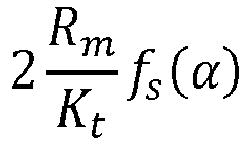
Where Kt represents a torque and voltage constant, Rm is a resistance value of the electric circuit comprising said electric motor and a power supply and control source of the electric motor and fs(α) represents a torque generated by the return spring.
Where Kt represents a torque and voltage constant, Rm is a resistance value of the electric circuit comprising said electric motor and a power supply and control source of the electric motor and fs(α) represents a torque generated by the return spring.
5. Method according to any one of the preceding claims, wherein said rest position differs
from a completely closed position of the shutter, by providing said return spring
and a further return spring which opposes said return spring, and wherein said limitation
of the power supply voltage of the electric motor is implemented when the action of
the electric motor is in agreement with said return spring or with said further return
spring.
6. Method according to any one of the preceding claims, wherein said limitation is achieved
by means of a saturator having as inputs upper and lower saturation limits respectively:
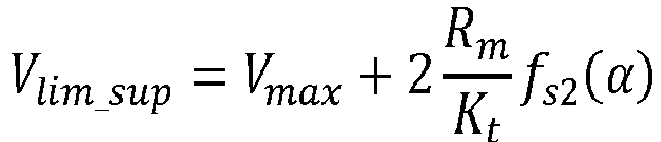

Where fs1 and fs2 respectively represent the torque generated by the return spring and of the additional return spring, where Vmax represents the maximum voltage value that can be generated by said power source and control of the electric motor.
Where fs1 and fs2 respectively represent the torque generated by the return spring and of the additional return spring, where Vmax represents the maximum voltage value that can be generated by said power source and control of the electric motor.
7. Method according to claim 6, wherein when there is a non-linearity due to a power
supply circuit of the electric motor or a non-linearity due to intrinsic characteristics
of the electric motor, and wherein said non-linearity can be represented by an odd
function f, then said lower saturation limit is given by

where ω represents a movement speed of the shutter.
where ω represents a movement speed of the shutter.
8. A processing unit configured to control a butterfly valve of an internal combustion
engine by means of an H-bridge arranged to power the butterfly valve, the valve comprising
a rotary shutter actuating motor and a return spring arranged to return the shutter
to a rest position, the processing unit being configured to power said electric motor
to reach a predetermined position of the shutter and being configured to limit a supply
voltage of the actuation motor, when an action of the actuating motor is concordant
with an action of the return spring.
9. A computer program comprising instructions for causing the processing unit of claim
8 to implement the method according to any one of claims 1 - 7.
10. A computer readable medium having stored the program of claim 9.
11. A system comprising an internal combustion engine, a butterfly valve and a processing
unit arranged to control the butterfly valve, wherein the processing unit is according
to claim 8.
REFERENCES CITED IN THE DESCRIPTION
This list of references cited by the applicant is for the reader's convenience only. It does not form part of the European patent document. Even though great care has been taken in compiling the references, errors or omissions cannot be excluded and the EPO disclaims all liability in this regard.
Patent documents cited in the description