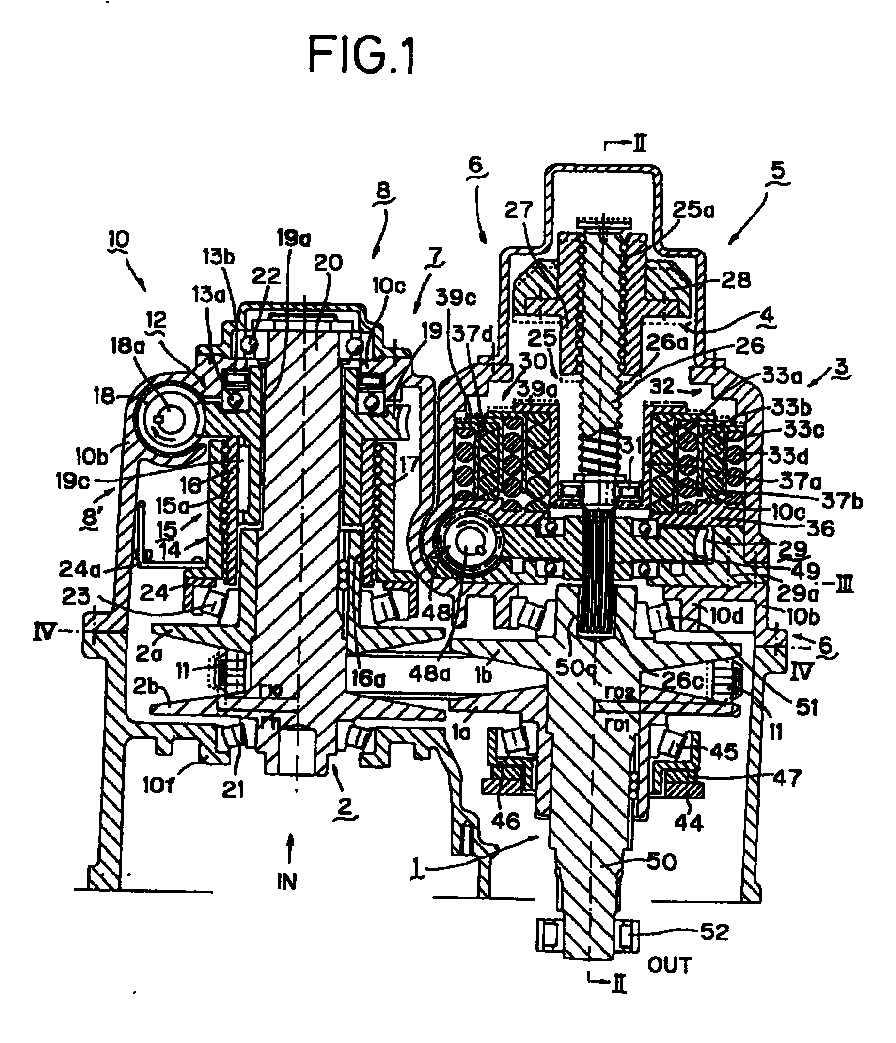
(57) A transmission wheel pressurizing apparatus for always supplying, in a continuously
variable transmission of a constant HP transmission type (10), a pressurizing force
and an elastic force to one out of two transmission wheels (1,2) simultaneously and
only a pressurizing force to the other. For securing the desired number of revolutions
and axial torque by always applying a variable pressurizing force and an elastic force
of the former, an indirect pressurizing system by way of an elastic member is employed
to solve problems, resulting from the employment of the elastic member which is great
in dimension and weight, of maintenance of elastic force of various mechanisms, installation
within a narrow space, securing a high-speed response controller, avoidance of centrifugal
force and simplification of assembly operating properties. Upon giving pressurizing
control to driven transmission wheel (1), an elastic device (3) and a compression
device (4) are combined so that respective pressurizing forces are superposed in series
one another, and the pressurizing force to the driven transmission wheel and the number
of revolutions of the transmission wheel are made in inverse proportion to one another
to realize pressurizing characteristics of negative inclination. Further, the elastic
force thereof is always maintained to secure automatic aligning function and stable
constant HP transmission to the transmission member (11), and apparatuses are supported
in a floating state for maintaining the elastic force thus minimizing in size, and
intensifying for arranging concentratively on the main body, and the entire pressurizing
apparatus is made to be in a detachable construction and at the same time, achieving
the high-speed responsiveness of variable speed control.
|
|
