|
(11) | EP 1 366 013 B1 |

| (12) | EUROPEAN PATENT SPECIFICATION |
|
|
| (54) |
A PROCESS FOR THE PREPARATION OF FIBRATES VERFAHREN ZUR HERSTELLUNG VON FIBRATEN PROCEDE DE PREPARATION DE FIBRATES |
|
|
|||||||||||||||||||||||||||||||
| Note: Within nine months from the publication of the mention of the grant of the European patent, any person may give notice to the European Patent Office of opposition to the European patent granted. Notice of opposition shall be filed in a written reasoned statement. It shall not be deemed to have been filed until the opposition fee has been paid. (Art. 99(1) European Patent Convention). |
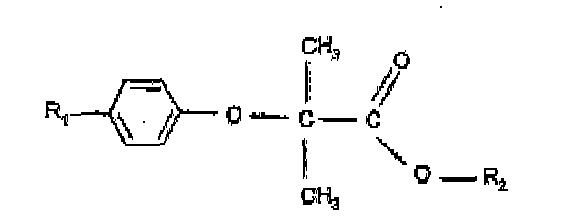
[0001] The present invention relates to a process for the preparation of fibrates of formula (I)
wherein R1 is a halogen atom, a 2,2-dichloro-cyclopropyl group, a (4-chlorophenyl)-hydroxymethyl group, a 4-chlorobenzoyl group or a 2-(4-chlorobenzamido)-ethyl group, and
R2 is hydrogen or a C1-C4 alkyl group.
[0002] The compounds of formula (I) are known medicaments with hypocholesterolemic activity. In particular, fenofibrate, clofibrate and ciprofibrate have been widely used in clinic for some time in the treatment of dyslipidemias. The preparation thereof is disclosed, for example, in GB 860,303 (clofibrate), GB 1,415,295 (fenofibrate), GB 1,539,897.
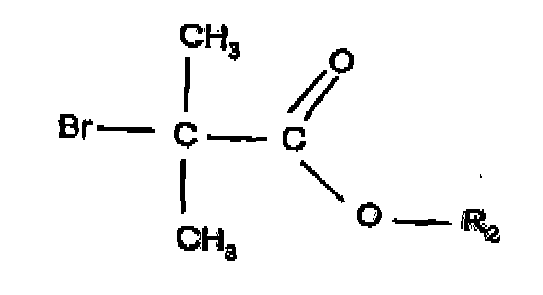
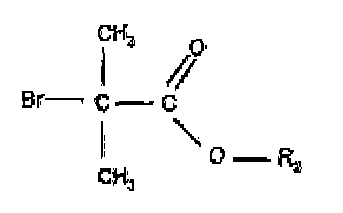
[0003] According to an improved process for the preparation of the fibrates of formula (I), disclosed in EP-B-245,156 (Fournier, 11.11.1987), an alkyl 2-bromo-2-methyl-propionate of formula (II)
wherein R2 is as defined above,
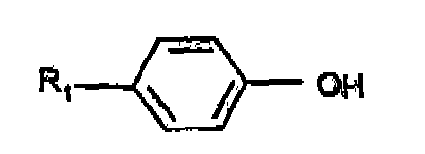
is reacted with a substituted phenol of formula (III)
wherein R1 is as defined above,
in the absence of solvent and in the presence of a potassium carbonate excess, at temperatures above 120°C for times longer than 2 hours.
[0004] It has now been found, and this is the object of the present invention, that the fibrates of formula (I) can advantageously be prepared by reacting the same compounds of formulae (II) and (III), as defined above, in the presence of potassium bicarbonate and of isopropanol as a solvent at temperatures ranging from room temperature to 100°C.
[0005] The process of the invention is particularly suitable for the preparation of fenofibrate (compound of formula I wherein R1 is 4.-chloxo-benzoyl).
[0006] Potassium bicarbonate can be used in amounts sufficient to neutralize the halo acid formed during the reaction. The compound of formula (II) is preferably used in a stoichiometric excess to the compound of formula (III).
[0007] The solvent and the unreacted compound of formula (II) are evaporated off the reaction mixture and the residue is crystallized from a suitable solvent.
[0008] Compared with the method described in EP 245,156, the process of the present invention allows therefore to recover the reaction product directly from the reaction medium, without preventive purification of the crude product. Furthermore, there is no need for an acid excess to neutralize the potassium salt. As a consequence, the process of the invention is cost-saving and industrially advantageous compared with those of the prior art, in particular that disclosed in EP 245,156.
EXAMPLE
[0010] Isopropanol (400 ml), 4-chloro-4'-hydroxy-benzophenone (100 g, 0.431 mols), potassium bicarbonate (78 g, 0.78 mols), isopropyl α-bromo-isobutyrate (180 g, 0.865 mols) are loaded into a 2 1 round-bottom flask at room temperature.
[0011] The solvent is refluxed (82-84°C inner temperature) for 36 hours. After completion of the reaction, the solvent and the isopropyl α-bromo-isobutyrate excess are evaporated off under vacuum. The residue is taken up into acetone (400 ml) and insolubles are filtered off at room temperature. The filtered solution is concentrated to a residue and diluted with isopropyl alcohol (400 ml), then cooled at a temperature of 0-5°C and the product is left to crystallize for at least 8 hours.
1. A process for the preparation of fibrates of formula (I)
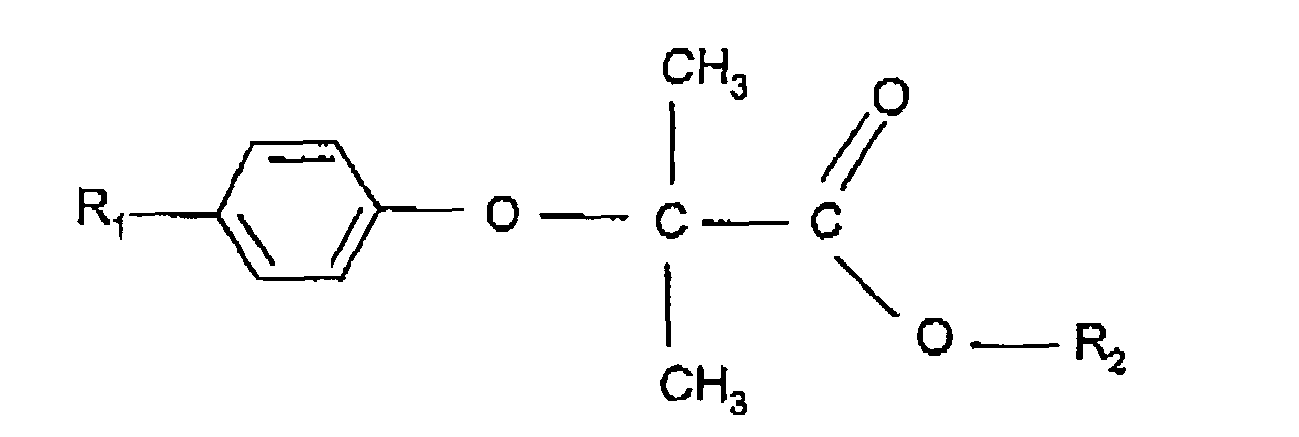
wherein R1 is a halogen atom, a 2,2,dichloro-cyclopropyl group, a (4-chlorophenyl)-hydtoxymethyl group, a 4-chlorobenzoyl group or a 2-(4-chloxobenzamido)-ethyl group, and
R2 is hydrogen or a C1-C4 alkyl group,
which process comprises reacting an alkyl 2-bromo-2-methyl-propionate of formula (II)
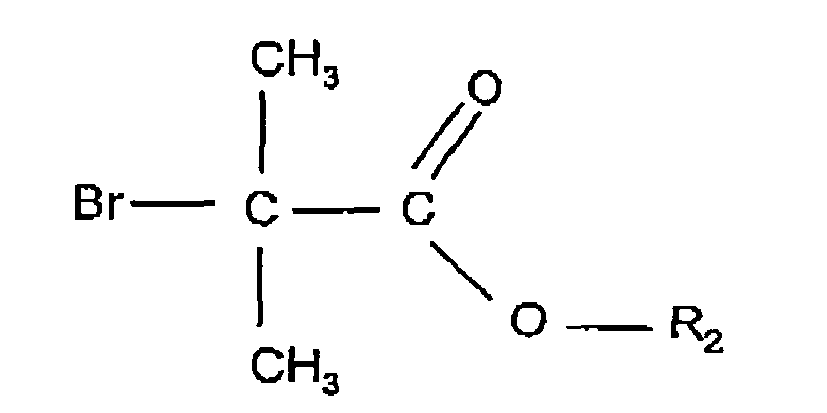
wherein R2 is as defined above,
with a substituted phenol of formula (III)
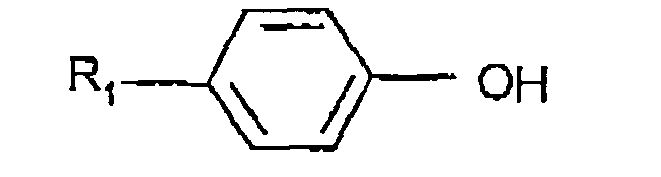
wherein R1 is as defined above,
in the presence of potassium bicarbonate and of isopropanol as a solvent, at temperatures ranging from room temperature to 100°C.
wherein R1 is a halogen atom, a 2,2,dichloro-cyclopropyl group, a (4-chlorophenyl)-hydtoxymethyl group, a 4-chlorobenzoyl group or a 2-(4-chloxobenzamido)-ethyl group, and
R2 is hydrogen or a C1-C4 alkyl group,
which process comprises reacting an alkyl 2-bromo-2-methyl-propionate of formula (II)
wherein R2 is as defined above,
with a substituted phenol of formula (III)
wherein R1 is as defined above,
in the presence of potassium bicarbonate and of isopropanol as a solvent, at temperatures ranging from room temperature to 100°C.
2. A process as claimed in claim 1 for the preparation of fenofibrate.
3. A process as claimed in any one of claims 1 to 2 wherein the final product is recovered
directly from the reaction medium, after evaporation of the solvent and crystallization.
1. Ein Verfahren zur Herstellung von Fibraten der Formel (I)
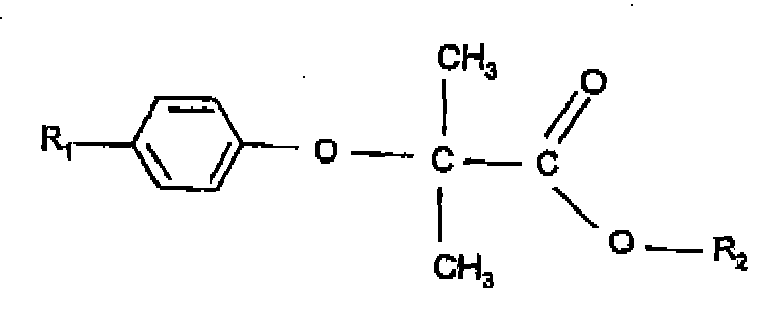
in der R1 ein Halogenatom, eine 2,2-Dichlor-Cyclopropyl-Gruppe, eine (4-Chlorphenyl)-Hydroxymethyl-Gruppe, eine 4-Chlorbenzoyl-Gruppe oder eine 2-(4-Chlorbenzamido)-Ethyl-Gruppe ist und
R2 Wasserstoff oder eine C1-C4-Alkyl-Gruppe ist,
welcher Prozess die Umsetzung eines Alkyl-2-Brom-2-Methylpropionats der Formel (II),
in der R2 wie oben definiert ist, mit einem substituierten Phenol der Formel (III)
in der R1 wie oben definiert ist,
in der Gegenwart von Kaliumbicarbonat und von Isopropanol als Lösemittel bei Temperaturen, die von Raumtemperatur bis 100° C reichen, umfasst
in der R1 ein Halogenatom, eine 2,2-Dichlor-Cyclopropyl-Gruppe, eine (4-Chlorphenyl)-Hydroxymethyl-Gruppe, eine 4-Chlorbenzoyl-Gruppe oder eine 2-(4-Chlorbenzamido)-Ethyl-Gruppe ist und
R2 Wasserstoff oder eine C1-C4-Alkyl-Gruppe ist,
welcher Prozess die Umsetzung eines Alkyl-2-Brom-2-Methylpropionats der Formel (II),
in der R2 wie oben definiert ist, mit einem substituierten Phenol der Formel (III)
in der R1 wie oben definiert ist,
in der Gegenwart von Kaliumbicarbonat und von Isopropanol als Lösemittel bei Temperaturen, die von Raumtemperatur bis 100° C reichen, umfasst
2. Ein Verfahren wie beansprucht in Anspruch 1 für die Herstellung von Fenofibrat.
3. Ein Verfahren wie beansprucht in einem der Ansprüche 1-2, worin das Endprodukt direkt
aus dem Reaktionsmedium nach Verdampfung des Lösemittels und Kristallisation gewonnen
wird.
1. Procédé pour la préparation de fibrates de formule (I)
dans laquelle R1 est un atome d'halogène, un groupe 2,2-dichloro-cyclopropyle, un groupe (4-chlorophényl)-hydroxyméthyle, un groupe 4-chlorobenzoyle, ou un groupe 2-(4-chlorobenzamido)-éthyle, et
R2 est l'hydrogène ou un groupe alkyle en C1-C4,
lequel procédé comprend la mise en réaction d'un alkyle 2-bromo-2-méthyl-propionate de formule (II)
dans laquelle R2 est tel que défini ci-dessus,
avec un phénol substitué de formule (III)
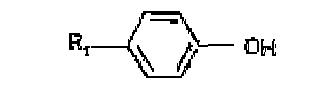
dans laquelle R1 est tel que défini ci-dessus,
en présence de bicarbonate de potassium et d'isopropanol en tant que solvant à des températures comprises entre la température ambiante et 100°C.
dans laquelle R1 est un atome d'halogène, un groupe 2,2-dichloro-cyclopropyle, un groupe (4-chlorophényl)-hydroxyméthyle, un groupe 4-chlorobenzoyle, ou un groupe 2-(4-chlorobenzamido)-éthyle, et
R2 est l'hydrogène ou un groupe alkyle en C1-C4,
lequel procédé comprend la mise en réaction d'un alkyle 2-bromo-2-méthyl-propionate de formule (II)
dans laquelle R2 est tel que défini ci-dessus,
avec un phénol substitué de formule (III)
dans laquelle R1 est tel que défini ci-dessus,
en présence de bicarbonate de potassium et d'isopropanol en tant que solvant à des températures comprises entre la température ambiante et 100°C.
2. Procédé tel que revendiqué dans la revendication 1 pour la préparation de fénofibrate.
3. Procédé tel que revendiqué dans l'une des revendications 1 à 2, dans lequel le produit
final est récupéré directement à partir du milieu réactionnel, après évaporation du
solvant et cristallisation.
REFERENCES CITED IN THE DESCRIPTION
This list of references cited by the applicant is for the reader's convenience only. It does not form part of the European patent document. Even though great care has been taken in compiling the references, errors or omissions cannot be excluded and the EPO disclaims all liability in this regard.
Patent documents cited in the description
- GB860303A [0002]
- GB1415295A [0002]
- GB1539897A [0002]
- EP245156B [0003]
- EP11111987B [0003]
- EP245156A [0008] [0008]