| (19) |
 |
|
(11) |
EP 1 834 119 B1 |
| (12) |
EUROPEAN PATENT SPECIFICATION |
| (45) |
Mention of the grant of the patent: |
|
08.04.2009 Bulletin 2009/15 |
| (22) |
Date of filing: 03.01.2005 |
|
| (51) |
International Patent Classification (IPC):
|
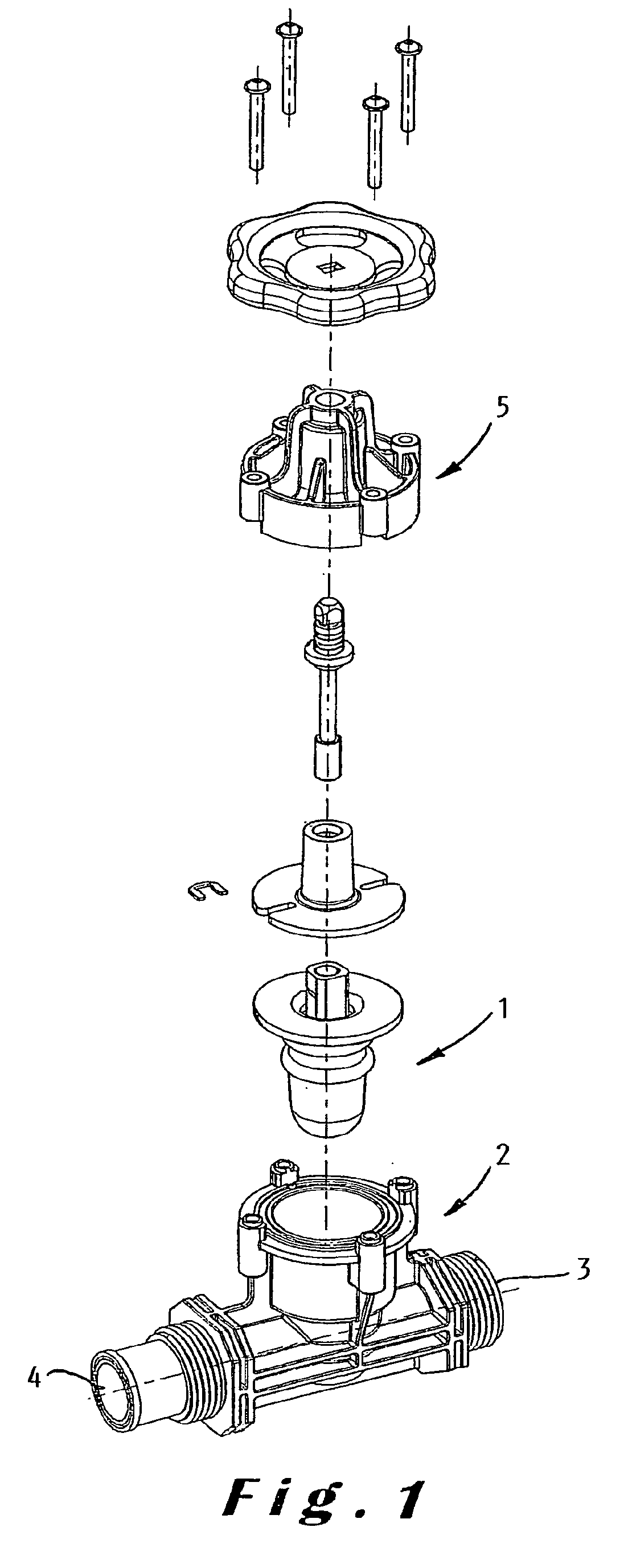
| (86) |
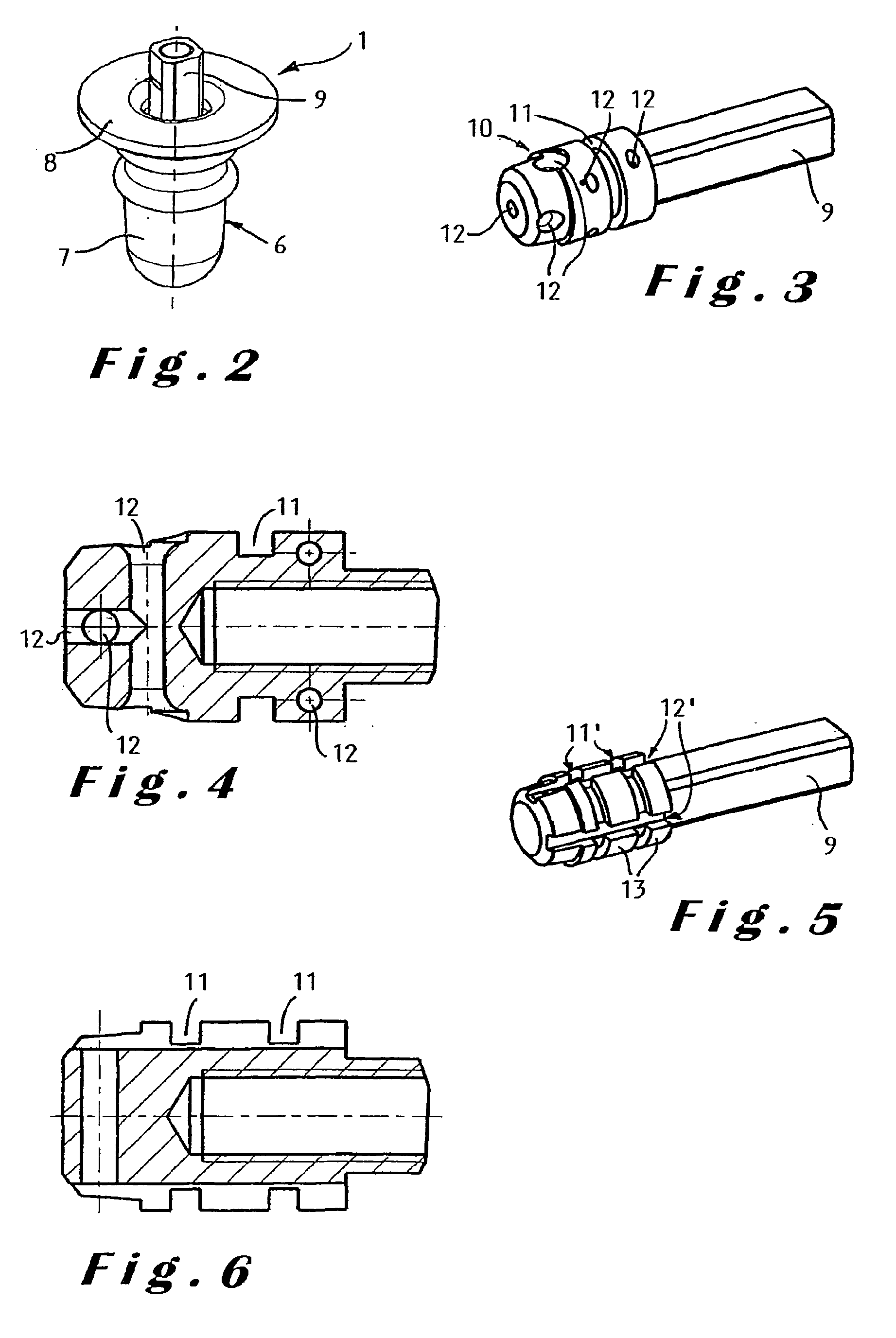
International application number: |
|
PCT/EP2005/050005 |
| (87) |
International publication number: |
|
WO 2006/072468 (13.07.2006 Gazette 2006/28) |
|
| (54) |
STOPCOCK CLOSURE PLUG
ABSPERRHAHNVERSCHLUSSSTOPFEN
BOUCHON POUR ROBINET D'ARRET
|
| (84) |
Designated Contracting States: |
|
AT BE BG CH CY CZ DE DK EE ES FI FR GB GR HU IE IS IT LI LT LU MC NL PL PT RO SE SI
SK TR |
| (43) |
Date of publication of application: |
|
19.09.2007 Bulletin 2007/38 |
| (73) |
Proprietor: Indigne, Mark |
|
2830 Willebroek (BE) |
|
| (72) |
Inventor: |
|
- Indigne, Mark
2830 Willebroek (BE)
|
| (74) |
Representative: Leherte, Georges M.L.M. et al |
|
Gevers & Vander Haeghen
Holidaystraat 5
1831 Diegem
1831 Diegem (BE) |
| (56) |
References cited: :
EP-A- 1 462 695
US-A1- 2001 032 954
|
US-A- 5 386 849
|
|
| |
|
|
|
|
| |
|
| Note: Within nine months from the publication of the mention of the grant of the European
patent, any person may give notice to the European Patent Office of opposition to
the European patent
granted. Notice of opposition shall be filed in a written reasoned statement. It shall
not be deemed to
have been filed until the opposition fee has been paid. (Art. 99(1) European Patent
Convention).
|
[0001] The invention relates to stopcock closure plugs, more particularly to stopcock closure
plugs with a closure membrane of synthetic material.
[0002] In the field of handling food and beverages, in particular drinking water, very stringent
criteria are being applied to the materials that come into contact therewith.
Whereas appropriate materials for the pipes and conducts for handling such type of
products are now commonly available, there remained serious difficulties in finding
appropriate stopcocks meeting the stringent criteria referred to.
Recently a new stopcock technology was proposed in
EP 1 462 695, comprising a housing with inlet and outlet accesses and a housing cover entirely
made of synthetic / plastic material.
This new stopcock technology however still involves problems in respect of the material
for the closure membrane. No proper material could be found that satisfies at the
same time a proper adherence (grip) of the closure membrane to the spindle nut of
the closure plug and extremely low levels of extractable elements as desirable for
food and drinking water applications.
A compromise had to be settled on low toxicity synthetic rubbers which involve an
in situ vulcanization / curing on the spindle nut for ensuring proper grip.
[0003] Furthermore from
US2001/032954 a stopcock with a closure membrane made from silicone or another suitable elastomeric
or resilient material is known, This document is considered to be the closest prior
art and corresponds to the preambles of claim 1 and claim 10.
[0004] It is an objective of this invention to overcome the drawbacks of state of the art
stopcocks by providing a stopcock in which all materials in contact with the liquid
(drinking water) can consist of materials that satisfy very stringent health and safety
criteria, and in particular all approvals for use in direct contact with food, medical
approvals and approvals for water in accordance with EC rules, US FDA approval, medical
USP class VI compliance and water-WRC criteria.
[0005] The invention therefor provides a stopcock, in particular a stopcock comprising a
housing with an inlet and an outlet access and a closure plug in the housing, and
with a spindle nut (being the driving spindle for the closure plug) and a closure
membrane adhering thereto, controlling the passage between the inlet and outlet, wherein
the stopcock closure plug membrane is made of thermoplastic elastomer (TPE).
[0006] The expression "thermoplastic elastomer' or TPE as used in the present specification
does not refer to a specific class of chemical compounds but rather to a class of
materials having a specific property profile, namely any polymeric material which
is processable as a typical thermoplastic material (in terms of injection molding,
extrusion or blow molding processability, and in terms of recyclability) but has mechanical
properties comparable to rubbers (in terms of flexibility -i.e. low stiffness- and
elasticity -i.e. compression set and tension set-).
[0007] According to a preferred feature of the invention the TPE used for the stopcock closure
plug membrane is suitably a polyester-polyether type TPE or a polyester-polyester
type TPE.
[0008] Particularly appropriate TPE types are for instance the products commercialized by
the company DSM under the references "ARNITEL E", "ARNITEL P" and "ARNITEL U".
[0009] The stopcock closure plug membranes according to the invention are particularly suitable
for use in stopcocks "essentially made of synthetic / plastic material", such as stopcocks
comprising a housing cover and a housing with its inlet and outlet accesses entirely
made of synthetic / plastic material, as described in
EP 1 462 695, the disclosure of which is hereby incorporated in this specification.
[0010] Particularly suitable stopcocks in this context, comprise, for instance, a housing
and housing cover made of a, optionally fiber reinforced, material selected from polypropylene,
polyphenylene ether and polyamide, optionally reinforced with fibers (glass fibers
or other engineering fibers), and/or a housing with its inlet and outlet accesses
consisting of a molded plastic piece comprising a longitudinal duct with longitudinal
reinforcing ribs, and a plug cavity provided with its axis perpendicular to said longitudinal
duct, with reinforcing ribs of said plug cavity extending parallel to its axis and
with at least three peripheral reinforcement zones for fixing the housing cover to
the housing, and a housing cover consisting of a molded plastic piece comprising a
cover surface with radial reinforcement ribs and/or one or more peripheral rib(s),
perpendicular to the plane of said cover surface, with at least three peripheral reinforcement
zones for fixing the housing cover to the housing, and a hollow protrusion, along
the axis of said plug cavity, for holding said driving spindle for the closure plug,
provided with radial reinforcement ribs.
[0011] The invention also specifically relates to closure plugs for controlling the passage
between the inlet and outlet of a stopcock for fluids, comprising a spindle nut and
a closure membrane adhering thereto, wherein said closure membrane is made of thermoplastic
elastomer (TPE), in particular a polyester-polyether type TPE or a polyester-polyester
type TPE.
According to a preferred feature of the invention the spindle nut of such closure
plug comprises means for ensuring proper adherence / grip of the TPE closure membrane
to the closure plug spindle nut, such as bores and/or grooves into which penetrates
the TPE material of the closure membrane, or grooves and/or protrusions cooperating
with adapted / corresponding ribs and/or grooves on the inside of the closure membrane,
to allow a forced "one-way" introduction/setting of the spindle nut in the closure
membrane.
[0012] Whereas with conventional rubbers no real problems are encountered in respect to
the adherence or grip of the membrane to the spindle nut, due to the in situ curing
(vulcanization / cross-linking / polymerization) of the rubber compound on the spindle
nut, for the stopcocks and the closure plugs according to the invention, a limited
adherence occurs with the thermoplastic elastomer.
According to a further preferred feature of the invention the spindle nut of the closure
plug can therefore most suitably comprise means for ensuring proper adherence / grip
of the TPE closure membrane to the closure plug spindle nut.
[0013] In a first preferred embodiment of the invention, such means may be linked to the
fact that the spindle nut comprises bores and/or grooves into which penetrates the
TPE material of the closure membrane.
This penetration of the TPE material into the bores and/or grooves of the spindle
nut may for instance result from injecting molten TPE on the spindle nut in a mould
for shaping the plug membrane.
[0014] In another preferred embodiment of the invention, the means means for ensuring proper
adherence / grip of the TPE closure membrane to the closure plug spindle nut may reside
in the fact that the spindle nut comprises grooves and/or protrusions cooperating
with adapted / corresponding ribs and/or grooves on the inside of the closure membrane,
to allow a forced "one-way" introduction/setting of the spindle nut in the closure
membrane.
[0015] Further features and details of the invention will become apparent from the following
description of two specific embodiments of the invention, given by way of mere illustrative
examples, having reference to the attached drawings.
[0016] In those drawings :
Figure 1 represents a view, in perspective, of a stopcock closure plug in accordance
with the invention ;
Figure 2 represents the stopcock closure plug of figure 1, in an exploded view of
a plastic stopcock according to EP 1 462 695 ;
Figure 3 represents a view, in perspective, of a first embodiment of a spindle nut
for a stopcock closure plug with a TPE closure membrane according to the invention
;
Figure 4 represents a section view of the spindle nut according of figure 3 ;
Figure 5 represents a view, in perspective, of another embodiment of a spindle nut
for a stopcock closure plug with a TPE closure membrane according to the invention
;
Figure 6 represents a section view of the spindle nut according of figure 5 ;
[0017] The stopcock shown in figure 1 comprises
a housing (2) with its outlet access (3) and its inlet access (4) and a housing cover
(5)
(both consisting of moulded (and/or tooled) plastic pieces),
and a stopcock closure plug (1) as further detailed in figure 2 and here below.
[0018] The stopcock closure plug (1) comprises an "elastic" closure membrane (6) - with
a plug part (7) adapted to control the fluid passage of the stopcock and a flange
part (8) adapted to be clamped (together with an intermediate bush) between the housing
(2) and housing cover (3) - adequately fitted to a spindle nut (9).
In accordance with the invention, the "elastic" closure membrane is made of a thermoplastic
elastomer (TPE), as specifically defined in this specification.
[0019] According to the embodiment of the invention shown in figures 3 and 4, the means
for ensuring adequate fitting (adherence/grip) of the TPE material to the spindle
nut (9) involves a spindle nut head part (10) with a circumferential groove (11) and
with several transverse bores or channels (12).
[0020] When injecting the molten thermoplastic elastomer on the spindle nut head part (10)
- in an appropriate mould - the molten TPE penetrates into the groove (11) and bores
(12), thus providing proper adherence / grip of the plug membrane to the spindle nut
head.
[0021] According to the embodiment of the invention shown in figures 5 and 6, the means
for ensuring adequate fitting (adherence/grip) of the TPE material to the spindle
nut (9') involves a spindle nut head part (10') with circumferential grooves (11')
and longitudinal grooves (12'), and corresponding ribs / protrusions (13).
[0022] When injecting the molten thermoplastic elastomer on the spindle nut head part (10')
- in an appropriate mould - the molten TPE penetrates into the grooves (11') and (12'),
thus providing proper adherence / grip of the plug membrane to the spindle nut head.
[0023] Alternatively the spindle nut according to figures 5 and 6 may also be introduced
/ set, in a forced way, into a pre-formed thermoplastic elastomer membrane, provided
with adapted/corresponding grooves and ribs/protrusions, so that once the spindle
nut has been forced into place, there is adequate fitting (adherence/grip) of the
TPE membrane to the spindle nut head.
[0024] The invention has thus been explained in detail having reference to particular embodiments.
It should however be observed that the details of these embodiment do not involve
any limitation of the scope of the invention as disclosed in the above text and as
expressed in the claims here below and that many variations within the scope of these
claims will be readily apparent to the skilled art person.
1. Stopcock assembly for controlling the passage of fluids, comprising a housing (2)
with an inlet (3) and an outlet (4) access and a closure plug (1) in the housing,
with a spindle nut (9) and a closure membrane (6) adhering thereto, controlling the
passage between the inlet (3) and outlet (4), characterized in that said closure membrane (6) is made of thermoplastic elastomer (TPE).
2. Stopcock assembly according to claim 1, characterized in that the TPE is a polyester-polyether type TPE or a polyester-polyester type TPE.
3. Stopcock assembly according to any one of claims 1 and 2, characterized in that the stopcock comprises a housing cover (5) and the housing (2) with its inlet (3)
and outlet (4) accesses made of synthetic / plastic material.
4. Stopcock assembly according to claim 3, characterized in that the housing (2) and housing cover (5) are made of a, optionally fiber reinforced,
material selected from polypropylene, polyphenylene ether and polyamide.
5. Stopcock assembly according to any one of the preceding claims, characterized in that the spindle nut (9) of the closure plug (1) comprises means for ensuring proper adherence
/ grip of the TPE closure membrane to the closure plug spindle nut.
6. Stopcock assembly according to claim 5, characterized in that the spindle nut comprises bores (12) and/or grooves (11) into which penetrates the
TPE material of the closure membrane.
7. Stopcock assembly according to claim 6, characterized in that the TPE material has penetrated into the bores (12) and/or grooves (11) of the spindle
nut as a result of injecting molten TPE on the spindle nut in a mould for shaping
the plug membrane.
8. Stopcock assembly according to claim 5, characterized in that the spindle nut comprises grooves (11) and/or protrusions (13) cooperating with adapted
/ corresponding ribs and/or grooves on the inside of the closure membrane, to allow
a forced "one-way" introduction/setting of the spindle nut in the closure membrane.
9. Stopcock assembly according to any one of claim 3 - 8, characterized in that the housing with its inlet and outlet accesses consists of a molded plastic piece
comprising a longitudinal duct with longitudinal reinforcing ribs, and a plug cavity
provided with its axis perpendicular to said longitudinal duct, with reinforcing ribs
of said plug cavity extending parallel to its axis and with at least three peripheral
reinforcement zones for fixing the housing cover to the housing, and the housing cover
consists of a molded plastic piece comprising a cover surface with radial reinforcement
ribs and/or one or more peripheral rib(s), perpendicular to the plane of said cover
surface, with at least three peripheral reinforcement zones for fixing the housing
cover to the housing, and a hollow protrusion, along the axis of said plug cavity,
for holding said driving spindle for the closure plug, provided with radial reinforcement
ribs.
10. Closure plug component (1) for a stopcock assembly for controlling the passage of
fluids, between the inlet (3) and outlet (4) of said stopcock assembly, comprising
a spindle nut and a closure membrane (6) adhering thereto, characterized in that said closure membrane (6) is made of thermoplastic elastomer (TPE).
11. Closure plug component according to claim 10,
characterized in that the TPE is a polyester-polyether type TPE or a polyester-polyester type TPE.
12. Closure plug component according to any one of claims 9 and 10, characterized in that the spindle nut of the closure plug comprises means for ensuring proper adherence
/ grip of the TPE closure membrane to the closure plug spindle nut.
13. Closure plug component according to claim 12,
characterized in that the spindle nut comprises bores and/or grooves into which penetrates the TPE material
of the closure membrane.
14. Closure plug component according to claim 13,
characterized in that the TPE material has penetrated into the bores and/or grooves of the spindle nut
as a result of injecting molten TPE on the spindle nut in a mould for shaping the
plug membrane.
15. Closure plug component according to claim 12,
characterized in that the spindle nut comprises grooves and/or protrusions cooperating with adapted / corresponding
ribs and/or grooves on the inside of the closure membrane, to allow a forced "one-way"
introduction/setting of the spindle nut in the closure membrane.
1. Sperrhahnanordnung zum Steuern des Durchlasses von Flüssigkeiten, umfassend ein Gehäuse
(2) mit einem Einlass (3) und einem Auslass (4) und einem Verschlussstopfen (1) in
dem Gehäuse, mit einer Spindelmutter (9) und einer daran befestigte Verschlussmembran
(6), die den Durchlass zwischen dem Einlass (3) und dem Auslass (4) steuern, dadurch gekennzeichnet, dass die Verschlussmembran (6) aus Thermoplastelastomer (TPE) gefertigt ist.
2. Sperrhandanordnung nach Anspruch 1, dadurch gekennzeichnet, dass das TPE ein TPE der Polyester-Polyether-Art oder ein TPE der Polyester-Polyester-Art
ist.
3. Sperrhahnanordnung nach einem der Ansprüche 1 und 2, dadurch gekennzeichnet, dass der Sperrhahn eine Gehäuseabdeckung (5) umfasst und das Gehäuse (2) mit seinem Einlass
(3) und seinem Auslass (4) aus synthetischem Material / Kunststoffmaterial gefertigt
ist.
4. Sperrhahnanordnung nach Anspruch 3, dadurch gekennzeichnet, dass das Gehäuse (2) und die Gehäuseabdeckung (5) aus einem wahlweise faserverstärkten
Material gefertigt sind, das ausgewählt ist aus Polypropylen, Polyphenylenehter und
Polyamid.
5. Sperrhahnanordnung nach einem der vorhergehenden Ansprüche, dadurch gekennzeichnet, dass die Spindelmutter (9) des Verschlussstopfens (1) Mittel zum Gewährleisten einer angemessenen
Haftung / Griffs der TPE-Verschlussmembran an der Spindelmutter des Verschlussstopfens
umfasst.
6. Sperrhahnanordnung nach Anspruch 5, dadurch gekennzeichnet, dass die Spindelmutter Bohröffnungen (12) und/oder Rillen (11) umfasst, in die das TPE-Material
der Verschlussmembran eindringt.
7. Sperrhahnanordnung nach Anspruch 6, dadurch gekennzeichnet, dass das TPE-Material in die Bohröffnungen (12) und/oder Rillen (11) der Spindelmutter
infolge des Injizierens von geschmolzenem TPE auf die Spindelmutter in eine Gussform
zum Formen der Stopfenmembran eingedrungen ist.
8. Sperrhahnanordnung nach Anspruch 5, dadurch gekennzeichnet, dass die Spindelmutter Rillen (11) und/oder Vorsprünge (13) umfasst, die mit angepassten
/ zugehörigen Rippen und/oder Rillen auf der Innenseite der Verschlussmembran zusammenwirken,
um eine "Einweg"-Einführung/Einsetzung der Spindelmutter in die Verschlussmembran
unter Druck zu ermöglichen.
9. Sperrhahnanordnung nach einem der Ansprüche 3 bis 8, dadurch gekennzeichnet, dass das Gehäuse mit seinem Einlass und seinem Auslass aus einem geformten Kunststoffstück,
das eine längs verlaufende Leitung mit längs verlaufenden Verstärkungsrippen umfasst,
und einem Stopfenhohlraum besteht, der mit seiner Achse senkrecht zu der längs verlaufenden
Leitung angeordnet ist, wobei die Verstärkungsrippen des Stopfenhohlraums parallel
zu ihrer Achse verlaufen und mindestens periphere Verstärkungsbereiche vorgesehen
sind, um die Gehäuseabdeckung an dem Gehäuse zu befestigen, wobei die Gehäuseabdeckung
aus einem geformten Kunststoffstück besteht, das eine Abdeckoberfläche mit radialen
Verstärkungsrippen und/oder eine oder mehrere periphere Rippe oder Rippen umfasst,
die zu der Ebene der Abdeckoberfläche senkrecht sind, mit mindestens drei peripheren
Verstärkungsbereichen zum Befestigen der Gehäuseabdeckung an dem Gehäuse und einem
hohlen Vorsprung entlang der Achse des Stopfenhohlraums zum Halten der Antriebsspindel
für den Verschlussstopfen, der mit radialen Verstärkungsrippen versehen ist.
10. Verschlussstopfenkomponente (1) für eine Sperrhahnanordnung zum Steuern des Durchlasses
von Flüssigkeiten zwischen dem Einlass (3) und dem Auslass (4) der Sperrhahnanordnung,
umfassend eine Spindelmutter und eine daran befestigte Verschlussmembran (6), dadurch gekennzeichnet, dass die Verschlussmembran (6) aus Thermoplastelastomer (TPE) gefertigt ist.
11. Verschlussstopfenkomponente nach Anspruch 10, dadurch gekennzeichnet, dass das TPE ein TPE der Polyester-Polyether-Art oder ein TPE der Polyester-Polyester-Art
ist.
12. Verschlussstopfenkomponente nach einem der Ansprüche 9 und 10, dadurch gekennzeichnet, dass die Spindelmutter des Verschlussstopfens Mittel zum Gewährleisten einer angemessenen
Haftung / Griffs der TPE-Verschlussmembran an der Spindelmutter des Verschlussstopfens
umfasst.
13. Verschlussstopfenkomponente nach Anspruch 12, dadurch gekennzeichnet, dass die Spindelmutter Bohröffnungen und/oder Rillen umfasst, in die das TPE-Material
der Verschlussmembran eindringt.
14. Verschlussstopfenkomponente nach Anspruch 13, dadurch gekennzeichnet, dass das TPE-Material in die Bohröffnungen und/oder Rillen der Spindelmutter infolge des
Injizierens von geschmolzenem TPE auf die Spindelmutter in eine Form zum Formen der
Stopfenmembran eingedrungen ist.
15. Verschlussstopfenkomponente nach Anspruch 12, dadurch gekennzeichnet, dass die Spindelmutter Rillen und/oder Vorsprünge umfasst, die mit angepassten / zugehörigen
Rippen und/oder Rillen auf der Innenseite der Verschlussmembran zusammenwirken, um
eine "Einweg"-Einführung/Einsetzung der Spindelmutter in die Verschlussmembran unter
Druck zu ermöglichen.
1. Ensemble de robinet d'arrêt pour contrôler le passage de fluides, comprenant un logement
(2) avec un accès d'entrée (3) et de sortie (4) et un bouchon de fermeture (1) dans
le logement, avec un écrou à broche (9) et une membrane de fermeture (6) y adhérant,
contrôlant le passage entre l'entrée (3) et la sortie (4), caractérisé en ce que ladite membrane de fermeture (6) est réalisée en élastomère thermoplastique (TPE).
2. Ensemble de robinet d'arrêt selon la revendication 1, caractérisé en ce que le TPE est un TPE de type polyester - polyéther ou un TPE de type polyester - polyester.
3. Ensemble de robinet d'arrêt selon l'une quelconque des revendications 1 et 2, caractérisé en ce que le robinet d'arrêt comprend un couvercle (5) de logement et le logement (2) avec
ses accès d'entrée (3) et de sortie (4) réalisés en matière plastique / synthétique.
4. Ensemble de robinet d'arrêt selon la revendication 3, caractérisé en ce que le logement (2) et le couvercle (5) de logement sont réalisés dans une matière, facultativement
renforcée par des fibres, choisie parmi le polypropylène, l'éther de polyphénylène
et le polyamide.
5. Ensemble de robinet d'arrêt selon l'une quelconque des revendications précédentes,
caractérisé en ce que l'écrou à broche (9) du bouchon de fermeture (1) comprend des moyens pour assurer
une adhérence / forte tenue adéquate de la membrane de fermeture en TPE à l'écrou
à broche du bouchon de fermeture.
6. Ensemble de robinet d'arrêt selon la revendication 5, caractérisé en ce que l'écrou à broche comprend des orifices (12) et / ou des rainures (11) dans lesquels
pénètre la matière TPE de la membrane de fermeture.
7. Ensemble de robinet d'arrêt selon la revendication 6,
caractérisé en ce que la matière TPE a pénétré dans les orifices (12) et / ou les rainures (11) de l'écrou
à broche du fait de l'injection de TPE fondu sur l'écrou à broche dans un moule pour
former la membrane de bouchon.
8. Ensemble de robinet d'arrêt selon la revendication 5, caractérisé en ce que l'écrou à broche comprend des rainures (11) et / ou des protubérances (13) coopérant
avec des nervures et / ou des rainures adaptées / correspondantes sur l'intérieur
de la membrane de fermeture, pour permettre l'introduction / la mise en place "unidirectionnelle"
forcée de l'écrou à broche dans la membrane de fermeture.
9. Ensemble de robinet d'arrêt selon l'une quelconque des revendications 3 - 8, caractérisé en ce que le logement avec ses accès d'entrée et de sortie consiste en une pièce en plastique
moulée comprenant un conduit longitudinal avec des nervures de renforcement longitudinales,
et une cavité pour bouchon prévue avec son axe perpendiculaire audit conduit longitudinal,
avec des nervures de renforcement de ladite cavité pour bouchon s'étendant parallèlement
à son axe et avec au moins trois zones de renforcement périphériques pour fixer le
couvercle de logement au logement, et le couvercle de logement consiste en une pièce
en plastique moulée comprenant une surface de couvercle avec des nervures de renforcement
radiales et / ou une ou plusieurs nervure(s) périphérique(s), perpendiculaires audit
plan de ladite surface de couvercle, avec au moins trois zones de renforcement périphériques
pour fixer le couvercle de logement au logement, et une protubérance creuse, le long
de l'axe de ladite cavité pour bouchon, pour retenir ladite broche d'entraînement,
pourvue de nervures de renforcement radiales.
10. Composant formant bouchon de fermeture (1) pour un ensemble de robinet d'arrêt pour
contrôler le passage de fluides, entre l'entrée (3) et la sortie (4) dudit ensemble
de robinet d'arrêt, comprenant un écrou à broche et une membrane de fermeture (6)
y adhérant, caractérisé en ce que ladite membrane de fermeture (6) est réalisée en élastomère thermoplastique (TPE).
11. Composant formant bouchon de fermeture selon la revendication 10, caractérisé en ce que le TPE est un TPE de type polyester - polyéther ou un TPE de type polyester - polyester.
12. Composant formant bouchon de fermeture selon l'une quelconque des revendications 9
et 10, caractérisé en ce que l'écrou à broche du bouchon de fermeture comprend des moyens pour assurer une adhérence
/ forte tenue adéquate de la membrane de fermeture en TPE à l'écrou à broche du bouchon
de fermeture.
13. Composant formant bouchon de fermeture selon la revendication 12, caractérisé en ce que l'écrou à broche comprend des orifices et / ou des rainures dans lesquels pénètre
la matière TPE de la membrane de fermeture.
14. Composant formant bouchon de fermeture selon la revendication 13, caractérisé en ce que la matière TPE a pénétré dans les orifices et / ou les rainures de l'écrou à broche
du fait de l'injection de TPE fondu sur l'écrou à broche dans un moule pour former
la membrane de bouchon.
15. Composant formant bouchon de fermeture selon la revendication 12, caractérisé en ce que l'écrou à broche comprend des rainures et / ou des protubérances coopérant avec des
nervures et / ou des rainures adaptées / correspondantes sur l'intérieur de la membrane
de fermeture, pour permettre l'introduction / la mise en place "unidirectionnelle"
forcée de l'écrou à broche dans la membrane de fermeture.
REFERENCES CITED IN THE DESCRIPTION
This list of references cited by the applicant is for the reader's convenience only.
It does not form part of the European patent document. Even though great care has
been taken in compiling the references, errors or omissions cannot be excluded and
the EPO disclaims all liability in this regard.
Patent documents cited in the description