|
(11) | EP 1 592 731 B1 |

| (12) | EUROPEAN PATENT SPECIFICATION |
|
|
| (54) |
SILOXANE-BASED POLYAMIDE ELASTOMERS AUF SILOXAN BASIERENDE POLYAMIDELASTOMERE ELASTOMERES POLYAMIDES A BASE DE SILOXANE |
|
|
|||||||||||||||||||||||||||||||
| Note: Within nine months from the publication of the mention of the grant of the European patent, any person may give notice to the European Patent Office of opposition to the European patent granted. Notice of opposition shall be filed in a written reasoned statement. It shall not be deemed to have been filed until the opposition fee has been paid. (Art. 99(1) European Patent Convention). |
[0001] This invention is an improvement and a modification of the method of making siloxane-based polyamides, as described for example in US Patent 5,981,680 referred to hereafter as the '680 patent.
[0002] Silicone elastomers can be produced from linear silicone polymers by a wide variety of crosslinking reactions. In the case of a silicone bathtub caulk, for example, the crosslinking reaction occurs between reactive silanol groups (=SiOH) and acetoxy groups (≡SiOCOCH3).
For each crosslink formed, a molecule of acetic acid is released, which produces the characteristic vinegar smell as the caulk cures. The acetoxy group in such a scenario is called a leaving group, because it is converted to acetic acid which leaves, i.e., evaporates, when the crosslink is formed. While there exist many other different crosslinking schemes to prepare silicone elastomers, those silicone elastomers designed for use in personal care applications all typically use hydrosilylation as the crosslinking reaction
[0003] There are many advantages for using hydrosilylation as the crosslinking reaction. It proceeds very rapidly, it requires very small amounts of a platinum catalyst, i.e., typically Karstedt's catalyst, as known in the art, and it does not involve a leaving group. But the most important reason for its popularity is that there are very few limitations in the types of materials that can be used as crosslinkers and polymers in the preparation of silicone elastomers. For example, the SiH functionality can be part of a polyorganosiloxane polymer, a silicone resin, or some other type of silicone or organosilicon composition. Similarly, the R group can be attached to a silicone, a hydrocarbon, or some other type of organic compound. This flexibility allows one skilled in the art to graft many and varied types of functional groups into the elastomer.
[0004] While siloxane-based polyamide elastomers are generally known in the art, as evidenced by US Patent 4,675,372 (June 23, 1987), referred to hereafter as the '372 patent, it does not employ hydrosilylation as the mechanism of reaction, and the components used to form siloxane-based polyamide elastomers in the '372 patent are not the same as, or the equivalent of, the components according to the present invention. Hence, the elastomers prepared according to the '372 patent would necessarily not be the same as the elastomers prepared herein.
[0005] While the '680 patent does refer to a method of preparing crosslinked molecules, it differs from the method herein in that the '680 patent uses a triamine, i.e., a tri-functional amine, in place of an organic diamine, in the preparation of the vinyl functional amide and the hydride functional polyorganosiloxane in the '680 patent is ≡SiH endblocked and contains no pendant hydrogen, as in the method of this invention. These differences are significant in that when an organic vinyl functional triamide is used, the crosslinker is the hydride functional polyorganosiloxane rather than the organic amide, i.e., see Formula IV in the '680 patent. In the method according to this invention, however, the organic diamide is the crosslinker between molecular chains of the pendant hydrogen containing hydride functional polyorganosiloxane. Hence, elastomers prepared according to the '680 patent would necessarily not be the same as the elastomers prepared herein.
[0006] This invention is directed to a method of making a siloxane-based polyamide elastomer by reacting an organic amide with a hydride functional polyorganosiloxane in the presence of a hydrosilylation catalyst to form the siloxane-based polyamide elastomer. The hydride functional polyorganosiloxane is a polymer or copolymer containing at least one pendant hydrogen.
[0007] The organic amine can be a compound such as hexamethylene diamine, ethylene diamine, and decamethylene diamine. The olefinic acid can be a compound such as undecylenic acid, acrylic acid, 3-butenoic acid, and 4-pentenoic acid.
[0008] If desired, a specified amount of a chain stopping agent can be included. Suitable chain stopping agents are described in US Patent Publication 20030105260 A1 entitled Methods for Making Silicone-Organic Copolymers.
[0009] The siloxane-based polyamide elastomer prepared by this method is a useful component of personal care type products, and it can be applied to the hair, skin, or underarm areas of the human body. It can also be used to modify thermoplastic nylons, and for treating woven and non-woven textiles, such as air bags, carpeting, and apparel.
The Hydride Functional Polyorganosiloxane
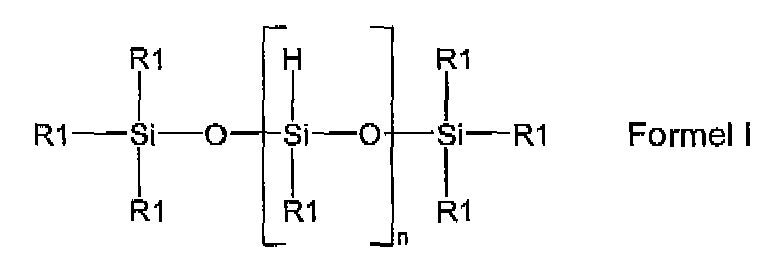
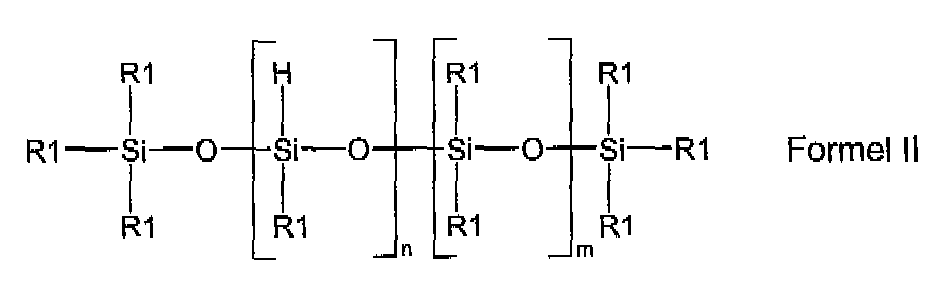
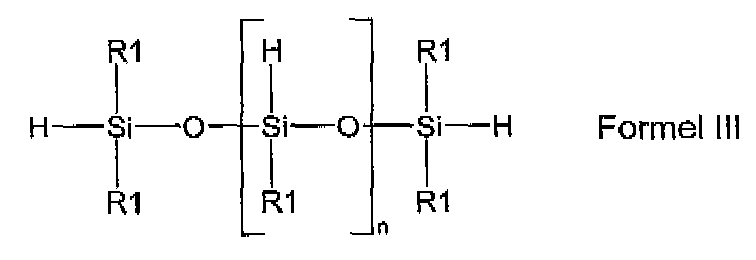
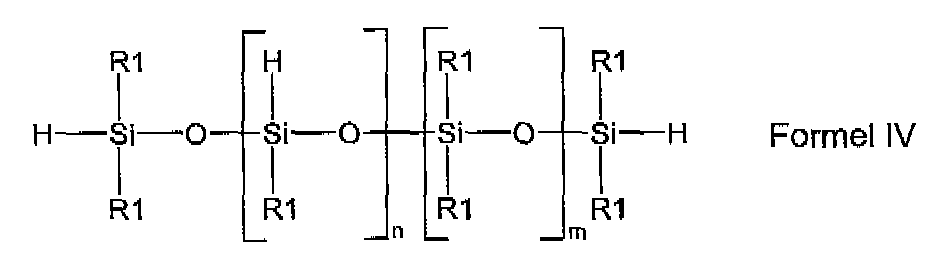
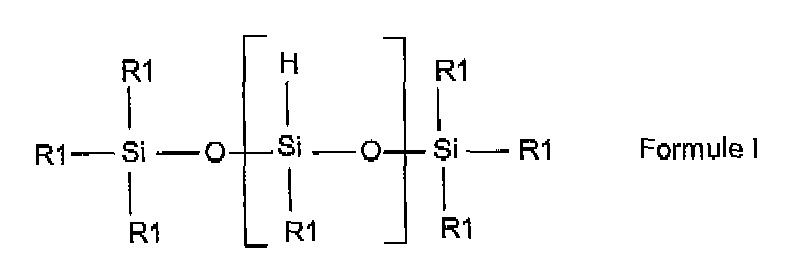
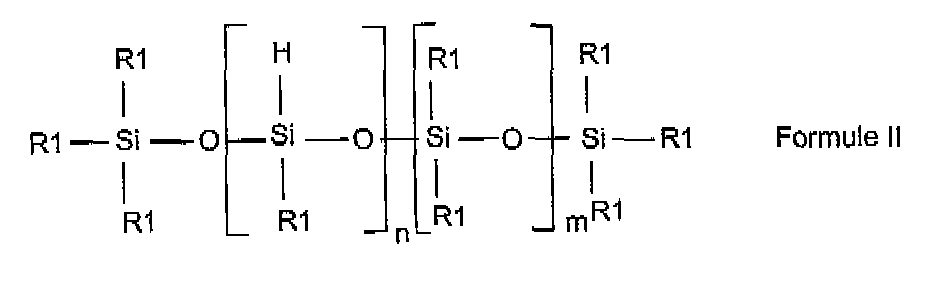
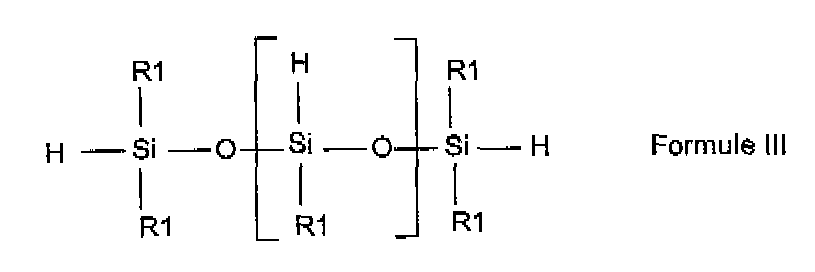
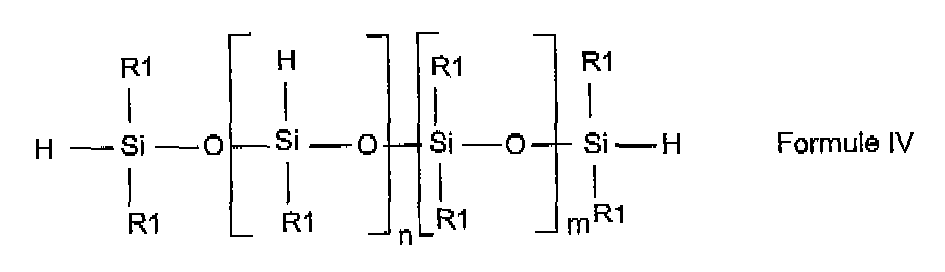
[0010] The hydride functional polyorganosiloxane (HFPOS) which is used in the process of the present invention is a HYPOS conforming generally to a polymer or copolymer having a formula corresponding to one of Formulas I-IV shown below.
[0011] In these formulas, R1 represents (i) an alkyl group containing 1-20 carbon atoms such as methyl, ethyl, propyl, isopropyl, butyl, isobutyl, pentyl, hexyl, octyl, dodecyl, and octadecyl; (ii) an aryl group such as phenyl, xenyl, i.e., diphenyl, napthyl, and anthracyl; (iii) an alkaryl, i.e., alkylaryl group such as tolyl and xylyl; (iv) an aralkyl, i.e., arylalkyl group such as benzyl, i.e., phenylmethyl, phenylethyl, i.e., phenethyl, and 2-phenylpropyl; and (v) n and m each have a value of 1-1,000. The HFPOS in Formulas I-IV contains at least one pendant hydrogen.
The Olefinic Acid
[0012] Some representative examples of suitable olefinic acids which can be used include undecylenic acid H2C=CH(CH2)8COOH, acrylic acid H2C=CHCOOH, 3-butenoic acid (vinylacetic acid) H2C=CHCH2COOH, 4-pentenoic acid H2C=CHCH2CH2COOH, and other olefinic acids with carbon chains of varying length.
The Organic Amine
[0013] Some representative examples of suitable organic amines which can be used include linear alkyl diamines such as hexamethylene diamine, ethylene diamine, mixtures of such linear alkyl diamines, as well as other amines such as decamethylene diamine.
The Organic Amide
[0014] Since one step of the process of the present invention, as illustrated schematically below, involves a reaction scenario in which an olefinic acid is reacted with an organic diamine to produce the organic diamide, the particular organic diamide will necessarily depend upon the particular olefinic acid and organic diamine which are employed.
In this regard, it should be noted that some level of saturated or non-vinyl terminated olefinic acid may be needed to limit the crosslink-density, in accordance with US Patent Publication 20030105260 A1, entitled Methods for Making Silicone-Organic Copolymers.
[0015] The organic amide is then in turn reacted with the hydride-functional polyorganosiloxane in the presence of a hydrosilylation catalyst to form siloxane-based polyamide elastomers.
The Catalyst
[0016] As noted above, a catalyzed hydrosilylation reaction is employed according to this invention, and so the process requires a catalyst to effect the reaction between the hydride functional polyorganosiloxane and the material containing unsaturation, i.e., the organic diamide in the case of the present invention. Suitable catalysts are Group VIII transition metals, i.e., the noble metals. Such noble metal catalysts are described in US Patent 3,923,705. One preferred platinum catalyst is Karstedt's catalyst, which is described in Karstedt's US Patents 3,715,334 and 3,814,730. Karstedt's catalyst is a platinum divinyl tetramethyl disiloxane complex typically containing one weight percent of platinum in a solvent such as toluene. Another preferred platinum catalyst is a reaction product of chloroplatinic acid and an organosilicon compound containing terminal aliphatic unsaturation,as described in US Patent 3,419,593. Most preferred as the catalyst is a neutralized complex of platinous chloride and divinyl tetramethyl disiloxane, for example as described in US Patent 5,175,325.
[0017] The noble metal catalyst can be used in an amount of from 0.00001-0.5 parts per 100 weight parts of the hydride functional polyorganosiloxane. Preferably, the catalyst should be used in an amount sufficient to provide 5-15 parts per million (ppm) Pt metal per total composition.
The Solvent
[0018] US Patents 5,811,487 (September 22, 1998) and 5,889,108 (March 30, 1999) contain extensive lists of appropriate compositions which can be used, among which are for example, (i) volatile polydimethylsiloxanes such as hexamethyldisiloxane, octamethyltrisiloxane, and decamethylcyclopentasiloxane, (ii) nonvolatile polydimethylsiloxanes having a viscosity generally in the range of 5-1,000 centistoke (mm2/s), (iii) fragrances such as musk and myrrh, and (iv) mixtures thereof.
[0019] Organic oils such as natural oils derived from animal, vegetable, or mineral sources are also suitable. Most preferred are modem cosmetic oils known to be safe for cosmetic purposes such as almond oil, apricot kernel oil, avocado oil, cacao butter (theobroma oil), carrot seed oil, castor oil, citrus seed oil, coconut oil, corn oil, cottonseed oil, cucumber oil, egg oil, jojoba oil, lanolin oil, linseed oil, mineral oil, mink oil, olive oil, palm kernel oil, peach kernel oil, peanut oil, rapeseed oil, safflower oil, sesame oil, shark liver oil, soybean oil, sunflower seed oil, sweet almond oil, tallow (beef) oil, tallow (mutton) oil, turtle oil, vegetable oil, whale oil, and wheat germ oil.
[0020] Solvents considered in the art as being non-aqueous polar solvents can be used, although compositions containing such solvents intended for personal care applications, should be limited to only non-aqueous polar solvents generally recognized as being cosmetically acceptable. Some representative examples of cosmetically acceptable non-aqueous polar solvents which can be used are monohydroxy alcohols such as ethyl alcohol and isopropyl alcohol; diols and triols such as propylene glycol, 1,2-hexanediol CH3(CH2)3CH(OH)CH2OH, and glycerol; glycerol esters such as glyceryl triacetate (triacetin), glyceryl tripropionate (tripropionin), and glyceryl tributyrate (tributyrin); and polyglycols such as polyethylene glycol. In applications other than personal care, however, these and other non-aqueous polar solvents can be employed.
[0021] While the use of a solvent is beneficial in many cases, the use of one or more solvents is not absolutely required. For example, in typical state of the art siloxane-based polyamide systems, toluene and xylene have been generally used, but possess the disadvantage in that they require removal by an added stripping process when the siloxane-based polyamides are intended for applications where odor, health, and/or environmental regulations are a concern. In such instances, no solvent or the use of compositions such as decamethylcyclopentasiloxane and phenyl tris (trimethylsiloxy) silane are generally considered solutions. Similarly, polypropylene glycol ethers of linear alcohols such as myristyl alcohol, may also be used. Typical of these glycol ethers are compositions such as PPG-3 myristyl ether and PPG-4 myristyl ether.
[0022] When solvents are omitted, siloxane-based polyamides of high molecular weight with a nearly clear appearance and low color can be made, when there is sufficient mixing during polymerization. Solventless as used herein is intended to cover instances wherein (i) minor amounts of residual solvent are introduced as part of the catalyst preparation, as well as to (ii) instances wherein no additional solvent is present.
[0023] Carrying out of the process is simply a matter of combining the hydride functional polyorganosiloxane(s), the material containing unsaturation, i.e., the organic amide, and the catalyst; and mixing these ingredients. The reaction temperature can vary over a wide range, and the optimum temperature is dependent upon the concentration of the catalyst and the nature of the reactants. Ordinarily, it is best to keep the reaction temperature below 300 °C. Best results with most reactants can be obtained by initiating the reaction at 80 °C to 180 °C, and maintaining the reaction within reasonable limits of this range.
[0024] Typically, the process is carried out using approximately a 1:1 molar ratio of the hydride functionality within the polyorganosiloxane and the material containing unsaturation. It is expected that useful materials may also be prepared by carrying out the process with an excess of either the hydride functional polyorganosiloxane or the material containing unsaturation, but this would be considered a less efficient use of the materials. When the process includes the use of a solvent(s), the solvent is present in an amount of 1-85 percent by weight, based on the total weight of the composition. As previously noted, however, the solvent(s) component of the process is optional, and so it can be omitted, if desired.
EXAMPLES
[0026] The hydride functional polyorganosiloxanes used in these examples were copolymers having a structure corresponding to Formula II noted above. In Example 1, the value of m was 93 and the value of n was 6. In Example 2, the value of m was 396 and the value of n was 4. Molecular weights are reported as weight average (Mw).
Example 1:
[0027] A 500 ml three neck round bottom flash, equipped with a temperature probe, an electrical stirrer, and a condenser, was charged with 7.6 gram of an organic diamide prepared by reacting undecylinic acid and hexamethylene diamine, 7.6 gram of PPG-4 myristyl ether (solvent), and 160 gram of decamethylcycolpentasiloxane (solvent). The mixture was heated to 130 °C for 15 minutes to dissolve the organic diamide. Next 40 gram of a hydride functional polyorganosiloxane was added dropwise via an addition funnel. Following the addition of 5 gram of the hydride functional polyorganosiloxane, 0.2 gram of a platinum catalyst was added. After addition of the remaining siloxane(s), another 0.2 gram of platinum catalyst was added. The reaction mixture was stirred for 1 hour to allow growth and crosslinking of the polymer. Analysis of the final composition indicated that it was a gel-like material with an elastomeric portion having a molecular weight of 107, 500. The polydispersity of this elastomer was 3.66. Example 2:
[0028] A 500 ml three neck round bottom flash, equipped with a temperature probe, an electrical stirrer, and a condenser, was charged with 6.35 gram of an organic diamide prepared by reacting undecylinic acid and hexamethylene diamine, 3.24 gram of PPG-4 myristyl ether (solvent), and 52 gram of decamethylcycolpentasiloxane (solvent). The mixture was heated to 130 °C for 15 minutes to dissolve the organic diamide. Then 212 gram of a hydride functional polyorganosiloxane was added dropwise via an addition funnel. Following the addition of 5 gram of the hydride functional polyorganosiloxane, 0.2 gram of a platinum catalyst was added. After addition of the remaining siloxane(s), another 0.2 gram of the platinum catalyst was added. The reaction mixture was stirred for 1 hour to allow growth and crosslinking of the polymer. Analysis of the final composition indicated that it was a gel-like material with an elastomeric portion having a molecular weight of 151,000. The polydispersity of this elastomer was 3.05.
[0029] The siloxane-based polyamide elastomer according to this invention is especially useful in personal care, for example, in the preparation of antiperspirants and deodorants. It can be used in skin creams, skin care lotions, moisturizers, facial treatments such as acne or wrinkle removers, personal and facial cleansers, bath oils, perfumes, colognes, sachets, sunscreens, pre-shave and after-shave lotions, shaving soaps, and shaving lathers. It can be used in hair shampoos, hair conditioners, hair sprays, mousses, permanents, depilatories, and cuticle coats. In cosmetics, it can be added to make-ups, color cosmetics, foundations, blushes, lipsticks, eyeliners, mascara, oil removers, color cosmetic removers, and powders. In such applications, it may include oil soluble, polar solvent soluble, and water soluble ingredients such as vitamins.
[0030] The siloxane-based polyamide elastomer is also capable of functioning as a carrier for pharmaceuticals, biocides, herbicides, pesticides, and other biologically active substances; and it has utility as an additive for cellulosic or synthetic nonwoven carrier substrates used in wet-like cleansing wipes such as wet-wipes, tissues, and towels, marketed generally for personal hygiene and household cleaning tasks. The siloxane-based polyamide elastomer can also be used to modify thermoplastic nylons, and for treating woven and non-woven textiles such as air bags, carpeting, and apparel
1. A method of making a siloxane-based polyamide elastomer comprising heating and reacting
(i) an organic amide with (ii) a hydride functional polyorganosiloxane, optionally
in the presence of (iii) a solvent, and (iv) a hydrosilylation catalyst, to form the
siloxane-based polyamide elastomer; the hydride functional polyorganosiloxane being
a polymer or copolymer having a formula selected from
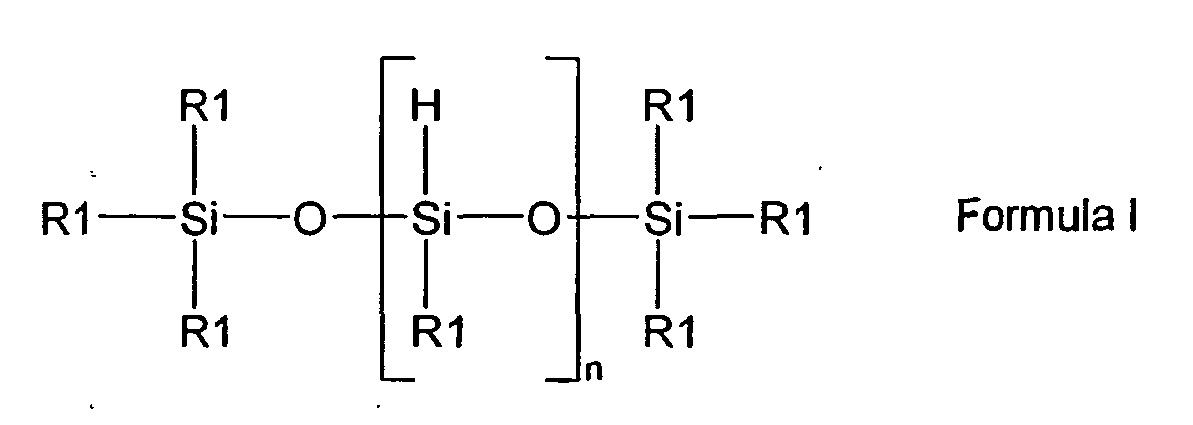
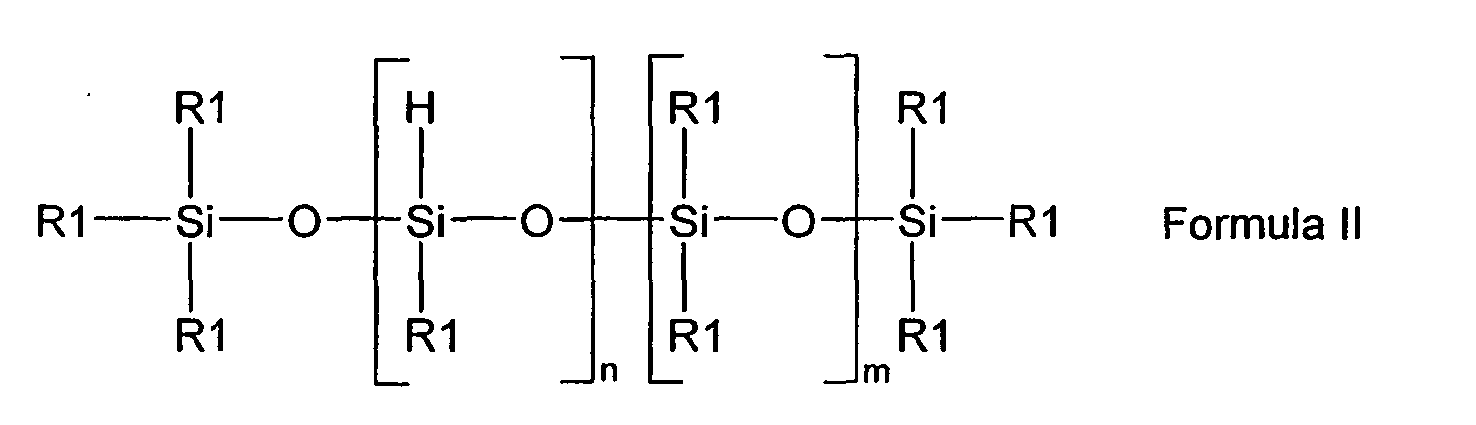
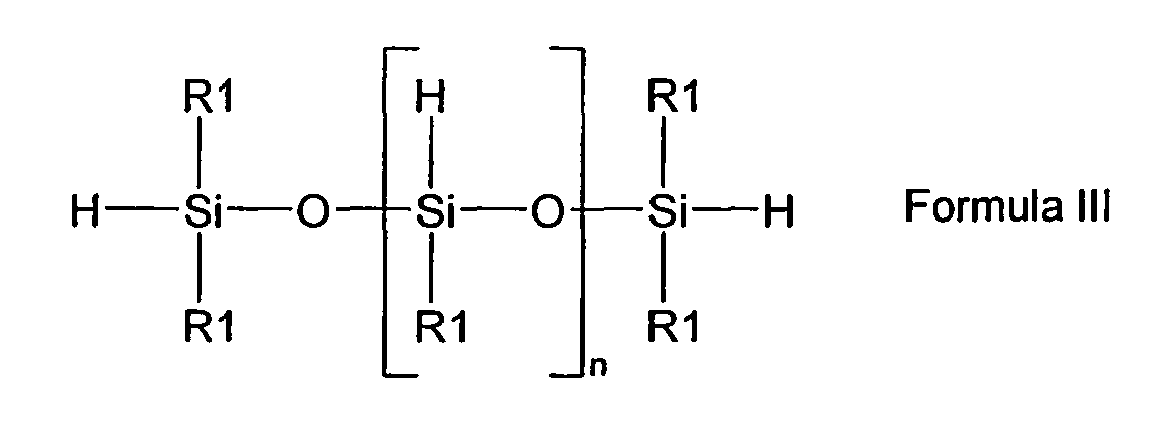
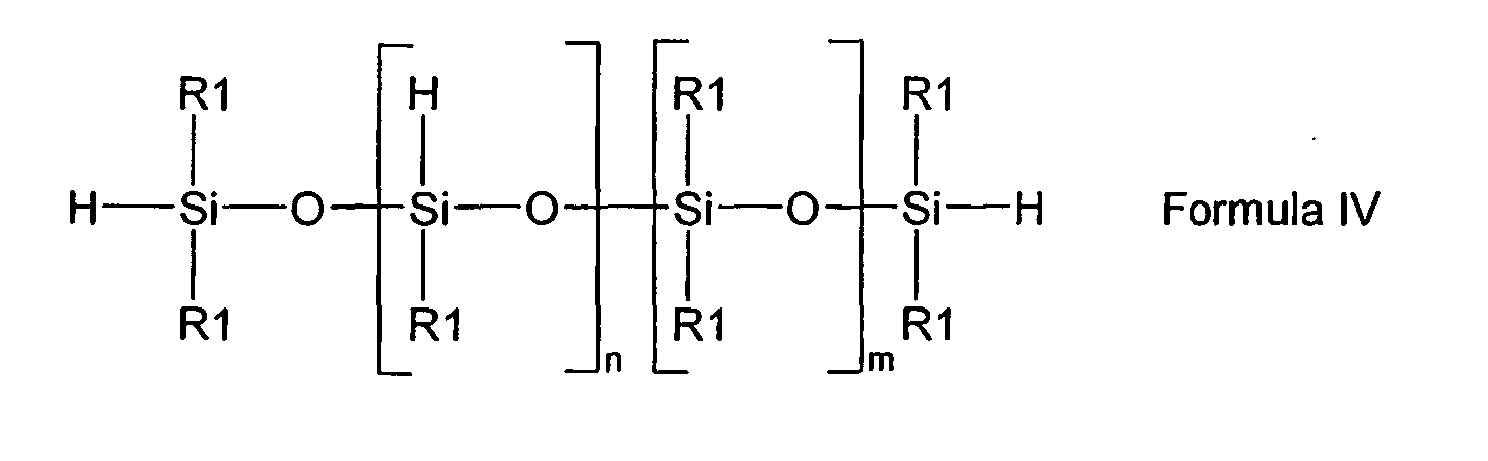
wherein R1 represents (i) an alkyl group containing 1-20 carbon atoms; (ii) an aryl group; (iii) an alkaryl group; or (iv) an aralkyl group; and (v) n and m each have a value of 1-1,000.
wherein R1 represents (i) an alkyl group containing 1-20 carbon atoms; (ii) an aryl group; (iii) an alkaryl group; or (iv) an aralkyl group; and (v) n and m each have a value of 1-1,000.
2. A method according to Claim 1 in which the organic amide is a diamide prepared from
an organic diamine selected from the group consisting of hexamethylene diamine, ethylene
diamine, and decamethylene diamine, and an olefinic acid.
3. A method according to Claim 2 in which the olefinic acid is a compound selected from
the group consisting of undecylenic acid, acrylic acid, 3-butenoic acid, and 4-pentenoic
acid.
4. A siloxane-based polyamide elastomer prepared according to the method defined in Claim
1.
5. A product containing the siloxane-based polyamide elastomer of Claim 4 in which the
product is selected from the group consisting of antiperspirants, deodorants, skin
creams, skin care lotions, moisturizers, facial treatments, acne removers, wrinkle
removers, personal cleansers, facial cleansers, bath oils, perfumes, colognes, sachets,
sunscreens, pre-shave lotions, after-shave lotions, shaving soaps, shaving lathers,
hair shampoos, hair conditioners, hair sprays, mousses, permanents, depilatories,
cuticle coats, make-up, color cosmetics, foundations, blushes, lipsticks, eyeliners,
mascara, oil removers, color cosmetic removers, bath powders, body powders, pharmaceuticals,
biocides, herbicides, pesticides, biologically active substances, cellulosic substrates,
synthetic nonwoven substrates, wet-cleansing wipes, tissues, and towels.
6. A method of treating hair, skin, or underarm, comprising applying to hair, skin, or
underarm the siloxane-based polyamide elastomer of Claim 4.
7. A method of modifying thermoplastic nylons comprising applying to the thermoplastic
nylons the siloxane-based polyamide elastomer of Claim 4.
8. A method of treating woven and non-woven textiles comprising applying to the textiles
the siloxane-based polyamide elastomer of Claim 4.
1. Verfahren zur Herstellung eines Polyamidelastomers auf Siloxanbasis, umfassend Erwärmen
und Umsetzen von (i) einem organischen Amid mit (ii) einem hydridfunktionellen Polyorganosiloxan,
optional in Gegenwart von (iii) einem Lösungsmittel, und (iv) einem Hydrosilylierungskatalysator,
um das Polyamidelastomer auf Siloxanbasis zu bilden, wobei das hydridfunktionelle
Polyorganosiloxan ein Polymer oder Copolymer ist mit einer Formel, ausgewählt aus
worin R1 für (i) eine Alkylgruppe mit 1-20 Kohlenstoffatomen, (ii) eine Arylgruppe, (iii) eine Alkarylgruppe oder (iv) eine Aralkylgruppe steht und (v) n und m jeweils einen Wert von 1-1.000 aufweisen.
worin R1 für (i) eine Alkylgruppe mit 1-20 Kohlenstoffatomen, (ii) eine Arylgruppe, (iii) eine Alkarylgruppe oder (iv) eine Aralkylgruppe steht und (v) n und m jeweils einen Wert von 1-1.000 aufweisen.
2. Verfahren nach Anspruch 1, bei dem das organische Amid ein Diamid ist, das aus einem
organischen Diamin, ausgewählt aus der Gruppe bestehend aus Hexamethylendiamin, Ethylendiamin
und Decamethylendiamin, und einer olefinischen Säure hergestellt ist.
3. Verfahren nach Anspruch 2, bei dem die olefinische Säure eine Verbindung ist, die
ausgewählt ist aus der Gruppe bestehend aus Undecylencarbonsäure, Acrylsäure, 3-Butencarbonsäure
und 4-Pentencarbonsäure.
4. Polyamidelastomer auf Siloxanbasis, das gemäß dem Verfahren wie in Anspruch 1 definiert
hergestellt ist.
5. Produkt, enthaltend das Polyamidelastomer auf Siloxanbasis nach Anspruch 4, wobei
das Produkt ausgewählt ist aus der Gruppe bestehend aus Antitranspirationsmitteln,
Deodorantien, Hautcremes, Hautpflegelotionen, feuchtigkeitsspendenden Präparaten,
Gesichtsbehandlungspräparaten, Anti-Aknepräparaten, Anti-Faltenpräparaten, Körperreinigungsmitteln,
Gesichtsreinigungsmitteln, Badeölen, Parfums, Eau de Colognes, Sachets, Sonnenschutzmitteln,
Pre-Shave-Lotionen, After-Shave-Lotionen, Rasierseifen, Rasierschäumen, Haarshampoos,
Haarkonditionierern, Haarsprays, Schäumen, Dauerwellpräparaten, Haarentfernungsmitteln,
Nagelhautabdeckern, Make-Ups, dekorativen Kosmetika, Grundierungen, Rouges, Lippenstiften,
Eyelinern, Wimperntuschen, Ölentfernern, Make-Up-Entfernern, Badepulvern, Körperpudern,
Pharmazeutika, Bioziden, Herbiziden, Pestiziden, biologisch aktiven Substanzen, Cellulosesubstraten,
synthetischen nichtgewebten Substraten, Feuchtreinigungstüchern, Papiertaschentüchern
und Papierhandtüchern.
6. Verfahren zur Behandlung von Haar, Haut oder Achselhöhle, umfassend Aufbringen auf
das Haar, die Haut oder die Achselhöhle des Polyamidelastomers auf Siloxanbasis nach
Anspruch 4.
7. Verfahren zur Modifizierung von thermoplastischen Nylonpolymeren, umfassend Aufbringen
des Polyamidelastomers auf Siloxanbasis nach Anspruch 4 auf die thermoplastischen
Nylonpolymere.
8. Verfahren zur Behandlung von gewebten und nichtgewebten Textilien, umfassend Aufbringen
des Polyamidelastomers auf Siloxanbasis nach Anspruch 4 auf die Textilien.
1. Procédé de fabrication d'un élastomère de type polyamide à base de siloxane comprenant
le chauffage et la mise à réagir (i) d'un amide organique avec (ii) un polyorganosiloxane
à fonctionnalité hydrure, facultativement en présence de (iii) un solvant et (iv)
un catalyseur d'hydrosilylation, pour former l'élastomère de type polyamide à base
de siloxane, le polyorganosiloxane à fonctionnalité hydrure étant un polymère ou un
copolymère de formule sélectionnée parmi :
où R1 représente (i) un groupe alkyle contenant 1 à 20 atomes de carbone ; (ii) un groupe aryle ; (iii) un groupe alkaryle ; ou (iv) un groupe aralkyle ; et (v) n et m ont chacun une valeur de 1 à 1 000.
où R1 représente (i) un groupe alkyle contenant 1 à 20 atomes de carbone ; (ii) un groupe aryle ; (iii) un groupe alkaryle ; ou (iv) un groupe aralkyle ; et (v) n et m ont chacun une valeur de 1 à 1 000.
2. Procédé selon la revendication 1, dans lequel l'amide organique est un diamide préparé
à partir d'une diamine organique sélectionnée dans le groupe constitué de l'hexaméthylènediamine,
de l'éthylènediamine et de la décaméthylènediamine, et d'un acide oléfinique.
3. Procédé selon la revendication 2, dans lequel l'acide oléfinique est un composé sélectionné
dans le groupe constitué de l'acide undécylénique, de l'acide acrylique, de l'acide
3-buténoïque et de l'acide 4-penténoïque.
4. Elastomère de type polyamide à base de siloxane préparé selon le procédé défini à
la revendication 1.
5. Produit contenant l'élastomère de type polyamide à base de siloxane selon la revendication
4, dans lequel le produit est sélectionné dans le groupe constitué des antitranspirants,
des déodorants, des crèmes pour la peau, des lotions de soin cutané, des humidifiantes,
des traitements du visage, des antiacnéïques, des antirides, des nettoyants corporels,
des nettoyants du visage, des huiles de bain, des parfums, des eaux de toilette, des
sachets, des écrans solaires, des lotions avant rasage, des lotions après rasage,
des savons de rasage, des mousses de rasage, des shampoings capillaires, des lotions
capillaires, des sprays capillaires, des mousses, des permanentes, des épilatoires,
des vernis à ongles, du maquillage, des cosmétiques colorés, des fonds de teint, des
fars à joues, des rouges à lèvres, des eyeliners, des mascaras, des démaquillants
huileux, des démaquillants de cosmétiques colorés, des poudres de bain, des poudres
corporelles, des produits pharmaceutiques, des biocides, des herbicides, des pesticides,
des substances bioactives, des substrats cellulosiques, des substrats non tissés synthétiques,
des lingettes humides, des mouchoirs en papier et des serviettes.
6. Procédé de traitement des cheveux, de la peau ou des aisselles, comprenant l'application
aux cheveux, à la peau ou aux aisselles de l'élastomère de type polyamide à base de
siloxane selon la revendication 4.
7. Procédé de modification de nylons thermoplastiques comprenant l'application aux nylons
thermoplastiques de l'élastomère de type polyamide à base de siloxane selon la revendication
4.
8. Procédé de traitement de textiles tissés et non tissés comprenant l'application aux
textiles de l'élastomère de type polyamide à base de siloxane selon la revendication
4.
REFERENCES CITED IN THE DESCRIPTION
This list of references cited by the applicant is for the reader's convenience only. It does not form part of the European patent document. Even though great care has been taken in compiling the references, errors or omissions cannot be excluded and the EPO disclaims all liability in this regard.
Patent documents cited in the description
- US5981680A [0001]
- US4675372A [0004]
- US20030105260A1 [0008] [0014]
- US3923705A [0016]
- US3715334A [0016]
- US3814730A [0016]
- US3419593A [0016]
- US5175325A [0016]
- US5811487A [0018]
- US5889108A [0018]