| (19) |
 |
|
(11) |
EP 1 898 760 B1 |
| (12) |
EUROPEAN PATENT SPECIFICATION |
| (45) |
Mention of the grant of the patent: |
|
20.01.2010 Bulletin 2010/03 |
| (22) |
Date of filing: 03.07.2006 |
|
| (51) |
International Patent Classification (IPC):
|
| (86) |
International application number: |
|
PCT/GB2006/002457 |
| (87) |
International publication number: |
|
WO 2007/007038 (18.01.2007 Gazette 2007/03) |
|
| (54) |
TOASTER
TOASTER
GRILLE-PAIN
|
| (84) |
Designated Contracting States: |
|
AT BE BG CH CY CZ DE DK EE ES FI FR GB GR HU IE IS IT LI LT LU LV MC NL PL PT RO SE
SI SK TR |
| (30) |
Priority: |
07.07.2005 GB 0513913
|
| (43) |
Date of publication of application: |
|
19.03.2008 Bulletin 2008/12 |
| (73) |
Proprietor: Kenwood Limited |
|
Havant,
Hampshire PO9 2NH (GB) |
|
| (72) |
Inventor: |
|
- LEAMAN, Keith
Havant, Hampshire PO9 2NH (GB)
|
| (74) |
Representative: Marsh, Robin Geoffrey |
|
QED Intellectual Property Limited
Parchment House
13 Northburgh Street
London
EC1V 0JP
London
EC1V 0JP (GB) |
|
| |
|
| Note: Within nine months from the publication of the mention of the grant of the European
patent, any person may give notice to the European Patent Office of opposition to
the European patent
granted. Notice of opposition shall be filed in a written reasoned statement. It shall
not be deemed to
have been filed until the opposition fee has been paid. (Art. 99(1) European Patent
Convention).
|
[0001] This invention relates to toasters, and it relates especially, though not exclusively,
to toasters intended for use in the domestic kitchen.
[0002] Electrically operated toasters are stock items in most domestic kitchens, and they
tend to be reasonably robust and reliable in use, despite the relatively modest purchase
prices which have come to be established for them. Changes in traditional eating habits,
however, leading to the development of popular taste for a wider variety of toastable
foodstuffs, have recently led to technical developments which have increased the sophistication
of toasters, enhancing their efficiency and providing greater flexibility of use.
[0003] One particular aspect of toasters which has received attention in this respect is
their ability to cope with foodstuffs of quite widely differing dimensions; in particular,
the thickness dimension of foodstuffs which users may wish to toast can vary quite
widely. Several proposals have thus been made for so-called "variable-slot" toasters
which can accommodate foodstuffs having width dimensions ranging from relatively narrow,
say for thinly-sliced bread, to relatively wide, for bagels and similar products.
[0005] Not all of these proposals have been commercially successful, however, and it is
believed in this respect that (inter alia) difficulties have been experienced in constructing
certain internal components whose dimensions need to change with variations in slot
width economically whilst maintaining ruggedness and reliability in operation, bearing
in mind that such internal components operate in an extremely hostile and challenging
environment.
[0006] Such difficulties as aforementioned are particularly acute in respect of the foodstuff-supporting
carriage, which is mobile within the toaster slot; this carriage being latched down
in a lower position to support the foodstuff adjacent the heater elements whilst it
is being toasted, and then released to spring upwards when the toasting cycle is complete,
thereby presenting the toasted foodstuff for easy withdrawal from the toaster slot.
It is well known for the heating elements to be de-energised when the carriage is
raised to its presentation position, and for the latching-down mechanism to be ineffective
unless power is applied to the toaster.
[0007] It will be appreciated that the carriage needs to be capable of reliably supporting
a wide variety of foodstuffs whatever the slot position set by the user, since potentially
hazardous situations could arise if this were not the case. For example, the toaster
could jam with the carriage down (and thus the heaters energised) if foodstuffs could
become entrapped between an edge of the carriage and a heater element or heater support
and thus a potential fire hazard could arise. In this respect, it needs to be borne
in mind that a user might inadvertently set (or leave) the slot at a wide position
whilst attempting to toast a relatively thin food item.
[0008] The present invention aims to provide a variable-slot toaster with a carriage which
is capable of adapting reliably to variations in slot width and which is economic
to manufacture.
[0009] According to the invention there is provided a toaster having a slot-like chamber
into which foodstuffs to be toasted can be placed, the chamber being flanked by respective
heating elements; a carriage having a foodstuff-supporting surface; a support structure
for said carriage configured to permit the carriage to be latched in a lower position
at which foodstuffs are exposed to said heating elements for toasting, for releasing
said carriage on completion of a toasting cycle, and for raising the carriage to an
upper, presentation position in which toasted foodstuffs can be removed from the toaster;
and user-operable means for varying the width dimension of the chamber to accommodate
foodstuffs of differing thickness; wherein the carriage comprises first and second
elongate members extending along the length dimension of said chamber and disposed
respectively to one and the other side of said chamber; a plurality of linking members
linking said elongate members and pivotally mounted to each, said linking members
collectively presenting at least a substantial part of the foodstuff-supporting surface
of the carriage; and control means maintaining said elongate members in contact with
opposing sides of the chamber such that said elongate members move relative to one
another when the width dimension of the chamber is varied; such movement of the elongate
members being accommodated by pivotal movement of said linking members, whereby said
carriage adapts automatically to said variations in the width dimension of said chamber.
[0010] In one preferred embodiment, the control means comprises latching means latching
the elongate members to opposing sides of the chamber, whereby movement in the width
dimension of the chamber pushes said elongate members closer together or pulls them
farther apart, depending upon the user-selected setting of the said width dimension.
[0011] By this means, no dedicated operational means are required to adapt the width of
the carriage to variations in the width dimension of the chamber.
[0012] Conveniently in such an arrangement the linking means comprise a plurality of chevron-like
links distributed along the length of the elongate members and having pivots at the
chevron points permitting the chevron angle to vary with variations in the width-dimension
of the chamber.
[0013] The chevron-like links may be regularly distributed along the length of the elongate
members, and the elongate members may be notched to receive, the chevron point pivots
when the chamber is adjusted to its narrowest width dimension.
[0014] In another preferred embodiment, the control means includes resilient means acting
upon at least one of said linking members for urging said elongate members apart.
[0015] In one such preferred embodiment, the resilient means comprises a coil spring, configured
to operate in either compression or tension, fixedly supported upon one of said elongate
members and connected to at least one of said linking members. By this means, the
necessary resilient urge is applied in a simple and cost-effective manner.
[0016] In another preferred embodiment, the resilient means comprises a torsion spring;
the shape and dimensions of which may, in some configurations, prove more convenient
or more compact in use than a coil spring.
[0017] In other preferred embodiments, the resilient urge is provided by plural spring members
carried by one of said elongate members; each of said spring members being coupled
between a respective fixed location on said elongate means and a respective one of
said linking members. It is further preferred that said spring members are evenly
distributed among said linking members. In such circumstances, coil springs or torsion
springs, or a combination of both, may be used.
[0018] It is further preferred that pivotal mounting points for the linking members are
regularly distributed along the elongate members, thereby providing an even distribution
of the resilient urging force.
[0019] In order that the invention may be clearly understood and readily carried into effect,
embodiments thereof will now be described, by way of example only, with reference
to the accompanying drawings, of which:
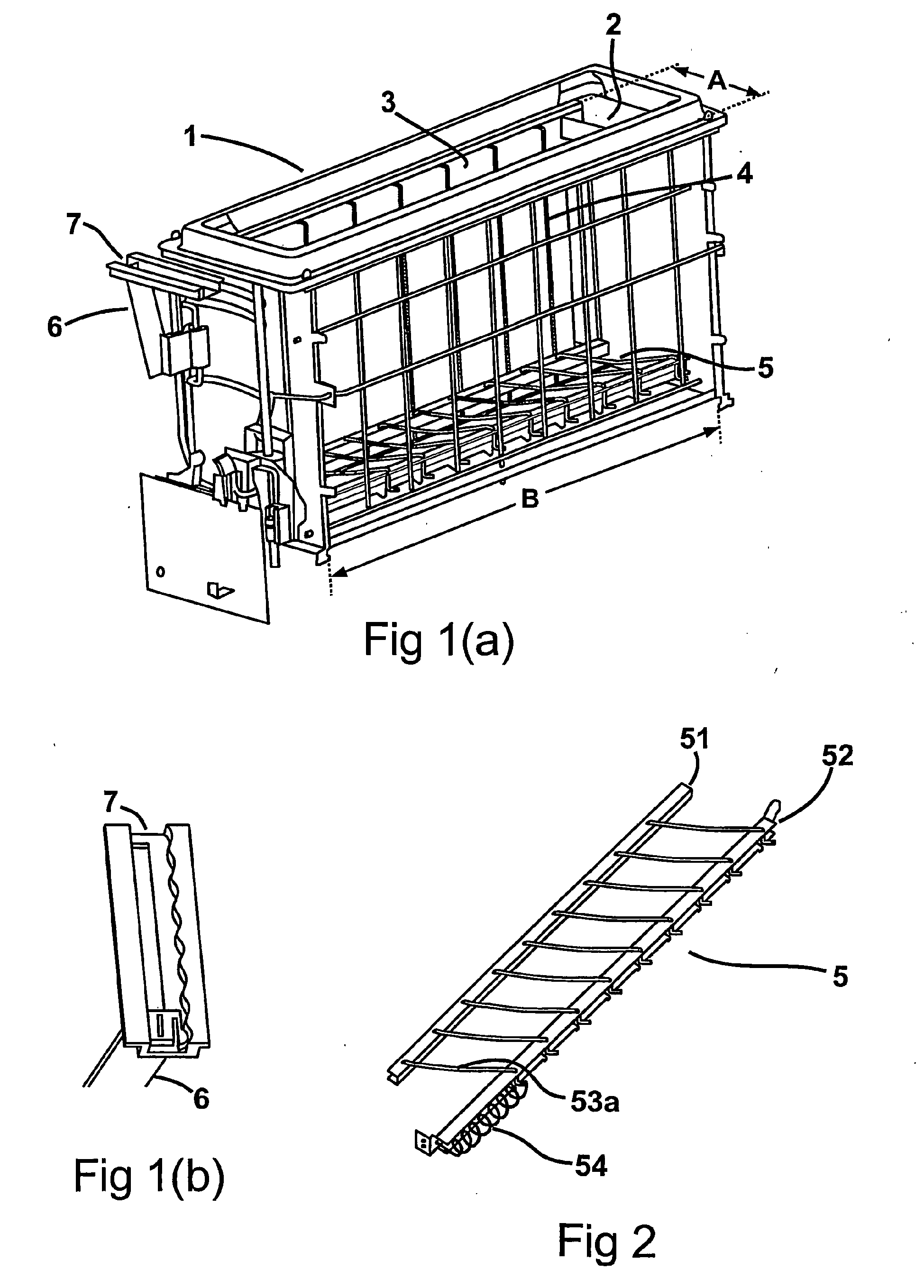
Figure 1(a) shows, in perspective view, part of a toaster in accordance with a first
embodiment of the invention, with a wall of the toasting chamber removed to illustrate
the carriage in relation to other internal components of the toaster;
Figure 1(b) shows a plan detail of a slider component of the toaster;
Figure 2 shows, in perspective view, essential components of a carriage for a toaster
in accordance with said first embodiment of the invention; and
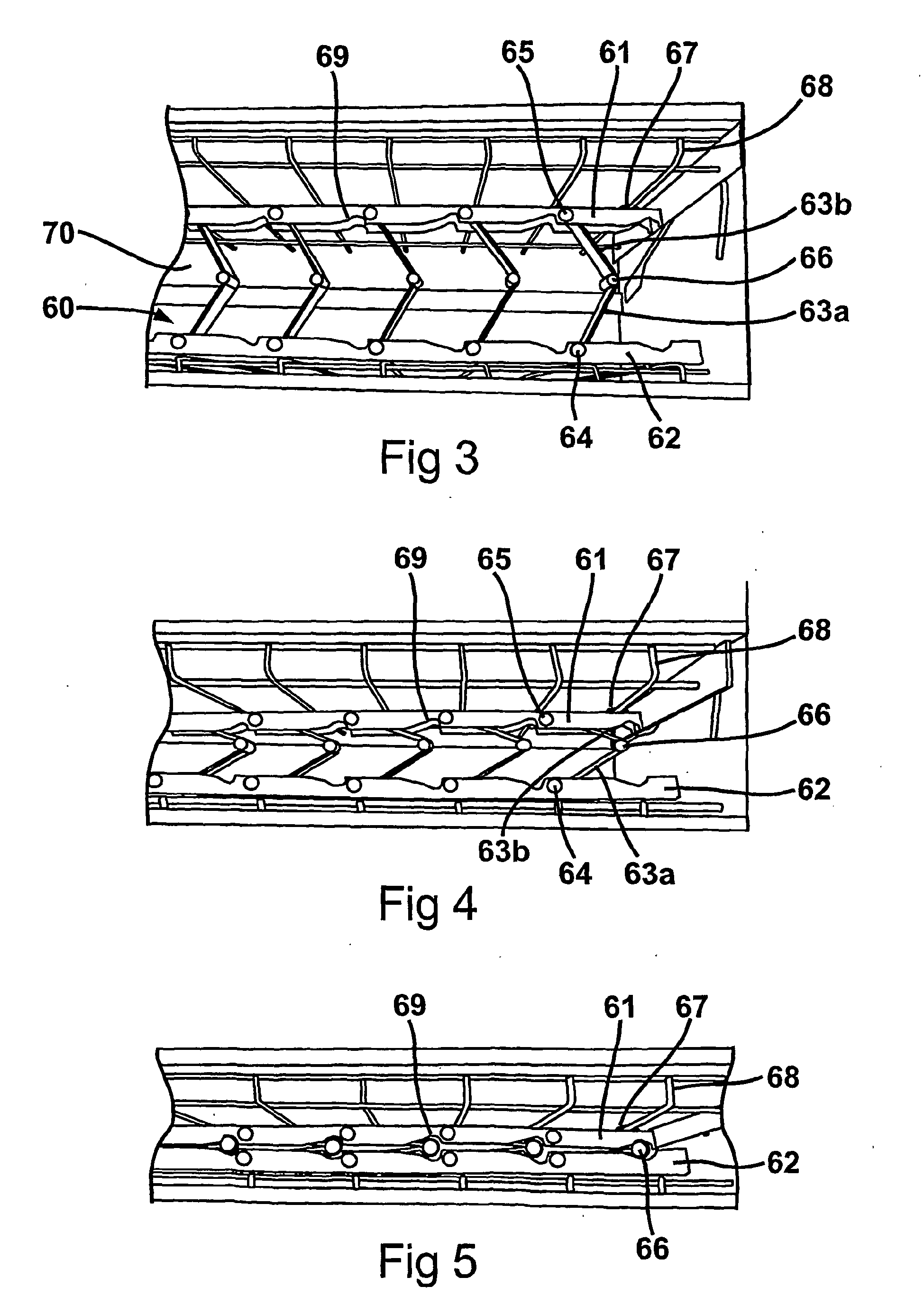
Figures 3, 4 and 5 show, in a partial plan view from the top, essential components
of a carriage for a toaster in accordance with a second embodiment of the invention,
respectively disposed at wide, medium and narrow settings.
[0020] Referring now to Figures 1 and 2 of the drawings, a toaster in accordance with one
embodiment of the invention comprises a main housing 1 in which is defined a slot-like
toasting chamber 2, flanked by respective heating elements, such as that shown at
3, of any convenient kind. The heating elements are typically substantially rectangular,
planar elements as shown, supported in known manner so as to stand vertically to either
side of the chamber 2, effectively forming side-walls thereof. Each heating element
is, in this example, protected by a grid-like guard member 4 from direct contact with
the foodstuffs inserted into the chamber 2.
[0021] A food-supporting carriage 5 is provided in the chamber 2, and the carriage is supported,
in known manner, by means of a conventional support structure (not shown) configured
to permit the carriage to be latched in a lower position at which foodstuffs are exposed
to said heating elements for toasting, for releasing said carriage on completion of
a toasting cycle, and for raising the carriage to an upper, presentation position
in which toasted foodstuffs can be removed from the toaster.
[0022] User-operable means, including a slider mechanism 6 is provided for varying the width
dimension A of the chamber to accommodate foodstuffs of differing thickness. In this
example, the mechanism 6 is disposed internally of an outer casing (not shown) of
metal or plastics material and is operated by means of a lever arrangement (not shown)
accessible to the user externally of the casing. The internal mechanism 6 includes,
in this example, a slot arrangement 7 (best seen in Figure 1(b)) comprising several
constrictions which define respective discrete width settings for the slot-like chamber
2. In alternative embodiments, the width setting may be smoothly variable to any chosen
position between two extreme end stops.
[0023] As shown in more detail in Figure 2, the carriage 5 comprises first and second elongate
members 51 and 52 extending along the length dimension B of said chamber and disposed
respectively to one and the other side of the chamber 2. A plurality of linking members
53a to 53n are provided, each linking the elongate members 51 and 52 and pivotally
mounted to each elongate member; and resilient means 54 are provided to urge the elongate
members 51 and 52 apart whereby the carriage 5 adapts automatically to variations
in the width dimension A of the chamber. In this respect, it will be appreciated that
in this embodiment the member 52 remains in contact with the heater guard in its side
of the slot 2 whilst the member 51 is mobile laterally of the toaster slot; moving
towards or away from the member 52 as appropriate to maintain contact with the heater
guard at the other side of the slot. The member 51 is either pushed towards the member
52 by contact with the heater guard 4 when the slot 2 is narrowed by a user, or urged
away from the member 52 by the resilient means 54 when the slot 2 is widened.
[0024] In this example of the invention, the resilient means 54 comprises a single coil
spring, fixedly supported upon the elongate member 52 and configured to operate in
compression, though it could alternatively, of course, be mounted and configured so
as to operate in tension, depending upon the detailed construction of the assembly.
Also in this example, the spring is connected to the linking member 53a but it could
alternatively, or in addition, be connected to one or more of the other linking members.
By this means, in any event, the necessary resilient urge is applied in a simple and
cost-effective manner.
[0025] In further alternative configurations, the resilient urge may be provided by a torsion
spring, and/or by plural spring members of any convenient kind carried by one, the
other, or both of the elongate members 51 and 52; each such spring member being coupled
between a respective fixed location on its elongate means and a respective one or
more of the linking members. If plural spring members are provided, it is preferable
to distribute them evenly among said linking members.
[0026] It is particularly preferred (though not essential) that pivotal mounting points
for the linking members 53a to 53n are regularly distributed along the elongate members
51 and 52, thereby providing an even distribution of the resilient urging force.
[0027] In some preferred embodiments of the invention, the mobile member 51 (or at least
a part thereof) is usefully made of, or coated with, a robust and slippery material,
such as a ceramic or a non-stick material such as that known by the Registered Trade
Mark "Teflon", which will resist repeated wiping contact with the heater guard 4.
[0028] Referring now to Figures 3, 4 and 5, which show various operational thickness settings
for a toaster in accordance with a second embodiment of the invention, the carriage
60 comprises first and second elongate members 61 and 62 extending, as before, along
the length dimension B of the toasting chamber 70 and disposed respectively to one
and the other side of the chamber 70. A plurality of paired, chevron-like linking
members such as 63a and 63b are provided; each linking member being pivotally linked
to a respective elongate member 61 or 62 and each pair of linking members, such as
63a and 63b being pivotally linked to each other, as at 66. Each end of each of the
elongate members 61, 62 is secured by means of an eye such as 67 to an upright wire
such as 68 forming part of the heater guard at the relevant side of the chamber 70,
such that the carriage 60 can execute its required vertical movements simply by each
eye such as 67 running up or down on its respective wire such as 68. When the toaster
chamber is widened or narrowed, however, the elongate members follow the relevant
movement towards or away from another as a result of their direct attachment to the
wires such as 68.
[0029] In this embodiment of the invention, therefore, there is no need for any resilient
means to urge the elongate members apart, as there was in the first embodiment, since
the carriage 60 adapts, as a result of its construction, to variations in the width
dimension A of the chamber 70 simply by the elongate members 61 and 62 being pushed
towards each other or pulled away from each other as appropriate by their direct mechanical
connection to the wires such as 68.
[0030] It will also be appreciated that, because of the folding capability of the pairs
of linking members such as 63a and 63b afforded by their central pivots such as 66,
the overall longitudinal offset between the two elongate members 61 and 62 that needs
to be accommodated in the second embodiment of the invention is only around half of
that needed for the elongate members 51 and 52 in the first embodiment.
[0031] The inner surface of each of the elongate members 61 and 62 (i.e. that surface facing
away from the heaters and thus into the interior of the chamber 70) is formed with
a plurality of notches, such as 69, to accommodate the central pivots, such as 66,
of the respective pairs of linking members, such as 63a and 63b, when the toasting
chamber 70 is set to a narrow setting as illustrated in Figure 5.
[0032] In some preferred embodiments of the invention, the eyes such as 67 are usefully
made of, or coated with, a robust and slippery material, such as a ceramic or a non-stick
material such as that known by the Registered Trade Mark "Teflon", which will resist
repeated wiping contact with the wires such as 68 during upward and downward movements
executed by the carriage 60 at various stages during the toasting process. Alternatively,
or in addition, the wires such as 68 may be so formed or coated. Alternatively, any
convenient form of linear bearing capable of operating in the toasting chamber environment
can be used to link the elongate members 61 and 62 to the wires such as 68.
1. A toaster having a slot-like chamber (2,70) into which foodstuffs to be toasted can
be placed, the chamber (2,70) being flanked by respective heating elements (3); a
carriage (5,60) having a foodstuff-supporting surface; a support structure for said
carriage configured to permit the carriage to be latched in a lower position at which
foodstuffs are exposed to said heating elements (3) for toasting, for releasing said
carriage (5,60) on completion of a toasting cycle, and for raising the carriage (5,60)
to an upper, presentation position in which toasted foodstuffs can be removed from
the toaster; and user-operable means (6,7) for varying the width dimension of the
chamber to accommodate foodstuffs of differing thickness; wherein the carriage (5,60)
comprises first and second elongate members (51,52) extending along the length dimension
(B) of said chamber (2,70) and disposed respectively to one and the other side of
said chamber (2,70); a plurality of linking members (53a-53n,63a-63b) linking said
elongate members (51,52) and pivotally mounted to each, said linking members (53a-53n,63a-63b)
collectively presenting at least a substantial part of the foodstuff-supporting surface
of the carriage (5,60); and control means (54) maintaining said elongate members (51,52,61,62)
in contact with opposing sides of the chamber (2,70) such that said elongate members
(51,52,61,62) move relative to one another when the width dimension of the chamber
(2,70) is varied; such movement of the elongate members being accommodated by pivotal
movement of said linking members (53a-53n,63a,63b), whereby said carriage (5,60) adapts
automatically to sad variations in the width dimension (A) of said chamber (2,70).
2. A toaster according to claim 1, wherein the control means comprises latching means
latching the elongate members (51-52,61-62) to opposing sides of the chamber (2,70),
whereby movement in the width dimension (A) of the chamber pushes said elongate members
(51-52,61-62) closer together or pulls them fai-ther apart, depending upon the user-selected
setting of the said width dimension (A).
3. A toaster according to claim 1 or claim 2, wherein the linking means comprise a plurality
of chevron-like links (63) distributed along the length of the elongate members (61-62)
and having pivots at the chevron points permitting the chevron angle to vary with
variations in the width-dimension of the chamber.
4. A toaster according to claim 3, wherein the chevron-like links (63) are regularly
distributed along the length of the elongate members (61-62).
5. A toaster according to claim 3 or claim 4, wherein the elongate members (61-62) are
notched (69) to receive the chevron point pivots (66) when the chamber is adjusted
to its narrowest width dimension (A).
6. A toaster according to any preceding claim, further comprising a plurality of eye
members (67) attached to each of said elongate members and each adapted for vertical
sliding motion relative to a respective static and upright wire member (68) to accommodate
vertical movements of the carriage (60) during the toasting process.
7. A toaster according to claim 6, wherein each said eye member (67) and/or each wire
member (68) is made of, or coated with, a robust and non-stick material which will
resist repeated wiping contact associated with said vertical movements.
8. A toaster according to claim 1, wherein the control means includes resilient means
(54) acting upon at least one of said linking members (53,63) for urging said elongate
members (51-52,61-62) apart.
9. A toaster according to claim 8, wherein the resilient means comprises a coil spring
(54) fixedly, supported upon one of said elongate members (52), configured to operate
in either tension or compression and connected to at least one of said linking members
(53a).
10. A toaster according to claim 8, wherein the resilient means comprises a torsion spring
fixedly supported upon one of said elongate members (51,52) and connected to at least
one of said linking members.
11. A toaster according to claim 8, wherein the resilient means comprises plural spring
members carried by one of said elongate members (51,52); each of said spring members
being coupled between a respective fixed location on said elongate means and a respective
one of said linking members.
12. A toaster according to claim 11, wherein said spring members are evenly distributed
among said linking members (51,52).
13. A toaster according to any of claims 8 to 12, wherein pivotal mounting points for
the linking members (53a-53n) are regularly distributed along the elongate members
(51,52), thereby providing an even distribution of the resilient urging force.
14. A toaster according to any of claims 8 to 13, wherein at least a part of one or both
of said elongate members (51,52) is formed of or coated with a robust and/or non-stick
material to facilitate sliding movement of a member so formed or coated relative to
a guard device juxtaposed with a heating element (3).
1. Toaster mit einer schlitzförmigen Kammer (2,70) zur Aufnahme von zu toastenden Lebensmitteln,
mit jeweils seitlich von der Kammer (2,70) angeordneten Heizelementen (3), einem Schlitten
(5,60) mit einer Tragfläche für Lebensmittel, einer Stützkonstruktion für den besagten
Schlitten, die so ausgebildet ist, dass der Schlitten in einer unteren Stellung verriegelt
werden kann, in der die Lebensmittel dem Einfluss der besagten Heizelemente (3) zum
Toasten derselben ausgesetzt sind und zur Entriegelung des besagten Schlittens (5,
60) nach Beendigung eines Toastingzyklus, sowie für das Hochstellen des besagten Schlitten
(5, 60) nach Abschluss eines Toastingzyklus in eine obere Präsentationsstellung, in
der die getoasteten Lebensmittel dem Toaster entnommen werden können, und mit vom
Benutzer bedienbaren Mitteln (6,7) zur Veränderung der Breite der Kammer in Anpassung
an Lebensmittel unterschiedlicher Dicken; wobei der Schlitten (5,60) erste und zweite
Längsglieder (51, 52) aufweist, die in Längsrichtung (B) der besagten Kammer (2,70)
verlaufen und jeweils der einen und der anderen Seite der Kammer (2,70) zugeordnet
sind und eine Vielzahl von Verbindungsgliedern (53a-53n; 63a-63b) zur Verbindung besagter
Längsglieder (51, 52) und jeweils schwenkbar an diesen montiert, wobei die besagten
Verbindungsglieder (53a-53n; 63a-63b) zusammen wenigsten einen wesentlichen Teil der
die Lebensmittel tragenden Fläche des Schlittens (5,60) darstellen, sowie mit Steuermitteln
(54), die die besagten Längsglieder (51,52; 61,62) in Kontakt mit den gegenüberliegenden
Seiten der Kammer (2,70) halten, so dass sich die besagten Längsglieder (51, 52; 61,
62) relativ zueinander bewegen, wenn die Breite der besagten Kammer (2,70) verändert
wird; wobei ein solche Bewegung der Längsglieder durch eine Schwenkbewegung der besagten
Verbindungsglieder (52a-53n; 63a-63b) ausgeglichen wird, so dass sich der besagte
Schlitten (5, 60) automatisch an die besagten Schwankungen in der Breite (A) der besagten
Kammer (2, 70) anpasst.
2. Toaster gemäß Anspruch 1, bei dem die Steuermittel Verriegelungsmittel zur Verriegelung
der Längsglieder (51-52;61-62) umfassen , mit denen die Längsglieder (55-51; 61-62)
mit gegenüberliegenden Seiten der Kammer (2,70) verriegelt werden, so dass eine Veränderung
der Breite (A) der Kammer die Längsglieder (51-51, 61-62) je nach der vom Benutzer
gewählten Voreinstellung der besagten Breite (A) enger zusammendrückt oder sie weiter
auseinanderzieht,.
3. Toaster gemäß Anspruch 1 oder Anspruch 2, bei dem es sich bei den Verbindungsmitteln
um eine Vielzahl von pfeilförmigen Verbindern (63) handelt, die über die Länge der
Längsglieder (61-,62) verteilt sind und an den Spitze Drehpunkte aufweisen, die eine
Änderung des Pfeilwinkels entsprechend den Änderungen in der Breite (A) der Kammer
erlauben.
4. Toaster gemäß Anspruch 3, bei dem die pfeilförmigen Verbinder (63) regelmäßig über
die Länge der Längsglieder (61-62) verteilt sind.
5. Toaster gemäß Anspruch 3 oder Anspruch 4, bei dem die Längsglieder (61-62) für die
Aufnahme der Drehpunkte (66) an den Spitzen bei Einstellung der Kammer auf ihre geringes
Breite eingekerbt (69) sind.
6. Toaster gemäß einem der vorhergehenden Ansprüche des weiteren mit einer Vielzahl von
Augen (67), die an jedem der besagten Längsglieder angebracht sind und jeweils für
die Ausführung einer gleitenden Bewegung relativ zu einem statischen bzw. aufrechten
Drahtglied (68) ausgebildet sind, so dass der Schlitten (60) während des Toastens
vertikale Bewegungen ausführen kann.
7. Toaster gemäß Anspruch 6, bei dem jedes besagte Auge (67) und/oder jedes Drahtglied
(68) aus einem robusten, nicht haftenden Material hergestellt oder mit einem solchen
so beschichtet sind, dass es dem wiederholten Reibungskontakt bei der besagter lotrechten
Bewegung widersteht.
8. Toaster gemäß Anspruch 1, bei dem das Steuerungsmittel nachgiebige Mittel (54) an
wenigstens einem der besagten Verbindungsglieder (52, 63) aufweist, mit denen die
besagte Längsglieder (51-52, 61-62) in einem Abstand voneinander gehalten werden.
9. Toaster gemäß Anspruch 8, bei dem die nachgiebigen Mittel eine Schraubenfeder (54)
aufweisen, die sich an einem der besagten Längsglieder (52) fest abstützt und mit
wenigstens einem der besagten Verbindungsgliedern (53a) verbunden ist.
10. Toaster gemäß Anspruch 8, bei dem die nachgiebigen Mittel eine fest montierte Schraubenfeder
(54) aufweisen, die sich an einem der besagten Längsglieder (51, 52) abstützt und
wenigstens an einem der besagten Verbindungsglieder angelenkt ist.
11. Toaster gemäß Anspruch 8, bei dem die nachgiebigen Mittel eine Vielzahl von Federgliedern
aufweisen, die von einem der besagten Längsglieder (51, 52) getragen werden, wobei
jedes der besagten Federglieder in einer jeweils bestimmten Lage zwischen den besagten
Längsgliedern und jeweils wenigstens einem der besagten Verbindungsglieder gekoppelt
angeordnet ist.
12. Toaster gemäß Anspruch 11, bei dem besagte Federglieder gleichmäßig über die besagten
Verbindungsglieder (51, 52) verteilt sind.
13. Toaster gemäß einem der Ansprüche 8 bis 12, bei dem Ansätze für die schwenkbare Montage
der Verbindungsglieder (52a-52n) regelmäßig über die Längsglieder (51,52) verteilt
sind und damit eine gleichmäßige Verteilung der elastisch wirkenden Druckkraft bewirken.
14. Toaster gemäß einem beliebigen der Ansprüche 8 bis 13, bei dem wenigstens ein Teil
eines oder von beiden Längsgliedern (51, 52) aus einem robusten, nicht haftenden Material
hergestellt oder mit einem solchen so beschichtet ist, dass eine Gleitbewegung eines
so hergestellten oder beschichteten Glieds relativ zu einer einem Heizelement (3)
gegenüberliegenden Schutzvorrichtung möglich ist.
1. Crrille-pain ayant une chambre similaire à une fente (2, 70) dans laquelle des aliments
devant être grillés peuvent être placés, la chambre (2, 70) étant flanquée d'éléments
chauffants respectifs (3) ; un chariot (5, 60) ayant une surface porte-aliments ;
une structure de support pour ledit chariot configurée pour permettre au chariot d'être
verrouillé dans une position inférieure dans laquelle des aliments sont exposés auxdits
éléments chauffants (3) à des fins de grillage, pour libérer ledit chariot (5, 60)
à la fin d'un cycle de grillage, et pour relever le chariot (5, 60) sur une position
supérieure de présentation dans laquelle les aliments grillés peuvent être retirés
du grille-pain ; et un moyen actionnable par l'utilisateur (6, 7) permettant de varier
la dimension de la largeur de la chambre pour recevoir des aliments de différentes
épaisseurs ; dans lequel le chariot (5, 60) comporte un premier élément allongé (51)
et un deuxième élément allongé (52) s'étendant le long de la dimension de la longueur
(B) de ladite chambre (2, 70) et disposés respectivement d'un côté et de l'autre de
ladite chambre (2, 70) ; une pluralité d'éléments de liaison (53a-53n, 63a-63b) reliant
lesdits éléments allongés (51, 52) et montés de manière pivotante sur chacun, lesdits
éléments de liaison (53a-53n, 63a-63b) présentant collectivement au moins une partie
importante de la surface porte-aliments du chariot (5, 60) ; et un moyen d'ajustement
(54) destiné à maintenir lesdits éléments allongés (51, 52, 61, 62) en contact avec
des côtés opposés de la chambre (2, 70) de sorte que lesdits éléments allongés (51,
52, 61, 62) se déplacent les uns par rapport aux autres quand la dimension de la largeur
de la chambre (2, 70) est variée ; un tel mouvement des éléments allongés étant rendu
possible par le mouvement pivotant desdits éléments de liaison (53a-53n, 63a-63b),
ce par quoi ledit chariot (5, 60) s'adapte automatiquement auxdites variations de
la dimension de la largeur (A) de ladite chambre (2, 70).
2. Grille-pain selon la revendication 1, dans lequel le moyen d'ajustement comporte un
moyen de verrouillage destiné à verrouiller les éléments allongés (51-52, 61-62) sur
des côtés opposés de la chambre (2, 70), ce par quoi le mouvement dans la dimension
de la largeur (A) de la chambre pousse lesdits éléments allongés (51-52, 61-62) pour
les rapprocher les uns par rapport aux autres ou tire sur ceux-ci pour les éloigner
les uns des autres, en fonction du réglage sélectionné par l'utilisateur de ladite
dimension de la largeur (A).
3. Crrille-pain selon la revendication 1 ou la revendication 2, dans lequel les moyens
de liaison comportent une pluralité d'éléments de liaison en chevrons (63) répartis
sur toute la longueur des éléments allongés (61-62) et ayant des pivots au niveau
des pointes des chevrons permettant de varier l'angle des chevrons en fonction des
variations de la dimension de la largeur de la chambre.
4. Crrille-pain selon la revendication 3, dans lequel les éléments de liaison en chevrons
(63) sont répartis de manière régulière sur toute la longueur des éléments allongés
(61-62).
5. Crrille-pain selon la revendication 3 ou la revendication 4, dans lequel les éléments
allongés (61-62) sont entaillés (69) pour recevoir les pivots (66) des pointes des
chevrons quand la chambre est ajustée sur sa dimension de largeur la plus étroite
(A).
6. Crrille-pain selon l'une quelconque des revendications précédentes, comportant par
ailleurs une pluralité d'éléments de type oeillet (67) attachés sur chacun desdits
éléments allongés et chacun adapté à des fins de mouvement coulissant vertical par
rapport à un élément de type fil statique et vertical respectif (68) rendant possibles
des mouvements verticaux du chariot (60) au cours du processus de grillage.
7. Crrille-pain selon la revendication 6, dans lequel chaque élément de type oeillet
(67) et/ou chaque élément de type fil (68) est réalisé, ou revêtu, à partir d'un matériau
robuste et non adhésif, qui résistera à un contact à glissement répété associé auxdits
mouvements verticaux.
8. Crrille-pain selon la revendication 1, dans lequel le moyen d'ajustement comprend
un moyen élastique (54) agissant sur au moins l'un desdits éléments de liaison (53,
63) pour solliciter lesdits éléments allongés (51-52, 61-62) à s'écarter.
9. Crrille-pain selon la revendication 8, dans lequel le moyen élastique comporte un
ressort enroulé (54), supporté de manière fixe sur l'un desdits éléments allongés
(52), configuré pour fonctionner sous tension ou sous compression et raccordé à au
moins l'un desdits éléments de liaison (53a).
10. Crrille-pain selon la revendication 8, dans lequel le moyen élastique comporte un
ressort de torsion supporté de manière fixe sur l'un desdits éléments allongés (51,
52) et raccordé à au moins l'un desdits éléments de liaison.
11. Crrille-pain selon la revendication 8, dans lequel le moyen élastique comporte plusieurs
éléments de type ressort portés par l'un desdits éléments allongés (51, 52) ; chacun
desdits éléments de type ressort étant accouplé entre un emplacement fixe respectif
sur lesdits moyens allongés et l'un quelconque respectif desdits éléments de liaison.
12. Crrille-pain selon la revendication 11, dans lequel lesdits éléments de type ressort
sont répartis de manière uniforme parmi lesdits éléments de liaison (51, 52).
13. Crrille-pain selon l'une quelconque des revendications 8 à 12, dans lequel des points
de montage pivotants pour les éléments de liaison (53a-53n) sont répartis de manière
régulière le long des éléments allongés (51, 52), pour de ce fait permettre une répartition
uniforme de la force de sollicitation élastique.
14. Crrille-pain selon l'une quelconque des revendications 8 à 13, dans lequel au moins
une partie de l'un quelconque ou des deux desdits éléments allongés (51, 52) est formée,
ou revêtue, à partir d'un matériau robuste et/ou non adhésif pour faciliter le mouvement
coulissant d'un élément ainsi formé ou revêtu par rapport à un dispositif de protection
juxtaposé à un élément chauffant (3).
REFERENCES CITED IN THE DESCRIPTION
This list of references cited by the applicant is for the reader's convenience only.
It does not form part of the European patent document. Even though great care has
been taken in compiling the references, errors or omissions cannot be excluded and
the EPO disclaims all liability in this regard.
Patent documents cited in the description