|
(11) | EP 1 737 814 B1 |

| (12) | EUROPEAN PATENT SPECIFICATION |
|
|
| (54) |
METHODS OF MAKING AN ANTISTATIC AGENT VERFAHREN ZUR HERSTELLUNG EINES ANTISTATISCHEN MITTELS PROCEDES DE FABRICATION D'UN AGENT ANTISTATIQUE |
|
|
|||||||||||||||||||||||||||||||||||
| Note: Within nine months from the publication of the mention of the grant of the European patent, any person may give notice to the European Patent Office of opposition to the European patent granted. Notice of opposition shall be filed in a written reasoned statement. It shall not be deemed to have been filed until the opposition fee has been paid. (Art. 99(1) European Patent Convention). |
CROSS-REFERENCE TO RELATED APPLICATION
[0001] This application claims the benefit of U.S. Provisional Application Serial No. 60/562,010, filed April 13, 2004,
BACKGROUND OF THE INVENTION
[0003] Thermoplastics are useful in the manufacture of articles and components for a wide range of applications, from automotive parts to electronic appliances. Because of their broad use, particularly in electronic applications, it is desirable to provide thermoplastic resins with antistatic agents. Many polymers or blends of polymers are relatively non-conductive, which can lead to static charge build-up during processing and use of the polymer. Charged molded parts, for example, may attract small dust particles, and may thus interfere with a smooth surface appearance, for example by causing a decrease in the transparency of the article. In addition, the electrostatic charge may be a serious obstacle in the production process of such polymers.
[0004] Anti-static agents are materials that are added to polymers to reduce their tendency to acquire an electrostatic charge, or, when a charge is present, to promote the dissipation of such a charge. Organic anti-static agents are usually hydrophilic or ionic in nature. When present on the surface of polymeric materials, they facilitate the transfer of electrons and thus eliminate the build up of a static charge. Anti-static agents have also been added to the polymer composition before further processing into articles, and may thus be referred to as "internally applied." Useful anti-static agents applied in this manner are thermally stable and able to migrate to the surface during processing.
[0005] A large number of anti-static agents having surfactants as their main constituent have been considered and tried. Many suffer from one or more drawbacks, such as lack of compatibility with the polymer (which interferes with uniform dispersibility), poor heat stability, and/or poor antistatic characteristics. Poor heat resistance in particular can adversely affect the optical properties of engineering thermoplastics such as aromatic polycarbonates.
[0006] Particular phosphonium salts of certain sulfonic acids, however, have been shown to be useful antistatic agents. U.S. Patent No. 4,943,380 discloses reducing the static charge on polycarbonate resins with an anti-static composition containing 90-99.9 weight % of polycarbonate and 0.1-10 weight % of a heat resistant phosphonium sulfonate having the general formula:
wherein R is a straight or branched chain alkyl group having 1 to 18 carbon atoms; R1, R2 and R3 are the same, each being an aliphatic hydrocarbon having 1 to 8 carbon atoms or an aromatic hydrocarbon group having 6 to 12 carbon atoms; and R4 is a hydrocarbon group having 1 to 18 carbon atoms.
[0007] U.S. Patent No. 6,194,497 discloses antistatic resin compositions, particularly transparent resin compositions, comprising a thermoplastic polymer and a halogenated medium- or short-chain alkylsulfonic acid salt of a tetrasubstituted phosphonium cation. The antistatic agent described therein is prepared by ion exchange of a potassium haloalkylsulfonate to produce the corresponding acid. The haloalkylsulfonic acid is then reacted with tetrabutylphosphonium hydroxide to product the antistatic agent.
[0008] An advantage of this synthesis is that use of an ion exchange step during synthesis results in a product that is very pure, i.e., contains little to no halogenated compounds that may ultimately lead to degradation of resins such as polycarbonates. However, while suitable for its intended purposes, this particular synthesis also has a number of drawbacks. For example, use of an ion exchange step increases the expense of the process, and may lead to the production of waste requiring disposal procedures. The synthesis also uses the potassium salt as a starting product, which is prepared from the corresponding sulfonylfluoride. Since the solubility of potassium peralkylsulfonates is relatively low, e.g., on the order of 5% at 20°C, a water/ethanol mixture is needed in the ion exchange. The flammability of ethanol requires the implementation of significant safety precautions during the synthesis. In addition, selecting the appropriate water/ethanol ratio is also important. An excess of alcohol may render the final product soluble in the reaction solvent, such that isolation of the product may require a further extraction step.
[0009] There accordingly remains a demand in the art for more efficient processes, particularly one-step processes, for making phosphonium sulfonate antistatic agents, as well as thermoplastic resin compositions that incorporate these antistatic agents. It would further be desirable for such processes to produce the antistatic agent in good yields without having a detrimental effect on the safety of the process and/or the purity of the product.
BRIEF SUMMARY OF THE INVENTION
[0010] The above-described and other deficiencies of the art are met by a method of making a phosphonium sulfonate salt of formula (1):
wherein each X is independently a halogen or hydrogen, provided that the molar ratio of halogen to hydrogen is greater than about 0.90; p is 0 or 1 and q and r are integers of 0 to about 7, provided that q+r is less than 8 and that if p is not zero then r is greater than zero; and each R is independently a hydrocarbon radical having 1 to about 18 carbon atoms, the method comprising combining in an aqueous medium a compound of the formula (2):
wherein M is Li or Na, and X, q, p, and r are as defined above, with a compound of the formula (3):
(R)4P-Z (3)
wherein Z is a halogen and R is as defined above; and separating the product of formula (1) from the aqueous medium.
[0011] In another embodiment, a method of making the phosphonium sulfonate salt of formula (1) comprises first combining in an aqueous medium, a compound of the formula (4)
with a stoichiometric excess of a compound of the generic formula (5):
(R)4P-OH (5)
wherein X, p, q, r, and R have the same meanings as in formula (1); and separating the product of formula (1) from the aqueous medium.
[0012] In another embodiment, a method of making the phosphonium sulfonate salt of formula (1) comprises combining in an aqueous medium sodium hydroxide and/or lithium hydroxide, a compound of the generic formula (4) above, and a compound of the generic formula (3) above, wherein X, q, p, r, and R are as defined above; and separating the phosphonium sulfonate of formula (1) from the aqueous medium.
DETAILED DESCRIPTION OF THE INVENTION
[0013] It has been unexpectedly found by the inventors hereof that a phosphonium haloalkylsulfonate salt suitable for use as antistatic agent may be readily obtained in aqueous medium in one step from the corresponding tetraalkylphosphonium halide and lithium or sodium haloalkylsulfonate salt. Alternatively, the phosphonium haloalkylsulfonate salt may be obtained in aqueous medium in one step from the corresponding tetraalkylphosphonium halide or hydroxide and the haloalkylsulfonyl fluoride. The reactants are readily available, and use of water as the reaction solvent expedites isolation of the product. Thus, in a surprising and highly advantageous feature, the inventors hereof have found that a simple mixing of the reactants may result in a precipitation of the targeted anti-static molecule in high yields.
[0014] In general, the phosphonium haloalkylsulfonate salts are of the generic formula (1):
wherein X is independently selected from halogen or hydrogen, provided that the molar ratio of halogen to hydrogen is greater than about 0.90. The halogens may be independently selected from bromine, chlorine, fluorine, and iodine. Specifically, the halogen is fluorine.
[0015] Further in formula (1), p is zero or one, and q and r are integers of 0 to about 7, provided that q+r is less than 8 and that if p is not zero then r is greater than zero. In one embodiment, p is zero.
[0016] Each R in formula (1) is independently a hydrocarbon radical containing 1 to about 18 carbon atoms, that is, each R is the same or different, and may be a straight or branched chain aliphatic hydrocarbon radical containing 1 to about 18 carbon atoms, or an aromatic hydrocarbon radical containing 6 to about 18 carbon atoms. As used herein, an "aromatic" radical is inclusive of fully aromatic radicals, aralkyl radicals, and alkaryl radicals. In one embodiment, three of the R groups in the organic phosphonium cation may be the same aliphatic hydrocarbon radical containing 1 to about 8 carbon atoms or aromatic hydrocarbon radical containing 6 to about 12 carbon atoms, while the fourth R group may be a hydrocarbon radical containing 1 to about 18 carbon atoms.
[0017] The antistatic agent may thus be a highly halogenated phosphonium sulfonate salt containing an organic sulfonate anion and a tetrasubstituted organic phosphonium cation. Specific examples are perfluorinated salts, but due to the production method of the fluorination (electrolysis) sometimes only partly fluorinated compounds are formed.
[0018] Specific examples of suitable organic sulfonate anions include perfluoromethane sulfonate, perfluoroethane sulfonate, perfluoropropane sulfonate, perfluorobutane sulfonate, perfluoropentane sulfonate, perfluorohexane sulfonate, perfluoroheptane sulfonate, and perfluorooctane sulfonate. Combinations of the foregoing may also be present.
[0019] Examples of specific phosphonium cations include cations such as tetramethyl phosphonium, tetraethyl phosphonium, tetra-n-propyl phosphonium, tetraisopropyl phosphonium, tetrabutyl phosphonium, triethylmethyl phosphonium, tributylmethyl phosphonium, tributylethyl phosphonium, trioctylmethyl phosphonium, trimethylbutyl phosphonium, trimethyloctyl phosphonium, trimethyllauryl phosphonium, trimethylstearyl phosphonium, triethyloctyl phosphonium, tetraphenyl phosphonium, triphenylmethyl phosphonium, triphenylbenzyl phosphonium, and tributylbenzyl phosphonium. Combinations of the foregoing may also be present.
[0020] In one embodiment there is provided a method for making the phosphonium sulfonates of formula (1) comprising combining, in an aqueous medium, a compound of the formula (2):
wherein M is an alkali metal selected from lithium (Li) or sodium (Na), and X, q, p, and r are as defined above, with a stoichiometric excess of a compound of the formula (3):
(R)4P-Z (3)
wherein Z is a halogen and R is as defined above; and separating the product of formula (1). Specifically Z may be bromine or chlorine.
[0021] In one manner of proceeding, the process may comprise dissolving a perhaloalkylsulfonate sodium or lithium salt of formula (2) in an aqueous medium. The aqueous medium may be substantially free of a cosolvent such as ethanol, for example. As used herein, "an aqueous medium" means a solution, dispersion, or suspension in water. Further as used herein, an aqueous medium "substantially free of a cosolvent" means an aqueous medium containing less than about 1, specifically less than about 0.5, and more specifically less than about 0.1 volume percent cosolvent. While the use of a cosolvent is possible, and necessary in the case of the potassium salts, the use of water substantially free of a cosolvent results in a higher purity product, and avoids the safety concerns that arise from use of volatile solvents. Suitable cosolvents, when used, aid in dissolving the sulfonate alkali salts, and include lower alcohols such as methanol, ethanol, and the like, and chlorinated solvents such as dichloromethane, and the like. Mixtures of cosolvents may be used.
[0022] The aqueous medium containing the perhaloalkylsulfonate alkali salt may then be reacted with a tetrasubstituted phosphonium halide. The order of addition does not appear to be important, i.e., reaction may also be accomplished by, for example, dissolving the tetrasubstituted phosphonium halide in an aqueous medium and then adding the perhaloalkylsulfonate alkali salt; by simultaneously dissolving and mixing the reactants; by separately dissolving then mixing the reactants; or the like. The phosphonium sulfonate salts obtained herein may be obtained by using mixtures of perhaloalkylsulfonate alkali salts and tetrasubstituted phosphonium halides.
[0023] The processes may be conducted at a broad range of temperatures and reaction times, and will depend on the particular reactants used, cosolvent (if present), desired yields, desired purity, cost, convenience, ease of manufacture, and like considerations. For example, temperatures for the various processes may generally be about 10°C to about 100°C, specifically about 20°C to about 95°C, more specifically about 30° to about 90°C. In one embodiment, the reaction is conducted at room temperature or ambient temperature, which may generally be about 20°C to about 25°C. Likewise, reaction times may vary, but generally may be about 5 minutes to about one day, specifically about 30 minutes to about 12 hours, or more specifically about 60 minutes to about 4 hours. These temperatures and times may be varied greatly and may be determined by those of ordinary skill in the art.
[0024] The tetrasubstituted phosphonium halide may used in an at least equimolar amount relative to the perhaloalkylsulfonate salt, and more specifically, the molar ratio of the perhaloalkylsulfonate salt of formula (2) to the tetrasubstituted phosphonium halide of formula (3) may be about 1:1.001 to about 1:1.5, specifically about 1:1.002 to about 1:1.1, more specifically about 1:1.005 to about 1:1.015. The optimum ratio may vary depending on the particular reactants, temperature, cosolvent(s) (if present), and time, and is readily determined by one of ordinary skill in the art.
[0025] In another embodiment, the molar ratio of the perhaloalkylsulfonate salt of formula (2) to the tetrasubstituted phosphonium halide of formula (3) may be about 1.001:1 to about 1.5:1, specifically about 1.002:1 to about 1.1:1, more specifically about 1.005:1 to about 1.015:1. The optimum ratio may vary depending on the particular reactants, temperature, cosolvent(s) (if present), and time, and is readily determined by one of ordinary skill in the art.
[0026] In a highly advantageous feature, the reactants and aqueous medium are selected so that phosphonium sulfonate salt (1) precipitates from the aqueous medium at high purity, and may be isolated from impurities, in particular halogen-containing impurities, by simple filtration and washing. It is desirable to remove halogen-containing impurities in particular (such as the tetrasubstituted phosphonium bromide and/or chloride) since these impurities are known to degrade resins such as polycarbonate. Removal of the impurities is readily and efficiently accomplished by washing with water, since the impurities are soluble in water, while the desired product is not.
[0027] Phosphonium sulfonate salt that may be made by the processes described herein include those having the general formula (6):
wherein F is fluorine; n is an integer of 0 to about 7, S is sulfur; and each R is the same or different aliphatic hydrocarbon radical containing 1 to about 18 carbon atoms or an aromatic hydrocarbon radical containing 6 to about 18 carbon atoms. In one embodiment, three of the R groups in the organic phosphonium cation may be the same aliphatic hydrocarbon radical containing 1 to about 8 carbon atoms or aromatic hydrocarbon radical containing 6 to about 12 carbon atoms, while the fourth R group may be a hydrocarbon radical containing 1 to about 18 carbon atoms. Anti-static compositions comprising fluorinated phosphonium sulfonates of formula (6) as the principle component thereof may be used in many different ways to make use of their anti-static, compatibility and heat resistance characteristics, for example, in providing such anti-static characteristics to thermoplastic resins. Suitable thermoplastic resins include but are not limited to polycarbonate, polyetherimide, polyester, polyphenylene ether/polystyrene blends, polyamides, polyketones, acrylonitrile-butadiene-styrenes (ABS), or combinations comprising at least one of the foregoing polymers. The phosphonium sulfonate salts are low melting semi-solid materials, and as such, they may be handled as a molten liquid. Some embodiment of the present disclosure are solid crystalline materials at room temperature (about 15 to about 25°C) and are easy to weigh, handle, and add to the above-described thermoplastic resins.
[0028] In addition to the thermoplastic resin, the thermoplastic composition may include various additives ordinarily incorporated in resin compositions of this type. Mixtures of additives may be used. Such additives may be mixed at a suitable time during the mixing of the components for forming the composition. Examples of suitable additives are impact modifiers, fillers, heat stabilizers, antioxidants, light stabilizers, plasticizers, mold release agents, UV absorbers, lubricants, pigments, dyes, colorants, blowing agents, antidrip agents, and flame-retardants.
[0029] A common way to practice this method is to add the agent directly to the thermoplastic resin and to mix it at the time of polymer production or fabrication. It may be processed by traditional means, including extrusion, injection, molding, compression molding or casting. The thermoplastic compositions may be manufactured by methods generally available in the art, for example, in one embodiment, in one manner of proceeding, powdered thermoplastic resin, antistatic agent, and/or other optional components are first blended, optionally with chopped glass strands or other fillers in a Henschel high speed mixer. Other low shear processes including but not limited to hand mixing may also accomplish this blending. The blend is then fed into the throat of a twin-screw extruder via a hopper. Alternatively, one or more of the components may be incorporated into the composition by feeding directly into the extruder at the throat and/or downstream through a sidestuffer. Such additives may also be compounded into a masterbatch with a desired polymeric resin and fed into the extruder. The extruder is generally operated at a temperature higher than that necessary to cause the composition to flow. The extrudate is immediately quenched in a water bath and pelletized. The pellets, so prepared, when cutting the extrudate may be one-fourth inch long or less as desired. Such pellets may be used for subsequent molding, shaping, or forming.
[0030] The quantity of the phosphonium sulfonate salt added to thermoplastic resin is an amount effective to reduce or eliminate a static charge and may be varied over a range. It has been found that if too little of the anti-static substituted phosphonium sulfonate salt is added to the resin, there still may be a tendency for static charge to build up on an article made of the resin. If the loadings of the anti-static additive become too high, the addition of these quantities is uneconomical, and at some level it may begin adversely to affect other properties of the resin. Thermoplastic compositions with enhanced antistatic properties may be obtained using about 0.01 to about 10 weight percent (wt %), specifically about 0.2 to about 2.0 wt %, more specifically about 0.5 to about 1.5 wt of the anti-static agent with about 90 to about 99.99 wt %, specifically about 99 to about 99.8 wt %, more specifically about 98.5 to about 99.5 wt % polymer, based on the total weight of anti-static agent and polymer. In one embodiment, in order to obtain a favorable result by such an internal application method in transparent polycarbonate grades, the antistatic agent is used generally in amounts of about 0.01 to about 3.0, specifically about 0.1 to about 1.5 weight percent (wt. %) with respect to the molding composition or specifically in amounts of about 0.4 to about 0.8 wt. %. The antistatic agents provided herein are more strongly resistant against heat and may be added in lower quantities than the traditional ionic surfactants, e.g. phosphonium alkyl sulfonates, and the resin compositions have good transparency and mechanical properties.
[0031] The above-described phosphonium salts may further be used to prepare thermoplastic polymer compositions having improved heat stability. In one embodiment a polycarbonate composition comprising an antistatic agent manufactured by one of the above processes has a Yellowness Index of less than about 15, specifically less than about 10, more specifically less than about 8, and even more specifically less than about 6 after aging at 130°C for 936 hours.
[0032] The thermoplastic composition comprising the antistatic agent may be used to form articles such as, for example, computer and business machine housings such as housings for monitors, handheld electronic device housings such as housings for cell phones, electrical connectors, and components of lighting fixtures, ornaments, home appliances, roofs, greenhouses, sun rooms, swimming pool enclosures, carrier tapes for semiconductor package material, automobile parts, and the like.
[0033] The thermoplastic compositions may be converted to articles using processes such as film and sheet extrusion, injection molding, gas-assist injection molding, extrusion molding, compression molding, and blow molding. Film and sheet extrusion processes may include and are not limited to melt casting, blown film extrusion and calendaring. Co-extrusion and lamination processes may be used to form composite multi-layer films or sheets. Single or multiple layers of coatings may further be applied to the single or multi-layer substrates to impart additional properties such as scratch resistance, ultra violet light resistance, aesthetic appeal, and the like. Coatings may be applied through application techniques such as rolling, spraying, dipping, brushing, or flow coating. Films or sheets may alternatively be prepared by casting a solution or suspension of the thermoplastic composition in a suitable solvent onto a substrate, belt, or roll followed by removal of the solvent.
[0034] Oriented films may be prepared through blown film extrusion or by stretching cast or calendared films in the vicinity of the thermal deformation temperature using conventional stretching techniques. For instance, a radial stretching pantograph may be employed for multi-axial simultaneous stretching; an x-y direction stretching pantograph can be used to simultaneously or sequentially stretch in the planar x-y directions. Equipment with sequential uniaxial stretching sections can also be used to achieve uniaxial and biaxial stretching, such as a machine equipped with a section of differential speed rolls for stretching in the machine direction and a tenter frame section for stretching in the transverse direction.
[0035] The thermoplastic compositions may also be converted to a multiwall sheet comprising a first sheet having a first side and a second side, wherein the first sheet comprises a thermoplastic polymer, and wherein the first side of the first sheet is disposed upon a first side of a plurality of ribs; and a second sheet having a first side and a second side, wherein the second sheet comprises a thermoplastic polymer; wherein the first side of the second sheet is disposed upon a second side of the plurality of ribs, and wherein the first side of the plurality of ribs is opposed to the second side of the plurality of ribs.
[0036] The films and sheets described above may further be thermoplastically processed into shaped articles via forming and molding processes including, for example thermoforming, vacuum forming, pressure forming, injection molding, and compression molding. Multi-layered shaped articles may also be formed by injection molding a thermoplastic resin onto a single or multi-layer film or sheet substrate, for example by providing a single or multi-layer thermoplastic substrate having optionally one or more colors on the surface, for instance, using screen printing or a transfer dye; conforming the substrate to a mold configuration such as by forming and trimming a substrate into a three dimensional shape and fitting the substrate into a mold having a surface which matches the three dimensional shape of the substrate; injecting a thermoplastic resin into the mold cavity behind the substrate to (i) produce a one-piece permanently bonded three-dimensional product or (ii) transfer a pattern or aesthetic effect from a printed substrate to the injected resin and remove the printed substrate, thus imparting the aesthetic effect to the molded resin.
[0037] Those skilled in the art will also appreciate that known curing and surface modification processes, including but not limited to heat-setting, texturing, embossing, corona treatment, flame treatment, plasma treatment, and/or vacuum deposition may further be applied to the above articles to alter surface appearances and impart additional functionalities to the articles.
[0038] The above processes may be used to form phosphonium salts (1) in an expedited manner and in high purity. In one embodiment, the total amount of ionic impurities is less than about 650 parts per million (ppm), more specifically less than about 500 ppm, even more specifically less than about 100 ppm, more specifically less than about 50 ppm, and most specifically less than about 10 ppm. In another embodiment, the products contain less than about 5 ppm of alkali metals, preferably less than about 4 ppm of alkali metals. In another embodiment, the products contain less than about 500 ppm, preferably less than about 100 ppm, more preferably less than about 50 ppm, and most preferably less than about 10 ppm of halide. Other ionic contaminants, for example phosphate or sulfate, are individually present in amounts of less than about 100 ppm, preferably less than about 50 ppm, most preferably less than about 10 ppm.
EXAMPLES
[0040] Differential scanning calorimetry (DSC) measurements were conducted by scanning the sample from 50°C to 100°C with a scan speed of 10°C/min. Thermal gravimetric analysis (TGA) was conducted by scanning the sample from 50°C to 600°C with a scan speed of 10°C/min. Ion content of the salts was determined by ion chromatography. Yellowness index (YI) was determined using a Gretag McBeth color-eye 7000A using propalette software.
[0041] In the following examples, "MQ water" refers to water deionized and processed through a MilliQ® System. (MilliQ® is a trademark of Millipore Corporation.) "TBPBr" refers to tetrabutyl phosphonium bromide.
Example 1.
[0042] First, 5.00 gram (MW 302, 16.55mmol) of perfluorobutane sulfonyl fluoride ("A") is weighed in a 100-mL 2-neck roundbottom flask, stirred with a magnetic stirrer and refluxed therein, in an oil bath at 85°C.
[0043] Next, 0.95 grams of lithium hydroxide (LiOH) (24.83mmol) is added and dissolved in 25 mL MQ water and slowly added to A. This is followed by letting the mixture reflux for an hour and then adding 25 mL MQ water and stirrring. Then the undissolved residue is filtered off, and collected in another 100-mL 2-neck roundbottom flask, and reheated in an oil bath at 85°C once more. Next 8.43 gram TBPBr (24.83mmol) is dissolved in 25 mL MQ water and is added slowly to the filtrate and the product antistatic agent is formed. After all the dissolved TBPBr is added the mixture is stirred for another 15 minutes. Then the mixture is cooled, preferably in an ice/water bath, and then the water is decanted. Next, 100 mL of MQ water is added and stirred for 15 minutes while heating in an oil bath at 85°C. The mixture is next cooled to room temperature and the product is isolated by filtration and is flushed with 25 mL MQ water. The product is dried in a vacuum drying oven at 50°C. The theoretical yield is 9.24 grams of antistatic agent; 3.8 g were obtained.
Example 2.
[0044] First, 54.8 grams (180.837 mmol) of lithium perfluorobutane sulfonate ("Li Rimar") is added to and dissolved in 300 mL MQ water at room temperature and 60.8 grams (179.062 mmol) of TBPBr is added to and dissolved in 200 mL MQ water at room temperature. The TBPBr solution is filtered and then poured gradually into the Li Rimar salt solution while stirring with a propeller stirrer, and the product antistatic agent is formed. After all the TBPBr is added the reaction mixture is stirred for 15 minutes more. At the end of the reaction the product antistatic agent is isolated by filtration and flushed with 50 mL MQ water to remove most impurities. Further purification is accomplished by suspending the product antistatic agent in MQ water and heating it up to 80°C, stirring it for a few minutes and cooling the mixture so that the product antistatic agent crystallizes again. The product antistatic agent can then be isolated by filtration and dried in a vacuum drying oven at 50°C. The theoretical yield is 100.0 grams of antistatic agent; 87.1 grams were obtained.
Example 3.
[0045] First 5.00 grams (MW 302, 16.55mmol) of perfluorobutane sulfonyl fluoride ("A") is weighed in a 100-mL 2-neck roundbottom flask, stirred with a magnetic stirrer and refluxed in an oil bath at 85°C.
[0046] Next a 32 wt% NaOH solution is slowly added, that is 2.4 times the amount of A. That is, 39.72mmol which corresonds with 1.58 grams of NaOH (4.94 grams of a 32 wt% solution). The mixture is then refluxed for an hour and then 50 mL MQ water is added and stirred until everything was dissolved. Next 5.62 grams of TBPBr (16.55mmol) is dissolved in 25 mL MQ water and is added slowly to this solution and the product antistatic agent is formed. After all the dissolved TBPBr is added the mixture is stirred for another 15 minutes. Next the mixture is cooled down, preferably in an ice/water bath, and then the water is decanted. Then 100 mL MQ water is added and stirred for 15 minutes while heating it in an oil bath at 85°C. The mixture is cooled to room temperature and the product antistatic agent is isolated by filtration and flushed with 25 mL MQ water. The product antistatic agent is then dried in a vacuum drying oven at 50°C. The theoretical yield is 9.24 grams of antistatic agent; 5.8 grams were obtained.
Example 4.
[0047] First 5.77 grams (18.083 mmol) of sodium perfluorobutane sulfonate ("Na Rimar") is added to and dissolved in 50 mL MQ water at room temperature and 6.08 (17.906 mmol) grams of TBPBr is added to and dissolved in 20 mL MQ water at room temperature. The TBPBr solution is filtered and then poured gradually into the Na Rimar salt solution while stirring with a strong magnetic stirrer, and the product antistatic agent is formed. After all the TBPBr is added the reaction mixture is stirred for 15 minutes more. At the end of the reaction the product antistatic agent is isolated by filtration and flushed with 50 mL MQ water to remove the most impurities. Further purification may be done by stirring the product antistatic agent in MQ water and heating it to 80°C, stirring it for a few minutes and cooling the mixture so that the product antistatic agent recrystallizes. The product antistatic agent is then isolated by filtration and dried in a vacuum drying oven at 50°C. The theoretical yield is 10.0 grams of antistatic agent; 8.10 grams were obtained.
Example 5.
[0048] First, 5.00 grams (MW 302, 16.55 mmol) of perfluorobutane sulfonyl fluoride ("A") is weighed in a 100-mL 2-neck roundbottom flask, stirred with a magnetic stirrer and refluxed in an oil bath at 85°C. Next, 4.46 g of a 50 wt% KOH solution is slowly added to provide 2.4 equivalents of KOH (2.23 g, 39.72 mmol) (4.46 gram of a 50 wt% solution). The mixture is refluxed for an hour and then 75 mL of ethanol/MQ (volume ratio of 3/4) is added and stirred until everything has dissolved. Next 5.56 grams of TBPBr (16.38 mmol) is dissolved in 25 mL MQ water and added slowly to this solution and the product antistatic agent is formed. After all the dissolved TBPBr is added the mixture is stirred for another 15 minutes before cooling the mixture to room temperature. The product antistatic agent is extracted with 75 mL dichloromethane in a separatory funnel and washed 3 times with 50 mL MQ water. The organic layer is removed under vacumm (50°C, pstart = 475 mbar and pend = 125 mbar). Additional purification may be accomplished by stirring the product antistatic agent in MQ water and heating it to 80°C, stirring for a few minutes, and cooling the mixture so that the product antistatic agent recrystallizes. The product antistatic agent is then isolated by filtration and dried in a vacuum drying oven at 50°C. The theoretical yield is 9.24 grams of antistatic agent; 6.04 grams were obtained.
Comparative Example 6.
[0049] First, 6.06 grams (17.9 mmol) potassium perfluorobutane sulfonate ("K Rimar") is added to and dissolved in 75 mL of an ethanol/MQ water solution having a volume ratio of 3/4 and 6.01 grams (17.7 mmol) of TBPBr is added to and dissolved in 25 mL MQ water at room temperature. The TBPBr solution is poured gradually into the K Rimar salt solution while stirring and the product antistatic agent is foamed. After all the TBPBr is added, the reaction mixture is stirred for 15 minutes more. Then the product antistatic agent is extracted with 75 mL of dichloromethane in a separatory funnel and washed 3 times with 50 mL MQ water. The organic layer is removed under vacumm (50°C, pstart = 475 mbar and pend = 125 mbar). Additional purification may be accomplished by stirring the product antistatic agent in MQ water and heating it to 80°C, stirring for a few minutes, and cooling the mixture so that the product antistatic agent recrystallizes. The product antistatic agent is then isolated by filtration and dried in a vacuum drying oven at 50°C. The theoretical yield is 10.0 grams of antistatic agent; 8.91 grams were obtained.
Example 7.
[0050] First, 5.00 grams (MW 302, 16.55 mmol) of A is weighed in a 100-mL 2-neck roundbottom flask, stirred with a magnetic stirrer and refluxed in an oil bath at 85°C. Next, 10.98 grams (39.72 mmol) a 40 wt% tetrabutylphosphonium hydroxide is added. The mixture is then refluxed for an hour. Then 50 mL MQ water is added and stirred for another 15 minutes. The mixture is then cooled down, preferably in an ice/water bath, and then the water is decanted. Then 100 mL MQ water is added and stirred for 15 minutes while heating it in an oil bath at 85°C. This is followed by cooling the mixture down to room temperature, isolating the product antistatic agent by filtration and flushing it with 25 mL MQ water. Next the product antistatic agent is dried in a vacuum drying oven at 50°C. The theoretical yield herein is 9.24 grams of antistatic agent; 7.4 grams were obtained.
[0051] Table 1 provides the characterizations of the antistatic agents made via the various synthethic routes detailed above in Examples 1-7. The reference sample is a perfluorobutanesulfonate antistatic agent obtained from Dupont under the trade name Zonyl® FASP-1. The melting point is determined using differential scanning calorimetry (DSC). The thermal degradation of the the antistatic agent is determined by thermal gravimetric analysis (TGA) and is measured at the temperature wherein degradation is first detected.
Table 1.
| Units | Example No. | ||||||||
| 1 | 2 | 3 | 4 | 5 | 6 | 7 | Ref. | ||
| Yield | % | 41.1 | 87.1 | 62.8 | 81.0 | 65.4 | 89.1 | 80.1 | - |
| Melting point (DSC) | °C | 77.5 | 75.9 | 77.6 | 77.4 | 75.1 | 78.0 | 77.3 | 76.7 |
| TGA Temperature onset | °C | 387 | 386 | 384 | 388 | 385 | 390 | 380 | 386 |
[0052] As may be seen from the above Table 1, the process of Example 3 is particularly advantageous, in that yields are high. In addition, the synthetic steps are simple.
[0053] Table 2 shows that the antistatic agent made via the various synthethic routes detailed in Examples 1-2 contains low ionic impurities after washing in water at 80 °C.
Table 2
| Ion | Units | Example No. | |||||||
| 1 | 2 | 3 | 4 | 5 | 6 | 7 | Ref. | ||
| Li+ | ppm | <1 | <1 | <1 | <1 | <1 | <1 | <1 | <1 |
| Na+ | ppm | <2 | <2 | <2 | <2 | <2 | <2 | <2 | <2 |
| K+ | ppm | <2 | <2 | <2 | <2 | <2 | <2 | <2 | 2.1 |
| F- | ppm | <2 | <1 | <2 | <2 | <1 | <1 | 4.3 | <2 |
| Cl- | ppm | <2 | <1 | <2 | <2 | <1 | <1 | <2 | <2 |
| Br- | ppm | 85 | 10 | 4.6 | <2 | 81 | <1 | <4 | <4 |
| SO4- | ppm | 3.5 | <1 | <2 | <1 | 6.7 | <2 | 2.8 | <2 |
| PO4- | ppm | <6 | <1 | <6 | <1 | <4 | <4 | <6 | <6 |
[0054] As is known, certain byproducts commonly found in antistatic agent may be deleterious to the properties of the compounded thermoplastic polymers, for example polycarbonate. For example, as shown in Figure 1, the presence of increasing amounts of bromine can result in increasing yellowing of the polycarbonate after heat aging at 130°C for 936 hours. Table 3 further shows the change in YI (Delta YI), after heat aging, of polycarbonate containing the indicated amounts of ionic contaminants. Spots were observed in the heat-aged polycarbonate, which likely result from potassium and sodium contamination.
Table 3.
| Ion concentration in PC (ppm) | Delta Y1 after heat aging at 130°C (Hours) | |||||||
| Br- | Li+ | Na+ | K+ | 0 | 65 | 166 | 569 | 936 |
| 0 | 0 | 0 | 0 | 0 | 0.7 | 1.1 | 3.3 | 5.6 |
| 0.1 | - | 0.1 | <0.15 | 0 | 0.6 | 1.1 | 2.8 | 5.1 |
| 12.4 | - | - | - | 0 | 0.7 | 1.7 | 3.9 | 6.2 |
| 21.8 | 1.0 | 1.4 | 0 | 0.6 | 1.8 | 4.6 | 8.1 | |
| 22.5 | 2.1 | 0.1 | <0.15 | 0 | 1.1 | 2 | 5.2 | 9.4 |
| 24.7 | - | - | - | 0 | 0.9 | 1.8 | 5.8 | 10.5 |
| 37.0 | - | - | - | 0 | 1 | 1.9 | 8.7 | 19.1 |
[0055] In order to determine the effectiveness of washing the antistatic agents of the above examples, 10.02 grams of unwashed antistatic agent produced in Example 2 above is weighed into a 150 mL beaker and 100 mL MQ water is added. This is stirred so as to homogeneously disperse the antistatic agent in the water, and stirring is continued at room temperature for 15 minutes. The antistatic agent was then filtered, dried, and tested for ionic impurities.
[0056] In a second test, 10.06 grams of unwashed antistatic agent produced in Example 2 above is weighed into a 150 mL beaker and 100 mL MQ water is added thereto. This is stirred well so that the antistatic agent is homogeneously dispersed in the water, and stirring is continued at 80°C for 15 minutes. At that temperature the antistatic agent of Example 2 is molten, and forms an emulsion while stirring. The mixture is then cooled, and the solid is filtered, dried, and tested for ionic impurities. Table 4 shows the yield after washing and Table 5 shows the ion chromatography results.
Table 4
| Units | Washing | ||
| At room temp. | At 80 °C | ||
| Amount before washing | gram | 10.02 | 10.06 |
| Amount of MQ water used | mL | 100 | 100 |
| Yield after washing | gram | 9.35 | 9.72 |
| Yiel after washing | % | 93.3 | 96.6 |
Table 5
| Ion | Units | Unwashed | Washed | |
| At room temp. | At 80 °C | |||
| Li+ | Ppm | 279 | 16 | <1 |
| Na+ | Ppm | <2 | <2 | <2 |
| K+ | Ppm | <2 | <2 | <2 |
| F- | Ppm | 1.0 | <1 | <1 |
| Cl- | Ppm | <1 | <1 | <1 |
| Br- | Ppm | 2766 | 165 | 10 |
| SO4- | Ppm | 14 | 2.3 | <1 |
| PO4- | Ppm | <1 | <1 | <1 |
[0057] It is possible to synthesize the antistatic agent according to all the examples as described above. Any ionic impurities can be washed out easily by washing the antistatic agent in water at room temperature or at 80°C.
[0058] The singular forms "a," "an," and "the" include plural referents unless the context clearly dictates otherwise. The terms "first," "second," and the like, herein do not denote any order, quantity, or importance, but rather are used to distinguish one element from another. The endpoints of all ranges reciting the same characteristic are combinable and inclusive of the recited endpoint. The modifier "about" used in connection with a quantity is inclusive of the stated value and has the meaning dictated by the context (e.g., includes the degree of error associated with measurement of the particular quantity).
1. A method for making the phosphonium sulfonate salt of generic formula (1):
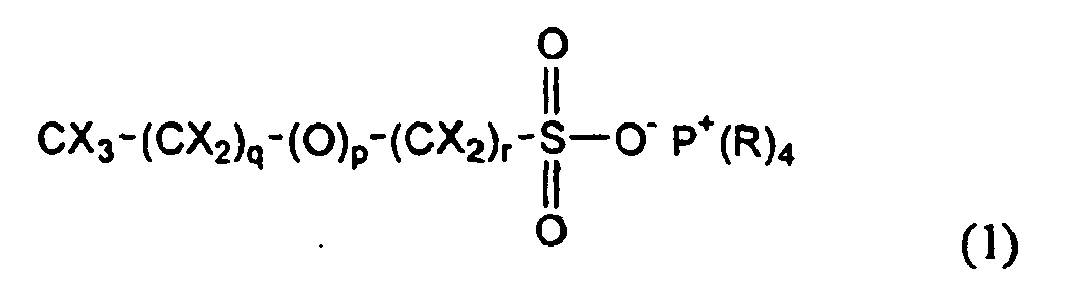
wherein each X is independently a halogen or hydrogen, provided that the molar ratio of halogen to hydrogen is greater than 0.90; p is 0 or 1 and q and r are integers of 0 to 7 provided that q+r is less than 8 and that if p is not zero then r is greater than zero; and each R is the same or different hydrocarbon radical containing 1 to 18 carbon atoms, the method comprising
combining in an aqueous medium, a compound of the generic formula (2):
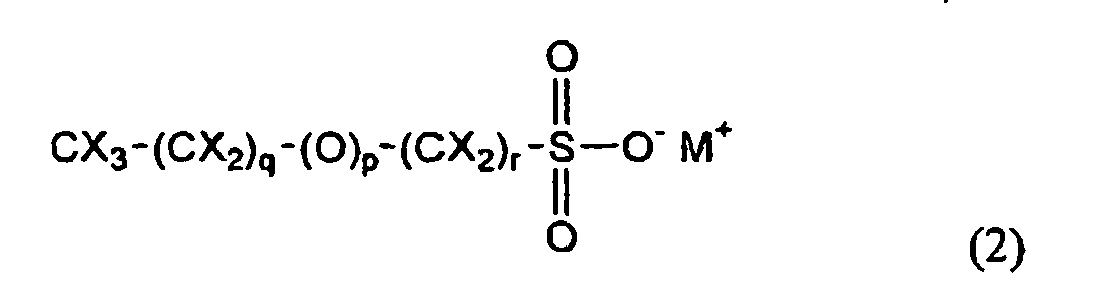
wherein M is Li or Na, and X, q, p, and r are as defined above, with a stoichiometric excess of a compound of the generic formula (3):
(R)4P-Z (3)
wherein Z is a halogen and R is as defined above; and
separating the phosphonium sulfonate of formula (1) from the aqueous medium.
wherein each X is independently a halogen or hydrogen, provided that the molar ratio of halogen to hydrogen is greater than 0.90; p is 0 or 1 and q and r are integers of 0 to 7 provided that q+r is less than 8 and that if p is not zero then r is greater than zero; and each R is the same or different hydrocarbon radical containing 1 to 18 carbon atoms, the method comprising
combining in an aqueous medium, a compound of the generic formula (2):
wherein M is Li or Na, and X, q, p, and r are as defined above, with a stoichiometric excess of a compound of the generic formula (3):
(R)4P-Z (3)
wherein Z is a halogen and R is as defined above; and
separating the phosphonium sulfonate of formula (1) from the aqueous medium.
2. The method of claim 1 wherein X is fluorine; Z is bromine or chlorine; and three of
the R groups are the same aliphatic hydrocarbon radical containing 1 to 8 carbon atoms
or aromatic hydrocarbon radical containing 6 to 12 carbon atoms, and the fourth R
group is a hydrocarbon radical containing 1 to 18 carbon atoms.
3. The method of claim 2 wherein p is zero.
4. The method of claim 1 wherein the sulfonate is perfluoromethane sulfonate, perfluoroethane
sulfonate, perfluoropropane sulfonate, perfluorobutane sulfonate, perfluoropentane
sulfonate, perfluorohexane sulfonate, perfluoroheptane sulfonate, perfluorooctane
sulfonate, or a combination comprising at least one of the foregoing sulfonates; and
wherein the phosphonium is tetramethyl phosphonium, tetraethyl phosphonium, tetrabutyl
phosphonium, triethylmethyl phosphonium, tributylmethyl phosphonium, tributylethyl
phosphonium, trioctylmethyl phosphonium, trimethylbutyl phosphonium, trimethyloctyl
phosphonium, trimethyllauryl phosphonium, trimethylstearyl phosphonium, triethyloctyl
phosphonium and aromatic phosphonium such as tetraphenyl phosphonium, triphenylmethyl
phosphonium, triphenylbenzyl phosphonium, tributylbenzyl phosphonium, or a combination
comprising at least one of the foregoing phosphonium.
5. The method of claim 4 wherein the sulfonate is perfluorobutane sulfonate,
and the phosphonium is tetrabutylphosphonium.
and the phosphonium is tetrabutylphosphonium.
6. The method of claim 1 wherein the molar ratio of the compound of formula (2) to the
compound of formula (3) is of 1:1.001 to 1:1.5.
7. The method of claim 1 wherein the molar ratio of the compound of formula (2) to the
compound of formula (3) is of 1.00 1: to 1.5:1
8. The method of claim 1 wherein the aqueous medium comprises less than 1 volume percent
of a non-aqueous medium.
9. The method of claim 1 wherein the product phosphonium sulfonate precipitates from
the aqueous medium.
1. Ein Verfahren zur Herstellung des Phosphoniumsulfonatsalzes mit der allgemeinen Formel
(1):
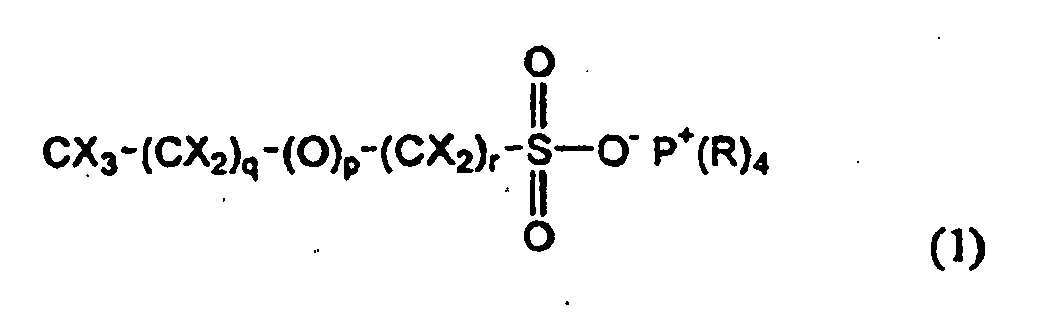
worin jedes X unabhängig ein Halogen oder Wasserstoff ist, vorausgesetzt, dass das Molverhältnis von Halogen zu Wasserstoff größer ist als 0,90; p 0 oder 1 ist und q und r ganze Zahlen von 0 bis 7 sind, vorausgesetzt, dass q+r weniger ist als 8 und dass, wenn p nicht Null ist, r größer ist als Null; und jedes R dasselbe oder ein anderes Kohlenwasserstoffradikal ist, das 1 bis 18 Kohlenstoffatome enthält, wobei das Verfahren Folgendes umfasst:
(R)4P-Z (3)
worin Z ein Halogen ist und R wie oben definiert ist; und Trennen des Phosphoniumsulfonats mit der Formel (1) von dem wässerigen Medium.
worin jedes X unabhängig ein Halogen oder Wasserstoff ist, vorausgesetzt, dass das Molverhältnis von Halogen zu Wasserstoff größer ist als 0,90; p 0 oder 1 ist und q und r ganze Zahlen von 0 bis 7 sind, vorausgesetzt, dass q+r weniger ist als 8 und dass, wenn p nicht Null ist, r größer ist als Null; und jedes R dasselbe oder ein anderes Kohlenwasserstoffradikal ist, das 1 bis 18 Kohlenstoffatome enthält, wobei das Verfahren Folgendes umfasst:
Kombinieren, in einem wässerigen Medium, einer Verbindung mit der allgemeinen Formel
(2):
(R)4P-Z (3)
worin Z ein Halogen ist und R wie oben definiert ist; und Trennen des Phosphoniumsulfonats mit der Formel (1) von dem wässerigen Medium.
2. Das Verfahren gemäß Anspruch 1, worin X Fluor ist, Z Brom oder Chlor ist und drei
der R-Gruppen dasselbe aliphatische Kohlenwasserstoffradikal sind, das 1 bis 8 Kohlenstoffatome
enthält, oder dasselbe aromatische Kohlenwasserstoffradikal, das 6 bis 12 Kohlenstoffatome
enthält, und die vierte R-Gruppe ein Kohlenwasserstoffradikal ist, das 1 bis 18 Kohlenstoffatome
enthält.
3. Das Verfahren gemäß Anspruch 2, worin p Null ist.
4. Das Verfahren gemäß Anspruch 1, worin das Sulfonat Perfluormethansulfonat, Perfluorethansulfonat,
Perfluorpropansulfonat, Perfluorbutansulfonat, Perfluorpentansulfonat, Perfluorhexansulfonat,
Perfluorheptansulfonat, Perfluoroctansulfonat oder eine Kombination ist, die mindestens
eines der oben genannten Sulfonate umfasst; und worin das Phosphonium Tetramethylphosphonium,
Tetraethylphosphonium, Tetrabutylphosphonium, Triethylmethylphosphonium, Tributylmethylphosphonium,
Tributylethylphosphonium, Trioctylmethylphosphonium, Trimethylbutylphosphonium, Trimethyloctylphosphonium,
Trimethyllaurylphosphonium, Trimethylstearylphosphonium, Triethyloctylphosphonium
und aromatisches Phosphonium ist, wie beispielsweise Tetraphenylphosphonium, Triphenylmethylphosphonium,
Triphenylbenzylphosphonium, Tributylbenzylphosphonium, oder eine Kombination, die
mindestens eines der oben genannten Phosphonien ist.
5. Das Verfahren gemäß Anspruch 4, worin das Sulfonat Perfluorbutansulfonat ist und das
Phosphonium Tetrabutylphosphonium ist.
6. Das Verfahren gemäß Anspruch 1, worin das Molverhältnis der Verbindung mit der Formel
(2) zu der Verbindung mit der Formel (3) von 1:1,001 bis 1:1,5 ist.
7. Das Verfahren gemäß Anspruch 1, worin das Molverhältnis der Verbindung mit der Formel
(2) zu der Verbindung mit der Formel (3) von 1,001:1 bis 1,5:1 ist.
8. Das Verfahren gemäß Anspruch 1, worin das wässerige Medium weniger als 1 Volumenprozent
eines nicht wässerigen Mediums umfasst.
9. Das Verfahren gemäß Anspruch 1, worin das Produkt-Phosphoniumsulfonat aus dem wässerigen
Medium präzipitiert.
1. Procédé de fabrication du sel sulfonate de phosphonium présentant la formule générique
(1) :
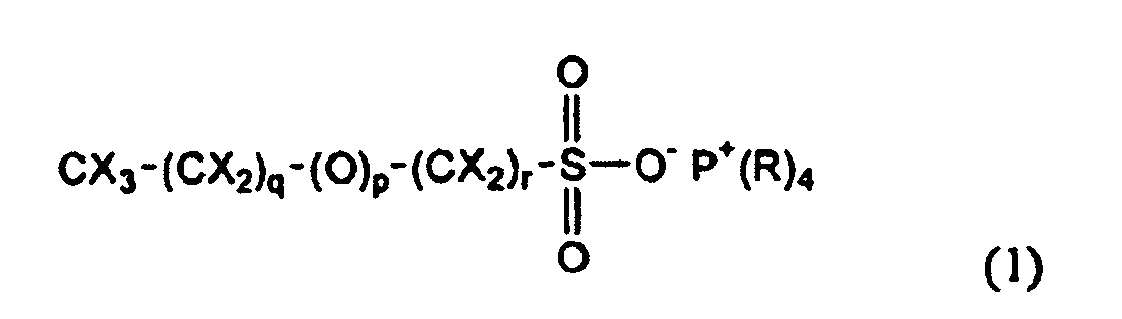
dans laquelle chaque X est, indépendamment, un halogène ou l'hydrogène, sachant que le rapport molaire entre halogène et hydrogène est supérieur à 0,90 ; p vaut 0 ou 1 et q et r sont des entiers dans la fourchette comprise entre 0 et 7, sachant que q+r est inférieur à 8 et que, si p est différent de zéro, alors r est supérieur à zéro ; et chaque R est un radical hydrocarboné identique ou différent, contenant 1 à 18 atomes de carbone, le procédé comprenant :
(R)4P-Z (3)
dans laquelle Z est un halogène et R est tel que défini ci-dessus ; et
la séparation du sulfonate de phosphonium de formule (1) vis-à-vis du milieu aqueux.
dans laquelle chaque X est, indépendamment, un halogène ou l'hydrogène, sachant que le rapport molaire entre halogène et hydrogène est supérieur à 0,90 ; p vaut 0 ou 1 et q et r sont des entiers dans la fourchette comprise entre 0 et 7, sachant que q+r est inférieur à 8 et que, si p est différent de zéro, alors r est supérieur à zéro ; et chaque R est un radical hydrocarboné identique ou différent, contenant 1 à 18 atomes de carbone, le procédé comprenant :
la combinaison, dans un milieu aqueux, d'un composé de la formule générique (2) :
(R)4P-Z (3)
dans laquelle Z est un halogène et R est tel que défini ci-dessus ; et
la séparation du sulfonate de phosphonium de formule (1) vis-à-vis du milieu aqueux.
2. Procédé selon la revendication 1, dans lequel X est le fluor ; Z est le brome ou le
chlore ; et trois des groupes R sont le même radical hydrocarboné aliphatique, contenant
de 1 à 8 atomes de carbone, ou un radical hydrocarboné aromatique, contenant de 6
à 12 atomes de carbone, et le quatrième groupe R est un radical hydrocarboné contenant
de 1 à 18 atomes de carbone.
3. Procédé selon la revendication 2, dans lequel p vaut zéro.
4. Procédé selon la revendication 1, dans lequel le sulfonate est le perfluorométhane
sulfonate,perfluoroéthane sulfonate, perfluoropropane sulfonate, perfluorobutane sulfonate,perfluoropentane
sulfonate, perfluorohexane sulfonate, perfluoroheptane sulfonate,perfluorooctane sulfonate,
ou une combinaison comprenant au moins l'un des sulfonates précédents; et dans lequel
le phosphonium est du tétraméthyl phosphonium, tétraéthylphosphonium, tétrabutyl phosphonium,
triéthylméthyl phosphonium, tributylméthylphosphonium, tributyléthyl phosphonium,
trioctylméthyl phosphonium, triméthylbutylphosphonium, triméthyloctyl phosphonium,
triméthyllauryl phosphonium,triméthylstéaryl phosphonium, triéthyloctyl phosphonium
et un phosphonium aromatique tel que le tétraphényl phosphonium, triphénylméthyl phosphonium,
triphénylbenzylphosphonium, tributylbenzyl phosphonium, ou une combination comprenant
au moins l'un des phosphoniums précédents.
5. Procédé selon la revendication 4, dans lequel le sulfonate est le perfluoroborate
sulfonate,
et le phosphonium est le tétrabutylphosphonium.
et le phosphonium est le tétrabutylphosphonium.
6. Procédé selon la revendication 1, dans lequel le rapport molaire entre le composé
de la formule (2) et le composé de la formule (3) est dans la fourchette comprise
entre 1:1,001 et 1:1,5.
7. Procédé selon la revendication 1, dans lequel le rapport molaire entre le composé
de la formule (2) et le composé de la formule (3) est dans la fourchette comprise
entre 1,001:1 et 1,5:1.
8. Procédé selon la revendication 1, dans lequel le milieu aqueux comprend moins de 1
pourcent en volume d'un fluide non aqueux.
9. Procédé selon la revendication 1, dans lequel le produit qu'est le sulfonate de phosphonium
précipite vis-à-vis du milieu aqueux.
REFERENCES CITED IN THE DESCRIPTION
This list of references cited by the applicant is for the reader's convenience only. It does not form part of the European patent document. Even though great care has been taken in compiling the references, errors or omissions cannot be excluded and the EPO disclaims all liability in this regard.
Patent documents cited in the description