|
(11) | EP 1 879 925 B1 |

| (12) | EUROPEAN PATENT SPECIFICATION |
|
|
| (54) |
PHENYLGLYOXALIC ESTERS GENERATING BY PHOTOLYSIS LOW MIGRATABLE FRAGMENTS PHENYLGLYOXALSÄUREESTER, DIE DURCH PHOTOLYSE WENIG MIGRIERENDE FRAGMENTE BILDEN ESTERS PHENYLGLYOXALIQUES GENERANT DES FRAGMENTS A FAIBLE CAPACITE DE MIGRATION PAR PHOTOLYSE |
|
|
|||||||||||||||||||||||||||
| Note: Within nine months from the publication of the mention of the grant of the European patent, any person may give notice to the European Patent Office of opposition to the European patent granted. Notice of opposition shall be filed in a written reasoned statement. It shall not be deemed to have been filed until the opposition fee has been paid. (Art. 99(1) European Patent Convention). |
[0001] This invention concerns photopolymerisable systems containing phenylglyoxalic esters that, by photochemical decomposition, generate fragments having low migratability and low odour.
[0002] Photopolymerisable systems contain photoinitiators characterised by the presence within their molecule of a functional group that, by electromagnetic excitation, generally UV radiation, generates radicals that are able to start a polymerisation process.
[0003] As it is known, both the photoinitiators and the fragments deriving from photochemical decomposition during the polymerisation process must follow strict criteria of low toxicity, volatility, migratability and odour and must be highly compatible within the photopolymerisable system.
[0005] Aromatic phenylglyoxalic esters and their use as photoinitiators are known and described, for example, in US 4038164 , US 4024297 and US 4475999.
[0006] More recently, in US 6048660, a large family of phenylglyoxalic esters is described; they are said to possess low volatility and low odour, but it is not reported if such characteristics can also be found in the products originating from their photo-decomposition.
[0007] The products originating from the decomposition of the phenylglyoxalic esters of US 6048660, nonetheless, derive from the radicals R1CO and R2CO; in the simplest cases, these radicals become benzaldehyde, 4-methoxy-benzaldehyde or 4-methylthio-benzaldehyde, ...which are notoriously irritant and malodorous.
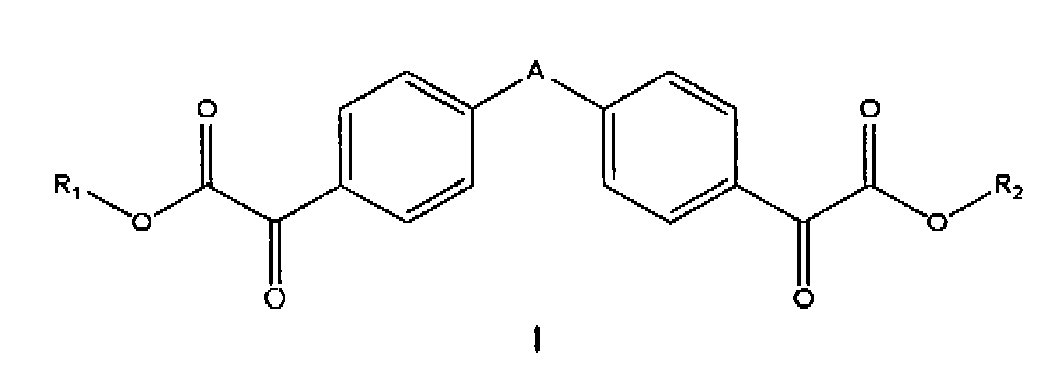
[0008] We have now found that the members of a restricted family of aromatic phenylglyoxalic esters having formula I:
[0011] A is selected among O, S, NR3, linear or branched C1-C6 alkyl or cycloalkyl and R3 is hydrogen or C1-C6 linear or branched alkyl;
[0012] R1 and R2 are, independently of one another, linear or branched C1-C18 alkyl or cycloalkyl, (CH2CH2O)nR4 where n is a number from 1 to 6 and R4 is hydrogen or linear or branched C1-C4 alkyl, or CH2CH2N(R5)2 where R5 is linear or branched C1-C4 alkyl,
[0013] by photochemical decomposition, generate fragments having low migratability, volatility and odour.
[0014] The photopolymerisable systems comprising reactive oligomers and/or monomers having ethylenically unsaturated groups and, as photoinitiators, the phenylglyoxalic esters of formula I are a fundamental object of the present invention, and are particularly useful for the preparation of coatings for food packaging.
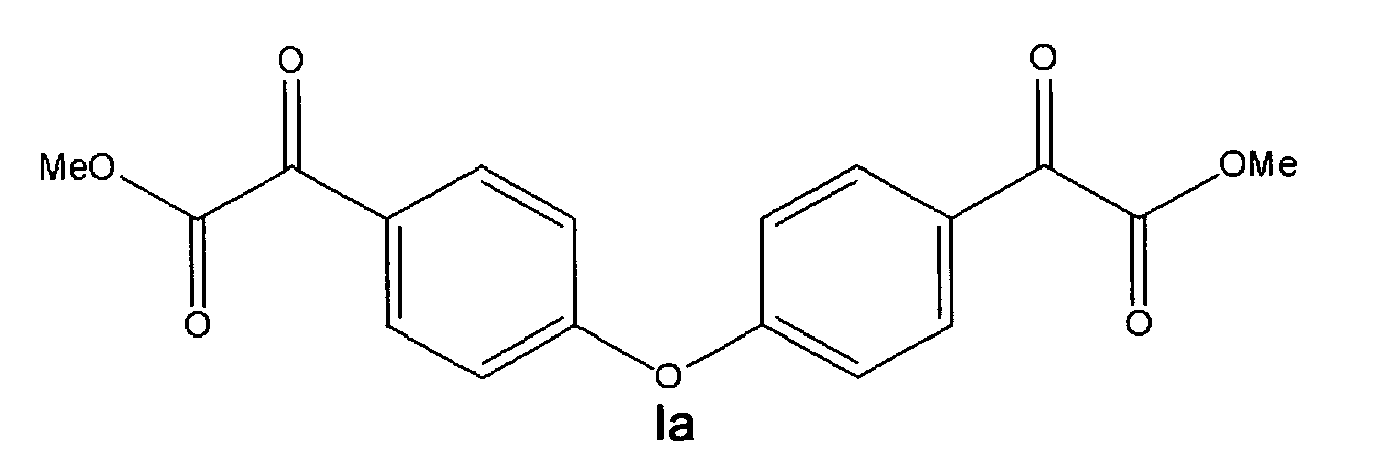
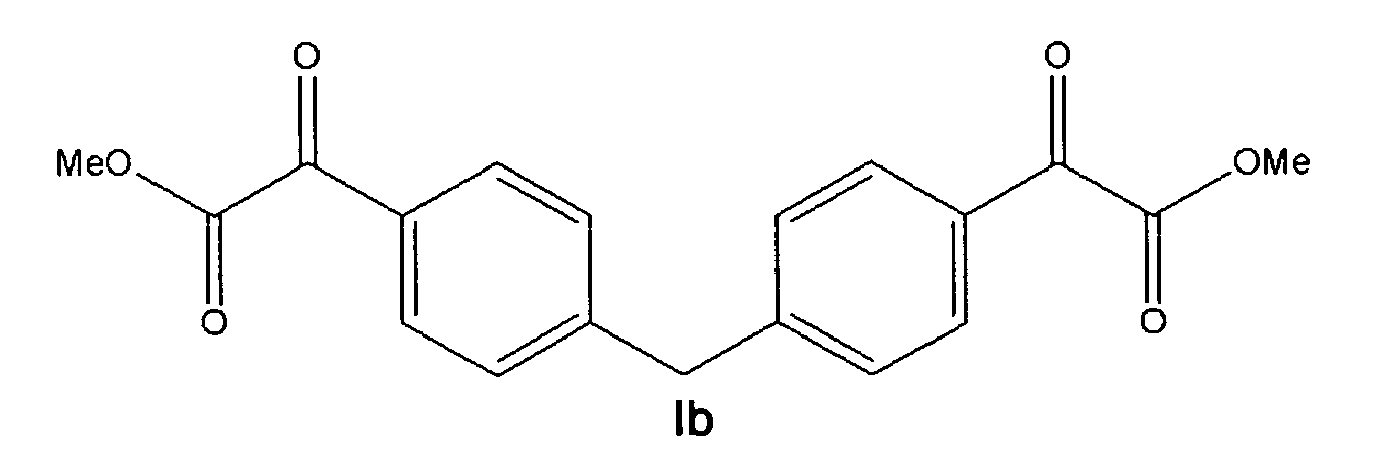
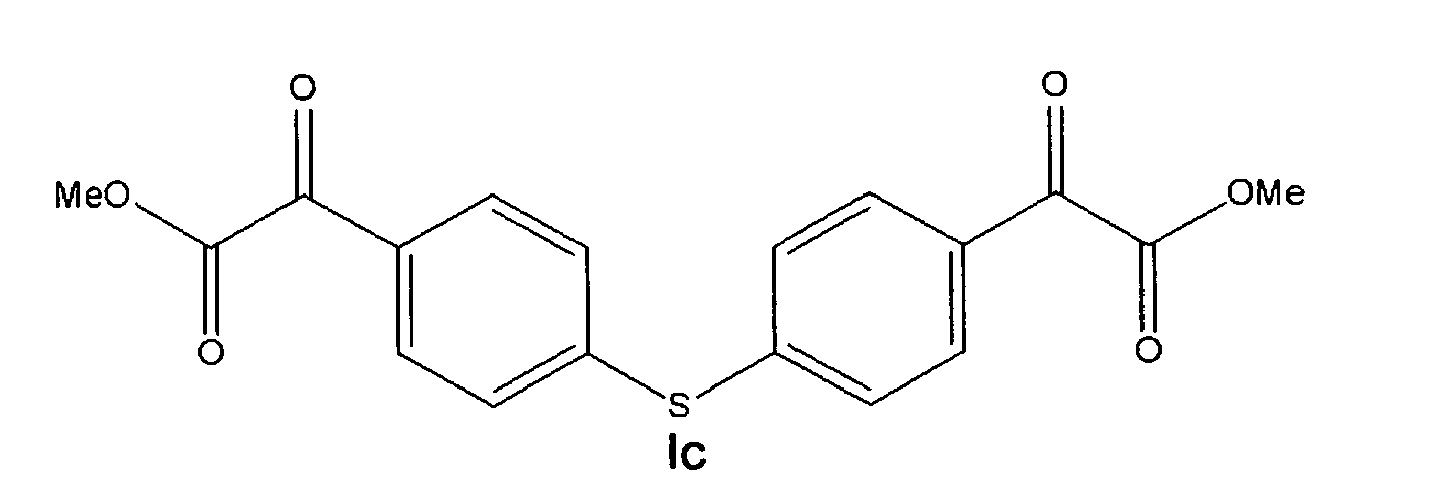
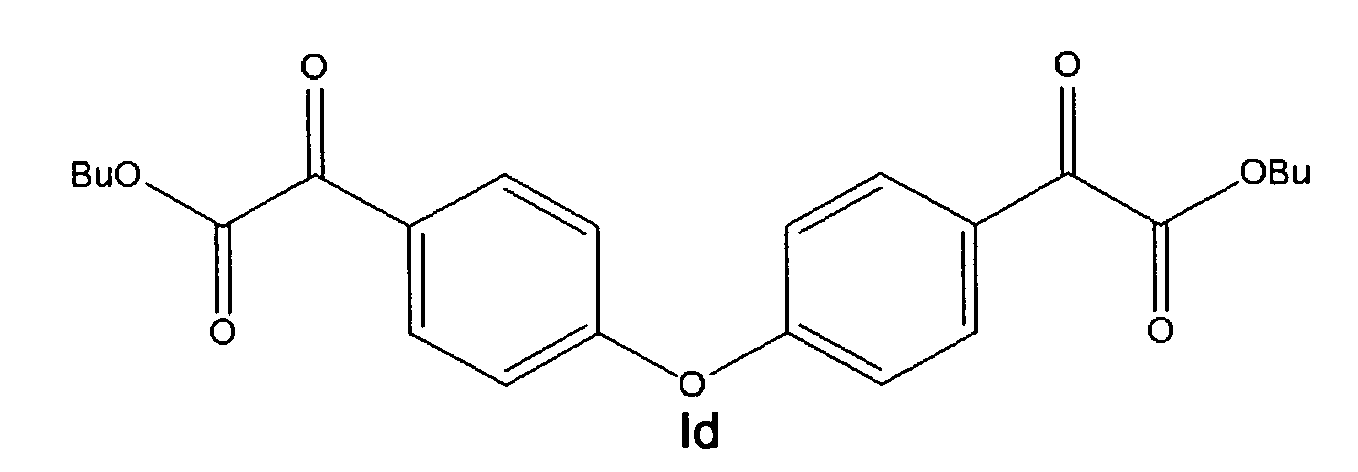
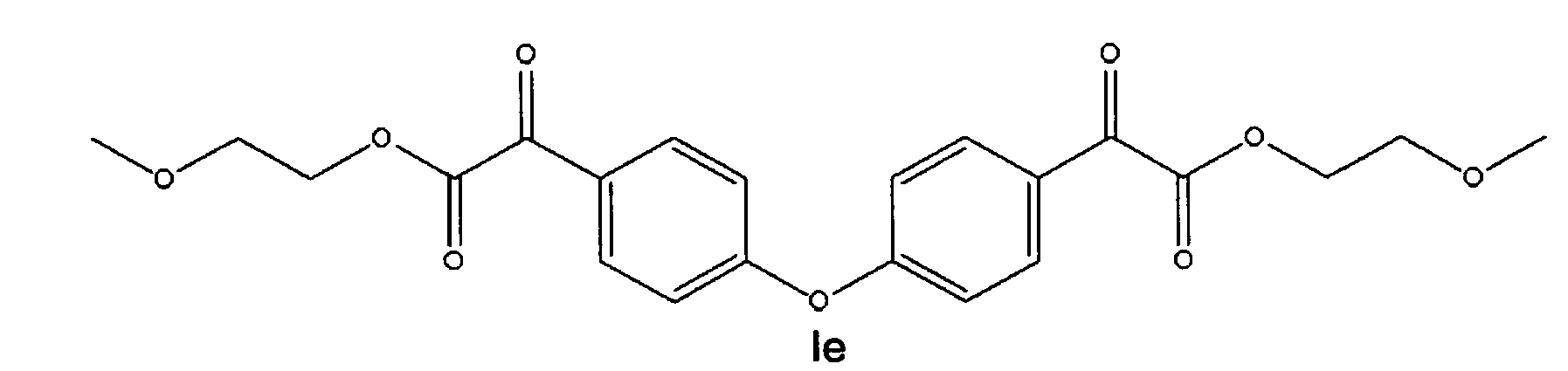
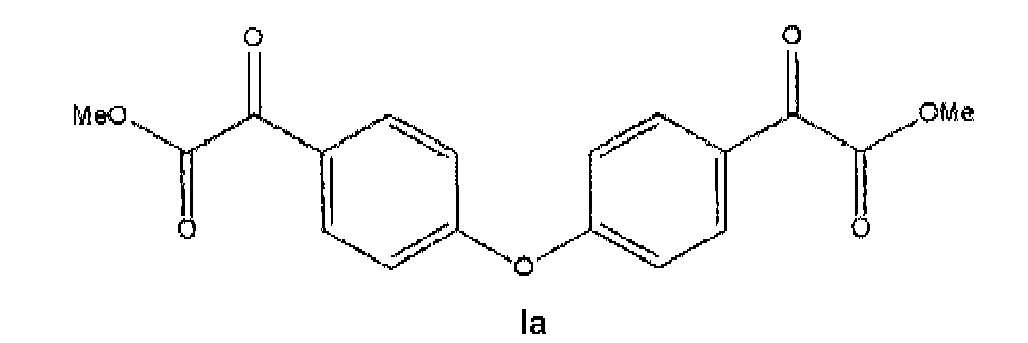
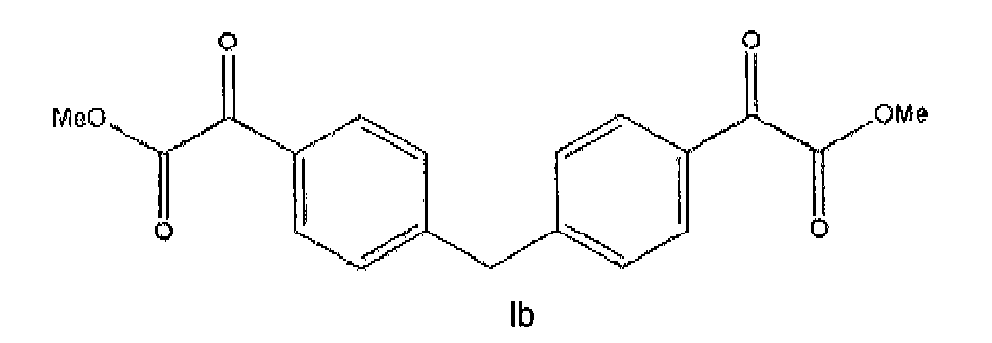
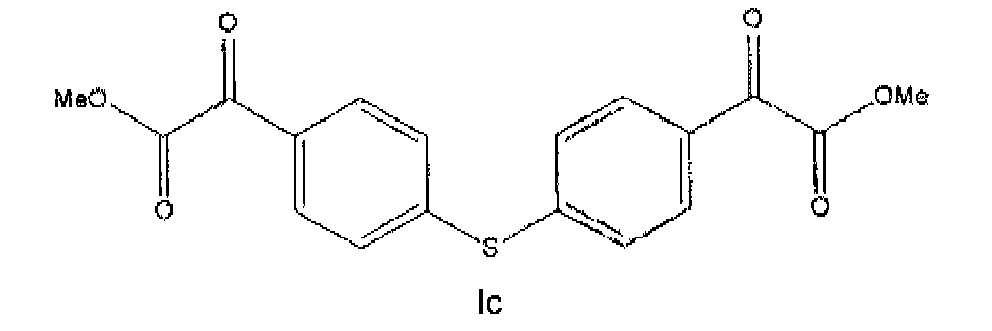
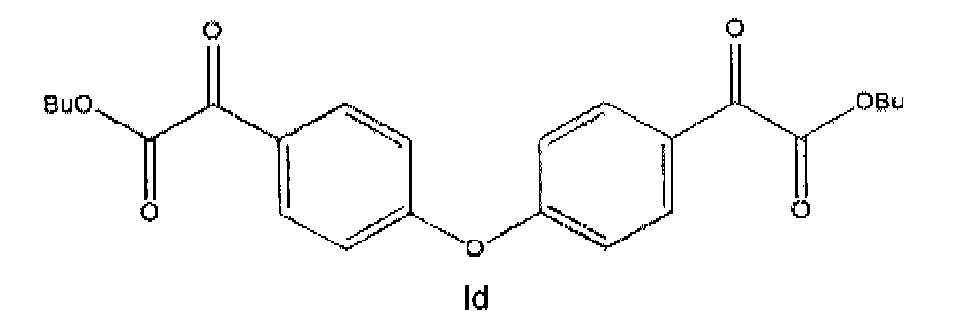
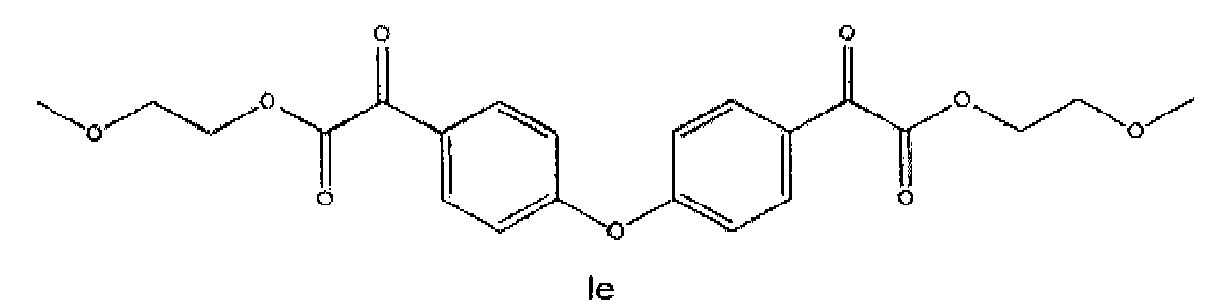
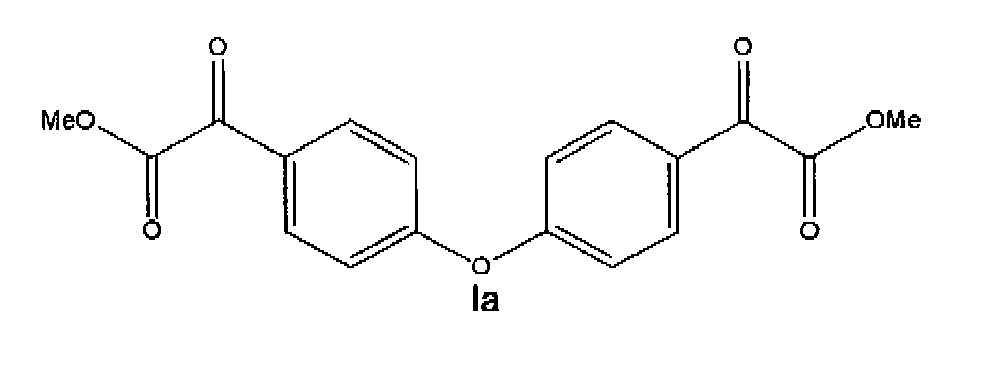
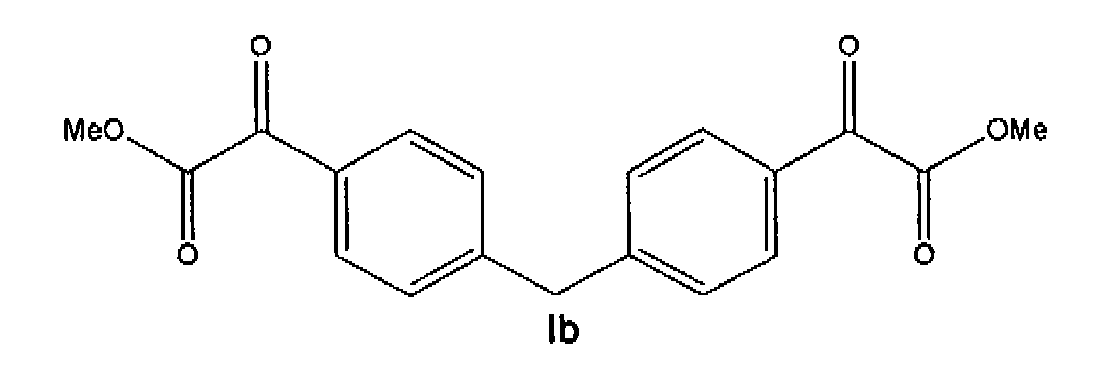
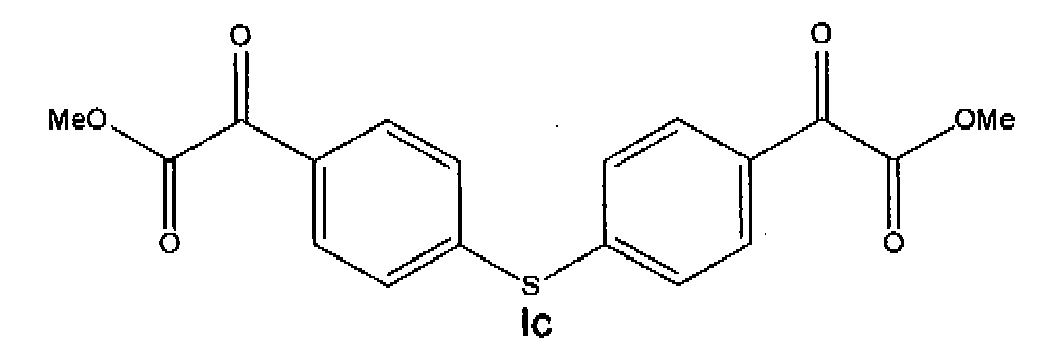
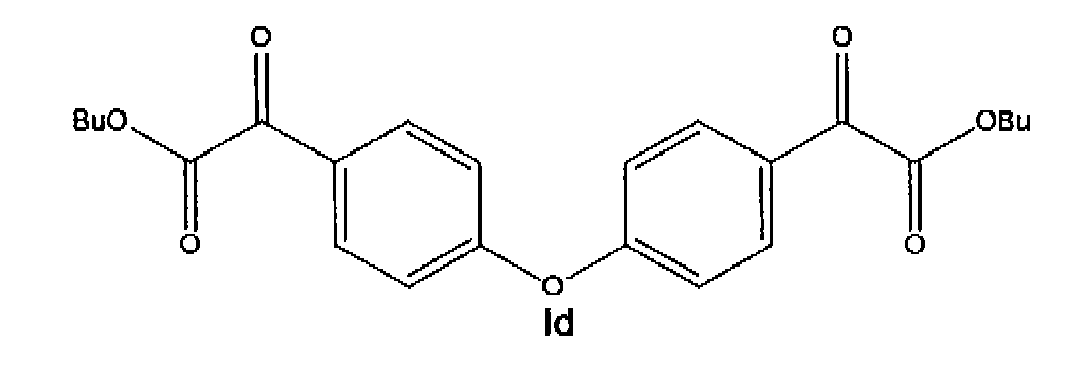
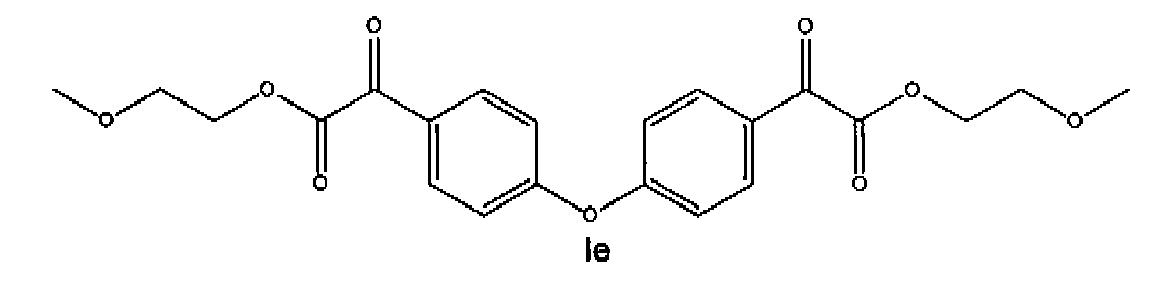
[0015] Among the products which are particularly useful for the realisation of the present invention we cite the compounds of formula I wherein A is selected among O, S or CH2, and R1 and R2 are methyl, ethyl, i-propyl, n-propyl, n-butyl, i-butyl, t-butyl, or CH2CH2OR4 where R4 is hydrogen, methyl or ethyl; the preferred products are those having formula Ia-Ie:
[0021] The phenylglyoxalic esters of formula I of the present invention may be prepared by conventional methods which are well known to the man skilled in the art.
[0023] where A is selected among O, S, NR3, linear or branched C1-C6 alkyl or cycloalkyl and R3 is hydrogen or linear or branched C2-C6 alkyl, and methyl oxalyl chloride and optionally transesterifiying the obtained product with R1OH and/or R2OH, where R1 and R2 are, independently of one another, linear or branched C2-C18 alkyl or cycloalkyl, (CH2CH2O)nR4 where n is a number from 1 to 6 and R4 is hydrogen or linear or branched C1-C4 alkyl, or CH2CH2N(R5)2 where R5 is linear or branched C1-C4 alkyl, in the presence of a transesterification catalyst.
[0024] It is a further object of the present invention a process for the realisation of coatings for metal, wood, paper or plastic surfaces, comprising applying the photopolymerisable system comprising reactive oligomers and/or monomers having ethylenically unsaturated groups and at least one phenylglyoxalic esters of formula I, and preferably of formula la, Ib, Ic, Id, or Ie, to obtain, after polymerisation, a 0.5 to 100 microns thick coating, and subsequently photopolymerising with a light source having emission bands in the UV-visible region and up to 450 nm.
[0025] The term "photopolymerisation" is intended in a wide sense and include, for example, the polymerisation or crosslinking of polymeric materials, such as for example pre-polymers, the homopolymerisation and the copolymerisation of simple monomers and the combination of this kind of reactions.
[0026] Monomers useful in the described system include, for example : acrylonitrile, acrylamide and its derivatives, vinyl ethers, N-vinylpyrrolidone, mono and polyfunctional allyl ethers, such as for example trimethylolpropane diallylether, styrenes and alpha-methyl styrenes, esters of acrylic and methacrylic acid with alyphatic alcohols, with glycols, or with polyhydroxylated compounds, as for example pentaerythritol, trimethylolpropane or aminoalcohols, esters of vinyl alcohol with aliphatic or acrylic acids, derivatives of fumaric or maleic acid.
[0027] The oligomers which are useful for the present invention include, for example, polyesters, polyacrylates, polyurethanes, epoxidic resins, polyethers with acrylic, maleic or fumaric functionalities.
[0028] Compounds of formula I of the present invention acts as photoinitiators and can be used alone or in combination with other photoinitiators as for example benzophenone and its derivatives (such as methylbenzophenone, trimethylbenzophenone), acetophenone derivatives, such as for example α-hydroxyacetophenones, (as α-hydroxycyclohexylphenyl ketone, oligo - [2-hydroxy-2-methyl-1-[4-(1-methylvinyl)phenyl]-propanone], 2-hydroxy-2-methyl-1-phenyl-propanone, 2-hydroxy-1-[4-(2-hydroxy-ethoxy)-phenyl]-2-methyl-propan-1-one, 1-[2,3-dihydro-1-[4-(2-hydroxy-2-methyl-1-oxopropyl)phenyl]-1,3,3-trimethyl-1H-inden-5-yl]-2-hydroxy-2-methyl-1-propanone, 1-[2,3-dihydro-3-[4-(2-hydroxy-2-methyl-1-oxopropyl)phenyl]-1,1,3-trimethyl-1H-inden-5-il]-2-hydroxy-2-methyl-1-propanone, 4,3'-bis(α,α-hydroxy-isobutyryl)-diphenylmethane, 4,4'-bis(α,α-hydroxy-isobutyryl)-diphenylmethane,, 4,3'-bis(α,α-hydroxy-isobutyryl)-diphenylether,, 4,4'-bis(α,α-hydroxy-isobutyryl)-diphenylether), α-aminoacetophenones (as 2-dimethylamino-2-(4-methylbenzyl)-1-(4-morpholin-4-yl-phenyl)-butan-1-one, 2-benzyl-2-dimethylamino-1-(3,4-dimethoxy-phenyl)-butan-1-one, 2-benzyl-2-dimethylamino-1-(4-morpholin-4-yl-phenyl)-butan-1-one, 2-methyl-1-(4-methylsulfanyl-phenyl)-2-morpholin-4-yl-propan-1-one), ketosulfones (as
[0029] 1-[4-(4-benzoyl-phenylsulfanyl)-phenyl]-2-methyl-2-(toluene-4-sulfonyl)-propan-1-one), dialcoxyacetophenones, benzoin ethers, benzyl ketals (as benzyl dimethyl ketal), phenylglyoxylic acid esters and their derivatives (as phenylglyoxylic acid methyl ester, ethyl ester of 2-(2-oxo-2-phenyl-acetoxy-etoxyethyl) oxyphenylacetic acid), monoacylphosphine oxides, as (2,4,6 - trimethylbenzoyl)-diphenyl-phosphine oxide or the ethyl ester of phenyl-(2,4,6-trimethylbenzoyl)-phosphinic acid, bisacylphosphine oxides, (as bis-(2,6-dimethoxybenzoyl)-(2,4,4-trimethyl-pent-1-yl)phosphine oxide, bis(2,4,6-trimethylbenzoyl)-phenyl-phosphine oxide, bis(2,4,6-trimethylbenzoyl)-(2,4-dipentoxyphenyl)phosphine oxide), trisacylphosphine oxides, halogenomethyltriazine, ferrocene or titanocene derivatives, photoinitiators containing the borate or O-acyloximic group, sulphonium, phosphonium or iodonium aromatic salts.
[0030] In addition to the compounds of formula I, many other components may be included in the photopolymerisable systems of the invention, for example thermal stabilisers, sensitisers, photo-oxydation stabilisers such as sterically hindered amines, antioxidants, oxygen inhibitors, thermal radicals generators such as organic and inorganic peroxides, peresters, hydroperoxides, benzopinacols, azoderivatives such as azodiisobutyronitrile, metallic compounds such as cobalt(II) salts, manganese, antifoams, fillers, dispersing agents, pigments, dyes and/or matting agents, other additives of general use, dispersed solids, glass and carbon fibres, thixotropic agents.
[0031] Chemically inert non photopolymerisable polymers, as for example nitrocellulose, polyacrylic esters, polyolefines., or polymers which are crosslinkables with other systems, as for example with peroxides and atmospheric oxygen or acid catalysis or thermal activation, as for example polyisocyanates, urea, melamine or epoxidic resins are further components that may be included in the photopolymerisable systems.
[0032] The compounds of formula I are generally used in the photopolymerisable system in quantity of 0.01 to 20% by weight, preferably of 1 to 6% by weight, on the total weight of the photopolymerisable system and are perfectly compatible with the system, imparting to it high photochemical reactivity and heat stability.
[0033] The compounds of formula I are very efficient photoinitiators both in clear and in pigmented photopolymerisable systems and are useful for example for the preparation of photocrosslinkable inks. They are especially suited for use in the coating of PVC floor and in the automobile field.
[0034] Examples of sources of light useful for the photopolymerisation of the photopolymerisable systems prepared according to the invention are mercury vapour or superactinic or excimers lamps, with emission bands in the UV-visible region and particularly between 180 and 450 nm.
[0035] Among the useful sources of light, sunlight and other artificial sources emitting electromagnetic radiation with a wavelength from 180 nm up to the IR region are also included.
[0036] A further advantage of the present invention is the fact that, using starting compounds which are easily available on the market, by varying the group A in formula I, it is possible to modify the absorbance spectrum of the phenyglyoxalic ester so to increase its reactivity in pigmented systems.
[0037] The phenylglyoxalic esters of the present invention have a high reactivity, as shown in the application tests here reported; beside not generating benzaldehyde or substituted benzaldehyde, they are themselves low migratable, low volatile and low odorous.
[0038] Examples of the preparation of compounds of formula I and of photopolymerisable systems containing them are herein reported, not to limit but to illustrate the invention.
[0042] 31.3 g (0.235 mol) of AlCl3 were added in 30', under stirring and in portions, to a solution of 10 g (0.0587 mol) of diphenylether and 11.33 ml (0.123 mol) of methyl oxalyl chloride in 300 ml of dichloromethane, at a temperature of 0 to 5°C.
[0043] At the end of the addition the temperature was raised to room temperature and after three hours the reaction was completed. The reaction mixture was poured into a solution of 200 ml of water and ice acidified with 15 ml of concentrated HCl. The organic phase was separated, washed twice with brine, dried on sodium sulphate, and evaporated under vacuum. The oily residue, taken with 100 ml of petroleum ether, solidified.
[0049] 5.33 g (0.04 mol) of AlCl3 were added in one portion, under stirring at room temperature, to a solution of 1.68 g (0.01 mol) of diphenylmethane and 1.93 ml (0.021 mol) of methyl oxalyl chloride in 100 ml of dichloromethane.
[0050] After four hours the reaction was completed. The reaction mixture was poured into a solution of 100 ml of water and ice acidified with 2.5 ml of conc. HCl. The organic phase was separated, washed twice with brine, dried on sodium sulphate, and evaporated under vacuum. The oily residue was washed with petroleum ether and then evaporated.
[0056] 7.14 g (0.0536 mol) of AlCl3 were added in one portion, under stirring at room temperature, to a solution of 2.5 g (0.0134 mol) of diphenylsulphide and 2.58 ml (0.0281 mol) of methyl oxalyl chloride in 100 ml of dichloromethane. A sticky precipitated product was formed.
[0058] The reaction mixture was poured into a solution of 200 ml of water and ice acidified with 3.5 ml of conc. HCl. The organic phase was separated, washed twice with brine, dried on sodium sulphate, and evaporated under vacuum. The oily residue was washed with petroleum ether and then evaporated.
[0060] The product was purified by flash chromatography eluting with dichloromethane/petroleum ether 7/3 and then with dichloromethane.
[0061] The residue solidified in petroleum ether and was filtrated; 850 mg of product Ic were obtained.
[0066] 50.5 mg (0.2 mmol) of dibutyltin oxide were added to a suspension of 2 g of product la in 10 ml of n-butanol. The reaction was heated under reflux and a solution obtained. After two hours the reaction was completed. The solution was diluted with 100 ml of dichloromethane and the organic phase washed twice with water, dried on sodium sulphate, and evaporated under vacuum to give an oily product which was purified by flash chromatography eluting with petroleum ether/dichloromethane 1/1.
[0068] 1H-NMR, 300 MHz, CDCl3 δ(ppm): 8.1, m, 4H; 7.15, m, 4H; 4.4, t, 4H; 1.78, m, 4H; 1.45, m, 4H; 0.9, t, 6H
[0070] Synthesis of {4-[4-(2-Methoxy-ethoxyoxalyl)-phenoxy]-phenyl}-oxo-acetic acid 2-methoxy-ethyl ester (Ie).
[0071] 50.5 mg (0.2 mmol) of dibutyltin oxide were added to a suspension of 2 g of product la in 10 ml of 2-methoxyethanol. The reaction was heated under reflux and a solution obtained. After two hours the reaction was completed. The solution was diluted with 100 ml of dichloromethane and the organic phase washed twice with water, dried on sodium sulphate, and evaporated under vacuum to give an oily product which was purified by flash chromatography eluting with petroleum ether/ethyl acetate 6/4.
[0073] 1H-NMR, 300 MHz, CDCl3 δ(ppm): ): 8.1, m, 4H; 7.15, m, 4H; 4.55,m, 4H; 3.73, m, 4H; 3.41, s, 6H.
[0075] The substances used for the preparation of the photopolymerisable systems evaluated in the following applicative tests are:
[0080] For the evaluation of the photopolymerisable systems, two matrixes were prepared mixing (% w/w), for the first matrix M1:
[0084] The photopolymerisable systems to be evaluated are then prepared with the compositions reported in Table 1.
[0085]
Table 1- Photopolymerisable systems composition (% w/w)
| A | B | C | D | E | F | |
| Matrix M1 | 95 | |||||
| Matrix M2 | 96 | 96 | 96 | 96 | 96 | |
| Compound Ia | 5 | 4 | ||||
| Compound Ib | 4 | |||||
| Compound Ic | 4 | |||||
| Compound Id | 4 | |||||
| Compound Ie | 4 |
[0086] The evaluation of the photopolymerisable systems was done by determining the reactivity, through cure and yellow and white indexes.
[0088] The photopolymerisable system is laid with a thickness of 50 or 6 microns on a varnished cardboard using a bar-coater mounted on an electric stretch-film and thereafter irradiated at a distance of 26 cm from the light source. A Fusion(R) photopolymerisator was used, equipped with a medium pressure mercury lamp operating with about 50% of its nominal power (about 120 W/cm).
[0089] The photopolymerisation speed, measured in m/min, is the maximum possible speed that results in a perfect superficial crosslinking of the system (" tack free").
[0090] The maximum speed (expressed in m/min) resulting in a surface resistant to any visible damage after rubbing with abrasive paper was also measured (superficial abrasion).
[0093]
Table 2
| A | B | C | E | D | F | |
| Tack-free (m/min) 50 µm | 45 | 41 | 36.5 | 32 | 28 | 27 |
| Tack-free (m/min) 6 µm | 43.5 | - | - | - | - | - |
| Superficial abrasion (m/min) 50 µm | 10 | 10** | 10*** | 10*** | 5 | 4 |
| ** two passages ***three passages |
[0095] The photopolymerisable system is laid with a thickness of 100 µm on a varnished cardboard using a bar-coater mounted on an electric stretch-film and then is passed at a distance of 26 cm from the light source, at a speed corresponding to 70% of the tack-free speed. A Fusion(R) photopolymerisator was used, equipped with a medium pressure mercury lamp operating with about 50% of its nominal power (about 120 W/cm).
[0096] White and yellow indexes were measured according to ASTM D1925-70 standard test method. A low value of yellow index and a high value of white index correspond to high stability of the colour of the formulation.
[0100] The photopolymerised systems B-F and a system prepared by mixing 4 parts by weight of Esacure (R)KL200 (hydroxyketone sold by Lamberti SpA) and 96 parts by weight of matrix M2 (photopolymerisable system G) are laid with a thickness of 50 µm on a varnished cardboard using a bar-coater mounted on an electric stretch-film and then is passed at a distance of 26 cm from the light source, at a speed corresponding to 70% of the tack-free speed. A Fusion(R) photopolymerisator was used, equipped with a medium pressure mercury operating with about 50% of its nominal power (about 120 W/cm).
[0102] The thus obtained cardboard samples are put into closed glass jars and the jars are stored in oven for 30 minutes at 60°C.
1. Photopolymerisable systems comprising reactive oligomers and/or monomers having ethylenically
unsaturated groups characterised by the fact that they contain at least one phenylglyoxalic ester of formula I:
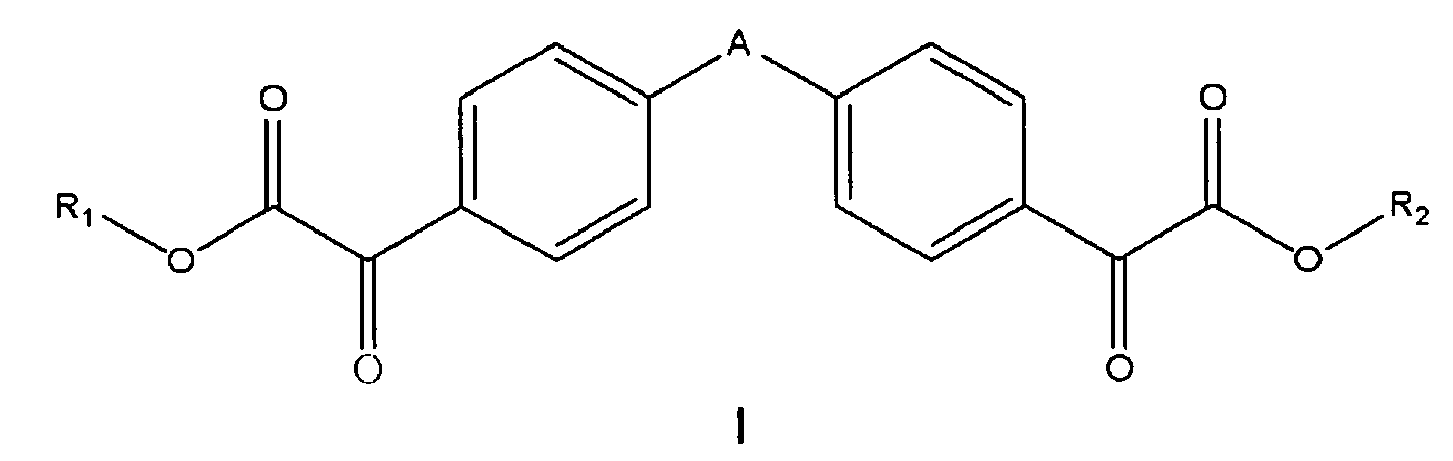
wherein A is selected among O, S, NR3, linear or branched C1-C6 alkyl or cycloalkyl and R3 is hydrogen or C1-C6 linear or branched alkyl; R1 and R2 are, independently of one another, linear or branched C1-C18 alkyl or cycloalkyl, (CH2CH2O)nR4 where n is a number from 1 to 6 and R4 is hydrogen or linear or branched C1-C4 alkyl, or CH2CH2N(R5)2 where R5 is linear or branched C1-C4 alkyl.
wherein A is selected among O, S, NR3, linear or branched C1-C6 alkyl or cycloalkyl and R3 is hydrogen or C1-C6 linear or branched alkyl; R1 and R2 are, independently of one another, linear or branched C1-C18 alkyl or cycloalkyl, (CH2CH2O)nR4 where n is a number from 1 to 6 and R4 is hydrogen or linear or branched C1-C4 alkyl, or CH2CH2N(R5)2 where R5 is linear or branched C1-C4 alkyl.
2. Photopolymerisable systems according to claim 1., characterised by the fact that they contain at least one phenylglyoxalic ester of formula I wherein
A is selected among O, S or CH2, and R1 and R2 are methyl, ethyl, i-propyl, n-propyl, n-butyl, i-butyl, t-butyl, or CH2CH2OR4 where R4 is hydrogen, methyl or ethyl.
3. Photopolymerisable systems according to claim 2., characterised by the fact that they contain at least one phenylglyoxalic ester of formula la:
4. Photopolymerisable systems according to claim 2., characterised by the fact that they contain at least one phenylglyoxalic ester of formula Ib:
5. Photopolymerisable systems according to claim 2., characterised by the fact that they contain at least one phenylglyoxalic ester of formula Ic:
6. Photopolymerisable systems according to claim 2., characterised by the fact that they contain at least one phenylglyoxalic ester of formula Id:
7. Photopolymerisable systems according to claim 2., characterised by the fact that they contain at least one phenylglyoxalic ester of formula Ie:
8. Process for the realisation of coatings for metal, wood, paper or plastic surfaces,
comprising applying a photopolymerisable system comprising reactive oligomers and/or
monomers having ethylenically unsaturated groups and at least one phenylglyoxalic
esters of formula I to obtain, after polymerisation, a 0.5 to 100 microns thick coating,
and subsequently photopolymerising with a light source having emission bands in the
UV-visible region and up to 450 nm.
9. Process for the realisation of coatings for metal, wood, paper or plastic surfaces
according to claim 8., where the photopolymerisable system comprises at least one
phenylglyoxalic esters of formula I wherein A is selected among O, S or CH2, and R1 and R2 are methyl, ethyl, i-propyl, n-propyl, n-butyl, i-butyl, t-butyl, or CH2CH2OR4 where R4 is hydrogen, methyl or ethyl.
10. Process for the realisation of coatings for metal, wood, paper or plastic surfaces
according to claim 9., where the photopolymerisable system comprises at least one
phenylglyoxalic ester of formula la, Ib, Ic, Id or Ie.
1. Photopolymerisierbare Systeme, die reaktive Oligomere und/oder Monomere mit ethylenisch
ungesättigten Gruppen beinhalten, dadurch gekennzeichnet, dass sie mindestens einen Phenylglyoxalester der Formel I enthalten:
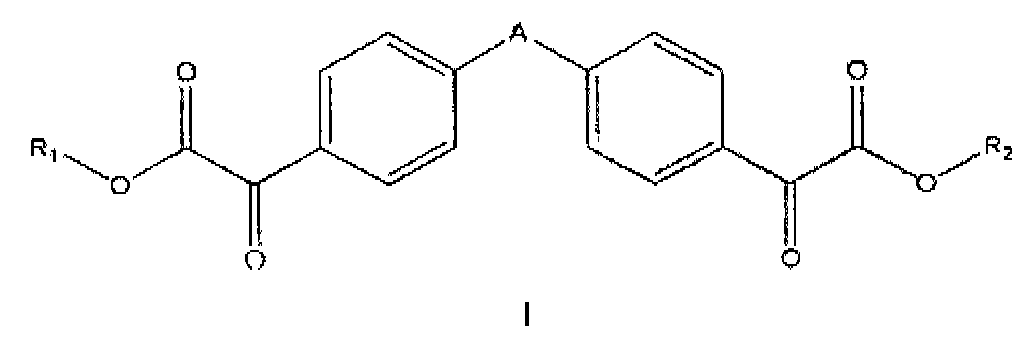
worin A aus O, S, NR3, einem linearen oder verzweigten C1-C6 Alkyl oder einem Zykloalkyl ausgewählt wird und R3 ein Wasserstoff oder lineares oder verzweigtes C1-C6 Alkyl ist; R1 und R2 unabhängig voneinander ein lineares oder verzweigtes C1-C18 Alkyl oder Zykloalkyl, ein (CH2CH2O)nR4, in dem n eine Zahl zwischen 1 und 6 und R4 ein Wasserstoff oder ein lineares oder verzweigtes C1-C4 Alkyl ist, oder ein CH2CH2N(R5), in dem R5 ein lineares oder verzweigtes C1-C4 Alkyl ist, sind.
worin A aus O, S, NR3, einem linearen oder verzweigten C1-C6 Alkyl oder einem Zykloalkyl ausgewählt wird und R3 ein Wasserstoff oder lineares oder verzweigtes C1-C6 Alkyl ist; R1 und R2 unabhängig voneinander ein lineares oder verzweigtes C1-C18 Alkyl oder Zykloalkyl, ein (CH2CH2O)nR4, in dem n eine Zahl zwischen 1 und 6 und R4 ein Wasserstoff oder ein lineares oder verzweigtes C1-C4 Alkyl ist, oder ein CH2CH2N(R5), in dem R5 ein lineares oder verzweigtes C1-C4 Alkyl ist, sind.
2. Photopolymerisierbare Systeme gemäß Patentanspruch 1, dadurch gekennzeichnet, dass sie mindestens einen Phenylglyoxalester der Formel I enthalten, worin A aus O, S
oder CH2 ausgewählt wird und R1 und R2 ein Methyl, Ethyl, i-Propyl, n-Propyl, n-Butyl, i-Butyl, t-Butyl oder CH2CH2OR4 sind, in dem R4 ein Wasserstoff, ein Methyl oder Ethyl ist.
3. Photopolymerisierbare Systeme gemäß Patentanspruch 2, dadurch gekennzeichnet, dass sie mindestens einen Phenylglyoxalester der Formel la enthalten.
4. Photopolymerisierbare Systeme gemäß Patentanspruch 2, dadurch gekennzeichnet, dass sie mindestens einen Phenylglyoxalester der Formel Ib enthalten.
5. Photopolymerisierbare Systeme gemäß Patentanspruch 2, dadurch gekennzeichnet, dass sie mindestens einen Phenylglyoxalester der Formel Ic enthalten.
6. Photopolymerisierbare Systeme gemäß Patentanspruch 2, dadurch gekennzeichnet, dass sie mindestens einen Phenylglyoxalester der Formel Id enthalten.
7. Photopolymerisierbare Systeme gemäß Patentanspruch 2, dadurch gekennzeichnet, dass sie mindestens einen Phenylglyoxalester der Formel le enthalten:
8. Prozess zur Zubereitung von Beschichtungen für Metall-, Holz-, Papier- oder Kunststoffoberflächen,
der die Anwendung eines photopolymerisierbaren Systems beinhaltet, das reaktive ethylenisch
ungesättigte Gruppen enthaltende Monomere und/oder Oligomere und mindestens einen
Phenylglyoxalester der Formel I enthält, um nach Polymerisation und anschließender
Photopolymerisation mit einer Lichtquelle von einer Emissionsbande im sichtbaren UV-Bereich
bis 450 nm eine 0.5 bis 100 Mikron starke Beschichtung zu erhalten.
9. Prozess zur Zubereitung von Beschichtungen für Metall-, Holz-, Papier- oder Kunststoffoberflächen
gemäß Patentanspruch 8, in dem das photopolymerisierbare System mindestens einen Phenylglyoxalester
der Formel I enthält, worin A aus O, S oder CH2 ausgewählt wird und R1 und R2 ein Methyl, Ethyl, i-Propyl, n-Propyl, n-Butyl, i-Butyl, t-Butyl oder CH2CH2OR4 sind, in dem R4 ein Wasserstoff, Methyl oder Ethyl ist.
10. Prozess zur Zubereitung von Beschichtungen für Metall-, Holz-, Papier- oder Kunststoffoberflächen
gemäß Patentanspruch 9, in dem das photopolymerisierbare System mindestens einen Phenylglyoxalester
der Formel Ia, Ib, Ic, Id oder le enthält.
1. Systèmes photopolymérisables contenant des oligomères et/ou des monomères réactifs
comprenant des groupes à insaturation éthylénique caractérisés en ce qu'ils contiennent au moins un ester phénylglyoxalique de formule I:
dans laquelle A est choisi parmi O, S, NR3, un alkyle linéaire ou ramifié en C1 à C6 ou un cycloalkyle et R3 est un atome d'hydrogène ou un alkyle linéaire ou ramifié en C1 à C6 ; R1 et R2 sont, indépendamment l'un de l'autre, un alkyle linéaire ou ramifié en C1 à C18 ou un cycloalkyle, (CH2CH2O)nR4 où n est un nombre de 1 à 6 et R4 est un atome d'hydrogène ou un alkyle linéaire ou ramifié en C1 à C4, ou bien CH2CH2N(R5)2, où R5 est un alkyle linéaire ou ramifié en C1 à C4.
dans laquelle A est choisi parmi O, S, NR3, un alkyle linéaire ou ramifié en C1 à C6 ou un cycloalkyle et R3 est un atome d'hydrogène ou un alkyle linéaire ou ramifié en C1 à C6 ; R1 et R2 sont, indépendamment l'un de l'autre, un alkyle linéaire ou ramifié en C1 à C18 ou un cycloalkyle, (CH2CH2O)nR4 où n est un nombre de 1 à 6 et R4 est un atome d'hydrogène ou un alkyle linéaire ou ramifié en C1 à C4, ou bien CH2CH2N(R5)2, où R5 est un alkyle linéaire ou ramifié en C1 à C4.
2. Systèmes photopolymérisables selon la revendication 1, caractérisés en ce qu'ils contiennent au moins un ester phénylglyoxalique de formule I, A étant choisi parmi
O, S ou CH2, et R1 et R2 étant un groupe méthyle, éthyle, i-propyle, n-propyle, n-butyle, i-butyle, t-butyle
ou bien CH2CH2OR4, où R4 est un atome d'hydrogène ou un groupe méthyle ou éthyle.
3. Systèmes photopolymérisables selon la revendication 2, caractérisés en ce qu'ils contiennent au moins un ester phénylglyoxalique de formule la :
4. Systèmes photopolymérisables selon la revendication 2, caractérisés en ce qu'ils contiennent au moins un ester phénylglyoxalique de formule Ib :
5. Systèmes photopolymérisables selon la revendication 2, caractérisés en ce qu'ils contiennent au moins un ester phénylglyoxalique de formule Ic :
6. Systèmes photopolymérisables selon la revendication 2, caractérisés en ce qu'ils contiennent au moins un ester phénylglyoxalique de formule Id :
7. Systèmes photopolymérisables selon la revendication 2, caractérisés en ce qu'ils contiennent au moins un ester phénylglyoxalique de formule Ie :
8. Procédé de réalisation de revêtements pour les surfaces en métal, bois, papier ou
plastique, comprenant l'application d'un système photopolymérisable contenant des
oligomères et/ou des monomères réactifs comprenant des groupes à insaturation éthylénique
et au moins un ester phénylglyoxalique de formule I de façon à obtenir, après polymérisation,
un revêtement d'épaisseur 0,5 à 100 microns ; suivie d'une photopolymérisation avec
une source lumineuse possédant des bandes d'émission dans la région UV-visible, jusqu'à
450 nm.
9. Procédé de réalisation de revêtements pour les surfaces en métal, bois, papier ou
plastique conformément à la revendication 8, ledit système photopolymérisable comprenant
au moins un ester phénylglyoxalique de formule I, dans laquelle A est choisi parmi
O, S ou CH2, et R1 et R2 sont un groupe méthyle, éthyle, i-propyle, n-propyle, n-butyle, i-butyle, t-butyle
ou CH2CH2OR4, R4 étant un atome d'hydrogène ou un groupe méthyle ou éthyle.
10. Procédé de réalisation de revêtements pour les surfaces en métal, bois, papier ou
plastique conformément à la revendication 9, ledit système photopolymérisable comprenant
au moins un ester phénylglyoxalique de formule Ia, Ib, Ic, Id ou le.
REFERENCES CITED IN THE DESCRIPTION
This list of references cited by the applicant is for the reader's convenience only. It does not form part of the European patent document. Even though great care has been taken in compiling the references, errors or omissions cannot be excluded and the EPO disclaims all liability in this regard.
Patent documents cited in the description