|
(11) | EP 2 333 036 A1 |

| (12) | EUROPEAN PATENT APPLICATION |
|
|
|
|
||||||||||||||||||||
| (54) | Lubricating composition comprising molybdenum compound and viscosity index improver |
| (57) The present invention provides a lubricating composition comprising: - a base oil; - one or more organomolybdenum compounds; and - one or more dispersant-viscosity index improver compounds. Preferably, the one or more dispersant-viscosity index improver compounds are selected from compounds according to formula (I), wherein n is an integer in the range of from 1 to 20, preferably 10 to 20, m is an integer in the range of from 75 to 200, y is an integer in the range of from 2 to 6 and x is an integer in the range of from 200 to 600. |
[0001] The present invention relates to a lubricating composition, and more in particular to a lubricating composition for use in the crankcase of an internal combustion engine.
[0002] WO 2007/096361 A1 discloses a lubricating composition comprising base oil, one or more glycerol esters selected from glycerol monooleate and/or glycerol dioleate, optionally in combination with glycerol trioleate, wherein said composition further comprises one or more dispersant-viscosity index improver compounds and an additive amount of one or more additional polyhydric alcohol esters. The lubricating compositions according to WO 2007/096361 exhibit good friction reduction and fuel economy properties, even when solely use is made of ashless friction modifiers (i.e. not containing molybdenum-based friction modifiers).
[0003] It has now surprisingly been found according to the present invention that synergistic friction reduction properties can be obtained by the combination of one or more organomolybdenum compounds and one or more dispersant-viscosity index improver compounds.
[0004] To this end the present invention provides a lubricating composition comprising:
- a base oil;
- one or more organomolybdenum compounds; and
- one or more dispersant-viscosity index improver compounds.
[0005] In this respect it is noted that WO 2007/096361 suggests to use ashless friction modifiers (instead of molybdenum friction modifiers), and no actual combinations of one or more organomolybdenum compounds; and one or more dispersant-viscosity index improver compounds have been disclosed in WO 2007/096361.
[0006] There are no particular limitations regarding the base oil used in the lubricating composition according to the present invention, and various conventional mineral oils, synthetic oils as well as naturally derived esters such as vegetable oils may be conveniently used.
[0007] The base oil used in the present invention may conveniently comprise mixtures of one or more mineral oils and/or one or more synthetic oils; thus, according to the present invention, the term "base oil" may refer to a mixture containing more than one base oil.
[0008] Mineral oils include liquid petroleum oils and solvent-treated or acid-treated mineral lubricating oil of the paraffinic, naphthenic, or mixed paraffinlc/naphthenic type which may be further refined by hydrofinishing processes and/or dewaxing.
[0009] Synthetic oils include hydrocarbon oils such as olefin oligomers (including polyalphaolefin base oils; Patsy dibasic acid esters, polyol esters, polyalkylene glycols (PAGs), alkyl naphthalenes, dewaxed waxy isomerates and Fischer-Tropsch derived base oils. Synthetic hydrocarbon base oils sold by the Shell Group under the designation "Shell XHVI" (trade mark) may be conveniently used. Poly-alpha olefin base oils (PAOs) and their manufacture are well known in the art. Fischer-Tropsch derived base oils are known in the art. By the term "Fischer-Tropsch derived" is meant that a base oil is, or is derived from, a synthesis product of a Fischer-Tropsch process. A Fischer-Tropsch derived base oil may also be referred to as a GTL (Gas-To-Liquids) base oil. Suitable Fischer-Tropsch derived base oils that may be conveniently used as the base oil in the lubricating composition of the present invention are those as for example disclosed in EP 0 776 959, EP 0 668 342, WO 97/21788, WO 00/15736, WO 00/14188, WO 00/14187, WO 00/14183, WO 00/14179, WO 00/08115, WO 99/41332, EP 1 029 029, WO 01/18156 and WO 01/57166. Preferably, the composition comprises at least 60 wt.% of a Fischer-Tropsch derived base oil, based on the total weight of the lubricating composition.
[0010] Suitable base oils for use in the lubricating oil composition of the present invention are Group I-III mineral base oils, Group IV poly-alpha olefins (PAOs), Group III Fischer-Tropsch derived base oils, etc., and mixtures thereof. By "Group I", Group II", "Group III" and "Group IV" base oils in the present invention are meant lubricating oil base oils according to the definitions of American Petroleum Institute (API) for category I and II. These API categories are defined in API Publication 1509, 15th Edition, Appendix E, April 2002.
[0011] The total amount of base oil incorporated in the lubricating composition of the present invention is preferably present in an amount in the range of from 60 to 99 wt.%, more preferably in an amount in the range of from 65 to 90 wt.% and most preferably in an amount in the range of from 70 to 85 wt.%, based on the total weight of the lubricating composition.
[0012] There are no particular limitations regarding the one or more organomolybdenum compounds used in the lubricating composition according to the present invention, and various conventional organomolybednum compounds may be conveniently used. Typical organomolybdenum compounds include molybdenum dithiocarbamates (MoDTC), molybdenum dithiophosphates (MoDTP), molybdenum amines, molybdenum alcoholates, and molybdenum alcohol-amides. The molybdenum-containing compound may also be a di- or trinuclear molybdenum compound. Preferably, the one or more organomolybdenum compounds comprise a compound selected from molybdenum dithiocarbamate (MoDTC) and molybdenum amine, or a mixture thereof; preferably, the one or more organomolybdenum compounds comprise at least molybdenum dithiocarbamate (MoDTC). Further it is preferred that the composition has a molybdenum content in the range of from 100 ppm to 2000 ppm, preferably from 200 to 1000 ppm, based on the total weight of the lubricating composition.
[0013] There are no particular limitations regarding the one or more dispersant-viscosity index improver compounds used in the lubricating composition according to the present invention, and various conventional dispersant-viscosity index improver compounds may be conveniently used.
[0014] Dispersant-viscosity index improver compounds are multi-functional compounds that in addition to acting as viscosity index improvers also exhibit dispersant behaviour. Such compounds are well known in the art and have been described in many publications, for example, Chapter 5 viscosity index improvers and thickeners") by R.L. Stambaugh in "Chemistry and Technology of Lubricants", eds., R.M. Mortier, S.T. Orszulik, Blackie/VCH, 1992, pp. 124. Such compounds may be conveniently prepared by conventional methods and may be generally prepared as described in the afore-mentioned reference. For example, amongst others, said compounds may also be prepared according to the methods described in EP-A-0 730 022, EP-A-0 730 021, US-A-3 506 574 and EP-A2-0 750 031. Examples of dispersant-viscosity index improver compounds that may be conveniently used include those described in US-B1-6 331 510, US-B1-6 204 224 and US-B1-6 372 696.
[0015] Examples of commercially available dispersant-viscosity index improver compounds include those available from Evonik Industries AG (Essen, Germany) under the trade designations "VISCOPLEX 6-325", "Viscoplex 6-054", "Viscoplex 6-954" and "Viscoplex 6-565" and that available from The Lubrizol Corporation under the trade designation "LZ 7720C".
[0016] Particularly preferred dispersant-viscosity index improver compounds that may be conveniently employed in the present invention are polyalkylene glycol-polymethacrylate copolymers. The polyalkylene glycol moieties therein may comprise branched or unbranched alkylene groups. Examples of polyalkylene glycol-polymethacrylate copolymers that may be conveniently used are polyethylene glycol-polymethacrylate copolymers and polypropylene glycol-polymethacrylate copolymers.
[0017] Polyalkylene glycol-polymethacrylate copolymers which are especially preferred for use as dispersant-viscosity index improver compounds in the present invention include compounds selected from compounds according to formula (I),
wherein n is an integer in the range of from 1 to 20, preferably 10 to 20, m is an integer in the range of from 75 to 200, y is an integer in the range of from 2 to 6 and x is an integer in the range of from 200 to 600. Examples of most preferred dispersant-viscosity index improver compounds that may be conveniently employed in the present invention include polyethylene glycol-polymethacrylate co-polymers.
[0018] Polyethylene glycol-polymethacrylate co-polymers which are especially preferred for use as dispersant-viscosity index improver compounds in the present invention include compounds according to formula II,
wherein n is an integer in the range of from 1 to 20, preferably 10 to 20, m is an integer in the range of from 75 to 200 and x is an integer in the range of from 200 to 600.
[0019] Preferred polyalkylene glycol-polymethacrylate copolymers dispersant-viscosity index improver compounds that may be conveniently used in the present invention include viscosity index improver which is available under the trade designation "VISCOPLEX 6-325" from Evonik Industries AG.
[0020] In a preferred embodiment of the present invention, the one or more dispersant-viscosity index improver compounds are present in a total amount in the range of from 0.1 to 10 wt.%, more preferably in the range of from 0.2 to 7 wt.% and most preferably in the range of from 0.5 to 4 wt.%, based on the total weight of the lubricating composition.
[0021] The lubricating composition according to the present invention typically further comprises one or more additives such as anti-oxidants, anti-wear additives, dispersants, detergents, overbased detergents, extreme pressure additives, friction modifiers, viscosity index improvers, pour point depressants, metal passivators, corrosion inhibitors, demulsifiers, anti-foam agents, seal compatibility agents and additive diluent base oils, etc. As the person skilled in the art is familiar with the above and other additives, these are not further discussed here in detail. Specific examples of such additives are described in for example Kirk-Othmer Encyclopedia of Chemical Technology, third edition, volume 14, pages 477-526. Examples of suitable additives are disclosed in WO 2007/096361 (in particular on page 11, line 14 - page 17, line 31), the teaching of which is hereby incorporated by specific reference.
[0022] Preferably, the lubricating composition according to the present invention has a kinematic viscosity at 100°C (ASTM D 445) in the range of from 2 to 80 mm2/s, more preferably in the range of from 3 to 50 mm2/s, most preferably in the range of from 4 to 20 mm2/s.
[0023] The total amount of phosphorus in the lubricating composition of the present invention is preferably in the range of from 0.04 to 0.1 wt.%, more preferably in the range of from 0.05 to 0.09 wt.% and most preferably in the range of from 0.06 to 0.08 wt.%, based on total weight of the lubricating composition.
[0024] The lubricating composition of the present invention preferably has typically a sulphur content of not greater than 1.2 wt.%, preferably not greater than 0.7 wt.%, more preferably not greater than 0.5 wt.% and most preferably not greater than 0.3 wt.%, based on the total weight of the lubricating composition.
[0025] Preferably, the lubricating composition according to the present invention meets the so-called SAE J300 Specifications (as revised in January 2009), preferably those of xW-20, xW-30 and xW-40 (wherein x = 0, 5, 10 or 15) crankcase engine oils. SAE stands for Society of Automotive Engineers. In particular the lubricating composition according to the present invention meets the specifications of a SAE OW-20 formulation.
[0026] The lubricating compositions of the present invention may be conveniently prepared by admixing the one or more additives with the base oil(s).
[0027] In another aspect the present invention provides a method of lubricating an internal combustion engine comprising applying a lubricating composition according to the present invention thereto. Further, the present invention provides the use of the lubricating composition according to the present invention in order to improve friction reduction properties.
[0028] Although the present invention is not limited to a certain type of lubricant, the present invention is of special use as an engine oil in internal combustion engines.
[0029] The present invention is described below with reference to the following Examples, which are not intended to limit the scope of the present invention in any way.
Examples
Lubricating Compositions
[0030] Various engine oils were formulated. Table 1 indicates the composition and properties of the fully formulated engine oils that were tested; the amounts of the components are given in wt.%, based on the total weight of the fully formulated compositions.
[0031] All tested engine oil compositions contained a combination of a base oil blend, an additive package (the same in all tested compositions), friction modifiers and a dispersant-viscosity index improver.
[0032] "Base oil 1" and "Base oil 2" were Fischer-Tropsch derived base oils having a kinematic viscosity at 100°C (ASTM D445) of approx. 4 cSt ("GTL 4") and 8 cSt ("GTL 8"), respectively. These GTL 4 and GTL 8 base oils may be conveniently manufactured by the process described in e.g. WO-A-02/070631, the teaching of which is hereby incorporated by reference.
[0033] The additive package contained a combination of additives including anti-oxidants, a zinc-based anti--wear additives, an ashless dispersant, an over-based detergent mixture, a pour point depressant and about 30 ppm of an anti-foaming agent.
[0034] "Friction modifier 1" was a molybdenum dithiocarbamate (MoDTC), commercially available from ADEKA Corporation (Tokyo, Japan) under the trade designation "Sakuralube 515" ("S-515").
[0035] "Friction modifier 2" was a molybdenum amine, commercially available from ADEKA Corporation under the trade designation "Sakuralube 710" ("S-710").
[0036] The dispersant-viscosity index improver was a polyethylene glycol-polymethacrylate (PEG-PMA) copolymer, commercially available from Evonik Industries AG (Essen Germany) under the trade designation "Viscoplex 6-325".
[0037] The compositions of Example 1 and Comparative Example 1 were obtained by mixing the base oils with the respective components using conventional lubricant blending procedures. The compositions of Example 1 and Comparative Example 1 met the requirements of a 0W-20 formulation according to SAE J300.
Table 1
| Component [wt.%] | Example 1 | Comp. Ex. 1 |
| Base oil 1 [GTL 4] | 61.0 | 61.6 |
| Base oil 2 [GTL 8] | 20.0 | 20.0 |
| Additive package | 15.9 | 15.9 |
| Friction modifier 1 | 0.3 | - |
| Friction modifier 2 | 0.3 | - |
| Dispersant-VI improver | 2.5 | 2.5 |
| TOTAL | 100 | 100 |
| Properties of total composition | ||
| Mo-content [ppm] | 600 | Not determined |
| S content [wt.%] | 0.2 | 0.2 |
Mini-Traction Machine (MTM) Test
[0038] In order to demonstrate the friction reduction properties of the present invention, friction measurements were carried out on a Mini-Traction Machine manufactured by PCS instruments.
[0039] The MTM Test was described by R.I. Taylor, E. Nagatomi, N.R. Horswill, D.M. James in "A screener test for the fuel economy potential of engine lubricants", presented at the 13th International Colloquium on Tribology, January 2002.
[0040] Friction coefficients were measured with the Mini-Traction Machine using the 'ball-on-disc' configuration. The ball specimen was a polished steel ball bearing, 19.05 mm in diameter. The disc specimen was a polished bearing steel disc, 46 mm in diameter and 6 mm thick. The ball specimen was secured concentrically on a motor driven shaft. The disc specimen was secured concentrically on another motor driven shaft. The ball was loaded against the disc to create a point contact area with minimum spin and skew components. At the point of contact, a slide to roll ratio of 100% was maintained by adjusting the surface speed of the ball and disc. The tests were run at a pressure of 0.82 GPa (load of 20N) with variable temperatures (45°C, 70°C, 105°C and 125°C) and mean surface speeds (2000, 1500, 1000, 500, 100 and 10 mm/s) as detailed in Table 2; the measured friction coefficients are included in Table 2 as well.
TABLE 2
| MTM Test Conditions | Ex. 1 | Comp. Ex. 1 | |
| Temp. [°C] |
Speed [mm/s] |
Friction Coefficient | |
| 125 | 2000 | 0.0170 | 0.0187 |
| 125 | 1500 | 0.0223 | 0.0287 |
| 125 | 1000 | 0.0386 | 0.0524 |
| 125 | 500 | 0.0796 | 0.0910 |
| 125 | 100 | 0.0864 | 0.0935 |
| 125 | 10 | 0.0795 | 0.0849 |
| 105 | 2000 | 0.0206 | 0.0217 |
| 105 | 1500 | 0.0240 | 0.0294 |
| 105 | 1000 | 0.0370 | 0.0500 |
| 105 | 500 | 0.0808 | 0.0939 |
| 105 | 100 | 0.0890 | 0.1003 |
| 105 | 10 | 0.0858 | 0.0936 |
| 70 | 2000 | 0.0282 | 0.0287 |
| 70 | 1500 | 0.0300 | 0.0318 |
| 70 | 1000 | 0.0341 | 0.0397 |
| 70 | 500 | 0.0663 | 0.0862 |
| 70 | 100 | 0.0815 | 0.1047 |
| 70 | 10 | 0.0935 | 0.1075 |
| 45 | 2000 | 0.0342 | 0.0341 |
| 45 | 1500 | 0.0380 | 0.0384 |
| 45 | 1000 | 0.0409 | 0.0423 |
| 45 | 500 | 0.0552 | 0.0685 |
| 45 | 100 | 0.0677 | 0.0879 |
| 45 | 10 | 0.0942 | 0.1122 |
Discussion
[0041] As can be learned from Table 2, the friction reduction properties for Example 1 were significantly improved when compared with Comparative Example 1. Also, it can be learned that desirable friction reduction properties can be obtained, whilst using Fischer-Tropsch derived base oils as the base oils.
1. A lubricating composition comprising:
- a base oil;
- one or more organomolybdenum compounds; and
- one or more dispersant-viscosity index improver compounds.
2. Lubricating composition according to claim 1, wherein the one or more organomolybdenum
compounds comprise a compound selected from molybdenum dithiocarbamate (MoDTC) and
molybdenum amine.
3. Lubricating composition according to claim 1 or 2, wherein the composition has a molybdenum
content in the range of from 100 ppm to 2000 ppm, preferably from 200 to 1000 ppm,
based on the total weight of the lubricating composition.
4. Lubricating composition according to any of the preceding claims, wherein the one
or more dispersant-viscosity index improver compounds are selected from compounds
according to formula (I),
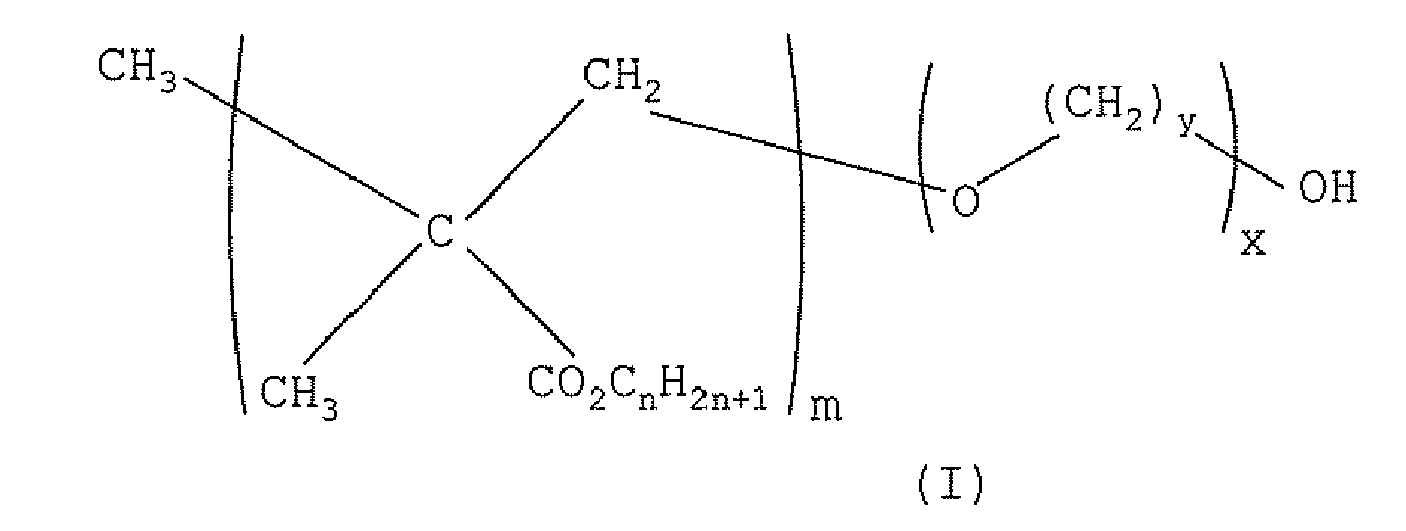
wherein n is an integer in the range of from 1 to 20, preferably 10 to 20, m is an integer in the range of from 75 to 200, y is an integer in the range of from 2 to 6 and x is an integer in the range of from 200 to 600.
wherein n is an integer in the range of from 1 to 20, preferably 10 to 20, m is an integer in the range of from 75 to 200, y is an integer in the range of from 2 to 6 and x is an integer in the range of from 200 to 600.
5. Lubricating composition according to any of the preceding claims, wherein the one
or more dispersant-viscosity index improver compounds are present in a total amount
in the range of from 0.1 to 10 wt.%, preferably from 0.5 to 4.0 wt.%, based on the
total weight of the lubricating composition.
6. Lubricating composition according to any of the preceding claims, wherein the composition
has a total amount of phosphorus in the range of from 0.04 to 0.1 wt.%, preferably
from 0.06 to 0.08 wt.%, based on the total weight of the lubricating composition.
7. Lubricating composition according to any of the preceding claims, wherein the composition
has a total amount of sulphur of at most 0.7 wt.%, preferably at most 0.5 wt.%, more
preferably at most 0.3 wt.%, based on the total weight of the lubricating composition.
8. Lubricating composition according to any of the preceding claims, wherein the composition
meets the specifications of a SAE OW-20 formulation.
9. Lubricating composition according to any of the preceding claims, comprising a Fischer-Tropsch
derived base oil, preferably at least 60 wt.%, based on the total weight of the lubricating
composition.
10. Method of lubricating an internal combustion engine comprising applying a lubricating
composition according to any of the preceding claims 1-9 thereto.
11. Use of the lubricating composition according to any of the preceding claims 1-9 in
order to improve friction reduction properties.
REFERENCES CITED IN THE DESCRIPTION
This list of references cited by the applicant is for the reader's convenience only. It does not form part of the European patent document. Even though great care has been taken in compiling the references, errors or omissions cannot be excluded and the EPO disclaims all liability in this regard.
Patent documents cited in the description
- WO2007096361A1 [0002]
- WO2007096361A [0002] [0005] [0005] [0021]
- EP0776959A [0009]
- EP0668342A [0009]
- WO9721788A [0009]
- WO0015736A [0009]
- WO0014188A [0009]
- WO0014187A [0009]
- WO0014183A [0009]
- WO0014179A [0009]
- WO0008115A [0009]
- WO9941332A [0009]
- EP1029029A [0009]
- WO0118156A [0009]
- WO0157166A [0009]
- EP0730022A [0014]
- EP0730021A [0014]
- US3506574A [0014]
- EP0750031A2 [0014]
- US6331510B1 [0014]
- US6204224B1 [0014]
- US6372696B1 [0014]
- WO02070631A [0032]
Non-patent literature cited in the description
- Appendix EAPI Publication200204001509- [0010]
- R.L. STAMBAUGHChemistry and Technology of LubricantsBlackie/VCH19920000124- [0014]
- KIRK-OTHMEREncyclopedia of Chemical Technologyvol. 14, 477-526 [0021]
- SAE J300 Specifications, 2009, [0025]
- R.I. TAYLORE. NAGATOMIN.R. HORSWILLD.M. JAMESA screener test for the fuel economy potential of engine lubricantspresented at the 13th International Colloquium on Tribology, 2002, [0039]