|
(11) | EP 2 174 941 B1 |

| (12) | EUROPEAN PATENT SPECIFICATION |
|
|
| (54) |
Isosorbide-derivatives Isosorbid-Derivate Dérivés d'isosorbide |
|
|
||||||||||||||||||||||||||||
| Note: Within nine months from the publication of the mention of the grant of the European patent, any person may give notice to the European Patent Office of opposition to the European patent granted. Notice of opposition shall be filed in a written reasoned statement. It shall not be deemed to have been filed until the opposition fee has been paid. (Art. 99(1) European Patent Convention). |
[0001] The present application pertains to derivatives of isosorbide, in particular isosorbidethers, and particularly hydroxyl ether derivatives thereof, as well as of methods for the preparation of these derivatives.
[0003] Upon heating sorbitol for example with concentrated sulfuric or hydrochloric acid, two molecules of water are eliminated with the formation of isosorbide. So far, these compounds are also known generally as dianhydrohexitols (including besides isosorbide also the isomers isomannide and isoidide). Besides isosorbide, certain derivatives of isosorbide are well known, inter alia mono- and diesters, and ethers, in particular mono- and dimethylethers of isosorbide. Those ethers are known to have good solvent properties for pharmaceutical and cosmetic compositions. EP 186 276 A2 discloses C1-C4-Alkyldiethers of isosorbide useful in oral hygiene preparations. The document discloses both, symmetrical as well as unsymmetrical ethers. A process for the preparation of such ethers is disclosed in EP 315 334 A2, using dialkylcarbonates and a basic catalyst to etherify the isosorbide. Chatti et al. reported in Recent Res. Devel. Organic Chem., 7(2003): 13-20 ISBN: 81-7895-093-6 a method to prepare various dialkylethers of isosorbide using microwave irradiation. Isosorbidethers are also known to be suitable in personal care applications, as disclosed in EP 1 216 685 A2.
[0004] European patent application EP 1106616 A2 discloses isosorbide derivatives obtained by reaction of isosorbide with alkyl epoxides and the use of those compounds as detergent additives for gasoline type fuels.
[0005] As isosorbide is derived from natural sources, applicable by double dehydration of starch, it is an interesting basis to obtain new compounds based on renewable resources. In this field, there is a constant search for new derivatives with new properties to suit the needs in some applications areas.
[0007] R1 means a moiety with 6 to 18, but preferably 6 to 16 C-atoms. The sum of indices z and t is between 2 and 50, and preferably chosen from the numbers 4, 10, 25 or 40. The numbers for the indices z and t may be even or odd numbers. Symmetrical compounds may be of advantage.
[0008] Compounds according to this formula show cloud points at temperatures between < 0 °C up to 60°C (1% in water), according to the amount of alkoxides groups in the molecule (the more alkoxides the higher the cloud point). The isosorbide derivatives according to the invention also show low foaming behavior.
[0009] To obtain the hydroxyl ether derivatives it is most preferred to react isosorbide with an epoxide compound, selected from ethylene oxide, propylene oxide, or 1,2-alkyloxides according to the general formula H2COCH-R1, where R1 has the same meaning as in formula (I) above, in the presence of basic catalysts at temperatures from 100 to 200 °C, and a pressure in the range from 1 to 10 bar. The reaction leads to a ring opening of the 1,2-alkyloxide to form a hydroxyl-ether derivative first. It is possible to carry out the reaction sequence twice, that means first an ethoxylation step takes place and subsequently a reaction with a long chain alkoxide, preferably 1,2-dodecyl- or 1,2- decenoxide is used. As the reaction is a polymerization reaction, the mole ratio isosorbide/1,2-alkoxyde must not be 1/1, but can differ according to the above definition of x. Useful catalysts are for example sodium- or potassium hydroxide, or sodium or potassium methylates, which are applied at temperatures from 100 - 220°C, especially between 160 - 200°C.
[0010] A further embodiment of the invention pertains to the use of compounds according to above formula for the preparation of detergents, cleansers and cosmetic compositions (solid, liquid or gel-like ones). The isosorbide derivatives may be present in amounts from 0.1 up to 80 % by weight, dependent on the particular formulation. The isosorbide derivatives are particular useful in home care applications, like all kind of cleansers (kitchen, bathroom, hard surface, automotive or car cleansers), as well as in dishwashing compositions (hand and automatic dish washing).
[0011] The isosorbide derivative may be formulated with other surfactants, like anionic, nonionic, amphoteric and/or cationic surfactants.
[0012] The isosorbide derivatives according to the present invention are particularly suitable to be included into detergents and cleaners, including liquid and solid detergents, and preferably for hard surface cleaners, like kitchen or bathroom cleansers, all purpose cleaners, car wash, or dish washing detergents (for hand washing as well as for automatic dish detergents) and for industrial and institutional cleaning. The use of isosorbide derivatives according to the present invention is particularly preferred in applications where the good low- or de-foaming properties of these compounds are of advantage. Examples, which are not limiting the application range, are automatic dishwashing detergents, spray cleaners, bottle cleaning, automotive and locomotive cleaning, high pressure cleaning, tank cleaner and others.
[0013] The isosorbide derivatives are also suitable in cosmetic preparations, where they can act as emulsifiers, solubilizers, cleaners, rheology modifiers, stabilizers, for rinse-off as well as for leave-on applications.
[0014] The isosorbide derivatives are also suitable for agrochemical preparations, especially for spray applications, where they can act as surfactants, emulsifiers, dispersants, foam regulator, rheology modifier or in general as formulation aid or performance enhancer.
Examples
Preparation of the isosorbide derivatives
[0015] I. 1 mole isosorbide (146 g) is reacted with 4, 10, 25 or 40 moles of ethylene oxide (176, 440, 1100 or 1760 g) with catalytic amounts of KOH (0.025 moles, 1.4 g) at temperatures of 160 - 180 °C in a pressure reactor at a maximum pressure of 5 bar. After completion of the reaction 2 moles of 1,2-dodeceneoxide (386 g) are added and the reaction is completed at 180 - 200 °C, which can be detected by epoxide titration according to Jay. The product is cooled and neutralized by adding adequate amounts of lactic acid. The epoxide value should be reduced to at least 1/10 or 1/20 of the starting value in order to obtain a yield of the reaction which is at least 90% or 95%.
Performance tests of the isosorbide derivatives
[0016] The cleaning performance of two selected candidates according to example II (with 4 and 10 moles ethylene oxide respectively) was tested at 25 °C in a modified Gardner test on PVC with a standard soil (IPP Soil for diluted applications; 1 % active matter).
[0017] Testing of the cleaning effect (Gardner Test): The cleaning preparation was applied to an artificially soiled plastic surface. The 26x28 cm test surface was uniformly coated with 2 g of the artificial soil using a surface spreader and was then cut up into seven equally large pieces measuring 26x4 cm. A plastic sponge was impregnated with 6 ml of the undiluted cleaning solution to be tested and moved by machine over the test surface. After 10 wiping movements, the cleaned test surface was held under running water and the loose soil removed. The cleaning effect, i.e. the whiteness of the plastic surface thus cleaned, was measured using a Dr. B. Lange LF 90 photoelectric colorimeter. The clean white plastic surface was used as the whiteness standard. The reflectance values are 66 and 71 % (for the 4 and the 10 moles product), which is comparable or better to known low foaming surfactants. Examples of low foaming surfactants are DEHYPON® LS 45, DEHYPON® LT 104 and DEHYPON® LS 24 (all products of Cognis GmbH), which give a reflectance of 58%, 57,5% and 49% according to this test.
1. A derivative of isosorbide according to formula
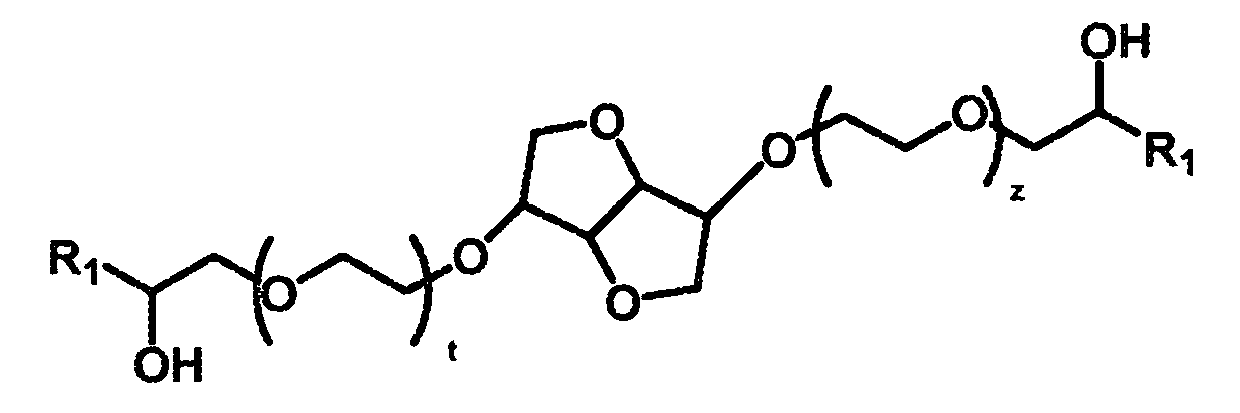
wherein R1 is an saturated or unsaturated, linear or branched alkyl or alkenyl moiety with 6 to 16 C-atoms, and the sum of the indices z and t is between 2 and 50, and preferable chosen from the numbers 4, 10, 25 or 40.
wherein R1 is an saturated or unsaturated, linear or branched alkyl or alkenyl moiety with 6 to 16 C-atoms, and the sum of the indices z and t is between 2 and 50, and preferable chosen from the numbers 4, 10, 25 or 40.
2. Process for the preparation of isosorbide derivatives according to the formula in
claim 1 whereby isosorbide is reacted with an epoxide compound, selected from ethylene
oxide, propylene oxide or 1,2-alkyloxides according to the general formula H2COCH-R1, where R1 has the same meaning as in the formula above in the presence of basic catalysts at
temperatures from 100 to 200 °C, and a pressure in the range from 1 to 10 bar.
3. Use of isosorbide derivatives according to claim 1 to prepare detergents, cleansers,
cosmetic compositions or agrochemical preparations.
1. Ein Isosorbidderivat gemäß der Formel
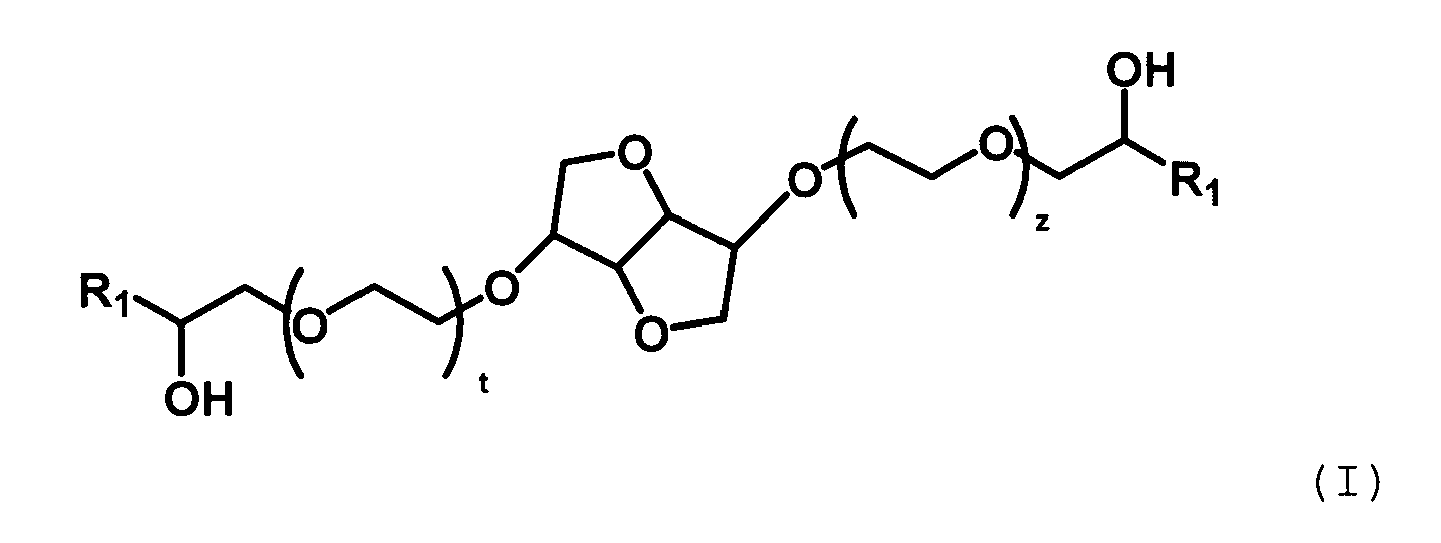
worin R1 eine gesättigte oder ungesättigte lineare oder verzweigte Alkyl- oder Alkylengruppe mit 6-16 C-Atomen ist, und die Summe der Indizies z und t zwischen 2 und 50 ist und vorzugsweise ausgewählt ist aus den Zahlen 4, 10, 25 oder 40.
worin R1 eine gesättigte oder ungesättigte lineare oder verzweigte Alkyl- oder Alkylengruppe mit 6-16 C-Atomen ist, und die Summe der Indizies z und t zwischen 2 und 50 ist und vorzugsweise ausgewählt ist aus den Zahlen 4, 10, 25 oder 40.
2. Verfahren für die Herstellung von Isosorbidderivaten gemäß der Formel in Anspruch
1, worin Isosorbid mit einer Epoxidkomponente zur Reaktion gebracht wird, wobei die
Epoxidkomponente ausgewählt ist aus Ethylenoxid, Propylenoxid oder 1,2 Alkoxiden gemäß
der allgemeinen Formel H2COCH-R1, worin R1 die gleiche Bedeutung hat wie in der obigen Formel und die Reaktion in der Gegenwart
von basischen Katalysatoren bei Temperaturen zwischen 100 und 200° C und einem Druck
im Bereich von 1-10 bar stattfindet.
3. Verwendung von Isosorbidderivaten gemäß Anspruch 1 zur Herstellung von Waschmitteln,
Reinigungsmitteln, kosmetischen Mitteln oder agrochemischen Zusammensetzungen.
1. Dérivé d'isosorbide selon la formule
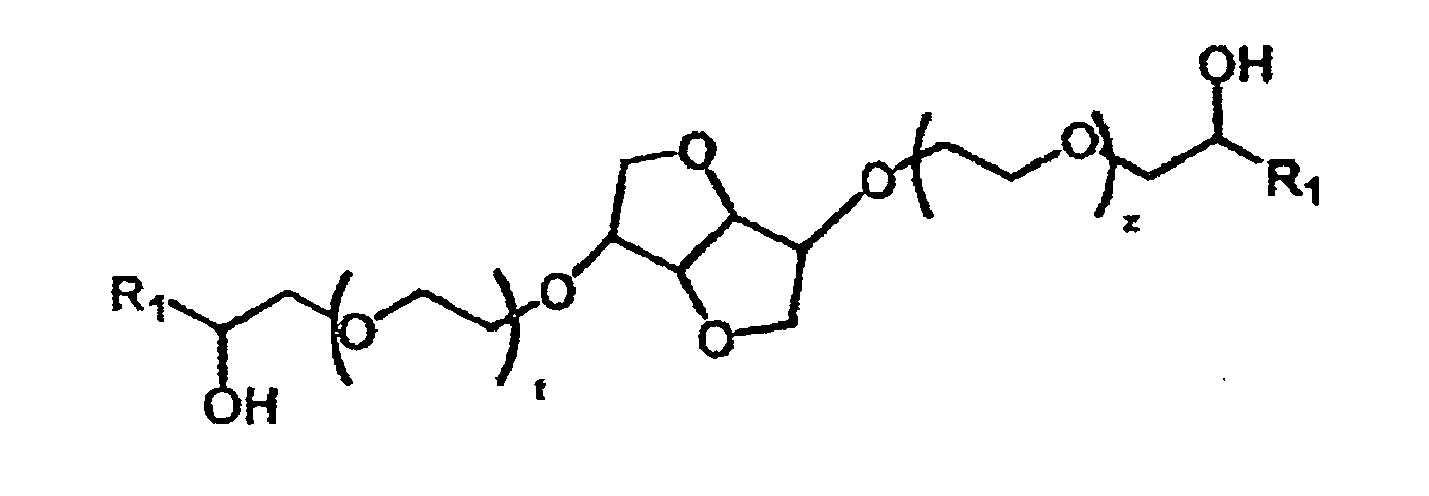
dans laquelle R1 est un motif alkyle ou alcényle linéaire ou ramifié, saturé ou insaturé ayant de 6 à 16 atomes de C, la somme des indices z et t est comprise entre 2 et 50, et choisie de préférence parmi les nombres 4, 10, 25 ou 40.
dans laquelle R1 est un motif alkyle ou alcényle linéaire ou ramifié, saturé ou insaturé ayant de 6 à 16 atomes de C, la somme des indices z et t est comprise entre 2 et 50, et choisie de préférence parmi les nombres 4, 10, 25 ou 40.
2. Procédé de préparation de dérivés d'isosorbide selon la formule dans la revendication
1, caractérisé en ce que l'isosorbide est mis en réaction avec un composé époxyde, choisi parmi l'oxyde d'éthylène,
l'oxyde de propylène, ou les 1,2-alkyloxydes selon la formule générale H2COCH-R1, dans laquelle R1 a la même signification que dans la formule ci-dessus, en présence de catalyseurs
basiques, à des températures de 100 à 200°C, et une pression dans la gamme de 1 à
10 bars.
3. Utilisation de dérivés d'isosorbide selon la revendication 1, pour préparer des détergents,
des produits de nettoyage, des compositions cosmétiques ou des préparations agrochimiques.
REFERENCES CITED IN THE DESCRIPTION
This list of references cited by the applicant is for the reader's convenience only. It does not form part of the European patent document. Even though great care has been taken in compiling the references, errors or omissions cannot be excluded and the EPO disclaims all liability in this regard.
Patent documents cited in the description
Non-patent literature cited in the description
- Recent Res. Devel. Organic Chem., 2003, vol. 7, 81-7895-093-613-20 [0003]