|
(11) | EP 1 610 790 B1 |

| (12) | EUROPEAN PATENT SPECIFICATION |
|
|
| (54) |
ANTICANCER COMPOUNDS VERBINDUNGEN GEGEN KREBS COMPOSES ANTICANCER |
|
|
|||||||||||||||||||||||||||||||
|
||||||||||||||||||||||||||||||||
| Note: Within nine months from the publication of the mention of the grant of the European patent, any person may give notice to the European Patent Office of opposition to the European patent granted. Notice of opposition shall be filed in a written reasoned statement. It shall not be deemed to have been filed until the opposition fee has been paid. (Art. 99(1) European Patent Convention). |
BACKGROUND
[0001] Podophyllotoxin is a naturally occurring compound extracted from a mandrake plant. Some derivatives of podophyllotoxin, e.g., etoposide and teniposide, have been studied for use in chemotherapy for cancer. (See, e.g., Jardine (1980) Anticancer Agents Based on Natural Products Models; Academic Press: New York, P 319; Issell (1982) Cancer Chemother. Pharmacol. 7: 73; and Lee et al. (1995) Food and Drug Analysis. 3:209). These derivatives inhibit topoisomerase II by stabilizing a topoisomerase II-DNA complex in which the DNA is cleaved and remains covalently linked to the enzyme. This inhibition leads to cell death. See, e.g., Osheroff et al. (1991) BioEssays 13: 269; Alton & Harris (1993) Br. J. Haematol. 85: 241-245, Cho et al. (1996) J. Med Chem. 39: 1383; MacDonald et al. (1991) DNA Topoisomerase in Cancer, Oxford University Press: New York. It is known that the aforementioned podophyllotoxin derivatives have several limitations such as development of drug resistance, myelo-suppression, and poor oral bioavailability Thus, identification of novel compounds that also target topoisomerase II can lead to new thetapeutics for treating or preventing cancer or symptoms associated with cancer.
[0002] XAO z et al: "Antibumor Agents.213.Modelling of Epipodophyllotoxin Derivatives using Variable Selection be Nearest Neighbour QSAR Method Journal of Medical Chemistry, ACS. vol 45, 1 January 2002, pg 2294-2309.
SUMMARY
[0003] The present invention is based, in part, on the discovery of novel podophyllotoxin derivatives that possess anticancer activities.
[0004] In accordance with the present invention there is provided a compound acccording to claim 1, 3, 4 or 5.
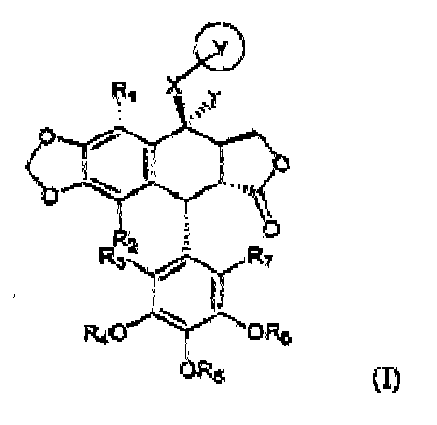
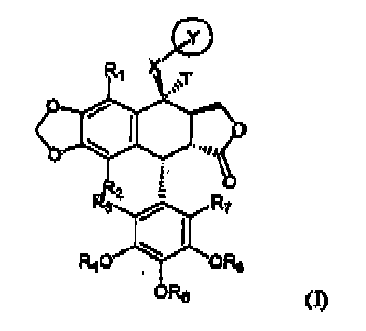
[0006] Set forth below are exemplary compounds of this invention. Compounds 1-6 having the following formula:
| Compound ID | R | X | T | R' |
| 1 |
|
NH | H | H |
| 2 |
|
NH | H | H |
| 3 |
|
NH | H | E |
| 4 |
|
NH | H | H |
| 5 |
|
NH | H | H |
| 6 |
|
NH | H | H |
| 7 |
|
NH | H | H |
| 8 |
|
NH | H | H |
| 9 |
|
NH | H | H |
| 10 |
|
NH | H | H |
| 11 |
|
NH | H | H |
| 12 |
|
NH | H | H |
| 13 |
|
NH | H | H |
| 14 |
|
NH | H | H |
| 15 |
|
NH | H | H |
| 16 |
|
NH | H | H |
| 17 |
|
NH | H | H |
| 18 |
|
NH | H | H |
| 19 |
|
NH | H | H |
| 20 |
|
MH | H | H |
| 21 |
|
NH | H | H |
| 22 |
|
NH | H | H |
| 23 |
|
NH | H | H |
| 24 |
|
NH | H | H |
| 25 |
|
NH | H | H |
| 26 |
|
NH | H | H |
| 27 |
|
NH | H | H |
| 28 |
|
NH | H | H |
| 29 |
|
NH | H | H |
| 30 |
|
NH | H | H |
| 31 |
|
NH | H | H |
| 32 |
|
NH | H | H |
| 33 |
|
NH | H | H |
| 34 |
|
NH | H | H |
| 35 |
|
NH | H | H |
| 36 |
|
NH | H | H |
| 37 |
|
NH | H | H |
| 38 |
|
NH | H | H |
| 39 |
|
NH | H | H |
| 40 |
|
NH | H | H |
| 41 |
|
NH | H | H |
| 42 |
|
NH | H | H |
| 43 |
|
NH | H | H |
| 44 |
|
NH | H | H |
| 45 |
|
NH | H | H |
| 46 |
|
NH | H | H |
| 47 |
|
NH | H | H |
| 48 |
|
NH | H | H |
| 49 |
|
NH | H | H |
| 50 |
|
NH | H | H |
| 51 |
|
NH | H | H |
| 52 |
|
NH | H | H |
| 53 |
|
NH | H | H |
| 54 |
|
NH | H | H |
| 55 |
|
NH | H | H |
| 56 |
|
NH | H | H |
| 57 |
|
NH | H | H |
| 58 |
|
NH | H | H |
| 59 |
|
NH | H | OPO3H2 |
| 60 |
|
NH | H | OPO3H2 |
| 61 |
|
NH | H | OPO3H2 |
[0007] The podophyllotoxin derivatives described above include the compounds themselves, as well as their salts and their prodrugs, if applicable. The salts, for example, can be formed between a positively charged substituent (e.g., amino) on a compound and an anion. Suitable anions include, but are not limited to, chloride, bromide, iodide, sulfate, nitrate, phosphate, citrate, methanesulfonate, tartrate, trifluoroacetate, and acetate. Likewise, a negatively charged substituent (e.g., carbozylate) on a compound can form a salt with a cation. Suitable cations include, but are not limited to, sodium ion, potassium ion, magnesium ion, calcium ion, and an ammonium cation such as teteramethylammonium ion. Examples of prodrugs include esters and other pharmaceutically acceptable derivatives, which, upon administration to a subject, are capable of providing the podophyllotoxin derivatives described above.
[0008] In addition, the just-described podophyllotoxin derivatives may have one or more double hands, or one or more additional asymmetric centers. Such compounds can occur as racemates, racemic mixtures, single enantiomers, individual diastereomers, and diastereomeric mixtures.
[0009] As used herein, "cancer" refers to a cellular tumor. Cancer cells have the capacity for autonomous growth, i.e., an abnormal state or condition characterized by rapidly proliferating cell growth. The term is meant to include all types of cancerous growths or oncogenic processes, metastatic tissues or malignantly transformed cells, tissues, or organs, irrespective of histopathologic type, or stage of invasiveness. Examples of cancers include, but are not limited to, carcinoma and sarcoma such as leukemia, sarcomas, osteosarcoma, lymphomas, melanoma, ovarian cancer, skin cancer, testicular cancer, gastric cancer, pancreatic cancer, renal cancer, breast cancer, prostate cancer, colorectal cancer, cancer of the head and neck, brain cancer, esophageal cancer, bladder cancer, adrenal cortical cancer, lung cancer, bronchus cancer, endometrial cancer, nasopharyngeal cancer, cervical or hepatic cancer, or cancer of unknown primary site. In addition, cancer can be associated with a drug resistance phenotype.
[0010] Also within the scope of this invention is a composition containing one or more of the podophyllotoxin derivatives described above for use in treating cancer, and the use of such a composition for the manufacture of a medicament for cancer treatment.
[0011] Other features or advantages of the present invention will be apparent from the following detailed description of several embodiments, and also from the appending claims.
DETAILED DESCRIPTION
[0012] The podophyllotoxin derivatives described above can be prepared by methods well known in the art, as well as by the synthetic routes disclosed herein. See, e.g., Wang et al. (1992) Yaoxue Xuebao 27: 656; Lee et al. (1989) J. Nat. Prod. 52: 606; and Chen et al. (2000) Chinese Chemical Letters 11 : 505. For example, as shown in the scheme below, one can use podophyllotoxin as a starting material. Bromination of podophyllotoxin gives an intermediate, 4'-O-demethyl-413-bromo-4-desoxypodophylotoxin (Kuhn, et al. (1969) Helv. Chim. Acta 52: 944). The intermediate reacts with an amino substituted heteroaryl or heterocyclyl side chain in the presence of a weak base, e.g., barium carbonate, to provide a podophyllotoxin derivative of this invention as shown in the scheme below (Y in the scheme is as defined in Summary). The amino substituted heteroaryl or heterocyclyl moiety is synthesized by a cyclization reaction followed by modifications on its substituents.
[0013] Alternatively, a compound of this invention can be synthesized by coupling of the aforementioned intermediate with a mercapto or hydroxyl substituted heteroaryl.
[0014] The chemicals used in the above-described synthetic route may include, for example, solvents, reagents, catalysts, protecting group and deprotecting group reagents. The methods described above may also additionally include steps, either before or after the steps described specifically herein, to add or remove suitable protecting groups in order to ultimately allow synthesis of the podophyllotoxin derivative. In addition, various synthetic steps may be performed in an alternate sequence or order to give the desired compounds. Synthetic chemistry transformations and protecting group methodologies (protection and deprotection) useful in synthesizing applicable podophyllotoxin derivatives are known in the art and include, for example, those described in R. Larock, Comprehensive Organic Transformations, VCH Publishers (1989); T.W. Greene and P.G.M. Wuts, Protective Groups in Organic Synthesis, 3rd Ed., John Wiley and Sons (1999); L. Fieser and M. Fieser, Fieser and Fieser's Reagents for Organic Synthesis, John Wiley and Sons (1994); and L. Paquette, ed., Encyclopedia of Reagents for Organic Synthesis, John Wiley and Sons (1995) and subsequent editions thereof.
[0015] A podophyllotoxin derivative thus synthesized can be further purified by a method such as column chromatography, High-Performance Liquid Chromatography (HPLC), High-Performance Flash Chromatography (HPFC), or recrystallization.
[0016] Podophyllotoxin derivative phosphate prodrugs of this invention are further prepared according to the method described in U.S. Patent 4,904,768 and U.S. Patent 5,606,039. They are synthesized by reacting podophyllotoxin derivatives with phosphorous oxychloride in an appropriate solvent, e.g., acetonitrile, in the presence of an organic base, e.g., N,N-diisopropylethtylamine.
[0017] This invention may be used in a method for treating cancer. The method include administering to a subject in need thereof an effective amount of one or more podophyllotoxin derivatives described in Summary and a pharmaceutically acceptable carrier. The term "treating" is defined as the application or administration of a composition including the podophyllotoxin derivative to a subject, who has cancer, a symptom of cancer, or a predisposition toward cancer, with the purpose to cure, heal, alleviate, relieve, alter, remedy, ameliorate, improve, or affect cancer, the symptoms of cancer, or the predisposition toward cancer. "An effective amount" is defined as the amount of podophyllotoxin compound which, upon administration to a subject in need thereof is required to confer therapeutic effect on the subject. An effective amount of a podophyllotoxin derivative may range from about 0.2 mg/Kg to about 60 mg/Kg. Effective doses also vary, as recognized by those skilled in the art, depending on route of administration, excipient usage, and the possibility of co-usage with other therapeutic treatments such as use of other anticancer agents or radiation therapy. Examples of the other anticancer agents include paclitaxel, docitaxel, doxorubicin, damorubicin, epirubicin, fluorouracil, melphalan cis-platin, carboplatin, cyclophosphamide, mitomycin C, methotrexate, mitoxantrone, vinblastine, vincristine, ifosfamido, teniposide, etoposide, bleomycin, leucovorin, cytarabine, dactinomycin, interferon alpha, streptozocin, prednisolone, procarbazine, trinotecan, topotecan, colony stimulating factor, granulocyte/monocyte colony stimulating factor, and imatirub mesylate.
[0018] To practice the method of treating cancer a podaphyllatoxin derivative can be administered orally, parenterally, by inhalation spray, or via an implanted reservoir. The term "parenteral" as used herein includes subcutaneous, intracutaneous, intravenous, intramuscular, intraarticullar, intraarterial, intrasynovial, intrasternal, intrathecal, intralesional and intracranial injection or infusion techniques.
[0019] A composition for oral administration can be any orally acceptably dosage form including but not limited to, tablets, capsules, emulsion and aqueous suspensions, dispersions and solutions. Commonly used carriers for tablets include lactose and corn starch. Lubricating agents, such as magnesium stearate, are also typically added to tablets. For oral administration in a capsule form, useful diluents include lactose and dried corn starch. When aqueous suspensions or emulsions are administered orally, the active ingredient can be suspended or dissolved in an oily phase combined with emulsifying or suspending agents. If desired, certain sweetening, flavoring, or coloring agents can be added.
[0020] A sterile injectable composition (e.g., aqueous or oleaginous suspension) can be formulated according to techniques known in the art using suitable dispersing or wetting agents (such as, for example, Tween 80) and suspending agents. The sterile injectable preparation can also be a sterile injectable solution or suspension in a nontoxic parenterally acceptable diluent or solvent, for example, as a solution in 1,3-butanediol. Among the acceptable vehicles and solvents that can be employed are mannitol, water, Ringer's solution and isotonic sodium chloride solution. In addition, sterile, fixed oils are conventionally employed as a solvent or suspending medium (e.g., synthetic mono- or di-glycerides). Fatty acids, such as oleic acid and its glyceride derivatives are useful in the preparation of injectables, as are natural pharmaceutically-acceptable oils, such as olive oil or castor oil, especially in their polyoxyethylated versions. These oil solutions or suspensions can also contain a long-chain alcohol diluent or dispersant, or carboxymethyl cellulose or similar dispersing agents.
[0021] An inhalation composition can be prepared according to techniques well-known in the art of pharmaceutical formulation and can be prepared as solutions in saline, employing benzyl alcohol or other suitable preservatives, absorption promoters to enhance bioavailability, fluorocarbons, and/or other solubilizing or dispersing agents known in the art.
[0022] A carrier in a pharmaceutical composition must be "acceptable" in the sense of being compatible with the active ingredient of the formulation (and preferably, capable of stabilizing it) and not deleterious to the subject to be treated. For example, solubilizing agents, such as cyclodextrins (which form specific, more soluble complexes with podophyllotoxin derivatives), can be utilized as pharmaceutical excipients for delivery of podophyllotoxin derivatives. Examples of other carriers include colloidal silicon dioxide, magnesium stearate, cellulose, sodium lauryl sulfate, and D&C Yellow #10.
[0023] Podophyllotoxin derivatives of this invention can be preliminarily screened for their efficacy in treating cancer by in vitro assays. For example, podophyllotoxin derivatives can be tested for their cytotoxicity against KB cells (nasopharyngeal carcinoma). More specifically, a test compound can be added to a culture of KB cells and its IC50 (i.e., the concentration of the test compound which achieves a half-maximal inhibition of cell growth) is determined using the sulforhodamine B (a protein binding dye) assay as described in J.N.C.I. (1990) 82: 1107. The podophyllotoxin derivatives of this invention are also tested for their abilitives to inhibit DNA topoisomerase II in vitro as described in Cho et al. (1996 J. Med. Chem. 39: 1396) and to stimulate protein-linked DNA breaks (PLDB) in KB cells as described in Rowe et al. (1986 Cancer Res. 46:2021). DNA topoisomerase II is a well known target for cancer treatment drugs. See, e.g., MacDonald et al. (1991) DNA Topoisomerase in Cancer; Oxford University Press: New York.
[0024] Podophyllotoxin derivatives of this invention can further be screened for their efficacy in treating caner by in vivo assays. For example, a test compound can be injected into an animal (e.g., a mouse model) and its therapeutic effects are then accessed. Based on the results, an appropriate dosage range and administration route can also be determined.
[0025] Without further elaboration, it is believed that the above description has adequately enabled the present invention. The following specific embodiments are, therefore, to be construed as merely illustrative, and not limitative of the remainder of the disclosure in any way whatsoever. All of the publications cited herein are hereby incorporated by reference in their entirety.
CHEMICAL SYNTHESES
[0026] As used herein, melting points were determined on a Fisher-John melting point apparatus and are uncorrected. Proton Nuclear Magnetic Resonance (1H NMR) spectra were measured on a Varian 300 or a Bruker 400 (if indicated) spectrometer with tetramethylsilane (TMS) as the internal standard. Chemical shifts are reported in δ (ppm). Mass spectra (MS) were obtained on an API 3000 LC/MS/MS spectrometer. Flash column chromatography was performed on silica gel (100-200 mesh). HPFC was conducted on a Biotage Horizon system. Precoated silica gel plates (Kieselgel 60 F254, 0.25mm) were used for thin layer chromatograhy (TLC) analysis.
Synthesis of Compounds 1-2,4-6,8-13,15-21 and 24-27
[0027] These compounds were synthesized starting from podaphyllatoxin as shown in Scheme 1 below. Bromination of podophyllotoxin gave an intermediate, 4'-O-demethyl-4B-bromoo-4-desoxypodophylotoxin (refered to as DBD hereinafter). Hydrolyzind the methyl ester m Compound 7 with 2N HCl m the afforded Compound 6 Removal of the tert-butyl and Boc groups in Compounds 17, 20 and 24 with trifluoroactic acid (TFA), in the presence of anisole, gave Compounds 15, 18 and 25, respectively. More specifically, 4β-N-linked-(substituted heteroaryl)-4'-O-dimethyl 4-epipodophyllotoxin was synthesized as follows. To a solution ofDBD in an appropriate solvent mixture (e.g., THF and 1,2-dichloroethane (DCE) (1.1) /or acetonitrile (1:1)) was added an amino substituted heteroaryl (1.2 equivalent) and BaCO3 (1.5 equivalents). The mixture was heated to reflux under nitrogen with TLC or LC-MS monitoring. The reaction mixture was cooled to room temperature and a solid was formed and filtered The filtrate thus obtained was concentrated to provide a crude product. The crude product was purified by silica gel column chromatography with CH2Cl2: EtOAc: acetone, EtOAc: hexanes: MeOH, or CH2Cl2: MeOH as the eluant.
[0028] Analytical data on two compounds are shown below. Compound 2, i.e., 4'-O-demethyl-4β-[4"-(ethyl L-tryptophan-N-acethyl)-2"-thiazolyl amino]-4-desoxypodophyllotoxin. ESIMS: 754 [M+H], 753 [M-H]; 1H NMR (300MHz, CDCl3) δ:8.35 (br s, 1H, NH), 7.96 (d, J= 8Hz, 1H, 7"-H), 7.42 (d, J= 8 Hz, 1H, 4"'-H), 7.05 (s, 1H, 3"'-H), 6.97 (m, 2H, 5"', 6'"-H), 6.82 (s, 1H, H-5), 6.49 (s, 1H, 8-H), 6.30 (s, 2H, 2', 6'-H), 6.22 (s, 1H, 5"-H), 5.95 (2H, d, J=12 Hz, OCH2O), 4.98 (m, 2H, 4,9"'-H), 4.51 (d, J=5 Hz, 1H, 1-H), 4.12 (t, J=7 Hz, 2H, OCH2CH3), 3.82 (s, 6H, 3', 5'-OCH3), 3.52 (d, J=7 Hz, 2H, 6"-H), 3.42 (m, 2H, 11, 8"'-H), 3.28 (dd, J=4,15 Hz, 1H, 8"'-H), 3 16 (t, J=10 Hz, 1H, 11-H), 2.78 (dd, J= 5,14 H2, 1H, 2-H), 2.58 (m, 1H, 3-H).
[0029] Compound 27, i.e., 4'-O-demethyl-4β-(4"-(etyl L-phenylglycyl-N-acetyl)-2"-thiazolyl amino]-4-desoxypodophyllatoxin. Amorphous, mp 150-153 °C (doc.); ESIMS: 700.4[M-H]; 1HNMR (300MHz, CDCl3): δ 8.21 (br. d, J=7.1 Hz, 1H, NH of amino acid), 7.35-7.23 (m, 5H, Benzene ring of amino acid), 6.90 (s, 1H, 5-H), 6.52 (s, 1H, 8-H), 6.32 (s, 2H; 2'-H, 6'-H), 6.29 (s, 1H, S-CH-), 5.96 (d, 2H, J=11.0 Hz, -OCH2O-), 5.54(d, J=7.1 H, 1H, CONH-CH), 5.32(br.s, 1H, 4-H), 4.57(d,J= 4.4 Hz 1H, 1-H), 4.25 (dd, J= 6 6, 8.8 Hz, 1H, 11β-H), 4.14 (q, J = 7.1 Hz, 2H, CH2CH3), 3.92 (t, J = 9.6 Hz, 1H, 11α-H), 3.77 (s, 6H, 3',5'-OCH3), 3.52 (s, 2H, CH2CONH), 298 (m, 2H, 2-H, 3-H), 1.26, 1.18 (total 3H, both t, J=7.1 Hz, CH2CH3, isomer radio = 2:55),
Synthesis of Compounds 37 30-34 42-43 and 48-51
[0030] Each Compounds 30 was synthesized as follows. Reaction of an amino substitued heteroaryl with (trimethylsilyl) diazomethane (2.0 M solution in hexanes) in a solvent of methamol and benzene yielded an intermediate. Substitution of the intermediate at C-4 position of DBD gave the desired product. See Scheme 2 below,
[0032] Compound 30 i.e., 4-O-demethyl-4β-[4"-(methyl-O-acethyl)-2"-thiazolylamino]-4-desoxypodophyllotoxin. Yield 59%; Amorphous, mp 116-120 °C (dec.); ESIMS: 553 [M-H]; 577 [M+Na], 1H NMR (CDCl3) δ 6.85 (s, 1H, 5-H), 6.52 (s, 1H, 8-H), 6.38 (s, 1H, 5"-H), 6.30 (s, 2H, 2',6'-H), 5.98 and 5.96 (dd, 2H, - OCH2O-), 5.16 (br, 1H, 4-H), 4.59 (br, 1H, 1-H), 4.40 (t, 1H, 11-H), 3.95 (t 1H, 11-H), 3.79 (s, 6H, 3', 5'-OCH3), 3.73 (s, 3H, -COOCH3), 3.60 (s, 2H, -CH2COOCH3), 3.00 (m, 2H, 2-H, 2-H).
[0033] Compounds 3,7 31-34 42,43, 48,49, 50 and 51 were synthesized by coupling an appropriate alcohol or amine to an amino substituted heteroaryl, followed by conjugation with DBD.
Synthesis of Compounds 22, 23 and 28-29
[0034] Compounds 22 and 23 were synthesized as shown in Scheme 3 Reaction of 1-(3-aminopropyl)-imidazole or 4-(3- aminopropyl)-morpholine with an amino substituted heteroaryl in the presence of isobutyl chloroformate and N-methyl morpholine afforded an amide compound. The amide compounds further reacted with DBD to give the desire product.
[0036] Compound 23. 4'-O-demethyl-4β-[4"-[4'''-(3'''-aminopropyl)-morpholine - N-acetyl)-2"- thiazolylamino]-4-desoxypodophylloxin. Amorphous, mp 105-109°C (dec.); ESI MS: 667 [M+H]. 1H NMR (CDCl3) δ 6.84 (s, 1H, 5-H), 6.54 (s, 1H, 8-H), 6.35 (s,1H, 5''-H), 6.31 (s, 2H, 2',6'-H), 6,00 (m, 2H, -OCH2O-), 5.08 (m, 1H. 4-H), 4.60 (d, J = 2.7Hz, 1H, 1-H), 4.25 (m, 2H, CH2CH3), 4.38 (m, 1H, 11-H), 3.88 (m, 1H, 11-H), 3.79 (s, 6H, 3', 5'- OCH3), 3.66 (t, 4H, 2''', 6''' -CH2- on morpholine ring), 3.47,(s, 2H, CH2CO on thiazole), 3.33 (m, 2H, CONHCH2CH2CH2), 3.02 (br, 2H, 2-H, 3-H), 2.38 (m, 6H, 3''',5"'-CH2- on morpholine ring and CONH2CH2-CH2CH2-), 1.70 (m, 2H, CONHCH2CH2CH2-).
[0037] Compound 28 was synthesized from a dipeptide as shown in Scheme 4. Methylation of the dipeptide under refluxing in acetyl chloride and methanol produced a methyl ester. Reaction of the methyl ester with an amino substituted heteroaryl gave an amine compound as a white crystal. The amine compound further react with DBD to give the desired product.
[0038] Compound 29 was synthesized by coupling of tert-butyl diphenylsilyl protected hydroxylamine to an amino substituted heteroaryl followed by conjugation with DBD (Scheme 3. Compoud 29 was obtained by silica. gel column chromatography.
[0040] Compound 29, i.e., 4'-O-demethyl-4β-[4"-(O-hydroxylamine)-N-acetyl)-2"-thiazolylamino]-4-desoxypodophyllotoxin. Amorphous, mp 165-168°C (softened), 210-2,13 (dec.); ESI MS m/e; 555 [M+H], 577 [M+Na]. 1H NMR (CDCl3) δ 6.63 (s, 1H, 5-H), 6.52 (s, 1H, 8-H), 6.34 (s, 1H, 5" -H), 6.31 (s, 2H, 2', 3'-H), 5.97 (d, J = 6.0 Hz, 2H, -OCH2O-), 4.90 (d, J = 4.4 Hz, 1H, 4-H), 4.60 (d, J = 4.4 Hz, 1H, 1-H),4.35 (m, 1H, 11-H), 3.84-3.90 (br, 1H, 11-H), 3.79 (s, 6H, 3', 5'-OCH3), 3,44 (s, 2H, CH2CO on thiazole), 3.25 (dd, J = 5.5 Hz, 1H, 2-H), 3.00 (m, 1H, 3-H).
Synthesis of Compounds 35-41,44-45,47, 52,53 and 55-56
[0041] These compounds were synthesized by reacting an amino or a hydroxyl substituted heteroaryl with DBD in the presence of barium carbonate.
[0043] Compound 32, ie., 4'-Odemethyl-4β-(5"-ethoxycarbonyl-4"-methyl-2"-thiazolyl amino)-4-desoxypodophyllotoxin. Amorphous, mp 257-259 °C (dec.); ESI MS: 495.2 (M-H); 1H NMM(300MHZ, CDCl3 + CD3OD): δ 7.37 (s, 1H 4-H of thiazole), 6 83 (s, 1H, 5-H), 6.53 (s, 1H, 8-H), 6.31 (s, 2H, 2'-H, 6'-H), 6.01 (br. d, J= 14,3 Hz, 2H, -OCH2O-),5.97 (s,1H, OH), 4.59 (d, J=4.9 Hz, 1H, 4-H), 4.47 (d, J= 4.4 Hz, 1H, 1-H), 4.39 (t, J = 8.8 Hz, 1H,11β-H, 4.02 (t, J = 7.Hz, 1H, 3.H), 3.78 (s, 6H,3',5-OCH3),3.13 (dd-like, J=4.9,13.7Hz, 1H, 11α-H), 3.03 (m, 1H, 2-H), 2.31 (s, 3H, -CH3).
[0044] Compound 39, i.e., 4'-O-demethyl-4β-(5"-nitro-2"-thiazolyl amino)-4-desoxypodophyllotoxin. Amorphous, mp 201-203 °C (dec.); ESI MS: 526.3 (M-H); 1H NMR (300 MHz, CDCl3): δ 8.05 (s,1H, -H of thiazole), 6.81 (s, 1H 5-H), 6.56 (s, 1H. 8-H), 6.29 (s, 2H, 2'-H, 6'-H), 5.99 (br. s, 2H, -OCH2O-), 5.28 (br, s, 1H 4-H), 4.61 (d, J=5.0Hz, is 1-H), 4.44 (br. d, J= 7.4, 8.8 Hz, 1H, 11β-H), 3.89 (t, J=9.8 Hz, 1H, 11α-H), 3.78 (s, 6H, 3',5'-OCH3), 3.04 (m, 1H, 2.H), 2.95 (dd, J=4.7, 14.0 Hz, 1H, 3-H).
[0045] Compound 44 i.e., 4'-O-demethyl-4β-[5" -(3"-methyl)-isoxazolylamino]-4-desoxypodophyllotoxin. Amorphous mp 227-229 °C (dec.); ESI MS: 479.1 (M-H); 1HNMR δ (Bruker 400 MHz, CDCl3): 6.80 (s,1H, 5-H), 6.54(s, 1H, 8.H), 6.30 (s, 2H, 2'-H, 6'-6H), 5.98 (dd, 2H, J-1.2,9.0 Hz, -OCH2O-), 5.43 (s, 1H, 4"-H of isoxazole), 4.74 (d, J= 3.5, 1H, 4.H), 4.60 (d, J=4.3 Hz, 1H, 1-H), 4,40 (dd, J= 7.0, 8.2 Hz, 1H, 11β-H), 4.00 (t, J=9.0 Hz, 1H, 2-H), 3.79 (s, 6H, 3',5'-OCH3), 3.03 (dd, J=4.7 1H, 14.1Hz, 11α-H), 2.98 (1H, m, 3-H), 2.20 (3H, s, CH3 of isoxazole).
[0046] Compound 47 ie., 4'-O-demetyl-4β-[2" -(5"-trifluromethyl-1",3",4"-thiadiazlylamino)]- 4-desoxypodophyllotoxin. Amorphous, mp 225-227 °C (dec.); ESI MS:550.4 (M-H); 1H NMR (Brucker 400 MHz, CDCl3); δ 6.70 (1H,s, 5-H), 6.57 (1H, s, 8-H), 6.32 (2H, s, 2'-H, 6'-H), 6.00, (2H, dd, J=1.2, 4.3 Hz, -OCH2O-), 5.97 (1H,d,J=5.5Hz, 4-H), 4.71 (1H, d, J=4.7Hz, 1-H), 4.42 (1H, dd, J= 7.4, 8.8 Hz, 11β-H), 3.79 (6H, s, 3',5'-OCH3), 3.70 (1H, dd, J=9.0,11.0 Hz, 11α-H), 3.47 (1H, dd, J=4.7, 5.1 Hz, 2-H), 3.14 (1H, m, 3-H).
Synthesis of Compound 46
[0047] Compound 46 was synthesized as followed. Reaction of an amino substituted heteroaryl carbaxylate with a reducing reagent, e.g., lithium aluminum hydride (1.3-2.0 eq), in a solvent of ether and tetrohydrofuran (3:1) yielded an alcohol as shown in Scheme 4. The resulting alcohol then reacted with DBD to give the desired compound.
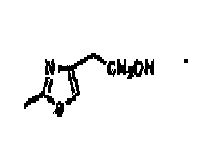
[0049] Compound 46, i.e., 4'-O-demethyl-4β-(4"hydroxylethyl)-thiazolylamino]- desoxypodophyllotoxin. Amorphous, mp 128°C (soften) 155.8 °C (dec); BSI MS; 526.2 (M-H); 1H NMR (Bruker 400 MHz, CD3OD): δ 6.82 (s, 1H, 5-H), 6.49 (s, 1H, 8-H), 6.32 (6, 2H, 2', 6'-H), 6.24 (s, (1H, 5"-H), 5.92 (d, J=2.0 Hz, 2H, OCH2O), 5,20 (d, J=4.3 Hz, 1H, 4-H), 4.56 (d,J= 5.1 Hz, 1H, 1-H), 4.39 (t, J= 7,4 Hz, 1H, 11-H), 3.89 (t, J=8.9 Hz, 1H, 11-H), 3.80 (t, J= 6.6 Hz, 2H, CH2CH2OH), 3.71 (s, 6H, 3', 5'.OCH3), 3.15 (dd; J= 5.1, 14.5 Hz, 1H, 2-H). 3.04 (m, 1H, 3-H), 2,74 (t, J= 6,6 Hz, 2H, -CH2CH2OH).
Synthzsis of Compound 54
[0050] Compound 54 was synthesized as shown in Scheme 5 Reaction of 5-amino-3-methyl isothiazole hydrochloride (2 mmol) with bromine (2 mmol) in a solution of 5% glacial acetic acid in benzene (5 mL) at 10 °C provided a solid product as a hydrobromide salt. The solid product was converted to a free base product by stirring with 2N sodium carbonate (D Buttimore et al. (1963) JACS 2032-2039). Reaction the resulting compound with DBD under Nz with reftuxing yielded the desired product.
Synthesis of compound 57
[0051] Compound 57, i.e., 4'-O-demethyl-4β-[2"-(4"-hydroxylmethyl)-thiazolylamino]-desoxypodophyllotoxin was synthesized as follows. 2-amino-4-chloromethylthiazole hydrochloride (42.0 mmol) in 16 mL of water was heated to reflux for 15min. The rection solution was evaporated to dryness and the residue was redissolved in water and evaporated. The residue was crystallized from ethanol to give an alcohol interdiate. The intermediate further reacted with DBD under reflux condition to afforded the title compound in 35% yield. Amorphous, mp 185-189 °C; ESIMS: 511.2 (M-H); 1H NMR (Bruker 400 MHz, CD3OD): δ 6.82 (s, 1H, 5-H), 6.49 (s, 1H, 8-H), 6.43 (s, 1H, 5"-H), 6.32 (s, 2H, 2',6'-H), 5.92 (d,J=2.7Hz, 2H, OCH2O), 5.24 (d,J=4.3Hz, 1H, 4.56(d,J=5.1Hz, 1H, 1-H), 4.45 (s,2H,-CH2OH), 4.41 (t, J= 7.4 Hz,.1H, 11-H). 3.g8 (t, J= 8.9 Hz, 1H, 11-H). 3.71 (s, 6H, 3', 5'-OCH3), 315 (dd, J=5.1, 14.5 Hz, 1H, 2-H), 3.04 (m,1H, 3-H).
Synthesis of Compounds 58-61
[0052] Each of these compounds was synthesized as synthesized as follows. Reaction of the podophyllotoxin derivates was treated with phosphorous oxychloride (2 eq for the compounds 58-60, and 4 eq for the compound 61) in the presence of N,N-diisopropylethylamine (5 eq and 10 eq, respectively) at -20 to -15°C. The resulting product was hydrolyzed in water at-5 to 0°C in the presence of pyridine to provide the desired product.
[0054] Compound 61, i.e., 4'-O-demethyl-4β-[2"-(4"-hydroxylethyl)-thiazolylamino]- desoxypodophyllotoxin- 4'-O,4"O-diphosphate. Amorphous, mp 176 °C (dec); ESIMS: 685.2 (M-H); 1HNMR (Brucker 400MHz, DMSO-d6): δ6.88 (s, 1H, 5-H), 6,52 (s, 1H, δ-H), 6.32 (s, 1H, 5"-1H), 6 22 (s, 2H, 2' 6'-H), 5.98 (d, J= 4.70Hz, 2H, OCH2O), 5.28 (d, J=4.7 Hz, 1H, 4-H), 4.52 (d, J= 5.1 Hz, 1H. 1-H), 4.34 (t, J=7.4 Hz, 1H,11-H, 3.92 (m, 2H, -CH2CH2OPO3H2), 3.78 (t, J= 8.6 Hz, 1H, 11-H), 3.58 (s, 6H, 3', 5'-OCH3), 2.72 (m, 1H, 2-H). 2.67 (m, 1H, 3-H), 2.33 (t, J 2.0 Hz, 2H, -CH2CH2O PO3H2).
BIOGICAL ASSAYS
[0055] A number of compounds of this invention were evaluated for cytotoxicity a gainst KB cells, which are nasopharyngeal carcinoma cells. They were also tested for stimulation of cellular protein-linked DNA breaks (pLDB) using etoposide as a positive control. Etopside is a widely-used antineoplastic agent, see, e.g., Zhang et al. (1994) J. Med. Chem,37:446.
[0056] Among the tested compounds, Compounds 1, 10, 30, 37 and 39 showed unexpectedly low IC50 values a gainst KB cells and are therefore strong cytotoxic agents against cancer cells. Indeed, Compounds 1, 30 and 39 showed unexpectedly high levels of PLDB induction in K.B cells when tested at 5 µg/ml.
[0057] three compounds, i.e., Compounds 1, 8, and 31, were also assayed for inhibition of tubulin polymerization in vitro. The results showed that none of them inhibited tubulin polymerization at concentrations as high as 40 µM, indicating that the growth inhibitory activity of these compounds did not result from inhibition of tubulin polymerization.
1. A compound of formula (I):
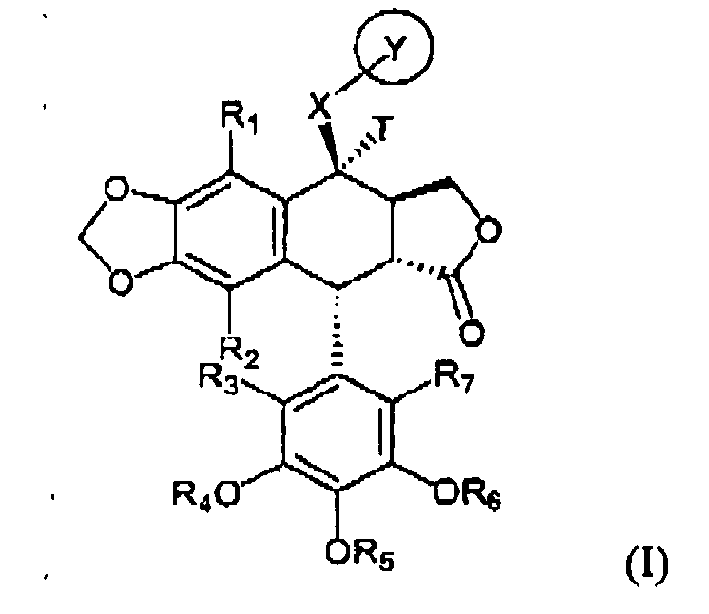
wherein
each of R1, R2, R3 and R7 independently is H;
each of R4 and R6 independently is alkyl;
R5 is P(O)(OH)2.
T is H,
X is NH; and
Y is 5-membered heteroaryl or heterocyclyl optionally substituted with one or more of halogen, alkyl, cyclyl, aryl, heteroaryl, heterocyclyl, -ORc, -NR-cRc', -SRc, -CN, -NO2, -SO2Rc, -C(O)ORc, -C(O)NRcRc', -NHC(O)Rc, -(CH2)qOPO3H2, -CH2C(O)NORc, and
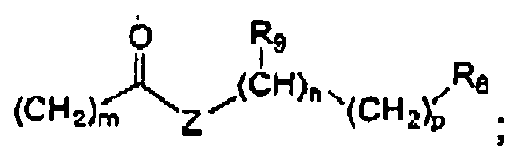
in which each of Rc and Rc' independently is H or alkyl; Rc" is H, alkyl, or silyl; Z is O or NH; each ofm and n independently is 0 or 1; p is 0, 1, or 2, q is 1, 2, 3, or 4; and each of R8 and R9 independently is H, alkyl, aryl, heteroaryl, heterocyclyl, -ORd, NRdRd', -SRd, -CN, - NO2, -SO2Rd -C(O)ORd, -C(O)NRdRd', -NHC(O)Rd, or -NHC(O)ORd, in which each of Rd and Rd' independently is H or alkyl.
wherein
each of R1, R2, R3 and R7 independently is H;
each of R4 and R6 independently is alkyl;
R5 is P(O)(OH)2.
T is H,
X is NH; and
Y is 5-membered heteroaryl or heterocyclyl optionally substituted with one or more of halogen, alkyl, cyclyl, aryl, heteroaryl, heterocyclyl, -ORc, -NR-cRc', -SRc, -CN, -NO2, -SO2Rc, -C(O)ORc, -C(O)NRcRc', -NHC(O)Rc, -(CH2)qOPO3H2, -CH2C(O)NORc, and
in which each of Rc and Rc' independently is H or alkyl; Rc" is H, alkyl, or silyl; Z is O or NH; each ofm and n independently is 0 or 1; p is 0, 1, or 2, q is 1, 2, 3, or 4; and each of R8 and R9 independently is H, alkyl, aryl, heteroaryl, heterocyclyl, -ORd, NRdRd', -SRd, -CN, - NO2, -SO2Rd -C(O)ORd, -C(O)NRdRd', -NHC(O)Rd, or -NHC(O)ORd, in which each of Rd and Rd' independently is H or alkyl.
2. A compound according to claim 1 wherein each of R4 and R6 independently is methyl and Y is
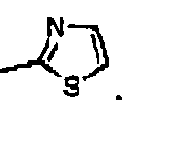
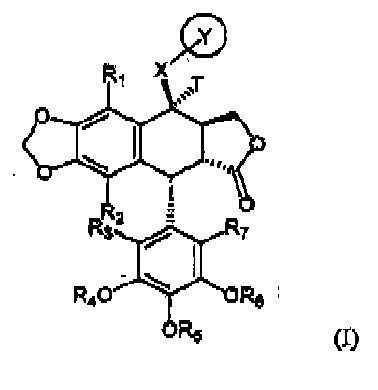
3. A compound of formula (I):
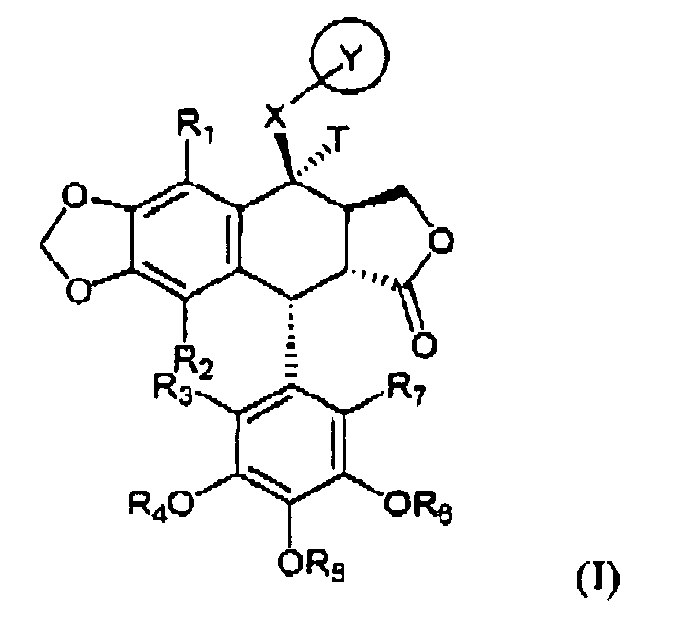
wherein
each of R1, R2, R1 and R7 independently is H;
each of R4 and R6 independently is methyl;
R5 is H,
T is H,
X is NH; and
Yis
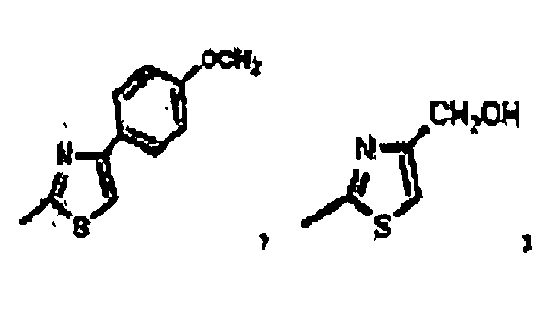
or
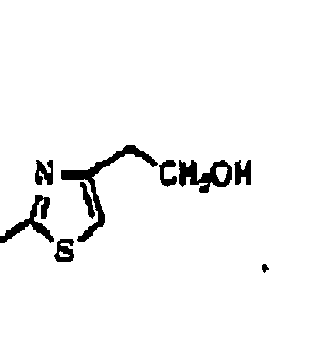
wherein
each of R1, R2, R1 and R7 independently is H;
each of R4 and R6 independently is methyl;
R5 is H,
T is H,
X is NH; and
Yis
or
4. A compound of formula (1):
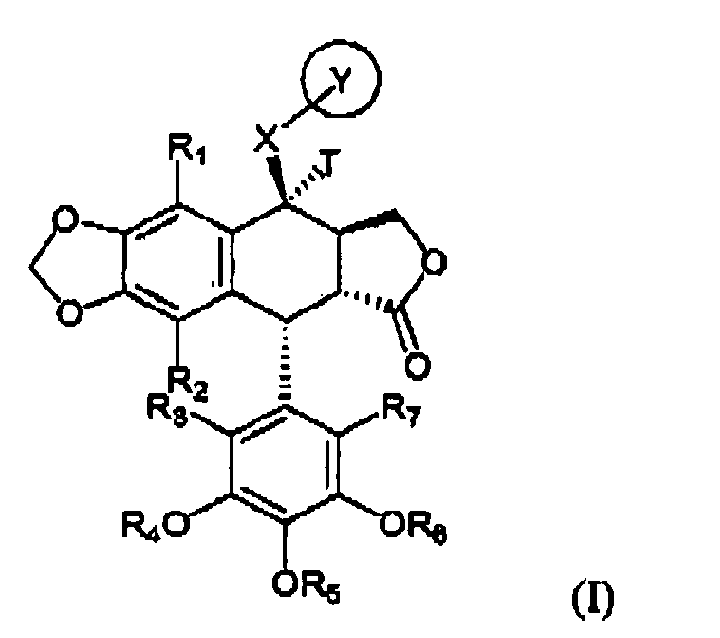
wherein
each of R10 R2, R3 and R7 independently is H;
each of R4, and R6 independently is methyl;
R5 is H;
T is H;
X is NH; and
Y is

in which Z is O or NH; each of m and n is independently 0 or 1; p is 0 or 1 or 2; each of R8 and R9 independently is H, alkyl, aryl, heteroaryl, heterocyclyl, -ORd, -NRdRd', -SRd, -CN, -NO2, -SO2Rd -C(O)ORd, - C(O)NRdRd', -NHC(O)Rd, or -NHC(O)ORd, in which each of Rd and Rd' independently is H or alkyl.
wherein
each of R10 R2, R3 and R7 independently is H;
each of R4, and R6 independently is methyl;
R5 is H;
T is H;
X is NH; and
Y is
in which Z is O or NH; each of m and n is independently 0 or 1; p is 0 or 1 or 2; each of R8 and R9 independently is H, alkyl, aryl, heteroaryl, heterocyclyl, -ORd, -NRdRd', -SRd, -CN, -NO2, -SO2Rd -C(O)ORd, - C(O)NRdRd', -NHC(O)Rd, or -NHC(O)ORd, in which each of Rd and Rd' independently is H or alkyl.
5. A compound of formula (I):

wherein
each of R1, R2, R3 and R7 independently is H.
each of R4 and R6 independently is methyl;
R5 is H,
TisH,
X is NH, and
Yin


wherein
each of R1, R2, R3 and R7 independently is H.
each of R4 and R6 independently is methyl;
R5 is H,
TisH,
X is NH, and
Yin
1. Verbindung der Formel (I):
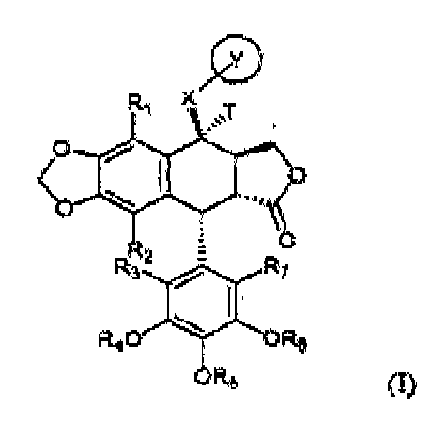
wobei
R1, R2, R3 und R7 jeweils unabhangig für H stehen;
R4 und R6 jeweils unabhangig für Alkyl stehen,
1\5 für P(O) (Oti)2 steht,
T fur H steht,
X Eür NH steht und
Y für eis 5-gliedriges Heteroaryl oder Heterocyclyl steht, gegebenenfalls substituiert durch eines oder mehrere von Halogen, Alkyl, Cyclyl, Aryl Heteroaryl, Heterocyclyl, -ORc, -NPcRc', SRc, -CN, -NO2, -SO2Rc, -C(O)ORc, -C(O)NRcRc', -NHC(O)Rc, -(CH2)qOPO3H2, -CH2C(O)NORc'', und
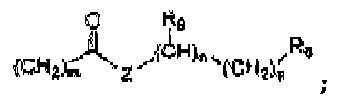
wobei Rc und Rc' jeweils unabhängig für H oder Alkyl stehen; Rc" für H, Alkyl oder Silyl steht; 2 fur O oder NH steht; m und n jeweils unabhängig für 0 oder 1 stehen; p für 0, 1 oder 2 steht; q für 1, 2, 3 oder 4 steht; und R8 und R9 jeweils unabhängig fur H, Alkyl, Aryl, Heteroaryl, Heterocyclyl, -ORd, -NRdRc', -SRd, -CN, -ND2, -SO2Rd -C(O)OR4, -C(O)NRdRd', -NHC(O)Rd oder NHC(O)ORd stehen, wobei Rd und Rd' jeweils unabhangig für H oder Alkyl stehen.
wobei
R1, R2, R3 und R7 jeweils unabhangig für H stehen;
R4 und R6 jeweils unabhangig für Alkyl stehen,
1\5 für P(O) (Oti)2 steht,
T fur H steht,
X Eür NH steht und
Y für eis 5-gliedriges Heteroaryl oder Heterocyclyl steht, gegebenenfalls substituiert durch eines oder mehrere von Halogen, Alkyl, Cyclyl, Aryl Heteroaryl, Heterocyclyl, -ORc, -NPcRc', SRc, -CN, -NO2, -SO2Rc, -C(O)ORc, -C(O)NRcRc', -NHC(O)Rc, -(CH2)qOPO3H2, -CH2C(O)NORc'', und
wobei Rc und Rc' jeweils unabhängig für H oder Alkyl stehen; Rc" für H, Alkyl oder Silyl steht; 2 fur O oder NH steht; m und n jeweils unabhängig für 0 oder 1 stehen; p für 0, 1 oder 2 steht; q für 1, 2, 3 oder 4 steht; und R8 und R9 jeweils unabhängig fur H, Alkyl, Aryl, Heteroaryl, Heterocyclyl, -ORd, -NRdRc', -SRd, -CN, -ND2, -SO2Rd -C(O)OR4, -C(O)NRdRd', -NHC(O)Rd oder NHC(O)ORd stehen, wobei Rd und Rd' jeweils unabhangig für H oder Alkyl stehen.
2. Verbindung nach Aspruch 1, wobei R4 und R5 jeweils unabhängig für Methyl stehen, und Y für

steht.
steht.
3. Verbindung der Formel (I):
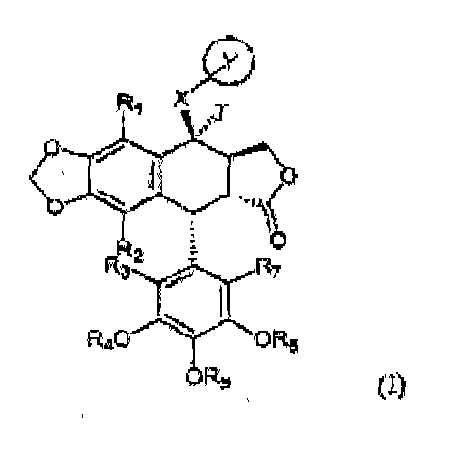
wobei
R1, R2, R3 und R7 jeweils unabhängig für H stehen:
R4 und R6 jeweils unabhängig für Methyl stehen;
R5 für H steht,
T für H steht,
X für NH steht; und
Y für
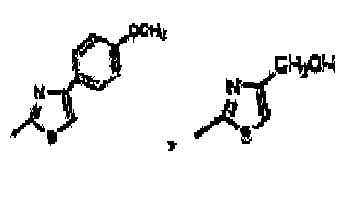
oder
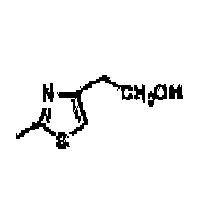
steht.
wobei
R1, R2, R3 und R7 jeweils unabhängig für H stehen:
R4 und R6 jeweils unabhängig für Methyl stehen;
R5 für H steht,
T für H steht,
X für NH steht; und
Y für
oder
steht.
4. Verbindung der Formel (I)
wobei
R1, R2, R3 und R7 jeweils unabhängig fur H stehen
R4 und R6 jeweils unabhängig für Methyl stehen;
R5 für H steht,
T fur H steht,
X für NH steht, und
Y für
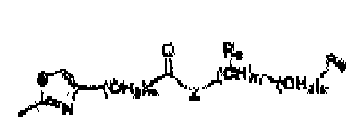
steht, wobei Z für 0 oder NH steht; m und n jeweils unabhängig für 0 oder 1 stehen; p für 0 oder 1 oder 2 steht R8 und R9 jeweils unabhängig für H, Alkyl, Aryl, Heteroaryl, Heterocyclyl, -ORd, NRaRa', -SRd, -CN, -NO2, -SO2Rd - C(O)ORd, -C(O)NRdRd', -NHC(O)Rd oder -NHC(O)ORd stehen, wobei Rd und Rd' jeweils unabhängig für H oder Alkyl stehen
wobei
R1, R2, R3 und R7 jeweils unabhängig fur H stehen
R4 und R6 jeweils unabhängig für Methyl stehen;
R5 für H steht,
T fur H steht,
X für NH steht, und
Y für
steht, wobei Z für 0 oder NH steht; m und n jeweils unabhängig für 0 oder 1 stehen; p für 0 oder 1 oder 2 steht R8 und R9 jeweils unabhängig für H, Alkyl, Aryl, Heteroaryl, Heterocyclyl, -ORd, NRaRa', -SRd, -CN, -NO2, -SO2Rd - C(O)ORd, -C(O)NRdRd', -NHC(O)Rd oder -NHC(O)ORd stehen, wobei Rd und Rd' jeweils unabhängig für H oder Alkyl stehen
5. Verbindung der Formel (1)
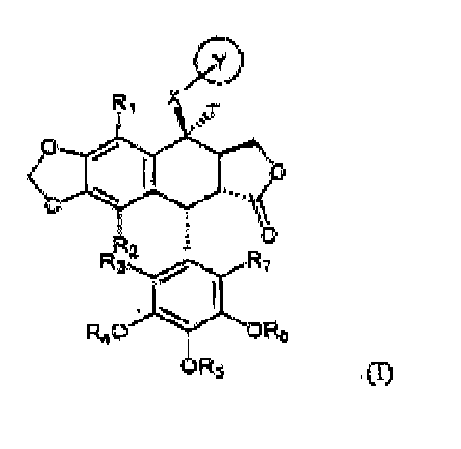
wobei
R1, R2, R3 und R7 jeweils unabhängig für H stehen;
R4 und R6 jeweils unabhängig für Methyl stehen;
R5 für H steht,
T für H steht,
X für NN steht, und
Y für


steht.
wobei
R1, R2, R3 und R7 jeweils unabhängig für H stehen;
R4 und R6 jeweils unabhängig für Methyl stehen;
R5 für H steht,
T für H steht,
X für NN steht, und
Y für
steht.
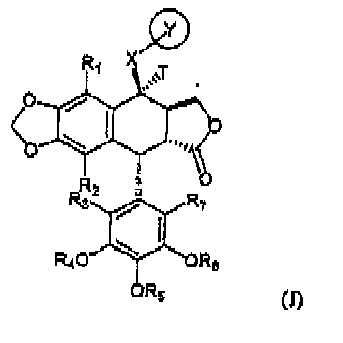
1. Composé de formule (I):
dans lequel
chaque groupement parmi R1, R2, R3, et R7 est indépendamment un H,
chaque groupement parmi R4 et R6 est indépendamment un alkyle;
R5 est un P(O)(OH)2,
T est un H,
X est un NH, et
Y est un hétéroaryle ou un hétérocyclyle à 5 membres, substitué optionnellement par un ou plusieurs éléments parmi Un halogéne, un akyle, un cyclyle, un aryle, un hétéroaryle, un hétérocyclyle, -ORc, -NRcRc', -SRc, -CN, -NO2. -SO2Rc, -C(O)ORc, -C(O)NRcRc', -NHC(O)Rc, -CH2)qOPO3H2, CH2C(O)NORc", et
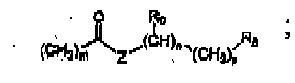
où chaque groupement parmi Rc et Rc' est indépendamment un H ou un alkyle; Rc" est un H, un alkyle, ou un silyle; Z est un O ou un NH, chacun parmi m et n vaut indépendamment 0 ou 1, p vaut 0, 1, ou 2. q vaut 1, 2, 3, ou 4, et chaque groupement parmi R8 et R9 est indépendamment un H, un alkyle, un aryle, un bétéroaryle, un hétérocyclyle, -ORd, -NRdRd', -SRd, -CN, NO2, -SO2Rd-C(O)ORd, -C(O)NRdRd', -NHC(O)Rd ou -NHC(O)ORd, ou chaque groupement parmi R4 et Pd' est indépendamment un H ou un alkyle
dans lequel
chaque groupement parmi R1, R2, R3, et R7 est indépendamment un H,
chaque groupement parmi R4 et R6 est indépendamment un alkyle;
R5 est un P(O)(OH)2,
T est un H,
X est un NH, et
Y est un hétéroaryle ou un hétérocyclyle à 5 membres, substitué optionnellement par un ou plusieurs éléments parmi Un halogéne, un akyle, un cyclyle, un aryle, un hétéroaryle, un hétérocyclyle, -ORc, -NRcRc', -SRc, -CN, -NO2. -SO2Rc, -C(O)ORc, -C(O)NRcRc', -NHC(O)Rc, -CH2)qOPO3H2, CH2C(O)NORc", et
où chaque groupement parmi Rc et Rc' est indépendamment un H ou un alkyle; Rc" est un H, un alkyle, ou un silyle; Z est un O ou un NH, chacun parmi m et n vaut indépendamment 0 ou 1, p vaut 0, 1, ou 2. q vaut 1, 2, 3, ou 4, et chaque groupement parmi R8 et R9 est indépendamment un H, un alkyle, un aryle, un bétéroaryle, un hétérocyclyle, -ORd, -NRdRd', -SRd, -CN, NO2, -SO2Rd-C(O)ORd, -C(O)NRdRd', -NHC(O)Rd ou -NHC(O)ORd, ou chaque groupement parmi R4 et Pd' est indépendamment un H ou un alkyle
2. Composé selon la revendication 1, dans lequel chaque groupement parmi R4 et R6 est indépendamment un méthyle et Y est un

3. Composé de formule (I):
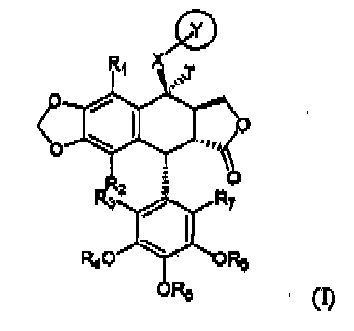
dans lequel
chaque groupement parmi R1 R2, R3, et R7 est indépendamment un H;
chaque groupement parmi R4 et R6 est indépendamment un méthyle,
R5 est un H,
T est un H,
X est un NH, et
Y est un
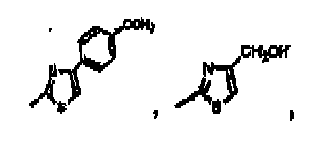
ou
dans lequel
chaque groupement parmi R1 R2, R3, et R7 est indépendamment un H;
chaque groupement parmi R4 et R6 est indépendamment un méthyle,
R5 est un H,
T est un H,
X est un NH, et
Y est un
ou
4. Composé de formule (I):
dans lequel
chaque groupement parmi R1, R2, R3 et R7 est indépendamment un H,
chaque groupement parmi R4 et R6 est indépendamment un méthyle;
R5 est un H,
T est un H;
X est un NH, et
Y est un
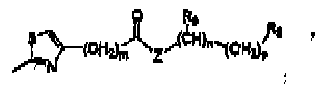
où Z est un O ou un NH; chacun parmi m et
n vaut indépendamment 0 ou 1, p vaut 0 ou 1 ou 2, chaque groupement parmi R8 et R9 est indépendamment un H, un alkyle, un aryle, un hétéroaryle, un hétérocyclyle, -ORd, NRdRd', SRd, -CN, NO2, -SO2Rd-C(O)ORd, -C(O)NRdRd', -NHC(O)Rd, ou -NHO(O)ORd, où chaque groupement parmi Rd et Rd' est indépendamment un H ou un alkyle
dans lequel
chaque groupement parmi R1, R2, R3 et R7 est indépendamment un H,
chaque groupement parmi R4 et R6 est indépendamment un méthyle;
R5 est un H,
T est un H;
X est un NH, et
Y est un
où Z est un O ou un NH; chacun parmi m et
n vaut indépendamment 0 ou 1, p vaut 0 ou 1 ou 2, chaque groupement parmi R8 et R9 est indépendamment un H, un alkyle, un aryle, un hétéroaryle, un hétérocyclyle, -ORd, NRdRd', SRd, -CN, NO2, -SO2Rd-C(O)ORd, -C(O)NRdRd', -NHC(O)Rd, ou -NHO(O)ORd, où chaque groupement parmi Rd et Rd' est indépendamment un H ou un alkyle
5. Composé de formule (I)
dans lequel
chaque groupement parmi R1, R2, R3 et R7 est indépendamment un H,
chaque groupement parmi R4 et R6 est indépendamment un méthyle,
R5 est un H,
Test un H,
X est un NH, et
Y est un


dans lequel
chaque groupement parmi R1, R2, R3 et R7 est indépendamment un H,
chaque groupement parmi R4 et R6 est indépendamment un méthyle,
R5 est un H,
Test un H,
X est un NH, et
Y est un
REFERENCES CITED IN THE DESCRIPTION
This list of references cited by the applicant is for the reader's convenience only. It does not form part of the European patent document. Even though great care has been taken in compiling the references, errors or omissions cannot be excluded and the EPO disclaims all liability in this regard.
Patent documents cited in the description
Non-patent literature cited in the description
- JardineAnticancer Agents Based on Natural Products ModelsAcademic Press19800000319- [0001]
- IssellCancer Chemother. Pharmacol., 1982, vol. 7, 73- [0001]
- Lee et al.Food and Drug Analysis, 1995, vol. 3, 209- [0001]
- Osheroff et al.BioEssays, 1991, vol. 13, 269- [0001]
- AltonHarrisBr. J. Haematol., 1993, vol. 85, 241-245 [0001]
- Cho et al.J. Med Chem., 1996, vol. 39, 1383- [0001]
- MacDonald et al.DNA Topoisomerase in CancerOxford University Press19910000 [0001] [0023]
- Antibumor Agents.213.Modelling of Epipodophyllotoxin Derivatives using Variable Selection be Nearest Neighbour QSAR MethodXAO z et al.Journal of Medical ChemistryACS20020101vol. 45, 2294-2309 [0002]
- Wang et al.Yaoxue Xuebao, 1992, vol. 27, 656- [0012]
- Lee et al.J. Nat. Prod., 1989, vol. 52, 606- [0012]
- Chen et al.Chinese Chemical Letters, 2000, vol. 11, 505- [0012]
- Kuhn et al.Helv. Chim. Acta, 1969, vol. 52, 944- [0012]
- R. LarockComprehensive Organic TransformationsVCH Publishers19890000 [0014]
- T.W. GreeneP.G.M. WutsProtective Groups in Organic SynthesisJohn Wiley and Sons19990000 [0014]
- L. FieserM. FieserFieser and Fieser's Reagents for Organic SynthesisJohn Wiley and Sons19940000 [0014]
- Encyclopedia of Reagents for Organic SynthesisJohn Wiley and Sons19950000 [0014]
- J.N.C.I., 1990, vol. 82, 1107- [0023]
- Cho et al.J. Med. Chem., 1996, vol. 39, 1396- [0023]
- Rowe et al.Cancer Res., 1986, vol. 46, 2021- [0023]
- D Buttimore et al.JACS, 1963, 2032-2039 [0050]
- Zhang et al.J. Med. Chem, 1994, vol. 37, 446- [0055]