|
(11) | EP 1 790 628 B1 |

| (12) | EUROPEAN PATENT SPECIFICATION |
|
|
| (54) |
METHOD FOR PRODUCING UNSATURATED VICINAL DIOL COMPOUND VERFAHREN ZUR HERSTELLUNG EINER UNGESÄTTIGTEN VICINALEN DIOLVERBINDUNG PROCÉDÉ SERVANT À PRODUIRE UN COMPOSÉ DIOL VICINAL INSATURÉ |
|
|
|||||||||||||||||||||||||||||||
| Note: Within nine months from the publication of the mention of the grant of the European patent, any person may give notice to the European Patent Office of opposition to the European patent granted. Notice of opposition shall be filed in a written reasoned statement. It shall not be deemed to have been filed until the opposition fee has been paid. (Art. 99(1) European Patent Convention). |
Technical Field
[0001] The present invention relates to a method for producing an unsaturated vicinal diol compound.
Background Art
[0002] Unsaturated vicinal diol compounds are important compounds as raw materials of bioactive substance such as pharmaceuticals and agrochemicals, and monomers for production of functional polymers as described in US 5336815. As methods for producing the unsaturated vicinal diol compound, a method comprising a reaction of an unsaturated epoxy compound with water in the presence of a sulfuric acid catalyst is described in US 5250743. A method comprising a reaction of an unsaturated epoxy compound with water in the presence of an acidic resin is described in WO 91/15469. A method comprising a reaction of an unsaturated epoxy compound with water in the presence of rhenium oxide catalyst is described in DE 4429700. A method comprising a reaction of an unsaturated epoxy compound with water in the presence of titanium silicate or zirconium silicate is described in DE 4429699.
Disclosure of the Invention
[0003] The present invention provides a method for producing an unsaturated vicinal diol compound represented by the formula (2) :
wherein R1, R2, R3, R4, R5 and R6 are the same or different and each independently represent a hydrogen atom; a C1-C20 alkyl group which may be substituted with a halogen atom, a C1-C6 alkoxy group, a C2-C7 alkoxycabonyl group, a C6-C10 aryl group, or a carboxyl group; or a C6-C10 aryl group which may be substituted with a halogen atom, a C1-C6 alkoxy group, a C6-C10 aryl group, or a carboxyl group,
which comprises reacting an unsaturated epoxy compound represented by the formula (1):
wherein R1, R2, R3, R4, R5 and R6 are the same as defined above, with water in the presence of a silicate containing at least one element selected from a group 5 element and a group 6 element of the periodic table, wherein the silicate containing at least one element selected from a group 5 element and a group 6 element of the periodic table is a metal-containing silicate obtained by reacting a metal oxide, which is obtained by reacting at least one compound selected from a group 5 metal of the periodic table, a group 6 metal of the periodic table, a compound containing a group 5 element of the periodic table and a compound containing a group 6 element of the periodic table, with hydrogen peroxide, with a silicon compound in the presence of an organic template, wherein the organic template is an alkylamine, a quaternary ammonium salt or a nonionic surfactant.
Best Mode for Carrying Out the Present Invention
[0004] In the present invention, the silicate containing at least one element selected from a group 5 element and a group 6 element of the periodic table (hereinafter, simply referred to as the metal-containing silicate) is not particularly limited as far as it is a silicate containing the group 5 element of the periodic table, the group 6 element of the periodic table or the both elements thereof.
[0005] Examples of the group 5 element of the periodic table include vanadium, niobium, tantalum and the like. Examples of the group 6 element of the periodic table include tungsten, molybdenum, chromium and the like. Preferred are vanadium, molybdenum and tungsten, and more preferred are vanadium and molybdenum.
[0006] The metal-containing silicate is produced by a method comprising reacting a metal oxide containing at least one element selected from the group 5 element and the group 6 element of the periodic table with a silicon compound in the presence of the organic template, followed by washing or calcining the obtained solid as described in EP 1473275 A, Applied Catalysis A: General 179, 11 (1999), and J. Chem. Soc., Chem. Commun., 2231 (1995). The metal oxide is obtained by reacting at least one compound selected from a group 5 metal of the periodic table, a group 6 metal of the periodic table, a compound containing the group 5 element of the periodic table and a compound containing the group 6 element of the periodic table with hydrogen peroxide. The method for producing the metal-containing silicate produced by using the metal oxide which is obtained by reacting at least one compound selected from a group 5 metal of the periodic table, a group 6 metal of the periodic table, a compound containing the group 5 element of the periodic table and a compound containing the group 6 element of the periodic table (hereinafter, simply referred to as the metal or compound) with hydrogen peroxide will be illustrated below.
[0007] Examples of the group 5 metal of the periodic table include vanadium metal, niobium metal and tantalum metal. Examples of the group 6 metal of the periodic table include tungsten metal, molybdenum metal and chromium metal. Examples of the compound containing the group 5 element of the periodic table include a vanadium compound such as vanadium oxide, ammonium vanadate, vanadium carbonyl complex, vanadium sulfate and vanadium sulfate ethylene diamine complex; a niobium compound such as niobium oxide, niobium chloride and niobium carbonyl complex; and a tantalum compound such as tantalum oxide and tantalum chloride. Examples of the compound containing the group 6 element of the periodic table include a tungsten compound such as tungsten boride, tungsten carbide, tungsten oxide, ammonium tungstate and tungsten carbonyl complex; a molybdenum compound such as molybdenum boride, molybdenum oxide, molybdenum chloride, molybdenum carbonyl complex; and a chromium compound such as chromium oxide and chromium chloride.
[0008] Among the metals or compounds, tungsten metal, the tungsten compound, molybdenum metal, the molybdenum compound, vanadium metal and the vanadium compound are preferable, and molybdenum metal, the molybdenum compound, vanadium metal and the vanadium compound are more preferable.
[0009] The metals or compounds may be used alone, or two or more thereof may be used. Among the metals or compounds, there are metals or compounds having hydrates and the hydrates may be used or anhydrous one may be used for the present invention.
[0010] The metal oxide is obtained by reacting the metal or compound with hydrogen peroxide. As hydrogen peroxide, an aqueous solution is usually used. A solution of hydrogen peroxide in an organic solvent may be used and it is preferred to use the aqueous hydrogen peroxide solution from the viewpoint of easier handling. The concentration of hydrogen peroxide in the aqueous hydrogen peroxide solution or in the solution of hydrogen peroxide in the organic solvent is not particularly limited, but in view of volume efficacy and safety, the practical concentration is 1 to 60% by weight. As the aqueous hydrogen peroxide solution, a commercially available aqueous hydrogen peroxide solution is usually used as it is, or if necessary, it may be used after adjusting the concentration by dilution or concentration. The solution of hydrogen peroxide in the organic solvent can be prepared by extracting the aqueous hydrogen peroxide solution with the organic solvent, or distilling the solution in the presence of the organic solvent.
[0011] The amount of hydrogen peroxide to be used is usually 3 moles or more, preferably 5 moles or more relative to 1 mole of the metal or compound, and the upper limit of the amount is not particularly defined.
[0012] The reaction of the metal or compound with hydrogen peroxide is usually carried out in an aqueous solution. The reaction may be carried out in an organic solvent, for example, an ether solvent such as diethyl ether, methyl tert-butyl ether and tetrahydrofuran, an ester solvent such as ethyl acetate, an alcohol solvent such as methanol, ethanol and tert-butanol, a nitrile solvent such as acetonitrile and propionitrile, or in a mixture of the organic solvent and water.
[0013] The reaction of the metal or compound with hydrogen peroxide is usually carried out by contacting both of them, and in order to improve efficacy of contact between the metal or compound, and hydrogen peroxide, preferably, the reaction is carried out with stirring so as to sufficiently disperse the metal or compound in a solution for preparing the metal oxide. The reaction temperature is usually -10 to 100°C.
[0014] By reacting the metal or compound with hydrogen peroxide in water, in the organic solvent, or in the mixed solvent of water and the organic solvent, all or a part of the metal or compound is dissolved, whereby, a homogeneous solution or slurry containing the metal oxide can be prepared. The metal oxide may be isolated from the homogeneous solution or slurry, for example, by concentration or filtration followed to preparing a metal-containing silicate, and the homogeneous solution or slurry may be used as it is for preparing the metal-containing silicate.
[0015] As the silicon compound, a tetraalkoxysilane such as tetramethoxysilane, tetraethoxysilane and tetraisopropoxysilane is usually used. The silicon compound is usually used in such an amount that silicon atoms are 4 moles or more relative to 1 mole of the metal atom of the above-mentioned metal oxide, and the upper limit thereof is not particularly defined.
[0016] The organic template is an alkylamine, a quaternary ammonium salt or a nonionic surfactant, and the alkylamine and the quaternary ammonium salt are preferable.
[0017] Examples of the alkylamine include a primary amine wherein a hydrogen atom of ammonia is substituted with an alkyl group having 8 to 20 carbon atoms such as octylamine, nonylamine, decylamine, undecylamine, dodecylamine, tridecylamine, tetradecylamine and eicosylamine; a secondary amine wherein one of hydrogen atoms of the amino group of the above-mentioned primary amine is substituted with a lower alkyl group having 1 to 6 carbon atoms such as a methyl group; and a tertiary amine wherein a hydrogen atoms of the amino group of the above-mentioned secondary amine is substituted with a lower alkyl group having 1 to 6 carbon atoms, and the primary amine is preferable.
[0018] As the quaternary ammonium salt, those consisting of a quaternary ammonium ion wherein four hydrogen atoms of the ammonium ion (NH4+) are substituted with same or different four alkyl groups having 1 to 18 carbon atoms and an anion such as a hydroxide ion, a chloride ion and a bromide ion are exemplified. Specific examples thereof include a quaternary ammonium hydroxide salt such as tetraethylammonium hydroxide, tetrapropylammonium hydroxide, tetrabutylammonium hydroxide and trimethyloctylammonium hydroxide; a quaternary ammonium chloride salt such as tetraethylammonium chloride, tetrapropylammonium chloride, tetrabutylammonium chloride and trimethyloctylammonium chloride; and a quaternary ammonium bromide salt such as tetraethylammonium bromide, tetrapropylammonium bromide, tetrabutylammonium bromide and trimethyloctylammonium bromide, and the quaternary ammonium hydroxide is preferable.
[0020] The organic template may be used as it is and by mixing with water or a hydrophilic solvent described below. The amount of the organic template to be used is usually 0.03 to 1 mole relative to 1 mole of the silicon compound.
[0021] The reaction of the above-mentioned metal oxide with the silicon compound in the presence of the organic template is usually conducted by mixing three components in the presence of a solvent. Examples of the solvent include water or the hydrophilic solvent alone or a mixture thereof and, water and mixtures of water and the hydrophilic solvent are preferable. Examples of the hydrophilic solvent include a hydrophilic alcohol solvent such as methanol, ethanol and isopropanol; a hydrophilic nitrile solvent such as acetnitrile; and a hydrophilic ether solvent such as dioxane, and the hydrophilic alcohol solvent is preferable, and methanol or ethanol is more preferable. The amount of the solvent to be used is usually 1 to 1000 parts by weight relative to 1 part by weight of the organic template.
[0023] After completion of the reaction, for example, the reaction product is separated by filtration from the reaction liquid, and the metal-containing silicate can be produced by washing or calcining the separated reaction product. In case of washing the separated reaction product, examples of the washing solvent include an alcohol solvent such as methanol and ethanol, and water. The amount thereof to be used is not particularly limited. In the case of calcining the separated reaction product, the calcination temperature is usually 300 to 700°C, preferably 500 to 600°C, and the calcinations time is usually 0.5 to 20 hours. The separated reaction product may be calcinated after washing.
[0024] The metal-containing silicate thus obtained usually has pores of which the average micropore diameter is 4 to 100 Å (calculated by BHJ method based on the result measured by the nitrogen adsorption method) and the specific surface area thereof is usually 100 m2/g or more (calculated by BET multipoint method (p/p0=0.1) based on the result measured by the nitrogen adsorption method).
[0025] Next, the method for producing the unsaturated vicinal diol compound represented by the formula (2) (hereinafter, simply referred to as the unsaturated vicinal diol compound (2)) by reacting the unsaturated epoxy compound represented by the formula (1) (hereinafter, simply referred to as the unsaturated epoxy compound (1)) with water in the presence of the metal-containing silicate.
[0026] In the formula of the unsaturated epoxy compound (1), R1, R2, R3, R4, R5 and R6 are the same or different and each independently represent a hydrogen atom; a C1-C20 alkyl group which may be substituted with a halogen atom, a C1-C6 alkoxy group, a C2-C7 alkoxycabonyl group, a C6-C10 aryl group, or a carboxyl group; or a C6-C10 aryl group which may be substituted with a halogen atom, a C1-C6 alkoxy group, a C6-C10 aryl group, or a carboxyl group.
[0027] Examples of the halogen atom include a fluorine, chlorine and bromine atom. Examples of the C1-C6 alkoxy group include a methoxy, ethoxy, n-propoxy, isopropoxy, n-butoxy, tert-butoxy and n-hexyloxy group.
[0028] In the present invention, carbon number of the alkoxycarbonyl group means carbon number of whole alkoxycarbonyl group containing carbonyl carbon. Examples of the C2-C7 alkoxycabonyl group include a methoxycarbonyl, ethoxycarbonyl and isopropoxycarbonyl group.
[0029] Examples of the C6-C10 aryl group include a phenyl, 2-methylphenyl, 4-methylphenyl and naphthyl group.
[0030] Examples of the C1-C20 alkyl group which may be substituted with a halogen atom, a C1-C6 alkoxy group, a C2-C7 alkoxycabonyl group, a C6-C10 aryl group, or a carboxyl group include a methyl, ethyl, n-propyl, isopropyl, n-butyl, isobutyl, sec-butyl, tert-butyl, n-pentyl, n-decyl, cyclopropyl, 2,2-dimethylcyclopropyl, cyclopentyl, cyclohexyl, menthyl, chloromethyl, fluoromethyl, trifluoromethyl, methoxymethyl, ethoxymethyl, methoxyethyl, methoxycarbonylmethyl and benzyl group.
[0031] Examples of the C6-C10 aryl group which may be substituted with a halogen atom, a C1-C6 alkoxy group, a C6-C10 aryl group, or a carboxyl group or groupsinclude a phenyl, naphthyl, 2-methylphenyl, 4-chlorophenyl, 4-methylphenyl, 4-methoxyphenyl, 4-phenoxyphenyl and 4-carboxyphenyl group.
[0032] Examples of the unsaturated epoxy compound (1) include 1,2-epoxy-3-butene, 1,2-epoxy-2-methyl-3-butene, 1,2-epoxy-1-phenyl-3-butene, 2,3-epoxy-2-methyl-4-pentene, 2,3-epoxy-1-phenyl-4-pentene, 2,3-epoxy-4-pentene, 2,3-epoxy-2,5-dimethyl-4-hexene and 2,3-epoxy-4-hexene.
[0033] Among the unsaturated epoxy compound (1), there are those having an asymmetric carbon atom within the molecule and having an optical isomer. Each of the optical isomer alone and a mixture thereof can be used in the present invention.
[0034] The unsaturated epoxy compound (1) can be produced according to a known method such as a method for oxidizing a diene compound with oxygen in the presence of a silver-containing catalyst (e.g. US 4897498 and US 4950773).
[0035] The amount of the metal-containing silicate to be used is usually 0.001 part by weight or more per 1 part by weight of the unsaturated epoxy compound (1). There is no specific upper limit and it is practically 5 parts by weight or less per 1 part by weight of the unsaturated epoxy compound (1) considering economical viewpoint.
[0036] The amount of water to be used is usually 1 mole or more relative to 1 mole of the unsaturated epoxy compound (1). There is no specific upper limit and large excess amount thereof, for example, 500 moles relative to 1 mole of the unsaturated compound, can be used also to serve as the solvent.
[0037] The reaction of the unsaturated epoxy compound (1) and water is usually carried out in the absence of a solvent or in water solvent, and the reaction may be carried out in the presence of an organic solvent. Examples of the organic solvent include an ether solvent such as diethyl ether, methyl tert-butyl ether and tetrahydrofuran; an ester solvent such as ethyl acetate; a tertiary alcohol solvent such as tert-butanol; and a nitrile solvent such as acetonitrile and propionitrile. The amount of the organic solvent to be used is not particularly limited, and it is practically 100 parts by weight or less per 1 part by weight of the unsaturated epoxy compound (1) considering volume efficacy.
[0038] The reaction of the unsaturated epoxy compound (1) and water is usually conducted by mixing the unsaturated epoxy compound (1), water and the metal-containing silicate, and the mixing order is not particularly limited.
[0039] The reaction is usually conducted under ordinary pressure conditions and may be conducted under reduced pressure conditions or pressurized conditions. The reaction temperature is usually 0 to 100°C.
[0040] The progress of the reaction can be confirmed by a conventional analytical means such as gas chromatography, high performance liquid chromatography, thin layer chromatography, nuclear magnetic resonance spectrum analysis and infrared adsorption spectrum analysis.
[0041] After completion of the reaction, the unsaturated vicinal diol compound (2) can be isolated by filtering the reaction liquid to separate the metal-containing silicate and then concentrating or crystallizing the filtrate obtained. The unsaturated vicinal diol compound (2) can be also isolated by, if necessary, adding water and/or a water-insoluble organic solvent to the above-mentioned filtrate, followed by extracting and concentrating the organic layer obtained. Examples of the water-insoluble organic solvent include a halogenated hydrocarbon solvent such as dichloromethane, chloroform and chlorobenzene; an ether solvent such as diethyl ether and methyl tert-butyl ether; and an ester solvent such as ethyl acetate, and the amount thereof to be used is not particularly limited.
[0042] The unsaturated vicinal diol compound (2) obtained may be further purified by conventional purification means such as distillation and column chromatography.
[0043] Examples of the unsaturated vicinal diol compound (2) thus obtained include 3-butene-1,2-diol, 2-methyl-3-butene-1,2-diol, 1-phenyl-3-butene-1,2-diol, 2-methyl-4-pentene-2,3-diol, 1-phenyl-4-pentene-2,3-diol, 4-pentene-2,3-diol, 2,5-dimethyl-4-hexene-2,3-diol and 4-hexene-2,3-diol.
[0044] When an optically active unsaturated epoxy compound (1) is used, an optically active unsaturated vicinal diol compound (2) is usually obtained.
[0045] The metal-containing silicate separated from the reaction liquid can be used again in the reaction of the unsaturated epoxy compound (1) and water.
Examples
[0046] The present invention will be further illustrated by Examples in detail below. The yield was calculated from the result of gas chromatography internal standard method.
[0047] Each of the specific surface area and the average micropore diameter of the metal-containing silicate obtained were measured at 150°C under a degassed condition of 1.35 X 10⁻⁵ Kg/cm-2 (equivalent of 0.013kPa) by the nitrogen adsorption method using Autosorb-6 manufactured by Quantachrome Instruments, and the specific surface area and the average micropore diameter thereof were calculated using BET multipoint method (p/p0=0.1) and BHJ method respectively.
Reference Example 1
[0048] To a 500 mL flask equipped with a stirrer, 5g of a tungsten metal powder and 25 g of ion-exchanged water were added, and an inner temperature was adjusted to 40°C. 15 g of a 60% by weight aqueous hydrogen peroxide solution was added dropwise thereto over 30 minutes, and then the mixture was maintained at the same temperature for 1 hour to obtain a solution containing tungsten oxide. To the solution containing tungsten oxide, 75 g of ion-exchanged water and 80 g of ethanol were added, and then 41.6 g of tetraethoxysilane was added dropwise thereto over 10 minutes. Further, 20 g of 40% by weight aqueous tetrabutylammonium hydroxide solution was added dropwise thereto at the same temperature over 10 minutes. Then, the mixture was cooled to an inner temperature of 25°C and stirring was continued at the same temperature, and solid was precipitated in about 30 minutes to form slurry. After stirring and maintaining at the same temperature for 24 hours, solid was collected by filtration. Solid filtrated was washed twice with 100 g of ion-exchanged water, and then dried at 130°C for 24 hours to obtain 38.0 g of the white solid. The white solid obtained was calcined at 550°C for 6 hours to obtain 16.5 g of the white tungsten-containing silicate.
[0049] XRD spectrum: A broad peak having an apex at a d value of 3.77 Å is observed. A peak assignable to tungsten oxide is not observed.
IR spectrum (KBr)
νmax: 3478, 1638, 1078, 960, 806, 557 cm-1
Elemental analysis value; W: 9.8%, Si: 39.5%
Specific surface area: 543 m2/g, Average micropore diameter: 16 Å
Reference Example 2
[0050] To a 500 mL flask equipped with a stirrer, 5 g of a tungsten metal powder and 25 g of ion-exchanged water were added, and an inner temperature was adjusted to 40°C. 15 g of a 60% by weight aqueous hydrogen peroxide solution was added dropwise thereto over 30 minutes, and then the mixture was maintained at the same temperature for 2 hours to obtain a solution containing tungsten oxide. To the solution containing tungsten oxide, 75 g of ion-exchanged water and 80 g of ethanol were added, and then 41.6 g of tetraethoxysilane was added thereto at an inner temperature of 40°C over 10 minutes. Further, 40 g of a 10% by weight tetrapropylammonium hydroxide solution was added dropwise thereto at the same temperature over 10 minutes. Then, the mixture was cooled to an inner temperature of 25°C and stirring was continued at the same temperature. Solid was precipitated in about 30 minutes to form slurry. After stirring and maintaining at the same temperature for 24 hours, solid was collected by filtration. Solid filtrated was washed twice with 100 g of ion-exchanged water and dried at 130°C for 24 hours to obtain 38.0 g of white solid. The white solid obtained was calcined at 550°C for 6 hours to obtain 17.3 g of a white tungsten-containing silicate.
[0051] XRD spectrum: A broad peak having an apex at a d value of 3.76 Å is observed. A sharp peak assignable to tungsten oxide is slightly observed.
IR spectrum (KBr)
νmax: 3480, 1638, 1078, 956, 800 cm-1
Elemental analysis value; W: 11.0%, Si: 31.4%
Specific surface area: 573 m2/g, Average micropore diameter: 22 Å
Reference Example 3
[0052] To a 500 mL flask equipped with a stirrer, 2 g of a molybdenum metal powder and 25 g of ion-exchanged water were added, and an inner temperature was adjusted to 40°C. 15 g of a 60% by weight aqueous hydrogen peroxide solution was added dropwise thereto over 1 hour, and then the mixture was maintained at the same temperature for 1 hour to obtain a solution containing molybdenum oxide. To the solution containing molybdenum oxide, 75 g of ion-exchanged water and 80 g of ethanol were added, and then 41.6 g of tetraethoxysilane was added thereto at an inner temperature of 40°C over 10 minutes. Further, 10 g of dodecylamine was added dropwise thereto at the same temperature over 10 minutes. Solid was immediately precipitated to form slurry. The mixture was cooled to an inner temperature of 25°C and stirred and maintained for 24 hours, and then solid was collected by filtration. Solid filtrated was washed twice with 100 g of ion-exchanged water, dried at 110°C for 6 hours and calcined at 550°C for 6 hours to obtain 15.5 g of a white molybdenum-containing silicate.
[0053] XRD spectrum: A mixed spectrum of a broad peak having an apex at a d value of 3.8 Å and a sharp peak assignable to molybdenum oxide is observed.
IR spectrum (KBr)
νmax: 3470, 1640, 1090, 956, 915, 802 cm-1 Elemental analysis value; Mo: 13.9%, Si: 32.4%
Specific surface area: 171 m2/g, Average micropore diameter: 73 Å
It was confirmed that the white molybdenum-containing silicate obtained had molybdenum oxide from these results.
Reference Example 4
[0054] To a 500 mL flask equipped with a stirrer, 2.5 g of a molybdenum metal powder and 25 g of ion-exchanged water were added, and an inner temperature was adjusted to 40°C. 15 g of a 60% by weight aqueous hydrogen peroxide solution was added dropwise thereto over 1 hour, and then the mixture was maintained at the same temperature for 1 hour to obtain a solution containing molybdenum oxide. To the solution containing molybdenum oxide, 75 g of ion-exchanged water and 80 g of ethanol were added, and then 41.6 g of tetraethoxysilane was added thereto at an inner temperature of 40°C over 10 minutes. Further, 20 g of a 40% by weight tetrabutylammonium hydroxide solution was added dropwise thereto over 10 minutes. Then, stirring was continued at the same temperature and solid was precipitated in about 15 minutes to form slurry. 200 g of ion-exchanged water was added to slurry. The mixture was cooled to an inner temperature of 25°C and stirred and maintained at the same temperature for 24 hours. Then, solid was collected by filtration. Solid filtrated was washed twice with 100 g of ion-exchanged water, dried at 110°C for 6 hours and calcined at 550°C for 6 hours to obtain 15.9 g of a white molybdenum-containing silicate.
[0055] XRD spectrum: A broad peak having an apex at a d value of 3.79 Å is observed. A sharp peak assignable to tungsten oxide is not observed.
IR spectrum (KBr)
νmax: 3470, 1640, 1080, 956, 913, 796 cm-1
Elemental analysis value; Mo: 5.22%, Si: 37.0%
Specific surface area: 649 m2/g, Average micropore diameter: 22 Å
Reference Example 5
[0056] To a 500 mL flask equipped with a stirrer, 1.3 g of a vanadium metal powder and 25 g of ion-exchanged water were added, and an inner temperature was adjusted to 40°C. 15 g of a 30% by weight aqueous hydrogen peroxide solution was added dropwise thereto over 30 minutes, and then the mixture was maintained at the same temperature for 1 hour to obtain a solution containing vanadium oxide. To the solution containing vanadium oxide, 75 g of ion-exchanged water and 80 g of ethanol were added, and then 41.6 g of tetraethoxysilane was added thereto at an inner temperature of 40°C over 10 minutes. Further, 40 g of a 40% by weight tetra-n-propylamine solution was added dropwise thereto over 10 minutes. Then, the mixture was cooled to an inner temperature of 25°C and stirring was continued and solid was precipitated in about 30 minutes to form slurry. The slurry was stirred and maintained at the same temperature for 24 hours. Then, solid was collected by filtration. Solid filtrated was washed twice with 100 g of ion-exchanged water, dried at 130°C for 8 hours and calcined at 550°C for 6 hours to obtain 16.0 g of a brown vanadium-containing silicate.
[0057] XRD spectrum: A broad peak having an apex at a d value of 3.85 Å is observed. A sharp peak assignable to vanadium oxide is not observed.
IR spectrum (KBr)
νmax: 1050, 956, 794, 629 cm-1
Elemental analysis value; V: 5.56%, Si: 36.1%
Specific surface area: 708 m2/g, Average micropore diameter: 27 Å
Example 1
[0058] To a 50 mL flask equipped with a magnetic stirrer and a reflux condenser, 30 mg of the molybdenum-containing silicate obtained in the above-mentioned Reference Example 4, 310 mg of 1,2-epoxy-3-butene and 3 g of distilled water were added. The resultant mixture was stirred at an inner temperature of 25°C for 5 hours to effect reaction. 10 g of tetrahydrofuran was added to the reaction liquid obtained to obtain a solution containing 3-butene-1,2-diol. The yield of 3-butene-1,2-diol was 93% and the yield of 2-butene-1,4-diol was 5%.
Example 2
[0059] According to a similar manner as that of Example 1, the reaction was conducted except that the vanadium-containing silicate obtained in the above-mentioned Reference Example 5 was used in place of the molybdenum-containing silicate obtained in the above-mentioned Reference Example 4 and 300 mg of 1,2-epoxy-3-butene was used.
Example 3
[0061] According to a similar manner as that of Example 1, the reaction was conducted except that the molybdenum-containing silicate obtained in the above-mentioned Reference Example 3 was used in place of the molybdenum-containing silicate obtained in the above-mentioned Reference Example 4 and 330 mg of 1,2-epoxy-3-butene was used.
The yield of 3-butene-1,2-diol was 95% and the yield of 2-butene-1,4-diol was 4%.
Example 4
[0062] According to a similar manner as that of Example 1, the reaction was conducted except that the tungsten-containing silicate obtained in the above-mentioned Reference Example 1 was used in place of the molybdenum-containing silicate obtained in the above-mentioned Reference Example 4.
The yield of 3-butene-1,2-diol was 81% and the yield of 2-butene-1,4-diol was 5%.
Example 5
[0063] According to a similar manner as that of Example 1, the reaction was conducted except that the tungsten-containing silicate obtained in the above-mentioned Reference Example 2 was used in place of the molybdenum-containing silicate obtained in the above-mentioned Reference Example 4.
The yield of 3-butene-1,2-diol was 82% and the yield of 2-butene-1,4-diol was 2%. 3-buten-1,2-epoxyde was remained in 9%.
Example 6
[0064] Into a 50 mL flask equipped with a magnetic stirrer and a reflux condenser, 30 mg of the vanadium-containing silicate obtained in the above-mentioned Reference Example 5, 300 mg of 1, 2-epoxy-3-butene and 3 g of distilled water were charged. The resultant mixture was stirred at an inner temperature of 25°C for 5 hours to effect reaction. 10 g of tetrahydrofuran was added to the reaction liquid obtained, and then the vanadium-containing silicate was separated by decantation to obtain a solution containing 3-butene-1,2-diol.
The yield of 3-butene-1,2-diol was 94% and the yield of 2-butene-1,4-diol was 5%.
Example 7
[0065] Into a 50 mL flask equipped with a magnetic stirrer and a reflux condenser, all amount of the vanadium-containing silicate separated by decantation in the above-mentioned Example 6, 300 mg of 1,2-epoxy-3-butene and 3 g of distilled water were charged. The resultant mixture was stirred at an inner temperature of 25°C for 5 hours to effect reaction. 10 g of tetrahydrofuran was added to the reaction liquid obtained to obtain a solution containing 3-butene-1,2-diol.
The yield of 3-butene-1,2-diol was 87% and the yield of 2-butene-1,4-diol was 8%. 1,2-epoxy-3-butene was remained in 5%.
1. A method for producing an unsaturated vicinal diol compound represented by the formula
(2):
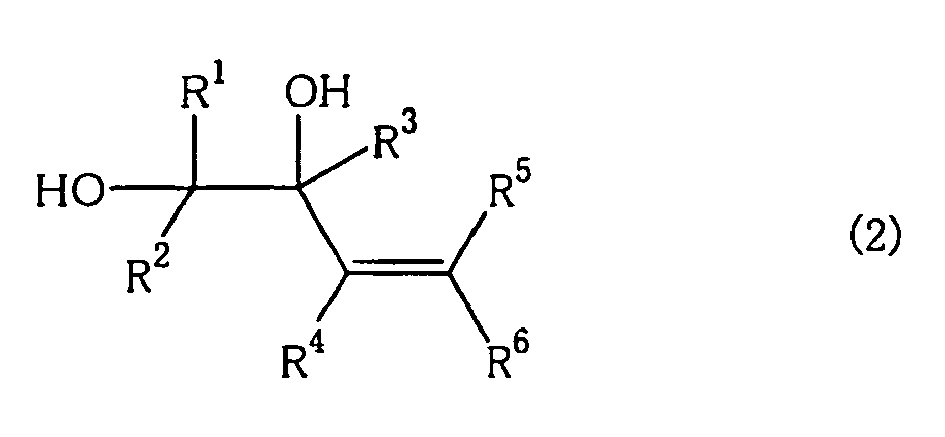
wherein R1, R2, R3, R4, R5 and R6 are the same or different and each independently represent a hydrogen atom; a C1-C20 alkyl group which may be substituted with a halogen atom, a C1-C6 alkoxy group, a C2-C7 alkoxycarbonyl group, a C6-C10 aryl group, or a carboxyl group; or a C6-C10 aryl group which may be substituted with a halogen atom, a C1-C6 alkoxy group, a C6-C10 aryl group, or a carboxyl group, which comprises reacting an unsaturated epoxy compound represented by the formula (1):
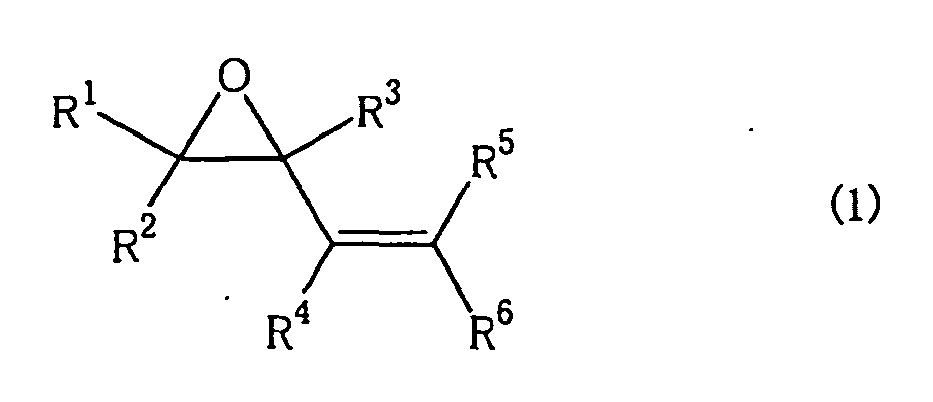
wherein R1, R2, R3, R4, R5 and R6 are the same as defined above, with water in the presence of a silicate containing at least one element selected from a group 5 element and a group 6 element of the periodic table, wherein the silicate containing at least one element selected from a group 5 element and a group 6 element of the periodic table is a metal-containing silicate obtained by reacting a metal oxide, which is obtained by reacting at least one compound selected from a group 5 metal of the periodic table, a group 6 metal of the periodic table, a compound containing a group 5 element of the periodic table and a compound containing a group 6 element of the periodic table, with hydrogen peroxide, with a silicon compound in the presence of an organic template, wherein the organic template is an alkylamine, a quaternary ammonium salt or a nonionic surfactant.
wherein R1, R2, R3, R4, R5 and R6 are the same or different and each independently represent a hydrogen atom; a C1-C20 alkyl group which may be substituted with a halogen atom, a C1-C6 alkoxy group, a C2-C7 alkoxycarbonyl group, a C6-C10 aryl group, or a carboxyl group; or a C6-C10 aryl group which may be substituted with a halogen atom, a C1-C6 alkoxy group, a C6-C10 aryl group, or a carboxyl group, which comprises reacting an unsaturated epoxy compound represented by the formula (1):
wherein R1, R2, R3, R4, R5 and R6 are the same as defined above, with water in the presence of a silicate containing at least one element selected from a group 5 element and a group 6 element of the periodic table, wherein the silicate containing at least one element selected from a group 5 element and a group 6 element of the periodic table is a metal-containing silicate obtained by reacting a metal oxide, which is obtained by reacting at least one compound selected from a group 5 metal of the periodic table, a group 6 metal of the periodic table, a compound containing a group 5 element of the periodic table and a compound containing a group 6 element of the periodic table, with hydrogen peroxide, with a silicon compound in the presence of an organic template, wherein the organic template is an alkylamine, a quaternary ammonium salt or a nonionic surfactant.
2. The method according to claim 1, wherein the group 5 metal of the periodic table,
the group 6 metal of the periodic table, the compound containing a group 5 element
of the periodic table and the compound containing a group 6 element of the periodic
table is tungsten metal, molybdenum metal, vanadium metal, a tungsten compound, a
molybdenum compound or a vanadium compound.
3. The method according to claim 1, wherein the unsaturated epoxy compounds represented
by the formula (1) is 1,2-epoxy-3-butene and the unsaturated vicinal diol compound
represented by the formula (2) is 3-butene-1,2-diol.
4. The method according to claim 1, wherein the metal-containing silicate is a metal-containing
silicate obtained by separating the reaction product from the reaction liquid after
the completion of the reaction, and washing or calcining the separated reaction product.
5. The method according to claim 1, wherein the organic template is an alkylamine or
a quaternary ammonium salt.
1. Verfahren zur Herstellung einer ungesättigten vicinalen Diolverbindung der Formel
(2):
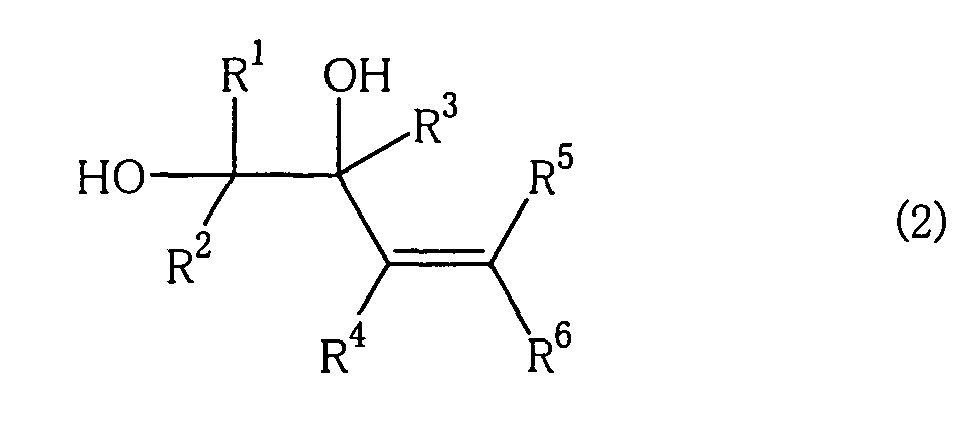
worin R1, R2, R3, R4, R5 und R6 gleich oder verschieden sind und jeweils unabhängig ein Wasserstoffatom; eine C1-C20 Alkylgruppe, die mit einem Halogenatom, einer C1-C6-Alkoxygruppe, einer C2-C7-Alkoxycarbonylgruppe, einer C6-C10-Arylgruppe oder einer Carboxylgruppe substituiert sein kann; oder eine C6-C10-Arylgruppe, die mit einem Halogenatom, einer C1-C6-Alkoxygruppe, einer C6-C10-Arylgruppe oder einer Carboxylgruppe substituiert sein kann, bedeuten, welches die Umsetzung einer ungesättigten Epoxyverbindung der Formel (1):
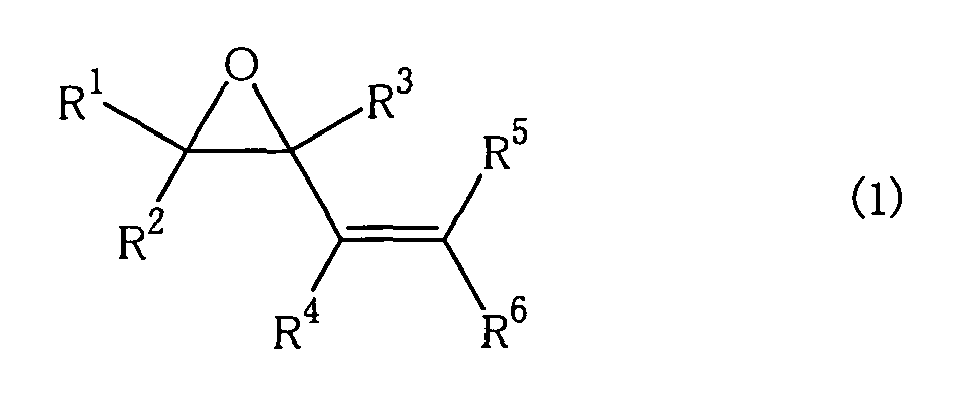
worin R1, R2, R3, R4, R5 und R6 die obige Bedeutung haben, mit Wasser in Gegenwart eines Silikats umfasst, das wenigstens ein Element enthält, das ausgewählt ist aus einem Element der Gruppe 5 und einem Element der Gruppe 6 des Periodensystems, wobei das Silikat, das wenigstens ein Element enthält, das ausgewählt ist aus einem Element der Gruppe 5 und einem Element der Gruppe 6 des Periodensystems, ein metallhaltiges Silikat ist, das erhalten wird durch Umsetzen eines Metalloxids, das durch Umsetzen wenigstens einer Verbindung, die ausgewählt ist aus einem Metall der Gruppe 5 des Periodensystem, einem
Metall der Gruppe 6 des Periodensystems, einer ein Element der Gruppe 5 des Periodensystems enthaltenden Verbindung und einer ein Element der Gruppe 6 des Periodensystems enthaltenden Verbindung, mit Wasserstoffperoxid erhalten wird, mit einer Siliziumverbindung in Gegenwart eines organischen Templats, wobei das organische Templat ein Alkylamin, ein quaternäres Ammoniumsalz oder ein nichtionisches Tensid ist.
worin R1, R2, R3, R4, R5 und R6 gleich oder verschieden sind und jeweils unabhängig ein Wasserstoffatom; eine C1-C20 Alkylgruppe, die mit einem Halogenatom, einer C1-C6-Alkoxygruppe, einer C2-C7-Alkoxycarbonylgruppe, einer C6-C10-Arylgruppe oder einer Carboxylgruppe substituiert sein kann; oder eine C6-C10-Arylgruppe, die mit einem Halogenatom, einer C1-C6-Alkoxygruppe, einer C6-C10-Arylgruppe oder einer Carboxylgruppe substituiert sein kann, bedeuten, welches die Umsetzung einer ungesättigten Epoxyverbindung der Formel (1):
worin R1, R2, R3, R4, R5 und R6 die obige Bedeutung haben, mit Wasser in Gegenwart eines Silikats umfasst, das wenigstens ein Element enthält, das ausgewählt ist aus einem Element der Gruppe 5 und einem Element der Gruppe 6 des Periodensystems, wobei das Silikat, das wenigstens ein Element enthält, das ausgewählt ist aus einem Element der Gruppe 5 und einem Element der Gruppe 6 des Periodensystems, ein metallhaltiges Silikat ist, das erhalten wird durch Umsetzen eines Metalloxids, das durch Umsetzen wenigstens einer Verbindung, die ausgewählt ist aus einem Metall der Gruppe 5 des Periodensystem, einem
Metall der Gruppe 6 des Periodensystems, einer ein Element der Gruppe 5 des Periodensystems enthaltenden Verbindung und einer ein Element der Gruppe 6 des Periodensystems enthaltenden Verbindung, mit Wasserstoffperoxid erhalten wird, mit einer Siliziumverbindung in Gegenwart eines organischen Templats, wobei das organische Templat ein Alkylamin, ein quaternäres Ammoniumsalz oder ein nichtionisches Tensid ist.
2. Verfahren nach Anspruch 1, wobei das Metall der Gruppe 5 des Periodensystems, das
Metall der Gruppe 6 des Periodensystems, die ein Element der Gruppe 5 des Periodensystems
enthaltende Verbindung und die ein Element der Gruppe 6 des Periodensystems enthaltende
Verbindung Wolframmetall, Molybdänmetall, Vanadiummetall, eine Wolframverbindung,
eine Molybdänverbindung oder eine Vanadiumverbindung ist.
3. Verfahren nach Anspruch 1, wobei die ungesättigte Epoxyverbindung der Formel (1) 1,2-Epoxy-3-buten
ist und die ungesättigte vicinale Diolverbindung der Formel (2) 3-Buten-1,2-diol ist.
4. Verfahren nach Anspruch 1, wobei das metallhaltige Silikat ein metallhaltiges Silikat
ist, das erhalten wird durch Abtrennen des Reaktionsprodukts aus der Reaktionsflüssigkeit
nach Beendigung der Umsetzung und Waschen oder Kalzinieren des abgetrennten Reaktionsprodukts.
5. Verfahren nach Anspruch 1, wobei das organische Templat ein Alkylamin oder ein quaternäres
Ammoniumsalz ist.
1. Procédé de production d'un composé de diol vicinal insaturé représenté par la formule
(2) :
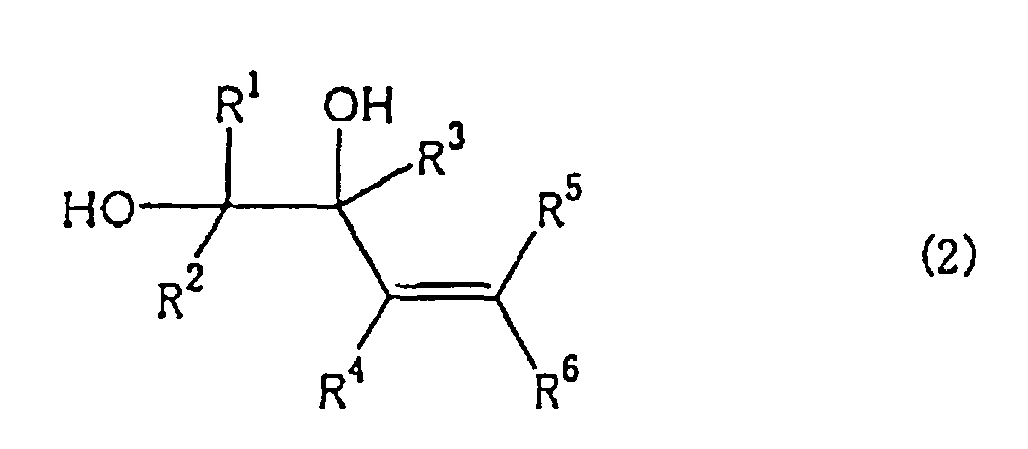
dans laquelle R1, R2, R3, R4, R5 et R6 sont identiques ou différents et représentent chacun indépendamment un atome d'hydrogène ; un groupe alkyle en C1-C20 qui peut être substitué avec un atome d'halogène, un groupe alcoxy en C1-C6, un groupe alcoxycarbonyle en C2-C7, un groupe aryle en C6-C10, ou un groupe carboxyle ; ou un groupe aryle en C6-C10 qui peut être substitué avec un atome d'halogène, un groupe alcoxy en C1-C6, un groupe aryle en C6-C10, ou un groupe carboxyle, lequel comprend la réaction d'un composé époxy insaturé représenté par la formule (1) :
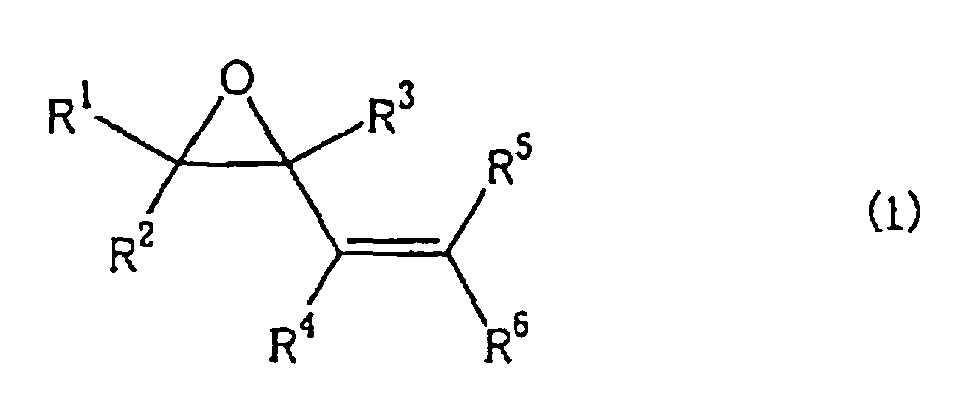
dans laquelle R1, R2, R3, R4, R5 et R6 sont identiques à ceux définis ci-dessus, avec de l'eau, en présence d'un silicate contenant au moins un élément choisi parmi un élément du groupe 5 et un élément du groupe 6 de la classification périodique des éléments, dans lequel le silicate contenant au moins un élément choisi parmi un élément du groupe 5 et un élément du groupe 6 de la classification périodique des éléments est un silicate contenant un métal obtenu par réaction d'un oxyde métallique, lequel est obtenu par réaction d'au moins un composé choisi parmi un métal du groupe 5 de la classification périodique des éléments, un métal du groupe 6 de la classification périodique des éléments, un composé contenant un élément du groupe 5 de la classification périodique des éléments et un composé contenant un élément du groupe 6 de la classification périodique des éléments, avec du peroxyde d'hydrogène, avec un composé de silicium en présence d'un modèle organique, dans lequel le modèle organique est une alkylamine, un sel d'ammonium quaternaire ou un tensioactif non ionique.
dans laquelle R1, R2, R3, R4, R5 et R6 sont identiques ou différents et représentent chacun indépendamment un atome d'hydrogène ; un groupe alkyle en C1-C20 qui peut être substitué avec un atome d'halogène, un groupe alcoxy en C1-C6, un groupe alcoxycarbonyle en C2-C7, un groupe aryle en C6-C10, ou un groupe carboxyle ; ou un groupe aryle en C6-C10 qui peut être substitué avec un atome d'halogène, un groupe alcoxy en C1-C6, un groupe aryle en C6-C10, ou un groupe carboxyle, lequel comprend la réaction d'un composé époxy insaturé représenté par la formule (1) :
dans laquelle R1, R2, R3, R4, R5 et R6 sont identiques à ceux définis ci-dessus, avec de l'eau, en présence d'un silicate contenant au moins un élément choisi parmi un élément du groupe 5 et un élément du groupe 6 de la classification périodique des éléments, dans lequel le silicate contenant au moins un élément choisi parmi un élément du groupe 5 et un élément du groupe 6 de la classification périodique des éléments est un silicate contenant un métal obtenu par réaction d'un oxyde métallique, lequel est obtenu par réaction d'au moins un composé choisi parmi un métal du groupe 5 de la classification périodique des éléments, un métal du groupe 6 de la classification périodique des éléments, un composé contenant un élément du groupe 5 de la classification périodique des éléments et un composé contenant un élément du groupe 6 de la classification périodique des éléments, avec du peroxyde d'hydrogène, avec un composé de silicium en présence d'un modèle organique, dans lequel le modèle organique est une alkylamine, un sel d'ammonium quaternaire ou un tensioactif non ionique.
2. Procédé selon la revendication 1, dans lequel le métal du groupe 5 de la classification
périodique des éléments, le métal du groupe 6 de la classification périodique des
éléments, le composé contenant un élément du groupe 5 de la classification périodique
des éléments et le composé contenant un élément du groupe 6 de la classification périodique
des éléments est le métal de tungstène, le métal de molybdène, le métal de vanadium,
un composé de tungstène, un composé de molybdène ou un composé de vanadium.
3. Procédé selon la revendication 1, dans lequel le composé époxy insaturé représenté
par la formule (1) est le 1,2-époxy-3-butène et le composé de diol vicinal insaturé
représenté par la formule (2) est le 3-butène-1,2-diol.
4. Procédé selon la revendication 1, dans lequel le silicate contenant un métal est un
silicate contenant un métal obtenu par séparation du produit de réaction du liquide
de réaction après l'achèvement de la réaction, et lavage ou calcination du produit
de réaction séparé.
5. Procédé selon la revendication 1, dans lequel le modèle organique est une alkylamine
ou un sel d'ammonium quaternaire.
REFERENCES CITED IN THE DESCRIPTION
This list of references cited by the applicant is for the reader's convenience only. It does not form part of the European patent document. Even though great care has been taken in compiling the references, errors or omissions cannot be excluded and the EPO disclaims all liability in this regard.
Patent documents cited in the description
- US5336815A [0002]
- US5250743A [0002]
- WO9115469A [0002]
- DE4429700 [0002]
- DE4429699 [0002]
- EP1473275A [0006]
- US4897498A [0034]
- US4950773A [0034]
Non-patent literature cited in the description
- Applied Catalysis A: General, 1999, vol. 179, 11- [0006]
- J. Chem. Soc., Chem. Commun., 1995, 2231- [0006]