|
(11) | EP 2 029 278 B1 |

| (12) | EUROPEAN PATENT SPECIFICATION |
|
|
| (54) |
COMPLEX OF RUTHENIUM, METHOD OF PRODUCTION THEREOF AND USE THEREOF AS (PRE)CATALYST OF THE METATHESIS REACTION KOMPLEX VON RUTHENIUM, HERSTELLUNSGVERFAHREN DAFÜR UND VERWENDUNG DAVON ALS (PRÄ)KATALYSATOREN DER METATHESEREAKTION COMPLEXE DE RUTHÉNIUM, SON PROCÉDÉ DE FABRICATION ET SON UTILISATION EN TANT QUE (PRÉ)CATALYSEUR DE LA RÉACTION DE MÉTATHÈSE |
|
|
|||||||||||||||||||||||||||||||
|
||||||||||||||||||||||||||||||||
| Note: Within nine months from the publication of the mention of the grant of the European patent, any person may give notice to the European Patent Office of opposition to the European patent granted. Notice of opposition shall be filed in a written reasoned statement. It shall not be deemed to have been filed until the opposition fee has been paid. (Art. 99(1) European Patent Convention). |
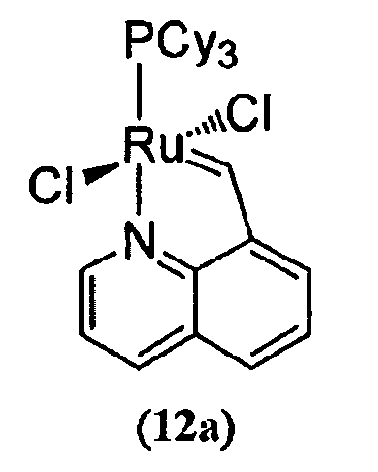
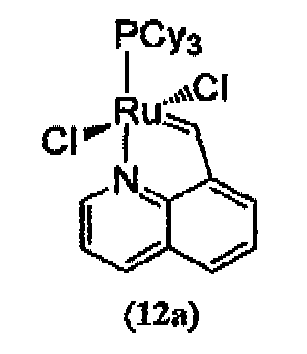
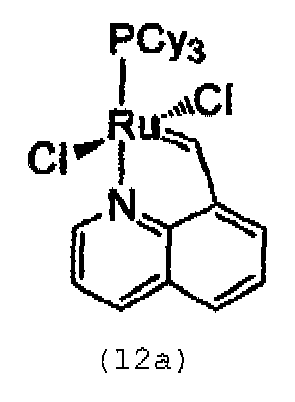
[0002] The invention also relates to the use of the compound of formula 12a, as (pre)catalyst in processes of metathesis.
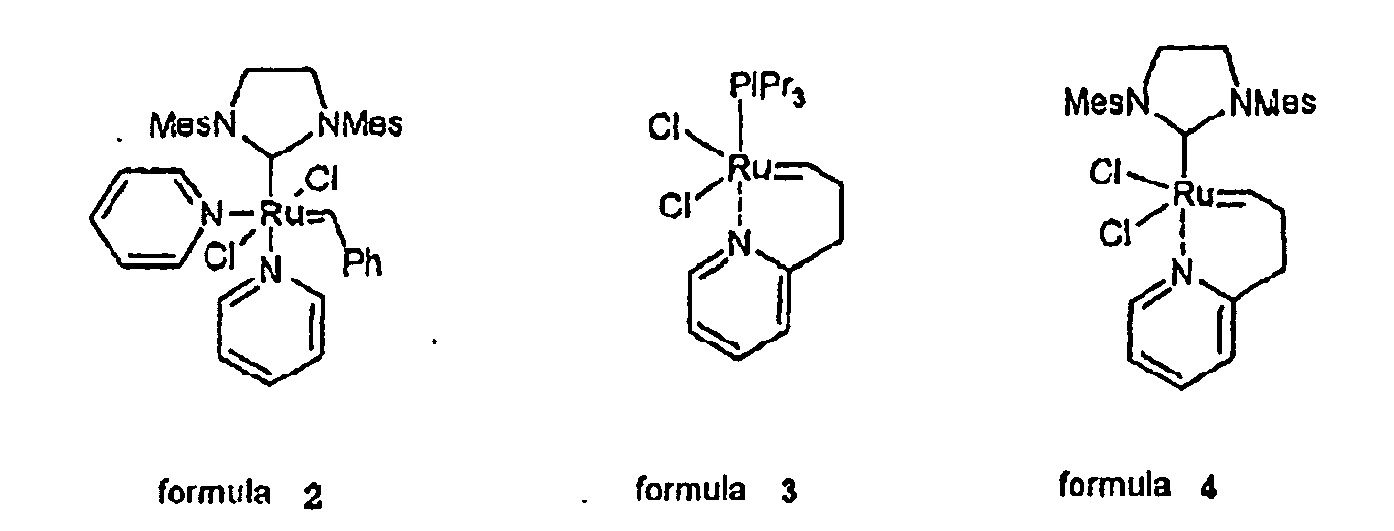
[0003] In applications of metathesis of olefins in organic synthesis, much progress has been achieved in recent years especially in the fields of organic chemistry and polymer chemistry. Practical applications, especially on an industrial scale, require these complexes to be stable for a prolonged time in conditions of elevated temperature and it should be possible to store, transport and use them without a protective gas atmosphere. Rapidly initiating (pre)catalysts, for example of formula 2, in which Mes denotes 2,4,6-trimethylphenyl, are often characterized by lower thermal stability. In addition, some metathesis reactions, especially polymerizations (ROMP, ADMET), are difficult to control in the case of rapidly initiating (pre)catalysts. For this reason it may be advantageous to use (pre)catalysts that are characterized by a lower rate of initiation of the metathesis reaction and that possess high thermal and chemical stability (Organometallics 2005, 24, 2255). This group of (pre)catalysts has found application in particular in polymer chemistry, as initiators permitting controlled polymerization. Representatives of such (pre)catalysts are the pyridine derivatives represented by formula 3, in which iPr denotes isopropyl (Journal of Organometallic Chemistry 2000, 606, 65) and 4 (Organometallics 2004, 23, 5399).
[0004] It was found, unexpectedly, that the novel complex of ruthenium according to the invention represented by formula 12a particularly advantageous as (pre)catalyst, it displays a low rate of initiation in ring-closure metathesis, and permits a controlled reaction of polymerization by ring opening, while displaying unusually high thermal stability and resistance to oxygen and moisture.
[0006] The method of production of the complex of ruthenium of formula 12a
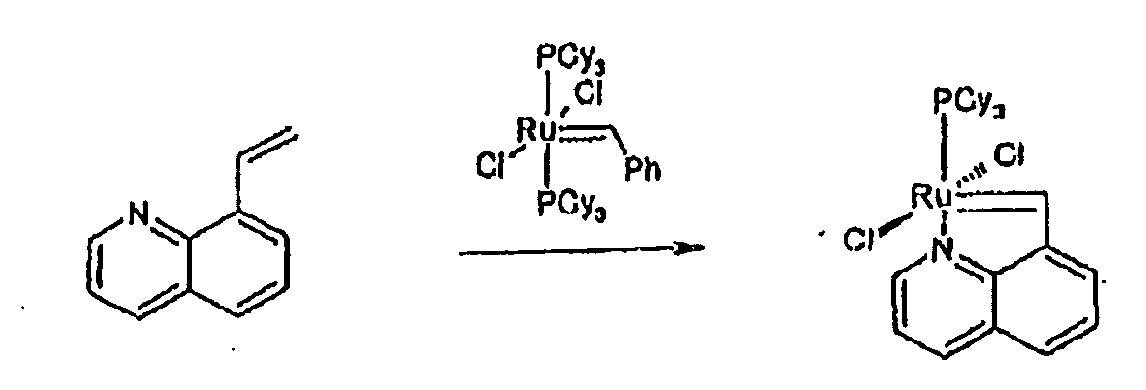
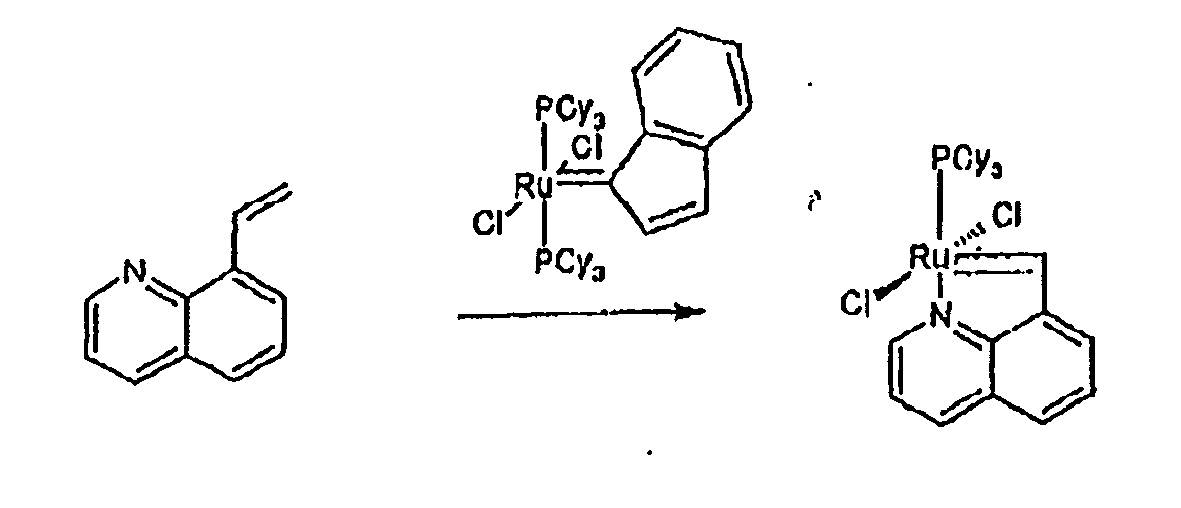
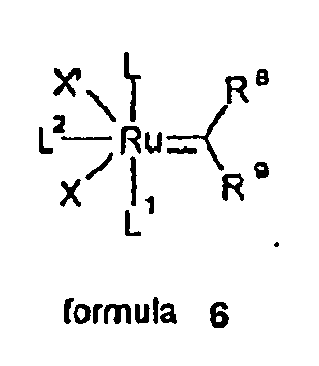
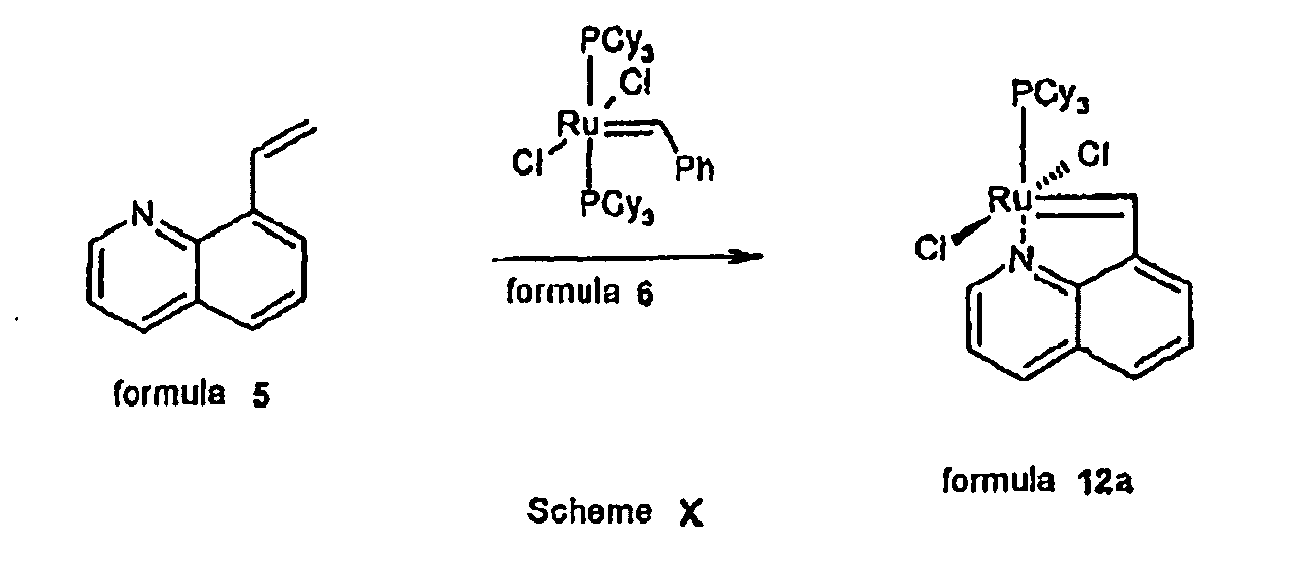
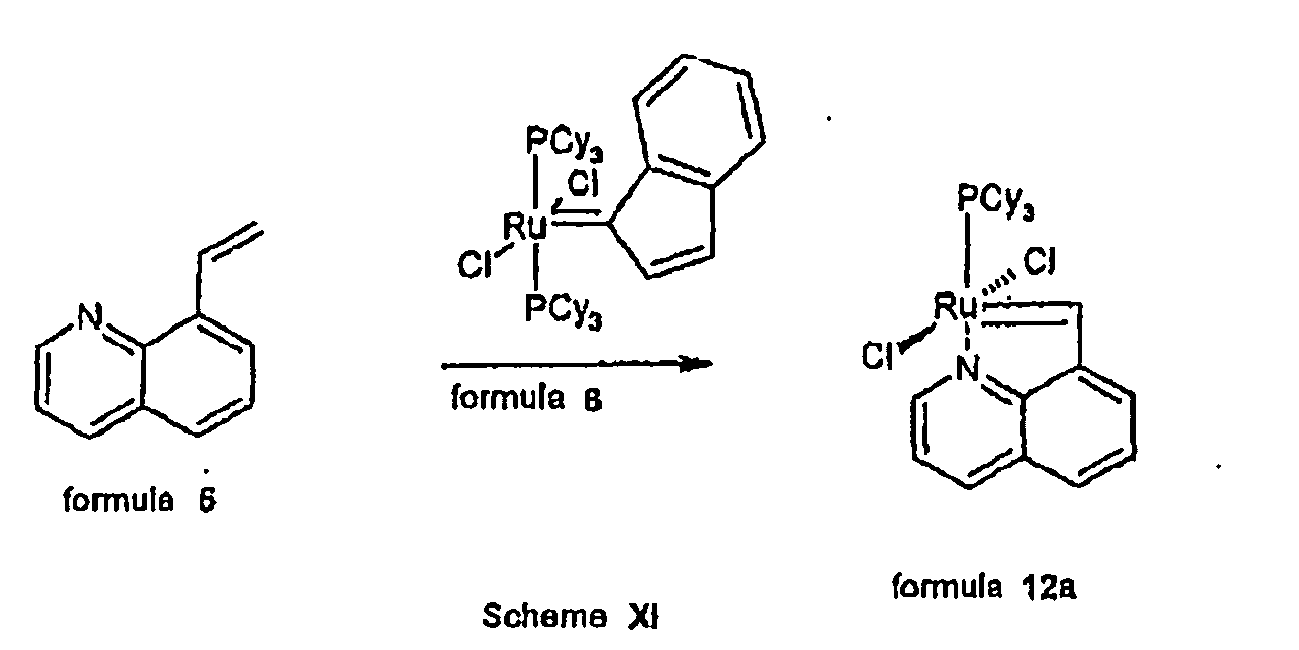
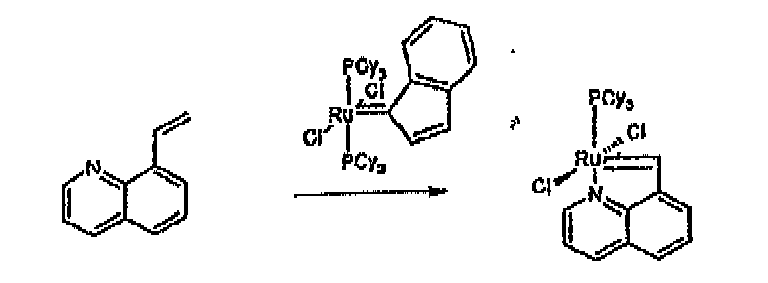
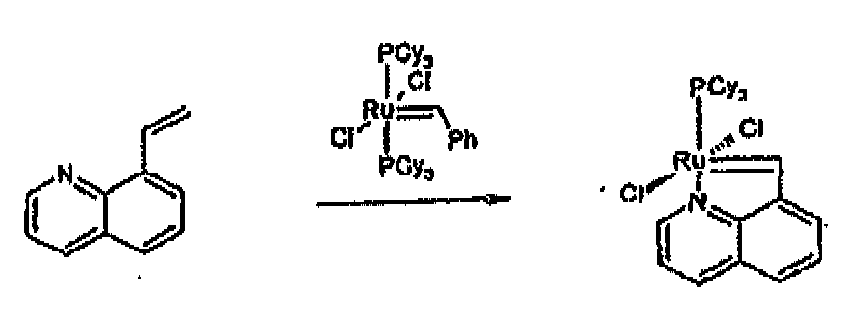
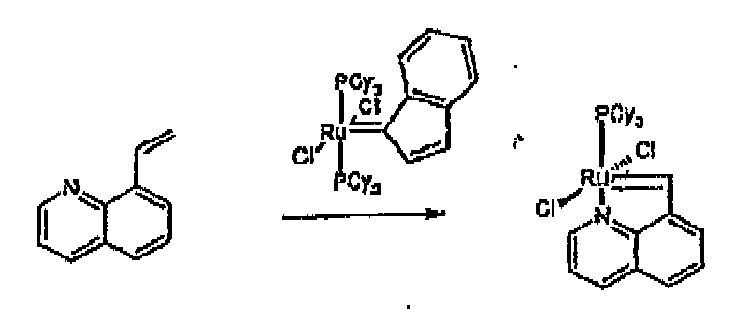
is based according to the invention on reacting an intermediate with formula 5, with a carbene complex of ruthenium of formula 6, according to schemes X and XI.
[0007] In the method according to the invention the compound of formula 12a is obtained as represented in Schemes X and XI in a reaction between an N-heterocyclic aromatic compound with formula 5 and a complex of ruthenium with formula 6, optionally in the presence of a copper(I) salt, preferably copper(I) chloride. The reaction is carried out in chlorinated solvents, or in aliphatic, cycloaliphatic and aromatic hydrocarbons, or in mixtures thereof, preferably in methylene chloride for a time from 1 min to 250 h at a temperature from 0 to 150°C.
[0008] The (Pre)catalyst of formula 12a according to the invention finds application in a wide range of metathesis reactions. It makes it possible to conduct reactions of ring-closure metathesis (RCM), and metathesis of the "alkene-alkyne" (ene-yne) type, but it finds particular application in reactions of ring-opening metathesis polymerization (ROMP). Unexpectedly, the novel (pre)catalyst of formula 12a described here proved to be slower initiators of RCM reactions than for example the comparable known (pre)catalyst of formula 3, while retaining good properties in the polymerization reaction.
Example VIII.
Production of compound 12a (Scheme X).
[0010] Using a protective atmosphere of argon, a Schlenk flask was charged with a solid carbene complex of formula 6, in which M denotes ruthenium, X and X' denote chlorine, L denotes absence of a ligand, L1 and L2 denote PCy3, and R10 denotes hydrogen and R11 phenyl (so-called Grubbs first-generation catalyst, 146.6 mg, 0.25 mmol), anhydrous CuCI (24.6 mg, 0.25 mmol), and dry deoxidized CH2Cl2 (5 ml) was added. Then a solution of compound 5 was added, in which R1 = R2 = R3 = R4 = R5 = R6 = R7 = H, and A denotes carbon, (34.1 mg, 0.23 mmol) in CH2Cl2 (5 ml). The suspension obtained was stirred at 35°C for 2 min. From this moment all subsequent operations were performed in air, without the need to use the protective atmosphere of argon. The reaction mixture was concentrated in an evaporator and the material obtained was fed to a short chromatography column packed with silica gel. The column was developed using pure ethyl acetate, collecting a green fraction. After evaporating the solvent and washing the residue with a small amount of a mixture of CH2Cl2 and cold n-pentane, complex 12a was obtained as a pale green, microcrystalline solid (83 mg, 70% yield). Rf = 0.40 (ethyl acetate).
Example IX.
Production of compound 12a (Scheme XI).
[0011] Using a protective atmosphere of argon, a Schlenk flask was charged with a solid carbene complex of formula 6, in which M denotes ruthenium, X and X' denote chlorine, L denotes absence of a ligand, L1 and L2 denote PCy3, and R10 and R11 denote an indenylidene residue (184.6 mg, 0.20 mmol), anhydrous CuCI (21.8 mg, 0.22 mmol), and dry deoxidized CH2Cl2 (5 ml) was added. Then a solution of compound 5 was added, in which R1 = R2 = R3 = R4 = R5 = R6 = R7 = H, and A denotes carbon, (34.1 mg, 0.22 mmol) in CH2Cl2 (5 ml). The suspension obtained was stirred at 35°C for 2 min. From this moment all subsequent operations were performed in air, without the need to use the protective atmosphere of argon. The reaction mixture was concentrated in an evaporator and the material obtained was fed to a short chromatography column packed with silica gel. The column was developed using pure ethyl acetate, collecting a green fraction. After evaporating the solvent and washing the residue with a small amount of a mixture of CH2Cl2 and cold n-pentane, complex 12a was obtained as a pale green, microcrystalline solid (84 mg, 70% yield). Rf = 0.40 (ethyl acetate).
1. Complex of ruthenium as (pre)catalyst of the metathesis reaction represented by the
formula
2. Method for preparing the ruthenium (pre)catalyst of claim 1 by reacting 8-ethenyl-quinoline
with a Ru carbene catalyst (so-called Grubbs first generation catalyst) according
to the following equation:
3. Method for preparing the ruthenium (pre)catalyst of claim 1 hy reacting 8-ethenyl-quinoline
with a Ru carbene catalyst comprising an indenylidene residue according to the following
equation:
4. Method according to claim 2. or 3, wherein the reaction is conducted in the presence
of a copper(I) salt, preferably copper(I) chloride.
5. Method according to any of claims 2 to 4, wherein the reaction is carried out in chlorinated
solvents or in aliphatic, cycloaliphatic or aromatic hydrocarbons or in mixtures thereof.
6. Use of the ruthenium (pre)catalyst according to claim 1 as initator for ring closing
metathesis (RCM).
7. Use of the ruthenium (pre)catalyst according to claim 1 as initiator for ring-opening
metathesis polymerisation (ROMP).
8. Use of the ruthenium (pre)catalysts according to claim 1 for metathesis of the "alkene-alkyne"
(ene-yne) type.
1. Rutheniumkomplex als (Prä)Katalysator der Metathesereaktion, wiedergegeben durch die
Formel
2. Verfahren zur Herstellung des Ruthenium-(Prä)Katalysators nach Anspruch 1 durch Umsetzung
von 8-Ethenylchinolin mit einem Ru-Carben-Katalysator (sogenannter Grubbs-Katalysator
der ersten Generation) gemäß der folgenden Gleichung:

3. Verfahren zur Herstellung des Ruthenium-(Prä)Katalysators nach Anspruch 1 durch Umsetzung
von 8-Ethenylchinolin mit einem Ru-Carben-Katalysator mit einem Indenylidenrest gemäß
der folgenden Gleichung:
4. Verfahren nach Anspruch 2 oder 3, brei dem man die Umsetzung in Gegenwart eines Kupfer(I)-Salzes,
vorzugsweise Kupfer(I)-chlorid, durchführt.
5. Verfahren nach einem der Ansprüche 2 bis 4, brei dem man die Umsetzung in chlorierten
Lösungsmitteln oder in aliphatischen, cycloaliphatischen oder aromatischen Kohlenwasserstoffen
oder in Mischungen davon durchführt.
6. Verwendung des Ruthenium-(Prä)Katalysators nach Anspruch 1 als Initiator für die Ringschlussmetathese
(ring closing metathesis, RCM).
7. Verwendung des Ruthenium-(Prä)Katalysators nach Anspruch 1 als Initiator für die Ringöffnungsmetathesepolymerisation
(ring opening metathesis polymerisation, ROMP).
8. Verwendung des Ruthenium-(Prä)Katalysators nach Anspruch 1 für die Metathese vom "Alken-Alkin"-Typ
(En-In-Typ).
1. Complexe de ruthénium en tant que (pré)catalyseur de la réaction de métathèse représenté
par la formule
2. Procédé pour préparer le (pré)catalyseur au ruthénium de la revendication 1 par réaction
de 8-éthényl-quinoléine avec un catalyseur à Ru-carbène (appelé catalyseur de première
génération de Grubbs) selon l'équation suivante :
3. Procédé pour préparer le (pré)catalyseur au ruthénium de la revendication 1 par réaction de 8-éthényl-quinoléine avec un catalyseur de Ru-carbène comprenant
un résidu indénylidène selon l'équation suivante :
4. Procédé selon la revendication 2, ou 3, dans lequel la réaction est conduite en présence
d'un sel de cuivre (I), de préférence le chlorure de cuivre (I).
5. Procédé selon l'une quelconque des revendications 2 to 4, dans lequel la réaction
est conduite dans des solvants chlorés ou dans des hydrocarbures aliphatiques, cycloaliphatiques
ou aromatiques ou dans des mélanges de ceux-ci.
6. Utilisation du (pré)catalyseur au ruthénium selon la revendication 1 en tant qu'initiateur
pour la métathèse par fermeture de cycle (RCM).
7. Utilisation du (pré)catalyseur au ruthénium selon la revendication 1 en tant qu'initiateur
pour la polymérisation par métathèse par ouverture de cycle (ROMP).
8. Utilisation des (pré)catalyseurs au ruthénium selon la revendication 1 pour la métathèse
du type « alcéne-alcyne » (ène-yne).
REFERENCES CITED IN THE DESCRIPTION
This list of references cited by the applicant is for the reader's convenience only. It does not form part of the European patent document. Even though great care has been taken in compiling the references, errors or omissions cannot be excluded and the EPO disclaims all liability in this regard.
Non-patent literature cited in the description
- Organometallics, 2005, vol. 24, 2255- [0003]
- Journal of Organometallic Chemistry, 2000, vol. 606, 65- [0003]
- Organometallics, 2004, vol. 23, 5399- [0003]