| (19) |
 |
|
(11) |
EP 1 810 315 B1 |
| (12) |
EUROPEAN PATENT SPECIFICATION |
| (45) |
Mention of the grant of the patent: |
|
03.12.2014 Bulletin 2014/49 |
| (22) |
Date of filing: 28.10.2005 |
|
| (51) |
International Patent Classification (IPC):
|
| (86) |
International application number: |
|
PCT/CA2005/001654 |
| (87) |
International publication number: |
|
WO 2006/045200 (04.05.2006 Gazette 2006/18) |
|
| (54) |
METHOD AND APPARATUS FOR SEPARATION OF ISOBARIC INTERFERENCES
VERFAHREN UND VORRICHTUNG ZUR TRENNUNG VON ISOBARISCHEN INTERFERENZEN
PROCEDE ET APPAREIL DE SEPARATION DES INTERFERENCES ISOBARIQUES
|
| (84) |
Designated Contracting States: |
|
AT BE BG CH CY CZ DE DK EE ES FI FR GB GR HU IE IS IT LI LT LU LV MC NL PL PT RO SE
SI SK TR |
| (30) |
Priority: |
28.10.2004 US 622617 P
|
| (43) |
Date of publication of application: |
|
25.07.2007 Bulletin 2007/30 |
| (73) |
Proprietors: |
|
- Litherland, Albert Edward
Toronto ON M4W 1P8 (CA)
- Doupe, Jonathan P.
Edmonton, Alberta T6G 0T1 (CA)
- Kieser, William Edward
Toronto ON M4C 2E1 (CA)
- Zhao, Xiao-Lei
Toronto ON M5T 3C2 (CA)
- Javahery, Gholamreza
Kettleby ON L0G 1J0 (CA)
- Cousins, Lisa
Woodbridge ON L4H 2A6 (CA)
- Tomski, Ilia
Concord ON L4K 5M4 (CA)
- Jolliffe, Charles
Schomberg ON L0G 1T0 (CA)
|
|
| (72) |
Inventors: |
|
- Litherland, Albert Edward
Toronto ON M4W 1P8 (CA)
- Doupe, Jonathan P.
Edmonton, Alberta T6G 0T1 (CA)
- Kieser, William Edward
Toronto ON M4C 2E1 (CA)
- Zhao, Xiao-Lei
Toronto ON M5T 3C2 (CA)
- Javahery, Gholamreza
Kettleby ON L0G 1J0 (CA)
- Cousins, Lisa
Woodbridge ON L4H 2A6 (CA)
- Tomski, Ilia
Concord ON L4K 5M4 (CA)
- Jolliffe, Charles
Schomberg ON L0G 1T0 (CA)
|
| (74) |
Representative: Dennemeyer & Associates S.A. |
|
55, rue des Bruyères
1274 Howald
1274 Howald (LU) |
| (56) |
References cited: :
WO-A1-01/01446
WO-A2-01/51917
US-A- 4 234 791
US-A- 5 783 823
US-A1- 2004 026 610
US-B1- 6 259 091
|
WO-A1-03/103007
GB-A- 2 129 607
US-A- 5 386 116
US-A- 6 140 638
US-B1- 6 259 091
|
|
| |
|
|
- ELMORE D. ET AL: 'Accelerator mass spectrometer for measurement of long-lived radioisotopes'
SCIENCE vol. 236, May 1987, pages 543 - 550, XP001031920
- DOUPE J P ET AL: "Isobar separation at low energy in accelerator mass spectrometry",
NUCLEAR INSTRUMENTS & METHODS IN PHYSICS RESEARCH, SECTION - B:BEAM INTERACTIONS WITH
MATERIALS AND ATOMS, ELSEVIER, AMSTERDAM, NL, vol. 223-224, 1 August 2004 (2004-08-01),
pages 323-327, XP004525910, ISSN: 0168-583X, DOI: 10.1016/J.NIMB.2004.04.064
- A. E. Litherland ET AL: "Mass spectrometry with accelerators", Mass Spectrometry Reviews,
vol. 30, no. 6, 23 December 2010 (2010-12-23), pages 1037-1072, XP055096124, ISSN:
0277-7037, DOI: 10.1002/mas.20311
|
|
| |
|
| Note: Within nine months from the publication of the mention of the grant of the European
patent, any person may give notice to the European Patent Office of opposition to
the European patent
granted. Notice of opposition shall be filed in a written reasoned statement. It shall
not be deemed to
have been filed until the opposition fee has been paid. (Art. 99(1) European Patent
Convention).
|
FIELD OF THE INVENTION
[0001] This invention relates to a method and apparatus for separation of rare stable or
radioactive isotopes from their atomic or molecular isobars in mass spectrometry,
and more particularly the present invention relates to a method of reducing the intensity
of the isobaric interference before accelerator mass spectrometry (AMS), and an accelerator
mass spectrometer which incorporates the method.
BACKGROUND OF THE INVENTION
[0002] A general problem in mass spectrometry is the interference caused by isobars, which
are atoms or molecules which have very nearly (substantially) the same mass as the
atom or molecule being analysed (the analyte). Such interferences occur in systems
which analyse cations (positively charge ions), anions (negatively charged ions) or
both.
[0003] Accelerator mass spectrometry (AMS) is the term often applied to a collection of
techniques, based upon the use of negative ions, a tandem accelerator and mass spectrometry,
that makes possible the measurement of isotopic ratios well below 10
-12. The methods have been described, for example,
U.S. Pat. No. 4,037,100 to K. H. Purser.;
A. E. Litherland, "Ultrasensitive Mass Spectrometry with Accelerators". Ann Rev Nucl.
and Particle Sci., 30, pages 437-473, (1980). A recent review of AMS techniques, as applied to measurements of the concentration
of long-lived isotopes, has been provided by
Elmore, D and Phillips, F. M., "Ultrasensitive Mass Spectrometry", Science, 296,543
(1987).
[0004] A central problem for AMS ultra-high sensitivity detection of rare stable or radioactive
atoms is that there is generally an atomic isobar that has substantially the same
mass as that of the rare atom to be analysed (analyte atom). Even though these isobars
have a different atomic number, and it might be expected they would be completely
eliminated by careful chemistry, the sensitivity of AMS is so great that residual
traces of the atomic isobars are often still present in the purified sample. Also,
because the mass differences between isobars is extremely small, high transmission
arrangements of dispersive electric and magnetic deflection fields seldom have the
dispersion needed to provide isobar separation. Thus, the wanted rare ions and the
isobaric background ions can pass unattenuated through the whole AMS system and into
the final detector.
[0005] An example of the use of such an isobar problem is the measurement of the long-lived
isotope
36Cl present in underground aquifers.
36Cl is introduced to the biosphere through spallation of
40Ar by cosmic rays and can be used to derive the time a sample of water has been away
from the surface. There are two stable isobars of the radioactive
36Cl atoms:
36Ar and
36S. Because it does not form negative ions
36Ar is not a problem. However,
36S is strongly electronegative and provides a troublesome background. Even after careful
chemical separation the background count rates from the
36S isobar may be many thousands per second compared to the wanted count rates of
35Cl of a few per second or less.
[0006] The procedure presently used for eliminating this background is to accelerate the
ions to an energy of at least 30 MeV and to use rate-of energy-loss methods (dE/dx
techniques), range methods, complete electron stripping or gas filled magnets to distinguish
individual
36Cl and
36S events. To realize such energies requires the use of expensive nuclear physics accelerators
operating at voltages between 6-10 million volts, with the larger voltage preferred
when the ratio of
36S/
36Cl is high. Such equipment is physically large, very expensive, is found only at major
nuclear facilities and requires the services of a large professional staff for operation
and maintenance. While isobar separation using these techniques is possible for lighter
analyte ions, for the heavier ions, isobaric backgrounds often establish a significant
limitation to ultimate detection limits.
[0007] A common and well-known use of accelerator mass spectrometry is analysis of small
quantities of carbon 14 for carbon-dating purposes. Although requiring only moderate
acceleration voltage for isobar removal, typically 500 kV- 3 MV,
14C AMS instruments are still large, complicated and expensive. Currently, important,
new applications of
14C analysis are being developed using these conventional AMS instruments. In particular,
drugs labelled with
14C tracers are dosed into human patients at very low levels of concentration, and are
analyzed by AMS to determine their metabolic fate. This technique is called microdosing
and is expected to have great impact on the approach to drug discovery and development.
[0008] Sputter ion sources are commonly used for AMS. They produce high current ion beams
at moderately high energy, typically 20-30 kV, with an ion energy spread of tens of
eV. Prior art approaches to isobaric separation for ion beams from near-thermal sources
separate isobars from much lower velocity incoming beams. These approaches do not
have the high sensitivity of AMS.
[0010] WO 03/103007 discloses an electron capture dissociation (ECD) system that is compatible with transmission
mass spectrometers. The system utilizes a low energy atmospheric pressure ion source,
conventional transfer optics with conventional ion energy reducing means, and conventional
collisional dissociation (CID) cell and high energy CID produced from a low energy
ion source. This document does not teach an apparatus or method according to the present
invention which enables the selective elimination of undesired isobaric interference
from the analyte before mass analysis and detection of ions.
[0011] An apparatus and method for separation of analyte ions from atomic or molecular isobar
ions is disclosed in
DOUPE J P ET AL: "Isobar separation at low energy in accelerator mass spectrometry",
NUCLEAR INSTRUMENTS & METHODS IN PHYSICS RESEARCH, SECTION - B:BEAM INTERACTIONS WITH
MATERIALS AND ATOMS, ELSEVIER, AMSTERDAM, NL, vol. 223-224, 1 August 2004 (2004-08-01),
pages 323-327, XP004525910, ISSN: 0168-583X, DOI: 10.1016/J.NIMB.2004.04.064. This document generally discusses the study of
low-energy isobar separation techniques that are compatible with AMS, and discloses
an apparatus for separation of analyte ions from atomic or molecular isobar ions,
comprising:
- a) a housing having an inlet and outlet, the inlet being for receiving a beam of ions
having an initial kinetic energy in the range of 10 keV to 100 keV;
- b) ion energy reducing means located downstream of said inlet in said housing being
configured for reducing and controlling the ion beam kinetic energy of said beam of
ions passing therethrough; and
- c) a reaction cell located downstream of said energy reducing means, said reaction
cell having an entrance for receiving said beam of ions, and an exit out of which
the beam of ions exits, said reaction cell containing a reactive gas, said reactive
gas and said pre-selected kinetic energy chosen to selectively separate analytes from
their isobaric interferences, by one of i) reacting said isobars present in the ion
beam thereby depleting the isobars with respect to the analyte ions in the ion beam
and ii) by reacting said analytes thereby shifting their mass-to-charge to a value
away from a mass-to-charge value of said isobar.
[0012] Thus, there exists a need for a device to separate isobaric interferences using higher
energy ion sources with few of the size, safety and cost disadvantages associated
with the conventional AMS separation techniques. Such a device and method also would
improve the sensitivity and usefulness of the mass spectrometer and have wide applicability
and higher sensitivity than conventional methods that are commonly available.
SUMMARY OF THE INVENTION
[0013] This invention relates to a method and apparatus for separation of rare stable or
radioactive analyte isotopes from their atomic or molecular isobars in mass spectrometry
(MS). This method and apparatus are also applicable to the case where the analyte
isotope is contained in a molecule which is selected for analysis by MS. In the present
invention, the approach taken to removing isobars utilizes a high transmission device
for decelerating ions in combination with low energy reactions, such as ion-molecule
reactions or near resonant electron transfer, in radiofrequency (RF) ion guides. The
isobar is selectively depleted by electron transfer, molecular fragmentation, or other
reactions between ions and gaseous targets in pressurized RF ion guides at low energies.
The energy is controlled in such a way as to prevent reaction of the radionuclide
of interest while inducing reactions with the undesired isobar interference. When
applied to AMS this technique allows substantial reductions in the necessary terminal
voltage of AMS spectrometers. The effect is to allow reductions in the size and cost
of AMS installations.
[0014] In one aspect of the invention there is provided a method for separation of analyte
ions from isobars, comprising the steps of:
- a) producing an ion beam containing analyte ions having initial kinetic energies in
the range of 100 eV to 100 keV;
- b) reducing and controlling the kinetic energy of said beam of ions selectively in
the transverse and axial directions from the initial kinetic energies in the range
of 100 eV to 100 keV to pre-selected kinetic energies on the order of electron volts;
and
- c) exposing the ion beam to a reactant gas chosen to selectively separate analytes
from their isobaric interferences, by one of i) reacting said isobars present in the
ion beam thereby depleting the isobars with respect to the analyte ions in the ion
beam and ii) by reacting said analytes thereby shifting their mass-to-charge to a
value away from a mass-to-charge value of said isobar; and
- d) detecting said analyte ions.
[0015] In another aspect of the invention there is provided an apparatus for separation
of analyte ions from atomic or molecular isobar ions, comprising:
- a) a housing having an inlet and outlet, the inlet being for receiving a beam of ions
having an initial kinetic energy in the range of 100 eV to 100 keV;
- b) ion energy reducing means located downstream of said inlet in said housing configured
for reducing and controlling the ion beam kinetic energy of said beam of ions passing
therethrough selectively in the transverse and axial directions from initial kinetic
energies in the range of 100 eV to 100 keV to pre-selected kinetic energies on the
order of electron volts; and
- c) a reaction cell located downstream of said energy reducing means, said reaction
cell having an entrance for receiving said beam of ions, and an exit out which the
beam of ions exits, said reaction cell containing a reactive gas chosen to selectively
separate analytes from their isobaric interferences, by one of i) reacting said isobars
present in the ion beam thereby depleting the isobars with respect to the analyte
ions in the ion beam and ii) by reacting said analytes thereby shifting their mass-to-charge
to a value away from a mass-to-charge value of said isobar.
[0016] The ion beam may contain radioactive isotope ions of
36Cl
- and its atomic isobar
36S
-, and wherein the reactive gas is NO
2 and the reaction is the separation of the rare
36Cl
- radioactive isotope from its
36S
- atomic isobar, and wherein the reaction is
36S
- + NO
2→
36S + NO
2-
for depleting the unwanted
36S
- atomic isobar from the analyte ion beam.
[0017] The ion beam containing the
14C analyte ions is produced by a compact microwave ion source. The cations of
14C may originate from pharmaceuticals labelled with
14C tracers are dosed into a human patient at very low levels of concentration in a
process of microdosing, said
14C being obtained from bodily fluids of the human patient.
BRIEF DESCRIPTION OF THE DRAWINGS
[0018] The method and apparatus to substantially reduce the intensity of the isobaric interference
in accelerator mass spectrometry (AMS) will now be described, by way of example only,
reference is made to the accompanying drawings, in which:
Figure 1 shows an apparatus for separating isotopes by reducing the intensity of isobaric
interference in accelerator mass spectrometry (AMS); and
Figure 2 shows an apparatus for separating isotopes by reducing the intensity of isobaric
interference from high energy ion sources, using an ordinary quadrupole mass spectrometer
analyzer downstream from the separator, followed by a suitable low dark current detector.
DETAILED DESCRIPTION OF THE INVENTION
[0019] As used herein the phrase "analyte ions" means ions of interest to be analysed using
the method and apparatus of the present invention.
[0020] As used herein the phrase "isobar ions" or "isobaric interferences" refers to atoms
or molecules which have very nearly (substantially) the same mass as the atom or molecule
being analysed (the analyte).
[0021] As used herein the phrase "ion beam kinetic energy" means the approximate average
value of the kinetic energy of an ensemble of ions within the ion beam containing
the analyte ions being analysed.
[0022] The present disclosure describes a method and apparatus to substantially reduce the
intensity of the isobaric interference while providing high transmission of the desired
analyte ion. Application of the technique to mass spectrometry increases the sensitivity
for the detection of the analyte ions. Its application to accelerator mass spectrometry
also allows substantial reductions in the necessary terminal voltage of AMS spectrometers.
The effect will be to allow reductions in the size and cost of AMS installations.
[0023] In the present invention, the method disclosed herein for removing isobars utilizes
a high transmission device for decelerating ions in combination with low energy reactions,
such as ion-molecule reactions or near resonant electron transfer in RF ion guides
pressurized with reactive gas. The ion beam is first decelerated and thermalized (typically
to near 300K) using a combination of electrostatic lenses and RF ion guides. The isobaric
interference is selectively removed by reactions between ions and gaseous targets
in pressurized RF ion guides. The reaction energy is carefully controlled by selecting
the appropriate ion beam kinetic energy in such a way as to separate an isobaric interference
from the analyte. This can be accomplished by preventing reaction of the analyte ion
in a reaction cell, while inducing reactions with the undesired isobaric interference,
depleting the concentration of the isobaric interference. It can also be accomplished
by selectively reacting the analyte in a reaction cell, in such a way that the product
of the reaction has a molecular mass-to-charge value substantially different from
the isobaric interference. This approach can be incorporated into a smaller AMS system
or another MS system with a suitable low dark current detector at a greatly reduced
equipment size, cost and complexity, and it may be possible to build instrumentation
with much lower voltage requirements, making it possible to use AMS in laboratories
with substantially less expense.
[0024] Specifically, an intense ion beam formed by a high current ion source is generated
and accelerated to high axial kinetic energy, typically 20-30kV. Here axial kinetic
energy refers to the value ½ mv
z2 where m is the ion mass, v
z is the ion velocity along the ion beam axis and z is the direction of the ion beam
axis. Due to the nature of the mechanism of ion beam formation, the ion beam also
acquires a substantial distribution in ion beam kinetic energy in all directions x,
y and z where x and y are the directions transverse to the axis. For a cesium ion
sputtering source, for example, the distribution in the ion beam kinetic energy tends
to be large, on average on the order of 30eV, with a large tail out to 100V.
[0025] After acceleration, the intense ion beam may be directed through an energy analyser
to select ions in with a narrow band of energies. The beam is then passed through
a mass selector. This mass selector removes large quantities of the abundant isotopes
from the analyte ion beam. The large axial kinetic energy and the large distribution
of energies in the axial and transverse directions are then reduced to well-known
and controlled values in order to selectively induce the ion reaction that removes
the undesired isobaric interference from the desired analyte ion beam.
[0026] Ions are axially decelerated using a combination of electrostatic lenses, vacuum
RF ion guides and pressurized RF ion guides. RF ion guides serve to contain the ions
by causing them to oscillate about the ion guide axis. The electrostatic lenses provide
the initial deceleration, on the order of tens of thousands of volts. The vacuum RF
ion guide provides an RF containment field for the decelerated ions, and can be configured
in such a way as to provide secondary deceleration, providing a kinetic energy reduction
typically on the order of several kilo electron volts (keV). A subsequent RF ion guide,
pressurized with non-reactive gas, positioned downstream from the vacuum RF ion guide,
may be utilized to further reduce the ion beam kinetic energy. Here the axial and
transverse kinetic energy of the ions, as well as their internal energy, may be reduced
further via energy transfer collisions with the non-reactive buffer gas to near thermal
energy (typically at 300K, although other temperatures may be used). Therefore the
large distribution in kinetic energy of the initial beam can be reduced to very low
values (on the order of kT, where k is the Boltzmann constant, and T is the ambient
temperature), and the axial energy of the beam is well-controlled. By application
of appropriate DC voltages to the ion guides, the kinetic energy of the ions as they
exit the ion guide can be very carefully controlled.
[0027] This combination of electrostatic lenses and RF ion guides generates a series of
stepwise drops in ion beam kinetic energy that yields minimum losses due to beam divergence,
and therefore maximum transmission. This approach is particularly important for the
deceleration and reaction of fragile ions, such as negative ions which typically have
binding energies less than ten eV and therefore are susceptible to electron loss via
energetic collisions with non-reactive buffer gas, or molecular ions that can readily
fragment at higher energies.
[0028] Once decelerated, the ion beam (containing analyte ions and their isobaric interferences),
is transferred into a reaction cell where the ions come into contact with pre-selected
reactant gas. A reaction is selectively induced on the basis of the ion kinetic or
internal energy, in order to remove the isobaric interference. Such reactions may
include ion/neutral, (i.e., ion/molecule, ion/atom), including charge transfer, charge
stripping, associative detachment, association, and collision-induced dissociation.
As discussed later in more detail, precursor reactants may be incorporated in order
to enhance the reaction, including, for example, electrons, ions, photons or positrons.
In such an embodiment, the reaction may further include ion/ion reactions, ion/electron
reactions and ion/positron reactions.
[0029] After the selective separation of substantially all of the undesired isobaric interference
from the analyte in the reaction cell, ions may then be mass analysed and detected
in a suitable low dark current detector, or re-accelerated to complete their analysis
in an AMS system
[0030] In this way, a technique is developed for the separation of rare radioactive isotopes
from their isobars. More specifically, one such technique is the separation of the
rare
36Cl
- radioactive isotope from its
36S
- atomic isobar. Early work by Ferguson and co-workers serendipitously demonstrated
that it is possible to selectively deplete S-over Cl
- in the presence of NO
2 (
Dunkin, D.B., Fehsenfeld, F.C., Ferguson, E.E., Chem. Phys. Lett. 15 257 (1972));
Fehsenfeld, F.C. and Fergusen, E.E. Plane. Space Sci. 16 701 (1968)). Both ions undergo charge transfer with NO
2 gas, but at different rates. The reactions are:
S
- + NO
2→ S + NO
2- (1)
Cl
- + NO
2→ Cl + NO
2- (2)
The reaction (2) for Cl
- with NO
2 has a rate constant of < 6 x 10
-12 cm
3/s (endothermic by 1.34eV) whereas the reaction (1) of S- with NO
2 is 1.3 x 10
-9 cm
3/s (exothermic by 0.2eV). Therefore, by careful control and adjustment of the kinetic
energy of the ions, it is possible to selectively react S
- while remaining above the threshold for reaction of Cl
-. By substantially reducing the spread in kinetic energy of the ions within the beam,
it is possible to selectively deplete unwanted isobars with high efficiency, while
preserving high transmission of the analyte beam.
[0031] Another such technique is the separation of
14C from isobaric interferences. For example,
14C cations (
14C+) may be generated by a compact microwave source, and may be separated from an ion
beam containing the isobaric interferences
14N
+,
12CH
2+ and
13CH
+ using hydrogen as the reactant gas in the apparatus described in the first example.
These isobars are eliminated by the following processes:
14N
+ + H
2 →
14NH
+ + H (fast reaction rate: 10
-9 cm3ls)
13CH
+ + H
2 →
13CH
2+ + H (fast reaction rate: 10
-9 cm3/
s)
12CH
2+ + H
2 →
12CH
3+ + H (fast reaction rate: 10
-9 cm3/
s)
(see
J. B. Marquette, C. Rebrion and B. R. Rowe, Reactions of N+(3P) ions with normal,
para and deuterated hydrogens at low temperatures, J. Chem. Phys. 89(4) (1988) 2041
- 2047. and
D. C. Clary, C. E. Dateo and D. Smith, Rates for the reactions of open-shell ions
with molecules, in Chemical Physics Letters 167(1,2) (1990) 1 - 6) whereas the equivalent reaction with the analyte ions (
14C
+)
14C
+ + H
2 →
14CH
2+ + (very slow reaction rate: 10
-16 cm3/
s)
is seven orders of magnitude slower and would allow most of the analyte ions to pass
unattenuated through the reaction cell.
[0032] This technique can be generalized to a range of analytes and their isobars. In addition
to
36Cl and
14C analysis, for example, a similar reaction cell approach will have applications to
the measurement of other rare analytes, including molecular ions.
[0033] Such an example is that of strongly bound super-halides (MX
n-). BeF
3- and CaF
3- have high F
- and electron binding energies, while by comparison the isobaric ions BF
3- and KF
3- are very weakly bound. Consequently the rare radioactive isotopes
10Be and
41Ca can be separated from the stable isotopes
10B and
41K using selective fragmentation of the weakly bound ion in a reaction cell. Other
residual anions, also containing
10B and
41K, will in general also be destroyed in the reaction cell, thereby making the detection
of low levels of
10Be and
41Ca possible with small AMS accelerators. Selective reactions of other super-anions
such as MO
n- are also possible.
[0034] Referring to Figure 1, an accelerator mass spectrometer incorporating an isobar separator
according to the present invention is shown generally at 60. The accelerator mass
spectrometer 60 includes an ion source 10 which initially accelerates ions from the
ion source to an energy E
o (typically between 5 kV and 40 kV); a magnetic filter 12 downstream of source 10
for preferentially selecting ions having a preset mass number (mass/charge) among
those ions generated by ion source 10, a set of off-axis Faraday cups 14 to intercept
the beams of the abundant isotopes (e.g.
35Cl and
37Cl) and to measure their currents, and a set of horizontal and a vertical steerer
plates 16 for minor lateral and vertical adjustment of the beam position. The Faraday
cups 14, steerer plates 16 and the following components labelled 24 through to 44
are located inside a vacuum enclosure, the housing of which is generally indicated
as 18, which is pumped by high vacuum pump 15. If an excessive number of abundant
isotopes, from tails in their energy distribution, are present in the desired analyte
ion beam, an electric analyser (not shown) to select mono-energetic beams may be added
between source 10 and magnet 12. The vacuum within housing 47 is pumped by high volume
vacuum pumps 48, connected to the housing 47 through electrically insulating pipes,
to minimize the residual gas pressure in the housing and so reduce unwanted scattering
of the ion beam.
[0035] The above described components are standard for accelerator mass spectrometers which
are instruments that are commercially available from manufacturers such as High Voltage
Engineering Europa B.V, Amersfoort, the Netherlands or National Electrostatics Corp.,
Madison Wisconsin.
[0036] The description of the modifications to mass spectrometers to effect the present
invention, including standard accelerator mass spectrometers, hereinafter known as
the isobar selector, shown generally at 70 in Figure 1, is described hereinafter.
[0037] Isobar selector 70 includes a gap lens 20, with appropriate electrostatic potentials
applied, is located in housing 47 downstream of steerer plates 16 and includes a conically-shaped
electrode with sides 54 and 56 extending into the interior of housing 47. Gap lens
20 serves two purposes, the first being to reduce the axial kinetic energy of the
ions from E
o provided by the ion source 10 (to several hundreds of eV (E
1), and the second purpose being to focus the ions, by means of its conically shaped
electrodes 54/56, so that ions decelerated across its potential are focussed towards
the principal axis 22 and are prepared for injection into the following downstream
stage. Gap lens 20 may be comprised of one or more lens electrodes. Gap lens 20 may
be pumped through vacuum housing 18 by pump 15 and through housing 47 by pumps 48
or additional pumping may be used.
[0038] Isobar selector 70 also includes a decelerating RF ion guide 24 which is located
downstream of gap lens 20. The purpose of ion guide 24 is to reduce the ion axial
kinetic energy from E
1, as resulting from the energy reduction by the gap lens 20, to several electron volts
(E
2). Exemplary ion guide 24 is comprised of 4, 6, 8 or more even number of rods (or
poles) 25, symmetrically positioned about axis 22, to which electrostatic DC and RF
potential is applied, with RF of alternating phase applied to adjacent rods, and includes
one or more segments 26, formed by the electrode poles being segmented, each segment
26 being electrically isolated from the other segments. One or more-segments 26 of
guide 24 can be set to a different electrostatic DC potential in order to form a decelerating
axial electrical field for decelerating ions travelling through guide 24 axially in
the downstream direction along axis 22. While the set of DC potentials provides a
decelerating field in the axial direction, the RF field generated by guide 24 provides
the necessary ion confining potential field, whereby ions may oscillate about the
axis 22 along the center of the segmented ion guide 24. Although a segmented multipole
RF ion guide 24 is illustrated in Figure 1, it is just only one possible embodiment,
in addition, other configurations or geometries are possible, so long as a net decelerating
axial field is produced along the axis.
[0039] Isobar selector 70 also includes a cooler 28 which is preferably (but not necessarily)
a pressurized cell containing a non-reactive gas in which interactions with the ion
beam in the pressurized cell preferably lead to thermalization of the ion energies.
In addition to containing a non-reactive gas, cooler 28 is comprised of a segmented
multipole RF ion guide including an even number of 4, 6, 8 or more rods 30 each of
which includes one or more segments 32 each electrically isolated from all other segments
32 in the rod 30. Rods 30 are symmetrically positioned about axis 22, to which RF
potential is applied as ion guide 24, and to which electrostatic DC potential is provided
to segments 32 to define the reference potential of the ions in the ion beam, and
to further control the ion beam kinetic energy.
[0040] The cooler 28 is comprised of rods 30 enclosed in an enclosure 34 in such a way as
to contain the non-reactive gas. Non-reactive gas is delivered to cooler 28 through
an inlet connected to the enclosure 34. In order to confine the non-reactive gas inside
cooler 28, rods 30 are housed in the enclosure 34 confined by aperture plates 27 and
29 electrically isolated from enclosure 34, to which appropriate potentials are applied.
Apertures in plates 27 and 29 are sufficiently small to prohibit most of the non-reactive
gas from leaving enclosure 34. Aperture plates 27 and 29 are located at the ends of
enclosure 34 aligned along axis 22 of housing 47 for ions to enter and exit RF ion
guide 28. The pressure range in enclosure 34 is typically on the order of 1 to 100
mTorr,
[0041] As ions leave guide 24 they have an axial kinetic energy on the order of several
to tens of electron volts. The distribution of ion kinetic energy in the transverse
and axial directions also may be of the order of tens of electron volts. The general
purpose of cooler 28 is to confine ions within the RF field while permitting ions
to collide with the non-reactive buffer gas contained within the cooler to further
reduce the total kinetic energy of the ions to near thermal energy (on the order of
3/2kT, where k is the Boltzmann constant and T is the ambient temperature, typically
at 300K). As ions collide with a non-reactive gas they transfer energy to the generally
non-reactive gas and lose their kinetic energy until they come to a thermal equilibrium.
Examples of non-reactive gas that may be used include noble gases such as argon, helium,
xenon, etc., as well as highly stable diatomic molecules such as N
2, and stable polyatomic molecules such as SF
6 and the like. This reduction in ion energy due to collisions in RF fields as been
well documented in Paul traps (Douglas and French, United States Patent No.
4,963,736 ;
R.E. March and J.F.J. Todd (Eds. ), 1995, Practical Aspects of Ion Trap Mass Spectrometry:
Fundamentals, Modern Mass Spectrometry Series, vol. 1. (Boca Raton, FL: CRC Press)).
[0042] In some cases it is desirable to control the kinetic energy of the ions inside the
cooler 28, as well as the ion transmission through cooler 28. This can be done by
setting two or more segments 32 of cooler 28 to a different electrostatic DC potential
in order to form an accelerating electrical field to accelerate ions travelling through
cooler 28 axially in the downstream direction along axis 22.
[0043] Exemplary isobar selector 70 also includes a reaction cell 36 located downstream
of cooler 28. Reaction cell 36 is a pressurized cell, the main purpose of which is
to confine and transmit ions efficiently while permitting the ions to interact with
the reactive gas, in order to induce reactions that separate unwanted isobaric interferences
from the analyte. Reaction cell 36 preferably includes a segmented multipole RF ion
guide comprised of an even number of 4, 6, 8 or more rods 38, each rod including one
or more segments 40 which is housed inside enclosure 42, with DC and RF voltages applied
to rods 38 in a manner similar to cooler 28.
[0044] In order to confine the reactive gas inside reaction cell 36, rods 38 are housed
in the enclosure 42 in a manner similar to rods 30 in enclosure 34, using aperture
plates 37 and 39 that are electrically isolated from enclosure 34 and to which appropriate
potentials are applied. Apertures plates 37 and 39 are located at the entrance and
exit apertures of enclosure 42 aligned along axis 22.
[0045] Reactive gas is introduced to reaction cell 36 through an inlet connected to the
enclosure 42. As reactive gas leaks out of reaction cell 36 through its entrance and
exit apertures in plates 37 and 39, it is then pumped away immediately by pump 48.
The pressure range here is also typically within 1 to 100 mTorr although higher or
lower pressures may be used, depending on the nature of the reaction. The reactive
gas may consist of NO
2 or a combination of buffer gas and reactive gas for selective transmission of
36Cl, or less specifically, any reactive gas that yields an appropriate reaction rate.
[0046] While such an enclosure 34 or 42 is cost-effective, other configurations are possible,
for example rods 30 or 38 may be arranged and constructed in such a way as to be conductance
limiting, reducing the need for apertures.
[0047] Now, turning specifically to the reaction in reaction cell 36, the thermalized ion
beam enters reaction cell 36 with a pre-selected ion beam kinetic energy specific
to a particular reaction. For example, in the above example of
S
- + NO
2→ S + NO
2- (1)
Cl
- + NO
2→ Cl + NO
2- (2)
the two reactions (1) and (2) are very different. Reaction (1), exothermic by about
0.2 eV, occurs via a near-resonant charge transfer mechanism, and very little excess
relative kinetic energy of collision partners S
- and NO
2 is required for reaction to occur. Reaction (2), endothermic by about 1.34 eV, undergoes
non-resonant charge transfer requiring a relative kinetic energy of collision partners
Cl- and NO
2 near or above 1.34 eV.
[0048] Thus, in order to selectively deplete the sulphur anion, the relative kinetic energy
is controlled such that sulphur and chlorine anions enter reaction cell 36 with relative
kinetic energy substantially less than 1.3 eV, preferably less than 0.5 eV. Other
reactions may vary by more or less energy.
[0049] The total kinetic energy of an ion of mass, velocity
mi, V/ and of gaseous species of mass, velocity
mg, vg is

[0050] Cast in terms of relative kinetic energy and centre-of-mass energy yields:

where

and the centre-of-mass velocity is

[0051] Thus the relative kinetic energy available for reaction can be controlled by controlling
the kinetic energy of the ion and the gas in the reaction cell 36.
For the example above, the gaseous NO
2 is held near 300 °C, and is nearly at rest relative to the incoming ion beam. The
kinetic energy of the ion entering reaction cell 36 is controlled by controlling the
electrostatic DC potential difference of the rods 30 of cooler 28 and rods 38 of reaction
cell 36. Specifically, ions enter reaction cell 36 with an axial kinetic energy defined
by an electrostatic DC potential difference between segments 32 of cooler 28 and segments
40 of reaction cell 36, and with a thermal kinetic energy distribution approximately
determined by the ambient temperature of the non-reactive gas of cooler 28.
[0052] For example if the electrostatic DC potential on rods 30 is E
1 and the electrostatic potential on rods 38 is E
2, the lab frame kinetic energy of ions of single charge (z=1) in an ion beam is roughly
(E
1 - E
2) eV (more generally for ions of n charge, z=n, the lab frame kinetic energy is n
x (E
1-E
2)). In this way the relative kinetic energy may be tuned precisely to permit optimum
selectivity. In some cases, minor variations in the kinetic energy may have a large
impact, for example selecting reactions that vary by only a small difference in endothermicity.
Therefore it may be useful to stepwise ramp the ion energy over a range, or in advance
to calibrate the lab frame collision energy to the reaction of interest.
[0053] Control of the ion beam kinetic energy inside the reaction cell 36, as well as the
ion transmission through reaction cell 36 can be done by setting one or more segments
40 of rods 38 to a different electrostatic potential in also a similar way as described
above for the segments 26 of rods 25 in guide 24. This provides additional means to
heating, for example to add internal energy to reactants prior to reaction.
[0054] The entrance and exit aperture plates 27, 29, 37 and 39 of enclosure 34, cooler 28
and enclosure 42 of reaction cell 36 may serve as entrance and exit lenses. These
lenses may be used for optimising ion transmission efficiency through cooler 28 and
reaction cell 36.
[0055] Optionally, a time-varying potential may be applied to aperture plates 27, 29, 37
or 39 to provide a temporary repelling potential at the entrance and exit, in order
to trap ions temporarily within enclosure 34 or 42. Optionally, time varying potentials
also may be applied to one or more segments 32 of rods 30 in cooler 28 or to the segments
40 of rods 38 in reaction cell 36 to provide a temporary repelling potential within
enclosure 34 or 42. Such electrostatic trapping of ions in ion guides is common in
the art, and provides control of the residence time within an ion guide, for purposes
including: enabling further control of the reaction time, or further manipulation
of ions in the ion beam, for example in conjunction with additional mass-selective
excitation means, or providing a pulsed ion beam at the exit.
[0056] For example a time-varying potential may be set on lens 37 and lens 39 to provide
time to mass-selectively excite an ion in reaction cell 36. At first a potential may
be applied to permit ions to enter enclosure 42 for a period of time, τ
1. Then a potential is applied provide a repulsive electric field to decelerate or
trap ions temporarily within enclosure 34 for a time τ
2. During this time excitation methods, including mass-selective heating, mass selective
ejection, or the like may be applied. Finally the potential may be set on lens 39
to accelerate ions toward, and then eject ions out, the exit of enclosure 34. The
time-varying potential on plates 27 and 29 of cooler 28 can be synchronized to the
time-varying potential on plates 37 and 39 of reaction cell 36, for example to provide
maximum duty cycle.
[0057] Mass-selective excitation means using quadrupole RF ion guides are common in the
art, including application of auxiliary frequencies in order to resonantly excite
or eject ions of specific mass-to-charge ratio, or application of resolving DC potentials,
and the like (
Dawson P H (ed), Quadrupole Mass Spectrometry and Its Applications (American Institute
of Physics Press, Woodbury, NY, 1995). These may be applied to rods 30 in cooler 28 or rods 38 in reaction cell 36and
provides benefits that include but are not restricted to mass-selective ejection,
mass-selective collision-induced dissociation, or mass-selective RF heating, with
or without the electrostatic trapping of the ions in cooler 28 or reaction cell 36,
although trapping the ions is often preferable for best control of the residence time.
[0058] An additional ion guiding device 35 may be positioned between ion cooler 28 and reaction
cell 36 to permit additional pumping between cooler 28 and reaction cell 36, shown
preferably as a supplementary RF ion guide in Figure 1., but it may also comprise
a set of one or more electrostatic lenses.
Exemplary isobar selector 70 may also include a mass selector (separator) 44. An ion
beam exiting reaction cell 36 may still contain potentially harmful ions formed after
the first mass analyzer, in any of the components downstream from the analyser, including
reaction cell 36, which may generate further interferences downstream of selector
70. Mass selector 44 filters ions of preset mass number and directs them to the following
gap electrode 46 downstream of selector 44, where typically a pre-selected mass range
is transmitted. Thus, molecular ions, such as hydrides, that could react downstream
and disadvantageously form isobaric interferences, will be selected out.
[0059] Mass selector 44 provides selective transmission preferably by means of auxiliary
excitation in a quadrupole RF ion guide, or RF/DC resolving quad rupole, although
other forms of mass selective filters are possible. The theory of the mass selection
in quadrupole RF ion guides is well known and such devices are widely used in practice
(
Dawson P H (ed), Quadrupole Mass Spectrometry and Its Applications (American Institute
of Physics Press, Woodbury, NY 1995). The principle of operation of these mass selectors is based on motion of charged
particles in a quadrupolar field. This ion motion can be either stable or unstable
based on several parameters, including the mass-to-charge ratio (m./z) of the ion,
and the amplitudes of applied RF and DC voltages. For some applications, no further
mass selection may be required after this stage.
[0060] RF ion guide 24, cooler 28, ion guiding device 35, reaction cell 36, and mass selector
44 are enclosed in vacuum housing 47 pumped by vacuum pumps 48, to obtain a pressure
near 1-10x10
-5Torr. Higher pressures are possible if additional pumping is used downstream and upstream
of selector 70.
[0061] It will be obvious to those skilled in the art that the multipole RF ion guide geometry
in segmented ion guide 24, cooler 28, reaction cell 36 and mass selector 44 may be
varied from that illustrated in Figure 1, while providing a similar function. For
example, the rods of the multipole RF ion guides may not be straight, but instead
tilted or offset, in cases where steering the beam slightly toward a secondary axis
may be advantageous. Each segment 26 of the rods 25 of segmented ion guide 24, and
each segment 32 of the rods 30 of the segmented ion guide in cooler 28 may also have
a different RF voltage level V applied thereto, to select the confinement potential,
proportional to V
2, for different segments.
[0062] Although guide 24; cooler 28 and reaction cell 36 include segmented multipole RF
ion guides as preferred embodiments, it will be appreciated by those skilled in the
art that other geometries or configu rations are possible that similarly contain ions
in an RF field. For example, RF ion guides including a series of ring electrodes to
which RF and DC voltages are applied, may be used. Ion funnels, comprised of a series
of aperture plates of increasingly smaller internal diameter, may be used. A series
of discs, rather than segments, arranged about an axis with applied alternating RF,
may be used.
It is also possible to control the ion energy through guide 24, cooler 28 or reaction
cell 36 by providing means other than segments of rods, to provide an axial field,
such as one or more segments of wires or wedges positioned between adjacent rods of
the multipole, and the like.
[0063] It may be sometimes advantageous to further reduce or increase the energy available
for the reaction, by further control of the kinetic or internal energy of the ions,
molecules or atoms in the non-reactive and reactive gases. For example, enclosure
34 and 42 may contain refrigeration means to provide further cooling. As another example,
enclosure 34 or 42 may contain a selective heating source, such as a laser or lamp
source with frequency output matched to an internal mode of vibration or rotation
of a molecular ion, or a non-selective heating source, such as a heating coil.
Although the reactant is typically a neutral gas, it may be sometimes advantageous
to use additional other reactants, including but not restricted to gaseous ions, photons,
electrons, or positrons.
[0064] It may be sometimes advantageous to provide a precursor reaction means for introducing
precursor reactions that may enhance the selective reactions in reaction cell 36.
For example, in order to induce or enhance a reaction in reaction cell 36, a precursor
reactant may be incorporated through an inlet attached to enclosure 34 or 42 of cooler
28 or reaction cell 36, including but not restricted to, electrons, ions, surfaces,
photons, positrons, or additional gases. Similarly, reactants may be Introduced to
ion guiding device 35. It may be advantageous for isobar selector 70 to contain an
additional reaction cell that serves as a precursor reaction cell to reaction cell
36.
[0065] Now, turning again to the application of conventional accelerator mass spectrometry,
a series of gap electrodes 46 are located at the end of housing 47 to axially re-accelerate
selected ions emerging from the reaction cell 36 and mass selector 44 to an energy
suitable to match the acceptance of the accelerator and high energy analyser section
50 of the accelerator mass spectrometer (typically 20-40keV). The ion path through
the accelerator and high energy analysers, section 50, and leading to detector 52
is contained in a vacuum housing 64 and pumped by one or more vacuum pumps 66.
The section of vacuum housing 47 between the gap electrode 20 and the series of gap
electrodes 46 and all the components located within it (24 to 44) are held at an elevated
negative DC electrical potential V near-E
0. The power supplies and control electronics for the segmented RF multipole ion guides
24, and those contained in cooler 28 and reaction cell 36 are referenced to this potential.
They receive power through an isolation transformer and their control signals through
fibre optic links.
[0066] As mentioned above, the vacuum within housing 47 is pumped by high volume vacuum
pumps 48 to minimize the residual gas pressure in the housing and so reduce unwanted
scattering of the ion beam. The ions then continue through the remainder of the accelerator
mass spectrometer 50, which typically includes acceleration to energy E
a (typically between 0.5 and 10 Mev), charge changing from negative to positive ions
(typical charge state n where 1 ≤ n < Z, the charge on the nucleus), further acceleration
to add energy of n x E
a and further electric and/or magnetic analysis.
[0067] The final element of the accelerator mass spectrometer is a gas ionization detector
52 which includes a chamber containing a low pressure gas and charge collection electrodes.
When the selected ions enter detector 52 they generate an electronic charge proportional
to the energy they lose in the gas. The signal resulting from the collection of this
charge provides the indication if the presence of the ion and some identification
information.
It will be understood that accelerator mass spectrometers such as that shown generally
at 60 in Figure 1 may be produced incorporating isobar selector 70 directly when produced.
Alternatively, existing accelerator mass spectrometers may be retrofitted to include
the isobar selector unit 70. These units may be constructed as modules and retrofitted
to existing mass spectrometers.
[0068] It will be appreciated by those skilled in the art that isobar selector 70 in combination
with an ion detector may stand alone as a suitable mass spectrometer for some applications,
or as a component in other mass spectrometer systems, including ion traps, single
or triple quadrupole mass filter systems, magnetic sectors, ICR cells, or time of
flight, and is not restricted to isobar selection in an accelerator mass spectrometer.
Ion sources such as sputtering, compact microwave, inductively-couple plasma, matrix-assisted
MALDI may be suitable.
[0069] It will be understood that while one embodiment for decelerating and thermalizing
an ion beam is described above, the series of decelerating devices can be configured
a number of ways. For example in some cases cooler 28 may not be necessary, if the
reacting species do not require the large degree of thermalization in order to differentiate
reactions, or if the gas in the pressurized reaction cell can be mixed with non-reactive
gas in such a way as to ensure thermalizing collisions without impacting the reaction
efficiency. Furthermore, for example where the ions in the initial ion beam are very
hard to dissociate, it may possible to decelerate the ion beam efficiently without
the requirement of ion guide 24. Additionally, it will be understood that in some
cases, cooler 28 may not be pressurized, but instead be evacuated, providing an additional
auxiliary ion guide prior to reaction cell 36.
Mass selective means such as resonant excitation, boundary-activated excitation, or
RF/DC filtering may be applied to evacuated cooler 28 to further pre-select an m/z
of the ion beam. Mass selective means may also be applied to auxiliary precursor reaction
cells and to ion guiding device 35.
[0070] More specifically, then, for separation of the rare
36Cl
- radioactive isotope from its
36S
- atomic isobar as discussed previously, S- can be selectively depleted over Cl
- in the presence of NO
2 (the reactive gas contained in reaction cell 36), using a controlled ion beam kinetic
energy, since both ions undergo charge transfer with NO
2 gas, but at different rates. The reactions, as given above, are:
S
- + NO
2→ S + NO
2- (1)
Cl
- + NO
2→ Cl + NO
2- (2)
The ion source 10 produces a beam of negative chlorine ions, as well as negative ions
of any sulphur which may be present as a contaminant in the sample. These ions have
energies E
0, typically between 20 and 40 keV. The magnet 12 separates the ions in the ion beam
by mass, so that the abundant isotopes of chlorine at mass 35 and mass 37 are directed
into the off-axis Faraday cups and the mass 36 ions are directed along the axis 22
of the isobar separator. Minor deflections in this ion beam are corrected by the horizontal
and vertical steerer plates 16.
[0071] Next, the kinetic energy of the ion beam containing the
36Cl
- radioactive isotopes and the isobaric interference
36S
- is initially reduced in the gap lens 20 from E
0 to E
1, typically several kilovolts, and while this deceleration is occurring, the conical
shape of the gap lens 20 focuses the beam onto the axis of the isobar separator at
the entrance to the decelerator ion guide 24 reducing the kinetic energy of the ions
at the exit to E
2, typically ~ 10 eV. As the ions still retain a distribution in their kinetic energy,
they are directed through cooler 28, where both their axial and transverse kinetic
energy distribution is reduced by controlled collisions with non-reactive buffer gas
to energy E
3.
[0072] The ions then enter the reaction cell 36 where their lab frame kinetic energy E
4 is defined by the voltage difference between the downstream segments 32 of cooler
28 and the upstream segment 40 of reaction cell 36 and is pre-selected to yield a
relative kinetic energy of approximately 0.5 eV. Sulphur negative ions undergo charge
neutralization reactions with the nitrogen dioxide gas and are removed from the ion
beam, while chlorine negative ions are not attenuated. The beam then enters the mass
separator 44 with energy E
5 defined by the voltage difference between the downstream segment 40 in reaction cell
36 and mass selector 44. Here any other contaminant ions which either originated from
the sample in the ion source 10 or were generated by secondary reactions in the reaction
cell 36 are removed. The ions are then re-accelerated through the gap lenses 46 and
are injected into the rest of the accelerator and high energy analyser section 50
of the mass spectrometer.
[0073] Section 50 removes any further molecular interferences and performs additional mass
and energy analyses to remove fragments of such molecules. The rare (
36Cl) ions are then counted in the gas ionization detector 52.
[0074] It will be appreciated that isobar selector 70 can be inserted upstream into various
types of mass analysers, including quadrupole mass filter, time-of-flight, quadrupole
ion trap, orbitrap, magnetic sector, and fourier-transform ion cyclotron resonance.
Selector 70 can also be coupled with a number of ion sources, such as sputtering,
compact microwave, inductively coupled plasma, electrospray, matrix-assisted laser
desorption ionization, electron cyclotron resonance, as long as the ion beam velocity
and position entering the mass spectrometer are matched to the mass spectrometer acceptance
criteria. For example, in device 600 in Figure 2 isobaric separator 70 is inserted
downstream of compact microwave ion source 72, producing a high energy beam of cations
containing analytes and their isobars. Magnet 12 mass separates the ions, and stable
isotopes are directed to the off-axis Faraday cups 14 whi le analyte and isobar ions
are directed along axis 22, corrected by the horizontal and vertical steerer plates
16.
[0075] The ion beam kinetic energy is reduced using a combination of gap lens 20, decelerator
ion guide 24, and cooler 28. The ions then enter the reaction cell 36 with a controlled
ion kinetic energy, where isobars are selectively depleted. The transmitted analyte
ions are then passed through a mass analyzer depicted here as RF quadrupole pre-filter
74 and RF quadrupole mass filter 76. Analyte ions are then detected by detector 78,
comprised of an electron multiplier or a very low dark current detector, or, if necessary,
components of a simplified single-ended (including a gas ionization detector mounted
on a high voltage deck) or tandem AMS system.
[0076] As used herein, the terms "comprises", "comprising", "including" and "includes" are
to be construed as being inclusive and open ended, and not exclusive. Specifically,
when used in this specification including claims, the terms "comprises", "comprising",
"including" and "includes" and variations thereof mean the specified features, steps
or components are included. These terms are not to be interpreted to exclude the presence
of other features, steps or components.
[0077] The foregoing description of the preferred embodiments of the invention has been
presented to illustrate the principles of the invention and not to limit the invention
to the particular embodiment illustrated.
1. An apparatus (70) for separation of analyte ions from atomic or molecular isobar ions,
comprising:
a) a housing (47) having an inlet and outlet, the inlet being for receiving a beam
of ions having an initial kinetic energy in the range of 10 keV to 100 keV;
b) ion energy reducing means located downstream of said inlet in said housing (47),
the means comprising:
a gap electrode (20) across which an electric potential is applied for decelerating
the ions;
a radio frequency (RF) ion guide (24), wherein the RF ion guide (24) includes a voltage
source to form a retarding axial electrical field for decelerating the ions in the
ion beam travelling through the RF ion guide (24) axially in the downstream direction,
and wherein the RF ion guide (24) produces an RF field for providing a confining potential
field; and
a radio frequency (RF) ion guide (30) located in an ion guide enclosure (34) having
an entrance and exit, wherein the RF ion guide includes a voltage source for applying
a pre-selected electrostatic DC potential and an RF field to said ion guide for producing
a confining potential, and wherein said ion guide enclosure (34) contains a non-reactive
gas, and
being configured for reducing and controlling the ion beam kinetic energy of said
beam of ions passing therethrough selectively in the transverse and axial directions
from initial kinetic energies in the range of 10 keV to 100 keV to pre-selected kinetic
energies on the order of electron volts; and
c) a reaction cell (36) located downstream of said energy reducing means, said reaction
cell having an entrance for receiving said beam of ions, and an exit out of which
the beam of ions exits, said reaction cell containing a reactive gas, said reactive
gas and said pre-selected kinetic energy chosen to selectively separate analytes from
their isobaric interferences, by one of i) reacting said isobars present in the ion
beam thereby depleting the isobars with respect to the analyte ions in the ion beam
and ii) by reacting said analytes thereby shifting their mass-to-charge to a value
away from a mass-to-charge value of said isobar.
2. The apparatus according to claim 1 wherein said ion energy reducing means includes
means for reducing the kinetic energy of the beam of ions having an initial kinetic
energy in a range of 10 keV to 50 keV.
3. The apparatus according to claim 1 or 2 wherein a mass separator (46) is located downstream
of an exit in the reaction cell (36) and upstream of the outlet.
4. The apparatus according to any one of claims 1 to 3 wherein the gap electrode (20)
includes conically shaped electrode members (54, 56) located adjacent to said inlet,
said conically shaped electrodes being positioned to focus the ions so that ions are
decelerated across its potential towards an axis of the gap electrode (20), and wherein
said ion beam is directed along said axis of the gap electrode (20).
5. The apparatus according to any one of claims 1 to 4 wherein the RF ion guide (24)
is a multipole RF ion guide.
6. The apparatus according to claim 5 wherein the multipole RF ion guide (24) includes
a pre-selected number of multipole ion guide segments (26), including a DC voltage
source for applying a pre-selected electrostatic DC potential to each segment in order
to form said retarding axial electrical field, and including an RF voltage source
for applying an RF voltage to each multipole ion guide segment to produce said confining
potential field.
7. The apparatus according to any one of claims 1 to 6 wherein said enclosure (34) includes
a temperature controller for controlling a temperature of said enclosure (34) for
further control of said ion beam kinetic energy.
8. The apparatus according to claim 7 wherein said RF ion guide (30) is a multipole RF
ion guide.
9. The apparatus according to claim 8 wherein additional mass selective excitation means
is applied to said multipole RF ion guide (30) to one or more of pre-select an m/z
of the ion beam, cause mass-selective ejection, mass-selective collision-induced dissociation,
and mass-selective RF heating, wherein said additional mass selective excitation means
includes any one or combination of resonant excitation, boundary-activated excitation,
and RF/DC filtering.
10. The apparatus according to claim 8 or 9 wherein said multipole RF ion guide (30) is
a quadrupole RF ion guide.
11. The apparatus according to claim 8 wherein the multipole RF ion guide (30) is a segmented
multipole RF ion guide including a pre-selected number of multipole ion guide segments
(32), wherein said voltage source includes a DC voltage source for applying a pre-selected
electrostatic DC potential to each segment (32) and said voltage source includes an
RF voltage source for applying an RF voltage to each multipole ion guide segment (32)
to produce said confining potential field.
12. The apparatus according to claim 11 wherein additional mass selective excitation means
is applied to said multipole RF ion guide (30) to one or more of pre-select an m/z
of the ion beam, cause mass-selective ejection, mass-selective collision-induced dissociation,
and mass-selective RF heating, wherein said additional mass selective excitation means
includes any one or combination of resonant excitation, boundary-activated excitation,
and RF/DC filtering.
13. The apparatus according to claim 11 or 12 wherein said multipole RF ion guide (30)
is a quadrupole RF ion guide.
14. The apparatus according to any one of claims 1 to 13 wherein said housing (47) includes
at least one guiding means (35) located adjacent to said entrance of said reaction
cell (36).
15. The apparatus according to claim 14 wherein said at least one guiding means (35) is
one of an electrostatic lenses and a multipole RF ion guide.
16. The apparatus according to claim 15 wherein additional mass selective excitation means
is applied to said multipole RF ion guide to one or more of pre-select an m/z of the
ion beam, cause mass-selective ejection, mass-selective collision-induced dissociation,
and mass-selective RF heating, wherein said additional mass selective excitation means
includes any one or combination of resonant excitation, boundary-activated excitation,
and RF/DC filtering.
17. The apparatus according to claim 15 or 16 wherein said multipole RF ion guide is a
quadrupole RF ion guide.
18. The apparatus according to any one of claims 1 to 17 wherein the reaction cell (36)
includes a radio frequency (RF) ion guide (38) located in a reaction cell, wherein
the RF ion guide (38) includes a voltage source for applying a pre-selected electrostatic
DC potential and an RF field to said ion guide for producing a confining potential
field.
19. The apparatus according to claim 18 wherein the RF ion guide (38) in said reaction
cell (36) is a multipole RF ion guide.
20. The apparatus according to claim 19 wherein said multipole RF ion guide (38) is a
segmented multipole RF ion guide which includes a pre-selected number of multipole
ion guide segments (40), wherein said voltage source includes a DC voltage source
for applying a pre-selected electrostatic DC potential to each segment (40) and said
voltage source includes an RF voltage source for applying an RF voltage to each multipole
ion guide segment (40) to produce said confining potential field.
21. The apparatus according to claim 19 wherein additional mass selective excitation means
is applied to said multipole RF ion guide (38) to one or more of pre-select an m/z
of the ion beam, cause mass-selective ejection, mass-selective collision-induced dissociation,
and mass-selective RF heating, wherein said additional mass selective excitation means
includes any one or combination of resonant excitation, boundary-activated excitation,
and RF/DC filtering.
22. The apparatus according to any one of claims 19 to 21 wherein said multipole RF ion
guide (38) is a quadrupole RF ion guide.
23. The apparatus according to claim 1 wherein said radio frequency (RF) ion guide (24)
is a first radio frequency (RF) ion guide, wherein the energy reducing means includes
a second radio frequency (RF) ion guide (30) located in an ion guide enclosure (34)
having an entrance and exit and being located downstream of said first radio frequency
(RF) ion guide (24), wherein the second RF ion guide (30) includes a voltage source
for applying a pre-selected electrostatic DC potential and an RF field to said second
RF ion guide (30) for producing a confining potential field, and wherein said ion
guide enclosure (34) contains a non-reactive gas for further reducing or controlling
the kinetic energy of the ions.
24. The apparatus according to claim 23 wherein said ion guide enclosure (34) includes
a chamber portion and opposed end plates (27, 29) with one located at each end of
said chamber portion, said end plates being electrically isolated from said chamber
portion, said opposed end plates(27, 29) having apertures therein with said apertures
being aligned along an axis of said chamber defining an axis of said beam of ions,
one of said apertures being said entrance to said ion guide enclosure(34) and the
other aperture being said exit from said ion guide enclosure (34), and including an
additional power supply configured to apply pre-selected potentials to said opposed
end plates (27, 29).
25. The apparatus according to claim 24 wherein said additional power supply is configured
for applying trapping and ejection voltage waveforms to said one or both off said
end plates (27, 29) of said ion guide enclosure (34).
26. The apparatus according to any one of claims 23 to 25 wherein said first radio frequency
(RF) ion guide (24), said second radio frequency (RF) ion guide (30) located in said
ion guide enclosure (34) and said reaction cell (36) are mounted in said housing (47),
including pumping means (48) for producing a vacuum in said housing (47).
27. The apparatus according to any one of claims 23 to 26, including a third radio frequency
(RF) ion guide (38) located in said reaction cell (36), wherein said third RF ion
guide (38) includes a voltage source for applying a pre-selected electrostatic DC
potential and an RF field to said third ion guide (38) for producing a confining potential
field.
28. The apparatus according to claim 27 wherein said DC voltage source for applying a
pre-selected electrostatic DC potential to said second ion guide (30) is referenced
to said DC voltage source for applying a pre-selected electrostatic DC potential to
said third RF ion to provide a pre-selected reaction energy.
29. The apparatus according to claim 28 whereby the pre-selected reaction energy is ramped
across one or more ranges.
30. The apparatus according to any one of claims 27 to 29, wherein said reaction cell
(36) comprises an ion guide enclosure (42) which includes a chamber portion and opposed
end plates (37, 39) with an end plate located at each end of said chamber portion,
said end plates (37, 39) being electrically isolated from said chamber portion, said
opposed end plates (37, 39) having apertures therein with said apertures being aligned
along an axis of said chamber defining an axis of said beam of ions, one of said apertures
being said entrance to said reaction cell (36) and the other aperture being said exit
from said reaction cell (36), and including an additional power supply configured
to apply pre-selected potentials to said opposed end plates, and wherein said end
plates (37, 39) are configured to serve as entrance and exit lenses for guiding said
ion beam entering and exiting said ion guide enclosure (42) of said reaction cell
(36).
31. The apparatus according to claim 30 wherein said additional power supply is configured
for applying trapping and ejection voltage waveforms to said one or both off said
end plates (37, 39) of said reaction cell (36).
32. The apparatus according to claim 30 wherein said voltage sources for applying a pre-selected
electrostatic DC potential and an RF field to said second and third ion guides (30,
38) are configured to apply trapping and ejection voltage waveforms in a synchronized
fashion to said entrance and exit of said ion guide enclosure and said reaction cell
(36).
33. The apparatus according to any one of claims 27 to 32 including a mass selector (44)
located in said housing (47) downstream of said reaction cell (36) for filtering ions
of preset mass number and directing them to said outlet of said housing (47).
34. The apparatus according to claim 33 including a gap electrode (46) located downstream
of said mass selector (44) for re-accelerating the ions in the ion beam to pre-selected
average kinetic energy levels.
35. The apparatus according to any one of claims 27 to 32, wherein said first, second
and third RF ion guides (24, 30, 38) are multipole RF ion guides.
36. The apparatus according to claim 35 wherein additional mass selective excitation means
is applied to said second and third multipole RF ion guides (30, 38) to further one
or more of pre-select an m/z of the ion beam, cause mass-selective ejection, mass-selective
collision-induced dissociation, and mass-selective RF heating, wherein said additional
mass selective excitation means includes any one or combination of resonant excitation,
boundary-activated excitation, and RF/DC filtering.
37. The apparatus according to claim 35 or 36 wherein said second and third multipole
RF ion guides (30, 38) are quadrupole RF ion guide.
38. The apparatus according to claim 35 wherein said first, second and third multipole
RF ion guides (24, 30, 38) are segmented multipole RF ion guides each including a
pre-selected number of multipole ion guide segments (26, 32, 40), and wherein said
voltage sources for applying a pre-selected electrostatic DC potential and an RF field
to said first, second third ion guides applies a pre-selected electrostatic DC potential
and an RF field to each segment of said multipole ion guide segments of each of said
first, second and third ion guides to produce said confining potential field.
39. The apparatus according to claim 38 wherein said DC voltage source for applying a
pre-selected electrostatic DC potential to each multipole ion guide segment of said
second multipole ion guide is referenced to said DC voltage source for applying a
pre-selected electrostatic DC potential to each multipole ion guide segment of each
of said third multipole RF ion to provide a pre-selected reaction energy.
40. The apparatus according to claim 39 whereby the pre-selected reaction energy is ramped
across one or more ranges.
41. The apparatus according to any one of claims 27 to 40 wherein said housing (47) includes
at least one guiding means (35) located between said exit of said enclosure (34) of
said second ion guide (30) and said entrance of said reaction cell (36) for guiding
said beam of ions.
42. The apparatus according to claim 41 wherein said at least one guiding means (35) is
one of an electrostatic lenses and a fourth multipole RF ion guide.
43. The apparatus according to claim 42 wherein additional mass selective excitation means
is applied to said fourth multipole RF ion guides to one or more of pre-select an
m/z of the ion beam, cause mass-selective ejection, mass-selective collision-induced
dissociation, and mass-selective RF heating, wherein said additional mass selective
excitation means includes any one or combination of resonant excitation, boundary-activated
excitation, and RF/DC filtering.
44. The apparatus according to claim 42 or 43 wherein said fourth multipole RF ion guide
is a quadrupole RF ion guide.
45. The apparatus according to any one of claims 1 to 44 wherein reaction cell (36) includes
a temperature controller for controlling a temperature of said reaction cell for further
control of said ion beam kinetic energy.
46. The apparatus according to any one of claims 1 to 45 wherein said reaction cell (36)
is provided with means for introducing additional reaction precursors in order to
produce or enhance a reaction.
47. The apparatus according to claim 46 wherein said additional reaction precursors includes
electrons, ions, photons, positrons, or gases.
48. The apparatus according to any one of claims 1 to 45 wherein said housing (47) includes
precursor reaction means for introducing precursor reactions to enhance the selective
reactions in the reaction cell, including an inlet for introducing electrons, ions,
photons, positrons, or gases.
49. The apparatus according to any one of claims 1 to 48 wherein reaction cell (36) includes
a non-reactive gas in addition to the reactive gas.
50. The apparatus according to any one of claims 1 to 49 inserted into an accelerator
mass spectrometer (60), said accelerator mass spectrometer (60) including an ion source
(10) for producing the beam of ions containing analyte ions, a magnetic filter (12)
for filtering ioris having a pre-set mass number (mass/charge) among those ions generated
by the ion source to pass through the magnetic filter (12), said inlet of said housing
(47) being positioned to receive the filtered beam of ions containing the analyte
ions and their isobars, said housing (47) including energy increasing means (46) located
downstream of said reaction cell (36) and mass separator (44) at said exit for re-accelerating
the ions in the ion beam to pre-selected average kinetic energy levels for injection
into an accelerator and high energy analysis section, and a detection means (52) positioned
downstream from said exit of the housing for destruction of any remaining molecular
isobars and the provision of low dark current analyte ion detection.
51. The apparatus according to claim 50 wherein said ion source (10) is selected from
group consisting of sputter sources, electron cyclotron resonance sources and compact
microwave sources.
52. A method for separation of analyte ions from isobars using the apparatus defined by
claim 1, comprising the steps of:
a) producing an ion beam containing analyte ions having initial kinetic energies in
the range of 10 keV to 100 keV;
b) reducing and controlling the kinetic energy of said beam of ions selectively in
the transverse and axial directions from the initial kinetic energies in the range
of 10 keV to 100 keV to pre-selected kinetic energies on the order of electron volts;
and
c) exposing the ion beam to a reactant gas, said reactant gas and said preselected
energy chosen to selectively separate analytes from their isobaric interferences,
by one of i) reacting said isobars present in the ion beam thereby depleting the isobars
with respect to the analyte ions in the ion beam and ii) by reacting said analytes
thereby shifting their mass-to-charge to a value away from a mass-to-charge value
of said isobar; and
d) detecting said analyte ions.
53. The method according to claim 52 wherein said step of reducing the kinetic energy
of ions in the ion beam to a pre-selected average kinetic energy includes decelerating
the ions in an electric field.
54. The method according to claim 52 or 53 wherein said step of reducing a kinetic energy
of ions in the ion beam to a pre-selected average kinetic energy includes exposing
the ion beam to a non-reactive gas while radially confining the ion beam whereby energy
transfer collisions occur between the ions and the non-reactive gas.
55. The method according to claim 54 wherein the non-reactive gas and the reactant gas
are contained in a common volume.
56. The method according to claim 54 wherein the non-reactive gas is contained in a first
volume located upstream of the reactant gas contained in a second volume.
57. The method according to any one of claims 52 to 56 wherein the analyte ions are radioactive
isotopes.
58. The method according to any one of claims 52 to 57 wherein said step of analyzing
said analyte ions includes counting said analyte ions.
59. The method according to any one of claims 52 to 58 wherein the reaction of the reactant
gas with the isobars is one of ion-molecule reactions, ion/atom reactions, and combinations
thereof, including charge transfer, charge stripping, collision-induced dissociation
and association.
60. The method according to claim 59 further comprising introducing additional reaction
precursors to produce or enhance the reaction.
61. The method according to claim 60 wherein said additional reaction precursors include
electrons, ions, photons, positrons, gases of a combination thereof, and the reaction
further includes one of ion/ion reactions, ion/electron reactions and ion/positron
reactions or a combination thereof.
62. The method according to claim any one of claims 52 to 61 wherein after step a) and
prior to step b) directing the ion beam through a magnetic filter for selecting ions
having a pre-set mass number (mass/charge) among those ions in the ion beam to pass
through the magnetic filter, and wherein after step c) including directing the ion
beam through a mass separator for removing reaction products produced between the
reactant gas and the atomic isobars from the ion beam, and re-accelerating the ions
remaining in the ion beam to a pre-selected average kinetic energy and directing the
beam of ions depleted of said isobars into a mass spectrometer for analysis of the
ions remaining in the beam.
63. The method according to any one of claims 52 to 62 wherein the ion beam contains radioactive
isotope ions of 36Cl- and its atomic isobar 36S-, and wherein the reactant gas is NO2 and the separation of the rare 36Cl- radioactive isotope from its 36S- atomic isobar is accomplished through a reaction given by
36S- + NO2 → 36S + NO2-
for depleting unwanted 36S- atomic isobar from the ion beam.
64. The method according to any one of claims 52 to 63 wherein the ion beam contains molecular
anions of strongly bound rare super-anions, and weakly bound isobars of the super-anions,
and wherein the reactant gas reacts with the weakly bound isobars thereby removing
them from the ion beam.
65. The method according to claim 64 wherein the super-anions are super-halide ions (XFn-).
66. The method according to claim 65 wherein the molecular anions of strongly bound rare
super-halide ions are BeF3- and CaF3-, and the weakly bound isobaric ions are BF3- and KF3- so that radioactive isotopes 10Be and 41Ca can be separated from isobars 10B and 41K.
67. The method according to any one of claims 52 to 66 wherein the step of producing an
ion beam containing analyte ions includes using an ion source selected from group
consisting of sputter sources, electron cyclotron resonance sources, compact microwave
sources.
68. A method according to any one of claims 52 to 67 wherein the analyte ions are cations
of 14C, the reactant gas is hydrogen and the detector is a low dark current detector.
69. A method according to claim 68 where the ion beam containing the 14C analyte ions is produced by a compact microwave ion source.
70. The method according to claim 68 wherein the cations of 14C originate from pharmaceuticals labelled with 14C tracers are dosed into a human patient at very low levels of concentration in a
process of microdosing, said 14C being obtained from bodily fluids of the human patient.
71. The method according to any one of claims 52 to 70 where said step of reducing a kinetic
energy of ions in the ion beam to a pre-selected average kinetic energy includes directing
said ion beam through one or more radio frequency (RF) ion guides (24).
72. The method according to claim 71 where said one or more radio frequency (RF) ion guides
are multipole RF ion guides.
73. The method according to claim 72 where said one or more multipole RF ion guides each
include a pre-selected number of multipole ion guide segments, including applying
a pre-selected electrostatic DC potential to each segment in order to form said retarding
axial electrical field, and including applying an RF voltage to each multipole ion
guide segment to produce said confining potential field.
74. The method according to claim 72 wherein said step of c) of exposing the ion beam
to a reactant gas chosen to selectively separate analytes from their isobaric interferences
is carried out in one of said one or more multipole RF ion guides which is enclosed
in an enclosure.
75. The method according to claim 74 including applying trapping and ejection voltage
waveforms to said enclosure of said reaction cell.
76. The method according to claim 73 including referencing a voltage applied to said ion
guide enclosed in said enclosure to a voltage applied to a preceding ion guide to
provide a pre-selected reaction energy.
77. The method according to claim 76 wherein the pre-selected reaction energy is ramped
across one or more ranges.
1. Gerät (70) zu Trennung von Analytionen von Atom- oder Molekular-Isobarionen, umfassend
a) ein Gehäuse (47) mit einem Einlass und einem Auslass, wobei der Einlass dazu dient,
einen Ionenstrahl mit einer anfänglichen Kinetischen Energie im Bereich von 10 keV
bis 100 keV zu empfangen;
b) Mittel zur Reduzierung der Ionenenergie, die nachgeordnet von dem Einlass in dem
Gehäuse (47) angeordnet sind, wobei die Mittel Folgendes umfassen:
eine Spalt-Elektrode (20), auf der ein elektrisches Potenzial angelegt ist, um die
Ionen abzubremsen,
eine Radiofrequenz (RF)-Ionenführung (24), wobei die RF-Ionenführung (24) eine Spannungsquelle
umfasst, um ein axiales elektrisches Verzögerungsfeld zu bilden, um die Ionen im Ionenstrahl
abzubremsen, die sich durch die RF-Ionenführung (24) axial in der nachgeordneten Richtung
bewegen, und wobei die RF-Ionenführung (24) ein RF-Feld erzeugt, um ein begrenzendes
potenzielles Feld bereitzustellen; und
eine Radiofrequenz (RF)-Ionenführung (30), die sich in einer Ionenführungs-Umhüllung
(34) mit einem Eingang und einem Ausgang befindet, wobei die RF-Ionenführung (24)
eine Spannungsquelle umfasst, um ein vorgewähltes elektrostatisches Gleichstrom-Potenzial
und ein RF-Feld auf die Ionenführung anzulegen, um ein begrenzendes Potenzial zu erzeugen,
und wobei die Ionenführungs-Umhüllung (34) ein nicht reaktives Gas enthält, und
konfiguriert ist, um die kinetische Ionenstrahlenergie des Ionenstrahls, der sich
selektiv in der Quer- und der axialen Richtung dadurch bewegt, von anfänglichen kinetischen
Energien im Bereich von 10 keV bis 100 keV zu vorgewählten kinetischen Energien im
Bereich von Elektronenvolt zu reduzieren und zu steuern; und
c) eine Reaktionszelle (36), die sich nachgeordnet von den Energie-reduzierenden Mitteln
befindet, wobei die Reaktionszelle einen Eingang, um den Ionenstrahl zu empfangen,
und einen Ausgang, aus dem der Ionenstrahl austritt, aufweist, wobei die Reaktionszelle
ein reaktives Gas enthält, wobei das reaktive Gas und die vorgewählte kinetische Energie
ausgewählt sind, um selektiv Analyten von ihren isobarischen Interferenzen zu trennen
durch eines von i) Reagieren der Isobare, die im Ionenstrahl vorhanden sind, wodurch
die Isobare mit Bezug auf die Analytionen im Ionenstrahl erschöpft werden, und ii)
durch Reagieren der Analyten, wodurch ihre ihr Masse-zu-Ladungs-Verhältnis auf einen
Wert weg von einem Masse-zu-Ladungs-Wert des Isobars verlagert wird.
2. Gerät nach Anspruch 1, wobei das Mittel zur Reduzierung der Ionenenergie Mittel zur
Reduzierung der kinetischen Energie des Ionenstrahls mit einer anfänglichen kinetischen
Energie in einem Bereich von 10 keV bis 50 keV umfasst.
3. Gerät nach Anspruch 1 oder 2, wobei ein Massenseparator (46) nachgelagert von einem
Ausgang in der Reaktionszelle (36) und vorgelagert vom Auslass angeordnet ist.
4. Gerät nach einem der Ansprüche 1 bis 3, wobei die Spalt-Elektrode (20) Elektrodenelemente
(54, 56) mit konischer Form umfasst, die sich benachbart zum Einlass befinden, wobei
die Elektroden mit konischer Form positioniert sind, um die Ionen zu fokussieren,
so dass Ionen auf ihrem Potential hin zu einer Achse der Spalt-Elektrode (20) abgebremst
werden, und wobei der Ionenstrahl entlang der Achse der Spalt-Elektrode (20) gerichtet
wird.
5. Gerät nach einem der Ansprüche 1 bis 4, wobei die RF-Ionenführung (24) eine mehrpolige
RF-Ionenführung ist.
6. Gerät nach Anspruch 5, wobei die mehrpolige RF-Ionenführung (24) eine vorgewählte
Anzahl von mehrpoligen Ionenführungs-Segmenten (26) umfasst, darin eingeschlossen
eine Gleichstrom-Spannungsquelle, um ein vorgewähltes elektrostatisches Gleichstrom-Potenzial
an jedes Segment anzulegen, um das axiale elektrische Verzögerungsfeld zu bilden,
und umfassend eine RF-Spannungsquelle, um eine RF-Spannung auf jedes mehrpolige Ionenführungs-Segment
anzulegen, um das begrenzende potenzielle Feld zu erzeugen.
7. Gerät nach einem der Ansprüche 1 bis 6, wobei die Umhüllung (34) eine Temperatur-Steuervorrichtung
umfasst, um eine Temperatur der Umhüllung (34) für eine weitere Steuerung der kinetischen
Energie des Ionenstrahls zu ermöglichen.
8. Gerät nach Anspruch 7, wobei die RF-Ionenführung (30) eine mehrpolige RF-Ionenführung
ist.
9. Gerät nach Anspruch 8, wobei ein zusätzliches massenselektives Erregungsmittel auf
die mehrpolige RF-Ionenführung (30) angelegt wird, um eines oder mehrere von eine
m/z des Ionenstrahls vorzuwählen, einen massenselektiven Ausstoß, eine massenselektive
Kollisions-induzierte Dissoziation und eine massenselektive RF-Erhitzung zu verursachen,
wobei das zusätzliche massenselektive Erregungsmittel jedes oder eine Kombination
aus resonanter Erregung, grenzaktivierter Erregung und RF-/Gleichstromfilterung umfasst.
10. Gerät nach Anspruch 8 oder 9, wobei die mehrpolige RF-Ionenführung (30) eine vierpolige
RF-Ionenführung ist.
11. Gerät nach Anspruch 8, wobei die mehrpolige RF-Ionenführung (30) eine segmentierte
mehrpolige RF-Ionenführung ist, darin eingeschlossen eine vorgewählte Anzahl von mehrpoligen
Ionenführungs-Segmenten (32), wobei die Spannungsquelle eine Gleichstrom-Spannungsquelle
umfasst, um ein vorgewähltes elektrostatisches Gleichstrom-Potenzial auf jedes Segment
(32) anzulegen, und die Spannungsquelle eine RF-Spannungsquelle umfasst, um eine RF-Spannung
auf jedes mehrpolige Ionenführungs-Segment (32) anzulegen, um das begrenzende potenzielle
Feld zu erzeugen.
12. Gerät nach Anspruch 11, wobei zusätzliche massenselektive Erregungsmittel auf die
mehrpolige RF-Ionenführung (30) angelegt werden, um eines oder mehrere von eine m/z
des Ionenstrahls vorzuwählen, einen massenselektiven Ausstoß, eine massenselektive
Kollisions-induzierte Dissoziation und eine massenselektive RF-Erhitzung zu verursachen,
wobei das zusätzliche massenselektive Erregungsmittel jedes oder eine Kombination
aus resonanter Erregung, grenzaktivierter Erregung und RF-/Gleichstromfilterung umfasst.
13. Gerät nach Anspruch 11 oder 12, wobei die mehrpolige RF-Ionenführung (30) eine vierpolige
RF-Ionenführung ist.
14. Gerät nach einem der Ansprüche 1 bis 13, wobei das Gehäuse (47) mindestens ein Führungsmittel
(35) umfasst, das sich benachbart zu dem Eingang der Reaktionszelle (36) befindet.
15. Gerät nach Anspruch 14, wobei das mindestens eine Führungsmittel (35) eines von einer
elektrostatischen Linse und einer mehrpoligen RF-Ionenführung ist.
16. Gerät nach Anspruch 15, wobei zusätzliche massenselektive Erregungsmittel auf die
mehrpolige RF-Ionenführung angelegt werden, um eines oder mehrere von eine m/z des
Ionenstrahls vorzuwählen, einen massenselektiven Ausstoß, eine massen-selektive Kollisions-induzierte
Dissoziation und eine massenselektive RF-Erhitzung zu verursachen, wobei das zusätzliche
massenselektive Erregungsmittel jedes oder eine Kombination aus resonanter Erregung,
grenzaktivierter Erregung und RF-/Gleichstromfilterung umfasst.
17. Gerät nach Anspruch 15 oder 16, wobei die mehrpolige RF-Ionenführung eine vierpolige
RF-Ionenführung ist.
18. Gerät nach einem der Ansprüche 1 bis 17, wobei die Reaktionszelle (36) eine Radiofrequenz
(RF)-Ionenführung (38) umfasst, der sich in einer Reaktionszelle befindet, wobei die
RF-Ionenführung (38) eine Spannungsquelle umfasst, um ein vorgewähltes elektrostatisches
Gleichstrom-Potenzial und ein RF-Feld auf die Ionenführung anzulegen, um ein begrenzendes
potenzielles Feld zu erzeugen.
19. Gerät nach Anspruch 18, wobei die RF-Ionenführung (38) in der Reaktionszelle (36)
eine mehrpolige RF-Ionenführung ist.
20. Gerät nach Anspruch 19, wobei die mehrpolige RF-Ionenführung (38) eine segmentierte
mehrpolige RF-Ionenführung ist, der eine vorgewählte Anzahl von mehrpoligen Ionenführungs-Segmenten
(40) umfasst, wobei die Spannungsquelle eine Gleichstrom-Spannungsquelle umfasst,
um ein vorgewähltes elektrostatisches Gleichstrom-Potenzial auf jedes Segment (40)
anzulegen, und die Spannungsquelle eine RF-Spannungsquelle umfasst, um eine RF-Spannung
auf jedes mehrpolige Ionenführungs-Segment (40) anzulegen, um das begrenzende potenzielle
Feld zu erzeugen.
21. Gerät nach Anspruch 19, wobei zusätzliche massenselektive Erregungsmittel auf die
mehrpolige RF-Ionenführung (38) angelegt werden, um eines oder mehrere von eine m/z
des Ionenstrahls vorzuwählen, einen massenselektiven Ausstoß, eine massenselektive
Kollisions-induzierte Dissoziation und eine massenselektive RF-Erhitzung zu verursachen,
wobei das zusätzliche massenselektive Erregungsmittel jedes oder eine Kombination
aus resonanter Erregung, grenzaktivierter Erregung und RF-/Gleichstromfilterung umfasst.
22. Gerät nach einem der Ansprüche 19 bis 21, wobei die mehrpolige RF-Ionenführung (38)
eine vierpolige RF-Ionenführung ist.
23. Gerät nach Anspruch 1, wobei die Radiofrequenz (RF)-Ionenführung (24) eine erste Radiofrequenz
(RF)-Ionenführung ist, wobei das Mittel zur Reduzierung der Energie eine zweite Radiofrequenz
(RF)-Ionenführung (30) umfasst, die sich ein einer Ionenführungs-Umhüllung (34) mit
einem Eingang und einem Ausgang befindet und nachgeordnet von der ersten Radiofrequenz
(RE)-Ionenführung (24) angeordnet ist, wobei die zweite RF-Ionenführung (30) eine
Spannungsquelle umfasst, um ein vorgewähltes elektrostatisches Gleichstrompotenzial
und ein RF-Feld auf die zweite RF-Ionenführung (30) anzulegen, um ein begrenzendes
potenzielles Feld zu erzeugen, und wobei die Ionenführungs-Umhüllung (34) ein nicht
reaktives Gas enthält, um die kinetische Energie der Ionen weiter zu reduzieren oder
zu steuern.
24. Gerät nach Anspruch 23, wobei die Ionenführungs-Umhüllung (34) einen Kammerabschnitt
und einander gegenüber liegende Endplatten (27, 29) umfasst, wobei eine an jedem Ende
des Kammerabschnitts angeordnet ist, wobei die Endplatten elektrisch von dem Kammerabschnitt
isoliert sind, wobei die einander gegenüber liegenden Endplatten (27, 29) Öffnungen
darin aufweisen, wobei die Öffnungen entlang einer Achse der Kammer ausgefluchtet
sind, die eine Achse des Ionenstrahls definiert, wobei eine der Öffnungen der Eingang
zu der Ionenführungs-Umhüllung (34) ist und die andere Öffnung der Ausgang aus dem
Ionenführungs-Umhüllung (34) ist und eine zusätzliche Stromversorgung umfassen, die
konfiguriert ist, um vorgewählte Potenziale auf die einander gegenüber liegenden Endplatten
(27, 29) anzulegen.
25. Gerät nach Anspruch 24, wobei die zusätzliche Stromversorgung konfiguriert ist, um
Einfang- und Ausstoßspannungs-Wellenformen auf die eine oder auf beide der Endplatten
(27, 29) der Ionenführungs-Umhüllung (24) anzulegen.
26. Gerät nach einem der Ansprüche 23 bis 25, wobei der erste Radiofrequenz (RF)-Ionenführung
(24) die zweite Radiofrequenz (RF)-Ionenführung (30), die in der Ionenführungs-Umhüllung
(34) angeordnet ist, und der Reaktionszelle (36) in dem Gehäuse (47) montiert sind,
darin eingeschlossen Pumpmittel (48), um ein Vakuum in dem Gehäuse (47) zu erzeugen.
27. Gerät nach einem der Ansprüche 23 bis 26, umfassend eine dritte Radiofrequenz (RF)-Ionenführung
(38), die sich in der Reaktionszelle (36) befindet, wobei die dritte RF-Ionenführung
(38) eine Spannungsquelle umfasst, um ein vorgewähltes elektrostatisches Gleichstrom-Potenzial
und ein RF-Feld auf die Ionenführung (38) anzulegen, um ein begrenzendes potenzielles
Feld zu erzeugen.
28. Gerät nach Anspruch 27, wobei die Gleichstrom-Spannungsquelle, um ein vorgewähltes
elektrostatisches Gleichstrom-Potenzial auf die zweite Ionenführung (30) anzulegen,
mit der Gleichstrom-Spannungsquelle in Bezug gebracht wird, um ein vorgewähltes elektrostatisches
Gleichstrom-Potenzial auf das dritte RF-Ion anzulegen, um eine vorgewählte Reaktionsenergie
bereitzustellen.
29. Gerät nach Anspruch 28, wobei die vorgewählte Reaktionsenergie über einen oder über
mehrere Bereiche gesteigert wird.
30. Gerät nach einem der Ansprüche 27 bis 29, wobei die Reaktionszelle (36) eine Ionenführungs-Umhüllung
(42) umfasst, das einen Kammerabschnitt und einander gegenüber liegende Endplatten
(37, 39) umfasst, wobei eine Endplatte an jedem Ende des Kammerabschnitts angeordnet
ist, wobei die Endplatten (37, 39) elektrisch von dem Kammerabschnitt isoliert sind,
wobei die einander gegenüber liegenden Endplatten (37, 39) Öffnungen darin aufweisen,
wobei die Öffnungen entlang einer Achse der Kammer ausgefluchtet sind, die eine Achse des Ionenstrahls definiert, wobei eine der Öffnungen
der Eingang zu der Ionenführungs-Umhüllung (36) ist und die andere Öffnung der Ausgang
aus der Ionenführungs-Umhüllung (36) ist und eine zusätzliche Stromversorgung umfasst,
die konfiguriert ist, um vorgewählte Potenziale auf die einander gegenüber liegenden
Endplatten anzulegen, und wobei die Endplatten (37, 39) konfiguriert sind, um als
Eingangs- und Ausgangslinsen zu dienen, um den Ionenstrahl zu führen, der in die Ionenführungs-Umhüllung
(42) der Reaktionszelle (36) eintritt und austritt.
31. Gerät nach Anspruch 30, wobei die zusätzliche Stromversorgung konfiguriert ist, Einfang-
und Ausstoßspannungs-Wellenformen auf die eine oder auf beide der Endplatten (37,
39) der Ionenführungs-Umhüllung (36) anzulegen.
32. Gerät nach Anspruch 30, wobei die Spannungsquellen, um ein vorgewähltes elektrostatisches
Gleichstrom-Potenzial und ein RF-Feld auf die zweite und die dritte Ionenführung (30,
38) anzulegen, konfiguriert sind, um Einfang- und Ausstoßspannungs-Wellenformen auf
eine synchronisierte Weise auf den Eingang und auf den Ausgang der Ionenführungs-Umhüllung
und die Reaktionszelle (36) anzulegen.
33. Gerät nach einem der Ansprüche 27 bis 32, umfassend einen Massenselektor (44), der
in dem Gehäuse (47) nachgeordnet von der Reaktionszelle (36) angeordnet ist, um Ionen
mit einer vorgewählten Massenzahl zu filtern und sie auf den Auslass des Gehäuses
(47) zu richten.
34. Gerät nach Anspruch 33, umfassend eine Spalt-Elektrode (46), die sich nachgeordnet
von dem Massenselektor (44) befindet, um die Ionen im Ionenstrahl erneut auf vorgewählte
durchschnittliche kinetische Energieniveaus zu beschleunigen.
35. Gerät nach einem der Ansprüche 27 bis 32, wobei die erste, die zweite und die dritte
RF-Ionenführung (24, 30, 38) mehrpolige RF-Ionenführungen sind.
36. Gerät nach Anspruch 35, wobei zusätzliche massenselektive Erregungsmittel auf der
zweiten und der dritten mehrpoligen RF-Ionenführung (30, 38) angelegt sind, um weiter
eines oder mehrere von einen m/z des Ionenstrahls vorzuwählen, eine massenselektiven
Ausstoß, eine massenselektive Kollisions-induzierte Dissoziation und eine massenselektive
RF-Erhitzung zu verursachen, wobei das zusätzliche massenselektive Erregungsmittel
jedes oder eine Kombination aus resonanter Erregung, grenzaktivierter Erregung und
RF-/Gleichstromfilterung umfasst.
37. Gerät nach Anspruch 35 oder 36, wobei die zweite und die dritte mehrpolige RF-Ionenführung
(30, 38) vierpolige RF-Ionenführungen sind.
38. Gerät nach Anspruch 35, wobei die erste, die zweite und die dritte mehrpolige RF-Ionenführung
(24, 30, 38) segmentierte mehrpolige RF-Ionenführungen sind, jeweils umfassend eine
vorgewählte Anzahl von mehrpoligen Ionenführungs-Segmenten (26, 32, 40),und wobei
die Spannungsquellen, um ein vorgewähltes elektrostatisches Gleichstrom-Potenzial
und ein RF-Feld auf die erste, die zweite und die dritte RF-Ionenführung anzulegen,
ein vorgewähltes elektrostatisches Gleichstrompotenzial und ein RF-Feld auf jedes
Segment der mehrpoligen Ionenführungs-Segmente jedes der ersten, der zweiten und der
dritten Ionenführung anlegen, um das begrenzende potenzielle Feld zu erzeugen.
39. Gerät nach Anspruch 38, wobei die Gleichstrom-Spannungsquelle, um ein vorgewähltes
elektrostatisches Gleichstrompotenzial auf jedes mehrpolige Ionenführungs-Segment
der zweiten mehrpoligen Innenführung anzulegen, mit der Gleichstrom-Spannungsquelle
im Bezug gebracht wird, um ein vorgewähltes elektrostatisches Gleichstrom-Potenzial
auf jedes mehrpolige Ionenführungs-Segment jedes des dritten mehrpoligen RF-Ions anzulegen,
um eine vorgewählte Reaktionsenergie bereitzustellen.
40. Gerät nach Anspruch 39, wobei die vorgewählte Reaktionsenergie über einen oder über
mehrere Bereiche gesteigert wird.
41. Gerät nach einem der Ansprüche 27 bis 40, wobei das Gehäuse (47) mindestens ein Führungsmittel
(35) umfasst, das zwischen dem Ausgang der Umhüllung (34) der zweiten Innenführung
(30) und dem Eingang der Reaktionszelle (36) angeordnet ist, um den Ionenstrahl zu
führen.
42. Gerät nach Anspruch 41, wobei das mindestens eine Führungsmittel (35) eines von einer
elektrostatischen Linse und einer vierten mehrpoligen RF-Ionenführung ist.
43. Gerät nach Anspruch 42, wobei zusätzliche massenselektive Erregungsmittel auf die
vierte mehrpolige RF-Ionenführung angelegt werden, um eines oder mehrere von eine
m/z des Ionenstrahls vorzuwählen, einen massenselektiven Ausstoß, eine massenselektive
Kollisions-induzierte Dissoziation und eine massenselektive RF-Erhitzung zu verursachen,
wobei das zusätzliche massenselektive Erregungsmittel jedes oder eine Kombination
aus resonanter Erregung, grenzaktivierter Erregung und RF-/Gleichstromfilterung umfasst.
44. Gerät nach Anspruch 42 oder 43, wobei die vierte mehrpolige RF-Ionenführung eine vierpolige
RF-Ionenführung ist.
45. Gerät nach einem der Ansprüche 1 bis 44, wobei die Reaktionszelle (36) eine Temperatursteuerung
umfasst, um eine Temperatur der Reaktionszelle für eine weiter Steuerung der kinetischen
Energie des Ionenstrahls zu steuern.
46. Gerät nach einem der Ansprüche 1 bis 45, wobei die Reaktionszelle (36) mit Mitteln
ausgestattet ist, um zusätzliche Reaktionsvorläufer einzuführen, um eine Reaktion
zu erzeugen oder zu verbessern.
47. Gerät nach Anspruch 46, wobei die zusätzlichen Reaktionsvorläufer Elektronen, Ionen,
Photonen, Positronen oder Gase umfassen.
48. Gerät nach einem der Ansprüche 1 bis 45, wobei das Gehäuse (47) Vorläuferreaktionsmittel
umfasst, um Vorläuferreaktionen einzuführen, um die selektiven Reaktionen in der Reaktionszelle
zu verbessern, darin eingeschlossen einen einlass zur Einführung von Elektronen, Ionen,
Photonen, Positronen oder Gasen.
49. Gerät nach einem der Ansprüche 1 bis 48, wobei die Reaktionszelle (36) ein nicht reaktives
Gas umfasst, zusätzlich zum reaktiven Gas.
50. Gerät nach einem der Ansprüche 1 bis 49, das in einen Beschleuniger-Massenspektrometer
(60) eingeführt ist, wobei der Beschleuniger-Massenspektrometer (60) eine Ionenquelle
(10) umfasst, um den Ionenstrahl mit Analytionen zu erzeugen, einen Magnetfilter (12)
um Ionen mit einer voreingestellten Massenzahl (Masse/Ladung) unter denjenigen Ionen
zu filtern, die von der Ionenquelle erzeugt werden, um durch den Magnetfilter (12)
zu verlaufen, wobei der Einlass des Gehäuses (47) positioniert ist, um den gefilterten
Ionenstrahl mit den Analytionen und ihren Isobaren zu empfangen, wobei das Gehäuse
(47) ein Mittel zur Energieerhöhung (46) umfasst, die nachgeordnet von der Reaktionszelle
(36) angeordnet sind, und einen Massenseparator (44) an dem Ausgang, um die Ionen
im Ionenstrahl erneut auf vorgewählte durchschnittliche kinetische Energieniveaus
zu beschleunigen zur Injektion in einen Beschleuniger - und Hochenergie-Analyseabschnitt,
und ein Nachweismittel (52), das nachgelagert von dem Ausgang des Gehäuses angeordnet
ist, um alle verbleibenden molekularen Isobare zu zerstören und ein Analytion mit
niedrigem Dunkelstrom bereitzustellen.
51. Gerät nach Anspruch 50, wobei die Ionenquelle (10) ausgewählt ist aus der Gruppe,
bestehend aus Sputter-Quellen, Elektron-Cyclotron-Resonanzquellen und kompakte Mikrowellenquellen.
52. Verfahren zur Trennung von Analytionen von Isobaren unter Verwendung des Geräts, wie
von Anspruch 1 definiert, umfassend die folgenden Schritte:
(a) Herstellen eines Ionenstrahls mit Analytionen mit anfänglichen kinetischen Energien
im Bereich von 10 keV bis 100 keV;
(b) Reduzieren und Steuern der kinetischen Energie des Ionenstrahls selektiv in der
quer liegenden und der axialen Richtung von den anfänglichen kinetischen Energien
im Bereich von 10 keV bis 100 keV zu vorgewählten kinetischen Energien im Bereich
von Elektronenvolt; und
(c) Aussetzen des Ionenstrahls an ein Reaktanzgas, wobei das Reaktanzgas und die vorgewählte
Energie gewählt sind, um selektiv Analyten von ihren isobarischen Interferenzen zu
trennen durch eines von i) Reagieren der Isobare, die im Ionenstrahl vorhanden sind,
dadurch Leeren der Isobare mit Bezug auf die Analytionen im Ionenstrahl und ii) durch
Reagieren der Analyten, dadurch Verlagern ihres Masse-zu-Ladungs-Verhältnisses auf
einen Wert weg vom Masse-zu-Ladungs-Wert des Isobars; und
(d) Nachweisen der Analytionen.
53. Verfahren nach Anspruch 52, wobei der Schritt des Reduzierens der kinetischen Energie
von Ionen im Ionenstrahl auf eine vorgewählte durchschnittliche kinetische Energie
die Verlangsamung der Ionen in einem elektrischen Feld umfasst.
54. Verfahren nach Anspruch 52 oder 53, wobei der Schritt des Reduzierens einer kinetischen
Energie von Ionen im Ionenstrahl auf eine vorgewählte durchschnittliche kinetische
Energie das Aussetzen des Ionenstrahls an ein nicht reaktives Gas umfasst, während
radial der Ionenstrahl beschränkt wird, wobei Energietransfer-Kollisionen zwischen
den Ionen und dem nicht reaktiven Gas auftreten.
55. Verfahren nach Anspruch 54, wobei das nicht reaktive Gas und das Reaktanzgas in einem
gemeinsamen Volumen enthalten sind.
56. Verfahren nach Anspruch 54, wobei das nicht reaktive Gas in einem ersten Volumen enthalten
ist, das vorgelagert vom Reaktanzgas angeordnet ist, das in einem zweiten Volumen
enthalten ist.
57. Verfahren nach einem der Ansprüche 52 bis 56, wobei die Analytionen radioaktive Isotope
sind.
58. Verfahren nach einem der Ansprüche 52 bis 57, wobei der Schritt des Analysierens der
Analytionen das Zählen der Analytionen umfasst.
59. Verfahren nach einem der Ansprüche 52 bis 58, wobei die Reaktion des Reaktanzgases
mit den Isobaren eine von Ion-Molekül-Reaktionen, Ion-/Atomreaktionen oder Kombinationen
daraus ist, darin eingeschlossen Ladungsübertragung, Ladungsablösen, Kollisions-induzierte
Dissoziation und Assoziation.
60. Verfahren nach Anspruch 59, weiter umfassend Einführung von zusätzlichen Reaktionsvorläufern,
um die Reaktion hervorzurufen oder zu verbessern.
61. Verfahren nach Anspruch 60, wobei die zusätzlichen Reaktionsvorläufer Elektronen,
Ionen, Photonen, Positronen, Gase einer Kombination daraus umfassen, und die Reaktion
weiter eine von Ion-/Ion-Reaktionen, Ion-/Elektron-Reaktionen und Ion-/Positron-Reaktionen
oder einer Kombination daraus umfasst.
62. Verfahren nach einem der Ansprüche 52 bis 61, wobei nach Schritt a) und vor Schritt
b) die Leitung des Ionenstrahls durch einen Magnetfilter zur Auswahl von Ionen mit
einer voreingestellten Ionenzahl (Masse/Ladung) unter denjenigen Ionen im Ionenstrahl,
die durch den Magnetfilter verlaufen sollen, erfolgt, und wobei nach Schritt c) die
Leitung des Ionenstrahls durch einen Massenseparator, um die Reaktionsprodukte zu
entfernen, die zwischen dem Reaktanzgas und den atomischen Isobaren vom Ionenstrahl
erzeugt werden, und die erneute Beschleunigung der Ionen, die im Ionenstrahl verbleiben,
auf eine vorgewählte durchschnittliche kinetische Energie und die Führung des Ionenstrahls
ohne die Isobaren in einen Massenspektrometer zur Analyse der Ionen, die im Strahl
verbleiben, erfolgt.
63. Verfahren nach einem der Ansprüche 52 bis 62, wobei der Ionenstrahl radioaktive Isotopionen
von 36CL- und sein atomisches Isobar 36S- enthält, und wobei das Reaktanzgas NO2 ist und die Trennung des seltenen radioaktiven Isotops 36CL- von seinem atomischen Isobar 36S- durch eine Reaktion, erfolgt ausgedrückt durch:
36S- + NO2 -> 36S + NO2-
um unerwünschte atomische Isobare 36S- vom Ionenstrahl zu entfernen.
64. Verfahren nach einem der Ansprüche 52 bis 63, wobei der Ionenstrahl molekulare Anionen
von stark gebundenen seltenen Superanionen, und schwach gebundene Isobaren von Superanionen
umfasst, und wobei das Reaktanzgas mit den schwach gebundenen Isobaren reagiert und
sie dadurch vom Ionenstrahl entfernt.
65. Verfahren nach Anspruch 64, wobei die Superanionen Superhalid-Ionen (XF-n) sind.
66. Verfahren nach Anspruch 65, wobei die molekularen Anionen von stark gebundenen seltenen
Suberhalid-IonenBeF3- und CaF3- sind und die schwach gebundenen isobarischen Ionen sind BF3- und KF3- sind, so dass die radioaktiven Isotope 10Be und 41Ca von den Isobaren 10B und 41K getrennt werden können.
67. Verfahren nach einem der Ansprüche 52 bis 66, wobei der Schritt des Herstellens eines
Ionenstrahls mit Analytionen die Verwendung einer Ionenquelle umfasst, ausgewählt
aus der Gruppe bestehend aus Sputter-Quellen, Elektron-Cyclotron-Resonanzquellen kompakten
Mikrowellenquellen.
68. Verfahren nach einem der Ansprüche 52 bis 67, wobei die Analytionen Kationen von 14C sind, das Reaktanzgas Wasserstoff ist und der Detektor ein Detektor von niedrigem
Dunkelstrom ist.
69. Verfahren nach Anspruch 68, wobei der Ionenstrahl, der die 14C-Analytionen umfasst, durch eine kompakte Mikrowellen-Ionenquelle erzeugt wird.
70. Verfahren nach Anspruch 68, wobei die Kationen von 14C aus Medikamenten stammen, die mit 14C-Markierungen etikettiert sind, sind in einen menschlichen Körper auf sehr geringen
Konzentrationsniveaus in einem Prozess der Mikrodosierung dosiert werden, wobei das
14C von Körperflüssigkeiten des menschlichen Patienten erhalten wird.
71. Verfahren nach einem der Ansprüche 52 bis 70, wobei der Schritt des Reduzierens einer
kinetischen Energie von Ionen im Ionenstrahl auf eine vorgewählte durchschnittliche
kinetische Energie die Leitung des Ionenstrahls durch eine oder durch mehrere Radiofrequenz
(RF)-Ionenführungen (24) umfasst.
72. Verfahren nach Anspruch 71, wobei die eine oder die mehreren Radiofrequenz (RF)-Ionenführungen
mehrpolige RF-Ionenführungen sind.
73. Verfahren nach Anspruch 72, wobei die eine oder die mehreren RF-Ionenführungen jeweils
eine vorgewählte Anzahl von mehrpoligen Ionenführungs-Segmenten umfassen, darin eingeschlossen
die Anlegung eines vorgewählten elektrostatischen Gleichstrom-Potenzials auf jedes
Segment, um das axiales elektrisches Verzögerungsfeld zu bilden, und darin eingeschlossen
die Anlegung einer RF-Spannung auf jedes mehrpolige Ionenführungs-Segment, um das
begrenzende potenzielle Feld zu erzeugen.
74. Verfahren nach Anspruch 72, wobei der Schritt (c) des Aussetzens des Ionenstrahls
an ein Reaktanzgas, ausgewählt, um selektiv Analyten von ihren isobarischen Interferenzen
zu trennen, in einer der einen oder der mehreren RF-Ionenführungen durchgeführt wird,
der in einer Umhüllung eingeschlossen ist.
75. Verfahren nach Anspruch 74, umfassend Anlegung von Einfang- und Ausstoßspannungs-Wellenformen
auf die Umhüllung Gehäuse der Reaktionszelle.
76. Verfahren nach Anspruch 73, umfassend In-Bezug-Setzung einer Spannung, die auf die
Innenführung angelegt wird, die in der Umhüllung eingeschlossen ist, mit einer Spannung,
die auf eine vorhergehenden Ionenführung angelegt ist, um eine vorgewählte Reaktionsenergie
bereitzustellen.
77. Verfahren nach Anspruch 76, wobei die vorgewählte Reaktionsenergie über einen oder
über mehrere Bereiche gesteigert wird.
1. Appareil (70) pour la séparation des ions de substance à analyser des ions d'isobares
atomiques ou moléculaires, comprenant :
a) un logement (47) comportant une entrée et une sortie, l'entrée servant à recevoir
un faisceau d'ions ayant une énergie cinétique initiale dans la plage de 10 keV à
100 keV ;
b) des moyens de réduction de l'énergie des ions situés en aval de ladite entrée dans
ledit logement (47), les moyens comprenant :
une électrode d'espace (20) à laquelle un potentiel électrique est appliqué pour décélérer
les ions ;
un guide d'ions radiofréquence (RF) (24), dans lequel le guide d'ions RF (24) comprend
une source de tension pour former un champ électrique axial de retardement pour décélérer
les ions dans le faisceau d'ions se propageant à travers le guide d'ions RF (24) axialement
dans la direction avale, et dans lequel le guide d'ions RF (24) produit un champ RF
pour fournir un champ de potentiel de confinement ; et
un guide d'ions radiofréquence (RF) (30) situé dans une enceinte de guide d'ions (34)
comportant une entrée et une sortie, dans lequel le guide d'ions RF comprend une source
de tension pour appliquer un potentiel électrostatique continu présélectionné et un
champ RF au dit guide d'ions pour produire un potentiel de confinement, et dans lequel
ladite enceinte de guide d'ions (34) contient un gaz non réactif, et
étant configurés pour réduire et commander l'énergie cinétique de faisceau d'ions
dudit faisceau d'ions passant à travers ceux-ci de manière sélective dans les directions
transversale et axiale d'énergies cinétiques initiales dans la plage de 10 keV à 100
keV à des énergies cinétiques présélectionnées de l'ordre des électronvolt ; et
c) une cellule de réaction (36) située en aval desdits moyens de réduction d'énergie,
ladite cellule de réaction comportant une entrée pour recevoir ledit faisceau d'ions,
et une sortie par laquelle le faisceau d'ions sort, ladite cellule de réaction contenant
un gaz réactif, ledit gaz réactif et ladite énergie cinétique présélectionnée étant
choisis pour séparer de manière sélective les substances à analyser de leurs interférences
isobariques par l'une i) d'une réaction desdits isobares présents dans le faisceau
d'ions, réduisant de ce fait les isobares par rapport aux ions de la substance à analyser
dans le faisceau d'ions, et ii) d'une réaction desdites substances à analyser, décalant
de ce fait leur masse-sur-charge vers une valeur éloignée d'une valeur de masse-sur-charge
dudit isobare.
2. Appareil selon la revendication 1, dans lequel lesdits moyens de réduction de l'énergie
des ions comprennent des moyens pour réduire l'énergie cinétique du faisceau d'ions
ayant une énergie cinétique initiale dans une plage de 10 keV à 50 keV.
3. Appareil selon la revendication 1 ou 2, dans lequel un séparateur de masse (46) est
situé en aval d'une sortie dans la cellule de réaction (36) et en amont de la sortie.
4. Appareil selon l'une quelconque des revendications 1 à 3, dans lequel l'électrode
d'espace (20) comprend des éléments d'électrode de forme conique (54, 56) situés adjacents
à ladite entrée, lesdites électrodes de forme conique étant positionnées pour focaliser
les ions de sorte que les ions soient décélérés à travers son potentiel vers un axe
de l'électrode d'espace (20), et dans lequel ledit faisceau d'ions est dirigé le long
dudit axe de l'électrode d'espace (20).
5. Appareil selon l'une quelconque des revendications 1 à 4, dans lequel le guide d'ions
RF (24) est un guide d'ions RF multipolaire.
6. Appareil selon la revendication 5, dans lequel le guide d'ions RF multipolaire (24)
comprend un nombre présélectionné de segments de guide d'ions multipolaire (26), comprenant
une source de tension continue pour appliquer un potentiel électrostatique continu
présélectionné à chaque segment afin de former ledit champ électrique axial de retardement,
et comprenant une source de tension RF pour appliquer une tension RF à chaque segment
de guide d'ions multipolaire pour produire ledit champ de potentiel de confinement.
7. Appareil selon l'une quelconque des revendications 1 à 6, dans lequel ladite enceinte
(34) comprend un contrôleur de température pour commander une température de ladite
enceinte (34) pour commander en outre ladite énergie cinétique du faisceau d'ions.
8. Appareil selon la revendication 7, dans lequel ledit guide d'ions RF (30) est un guide
d'ions RF multipolaire.
9. Appareil selon la revendication 8, dans lequel des moyens d'excitation sélective en
fonction de la masse supplémentaires sont appliqués au dit guide d'ions RF multipolaire
(30) pour un ou plusieurs m/z présélectionnés du faisceau d'ions, pour provoquer une
éjection sélective en fonction de la masse, une dissociation induite par une collision
sélective en fonction de la masse, et un échauffement RF sélectif en fonction de la
masse, dans lequel lesdits moyens d'excitation sélective en fonction de la masse supplémentaires
comprennent l'un quelconque ou une combinaison d'une excitation résonante, d'une excitation
activée à la frontière et d'un filtrage RF/continu.
10. Appareil selon la revendication 8 ou 9, dans lequel ledit guide d'ions RF multipolaire
(30) est un guide d'ions RF quadripolaire.
11. Appareil selon la revendication 8, dans lequel le guide d'ions RF multipolaire (30)
est un guide d'ions RF multipolaire segmenté comprenant un nombre présélectionné de
segments de guide d'ions multipolaire (32), dans lequel ladite source de tension comprend
une source de tension continue pour appliquer un potentiel électrostatique continu
présélectionné à chaque segment (32) et ladite source de tension comprend une source
de tension RF pour appliquer une tension RF à chaque segment de guide d'ions multipolaire
(32) pour produire ledit champ de potentiel de confinement.
12. Appareil selon la revendication 11, dans lequel des moyens d'excitation sélective
en fonction de la masse supplémentaires sont appliqués au dit guide d'ions RF multipolaire
(30) pour un ou plusieurs m/z présélectionnés du faisceau d'ions, pour provoquer une
éjection sélective en fonction de la masse, une dissociation induite par une collision
sélective en fonction de la masse, et un échauffement RF sélectif en fonction de la
masse, dans lequel lesdits moyens d'excitation sélective en fonction de la masse supplémentaires
comprennent l'un quelconque ou une combinaison d'une excitation résonante, d'une excitation
activée à la frontière et d'un filtrage RF/continu.
13. Appareil selon la revendication 11 ou 12, dans lequel ledit guide d'ions RF multipolaire
(30) est un guide d'ions RF quadripolaire.
14. Appareil selon l'une quelconque des revendications 1 à 13, dans lequel ledit logement
(47) comprend au moins un moyen de guidage (35) situé adjacent à ladite entrée de
ladite cellule de réaction (36).
15. Appareil selon la revendication 14, dans lequel ledit au moins un moyen de guidage
(35) est l'un d'une lentille électrostatique et d'un guide d'ions RF multipolaire.
16. Appareil selon la revendication 15, dans lequel des moyens d'excitation sélective
en fonction de la masse supplémentaires sont appliqués au dit guide d'ions RF multipolaire
pour un ou plusieurs m/z présélectionnés du faisceau d'ions, pour provoquer une éjection
sélective en fonction de la masse, une dissociation induite par une collision sélective
en fonction de la masse, et un échauffement RF sélectif en fonction de la masse, dans
lequel lesdits moyens d'excitation sélective en fonction de la masse supplémentaires
comprennent l'un quelconque ou une combinaison d'une excitation résonante, d'une excitation
activée à la frontière et d'un filtrage RF/continu.
17. Appareil selon la revendication 15 ou 16, dans lequel ledit guide d'ions RF multipolaire
est un guide d'ions RF quadripolaire.
18. Appareil selon l'une quelconque des revendications 1 à 17, dans lequel la cellule
de réaction (36) comprend un guide d'ions radiofréquence (RF) (38) situé dans une
cellule de réaction, dans lequel le guide d'ions RF (38) comprend une source de tension
pour appliquer un potentiel électrostatique continu présélectionné et un champ RF
au dit guide d'ions pour produire un champ de potentiel de confinement.
19. Appareil selon la revendication 18, dans lequel le guide d'ions RF (38) dans ladite
cellule de réaction (36) est un guide d'ions RF multipolaire.
20. Appareil selon la revendication 19, dans lequel ledit guide d'ions RF multipolaire
(38) est un guide d'ions RF multipolaire segmenté qui comprend un nombre présélectionné
de segments de guide d'ions multipolaire (40), dans lequel ladite source de tension
comprend une source de tension continue pour appliquer un potentiel électrostatique
continu présélectionné à chaque segment (40) et ladite source de tension comprend
une source de tension RF pour appliquer une tension RF à chaque segment de guide d'ions
multipolaire (40) pour produire ledit champ de potentiel de confinement.
21. Appareil selon la revendication 19, dans lequel des moyens d'excitation sélective
en fonction de la masse supplémentaires sont appliqués au dit guide d'ions RF multipolaire
(38) pour un ou plusieurs m/z présélectionnés du faisceau d'ions, pour provoquer une
éjection sélective en fonction de la masse, une dissociation induite par une collision
sélective en fonction de la masse, et un échauffement RF sélectif en fonction de la
masse, dans lequel lesdits moyens d'excitation sélective en fonction de la masse supplémentaires
comprennent l'un quelconque ou une combinaison d'une excitation résonante, d'une excitation
activée à la frontière et d'un filtrage RF/continu.
22. Appareil selon l'une quelconque des revendications 19 à 21, dans lequel ledit guide
d'ions RF multipolaire (38) est un guide d'ions RF quadripolaire.
23. Appareil selon la revendication 1, dans lequel ledit guide d'ions radiofréquence (RF)
(24) est un premier guide d'ions radiofréquence (RF), dans lequel les moyens de réduction
d'énergie comprennent un deuxième guide d'ions radiofréquence (RF) (30) situé dans
une enceinte de guide d'ions (34) comportant une entrée et une sortie et situé en
aval dudit premier guide d'ions radiofréquence (RF) (24), dans lequel le deuxième
guide d'ions RF (30) comprend une source de tension pour appliquer un potentiel électrostatique
continu présélectionné et un champ RF au dit deuxième guide d'ions RF (30) pour produire
un champ de potentiel de confinement, et dans lequel ladite enceinte de guide d'ions
(34) contient un gaz non réactif pour réduire ou commander en outre l'énergie cinétique
des ions.
24. Appareil selon la revendication 23, dans lequel ladite enceinte de guide d'ions (34)
comprend une partie de chambre et des plaques d'extrémité opposées (27, 29), une étant
située à chaque extrémité de ladite partie de chambre, lesdites plaques d'extrémité
étant isolées électriquement de ladite partie de chambre, lesdites plaques d'extrémité
opposées (27, 29) comportant des ouvertures dans celles-ci, lesdites ouvertures étant
alignées le long d'un axe de ladite chambre définissant un axe dudit faisceau d'ions,
l'une desdites ouvertures étant ladite entrée vers ladite enceinte de guide d'ions
(34) et l'autre ouverture étant ladite sortie de ladite enceinte de guide d'ions (34),
et comprenant une alimentation supplémentaire configurée pour appliquer des potentiels
présélectionnés aux dites plaques d'extrémité opposées (27, 29).
25. Appareil selon la revendication 24, dans lequel ladite alimentation supplémentaire
est configurée pour appliquer des formes d'onde de tension de piégeage et d'éjection
à ladite une desdites plaques d'extrémité (27, 29) ou aux deux de ladite enceinte
de guide d'ions (34).
26. Appareil selon l'une quelconque des revendications 23 à 25, dans lequel ledit premier
guide d'ions radiofréquence (RF) (24), ledit deuxième guide d'ions radiofréquence
(RF) (30) situé dans ladite enceinte de guide d'ions (34) et ladite cellule de réaction
(36) sont montés dans ledit logement (47), comprenant des moyens de pompage (48) pour
produire un vide dans ledit logement (47).
27. Appareil selon l'une quelconque des revendications 23 à 26, comprenant un troisième
guide d'ions radiofréquence (RF) (38) situé dans ladite cellule de réaction (36),
dans lequel ledit troisième guide d'ions RF (38) comprend une source de tension pour
appliquer un potentiel électrostatique continu présélectionné et un champ RF au dit
troisième guide d'ions (38) pour produire un champ de potentiel de confinement.
28. Appareil selon la revendication 27, dans lequel ladite source de tension continue
pour appliquer un potentiel électrostatique continu présélectionné au dit deuxième
guide d'ions (30) est référencé à ladite source de tension continue pour appliquer
un potentiel électrostatique continu présélectionné au dit troisième guide d'ions
RF pour fournir une énergie de réaction présélectionnée.
29. Appareil selon la revendication 28, par lequel l'énergie de réaction présélectionnée
est modifiée linéairement à travers une ou plusieurs plages.
30. Appareil selon l'une quelconque des revendications 27 à 29, dans lequel ladite cellule
de réaction (36) comprend une enceinte de guide d'ions (42) qui comprend une partie
de chambre et des plaques d'extrémité opposées (37, 39), une plaque d'extrémité étant
située à chaque extrémité de ladite partie de chambre, lesdites plaques d'extrémité
(37, 39) étant isolées électriquement de ladite partie de chambre, lesdites plaques
d'extrémité opposées (37, 39) comportant des ouvertures dans celles-ci, lesdites ouvertures
étant alignées le long d'un axe de ladite chambre définissant un axe dudit faisceau
d'ions, l'une desdites ouvertures étant ladite entrée vers ladite cellule de réaction
(36) et l'autre ouverture étant ladite sortie de ladite cellule de réaction (36),
et comprenant une alimentation supplémentaire configurée pour appliquer des potentiels
présélectionnés aux dites plaques d'extrémité opposées, et dans lequel lesdites plaques
d'extrémité (37, 39) sont configurées pour servir de lentilles d'entrée et de sortie
pour guider ledit faisceau d'ions entrant dans et sortant de ladite enceinte de guide
d'ions (42) de ladite cellule de réaction (36).
31. Appareil selon la revendication 30, dans lequel ladite alimentation supplémentaire
est configurée pour appliquer des formes d'onde de tension de piégeage et d'éjection
à ladite une desdites plaques d'extrémité (37, 39) ou aux deux de ladite cellule de
réaction (36).
32. Appareil selon la revendication 30, dans lequel lesdites sources de tension pour appliquer
un potentiel électrostatique continu présélectionné et un champ RF aux dits deuxième
et troisième guides d'ions (30, 38) sont configurées pour appliquer des formes d'onde
de tension de piégeage et d'éjection d'une manière synchronisée à ladite entrée et
à ladite sortie de ladite enceinte de guide d'ions et de ladite cellule de réaction
(36).
33. Appareil selon l'une quelconque des revendications 27 à 32, comprenant un sélecteur
de masse (44) situé dans ledit logement (47) en aval de ladite cellule de réaction
(36) pour filtrer les ions avec un nombre de masse présélectionné et les diriger vers
ladite sortie dudit logement (47).
34. Appareil selon la revendication 33, comprenant une électrode d'espace (46) située
en aval dudit sélecteur de masse (44) pour accélérer de nouveau les ions dans le faisceau
d'ions à des niveaux d'énergie cinétique moyens présélectionnés.
35. Appareil selon l'une quelconque des revendications 27 à 32, dans lequel lesdits premier,
deuxième et troisième guides d'ions RF (24, 30, 38) sont des guides d'ions RF multipolaires.
36. Appareil selon la revendication 35, dans lequel des moyens d'excitation sélective
en fonction de la masse supplémentaires sont appliqués aux dits deuxième et troisième
guides d'ions RF multipolaires (30, 38) pour un ou plusieurs m/z présélectionnés supplémentaires
du faisceau d'ions, pour provoquer une éjection sélective en fonction de la masse,
une dissociation induite par une collision sélective en fonction de la masse, et un
échauffement RF sélectif en fonction de la masse, dans lequel lesdits moyens d'excitation
sélective en fonction de la masse supplémentaires comprennent l'un quelconque ou une
combinaison d'une excitation résonante, d'une excitation activée à la frontière et
d'un filtrage RF/continu.
37. Appareil selon la revendication 35 ou 36, dans lequel lesdits deuxième et troisième
guides d'ions RF multipolaires (30, 38) sont des guides d'ions RF quadripolaires.
38. Appareil selon la revendication 35, dans lequel lesdits premier, deuxième et troisième
guides d'ions RF multipolaires (24, 30, 38) sont des guides d'ions RF multipolaires
segmentés comprenant chacun un nombre présélectionné de segments de guide d'ions multipolaire
(26, 32, 40), et dans lequel lesdites sources de tension pour appliquer un potentiel
électrostatique continu présélectionné et un champ RF aux dits premier, deuxième et
troisième guides d'ions appliquent un potentiel électrostatique continu présélectionné
et un champ RF à chaque segment desdits segments de guide d'ions multipolaire de chacun
desdits premier, deuxième et troisième guides d'ions pour produire ledit champ de
potentiel de confinement.
39. Appareil selon la revendication 38, dans lequel ladite source de tension continue
pour appliquer un potentiel électrostatique continu présélectionné à chaque segment
de guide d'ions multipolaire dudit deuxième guide d'ions multipolaire est référencée
à ladite source de tension continue pour appliquer un potentiel électrostatique continu
présélectionné à chaque segment de guide d'ions multipolaire dudit troisième guide
d'ions RF multipolaire pour fournir une énergie de réaction présélectionnée.
40. Appareil selon la revendication 39, par lequel l'énergie de réaction présélectionnée
est modifiée linéairement à travers une ou plusieurs plages.
41. Appareil selon l'une quelconque des revendications 27 à 40, dans lequel ledit logement
(47) comprend au moins un moyen de guidage (35) situé entre ladite sortie de ladite
enceinte (34) dudit deuxième guide d'ions (30) et ladite entrée de ladite cellule
de réaction (36) pour guider ledit faisceau d'ions.
42. Appareil selon la revendication 41, dans lequel ledit au moins un moyen de guidage
(35) est l'un d'une lentille électrostatique et d'un quatrième guide d'ions RF multipolaire.
43. Appareil selon la revendication 42, dans lequel des moyens d'excitation sélective
en fonction de la masse supplémentaires sont appliqués au dit quatrième guide d'ions
RF multipolaire pour un ou plusieurs m/z présélectionnés du faisceau d'ions, pour
provoquer une éjection sélective en fonction de la masse, une dissociation induite
par une collision sélective en fonction de la masse, et un échauffement RF sélectif
en fonction de la masse, dans lequel lesdits moyens d'excitation sélective en fonction
de la masse supplémentaires comprennent l'un quelconque ou une combinaison d'une excitation
résonante, d'une excitation activée à la frontière et d'un filtrage RF/continu.
44. Appareil selon la revendication 42 ou 43, dans lequel ledit quatrième guide d'ions
RF multipolaire est un guide d'ions RF quadripolaire.
45. Appareil selon l'une quelconque des revendications 1 à 44, dans lequel la cellule
de réaction (36) comprend un contrôleur de température pour commander une température
de ladite cellule de réaction pour commander en outre ladite énergie cinétique du
faisceau d'ions.
46. Appareil selon l'une quelconque des revendications 1 à 45, dans lequel ladite cellule
de réaction (36) est pourvue de moyens pour introduire des précurseurs de réaction
supplémentaires afin de produire ou d'améliorer une réaction.
47. Appareil selon la revendication 46, dans lequel lesdits précurseurs de réaction supplémentaires
comprennent des électrons, des ions, des photons, des positons, ou des gaz.
48. Appareil selon l'une quelconque des revendications 1 à 45, dans lequel ledit logement
(47) comprend des moyens de réaction de précurseur pour introduire des réactions de
précurseur pour améliorer les réactions sélectives dans la cellule de réaction, comprenant
une entrée pour introduire des électrons, des ions, des photons, des positons, ou
des gaz.
49. Appareil selon l'une quelconque des revendications 1 à 48, dans lequel la cellule
de réaction (36) comprend un gaz non réactif en plus du gaz réactif.
50. Appareil selon l'une quelconque des revendications 1 à 49, inséré dans un spectromètre
de masse par accélérateur (60), ledit spectromètre de masse par accélérateur (60)
comprenant une source d'ions (10) pour produire le faisceau d'ions contenant des ions
de la substance à analyser, un filtre magnétique (12) pour filtrer les ions ayant
un nombre de masse (masse/charge) prédéfini parmi les ions générés par la source d'ions
pour passer à travers le filtre magnétique (12), ladite entrée dudit logement (47)
étant positionnée pour recevoir le faisceau filtré d'ions contenant les ions de la
substance à analyser et leurs isobares, ledit logement (47) comprenant des moyens
d'augmentation d'énergie (46) situés en aval de ladite cellule de réaction (36) et
un séparateur de masse (44) à ladite sortie pour accélérer de nouveau les ions dans
le faisceau d'ions à des niveaux d'énergie cinétique moyens présélectionnés pour une
injection dans un accélérateur et une section d'analyse à énergie élevée, et des moyens
de détection (52) positionnés en aval de ladite sortie du logement pour la destruction
de tous les isobares moléculaires restants et l'exécution d'une détection d'ions de
substance à analyser à faible courant d'obscurité.
51. Appareil selon la revendication 50, dans lequel ladite source d'ions (10) est sélectionnée
dans un groupe consistant en des sources de pulvérisation, des sources de résonance
cyclotron électronique et des sources hyperfréquence compactes.
52. Procédé pour séparer des ions de la substance à analyser des isobares en utilisant
l'appareil selon la revendication 1, comprenant les étapes :
a) de production d'un faisceau d'ions contenant des ions de la substance à analyser
ayant des énergies cinétiques initiales dans la plage de 10 keV à 100 keV ;
b) de réduction et de commande de l'énergie cinétique dudit faisceau d'ions de manière
sélective dans les directions transversale et axiale des énergies cinétiques initiales
dans la plage de 10 keV à 100 keV à des énergies cinétiques présélectionnées de l'ordre
des électronvolts ; et
c) d'exposition du faisceau d'ions à un gaz réactif, ledit gaz réactif et ladite énergie
présélectionnée étant choisis pour séparer de manière sélective des substances à analyser
de leurs interférences isobariques, par l'une i) d'une réaction desdits isobares présents
dans le faisceau d'ions, réduisant de ce fait les isobares par rapport aux ions de
la substance à analyser dans le faisceau d'ions, et ii) d'une réaction desdites substances
à analyser, décalant de ce fait leur masse-sur-charge vers une valeur éloignée d'une
valeur de masse-sur-charge dudit isobare ; et
d) de détection desdits ions de la substance à analyser.
53. Procédé selon la revendication 52, dans lequel ladite étape de réduction de l'énergie
cinétique des ions dans le faisceau d'ions à une énergie cinétique moyenne présélectionnée
comprend la décélération des ions dans un champ électrique.
54. Procédé selon la revendication 52 ou 53, dans lequel ladite étape de réduction d'une
énergie cinétique des ions dans le faisceau d'ions à une énergie cinétique moyenne
présélectionnée comprend l'exposition du faisceau d'ions à un gaz non réactif tout
en confinant radialement le faisceau d'ions, moyennant quoi des collisions à transfert
d'énergie se produisent entre les ions et le gaz non réactif.
55. Procédé selon la revendication 54, dans lequel le gaz non réactif et le gaz réactif
sont contenus dans un volume commun.
56. Procédé selon la revendication 54, dans lequel le gaz non réactif est contenu dans
un premier volume situé en amont du gaz réactif contenu dans un deuxième volume.
57. Procédé selon l'une quelconque des revendications 52 à 56, dans lequel les ions de
la substance à analyser sont des isotopes radioactifs.
58. Procédé selon l'une quelconque des revendications 52 à 57, dans lequel ladite étape
d'analyse desdits ions de la substance à analyser comprend le comptage desdits ions
de la substance à analyser.
59. Procédé selon l'une quelconque des revendications 52 à 58, dans lequel la réaction
du gaz réactif avec les isobares est l'une de réactions ion-molécule, de réactions
ion-atome, et de combinaisons de celles-ci comprenant un transfert de charge, un retrait
de charge, une dissociation et une association induites par une collision.
60. Procédé selon la revendication 59, comprenant en outre l'introduction de précurseurs
de réaction supplémentaires pour produire ou améliorer la réaction.
61. Procédé selon la revendication 60, dans lequel lesdits précurseurs de réaction supplémentaires
comprennent des électrons, des ions, des photons, des positons, des gaz d'une combinaison
de ceux-ci, et la réaction comprend en outre l'une de réactions ion-ion, de réactions
ion-électron, de réactions ion-positon ou d'une combinaison de celles-ci.
62. Procédé selon l'une quelconque des revendications 52 à 61, dans lequel, après l'étape
a) et avant l'étape b), le faisceau d'ions est dirigé à travers un filtre magnétique
pour sélectionner les ions ayant un nombre de masse (masse/charge) prédéfini parmi
les ions dans le faisceau d'ions pour qu'il passe à travers le filtre magnétique,
et dans lequel, après l'étape c), le faisceau d'ions est dirigé à travers un séparateur
de masse pour retirer les produits de réaction produits entre le gaz réactif et les
isobares atomiques du faisceau d'ions, et les ions restants dans le faisceau d'ions
sont de nouveau accélérés à une énergie cinétique moyenne présélectionnée et le faisceau
d'ions duquel lesdits isobares ont été retirés est dirigé dans un spectromètre de
masse pour l'analyse des ions restants dans le faisceau.
63. Procédé selon l'une quelconque des revendications 52 à 62, dans lequel le faisceau
d'ions contient des ions d'isotope radioactif 36Cl- et son isobare atomique 36S-, et dans lequel le gaz réactif est du NO2 et la séparation de l'isotope radioactif 36Cl- rare de son isobare atomique 36S- est accomplie par une réaction donnée par
36S- + NO2 -> 36S + NO2-
pour réduire l'isobare atomique 36S- non souhaité du faisceau d'ions.
64. Procédé selon l'une quelconque des revendications 52 à 63, dans lequel le faisceau
d'ions contient des anions moléculaires de super-anions rares fortement liés, et des
isobares faiblement liés des super-anions, et dans lequel le gaz réactif réagit avec
les isobares faiblement liés, les retirant de ce fait du faisceau d'ions.
65. Procédé selon la revendication 64, dans lequel les super-anions sont des ions de super-halogénure
(XFn-).
66. Procédé selon la revendication 65, dans lequel les anions moléculaires des ions de
super-halogénures rares fortement liés sont des BeF3- et des CaF3-, et les ions isobariques faiblement liés sont des BF3- et des KF3-, de sorte que les isotopes radioactifs 10Be et 41Ca peuvent être séparés des isobares 10B et 41K.
67. Procédé selon l'une quelconque des revendications 52 à 66, dans lequel l'étape de
production d'un faisceau d'ions contenant des ions de la substance à analyser comprend
l'utilisation d'une source d'ions sélectionnée dans un groupe consistant en des sources
de pulvérisation, des sources de résonance cyclotron électronique, des sources hyperfréquence
compactes.
68. Procédé selon l'une quelconque des revendications 52 à 67, dans lequel les ions de
la substance à analyser sont des cations de 14C, le gaz réactif est l'hydrogène et le détecteur est un détecteur à faible courant
d'obscurité.
69. Procédé selon la revendication 68, dans lequel le faisceau d'ions contenant les ions
de la substance à analyser 14C est produit par une source d'ions hyperfréquence compacte.
70. Procédé selon la revendication 68, dans lequel les cations du 14C provenant de produits pharmaceutiques avec des traceurs de 14C sont dosés dans un patient humain à des niveaux de concentration très faibles dans
un processus de microdosage, ledit 14C étant obtenu à partir de fluides corporels du patient humain.
71. Procédé selon l'une quelconque des revendications 52 à 70, dans lequel ladite étape
de réduction de l'énergie cinétique des ions dans le faisceau d'ions à une énergie
cinétique moyenne présélectionnée comprend le passage dudit faisceau d'ions à travers
un ou plusieurs guides d'ions radiofréquence (RF) (24).
72. Procédé selon la revendication 71, dans lequel lesdits un ou plusieurs guides d'ions
radiofréquence (RF) sont des guides d'ions RF multipolaires.
73. Procédé selon la revendication 72 où lesdits un ou plusieurs guides d'ions RF multipolaires
comprennent chacun un nombre présélectionné de segments de guide d'ions multipolaire,
comprenant l'application d'un potentiel électrostatique continu présélectionné à chaque
segment afin de former ledit champ électrique axial de retardement, et comprenant
l'application d'une tension RF à chaque segment de guide d'ions multipolaire pour
produire ledit champ de potentiel de confinement.
74. Procédé selon la revendication 72, dans lequel ladite étape c) d'exposition du faisceau
d'ions à un gaz réactif choisi pour séparer de manière sélective les substances à
analyser de leurs interférences isobariques est effectuée dans l'un desdits un ou
plusieurs guides d'ions RF multipolaires qui est enfermé dans une enceinte.
75. Procédé selon la revendication 74, comprenant l'application de formes d'onde de tension
de piégeage et d'éjection à ladite enceinte de ladite cellule de réaction.
76. Procédé selon la revendication 73, comprenant le référencement d'une tension appliquée
au dit guide d'ions enfermé dans ladite enceinte à une tension appliquée à un guide
d'ions précédent pour fournir une énergie de réaction présélectionnée.
77. Procédé selon la revendication 76, dans lequel l'énergie de réaction présélectionnée
est modifiée linéairement à travers une ou plusieurs plages.
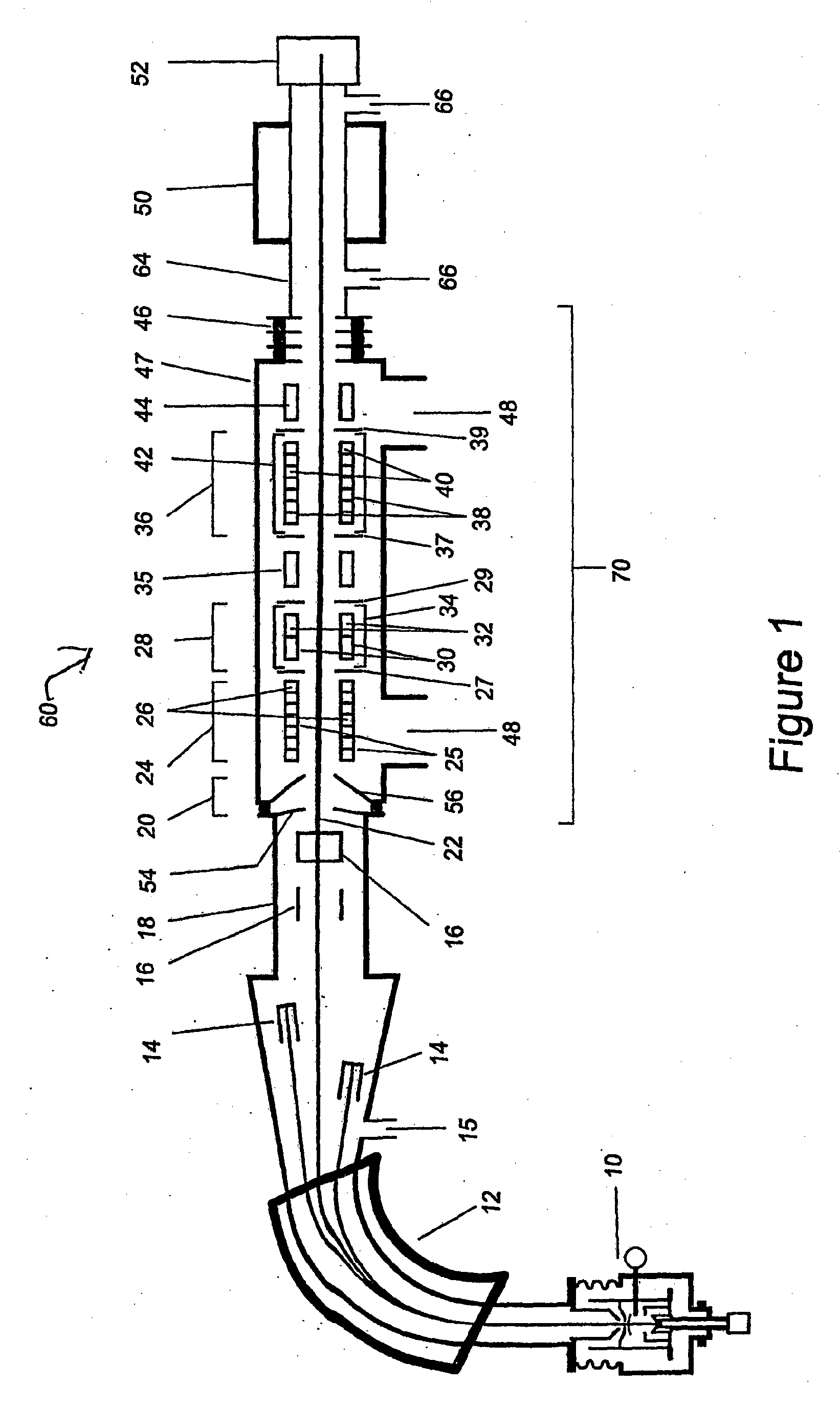
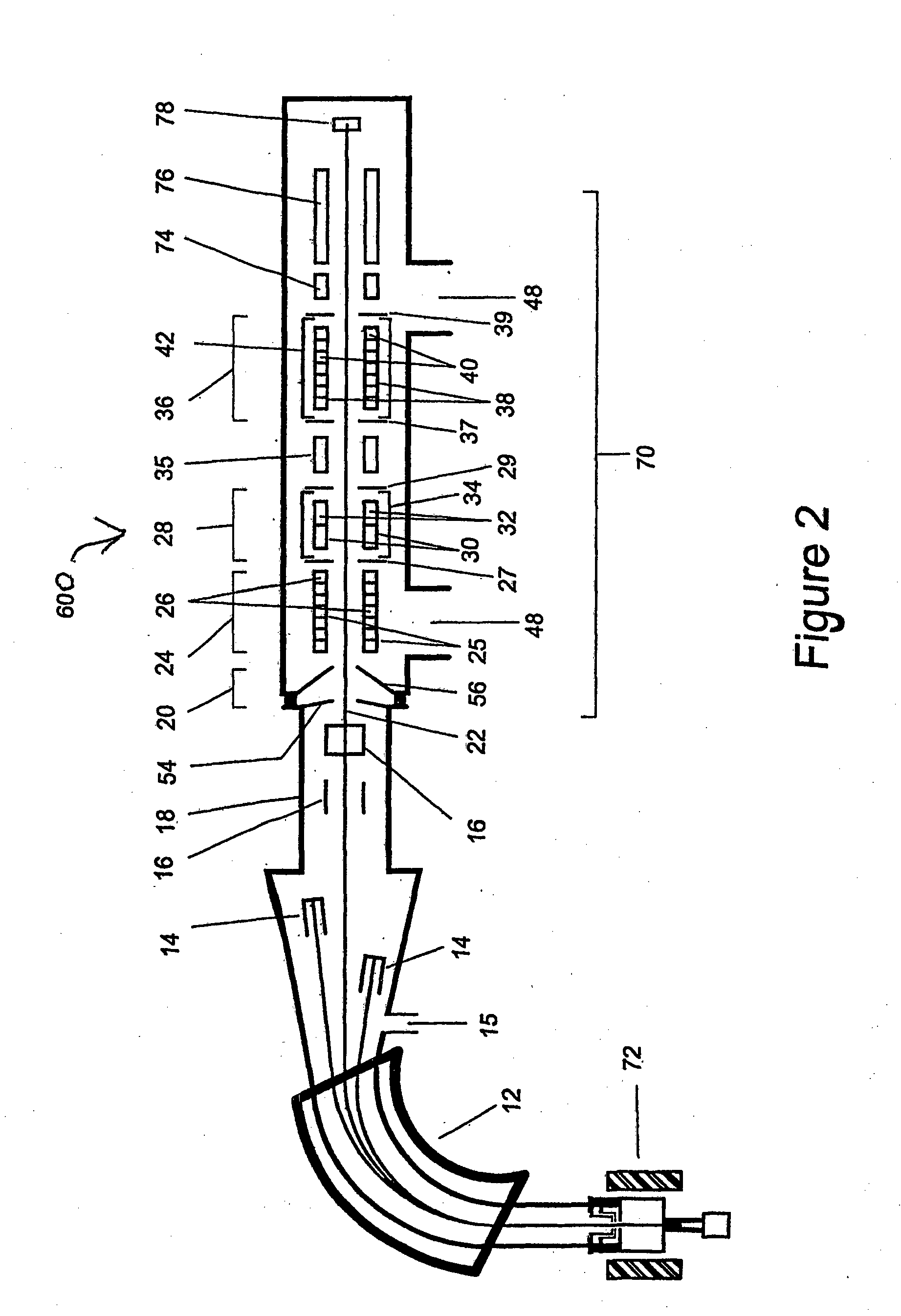
REFERENCES CITED IN THE DESCRIPTION
This list of references cited by the applicant is for the reader's convenience only.
It does not form part of the European patent document. Even though great care has
been taken in compiling the references, errors or omissions cannot be excluded and
the EPO disclaims all liability in this regard.
Patent documents cited in the description
Non-patent literature cited in the description
- A. E. LITHERLANDUltrasensitive Mass Spectrometry with AcceleratorsAnn Rev Nucl. and Particle Sci.,
1980, vol. 30, 437-473 [0003]
- ELMORE, DPHILLIPS, F. MUltrasensitive Mass SpectrometryScience, 1987, vol. 296, 543- [0003]
- S-W KIMR. J. SCHNEIDERK. F. VON REDENJ. M. HAYESJ. S. C. WILLSTest of negative ion beams from a microwave ion source with a charge exchange canal
for accelerator mass spectrometry applicationsRev. Scientific Instruments, 2002, vol.
73, 846-848 [0009]
- Isobar separation at low energy in accelerator mass spectrometryDOUPE J P et al.NUCLEAR INSTRUMENTS & METHODS IN PHYSICS RESEARCH, SECTION - B:BEAM INTERACTIONS WITH
MATERIALS AND ATOMSELSEVIER20040801vol. 223-224, 323-327 [0011]
- DUNKIN, D.B.FEHSENFELD, F.C.FERGUSON, E.E.Chem. Phys. Lett., 1972, vol. 15, 257- [0030]
- FEHSENFELD, F.C.FERGUSEN, E.E.Plane. Space Sci., 1968, vol. 16, 701- [0030]
- J. B. MARQUETTEC. REBRIONB. R. ROWEReactions of N+(3P) ions with normal, para and deuterated hydrogens at low temperaturesJ.
Chem. Phys., 1988, vol. 89, 42041-2047 [0031]
- D. C. CLARYC. E. DATEOD. SMITHRates for the reactions of open-shell ions with moleculesChemical Physics Letters,
1990, vol. 167, 1,2 [0031]
- Practical Aspects of Ion Trap Mass Spectrometry: FundamentalsModern Mass Spectrometry
SeriesCRC Press19950000vol. 1, [0041]
- Quadrupole Mass Spectrometry and Its ApplicationsAmerican Institute of Physics Press19950000 [0057] [0059]