|
(11) | EP 2 800 739 B1 |

| (12) | EUROPEAN PATENT SPECIFICATION |
|
|
| (54) |
METHOD FOR PREPARATION OF OCTAHYDROCYCLOPENTA[C]PYRROLE VERFAHREN ZUR HERSTELLUNG VON OCTAHYDROCYCLOPENTA[C]PYRROL PROCÉDÉ POUR LA PRÉPARATION D'OCTAHYDROCYCLOPENTA[C]PYRROLE |
|
|
|||||||||||||||||||||||||||
| Note: Within nine months from the publication of the mention of the grant of the European patent, any person may give notice to the European Patent Office of opposition to the European patent granted. Notice of opposition shall be filed in a written reasoned statement. It shall not be deemed to have been filed until the opposition fee has been paid. (Art. 99(1) European Patent Convention). |
[0001] The invention discloses a method for the preparation of octahydrocyclopenta[c]pyrrole, also called 3-azabicyclo[3.3.0]octane, by hydrogenation of 1,2-dicyanocyclo-1-pentene. Octahydrocyclopenta[c]pyrrole is an important intermediate for the preparation of various biologically active compounds, such as antidiabetics and antivirals.
[0002] WO 2009/140279 A2 discloses the use of compound of formula (I) as an intermediate for the preparation of the antidiabetic sulfonylurea gliclazide, compound of formula (I-gli).
[0003] Moreover, protected derivatives of 3-azabicyclo[3.3.0]octane have been used as intermediates for the preparation of antivirals, such as telaprevir.
[0004] Various methods have been reported in the literature for the preparation of compound of formula (I). Most of them are based on a Dieckmann cyclization of diethyl or dimethyl adipate, followed by cyanohydrin formation and reduction of an intermediate cyclic amide or imide, as disclosed for instance in WO 2009/140279 A2. The reduction of amides or imides requires expensive reducing reagents, such as LiAlH4 or borane, which generate large amounts of inorganic salts as waste. Alternatively, the reduction can be achieved in low yield by high-pressure, high-temperature two-step hydrogenation of 2-cyano-1-cyclopentenecarboxylic acid ester with firstly a Raney catalyst and secondly a copper chromite catalyst as disclosed for instance in JP 05-070429 A.
[0005] DE 1695677 B discloses, that 3-aza-bicyclo alkane can be prepared in two steps by converting corresponding 1,2-dicarboxylic acids of cyclopropane, cyclobutane or cyclopentane into their imides and subsequent reduction of these imides with lithium aluminum hydride.
EP 1127876 A1 discloses the preparation of 3-aza-bicyclo alkane by hydrogenation of phthalonitrile.
US 3 192 262 B discloses that cis-1,2-dicyanocyclobutane can be converted by hydrogenation into 3-aza(3.2.0) bicycloheptane.
[0006] None of the prior art discloses a method starting from unsaturated dicyano cycloalkane, wherein in one step both the reduction of the unsaturated C-C bond and the cyclisation of the two cyano residues is effected.
[0007] 1,2-Dicyanocyclopentane is not known in literature and would need to be synthesized from the compound of formula (II), as defined below, resulting again in a two step synthesis.
[0008] There was a need for a method for the preparation of compound of formula (I) from inexpensive starting materials without the use of expensive hydrides or borane as reducing reagent, or of high-temperature hydrogenations with copper chromite, or of a two step process, such as a two step hydrogenations using two different catalysts or such as a synthesis starting from 1,2-dicyanocyclopentane.
[0009] In the text, the following abbreviations mean
| DABCO | diazabicyclo[2.2.2]octane, |
| hexanes | mixture of isomeric hexanes, |
| THF | tetrahydrofuran, |
| quant. | quantitative, |
[0010] Subject of the invention is a method for the preparation of a compound of formula (I);
the method comprises a reaction (A), wherein a compound of formula (II) is reacted with a reagent (A-rea) in the presence of a catalyst (A-cat),
reagent (A-rea) is hydrogen;
catalyst (A-cat) is selected from the group consisting of metalcatalyst (A-metcat), metalcatalyst (A-metcat) on a support (A-sup) and mixtures thereof;
metalcatalyst (A-metcat) is a substance conventionally used in organic reduction reactions and is preferably a substance derived from Pd(0), Pd (I), Pd(II), Ni(0), Ni(I), Ni(II), Pt(0), Pt(I), Pt(II), Pt(IV), Co(0), Co(II), Ru(0), Ir(0), Rh(0), Rh(I), Rh(III), Cr(III), Cu(0), Cu(I) or Cu(II);
support (A-sup) is a support conventionally used for supporting metalcatalysts, which are used in organic reduction reactions.
[0012] Reaction (A) is a reduction. The reaction mechanism is not known. The unsaturated compound of formula (II), which is fed into the reactor in the beginning, can be converted during the course of the reaction (A) into one of the other unsaturated compounds of formula (II-c) or (II-d) by isomerization, or can be reduced to the saturated compound of formula (II-a), before the cyclisation takes place during reaction (A). Or at first the cyclisation takes place and then the double bond is reduced. Or the C-C double bond is reduced during one of the intermediate steps or in between two intermediate steps of the cyclisation.
[0013] Preferably, the molar amount of reagent (A-rea) is from 6000 equivalents to 6 equivalents, more especially from 600 equivalents to 6 equivalents, even more especially 100 equivalents to 6 equivalents, the equivalents being based on the molar amount of compound of formula (II).
[0015] The amount of reagent (A-rea) used in reaction (A) is in molar excess to compound of formula (II) and can be adjusted by applying and optionally maintaining pressure with reagent (A-rea), said pressure being preferably 600 bar to 10 bar, more preferably 300 bar to 20 bar, even more preferably 200 bar to 50 bar.
[0016] Preferably, reaction (A) is done at a temperature (A-temp) of 300 °C to 10 °C, more preferably of 200 °C to 50 °C, even more preferably of 150 °C to 80 °C, especially of 145 °C to 80 °C.
[0017] Preferably, the reaction time of reaction (A) is from 10 min to 72 h, more preferably from 60 min to 48 h, even more preferably from 5 h to 36 h.
[0018] Preferably, metalcatalyst (A-metcat) is selected from a substance derived from Pd(0), Ni(0), Pt(0), Pt(IV), Co(0), Co(II), Ru(0), Ir(0), Rh(0), Rh(I), Cr(III), Cu(I) or Cu(II), or mixtures thereof;
more preferably, metalcatalyst (A-metcat) is selected from a substance derived from Pd(0), Ni(0), Pt(0), Pt(IV), Ru(0), Rh(0) or Co(0), or mixtures thereof;
even more preferably, metalcatalyst (A-metcat) is selected from a substance derived from Pd(0), Pt(0), Pt(IV), Ru(0) or Rh(0) or mixtures thereof.
[0019] Preferably, support (A-sup) is a support conventionally used for supporting metalcatalysts, which are used in heterogeneously catalyzed organic reactions.
[0020] More preferably, support (A-sup) is carbon or an inorganic substance conventionally used for supporting metalcatalysts, which are used in heterogeneously catalyzed organic reactions.
[0021] Even more preferably, support (A-sup) is selected from the group consisting of carbon, of alumina, of oxides, sulfates and carbonates of metals, said metals are selected from the group consisting of alkaline earth metals, Al, Si, Ce, Zr, La, Ti and Zn, of mixed metal oxides of said metals, of mixed metal carbonates of said metals, of mixed metal oxides carbonates of said metals and of mixtures thereof,
[0022] Especially, support (A-sup) is selected from the group consisting of carbon, alumina, alkaline earth oxides, alkaline earth carbonates, silica, zeolithes, oxides, mixed metal oxides and mixed metal carbonates of Ce, Zr, La, Ti and Zn, and mixtures thereof.
[0024] Carbon as support comprises any type of carbon, preferably carbon as support is selected from the group consisting of charcoal and graphite.
[0025] Preferably, if metalcatalyst (A-metcat) is derived from Pd(0), Pd(I) or Pd(II), then catalyst (A-cat) is selected from the group consisting of
Pd; PdO, PdCl2, Pd(OAc)2, Pd on carbon, on Al2O3, or on BaSO4, and mixtures thereof;
more preferably selected from the group consisting of
Pd, PdO, Pd on carbon, on Al2O3, or on BaSO4, and mixtures thereof;
even more preferably selected from the group consisting of
Pd, PdO, Pd on carbon, and mixtures thereof;
especially selected from the group consisting of Pd and Pd on carbon.
[0026] Preferably, if metalcatalyst (A-metcat) is derived from Ru(0), then catalyst (A-cat) is Ru on a support (A-sup), and support (A-sup) is preferably carbon or alumina.
[0027] Preferably, if metalcatalyst (A-metcat) is derived from Ni(O), Ni(I) or Ni(II), then catalyst (A-cat) is Raney-Ni or Ni on a support (A-sup), and support (A-sup) is preferably SiO2.
[0028] Preferably, if metalcatalyst (A-metcat) is derived from Cu(0), Cu(I) or Cu(II), then catalyst (A-cat) is selected from the group consisting of Cu, CuCl, copper chromite, and CuCl2.
[0029] Preferably, if metalcatalyst (A-metcat) is derived from Co(0) or Co(II), then catalyst (A-cat) is selected from the group consisting of Raney-cobalt, Co(OH)2, and CoO.
[0030] Preferably, if metalcatalyst (A-metcat) is derived from Ir(0), then catalyst (A-cat) is selected from the group consisting of Ir, Ir on carbon, Ir on Al2O3, and Ir on calcium carbonate.
[0031] Preferably, if metalcatalyst (A-metcat) is derived from Rh(0), Rh(I), or Rh(III), then catalyst (A-cat) is selected from the group consisting of Rh, Rh on carbon, Rh on alumina, Rh on Al2O3, Rh2O3, and RhCl(PPh3)3.
[0032] Preferably, if metalcatalyst (A-metcat) is derived from Pt(0), Pt(II), or Pt(IV), then catalyst (A-cat) is selected from the group consisting of Pt, Pt on carbon, Pt on Al2O3, Pt on calcium carbonate, Pt on barium sulfate, Pt on silicon dioxide, PtO2, and PtCl2.
[0033] Preferably, if metalcatalyst (A-metcat) is derived from Cr(III), then catalyst (A-cat) is copper chromite.
[0034] Preferably, catalyst (A-cat) is selected from the group consisting of copper chromite, Raney nickel, Raney cobalt, platinum on carbon, palladium on carbon, ruthenium on carbon, rhodium on alumina and rhodium on carbon;
more preferably, catalyst (A-cat) is selected from the group consisting of Raney nickel, Raney cobalt, platinum on carbon, palladium on carbon, ruthenium on carbon, rhodium on alumina and rhodium on carbon;
even more preferably, catalyst (A-cat) is selected from the group consisting of platinum on carbon, ruthenium on carbon, rhodium on alumina and rhodium on carbon;
even more preferably, catalyst (A-cat) is platinum on carbon, rhodium on alumina or rhodium on carbon.
[0035] When catalyst (A-cat) is platinum on carbon, ruthenium on carbon or rhodium on carbon, then carbon as support is preferably charcoal.
[0036] Preferably, the molar amount of metalcatalyst (A-metcat) is from 0.001 to 1000 %, more preferably from 0.001 to 100 %, even more preferably 0.5 to 30 %, the % being based on the molar amount of compound of formula (II).
[0037] Preferably, when catalyst (A-cat) comprises a support ort (A-sup), the amount of support (A-sup) is from 20% to 99.99%, more preferably from 40% to 99.9%, even more preferably from 70% to 99.5%, the % being % by weight and are based on the total weight of catalyst (A-cat).
[0038] In one embodiment, reaction (A) is done or carried out in the presence of an auxiliary substance (A-aux), auxiliary substance (A-aux) is selected from the group consisting of N(R1)(R2)R3, diazabicyclo[2.2.2]octane, [N(R4)(R5)(R6)R7+][X-], sodium fluoride, potassium fluoride, sodium hydroxide, potassium hydroxide, sodium carbonates, potassium carbonate, sodium hydride, acetic acid, formic acid and hydrogen chloride;
R1, R2 and R3 are identical or different and independently selected from the group consisting of H and C1-4 alkyl;
R4, R5, R6 and R7 are identical or different and independently selected from the group consisting of H and C1-4 alkyl;
X- is selected from the group consisting of fluoride, chloride, hydroxide and carbonate.
[0039] Preferably, R1, R2 and R3 are identical and selected from the group consisting of H and C1-4 alkyl;
more preferably are identical and selected from the group consisting of H, methyl, ethyl and butyl;
even more preferably are identical and are methyl or ethyl.
[0040] Preferably, R4, R5, R6 and R7 are identical and selected from the group consisting of H and C1-4 alkyl;
more preferably are identical and selected from the group consisting of H, methyl, ethyl and butyl;
even more preferably are identical and are butyl.
[0042] In particular, auxiliary substance (A-aux) is selected from the group consisting of ammonia, trimethylamine, triethylamine, diazabicyclo[2.2.2]octane, tetrabutylammonium fluoride, sodium fluoride, potassium fluoride, sodium hydroxide, potassium hydroxide, sodium carbonates, potassium carbonate, sodium hydride, acetic acid, formic acid and hydrogen chloride.
[0043] Preferably, the molar amount of auxiliary substance (A-aux) is from 1000 to 1%, more preferably from 500 to 10%, even more preferably 300 to 50%, the % being based on the molar amount of compound of formula (II).
[0044] Reaction (A) can be done in gaseous phase. Reaction (A) can be done with gaseous compound of formula (II).
[0045] In one embodiment, reaction (A) is done or carried out without a solvent.
In another embodiment, reaction (A) is done or carried out in a solvent (A-sol).
Preferably, solvent (A-sol) is selected from the group consisting of water, acetic acid, propionic acid, tetrahydrofuran, 2-methyl-tetrahydrofuran, dioxane, 1,2-dimethoxyethane, methanol, ethanol, 1-propanol, 2-propanol, butanol, pentanol, ethylene glycol, glycerol and mixtures thereof;
more preferably from the group consisting of acetic acid, tetrahydrofuran, 2-methyl-tetrahydrofuran, methanol, ethanol, 1-propanol and mixtures thereof;
even more preferably solvent (A-sol) is tetrahydrofuran.
[0046] Preferably, the amount of solvent (A-sol) is from 0.5 to 200 fold, more preferably from 2 to 100 fold, even more preferably from 5 to 60 fold, of the weight of compound of formula (II).
[0047] Preferably, reaction (A) is done with low water content or even in the absence of water. Absence of water means, that water is not used as solvent and solvent (A-sol) is preferably used in dried form; the residual water in solvent (A-sol) is preferably not more than 1% (w/w), more preferably not more than 0.1% (w/w), even more preferably not more than 0.05% (w/w), especially not more than 0.01% (w/w).
[0048] Compound of formula (II) is a known compounds and can be prepared by known methods. The cyclization of adiponitrile to 1-cyano-2-amino-1-cyclopentene and the hydrolysis of this product to 2-cyanocyclopentanone have been reported, for instance in Thompson, J. Am. Chem. Soc., 1958, 80, 5483-5487. The conversion of 2-cyanocyclopentanone to 1,2-dicyanocyclo-1-pentene, i.e. compound of formula (II), has also been reported, for instance in Cariou et al., Compt. Rend. Acad. Sci. Paris Serie C, 1974, 278, 1457-1460. Compound of formula (II) can also be prepared from cyclopentanone as disclosed in WO 95/06631 A1.
[0049] Reaction (A) can be done under inert atmosphere. The inert atmosphere can be made from a gas (A-gas) selected from the group consisting of nitrogen, helium, neon, argon, carbon dioxide and mixtures thereof.
[0050] The method can be conducted batch wise or continuously. In case of a continuous way, i.e. the reaction (A) is done in a continuous way in a reactor for continuous reactions, called continuous reactor in the following. Preferably, a melt or a mixture, preferably a solution, of compound of formula (II) in solvent (A-sol), and reagent (A-rea) are continuously added into the continuous reactor, such as a tube reactor or a micro reactor; compound of formula (II) and reagent (A-rea) can be added as a mixture or separately. The continuous reactor is, preferably precharged with catalyst (A-cat), heated, preferably preheated, to the desired temperature (A-temp), and the product is removed at the other end of the continuous reactor. Preferably, the whole zone of the continuous reactor, where the reaction (A) takes place, and where a possible catalyst (A-cat) is located, is heated to the desired temperature (A-temp). The time of contact of compound of formula (II) with reagent (A-rea) will depend on the concentration of compound of formula (II) and of reagent (A-rea), on the addition rate of compound of formula (II) and reagent (A-rea) into the continuous reactor, on the flow rate (A-flow) of compound of formula (II) and of reagent (A-rea), and optionally on the flow rate of an optional gas (A-gas).
[0051] In case of a continuous reaction (A), the process parameters can be adjusted in such a way, that a high conversion of compound of formula (II) into compound of formula (I) is attained, but the amount of byproducts is kept low.
[0052] In another embodiment, a continuous reaction (A) can be done in such a way, that only a low, preferably equal or below 40%, conversion rate of compound of formula (II) into compound of formula (I) is attained, the conversion rate in % are weight % of compound of formula (I) based on the weight of compound of formula (II).
Optionally in case of a continuous reaction (A), the crude product mixture comprising compound of formula (I) and compound of formula (II), and reagent (A-rea) can be fed again into the continuous reactor and be subjected again to the conditions of reaction (A). Such a technique would be suitable for a continuous loop reactor set-up.
[0053] A continuous method or continuous reaction (A) has the advantage, that residence time of the product, i.e. compound of formula (I), at the elevated temperature (A-temp) and optionally in the solvent (A-sol) can be minimized, thereby side reactions can be avoided or at least minimized.
[0054] Compound of formula (II) can inter alia be added to a reactor either as a gas, as a melt or as a mixture with or a solution in solvent (A-sol).
[0055] If a mixture of compound of formula (I) and compound of formula (II) is obtained, compound of formula (I) can be separated by conventional separation techniques, such as filtration, distillation or crystallization.
[0056] The compound of formula (I) can be isolated, purified, and analyzed using conventional techniques, well known to those skilled in the art. For instance, in the case of a batch reaction, the reaction mixture can be filtered to remove the catalyst, and then distilled. For instance, in the case of a continuous reaction, the gases leaving a reactor can be cooled, and the products of the reaction can be collected in a freezing trap. Alternatively, the gases leaving a reactor can be conveyed into a cold inert solvent, such as solvent (A-sol) or dichloromethane, preferably dichloromethane, acetonitrile or toluene. The resulting solution or mixture can be distilled.
Compound of formula (I) can be purified, preferably by distillation, optionally under reduced pressure, or by crystallization.
[0057] The condensed crude products from reaction (A) can also be treated with water, optionally water comprising a base, i.e. of alkaline pH, in order to hydrolyze the unreacted compound of formula (II), and compound of formula (I) can be isolated by phase separation and distillation.
[0058] Compound of formula (I) may also be purified by dissolution in an aqueous acid, followed by extraction of residual compound of formula (II) and of other, non-basic byproducts with an organic solvent immiscible with water, such as toluene, dichloromethane, or acetic acid esters, followed by basification of the aqueous, acidic phase and extraction or distillation of the compound of formula (I).
[0059] Compound of formula (I) may be purified further by conversion into a salt (e.g. a hydrochloride, an acetate, a benzoate, or a formate), recrystallization from a suitable solvent, preferably selected from the group consisting of water, methanol, ethanol, isopropanol, and mixtures thereof, followed by liberation of the unprotonated compound of formula (I) from said salt by treatment with a base.
[0060] The method of the present invention can be performed continuously, which provides a more constant product quality than batch wise processes. A continuous process is also more convenient for the large scale production of compounds, because fewer operations and fewer operators are required, because no dangerous accumulation of starting materials occurs, and because the process is easier to control. Alternatively, the method of the present invention can be conducted batch wise.
[0061] The method of the present invention uses inexpensive starting materials, does not require the use of expensive hydrides or borane as reducing reagent, can be done at relatively low temperatures and does not require the use of copper chromite. Moreover, the method of the present invention is requires less process steps than the previously disclosed methods resulting in lower production costs for compound of formula (I) and its salts.
Examples
GC Method
[0062] column: ZS-G000111, HP-5 ms, 30 m x 0.25 mm x 0.25 µm
initial temperature: 60 °C
initial time: 1.0 min
number of ramps: 1
rate: 20 K/min
final temperature: 280 °C
GC-MS Method
Example A - Preparation of compound of formula (II)
[0064] A mixture of 2-cyanocyclopentanone (20.0 g, 183 mmol, prepared as described in Fleming et al., J. Org. Chem. 2007, 72, 1431-1436 in the Supporting Information), water (24.7 ml), and sodium cyanide (14.8 g, 302 mmol) was cooled with an ice bath to a temperature of 5 °C to 10 °C. A mixture of sulfuric acid (29.3 ml, 550 mmol) and water (24.7 ml), said mixture having a temperature of 10 °C, was added drop wise within 0.5 h while stirring. The ice bath was then removed, and the mixture was stirred for 2.5 h at room temperature. Water (50 ml) was added, and the mixture was extracted with ethyl acetate (3 × 100 ml). The combined extracts were dried with magnesium sulfate, and pyridine (51 ml, 631 mmol) was added. The solution was cooled with an ice bath to a temperature of 5 °C to 10 °C, and acetyl chloride (40.0 ml, 561 mmol) was added drop wise. The resulting mixture was stirred at 0 °C for 2 h, and then at room temperature overnight. After filtration and concentration under reduced pressure, toluene (100 ml) and ethyldiisopropylamine (94 ml, 553 mmol) were added to the residue, and the mixture was stirred at 100 °C for 6 h, and at room temperature overnight. The mixture was poured into a mixture of aqueous, concentrated hydrochloric acid (68 ml) and water (70 ml), phases were separated, the aqueous phase was extracted with ethyl acetate (3 × 150 ml), the combined extracts were washed with brine, dried with magnesium sulfate, and concentrated under reduced pressure to yield 22.5 g of a dark oil. Distillation (2 mbar) yielded 8.6 g (40%) of compound of formula (II) (bp 66-71 °C).
1H NMR (CDCl3, 400 MHz) compound of formula (II): δ 2.17 (quint, J = 7 Hz, 2H), 2.83 (t, J = 7 Hz, 4H).
Example B - Preparation of compound of formula (II-a)
[0065] A mixture of isopropanol (1.0 ml), compound of formula (II) (0.10 g, 0.85 mmol), prepared according to example A, and palladium on charcoal (5%, containing 57% of water; 0.10 g, 0.02 mmol) was placed under hydrogen, and stirred vigorously at 80 °C for 21 h. The mixture was filtered, and the filtrate concentrated under reduced pressure, to yield 0.10 g of compound of formula (II-a).
1H NMR (CDCl3, 400 MHz) compound of formula (II-a): δ 1.82 (m, 1H), 2.05 (m, 1H), 2.17 (m, 4H), 3.14 (m, 2H). Analysis by GC-MS indicated a purity of 73% for compound of formula (II-a).
Compound of formula (II-a) can be used as substrate for the preparation of compound of formula (I) according to example 1, wherein compound of formula (II-a) is used instead of compound of formula (II)
Example 1
[0066] A mixture of compound of formula (II) (496 mg, 4.20 mmol), prepared according to example A, THF (110 ml), and Pt on charcoal (0.88 g, 0.45 mmol, 10% by weight Pt based on total weight of catalyst) was placed in an autoclave and stirred under hydrogen (55 bar) at 140 °C for 16 h. The mixture was filtered and concentrated under reduced pressure, to yield 410 mg of an oil. Analysis by GC-MS indicated that 43% of compound of formula (I) had been formed.
Example 2
[0067] A mixture of compound of formula (II) (2.04 g, 17.3 mmol), prepared according to example A, THF (110 ml), and Pt on charcoal (1.66 g, 0.85 mmol, 10% by weight Pt) was placed in an autoclave and stirred under hydrogen (55 bar) at 88 °C for 16 h and then at 100 °C for 17 h. The mixture was filtered and concentrated at atmospheric pressure, and the residual oil was distilled to yield 2.6 g of a mixture of THF and compound of formula (I). Analysis by GC-MS indicated a purity of 67% for compound of formula (I).
Example 3
[0068] A mixture of compound of formula (II) (497 mg, 4.21 mmol), prepared according to example A, THF (109 ml), and Rh on charcoal (0.87 g, 0.42 mmol, 5% by weight Rh) was placed in an autoclave and stirred under hydrogen (55 bar) at 130 °C for 11 h. The mixture was filtered and concentrated at atmospheric pressure, and the residual oil was analyzed by GC and GC-MS. Analysis by GC indicated a purity of 73% for compound of formula (I). A sample was purified by extraction and distillation.
1H NMR (CDCl3, 500 MHz) delta 1.23 to 1.33 (m, 2H), 1.45 to 1.65 (m, 2H), 1.68 to 1.77 (m, 2H), 2.47 to 2.55 (m, 4H), 2.99 (m, 2H)
13C NMR (CDCl3, 125 MHz) delta 26.42, 32.90, 44.45, 54.85.
Example 4
[0069] A mixture of compound of formula (II) (494 mg, 4.18 mmol), prepared according to example A, THF (110 ml), and Ru on charcoal (0.89 g, 0.44 mmol, 5% by weight Ru) was placed in an autoclave and stirred under hydrogen (55 bar) at 130 °C for 24 h. The mixture was filtered and concentrated at atmospheric pressure, and the residual oil was analyzed by GC and GC-MS. Analysis by GC indicated a purity of 63% for compound of formula (I).
Example 5
[0070] A mixture of compound of formula (II) (3.86 g, 32.7 mmol), prepared according to example A, THF (89 ml), and Rh on alumina (1.35 g, 0.66 mmol, 5% by weight Rh) was placed in an autoclave and stirred under hydrogen (80 bar) at 120 °C for 22 h. The mixture was filtered and concentrated at 250 mbar, and the residual oil (5.44 g) was distilled at 16 mbar. The fraction distilling at 160 °C (1.64 g) was analyzed by GC-MS, which indicated a purity of 40% for compound of formula (I).
Example 6
[0071] A mixture of compound of formula (II) (1.10 g, 9.31 mmol), prepared according to example A, THF (90 ml), and Rh on alumina (0.39 g, 0.19 mmol, 5% by weight Rh) was placed in an autoclave and stirred under hydrogen (80 bar) at 120 °C for 22 h. The mixture was filtered and concentrated at 250 mbar, and the residual oil (1.96 g) was distilled at 16 mbar. The fraction distilling at 160 °C (0.63 g) was analyzed by GC-MS, which indicated a purity of 58% for compound of formula (I). This corresponds to a yield of 35% of compound of formula (I).
1. Method for the preparation of compound of formula (I);
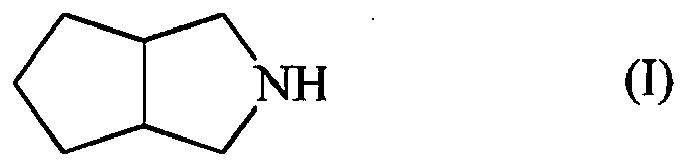
the method comprises a reaction (A), wherein a compound of formula (II) is reacted with a reagent (A-rea) in the presence of a catalyst (A-cat),
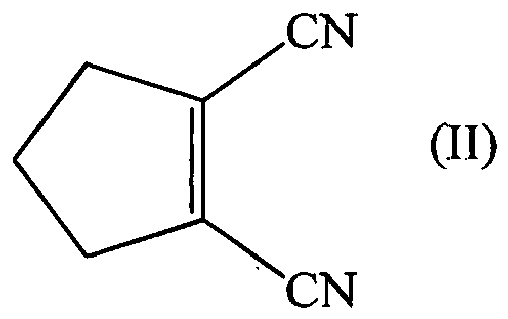
reagent (A-rea) is hydrogen;
catalyst (A-cat) is selected from the group consisting of metalcatalyst (A-metcat),
metalcatalyst (A-metcat) on a support (A-sup) and mixtures thereof;
metalcatalyst (A-metcat) is a substance conventionally used in organic reduction reactions
and is derived from Pd(0), Pd (I), Pd(II), Ni(0), Ni(I), Ni(II), Pt(0), Pt(I), Pt(II), Pt(IV), Co(0), Co(II), Ru(0), Ir(0), Rh(0), Rh(I), Rh(III), Cr(III), Cu(0), Cu(I) or Cu(II);
support (A-sup) is a support conventionally used for supporting metalcatalysts, which are
used in organic reduction reactions.
the method comprises a reaction (A), wherein a compound of formula (II) is reacted with a reagent (A-rea) in the presence of a catalyst (A-cat),
reagent (A-rea) is hydrogen;
catalyst (A-cat) is selected from the group consisting of metalcatalyst (A-metcat),
metalcatalyst (A-metcat) on a support (A-sup) and mixtures thereof;
metalcatalyst (A-metcat) is a substance conventionally used in organic reduction reactions
and is derived from Pd(0), Pd (I), Pd(II), Ni(0), Ni(I), Ni(II), Pt(0), Pt(I), Pt(II), Pt(IV), Co(0), Co(II), Ru(0), Ir(0), Rh(0), Rh(I), Rh(III), Cr(III), Cu(0), Cu(I) or Cu(II);
support (A-sup) is a support conventionally used for supporting metalcatalysts, which are
used in organic reduction reactions.
2. Method according to claim 1, wherein catalyst (A-cat) is selected from the group consisting
of Raney nickel, Raney cobalt, platinum on carbon, palladium on carbon, ruthenium
on carbon, rhodium on alumina and rhodium on carbon.
3. Method according to claim 1 or 2, wherein reaction (A) is carried out in the presence
of an auxiliary substance (A-aux), auxiliary substance (A-aux) is selected from the
group consisting of N(R1)(R2)R3, diazabicyclo[2.2.2]octane, [N(R4)(R5)(R6)R7+][X-], sodium fluoride, potassium fluoride, sodium hydroxide, potassium hydroxide, sodium
carbonates, potassium carbonate, sodium hydride, acetic acid, formic acid and hydrogen
chloride;
R1, R2 and R3 are identical or different and independently selected from the group consisting of H and C1-4 alkyl;
R4, R5, R6 and R7 are identical or different and independently selected from the group consisting of H and C1-4 alkyl;
X- is selected from the group consisting of fluoride, chloride, hydroxide and carbonate.
R1, R2 and R3 are identical or different and independently selected from the group consisting of H and C1-4 alkyl;
R4, R5, R6 and R7 are identical or different and independently selected from the group consisting of H and C1-4 alkyl;
X- is selected from the group consisting of fluoride, chloride, hydroxide and carbonate.
4. Method according to claim 3, wherein auxiliary substance (A-aux) is selected from
the group consisting of ammonia, trimethylamine, triethylamine, diazabicyclo[2.2.2]octane,
tetrabutylammonium fluoride, sodium fluoride, potassium fluoride, sodium hydroxide,
potassium hydroxide, sodium carbonates, potassium carbonate, sodium hydride, acetic
acid, formic acid and hydrogen chloride.
5. Method according to one or more of claims 1 to 4, wherein reaction (A) is done in
a solvent (A-sol), solvent (A-sol) is selected from the group consisting of water,
acetic acid, propionic acid, tetrahydrofuran, 2-methyl-tetrahydrofuran, dioxane, 1,2-dimethoxyethane,
methanol, ethanol, 1-propanol, 2-propanol, butanol, pentanol, ethylene glycol, glycerol
and mixtures thereof.
1. Verfahren zur Herstellung der Verbindung der Formel (I);
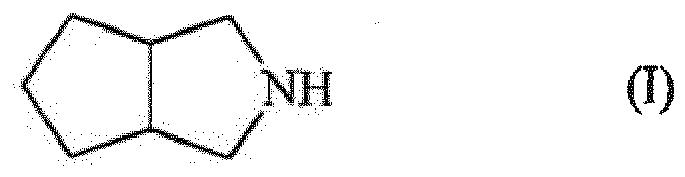
wobei das Verfahren eine Reaktion (A) umfasst, bei der eine Verbindung der Formel (II) in Gegenwart eines Katalysators (A-Kat) mit einem Reagenz (A-Rea) umgesetzt wird,
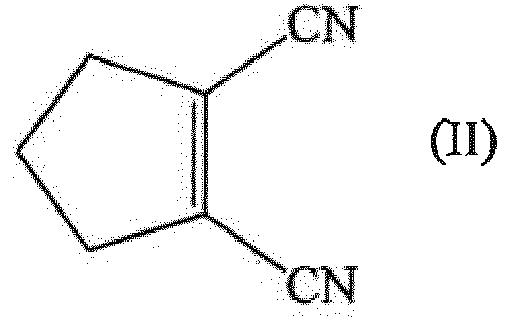
es sich bei dem Reagenz (A-Rea) um Wasserstoff handelt;
der Katalysator (A-Kat) aus der Gruppe bestehend aus Metallkatalysator (A-Metkat), Metallkatalysator (A-Metkat) auf einem Träger (A-Trä) und Mischungen davon ausgewählt wird;
es sich bei dem Metallkatalysator (A-Metkat) um eine Substanz handelt, die herkömmlicherweise bei organischen Reduktionsreaktionen verwendet wird und sich von Pd(0), Pd(I), Pd(II), Ni(0), Ni(I), Ni(II), Pt(0), Pt(I), Pt(II), Pt(IV), Co(0), Co(II), Ru(0), Ir(0), Rh(0), Rh(I), Rh(III), Cr(III), Cu(0), Cu(I) oder Cu(II) ableitet;
es sich bei dem Träger (A-Trä) um einen Träger handelt, der herkömmlicherweise zur Trägerung von Metallkatalysatoren, die bei organischen Reduktionsreaktionen verwendet werden, verwendet wird.
wobei das Verfahren eine Reaktion (A) umfasst, bei der eine Verbindung der Formel (II) in Gegenwart eines Katalysators (A-Kat) mit einem Reagenz (A-Rea) umgesetzt wird,
es sich bei dem Reagenz (A-Rea) um Wasserstoff handelt;
der Katalysator (A-Kat) aus der Gruppe bestehend aus Metallkatalysator (A-Metkat), Metallkatalysator (A-Metkat) auf einem Träger (A-Trä) und Mischungen davon ausgewählt wird;
es sich bei dem Metallkatalysator (A-Metkat) um eine Substanz handelt, die herkömmlicherweise bei organischen Reduktionsreaktionen verwendet wird und sich von Pd(0), Pd(I), Pd(II), Ni(0), Ni(I), Ni(II), Pt(0), Pt(I), Pt(II), Pt(IV), Co(0), Co(II), Ru(0), Ir(0), Rh(0), Rh(I), Rh(III), Cr(III), Cu(0), Cu(I) oder Cu(II) ableitet;
es sich bei dem Träger (A-Trä) um einen Träger handelt, der herkömmlicherweise zur Trägerung von Metallkatalysatoren, die bei organischen Reduktionsreaktionen verwendet werden, verwendet wird.
2. Verfahren nach Anspruch 1, wobei der Katalysator (A-Kat) aus der Gruppe bestehend
aus Raney-Nickel, Raney-Cobalt, Platin auf Kohle, Palladium auf Kohle, Ruthenium auf
Kohle, Rhodium auf Aluminiumoxid und Rhodium auf Kohle ausgewählt wird.
3. Verfahren nach Anspruch 1 oder 2, wobei Reaktion (A) in Gegenwart einer Hilfssubstanz
(A-Hil) durchgeführt wird, die Hilfssubstanz (A-Hil) aus der Gruppe bestehend aus
N(R1)(R2)R3, Diazabicyclo[2.2.2]octan, [N(R4)(R5)(R6)R7+][X-], Natriumfluorid, Kaliumfluorid, Natriumhydroxid, Kaliumhydroxid, Natriumcarbonat,
Kaliumcarbonat, Natriumhydrid, Essigsäure, Ameisensäure und Chlorwasserstoff ausgewählt
wird;
R1, R2 und R3 gleich oder verschieden sind und unabhängig aus der Gruppe bestehend aus H und C1-4-Alkyl ausgewählt sind;
R4, R5, R6 und R7 gleich oder verschieden sind und unabhängig aus der Gruppe bestehend aus H und C1-4-Alkyl ausgewählt sind;
X- aus der Gruppe bestehend aus Fluorid, Chlorid, Hydroxid und Carbonat ausgewählt ist.
R1, R2 und R3 gleich oder verschieden sind und unabhängig aus der Gruppe bestehend aus H und C1-4-Alkyl ausgewählt sind;
R4, R5, R6 und R7 gleich oder verschieden sind und unabhängig aus der Gruppe bestehend aus H und C1-4-Alkyl ausgewählt sind;
X- aus der Gruppe bestehend aus Fluorid, Chlorid, Hydroxid und Carbonat ausgewählt ist.
4. Verfahren nach Anspruch 3, wobei die Hilfssubstanz (A-Hil) aus der Gruppe bestehend
aus Ammoniak, Trimethylamin, Triethylamin, Diazabicyclo[2.2.2]-octan, Tetrabutylammoniumfluorid,
Natriumfluorid, Kaliumfluorid, Natriumhydroxid, Kaliumhydroxid, Natriumcarbonat, Kaliumcarbonat,
Natriumhydrid, Essigsäure, Ameisensäure und Chlorwasserstoff ausgewählt wird.
5. Verfahren nach einem oder mehreren der Ansprüche 1 bis 4, wobei die Reaktion (A) in
einem Lösungsmittel (A-Lös) durchgeführt wird, das Lösungsmittel (A-Lös) aus der Gruppe
bestehend aus Wasser, Essigsäure, Propionsäure, Tetrahydrofuran, 2-Methyltetrahydrofuran,
Dioxan, 1,2-Dimethoxyethan, Methanol, Ethanol, 1-Propanol, 2-Propanol, Butanol, Pentanol,
Ethylenglykol, Glycerin und Mischungen davon ausgewählt wird.
1. Procédé de préparation d'un composé de formule (I) ;
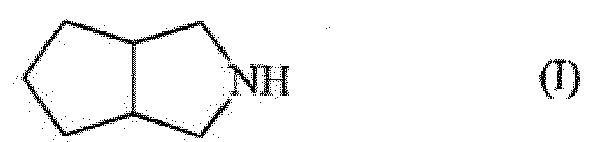
le procédé comprend une réaction (A), dans laquelle on fait réagir un composé de formule (II) avec un réactif (A-rea) en présence d'un catalyseur (A-cat),
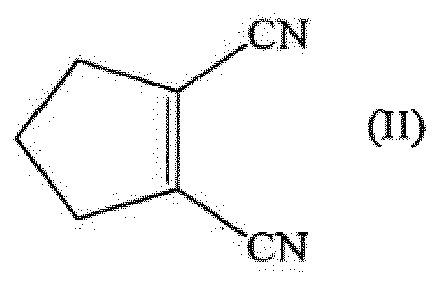
le réactif (A-rea) est l'hydrogène ;
le catalyseur (A-cat) est choisi dans le groupe constitué par un catalyseur métallique (A-metcat), un catalyseur métallique (A-metcat) sur un support (A-sup) et les mélanges de ceux-ci ;
le catalyseur métallique (A-metcat) est une substance classiquement utilisée dans les réactions de réduction organique et est dérivé de Pd(0), Pd(I), Pd(II), Ni(0), Ni(I), Ni(II), Pt(0), Pt(I), Pt(II), Pt(IV), Co(0), Co(II), Ru(0), Ir(0), Rh(0), Rh(I), Rh(III), Cr(III), Cu(0), Cu(I) ou Cu(II);
le support (A-sup) est un support classiquement utilisé pour supporter les catalyseurs métalliques qui sont utilisés dans les réactions de réduction organique.
le procédé comprend une réaction (A), dans laquelle on fait réagir un composé de formule (II) avec un réactif (A-rea) en présence d'un catalyseur (A-cat),
le réactif (A-rea) est l'hydrogène ;
le catalyseur (A-cat) est choisi dans le groupe constitué par un catalyseur métallique (A-metcat), un catalyseur métallique (A-metcat) sur un support (A-sup) et les mélanges de ceux-ci ;
le catalyseur métallique (A-metcat) est une substance classiquement utilisée dans les réactions de réduction organique et est dérivé de Pd(0), Pd(I), Pd(II), Ni(0), Ni(I), Ni(II), Pt(0), Pt(I), Pt(II), Pt(IV), Co(0), Co(II), Ru(0), Ir(0), Rh(0), Rh(I), Rh(III), Cr(III), Cu(0), Cu(I) ou Cu(II);
le support (A-sup) est un support classiquement utilisé pour supporter les catalyseurs métalliques qui sont utilisés dans les réactions de réduction organique.
2. Procédé selon la revendication 1, dans lequel le catalyseur (A-cat) est choisi dans
le groupe constitué par le nickel de Raney, le cobalt de Raney, le platine sur carbone,
le palladium sur carbone, le ruthénium sur carbone, le rhodium sur alumine et le rhodium
sur carbone.
3. Procédé selon la revendication 1 ou 2, dans lequel la réaction (A) est réalisée en
présence d'une substance auxiliaire (A-aux), la substance auxiliaire (A-aux) est choisie
dans le groupe constitué par N(R1)(R2)R3, le diazabicyclo[2.2.2]octane, [N(R4)(R5)(R6)R7+][X-], le fluorure de sodium, le fluorure de potassium, l'hydroxyde de sodium, l'hydroxyde
de potassium, les carbonates de sodium, le carbonate de potassium, l'hydrure de sodium,
l'acide acétique, l'acide formique et le chlorure d'hydrogène ;
R1, R2 et R3 sont identiques ou différents et indépendamment choisis dans le groupe constitué par H et un alkyle en C1-4 ;
R4, R5, R6 et R7 sont identiques ou différents et indépendamment choisis dans le groupe constitué par H et un alkyle en C1-4 ;
X- est choisi dans le groupe constitué par le fluorure, le chlorure, l'hydroxyde et le carbonate.
R1, R2 et R3 sont identiques ou différents et indépendamment choisis dans le groupe constitué par H et un alkyle en C1-4 ;
R4, R5, R6 et R7 sont identiques ou différents et indépendamment choisis dans le groupe constitué par H et un alkyle en C1-4 ;
X- est choisi dans le groupe constitué par le fluorure, le chlorure, l'hydroxyde et le carbonate.
4. Procédé selon la revendication 3, dans lequel la substance auxiliaire (A-aux) est
choisie dans le groupe constitué par l'ammoniac, la triméthylamine, la triéthylamine,
le diazabicyclo[2.2.2]octane, le fluorure de tétrabutylammonium, le fluorure de sodium,
le fluorure de potassium, l'hydroxyde de sodium, l'hydroxyde de potassium, les carbonates
de sodium, le carbonate de potassium, l'hydrure de sodium, l'acide acétique, l'acide
formique et le chlorure d'hydrogène.
5. Procédé selon une ou plusieurs des revendications 1 à 4, dans lequel la réaction (A)
est effectuée dans un solvant (A-sol), le solvant (A-sol) est choisi dans le groupe
constitué par l'eau, l'acide acétique, l'acide propionique, le tétrahydrofurane, le
2-méthyl-tétrahydrofurane, le dioxane, le 1,2-diméthoxyéthane, le méthanol, l'éthanol,
le 1-propanol, le 2-propanol, le butanol, le pentanol, l'éthylène glycol, le glycérol
et les mélanges de ceux-ci.
REFERENCES CITED IN THE DESCRIPTION
This list of references cited by the applicant is for the reader's convenience only. It does not form part of the European patent document. Even though great care has been taken in compiling the references, errors or omissions cannot be excluded and the EPO disclaims all liability in this regard.
Patent documents cited in the description
- WO2009140279A2 [0002] [0004]
- JP5070429A [0004]
- DE1695677B [0005]
- EP1127876A1 [0005]
- US3192262B [0005]
- WO9506631A1 [0048]
Non-patent literature cited in the description
- THOMPSONJ. Am. Chem. Soc., 1958, vol. 80, 5483-5487 [0048]
- CARIOU et al.Compt. Rend. Acad. Sci. Paris Serie C, 1974, vol. 278, 1457-1460 [0048]
- FLEMING et al.J. Org. Chem., 2007, vol. 72, 1431-1436 [0064]