|
(11) | EP 2 655 518 B1 |

| (12) | EUROPEAN PATENT SPECIFICATION |
|
|
| (54) |
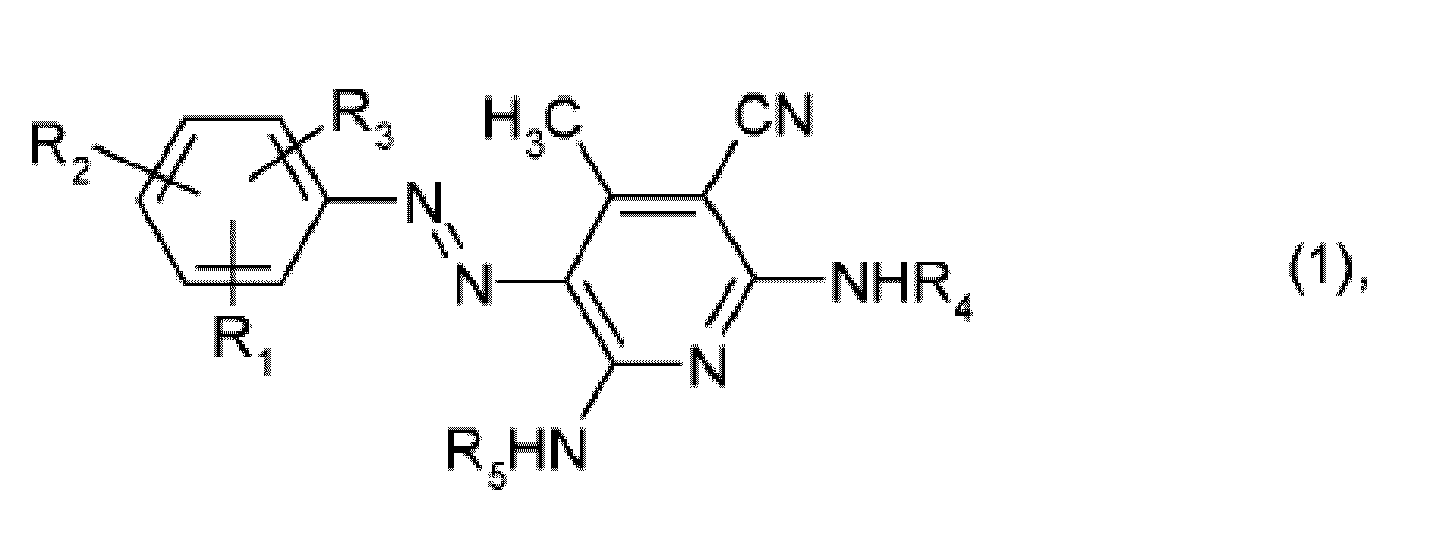
DISPERSE AZO DYES DISPERGIERBARE AZO-FARBSTOFFE COLORANTS AZOÏQUES DISPERSÉS |
|
|
|||||||||||||||||||||||||||
|
||||||||||||||||||||||||||||
| Note: Within nine months from the publication of the mention of the grant of the European patent, any person may give notice to the European Patent Office of opposition to the European patent granted. Notice of opposition shall be filed in a written reasoned statement. It shall not be deemed to have been filed until the opposition fee has been paid. (Art. 99(1) European Patent Convention). |
[0001] The present invention relates to disperse dyes based on diazo components having at least one fluorine-containing substituent, to a process for the preparation of such dyes and to their use in the dyeing or printing of semi-synthetic and, especially, synthetic hydrophobic fibre materials, more especially textile materials.
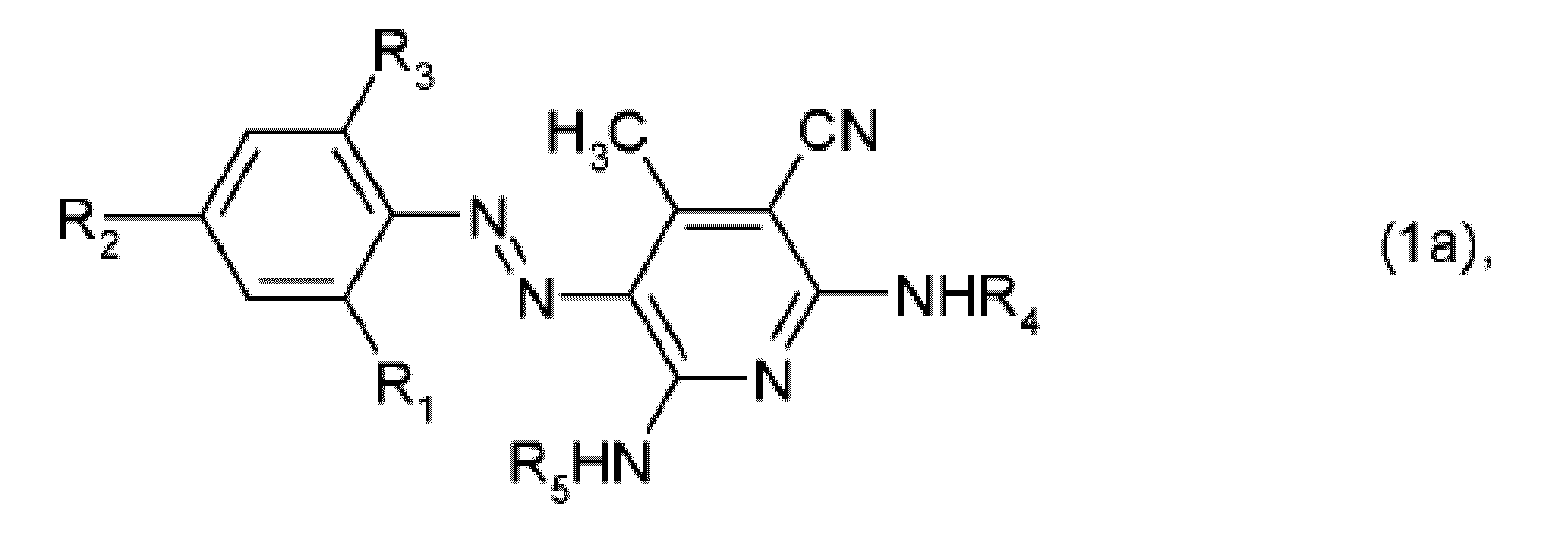
[0002] Disperse azo dyes having an aniline diazo component and an 2,6-diaminosubstituted pyridine coupling component have been known for a long time and are used in the dyeing of hydrophobic fibre materials. US 3,974,123 as well as WO 02/059215 describe azo dyes based on diazo components having a fluorine-containing substituents.
[0003] It has been found, however, that the dyeings or prints obtained using the dyes known at present do not in all cases meet current requirements of the automotive industry, especially with regard to their fastness to light properties, in particular their hot light fastness.
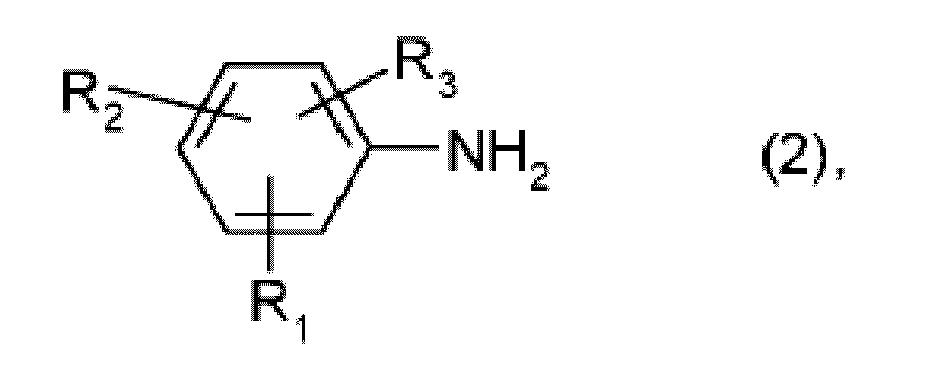
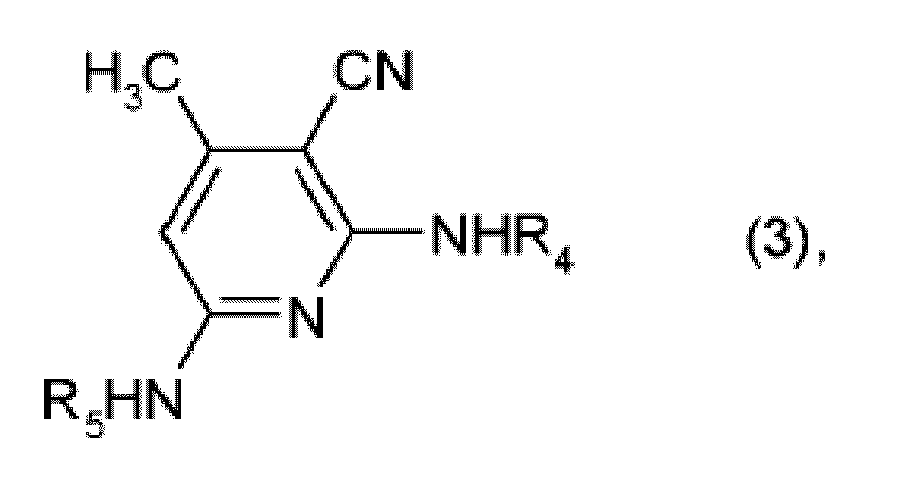
[0004] It has now been found, surprisingly, that the dyes according to the invention meet the criteria mentioned above to a great extent.
[0005] The present invention accordingly relates to disperse dyes that yield dyeings having very good fastness to light and, in addition, exhibit good build-up both in the exhaust and thermosol processes and in textile printing.
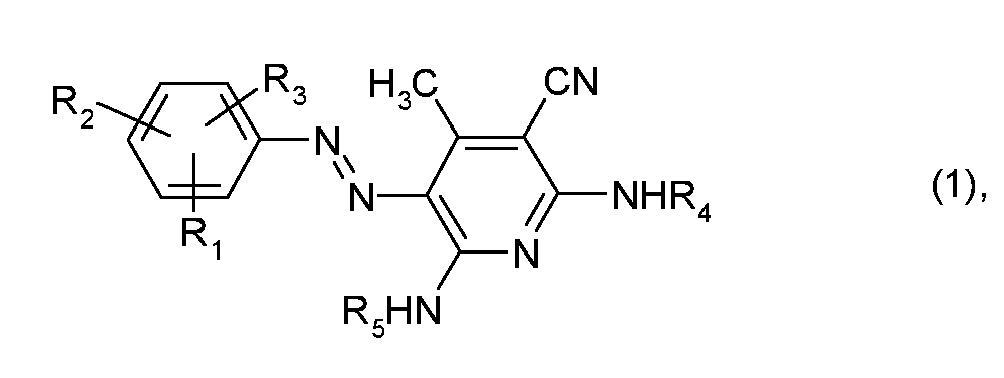
[0006] The dyes according to the invention correspond to formula
wherein R1 is fluoro, trifluoromethyl, trifluoromethoxy or trifluoromethylsulfonyl,
R2 and R3 each independently of the other represent hydrogen, C1-C12alkyl, C1-C12alkoxy, halogen, cyano, nitro, trifluoromethyl or -COOR6, wherein R6 is C1-C12alkyl unsubstituted or substituted by one or more C1-C12alkoxy groups, hydroxyl groups, amino groups or halogen atoms,
R4 and R5 denote hydrogen or phenyl that is unsubstituted or substituted with one or more C1-C12alkyl, C1-C12alkoxy or trifluoromethyl groups, with the proviso that one of the radicals R4 and R5 is hydrogen and the other is unsubstituted or substituted phenyl,
and with the proviso that in case R1 represents trifluoromethyl in ortho-position to the azo group, at least one of R2 and R3 is not hydrogen.
[0007] When any of the radicals R1, R2 or R6 or any of the substituents of R4 or R5 is alkyl, that radical or those radicals may be straight-chain or branched. Examples of alkyl groups are methyl, ethyl, n-propyl, isopropyl, n-butyl, isobutyl, sec-butyl, tert-butyl, n-pentyl, neopentyl, n-hexyl, n-heptyl, n-octyl, isooctyl, n-decyl and n-dodecyl.
[0008] Substituted alkyl groups are, for example, 2-hydroxyethyl, 2-hydroxypropyl, 4-hydroxybutyl, 2-aminoethyl, 2-aminopropyl, 4-aminobutyl, cyanomethyl, 2-cyanoethyl, 2-chloroethyl, 2-bromoethyl and 4-chlorobutyl.
[0009] Examples of alkoxy groups are methoxy, ethoxy, n-propoxy, isopropoxy, n-butoxy, isobutoxy, sec-butoxy, tert-butoxy, n-pentyloxy, neopentyloxy, n-hexyloxy, n-heptyloxy, n-octyloxy, isooctyloxy, n-decyloxy and n-dodecyloxy.
[0012] Also preferred are dyes of formula (1) wherein R2 and R3 denote hydrogen, fluoro, chloro, bromo, cyano or nitro.
[0013] In formula (1), R4 and R5 preferably denote hydrogen or phenyl substituted with trifluoromethyl, n-propyl, n-butyl or n-butoxy.
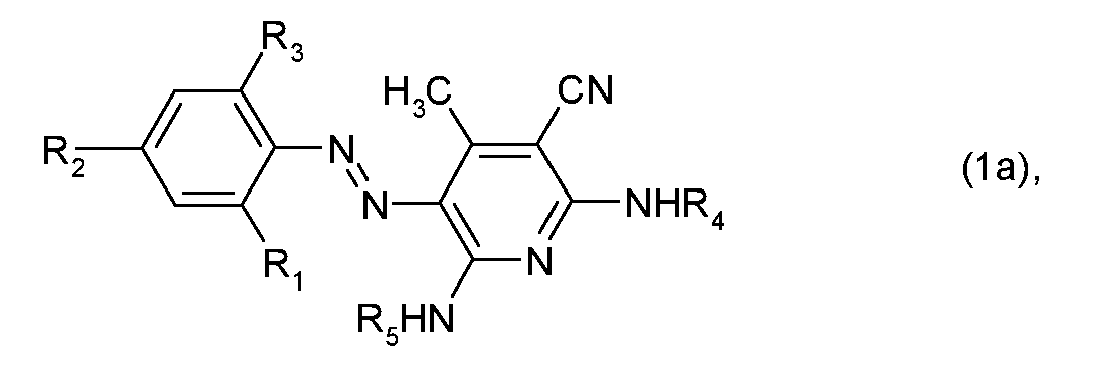
[0014] Preference is given to dyes of formula (1) represented by formula
wherein R1 is fluoro or trifluoromethyl,
R2 denotes fluoro, chloro, bromo or nitro,
R3 represents hydrogen, bromo, cyano or nitro, and
R4 and R5 are as defined above.
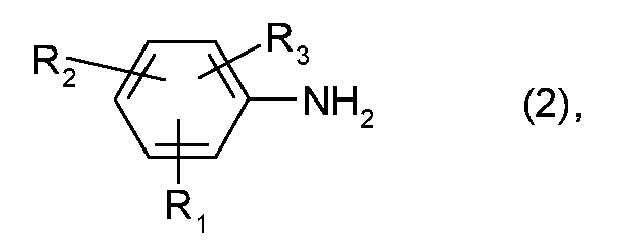
[0016] The invention relates also to a process for the preparation of an azo dye of formula (1) as defined above, wherein a compound of formula
wherein R1, R2 and R3 are as defined above,
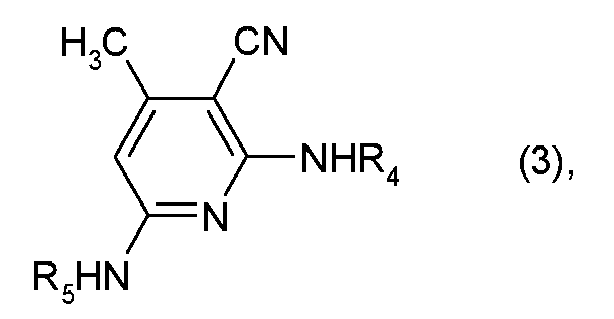
is diazotised in accordance with a customary procedure and then coupled to a coupling component of formula
wherein R4 and R5 are as defined above.
[0017] The anilines of formula (2) are known or can be prepared according to known methods. Some are commercially available.
[0018] Suitable anilines of formula (2) are, for example, 3-trifluoromethyl-6-methylaniline, 3-trifluoromethyl-4-methylaniline, 2-chloro-4-trifluoromethoxyaniline, 2-chloro-4-trifluoromethylaniline, 2-chloro-5-trifluoromethylaniline, 4-chloro-2-trifluoromethylaniline, 4-chloro-3-trifluoromethylaniline, 3,5-bis-(trifluoromethyl)aniline, 3-trifluoromethyl-4-cyanoaniline, 3-trifluoromethyl-4-nitroaniline, 2-bromo-4-trifluoromethoxyaniline, 4-bromo-2-trifluoromethoxyaniline, 2-bromo-4-trifluoromethylaniline, 2-bromo-5-trifluoromethylaniline, 4-bromo-2-trifluoromethylaniline, 4-bromo-3-trifluoromethylaniline, 2-fluoro-3-trifluoromethylaniline, 2-fluoro-5-trifluoromethylaniline, 2-fluoro-6-trifluoromethylaniline, 4-fluoro-2-trifluoromethylaniline, 4-fluoro-3-trifluoromethylaniline, 2-nitro-4-trifluoromethylaniline, 3-nitro-6-trifluoromethylaniline, 4-nitro-2-trifluoromethylaniline, 2,4-dinitro-6-trifluoromethylaniline, 2-bromo-4-nitro-6-trifluoromethylaniline and 2-cyano-4-nitro-6-trifluoromethylaniline
[0019] The coupling components of formula (3) are likewise known or are obtainable by known methods, for example by the process described in US 3,853,895.
According to this process, 2,6-dichloro-3-cyano-4-methylpyridine is successively reacted with ammonia and an optionally substituted aniline. Due to the different reactivities of both chlorine atoms in the educt, two isomeric products are usually obtained.
For example, reaction of 2,6-dichloro-3-cyano-4-methylpyridine with aniline in the first step yields a mixture of 2-phenylamino-3-cyano-4-methyl-6-chloropyridine and 2-chloro-3-cyano-4-methyl-6- phenylaminopyridine.
Accordingly, the final product obtained by subsequent reaction with ammonia mainly consists of 2-phenylamino-3-cyano-4-methyl-6-aminopyridine and 2-amino-3-cyano-4-methyl-6- phenylaminopyridine in the same ratio of isomers.
[0020] The invention therefore also relates to dye mixtures comprising at least two structurally different azo dyes of formula (1) according to claim 1.
[0021] The diazotisation is carried out in a manner known per se, for example with sodium nitrite in an acidic, e.g. hydrochloric-acid-containing or sulfuric-acid-containing, aqueous medium. The diazotisation may, however, also be carried out using other diazotisation agents, for example using nitrosylsulfuric acid. In the diazotisation, an additional acid may be present in the reaction medium, for example phosphoric acid, sulfuric acid, acetic acid, propionic acid or hydrochloric acid or a mixture of such acids, for example a mixture of propionic acid and acetic acid. The diazotisation is advantageously carried out at temperatures of from -10 to 30°C, for example from -10°C to room temperature.
[0022] The coupling of the diazotised compound to the coupling component of formula (3) is likewise effected in known manner, for example in an acidic, aqueous or aqueous-organic medium, advantageously at temperatures of from -10 to 30°C, especially below 10°C. Examples of acids used are hydrochloric acid, acetic acid, propionic acid, sulfuric acid and phosphoric acid.
[0023] The present invention relates also to dye mixtures comprising at least one dye of formula (1) and at least one dye other than of formula (1).
[0024] Suitable dyes which can advantageously be mixed with the dyes of formula (1) according to the invention are, for example, C.I. Disperse Yellow 42, C.I. Disperse Yellow 51. C.I. Disperse Yellow 65, C.I. Disperse Yellow 251, C.I. Solvent Yellow 163, C.I. Disperse Orange 157, Palanil Red FFB, C.I. Disperse Red 55, C.I. Disperse Red 55:1, C.I. Disperse Red 59, C.I. Disperse Red 60, C.I. Disperse Red 75, C.I. Disperse Red 86, C.I. Disperse Red 91, C.I. Disperse Red 92, C.I. Disperse Red 133, C.I. Disperse Red 146, C.I. Disperse Red 191, C.I. Disperse Red 279, C.I. Disperse Red 302, C.I. Disperse Red 302:1, C.I. Disperse Red 380, C.I. Disperse Red 381, C.I. Disperse Red 385, C.I. Disperse Violet 57, C.I. Disperse Blue 27, C.I. Disperse Blue 54, C.I. Disperse Blue 56, C.I. Disperse Blue 60, C.I. Disperse Blue 77 and C.I. Disperse Blue 379.
[0025] The dye mixtures according to the invention can be prepared, for example, by simply mixing the individual dyes.
[0026] The amount of the individual dyes in the dye mixtures according to the invention can vary within a wide range.
The dye mixtures according to the invention advantageously contain at least 10 % by weight, preferably at least 20 % by weight and especially at least 40 % by weight, of one or more dyes of formula (1).
[0027] The dyes and dye mixtures according to the invention can be used in the dyeing or printing of semi-synthetic and, especially, synthetic hydrophobic fibre materials, more especially textile materials. Textile materials composed of blends that contain such semi-synthetic and/or synthetic hydrophobic fibre materials can likewise be dyed or printed using the dyes or dye mixtures according to the invention.
[0028] Semi-synthetic fibre materials that come into consideration are especially cellulose 2½ acetate and cellulose triacetate.
[0029] Synthetic hydrophobic fibre materials consist especially of linear, aromatic polyesters, for example those of terephthalic acid and glycols, especially ethylene glycol, or condensation products of terephthalic acid and 1,4-bis(hydroxymethyl)cyclohexane; of polycarbonates, for example those of α,α-dimethyl-4,4-dihydroxy-diphenylmethane and phosgene, and of fibres based on polyvinyl chloride and on polyamide.
[0030] The application of the dyes and dye mixtures according to the invention to the fibre materials is effected in accordance with known dyeing procedures. For example, polyester fibre materials are dyed in the exhaust process from an aqueous dispersion in the presence of customary anionic or non-ionic dispersants and optionally customary swelling agents (carriers) at temperatures of from 80 to 140°C. Cellulose 2½ acetate is dyed preferably at from 65 to 85°C and cellulose triacetate at temperatures of from 65 to 115°C.
[0031] The dyes and dye mixtures according to the invention will not colour wool and cotton present at the same time in the dyebath or will colour such materials only slightly (very good reservation), so that they can also be used satisfactorily in the dyeing of polyester/wool and polyester/cellulosic fibre blend fabrics.
[0032] The dyes and dye mixtures according to the invention are suitable for dyeing in accordance with the thermosol process, in the exhaust process and for printing processes.
[0033] The said fibre materials can be in a variety of processing forms, e.g. in the form of fibres, yarns or non-wovens, in the form of woven fabrics or knitted fabrics.
[0034] It is advantageous to convert the dyes and dye mixtures according to the invention into a dye preparation prior to use. For that purpose, the dye is ground so that its particle size is on average from 0.1 to 10 microns. The grinding can be carried out in the presence of dispersants. For example, the dried dye is ground with a dispersant or is kneaded in paste form with a dispersant and then dried in vacuo or by atomisation. The preparations so obtained can be used, after the addition of water, to prepare print pastes and dyebaths.
[0035] For printing, the customary thickeners will be used, e.g. modified or unmodified natural products, for example alginates, British gum, gum arabic, crystal gum, locust bean flour, tragacanth, carboxymethylcellulose, hydroxyethylcellulose, starch or synthetic products, for example polyacrylamides, polyacrylic acid or copolymers thereof, or polyvinyl alcohols.
[0036] The dyes and dye mixtures according to the invention impart to the mentioned materials, especially to polyester materials, level colour shades having very good in-use fastness properties, such as, especially, good fastness to light, to thermofixing, to pleating, to chlorine and to wetting, such as fastness to water, to perspiration and to washing; the finished dyeings are also distinguished by very good fastness to rubbing. Special mention should be made of the good fastness properties of the resulting dyeings in respect of light, especially hot light.
[0037] The dyes and dye mixtures according to the invention can also be used satisfactorily in the preparation of mixed shades together with other dyes.
[0038] The dyes and dye mixtures according to the invention are also very suitable for dyeing hydrophobic fibre materials from supercritical CO2.
[0039] The present invention relates also to the above-mentioned use of the dyes and dye mixtures according to the invention as well as to a process for the dyeing or printing of semi-synthetic or synthetic hydrophobic fibre materials, especially textile materials, wherein a dye according to the invention is applied to the said materials or is incorporated into those materials. The said hydrophobic fibre materials are preferably textile polyester materials. Further substrates that can be treated by the process according to the invention as well as preferred process conditions can be found above in the detailed description of the use of the dyes according to the invention.
[0040] The invention relates also to hydrophobic fibre materials, especially polyester textile materials, dyed or printed by the said process.
The dyes according to the invention are also suitable for modern reproduction processes, for example thermotransfer printing.
[0041] The following Examples serve to illustrate the invention. In the Examples, unless otherwise indicated, parts are parts by weight and percentages are percent by weight. The temperatures are given in degrees Celsius. The relationship between parts by weight and parts by volume is the same as that between grams and cubic centimetres.
I. Preparation Examples
Example 1.1
A. Diazotisation
[0042] 10.67 g of 1 M-nitrosylsulfuric acid are placed in a laboratory reaction apparatus. At 15 - 20°C, 3.2 g of 2,4-dibromo-6-trifluoromethylaniline are introduced. After being stirred for
[0043] 2 hours at 15 - 20°C, the mixture is poured into 80 g of ice-water and stirred for a further 10 min. The excess nitrite is destroyed by addition of sulfamic acid.
B. Coupling
[0044] 2.3 g of a mixture of 2-phenylamino-3-cyano-4-methyl-6-aminopyridine and 2-amino-3-cyano-4-methyl-6-phenylaminopyridine in 40 ml of 80 % acetic acid are placed in a laboratory reaction apparatus and 2 drops of Surfynol 104 E (2,4,7,9-tetramethyl-5-decyne-4,7-diol) are added thereto. After addition of 30 g of ice, the solution of the diazonium salt prepared under A is slowly added dropwise so that the internal temperature is < 15°C. The mixture is stirred for 1 hour, while the temperature is kept < 15°C by addition of ice and pH is adjusted to 3.0 to 3.5 by addition of 30% NaOH. After heating to 50 °C, the mixture is stirred for 30 min and afterwards the solid is filtered off with suction, washed with deionised water and dried. 4.8 g (8.6 mmol, 86 % yield) of a mixture of golden yellow dyes of formulae (101a) and (101b) is obtained.
Example 1.2
A. Diazotation
[0045] 3.2 g of 2-chloro-5-trifluoromethylaniline are dissolved in 20 g of 50 % sulfuric acid at room temperature. 0.1 g of ice and 5.55 g of 1 M-nitrosylsulfuric acid are added under stirring. After being stirred for 5 hours at 15 - 20°C, the mixture is poured into 65 ml of acetic acid and stirred for a further 10 min. The excess nitrite is destroyed by addition of 0.5 g of sulfamic acid.
B. Coupling
[0046] 3.58 g of a mixture of 2-phenylamino-3-cyano-4-methyl-6-aminopyridine and 2-amino-3-cyano-4-methyl-6-phenylaminopyridine are added to at 5 °C to a solution of 0.5 g of Surfynol 104 E (2,4,7,9-tetramethyl-5-decyne-4,7-diol) and 0.5 g of Baykanol® (dispersing agent, supplied by Lanxess) in 65 ml of 80 % acetic acid. The solution of the diazonium salt prepared under A is slowly added dropwise under cooling so that the internal temperature is 0 - 5°C. Subsequently, the mixture is stirred until the internal temperature is about room temperature and afterwards the solid is filtered off with suction, washed with deionised water and dried. 6.1 g (14 mmol, 88 % yield) of a mixture of dyes of formulae (102a) and (102b) is obtained.
[0047] The dyes (102) - (106) listed in Table 1 are prepared analogously to the process described in Example I.1.
II. Application Examples
Example II.1:
1. A dye of formula
wherein R1 is fluoro, trifluoromethyl, trifluoromethoxy or trifluoromethylsulfonyl,
R2 and R3 each independently of the other represent hydrogen, C1-C12alkyl, C1-C12alkoxy, halogen, cyano, nitro, trifluoromethyl or -COOR6, wherein R6 is C1-C12alkyl unsubstituted or substituted by one or more C1-C12alkoxy groups, hydroxyl groups, amino groups or halogen atoms,
R4 and R5 denote hydrogen or phenyl that is unsubstituted or substituted with one or more C1-C12alkyl, C1-C12alkoxy or trifluoromethyl groups,
with the proviso that one of the radicals R4 and R5 is hydrogen and the other is unsubstituted or substituted phenyl,
and with the proviso that in case R1 represents trifluoromethyl in ortho-position to the azo group, at least one of R2 and R3 is not hydrogen.
wherein R1 is fluoro, trifluoromethyl, trifluoromethoxy or trifluoromethylsulfonyl,
R2 and R3 each independently of the other represent hydrogen, C1-C12alkyl, C1-C12alkoxy, halogen, cyano, nitro, trifluoromethyl or -COOR6, wherein R6 is C1-C12alkyl unsubstituted or substituted by one or more C1-C12alkoxy groups, hydroxyl groups, amino groups or halogen atoms,
R4 and R5 denote hydrogen or phenyl that is unsubstituted or substituted with one or more C1-C12alkyl, C1-C12alkoxy or trifluoromethyl groups,
with the proviso that one of the radicals R4 and R5 is hydrogen and the other is unsubstituted or substituted phenyl,
and with the proviso that in case R1 represents trifluoromethyl in ortho-position to the azo group, at least one of R2 and R3 is not hydrogen.
2. A dye of formula (1) according to claim 1, wherein R1 is fluoro or trifluoromethyl.
3. A dye of formula (1) according to claim 1 or 2, wherein R2 and R3 denote hydrogen, fluoro, chloro, bromo, cyano or nitro.
4. A dye of formula (1) according to any of the preceding claims, wherein R4 and R5 denote hydrogen or phenyl substituted with trifluoromethyl, n-propyl, n-butyl or
n-butoxy.
5. A dye of formula (1) according to claim 1 represented by formula
wherein R1 is fluoro or trifluoromethyl,
R2 denotes fluoro, chloro, bromo or nitro,
R3 represents hydrogen, bromo, cyano or nitro, and
R4 and R5 are as defined in claim 1.
wherein R1 is fluoro or trifluoromethyl,
R2 denotes fluoro, chloro, bromo or nitro,
R3 represents hydrogen, bromo, cyano or nitro, and
R4 and R5 are as defined in claim 1.
6. A dye of formula (1 a) according to claim 5, wherein R4 and R5 are hydrogen or phenyl.
7. A process for the preparation of an azo dye of formula (1) according to claim 1, wherein
a compound of formula
wherein R1, R2 and R3 are as defined in claim 1,
is diazotised in accordance with a customary procedure and then coupled to a coupling component of formula
wherein R4 and R5 are as defined in claim 1.
wherein R1, R2 and R3 are as defined in claim 1,
is diazotised in accordance with a customary procedure and then coupled to a coupling component of formula
wherein R4 and R5 are as defined in claim 1.
8. A dye mixture comprising at least two structurally different azo dyes of formula (1)
according to claim 1.
9. A process for the dyeing or printing of a semi-synthetic or synthetic hydrophobic
fibre material, wherein a dye of formula (1) according to claim 1 or a dye mixture
according to claim 14 is applied to the said material or is incorporated into that
material.
10. Use of a dye of formula (1) according to claim 1 in the dyeing or printing of semi-synthetic
and, especially, synthetic hydrophobic fibre materials, more especially textile materials.
1. Farbstoff der Formel
worin R1 Fluor, Trifluormethyl, Trifluormethoxy oder Trifluormethylsulfonyl ist, R2 und R3 jeweils unabhängig voneinander Wasserstoff, C1-C12-Alkyl, C1-C12-Alkoxy, Halogen, Cyano, Nitro, Trifluormethyl oder -COOR6, worin R6 C1-C12-Alkyl, unsubstituiert oder durch eine oder mehrere C1-C12-Alkoxygruppen, Hydroxylgruppen, Aminogruppen oder Halogenatome substituiert, ist, darstellen,
R4 und R5 Wasserstoff oder Phenyl, welches unsubstituiert oder durch ein oder mehrere C1-C12-Alkyl-, C1-C12-Alkoxy- oder Trifluormethylgruppen substituiert ist, bezeichnen,
mit der Maßgabe, dass einer der Reste R4 und R5 Wasserstoff ist und der andere unsubstituiertes oder substituiertes Phenyl ist,
und mit der Maßgabe, dass, wenn R1 Trifluormethyl in ortho-Position zu der Azo-Gruppe darstellt, mindestens eines aus R2 und R3 nicht Wasserstoff ist.
worin R1 Fluor, Trifluormethyl, Trifluormethoxy oder Trifluormethylsulfonyl ist, R2 und R3 jeweils unabhängig voneinander Wasserstoff, C1-C12-Alkyl, C1-C12-Alkoxy, Halogen, Cyano, Nitro, Trifluormethyl oder -COOR6, worin R6 C1-C12-Alkyl, unsubstituiert oder durch eine oder mehrere C1-C12-Alkoxygruppen, Hydroxylgruppen, Aminogruppen oder Halogenatome substituiert, ist, darstellen,
R4 und R5 Wasserstoff oder Phenyl, welches unsubstituiert oder durch ein oder mehrere C1-C12-Alkyl-, C1-C12-Alkoxy- oder Trifluormethylgruppen substituiert ist, bezeichnen,
mit der Maßgabe, dass einer der Reste R4 und R5 Wasserstoff ist und der andere unsubstituiertes oder substituiertes Phenyl ist,
und mit der Maßgabe, dass, wenn R1 Trifluormethyl in ortho-Position zu der Azo-Gruppe darstellt, mindestens eines aus R2 und R3 nicht Wasserstoff ist.
2. Farbstoff der Formel (1) nach Anspruch 1, worin R1 Fluor oder Trifluormethyl ist.
3. Farbstoff der Formel (1) nach Anspruch 1 oder 2, worin R2 und R3 Wasserstoff, Fluor, Chlor, Brom, Cyano oder Nitro sind.
4. Farbstoff der Formel (1) nach einem der vorangehenden Ansprüche, worin R4 und R5 Wasserstoff oder mit Trifluormethyl, n-Propyl, n-Butyl oder n-Butoxy substituiertes
Phenyl sind.
5. Farbstoff der Formel (1) nach Anspruch 1, dargestellt durch Formel
worin R1 Fluor oder Trifluormethly ist,
R2 Fluor, Chlor, Brom oder Nitro darstellt,
R3 Wasserstoff, Brom, Cyano oder Nitro ist, und
R4 und R5 wie in Anspruch 1 definiert sind.
worin R1 Fluor oder Trifluormethly ist,
R2 Fluor, Chlor, Brom oder Nitro darstellt,
R3 Wasserstoff, Brom, Cyano oder Nitro ist, und
R4 und R5 wie in Anspruch 1 definiert sind.
6. Farbstoff der Formel (1a) nach Anspruch 5, worin R4 und R5 Wasserstoff oder Phenyl sind.
7. Verfahren zur Herstellung eines Azo-Farbstoffs der Formel (1) nach Anspruch 1, worin
eine Verbindung der Formel
worin R1, R2 und R3 wie in Anspruch 1 definiert sind,
gemäß einem herkömmlichen Verfahren diazotiert wird und anschließend an eine Kupplungskomponente der Formel
gekuppelt wird, worin R4 und R5 wie in Anspruch 1 definiert sind.
worin R1, R2 und R3 wie in Anspruch 1 definiert sind,
gemäß einem herkömmlichen Verfahren diazotiert wird und anschließend an eine Kupplungskomponente der Formel
gekuppelt wird, worin R4 und R5 wie in Anspruch 1 definiert sind.
8. Farbstoffmischung, umfassend mindestens zwei strukturell unterschiedliche AzoFarbstoffe
der Formel (1) nach Anspruch 1.
9. Verfahren zum Färben oder Bedrucken eines halbsynthetischen oder synthetischen hydrophoben
Fasermaterials, worin ein Farbstoff der Formel (1) nach Anspruch 1 oder eine Farbstoffmischung
nach Anspruch 8 auf das Material aufgetragen oder in das Material inkorporiert wird.
10. Verwendung eines Farbstoffs der Formel (1) nach Anspruch 1 in der Farbgebung oder
Bedruckung von halbsynthetischen und insbesondere synthetischen hydrophoben Fasermaterialien,
insbesondere Textilmaterialien.
1. Colorant de formule :
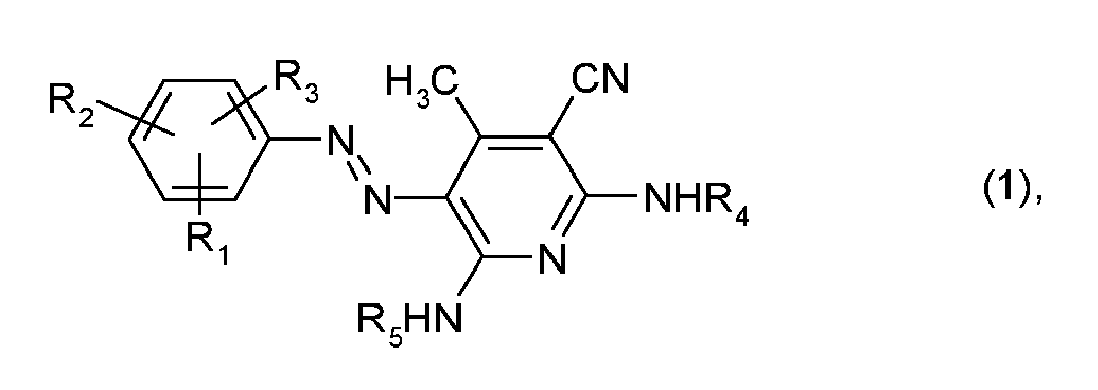
dans laquelle R1 représente fluoro, trifluorométhyle, trifluorométhoxy ou trifluorométhylsulfonyle,
R2 et R3 représentent chacun indépendamment de l'autre hydrogène, alkyle en C1-C12, alcoxy en C1-C12, halogène, cyano, nitro, trifluorométhyle ou -COOR6, R6 représentant alkyle en C1-C12 non substitué ou substitué par un ou plusieurs groupes alcoxy en C1-C12, groupes hydroxyle, groupes amino ou atomes d'halogène,
R4 et R5 désignent hydrogène ou phényle qui est non substitué ou substitué par un ou plusieurs groupes alkyle en C1-C12, alcoxy en C1-C12 ou trifluorométhyle,
à la condition que l'un des radicaux R4 et R5 représente hydrogène et que l'autre représente phényle non substitué ou substitué,
et à la condition que, dans le cas où R1 représente trifluorométhyle dans la position ortho au groupe azoïque, au moins l'un parmi R2 et R3 ne représente pas hydrogène.
dans laquelle R1 représente fluoro, trifluorométhyle, trifluorométhoxy ou trifluorométhylsulfonyle,
R2 et R3 représentent chacun indépendamment de l'autre hydrogène, alkyle en C1-C12, alcoxy en C1-C12, halogène, cyano, nitro, trifluorométhyle ou -COOR6, R6 représentant alkyle en C1-C12 non substitué ou substitué par un ou plusieurs groupes alcoxy en C1-C12, groupes hydroxyle, groupes amino ou atomes d'halogène,
R4 et R5 désignent hydrogène ou phényle qui est non substitué ou substitué par un ou plusieurs groupes alkyle en C1-C12, alcoxy en C1-C12 ou trifluorométhyle,
à la condition que l'un des radicaux R4 et R5 représente hydrogène et que l'autre représente phényle non substitué ou substitué,
et à la condition que, dans le cas où R1 représente trifluorométhyle dans la position ortho au groupe azoïque, au moins l'un parmi R2 et R3 ne représente pas hydrogène.
2. Colorant de la formule (1) selon la revendication 1, dans lequel R1 représente fluoro ou trifluorométhyle.
3. Colorant de la formule (1) selon l'une des revendications 1 ou 2, dans lequel R2 et R3 désignent hydrogène, fluoro, chloro, bromo, cyano ou nitro.
4. Colorant de la formule (1) selon l'une quelconque des revendications précédentes,
dans lequel R4 et R5 désignent hydrogène ou phényle substitué par trifluorométhyle, n-propyle, n-butyle
ou n-butoxy.
5. Colorant de la formule (1) selon la revendication 1 représenté par la formule :
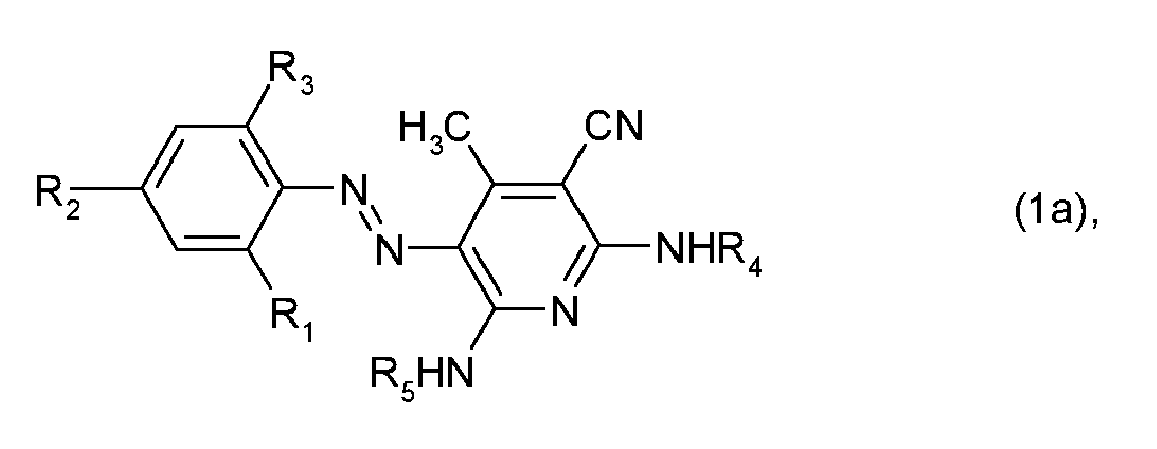
dans laquelle
R1 représente fluoro ou trifluorométhyle,
R2 désigne fluoro, chloro, bromo ou nitro,
R3 représente hydrogène, bromo, cyano ou nitro, et
R4 et R5 sont tels que définis dans la revendication 1.
dans laquelle
R1 représente fluoro ou trifluorométhyle,
R2 désigne fluoro, chloro, bromo ou nitro,
R3 représente hydrogène, bromo, cyano ou nitro, et
R4 et R5 sont tels que définis dans la revendication 1.
6. Colorant de la formule (1a) selon la revendication 5, dans lequel R4 et R5 représentent hydrogène ou phényle.
7. Procédé de préparation d'un colorant azoïque de formule (1) selon la revendication
1, dans lequel un composé de formule :
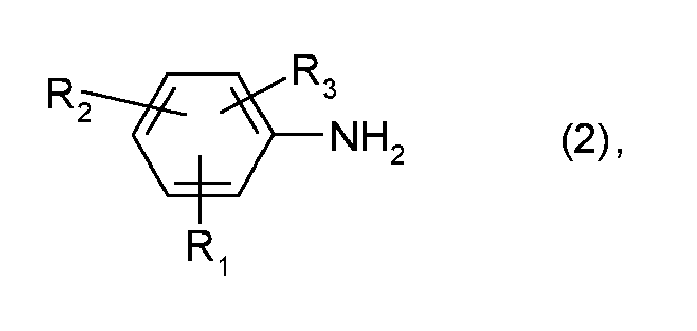
dans laquelle R1, R2 et R3 sont tels que définis dans la revendication 1,
est diazoté selon une mode opératoire habituel, puis couplé à un composant de couplage de formule :
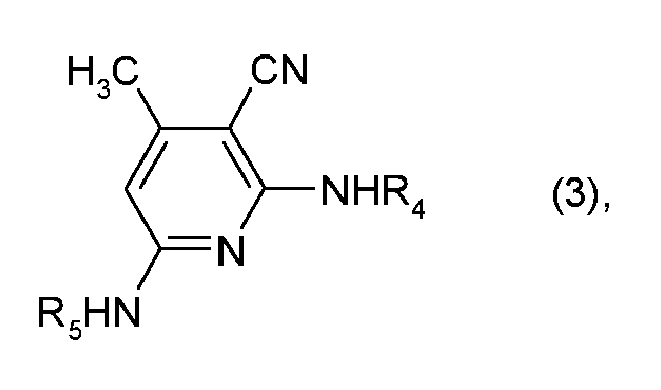
dans laquelle R4 et R5 sont tels que définis dans la revendication 1.
dans laquelle R1, R2 et R3 sont tels que définis dans la revendication 1,
est diazoté selon une mode opératoire habituel, puis couplé à un composant de couplage de formule :
dans laquelle R4 et R5 sont tels que définis dans la revendication 1.
8. Mélange de colorants comprenant au moins deux colorants azoïques de structures différentes
de formule (1) selon la revendication 1.
9. Procédé de coloration ou d'impression d'une matière fibreuse hydrophobe semi-synthétique
ou synthétique, dans lequel un colorant de formule (1) selon la revendication 1 ou
un mélange de colorants selon la revendication 14 est appliqué à ladite matière ou
est incorporé dans cette matière.
10. Utilisation d'un colorant de formule (1) selon la revendication 1 dans la coloration
ou l'impression de matières fibreuses hydrophobes semi-synthétiques, et notamment
synthétiques, plus particulièrement de matières textiles.
REFERENCES CITED IN THE DESCRIPTION
This list of references cited by the applicant is for the reader's convenience only. It does not form part of the European patent document. Even though great care has been taken in compiling the references, errors or omissions cannot be excluded and the EPO disclaims all liability in this regard.
Patent documents cited in the description