|
(11) | EP 2 497 817 B1 |

| (12) | EUROPEAN PATENT SPECIFICATION |
|
|
| (54) |
USE OF A MARINE LUBRICATING OIL COMPOSITE ADDITIVE VERWENDUNG VON SCHMIERÖLKONZENTRATEN FÜR SCHIFFSÖLE UTILISATION D' UN ADDITIF COMPOSITE D'HUILE LUBRIFIANTE MARINE |
|
|
|||||||||||||||||||||||||||||||
| Note: Within nine months from the publication of the mention of the grant of the European patent, any person may give notice to the European Patent Office of opposition to the European patent granted. Notice of opposition shall be filed in a written reasoned statement. It shall not be deemed to have been filed until the opposition fee has been paid. (Art. 99(1) European Patent Convention). |
FIELD OF THE INVENTION
[0001] The present invention relates to use of a marine lubricating oil composite additive for cylinder oils in shipborne BOB systems.
BACKGROUND OF THE INVENTION
[0002] The current BOB (Blender-on-Board) online blending system equipped on ocean vessels is an automatic control system that blends the marine system oil with a composite additive which is designed for the marine lubricating oils in the BOB system so as to provide a cylinder lubricating oil that have an optional target base number, and such cylinder lubricating oil can be rapidly transferred to the engine in order to meet the different requirements for the base number of the cylinder lubricating oil in cases of using fuels with different sulfur contents. A schematic diagram for the operating principle of BOB online blending system is shown in Figure 1.
[0003] The operating procedure of the BOB system is as follows: the system oil is pumped from the main oil tank to each lubrication point of the engine so as to provide lubrication and thereafter recycled back to the main oil tank, wherein part of the system oil is side-drawn and then blended with a composite additive in the BOB blending device to form a cylinder oil with required base numbers, which is burned off after fulfilling lubrication, and the residue thereof flows into a waste oil tank. The composite additives designed for the BOB system are remarkably different from the traditional marine lubricating oils. The later are lubricating oil products with fixed base numbers, which are produced in blending plants and may be directly used by adding into the oil tank of vessels, whereas the former are additives produced by blending plants and blended with the system oil before adding into a tank of vessels so as to provide marine cylinder lubricating oils with different base numbers in order to meet the requirement of the use in engines.
[0004] Therefore, the composite additives designed for the BOB system have several features in terms of the technical requirement:
- 1. Sufficient antiwear and antioxidization properties should be preserved when relatively low dosage is used;
- 2. Good compatibility to system oils under different brands;
- 3. The composite additive should satisfy the requirement of being pumped within the BOB system and fit with the blending system.
[0005] According to the novelty search within Chinese and worldwide patents, no related reference documents are found in the field of both shipborne BOB online blending system and the composite additive designed the BOB system.
[0006] In the light of the disclosure reported by related Chinese and worldwide patents, it is known that the binary detergent system composed by a sulfonate detergent and a phenolate detergent is widely used in the formulation of the cylinder oil at present. Meanwhile, the above two primary additives of sulfonate and phenolate detergents are both easy to purchase and cheap in price in the international market.
[0007] EP 1 640 442 A1 discloses a method (and a corresponding system) of creating a cylinder oil, the method comprising modification of at least one initial fluid by determining a desired TBN(s) of the at least one initial fluid, determining a desired TBN of cylinder oil and adjusting the TBN(s) of the at least one initial fluid accordingly by blending the at least one initial fluid with suited additive(s). The suited additive(s) comprise at least on base, wherein the at least one base comprise basic salts of alkaline or earth alkaline elements, and/or detergents and/or dispersants.
[0008] EP 1126010 A1 disclosed a lubricating oil composition comprising a major amount of a base oil of lubricating viscosity, an overbased sulfurized alkylphenate detergent, an overbased alkylsulfonate detergent, an ashless dispersant, and a zinc dialkyldithiophosphate or of a zinc diaryidithiophosphate, wherein the weight ratio between the overbased sulfurized alkylphenate detergent and the overbased alkylsulfonate detergent is in the range of 55:45 to 95:5.
[0009] With an aim to the world market of the marine lubricating oil, the establishment of an international blending and supplying network can, on one hand, expand the oil supplying network of PetroChina and improve the sale and service level, and can benefit to reducing the production cost so as to sharpen the competitive edge of self-owned brand products of PetroChina.
SUMMARY OF THE INVENTION
[0010] The purpose of the present invention is to provide a use of a marine lubricating oil composite additive, wherein the marine lubricating oil composite additive can not only satisfy the requirement of the marine BOB online blending system but also have wide adaptability.
[0011] The marine lubricating oil composite additive is characterized in that based on the total weight of the composite additive, it comprises: 25-45% sulfonate detergent with superhigh base number, 40-60% phenolate detergent with low base number, 0-8% dispersing agent, 0-4% antiwear agent, and 10-20% Group I base oil with high viscosity index.
[0012] Said sulfonate detergent with superhigh base number is C22-C30 linear alkyl benzene calcium sulphonate, wherein the base number thereof is 395-430 mgKOH/g.
[0013] Said phenolate detergent with low base number is C20-C25 alkyl sulfurized calcium phenolate, wherein the base number thereof is 240-265 mgKOH/g.
[0014] Said dispersing agent is selected from the group consisting of mono-polyisobutylene succinimide, bis-polyisobutylene succinimide and multi-polyisobutylene succinimide. Said antiwear agent is zinc long-chain alkyl thiophosphate with the structure corresponding to the following formula,
wherein Ri, R2, R3 and R4 are long-chain primary alkyl groups each comprising 12-18 carbon atoms, or Ri, R2, R3 and R4 are long-chain secondary alkyl groups each comprising 12-16 carbon atoms.
[0015] Said base oil is Group I base oil with high viscosity index which is selected from the group consisting of 400SN, 500SN and 600SN, the kinematic viscosity of which is 8.5-11.5 cst at 100°C. The appropriate base oils are commercially available from PetroChina Company.
[0016] The marine lubricating oil composite additive employs two composed detergents supplemented by antiwear agent and dispersing agent, and takes advantage of not only the excellent detergency and dispersion performance of the sulfonate detergent with superhigh base number but also the excellent antiwear and antioxidization performance of the phenolate detergent with low base number. The formulation of composite additive is optimized so as to satisfy the requirement of the BOB online blending system.
[0017] The technical features of the present invention are as follows: the requirement of BOB system process for the viscosity and base number can be satisfied; the composite additive is compatible with many system oils under typical foreign brands, and the formulated cylinder lubricating oils with different base numbers have excellent performances in terms of antiwear, antioxidization and high temperature detergency. The present composite additive has been tested by sailing over 4000 hours, and has been technically certified by MAN B&W, the engine OEM (original equipment manufacturer).
DESCRIPTION OF DRAWINGS
[0018] Figure 1 shows a schematic diagram for the operating principle of BOB online blending system. Figure 2 shows the monitoring data for samples of the fresh/waste cylinder oils using the composite additive of the present application during the sailing.
DETAILED DESCRIPTION OF THE INVENTION
Example 1:
[0019] The composite additive used in BOB system may be prepared from the components mentioned below (their contents in weight percentage are also given in detail) by means of normal process. The blending process is as follows: the base oil is firstly added into a blending barrel/tank, and then the temperature is raised to 65±5°C, wherein the base oil should have a kinematic viscosity of 7.0-12.0 mm2/s at 100°C; the antiwear agent, the dispersing agent and the detergents are subsequently introduced into said blending barrel/tank, and stirring is carried out at 65±5°C for 2 hours until completely homogeneous. The above process is implemented in every example hereafter.
[0020] In this example, the sulfonate with superhigh base number is calcium long-chain linear alkyl benzene sulphonate with superhigh base number wherein the long-chain linear alkyl group comprises 22 carbon atoms, and the base number thereof is 430 mgKOH/g. The sulfurized alkyl phenolate with low base number is sulfurized calcium long-chain alkyl phenolate wherein the alkyl group comprises 25 carbon atoms, and the base number thereof is 240 mgKOH/g. The antiwear agent is zinc long-chain primary alkyl thiophosphate wherein the long-chain primary alkyl group comprises 12 carbon atoms. The dispersing agent is bis-polyisobutylene succinimide. The base oil is group I base oil 600SN available from PetroChina Daqing Petrochemical Company.
| Components | Contents (%) |
| Linear alkyl (C22) calcium sulfonate with superhigh base number | 25 |
| Sulfurized calcium alkyl (C25) phenolate with low base number | 55 |
| Zinc primary alkyl (C12) thiophosphate | 2 |
| Bis-polyisobutylene succinimide | 8 |
| Group I base oil of 600SN | 10 |
Example 2:
[0021] The composite additive used in BOB system may be prepared from the components mentioned below (their contents in weight percentage are also given in detail) by means of normal process.
[0022] In this example, the sulfonate with superhigh base number is calcium long-chain linear alkyl benzene sulphonate with superhigh base number wherein the long-chain linear alkyl group comprises 30 carbon atoms, and the base number thereof is 395 mgKOH/g. The sulfurized alkyl phenolate with low base number is sulfurized calcium long-chain alkyl phenolate wherein the alkyl group comprises 20 carbon atoms, and the base number thereof is 265 mgKOH/g. The antiwear agent is zinc long-chain secondary alkyl thiophosphate wherein the long-chain secondary alkyl group comprises 16 carbon atoms. The dispersing agent is multi-polyisobutylene succinimide. The base oil is group I base oil 500SN available from PetroChina Daqing Petrochemical Company.
| Components | Contents (%) |
| Linear alkyl (C30) calcium sulfonate with superhigh base number | 45 |
| Sulfurized calcium alkyl (C20) phenolate with low base number | 41 |
| Zinc secondary alkyl (C16) thiophosphate | 4 |
| Multi-polyisobutylene succinimide | 0 |
| Group I base oil of 500SN | 10 |
Example 3:
[0023] The composite additive used in BOB system may be prepared from the components mentioned below (their contents in weight percentage are also given in detail) by means of normal process.
[0024] In this example, the sulfonate with superhigh base number is calcium long-chain linear alkyl benzene sulphonate with superhigh base number wherein the long-chain linear alkyl group comprises 22 carbon atoms, and the base number thereof is 430 mgKOH/g. The sulfurized alkyl phenolate with low base number is sulfurized calcium long-chain alkyl phenolate wherein the alkyl group comprises 25 carbon atoms, and the base number thereof is 250 mgKOH/g. The antiwear agent is zinc long-chain primary alkyl thiophosphate wherein the long-chain primary alkyl group comprises 18 carbon atoms. The dispersing agent is bis-polyisobutylene succinimide. The base oil is group I base oil 400SN available from PetroChina Daqing Petrochemical Company.
| Components | Contents (%) |
| Linear alkyl (C22) calcium sulfonate with superhigh base number | 32 |
| Sulfurized calcium alkyl (C25) phenolate with low base number | 40 |
| Zinc primary alkyl (C18) thiophosphate | 0 |
| Bis-polyisobutylene succinimide | 8 |
| Group I base oil of 400SN | 20 |
Example 4:
[0025] The composite additive used in BOB system may be prepared from the components mentioned below (their contents in weight percentage are also given in detail) by means of normal process.
[0026] In this example, the sulfonate with superhigh base number is calcium long-chain linear alkyl benzene sulphonate with superhigh base number wherein the long-chain linear alkyl group comprises 22 carbon atoms, and the base number thereof is 430 mgKOH/g. The sulfurized alkyl phenolate with low base number is sulfurized calcium long-chain alkyl phenolate wherein the alkyl group comprises 25 carbon atoms, and the base number thereof is 240 mgKOH/g. The antiwear agent is zinc long-chain primary alkyl thiophosphate wherein the long-chain primary alkyl group comprises 12 carbon atoms. The dispersing agent is bis-polyisobutylene succinimide. The base oil is group I base oil 400SN available from PetroChina Daqing Petrochemical Company.
| Components | Contents (%) |
| Linear alkyl (C22) calcium sulfonate with superhigh base number | 28 |
| Sulfurized calcium alkyl (C25) phenolate with low base number | 60 |
| Zinc primary alkyl (C12) thiophosphate | 2 |
| Bis-polyisobutylene succinimide | 0 |
| Group I base oil of 400SN | 10 |
Example 5:
[0027] The composite additive used in BOB system may be prepared from the components mentioned below (their contents in weight percentage are also given in detail) by means of normal process.
[0028] In this example, the sulfonate with superhigh base number is calcium long-chain linear alkyl benzene sulphonate with superhigh base number wherein the long-chain linear alkyl group comprises 30 carbon atoms, and the base number thereof is 410 mgKOH/g. The sulfurized alkyl phenolate with low base number is sulfurized calcium long-chain alkyl phenolate wherein the alkyl group comprises 25 carbon atoms, and the base number thereof is 265 mgKOH/g. The antiwear agent is zinc long-chain primary alkyl thiophosphate wherein the long-chain primary alkyl group comprises 18 carbon atoms. The dispersing agent is multi-polyisobutylene succinimide. The base oil is group I base oil 600SN available from PetroChina Daqing Petrochemical Company.
| Components | Contents (%) |
| Linear alkyl (C30) calcium sulfonate with superhigh base number | 30 |
| Sulfurized calcium alkyl (C25) phenolate with low base number | 45 |
| Zinc primary alkyl (C18) thiophosphate | 4 |
| Multi-polyisobutylene succinimide | 6 |
| Group I base oil of 600SN | 15 |
Example 6:
[0029] The composite additive used in BOB system may be prepared from the components mentioned below (their contents in weight percentage are also given in detail) by means of normal process.
[0030] In this example, the sulfonate with superhigh base number is calcium long-chain linear alkyl benzene sulphonate with superhigh base number wherein the long-chain linear alkyl group comprises 22 carbon atoms, and the base number thereof is 410 mgKOH/g. The sulfurized alkyl phenolate with low base number is sulfurized calcium long-chain alkyl phenolate wherein the alkyl group comprises 20 carbon atoms, and the base number thereof is 300 mgKOH/g. The antiwear agent is zinc long-chain secondary alkyl thiophosphate wherein the long-chain secondary alkyl group comprises 12 carbon atoms. The dispersing agent is mono-polyisobutylene succinimide. The base oil is Group I base oil 500SN available from PetroChina Daqing Petrochemical Company.
| Components | Contents (%) |
| Linear alkyl (C22) calcium sulfonate with superhigh base number | 40 |
| Sulfurized calcium alkyl (C20) phenolate with low base number | 40 |
| Zinc secondary alkyl (C12) thiophosphate | 1 |
| Mono-polyisobutylene succinimide | 4 |
| Group I base oil of 500SN | 15 |
Example 7:
[0031] The composite additive used in BOB system may be prepared from the components mentioned below (their contents in weight percentage are also given in detail) by means of normal process.
[0032] In this example, the sulfonate with superhigh base number is calcium long-chain linear alkyl benzene sulphonate with superhigh base number wherein the long-chain linear alkyl group comprises 22 carbon atoms, and the base number thereof is 430 mgKOH/g. The sulfurized alkyl phenolate with low base number is sulfurized calcium long-chain alkyl phenolate wherein the alkyl group comprises 25 carbon atoms, and the base number thereof is 240 mgKOH/g. The antiwear agent is zinc long-chain primary alkyl thiophosphate wherein the long-chain primary alkyl group comprises 18 carbon atoms. The dispersing agent is bis-polyisobutylene succinimide. The base oil is group I base oil 400SN available from PetroChina Daqing Petrochemical Company.
| Components | Contents (%) |
| Linear alkyl (C22) calcium sulfonate with superhigh base number | 32 |
| Sulfurized calcium alkyl (C25) phenolate with low base number | 58 |
| Zinc primary alkyl (C18) thiophosphate | 0 |
| Bis-polyisobutylene succinimide | 0 |
| Group I base oil of 400SN | 10 |
[0033] The present invention provides a bis-detergent composite additive designed for the BOB system, and the physical and chemical properties of such composite additive are able to satisfy the requirement of Maersk Fluid Co. about the composite additive designed for the BOB system. The physical and chemical properties of the composite additives obtained by the above examples are listed in Table 1.
Table 1 Comparison of the physical and chemical properties of the bis-detergent cylinder
oil composite additives designed for the BOB system
| Item | Sample | Technical requirement | Method | ||||||
| Example 1 | Example 2 | Example 3 | Example 4 | Example 5 | Example 6 | Example 7 | |||
| Kinematic viscosity (100°C), mm2/s | 81.68 | 90.46 | 85.38 | 86.72 | 92.36 | 86.46 | 88.69 | ≤95 according to OEM | GB/T 265 |
| Base number, mgKOH/g | 305 | 295 | 310 | 290 | 292 | 302 | 298 | ≥285 according to OEM | SH/T 0251 |
| Density (20°C), kg/m3 | 1097.6 | 1085.5 | 1072.0 | 1095.0 | 1079.6 | 1105.4 | 1092.6 | Report | SH/T 0604 |
| Flash point (closed), °C | 185 | 186 | 192 | 178 | 184 | 198 | 186 | ≥150 | GB/T 261 |
| Moisture, % | 0.18 | 0.03 | 0.06 | 0.08 | 0.03 | 0.06 | 0.03 | ≤0.2 | GB/T 260 |
| Mechanical impurity, % | 0.032 | 0.012 | 0.020 | 0.030 | 0.018 | 0.028 | 0.032 | ≤0.1 | GB/T 511 |
| Sulfated ash, % | 32.96 | 36.68 | 38.42 | 37.61 | 34.98 | 35.29 | 30.64 | Report | GB/T 2433 |
[0034] The composite additive designed for the BOB system using double detergents used by the present invention is well compatible with system oil products under typical domestic and foreign brands, for example Exxon-Mobile
[0035] Company, BP Company and PetroChina. The performances of the formulated cylinder oils with different base numbers are individually studied by simulated experiments, and the results demonstrate that the cylinder oils with different base numbers maintain good combination property as for lubricating oil, for example the antioxidization, antiwear, detergency and water resisting performances and etc.
[0036] Herein, the antioxidization performance of the cylinder oil is evaluated according to the oxidative induction time which is measured by differential scanning calorimetry (PDSC). The antiwear performance is evaluated by the Pb value and the long wear extent which are obtained by four-ball test. The coking tests are carried out in order to test the detergency performance of the cylinder oil, while the gel tests are carried out so as to test the storage stability.
[0037] The bis-detergent composite additive designed for the BOB system formulated according to the formulation of Example 6 is blended with Exxon-Mobile system oil Mobilgard M300, BP system oil Energol OE-HT30 and Kunlun system oil DCC3008, respectively, so as to provide cylinder oils with the base numbers of 70 mgKOH/g, 60 mgKOH/g, 50 mgKOH/g and 40 mgKOH/g as shown in Tables 2, 3, 4 and 5.
Table 2 Physical and chemical properties of the cylinder oil with the base number
of 70 mgKOH/g and the simulated performance thereof
| Item | Unit | Mobilgard M300 | Energol OE-HT30 | KUNLUN DCC3008 | Method |
| Dosage of the composite additive, % | 22 | 22 | 21.2 | ||
| Viscosity, 100°C | mm2/s | 13.77 | 14.23 | 13.37 | GB/T 265 |
| Viscosity coefficient | - | 103 | 105 | 100 | ISO2909 |
| Base number | mgKOH /g | 69.7 | 69.4 | 69.4 | SH/T 0251 |
| Flash point | °C | 258 | 252 | 250 | GB/T 261 |
| Sulfated ash, % | w% | 7.49 | 7.85 | 7.38 | GB/T 2433 |
| Oxidative induction time by PDSC | min | 15.13 | 15.06 | 13.24 | SH/T 0719, the test condition is: 200°C, 3.0MPa, O2 |
| Pb value by four-ball test | N | 1254 | 1186 | 1186 | GB/T 3142 |
| Long wear extent by four-ball test | mm | 0.33 | 0.34 | 0.33 | SH/T 0189 |
| Coking test | mg | 12 | 18 | 16 | SH/T 0300 |
| Gel test | ml | 0.5 | 0.25 | 0.1 | 1% of water and 99% of oil are blended in the test tube, stirred by an agitator blade (2000 rpm) for 60 sec and stored at 70°C for 96 h. The precipitation amount at tube bottom is observed. |
Table 3 Physical and chemical properties of the cylinder oil with the base number
of 60 mgKOH/g and the simulated performance thereof
| Item | Unit | Mobilgard M300 | Energol OE-HT30 | KUNLUN DCC3008 | Method |
| Dosage of the composite additive, % | 18.64 | 18.64 | 17.8 | ||
| Viscosity, 100°C | mm2/ s | 13.26 | 13.70 | 12.82 | GB/T 265 |
| Viscosity coefficient | - | 103 | 105 | 102 | ISO2909 |
| Base number | mgK OH/g | 69.6 | 69.7 | 60.5 | SH/T 0251 |
| Flash point | °C | 254 | 254 | 258 | GB/T 261 |
| Sulfated ash, % | w% | 7.10 | 7.28 | 7.05 | GB/T 2433 |
| PDSC | min | 13.20 | 14.22 | 12.83 | SH/T 0719, the test condition is: 200°C, 3.0MPa, O2 |
| Pb value by four-ball test | N | 1186 | 1117 | 1186 | GB/T 3142 |
| Long wear extent by four-ball test | mm | 0.34 | 0.35 | 0.34 | SH/T 0189 |
| Coking test | mg | 16 | 22 | 9 | SH/T 0300 |
| Gel test | ml | 0.3 | 0.3 | 0.2 | 1% of water and 99% of oil are blended in the test tube, stirred by an agitator blade (2000 rpm) for 60 sec and stored at 70°C for 96 h. The precipitation amount at tube bottom is observed. |
Table 4 Physical and chemical properties of the cylinder oil with the base number
of 50 mgKOH/g and the simulated performance thereof
| Item | Unit | Mobilgard M300 | Energol OE-HT30 | KUNLUN DCC3008 | Method |
| Dosage of the composite additive, % | 15.25 | 15.25 | 14.38 | ||
| Viscosity, 100°C | mm2/ s | 12.89 | 13.36 | 12.36 | GB/T 265 |
| Viscosity coefficient | - | 101 | 105 | 101 | ISO2909 |
| Base number | mgK OH/g | 49.5 | 49.4 | 49.3 | SH/T 0251 |
| Flash point | °C | 252 | 260 | 252 | GB/T 261 |
| Sulfated ash, % | w% | 6.83 | 6.78 | 6.62 | GB/T 2433 |
| PDSC | min | 12.98 | 13.68 | 12.22 | SH/T 0719, the test condition is: 200°C, 3.0MPa, O2 |
| Pb value by four-ball test | N | 1117 | 1049 | 1117 | GB/T 3142 |
| Long wear extent by four-ball test | mm | 0.34 | 0.35 | 0.35 | SH/T 0189 |
| Coking test | mg | 19 | 26 | 12 | SH/T 0300 |
| Gel test | ml | 0.5 | 0.45 | 0.35 | 1% of water and 99% of oil |
| are blended in the test tube, stirred by an agitator blade (2000 rpm) for 60 sec and stored at 70°C for 96 h. The precipitation amount at tube bottom is observed. |
Table 5 Physical and chemical properties of the cylinder oil with the base number
of 40 mgKOH/g and the simulated performance thereof
| Item | Unit | Mobilgard M300 | Energol OE-HT30 | KUNLUN DCC3008 | Method |
| Dosage of the composite additive, % | 11.86 | 11.86 | 10.96 | ||
| Viscosity, 100°C | mm2/ s | 12.56 | 12.89 | 11.98 | GB/T 265 |
| Viscosity coefficient | - | 102 | 104 | 100 | ISO2909 |
| Base number | mgK OH/g | 39.8 | 39.2 | 40.2 | SH/T 0251 |
| Flash point | °C | 250 | 254 | 249 | GB/T 261 |
| Sulfated ash, % | w% | 6.53 | 6.39 | 6.31 | GB/T 2433 |
| PDSC | min | 12.74 | 13.34 | 11.96 | SH/T 0719, the test condition is: 200°C, 3.0MPa, O2 |
| Pb value by four-ball test | N | 1117 | 1117 | 1186 | GB/T 3142 |
| Long wear extent by four-ball test | mm | 0.34 | 0.35 | 0.34 | SH/T 0189 |
| Coking test | mg | 21 | 24 | 18 | SH/T 0300 |
| Gel test | ml | 0.4 | 0.25 | 0.5 | 1% of water and 99% of oil are blended in the test tube, stirred by an agitator blade (2000 rpm) for 60 sec and stored at 70°C for 96 h. The precipitation amount at tube bottom is observed. |
[0038] The composite additive designed for the BOB system using double detergents used by the present invention can be blended with system oils so as to provide cylinder oils that can satisfy the requirement of the engine. Such composite additive has been tested by sailing over 4000 hours wherein BP Energol OE-HT30 is used as the system oil by the vessel, and has been technically certified by MAN B&W. Samples of the fresh/waste cylinder oils using such composite additive during the sailing were monitored, and the data are illustrated in Figure 2. Throughout the test of 4000 hours, the base number of the cylinder oil formulated from the composite additive decreased from 70 mgKOH/g at the beginning, through 60 mgKOH/g and 50 mgKOH/g, to 40 mgKOH/g at the end. The entire sailing test could be divided into four stages according to the base number of the cylinder oil, and each stage lasted about 1000 hours. It can be clearly seen from Figure 2 that the residual base number in the waste oil was not notably decreased, and the Fe content resulted from the wear was not notably increased, either, that is, the both important index fluctuated within normal ranges.
- 1. The Fe content in the waste oil was never abnormally high, and the Fe content of all the samples was always less than 200 ppm, which satisfied the requirement of the engine OEM about the performance of cylinder oils;
- 2. The residue base number of the waste oil from the four different stages tended to decrease due to the decrease of the base number of fresh oils. Furthermore, even if the cylinder oil with a base number of 40 mgKOH/g was used, the residue base number in the waste oil was still above 12 mgKOH/g. It is shown that the composite additive has strong ability to "store" the base number, and thus effectively prevent the wear of engine parts to occur.
[0039] In conclusion, the cylinder lubricating oil maintained steady combination performance in case that the variation of the dosage of the composite additive reached the extent close to 50%, especially in terms of the antiwear performance under extreme pressure and the ability to preserve the base number. The test results sufficiently satisfied the requirement of the engine about the lubricating oil performance and were technically certified by the engine OEM.
1. Use of a marine lubricating oil composite additive for cylinder oils in shipborne
Blender-on-Board system, characterized in that, based on the total weight of the composite additive, it comprises: 25-45% sulfonate
detergent with superhigh base number, 40-60% phenolate detergent with low base number,
0-8% dispersing agent, 0-4% antiwear agent, and 10-20% Group I base oil with high
viscosity index which is selected from the group consisting of 400SN, 500SN and 600SN;
said sulfonate detergent with superhigh base number is C22-C30 linear alkyl benzene calcium sulphonate, wherein the base number thereof is 395-430 mgKOH/g;
said phenolate detergent with low base number is C20-C25 alkyl sulfurized calcium phenolate, wherein the base number thereof is 240-265 mgKOH/g;
said dispersing agent is selected from the group consisting of mono-polyisobutylene succinimide, bis-polyisobutylene succinimide and multi-polyisobutylene succinimide;
said antiwear agent is zinc long-chain alkyl thiophosphate with the structure corresponding to the following formula,
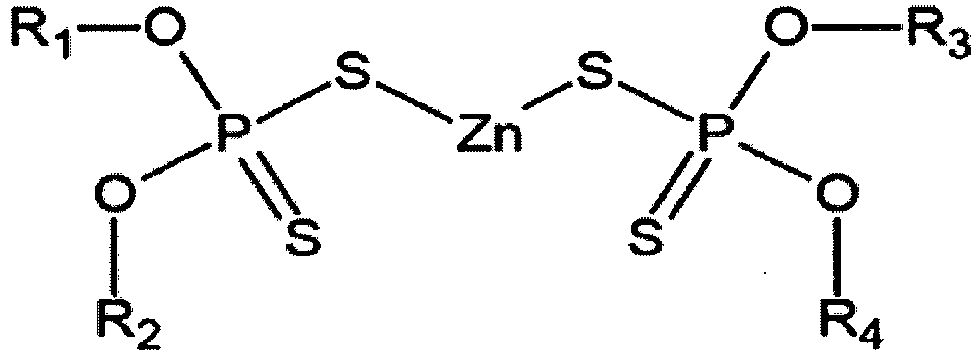
wherein R1, R2, R3 and R4 are long-chain primary alkyl groups each comprising 12-18 carbon atoms, or R1, R2, R3 and R4 are long-chain secondary alkyl groups each comprising 12-16 carbon atoms.
said sulfonate detergent with superhigh base number is C22-C30 linear alkyl benzene calcium sulphonate, wherein the base number thereof is 395-430 mgKOH/g;
said phenolate detergent with low base number is C20-C25 alkyl sulfurized calcium phenolate, wherein the base number thereof is 240-265 mgKOH/g;
said dispersing agent is selected from the group consisting of mono-polyisobutylene succinimide, bis-polyisobutylene succinimide and multi-polyisobutylene succinimide;
said antiwear agent is zinc long-chain alkyl thiophosphate with the structure corresponding to the following formula,
wherein R1, R2, R3 and R4 are long-chain primary alkyl groups each comprising 12-18 carbon atoms, or R1, R2, R3 and R4 are long-chain secondary alkyl groups each comprising 12-16 carbon atoms.
2. Use of a marine lubricating oil composite additive for cylinder oils in shipborne
Blender-on-Board system according to claim 1, characterized in that, the 2 kinematic viscosity of said base oil is 8.5-11.5 mm2/s at 100°C.
1. Verwendung eines Schiffszylinderöladditivs für Verbundzylinderöle in einem Blender-on-Board-System
an Bord, dadurch gekennzeichnet, dass, bezogen auf das Gesamtgewicht des Additivs, folgendes umfasst ist: 25-45% Detergens
mit sehr hoher Basenzahl, 40-60% Phenolat-Detergens mit niedriger Basenzahl, 0-8%
Dispergiermittel, 0-4% Antiverschleißmittel, und 10-20% Gruppe I Basisöl mit hohem
Viskositätsindex, das aus folgender Gruppe ausgewählt ist: 400SN, 500SN und 600SN;
wobei das Detergens mit sehr hoher Basenzahl ein C22-C30 lineares Alkylbenzol Calciumsulfonat ist, wobei die Basenzahl davon 395-430 mg KOH / g ist;
wobei das Phenolat-Detergens mit niedriger Basenzahl C20-C25 Alkyl geschwefelt Calcium Phenolat ist, wobei die Basiszahl davon 240-265 mgKOH / g ist;
wobei das Dispergiermittel aus der folgenden Gruppe ausgewählt ist: Mono-Polyisobutylensuccinimid, bis-Polyisobutylensuccinimid und Multi- Polyisobutylensuccinimid;
wobei das Antiverschleißmittel ein langkettiges Zink-Alkyl-Thiophosphat mit der Struktur entsprechend der folgenden Formel ist,
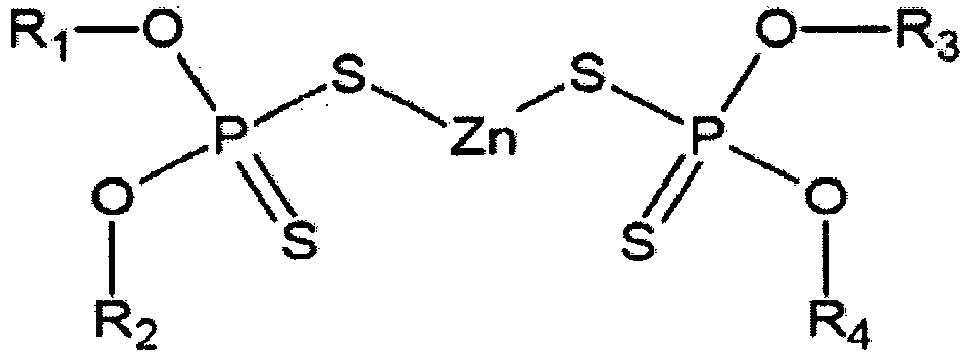
wobei R1, R2, R3 und R4 langkettige primäre Alkylgruppen mit jeweils 12-18 Kohlenstoffatomen sind oder R1, R2, R3 und R4 langkettige sekundäre Alkylgruppen mit jeweils 12-16 Kohlenstoffatome sind.
wobei das Detergens mit sehr hoher Basenzahl ein C22-C30 lineares Alkylbenzol Calciumsulfonat ist, wobei die Basenzahl davon 395-430 mg KOH / g ist;
wobei das Phenolat-Detergens mit niedriger Basenzahl C20-C25 Alkyl geschwefelt Calcium Phenolat ist, wobei die Basiszahl davon 240-265 mgKOH / g ist;
wobei das Dispergiermittel aus der folgenden Gruppe ausgewählt ist: Mono-Polyisobutylensuccinimid, bis-Polyisobutylensuccinimid und Multi- Polyisobutylensuccinimid;
wobei das Antiverschleißmittel ein langkettiges Zink-Alkyl-Thiophosphat mit der Struktur entsprechend der folgenden Formel ist,
wobei R1, R2, R3 und R4 langkettige primäre Alkylgruppen mit jeweils 12-18 Kohlenstoffatomen sind oder R1, R2, R3 und R4 langkettige sekundäre Alkylgruppen mit jeweils 12-16 Kohlenstoffatome sind.
2. Verwendung eines Schiffszylinderöladditivs für Verbundzylinderöle in einem Blender-on-Board-System
an Bord nach Anspruch 1, dadurch gekennzeichnet, dass die kinematische Viskosität des Basisöls 8,5 bis 11,5 mm2 / s bei 100 °C beträgt.
1. Utilisation d'un additif pour huile de cylindre marine pour huile de cylindre composite
dans un système mélangeur-bord à bord, caractérisé en ce que, par rapport au poids total de l'additif, il comprend: 25-45% de détergent sulfonate
avec un indice de base très élevée , 40-60% de détergent phénolate avec un indice
de base faible, 0-8% de dispersant, 0-4% d'agents anti-usure, et 10-20% d'huile de
base groupe I avec un indice de viscosité élevé, qui est choisi parmi les suivants:
400SN, 500SN et 600SN ;
dans lequel le détergent avec l'indice de base très élevée, est un sulfonate d'alkylbenzène linéaire de calcium en C22-C30 et le nombre de base est de 395 à 430 mg de KOH / g;
dans lequel le détergent phénolate avec un indice faible de base est un alkyle sulfurée phénolate de calcium en C20-C25, dans lequel l'indice de base est de 240-265 mg de KOH / g;
dans lequel l'agent de dispersion est choisi parmi les suivants: mono-polyisobutylène, bis-polyisobutylène et multi-polyisobutylène;
dans lequel l'agent anti-usure est un alkyle en zinc thiophosphate à longue chaîne ayant la structure selon la formule suivante,
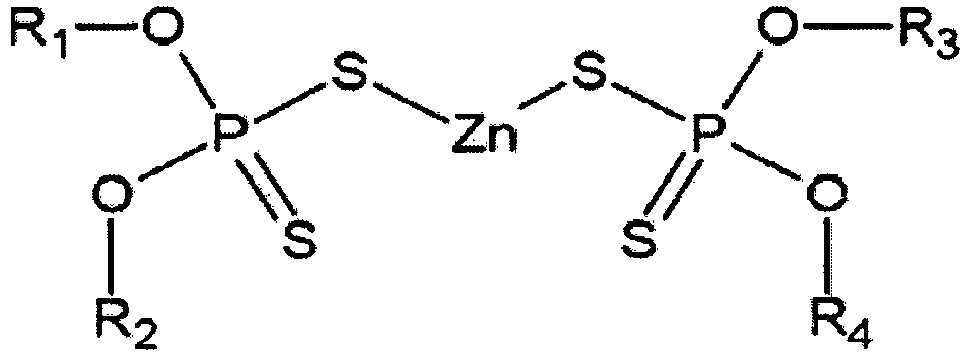
dans lequel R1, R2, R3 et R4 sont des groupes alkyles primaires à longue chaîne ayant 12-18 atomes de carbone, ou bien R1, R2, R3 et R4 sont, des groupes alkyle secondaires à longue chaîne ayant chacun 12-16 atomes de carbone.
dans lequel le détergent avec l'indice de base très élevée, est un sulfonate d'alkylbenzène linéaire de calcium en C22-C30 et le nombre de base est de 395 à 430 mg de KOH / g;
dans lequel le détergent phénolate avec un indice faible de base est un alkyle sulfurée phénolate de calcium en C20-C25, dans lequel l'indice de base est de 240-265 mg de KOH / g;
dans lequel l'agent de dispersion est choisi parmi les suivants: mono-polyisobutylène, bis-polyisobutylène et multi-polyisobutylène;
dans lequel l'agent anti-usure est un alkyle en zinc thiophosphate à longue chaîne ayant la structure selon la formule suivante,
dans lequel R1, R2, R3 et R4 sont des groupes alkyles primaires à longue chaîne ayant 12-18 atomes de carbone, ou bien R1, R2, R3 et R4 sont, des groupes alkyle secondaires à longue chaîne ayant chacun 12-16 atomes de carbone.
2. Utilisation d'un additif pour huile de cylindre marine pour huile de cylindre composite
dans un système mélangeur-bord à bord selon la revendication 1, caractérisé en ce que la viscosité cinématique de l'huile de base est de 8,5 bis 11,5 mm2 / s à 100 °C.
REFERENCES CITED IN THE DESCRIPTION
This list of references cited by the applicant is for the reader's convenience only. It does not form part of the European patent document. Even though great care has been taken in compiling the references, errors or omissions cannot be excluded and the EPO disclaims all liability in this regard.
Patent documents cited in the description