|
(11) | EP 2 763 991 B1 |

| (12) | EUROPEAN PATENT SPECIFICATION |
|
|
| (54) |
METHOD FOR PREPARING 2-AMINO-5-ETHYNYLPYRIDINE VERFAHREN ZUR HERSTELLUNG VON 2-AMINO-5-ETHYNYLPYRIDIN PROCÉDÉ POUR PRÉPARER LA 2-AMINO-5-ÉTHYNYLPYRIDINE |
|
|
|||||||||||||||||||||||||||||||
| Note: Within nine months from the publication of the mention of the grant of the European patent, any person may give notice to the European Patent Office of opposition to the European patent granted. Notice of opposition shall be filed in a written reasoned statement. It shall not be deemed to have been filed until the opposition fee has been paid. (Art. 99(1) European Patent Convention). |
Field of the Invention
[0001] The present invention relates to methods for preparing 5-[2-[7-(trifluoromethyl)-5-[4-(trifluoromethyl)phenyl]pyrazolo[1,5-a]pyrimidin-3-yl]ethynyl]-2-pyridinamine (compound A).
Background of the Invention
[0002] 5-[2-[7-(Trifluoromethyl)-5-[4-(trifluoromethyl)phenyl]pyrazolo[1,5-a]pyrimidin-3-yl] ethynyl]-2-pyridinamine (compound A) is a mGluR2 (metabotropic glutamate receptor) antagonist, which is useful for the treatment of depression and other CNS disorders. WO 2006/0999721 describes a synthesis of compound A and its potential applications in treating central nervous system (CNS) disorders. Also disclosed in WO 2006/0999721 are analogues and synthetic methods for making these analogues.
Summary of the Invention
[0003] A method for preparing compound A having the formula:
comprises reacting compound 3 or 7 with compound 9;
via a Sonogashira coupling reaction in an inert solvent to provide compound A.
[0004] The present invention grossly provides a method for preparing compound 9 having the formula:
which comprises:
- (a) reacting compound 8;
with 2-methyl-3-butyn-2-ol via a Sonogashira coupling reaction in an inert solvent to provide compound 13;
and - (b) deprotecting compound 13 with a base in an inert solvent to provide compound 9.
Detailed Description of the Invention
[0005] The term "Sonogashira coupling reaction" refers to a coupling reaction of terminal alkynes with aryl or vinyl halides. Typically, two catalysts are needed for this reaction: a zerovalent palladium complex and a halide salt of copper (I). The palladium complex activates the organic halides by oxidative addition into the carbon halogen bond. Phosphine-palladium complexes such as tetrakis(triphenylphosphine)palladium(0) or bis-(triphenylphosphine)-palladium(II)-dichloride are typically used for this reaction. Copper (I) halides react with the terminal alkyne and produce copper (I) acetylide, which acts as an activated species for the coupling reaction. The reaction medium must be basic to neutralize the hydrogen halide produced as the byproduct of this coupling reaction. Alkylamine compounds such as triethylamine, diethylamine, or diisopropylamine may be used as bases.
[0006] The invention grossly provides a method for preparing compound 9, as illustrated in Scheme 5.
[0007] The method in Scheme 5 comprises: : (a) coupling compound 8 with 2-methyl-3-butyn-2-ol using a Sonogashira coupling reaction to provide compound 13; and (b) deprotecting compound 13 to provide compound 9.
[0009] In one embodiment, the preparation of compound 13 comprises (a) reacting 2-amino-5-iodopyridine 8 with 2-methyl-3-butyn-2-ol in a Sonogashira coupling reaction, employing a PdCl2(PPh3)2-CuI catalyst with triethylamine as base in 2-methyltetrahydrofuran at a temperature of about 50°C for approximately 5 hours.
Examples
[0010] In accordance with the present invention, the following examples are provided to illustrate preferred methods for the preparation of the compounds of this invention.
Example 11
[0012] A solution of 2-amino-5-iodopyridine (48.0 g), copper(I)-iodide (520 mg), bis-(triphenylphosphine)-palladium(II)-dichloride (765 mg), and triethylamine (32.0 g) in MeTHF (220 mL) was treated at 48-52 °C over 2 to 3 hours with a solution of 2-methyl-3-butyn-2-ol (30.0 g) in MeTHF (40 mL) and the resulting suspension was subsequently stirred at 50 °C for an additional 3 hours. The mixture was cooled to 25-30 °C then treated with water (160 mL) and 25% aqueous ammonium hydroxide solution (40 mL). The biphasic mixture was stirred at 25-30 °C for 20 minutes and the layers were allowed to separate over 20 minutes. The aqueous layer was removed and back extracted with MeTHF (2x80 mL). The combined organic layers were diluted with water and the resulting mixture was acidified with 37% aqueous hydrochloric acid (ca. 43 g) to pH 1. The lower product containing aqueous layer was removed and the MeTHF-layer was extracted with water (1x100 mL). From the combined aqueous layers, MeTHF was distilled off under reduced pressure (200-80 mbar). The pH of the resulting aqueous layer (ca. 420 mL) was then adjusted to pH 9-10 by addition of 28% aqueous sodium hydroxide solution (ca. 37 g) at 15-20 °C. At pH 5 the product started to precipitate. The resulting suspension was stirred for 2 hours at 15 to 20 °C and the product was filtered and washed in two portions with water (300 mL in total). The wet crystalline mass (ca. 46 g) was dried at 40°C and <30 mbar until constant weight affording 33.56 g (87% yield) of compound 13, as yellow-beige crystals with a purity of 99.5 % (HPLC, area-%).
[0013] A suspension of compound 13 (17.10 g) and sodium hydroxide (12.2 g) in toluene (170 mL) was heated under reduced pressure (approx. 750 mbar) to 95 to 102 °C within 30 to 60 minutes (approx. 110 °C jacket temperature). The mixture was subsequently stirred at this temperature for 4 to 7 hours. Upon complete conversion (<2% starting material), the mixture was cooled to 80-86 °C and washed at this temperature three times with water (45 mL and 2x30 mL). The combined aqueous layers were back extracted at room temperature with MeTHF (80 mL). The combined toluene and MeTHF layers were concentrated to almost dryness. The residue was dissolved in 120 mL of MeTHF and subsequently polish filtered. The filter cake was rinsed with MeTHF (2x25 mL) furnishing 157.16 g solution of compound 9 with an assay of 6.4% (w/w), corresponding to a corrected yield of 88%.
Example 20
[0015] A solution of 2-amino-5-iodopyridine (48.0 g), copper(I)-iodide (520 mg), bis-(triphenyl phosphine)-palladium(II)-dichloride (765 mg), and triethylamine (38.0 g) in MeTHF (220 mL) was treated at 48-54 °C within 1 to 2 hours with a solution of 2-methyl-3-butyn-2-ol (30.0 g) in MeTHF (40 mL), and the resulting suspension was stirred at 50 °C for 3 hours. The mixture was cooled to 25-30 °C and then treated with water (80 mL) and 25% aqueous ammonium hydroxide solution (40 mL). The biphasic mixture was stirred at 25-30 °C for 20 minutes, and the layers were allowed to separate over 20 minutes. The aqueous layer was removed, and the organic layer was washed a mixture of water (40 mL) and 25% aqueous ammonium hydroxide solution (40 mL). The combined aqueous layers were back extracted with MeTHF (100 mL). The combined organic layers were washed with water (30 mL) and then concentrated under reduced pressure to a residual volume of approx. 80 mL. Toluene (500 mL) was then added, and the mixture was concentrated under reduced pressure to a residual volume of approx. 400 mL. The mixture was treated with isopropanol (60 mL) and tributyl phosphine (2 mL). The suspension was heated to reflux temperature to obtain a clear solution and subsequently cooled 0°C within 5 h whereby the product crystallized. The resulting suspension was stirred at 0°C for four hours. The product was filtered and washed with 80 mL of toluene. The wet crystals were dried at 50°C and <30 mbar until constant weight affording 32.8 g (85% yield) of compound 13 as slightly yellow crystals with a purity of 99.9 % (HPLC, area-%) and an assay of 100.0 % (HPLC, w/w-%).
1. A method for preparing compound 9 having the formula:
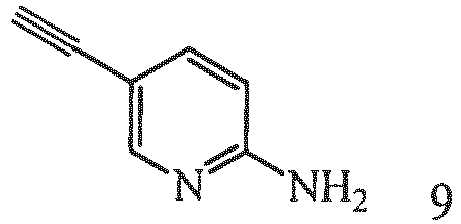
which comprises the following steps:
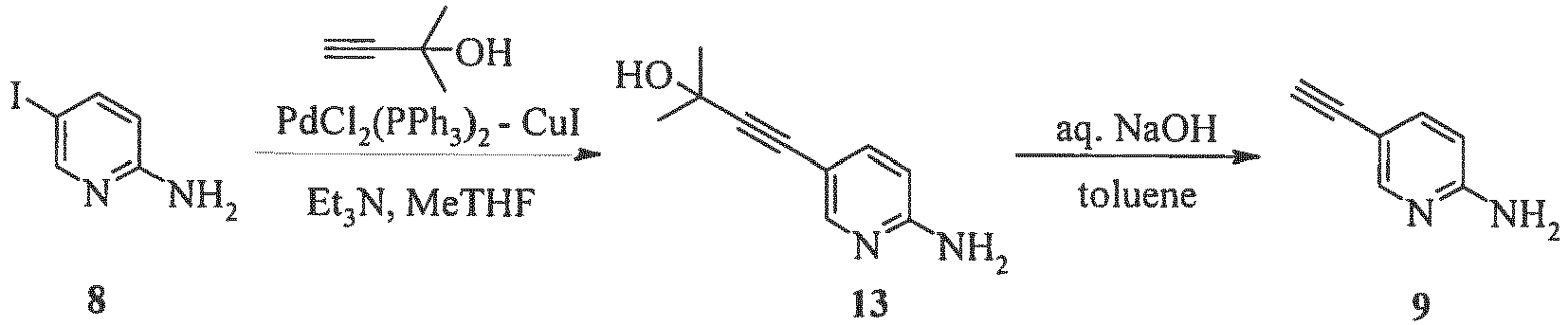
which comprises the following steps:
1. Ein Verfahren zur Herstellung der Verbindung 9 der Formel:
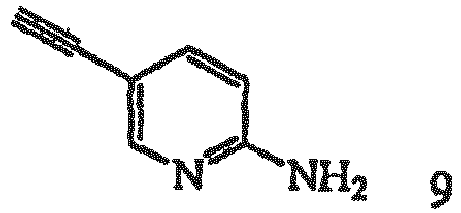
das die folgenden Schritte umfasst:
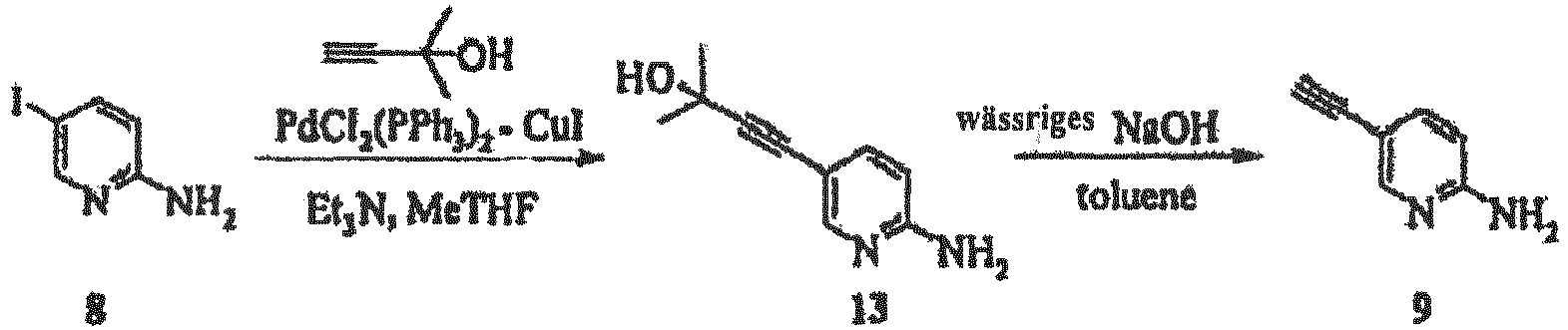
das die folgenden Schritte umfasst:
1. Procédé pour préparer le composé 9 répondant à la formulé :
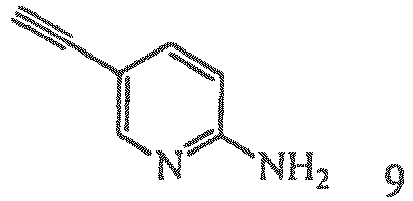
qui comprend les étapes suivantes :
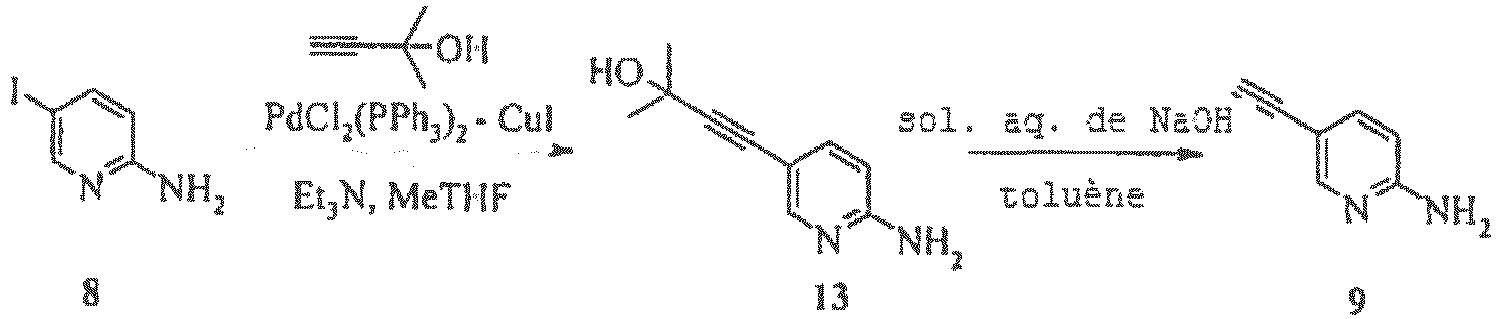
qui comprend les étapes suivantes :
REFERENCES CITED IN THE DESCRIPTION
This list of references cited by the applicant is for the reader's convenience only. It does not form part of the European patent document. Even though great care has been taken in compiling the references, errors or omissions cannot be excluded and the EPO disclaims all liability in this regard.
Patent documents cited in the description