|
(11) | EP 3 027 589 B1 |

| (12) | EUROPEAN PATENT SPECIFICATION |
|
|
| (54) |
PROCESS FOR THE PREPARATION OF FLUORINATED COMPOUNDS CONTAINING A -OSF5 GROUP VERFAHREN ZUR HERSTELLUNG VON FLUORIERTEN VERBINDUNGEN ENTHALTEND EINE -OSF5-GRUPPE PROCÉDÉ POUR LA PRÉPARATION DE COMPOSÉS FLUORÉS CONTENANT UN GROUPE -OSF5 |
|
|
|||||||||||||||||||||||||||||||
| Note: Within nine months from the publication of the mention of the grant of the European patent, any person may give notice to the European Patent Office of opposition to the European patent granted. Notice of opposition shall be filed in a written reasoned statement. It shall not be deemed to have been filed until the opposition fee has been paid. (Art. 99(1) European Patent Convention). |
Technical Field
[0001] The present invention relates to the preparation of fluorinated compounds containing the -OSF5 moiety.
Background Art
[0002] It is known to modify the bulk and surface properties of polymers with the use of monomers having side groups and/or functional groups. For instance, the use of fluorinated vinyl ethers as monomers in the preparation of fluorinated polymers has been extensively described; e.g. CARLSON, Peter, et al. Organic Fluoropolymers; Ullmann's Encyclopedia of Industial Chemistry. Weinheim: Wiley-VCH Verlag, 2000. p.495 - 533.
[0003] The bulkiness of the -OSF5 moiety in the side chain of monomeric units may provide advantages in the modification of the crystallinity and of the surface properties of fluorinated polymers or of fluorinated compounds in general. Compounds comprising the -OSF5 moiety might also find use in the preparation of surface active agents, such as surfactants.
[0004] So far, however, the preparation of only one fluorinated unsaturated compound comprising the -OSF5 moiety, namely CF2=CFCF2OSF5, has been achieved, see WO 2013/000735 A (SOLVAY SPECIALTY POLYMERS ITALY SPA) 03.01.2013 .
[0005] The synthesis of other fluorinated unsaturated compounds comprising the -OSF5 moiety via the direct addition of SOF4 to a fluorinated unsaturated compound has so far been unsuccessful in standard conditions, see DU, L., et al. Synthesis of pentafluorosulfanyl trifluorovinyl ether and its facile rearrangement to difluoro(pentafluorosulfanyl)acetyl fluoride. Angew. Chem., Int. Ed. Engl.. 2007, vol.46, p.6626-6628.
[0006] MARCELLIS, Alphonso W., et al. Synthesis of pentafluorosulfuroxydifluoroacetly fluoride. Journal of Fluorine Chemistry. 1975, vol.5, p.71 - 75. teaches to prepare SF5OCF2C(O)F by the action of both ozone and oxygen on the olefin SF5CF=CF2.
[0007] SCHACK, Carl J., et al. Introduction of functional Groups into Some Chlorofluorocarbon Ethers. Journal of Fluorine Chemistry. 1979, vol.14, p.519-522. discloses SF5OCF2C(O)F, which is prepared by addition of SF 5OCl to a perfluoroolefin.
[0008] EP 1889832 A (AIR PROD & CHEM) 20.02.2008 discloses compositions that may comprise a molecular compound of the formula ZOSF5, wherein Z is a member selected from C1-20 alkyl, aryl, cycloalkyl, combinations thereof, and analogues containing at least one halogen and/or heteroatom (page 2, par. [0004]). The compound ZOSF5 can be obtained by addition of the OSF5 function to a compound ZL, wherein L is a leaving group and Z is as defined above, by way of a nucleophilic displacement reaction (page 2, par. [0009] and page 3, par. [0013]).
[0009] DE 102011114650 (MERCK PATENT GMBH) 03.05.2012 relates to compounds comprising -OSF5 end groups, including certain compounds complying with formula (III) reported on page 14. The compounds of formula (III) are prepared by addition of SF5OCl to an olefin or by nucleophile substitution of triflates with, for instance, TAS+F5SO-.
[0010] CASE, J.R., et al. Pentafluorosulpuroxy-derivatives of Hexafluoropropene. Journal of the Chemical Society. 1964, p. 946-948 discloses the reaction of bispentafluorosulphur peroxide and pentafluorosulphur hypofluorite with hexafluoropropene to give a series of compounds SF5 O[C3F6]nOSF5 where n = 2, 3, or 4.
[0011] A new method for the preparation of fluorinated compounds comprising the pentafluorosulfanyl moiety -OSF5, as starting materials for the preparation of a wide range of novel fluorinated compounds comprising -OSF5 groups, has now been found.
Description of invention
[0012] The object of the present invention is a process for the preparation of fluorinated compounds having a -OSF5 group, said method comprising the reaction of SOF4 with a fluorinated 3- or 4-membered cyclic ether in the presence of a suitable fluoride catalyst.
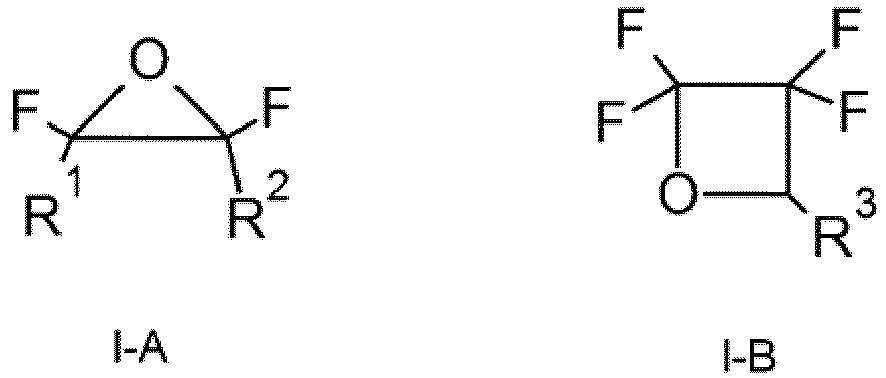
[0013] Suitable fluorinated 3-membered cyclic ethers are compounds of formula (I-A):
wherein R1 and R2, equal to or different from each other, are independently selected from the group consisting of F, C1-C5 fluorinated alkyl, optionally containing Cl atoms and/or optionally containing etheric oxygen atoms in the chain. Preferably, R1 and R2, equal to or different from each other, are independently selected from the group consisting of F and fluorinated C1-C3 alkyl, preferably a fully fluorinated C1-C3 alkyl. In a preferred embodiment at least one of R1 or R2 is F. In a more preferred embodiment R1 is selected from the group consisting of F and fully fluorinated C1-C3 alkyl and R2 is F.
[0014] A readily available compound of formula (I-A) that can be used as a starting material in the inventive process is hexafluoropropylene oxide, that is a compound of formula (I-A) wherein R1 = CF3 and R2 = F.
[0015] Suitable fluorinated 4-membered cyclic ethers for the inventive process are compounds of formula (I-B):
wherein R3 is selected from the group consisting of H, C1-C3 alkyl, optionally containing F and/or Cl atoms and/or optionally containing etheric oxygen atoms in the chain. Preferably, R3 is selected from the group consisting of H and C1-C3 alkyl. More preferably R3 is H.
[0016] An advantageous 4-membered cyclic ether of formula (I-B) is 2,2,3,3-tetrafluorooxethane, that is a compound of formula (I-B) wherein R 3= H.
[0017] The expression "fluorinated" is used herein to refer to compounds that are either totally or partially fluorinated, i.e. wherein all or only a part of the hydrogen atoms have been replaced by fluorine atoms. Analogously, the expression "non-fluorinated" is used herein to refer to compounds that do not contain any fluorine atoms.
[0018] The process is carried out in the presence of a fluoride catalyst. The expression "fluoride catalyst" is used throughout the present specification to refer to fluorides selected from the group consisting of the alkali metal fluorides, the alkali-earth metal fluorides, the quaternary ammonium fluorides and silver fluoride. Preferred fluoride catalysts are those selected from the group consisting of CsF, KF, RbF, LiF, NaF, CaF2, BaF2, MgF2, SrF2, AgF. Most preferred fluoride catalysts are CsF and KF.
[0019] Catalyst concentration is not critical and the amounts of catalyst is determined by the environment in which the reaction is carried out.
[0020] SOF4 may be added to the reaction in an equimolar amount with respect to the 3- or 4-membered cyclic ether but it is generally added in an excess. Typical molar ratio of SOF4 with respect to the 3- or 4-membered cyclic ether is for instance from 1.5:1 to 5:1, more typically from 2:1 to 4:1.
[0021] The reaction is generally carried out in liquid phase, either in the absence or in the presence of an organic solvent, inert under the reaction conditions. Non-limiting examples of suitable organic solvents are for instance glymes, e.g. diethylenglycol diethylether, chlorofluorocarbons, perfluorocarbons, e.g. CF3CF2CF3, perfluoroethers, e.g. CF3OCF2CF3, chlorofluoroethers, e.g. CF3OCFClCCIF2 or perfluoropolyethers.
[0022] The reaction between SOF4 and the 3- or 4-membered cyclic ether is generally carried out at a temperature from -100 to 200°C, preferably from -50°C to 150°C, more preferably from -20°C to 100°C.
[0023] Reaction pressure is not a critical parameter. Reaction pressure is generally atmospheric pressure.
[0024] At the end of the reaction the fluorinated compound having a -OSF5 group can be separated and recovered from the solvent (if any) and from any residual starting material and/or by-product using conventional techniques, such as distillation, either at standard pressure or under vacuum.
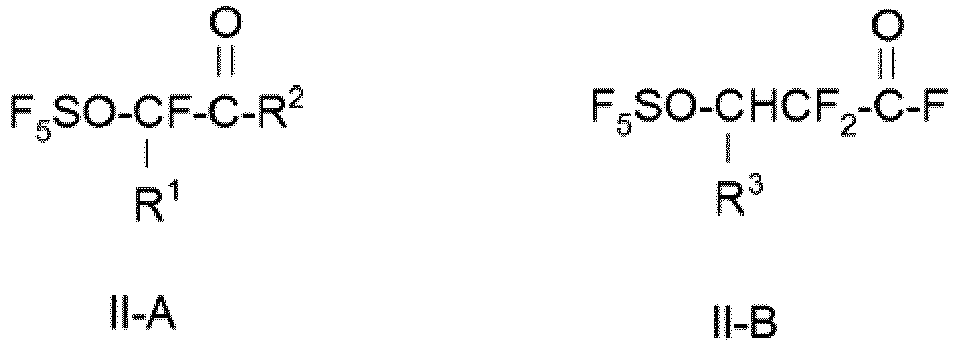
[0025] Compounds of formula (II-A) and (II-B) here below are obtained from compounds of formula (I-A) and (I-B), respectively, at the end of the inventive process:
wherein in formula (II-A) and (II-B) R1, R2 and R3 have the same meaning as in formula (I-A) and (I-B).
[0027] A notable example of a compound of formula (II-A1) is F5SO-CF(CF3 )COF, which can be obtained in good yields and high purity with the inventive process starting from hexafluoropropylene oxide.
[0028] A notable example of a compound of formula (II-B) is F5SOCH2CF2COF, which can be obtained in good yields and high purity with the inventive process starting from 2,2,3,3-tetrafluorooxethane.
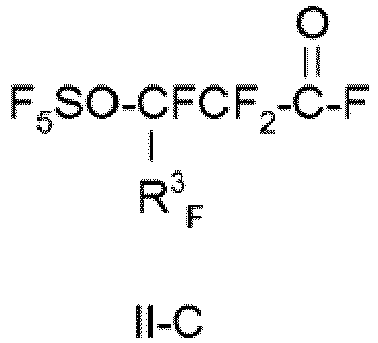
[0029] Compounds of formula (II-B) may be converted by fluorination into the corresponding fully fluorinated compounds of formula (II-C):
wherein R3F is the fully fluorinated analogue of R3 in formula (II-B), namely F or a fully fluorinated C1-C3 alkyl, optionally containing Cl atoms and/or optionally containing etheric oxygen atoms in the chain. Preferably, R3F is selected from the group consisting of F and fully fluorinated C1-C3 alkyl. More preferably R3F is F.
[0030] Should groups R1 and R2 in the compounds of formula (II-A) and (II-A1) contain hydrogen atoms, the fully fluorinated corresponding compounds may be obtained by fluorination. In the remainder of the specification the notation R1F and R2F will identify the fully fluorinated groups, whereas the notation R1 and R2 will identify the broader definition of the groups.
[0031] Fluorination of compounds of formula (II-A) and (II-B) may be carried out according to any fluorination process known in the art, such as that disclosed in WO 2012/007310 (SOLVAY SPECIALTY POLYMERS ITALY SPA) 1/19/2012 .
[0032] Compounds of formula (II-A1), (II-B) and (II-C) which contain the acyl fluoride functionality, -COF, can be conveniently used as reagents to obtain a larger number of compounds having the -OSF5 group.
[0033] Fluoroacyl compounds are known precursors for yielding different compounds, such as fluoroethers which can undergo suitable dehydro/halogenation reactions thereby providing the corresponding vinyl ethers. Chemistry of acyl fluorides (II-A1), (II-B) and (II-C) has been found to be particularly useful for the manufacture of ethers, particularly vinyl ethers.
[0034] Thus, according to a first embodiment, the process comprises reacting an acyl fluoride of formula (II-A1), (II-B) or (II-C) as above defined with hexafluoropropylene oxide in the presence of a suitable catalyst, so as to obtain compounds of formula (III-A), (III-B) or (III-C):
wherein R1, R3 and R3F have the meanings as above defined and n is an integer from 1 to 15. In each of formula (III-A), (III-B) or (III-C) n is preferably an integer from 1 to 10. Typical values of n are for instance 1, 2, 3 or 4.
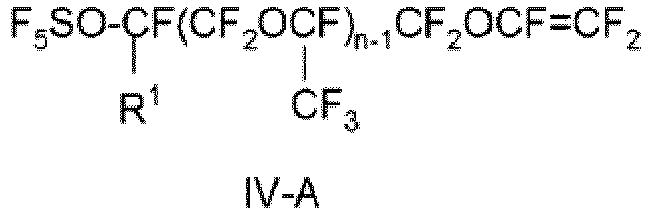
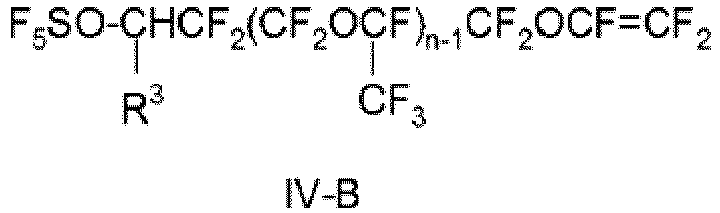
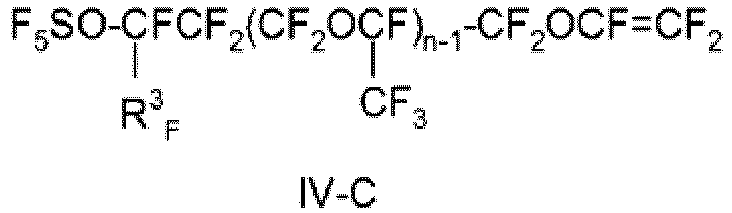
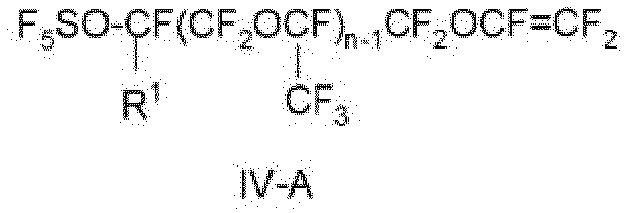
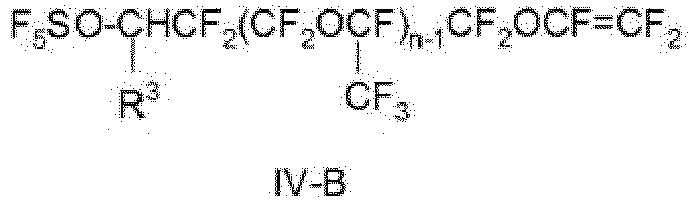
[0035] Acyl fluorides of formula (III-A), (III-B) and (III-C) may be pyrolyzed in the presence of a basic compound to give the corresponding vinyl ethers of formula (IV-A), (IV-B) and (IV-C):
wherein R1, R3, R3F and n have the meaning as above defined.
[0036] The pyrolysis can be carried out directly on the acyl fluorides of formula (III-A), (III-B) or (III-C) or the acyl fluorides can be first converted into a monovalent metal salt, such as the alkali metal salt of the corresponding carboxylic acid, and then pyrolyzed. The hydrolysis and formation of the alkali metal salt is generally carried out by contacting the acyl fluorides of formula (III-A), (III-B) or (III-C) with water and then with an alkali metal base, such as KOH or NaOH. Pyrolysis of the alkali metal salt is generally carried out at a temperature of from 150 to 250°C, preferably from 170°C to 220°C.
[0037] The direct pyrolysis of the acyl fluoride of formula (III-A), (III-B) or (III-C) is generally carried out in the gas phase by contacting said acyl fluoride with a catalyst, preferably sodium sulfate or sodium carbonate, at a temperature of 150° to 350°C, preferably from 150°C to 250°C.
[0038] According to a second embodiment, the process comprises reacting an acyl fluoride of formula (II-A1), (II-B) or (II-C), as above defined, with 2,2,3,3-tetrafluorooxethane in the presence of a suitable catalyst, to obtain compounds of formula (V-A), (V-B) and (V-C), respectively:
wherein R1, R3 and R3F have the meaning as above defined and m is an integer from 1 to 15. In each one of formula (V-A), (V-B) and (V-C) m is preferably an integer from 1 to 10; typical values of m are for instance 1, 2, 3 or 4.
[0039] Acyl fluorides comprising units deriving from both hexafluoropropylene oxide and 2,2,3,3-tetrafluorooxethane may be prepared either by reacting acyl fluorides of formula (III-A), (III-B) or (III-C) with 2,2,3,3-tetrafluorooxethane; or by reacting acyl fluorides of formula (V-A), (V-B) or (V-C) with hexafluoropropylene oxide; or still by reacting acyl fluorides of formula (II-A1), (II-B) or (11-C) with a mixture of hexafluoropropylene oxide and 2,2,3,3-tetrafluorooxethane. In this latter case a mixture of products comprising randomly distributed units of hexafluoropropylene oxide and 2,2,3,3-tetrafluorooxethane will be obtained.
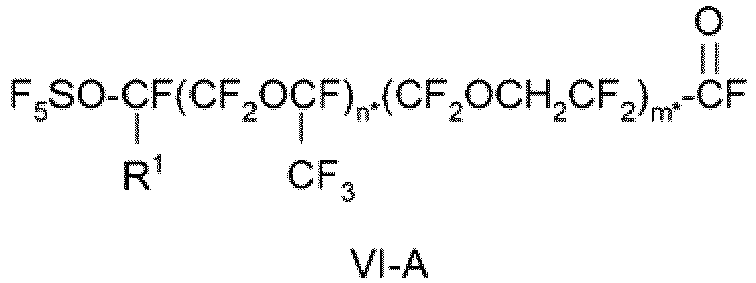
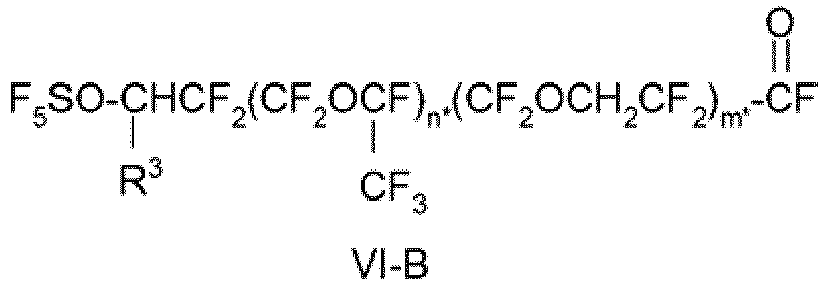
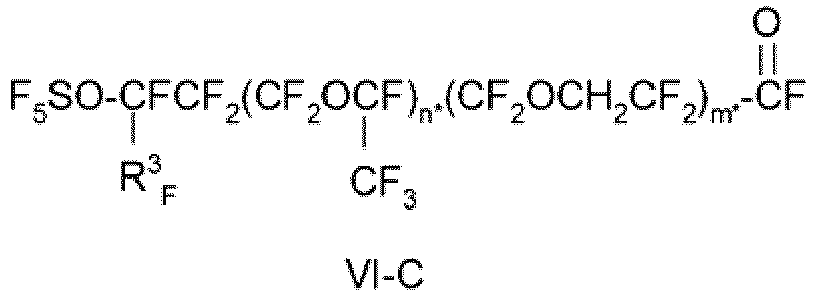
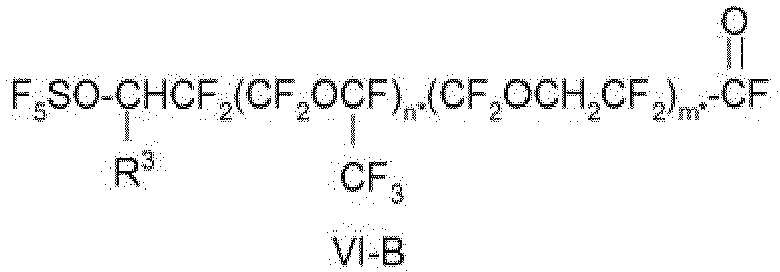
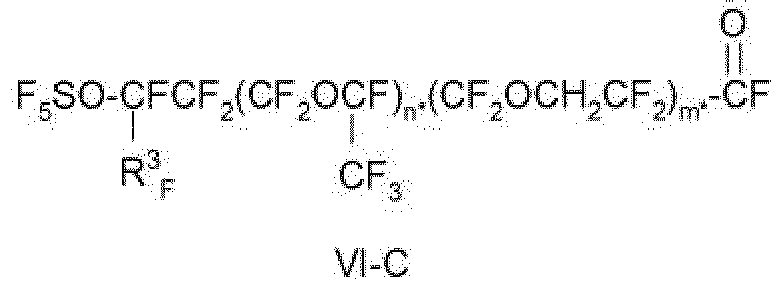
[0040] Acyl fluorides of formula (II-A1), (II-B), (II-C), (III-A), (III-B), (III-C), (V-A), (V-B) and (V-C) and those comprising both hexafluoropropylene oxide and 2,2,3,3-tetrafluorooxethane units are collectively represented by each one of formula (VI-A), (VI-B) and (VI-C):
wherein R1, R3 and R3F have the meaning as above defined; n* is equal to 0 or is an integer from 1 to 15, preferably from 1 to 10; and m* is equal to 0 or is an integer from 1 to 15, preferably from 1 to 10. Typical values for n* are 0, 1, 2, 3 or 4. Typical values for m* are 0, 1, 2, 3 or 4.
[0041] The reaction between the acyl fluorides of formula (II-A1), (II-B), (II-C), (III-A), (III-B), (III-C), (V-A), (V-B) or (V-C) with hexafluoropropylene oxide and/or 2,2,3,3-tetrafluorooxethane to yield compounds of formula (VI-A), (VI-B) or (VI-C) can be carried out as described in US 3114778 (DU PONT) 17.02.1963 . The reaction can be carried out either in bulk using active carbon as catalyst or by reaction in a polar solvent using a fluoride catalyst, this latter embodiment being preferred. Suitable fluoride catalysts are the same as those described for the reaction of SOF4 with the 3- or 4-membered ring cyclic ethers. Reaction temperatures may be greatly varied from -80°C to 200°C, although a preferred range is from -30° to 100°C.
[0042] The acyl fluorides of formula (VI-A), (VI-B) and (VI-C) may be converted into their corresponding fully fluorinated analogues of formula (VII-A) and (VII-C):
by fluorination. Fluorination may be carried out using any fluorination technique known in the art. In formula (VII-A) and (VII-C) R3F, n* and m* have the same meaning as above defined, wherein R1F is the fully fluorinated analogue of R1, namely F, C1-C5 fully fluorinated alkyl, optionally containing Cl atoms and/or optionally containing etheric oxygen atoms in the chain, preferably F or a fully fluorinated C1-C3 alkyl.
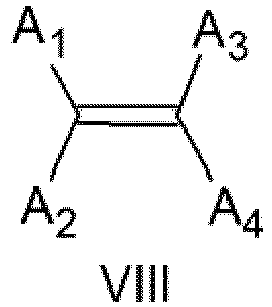
[0043] According to a further embodiment of the process, the process comprises the step of reacting acyl fluorides of formula (VII-A) or (VII-C), in the liquid phase at a temperature of from -150°C to 0°C, with elemental fluorine and with at least one olefin of formula (VIII):
to obtain compounds of formula (IX-A) and (IX-C), respectively:
wherein R1F, R3F, no* and m* are as defined above; A1, A2, A3, and A4, equal to or different from each other, are independently selected from the group consisting of H, F, Cl, Br.
[0044] It is generally preferred that olefin of formula (VIII) comprises at least one fluorine atom and at least one halogen atom chosen among bromine and chlorine. More preferred olefins are those complying with formula (VIII) wherein one of A1 and A2 is a fluorine atom, the remaining being selected from the group consisting of H, Cl, Br, and wherein one of A3 and A4 is a fluorine atom, the remaining being chosen among H, Cl, Br.
[0045] Preferred olefins comply with formula (X): CAF=CA'F wherein A and A', equal or different from each other, are independently selected from the group consisting of H, Cl, Br; with A and A' being not simultaneously H.
[0046] Non limiting examples of olefins which are particularly suitable to the purposes of the invention are 1,2-dichloro-1,2-difluoroethylene, 1,2-dibromo-1,2-difluoroethylene, and 1-chloro-1,2-difluoroethylene. More preferred olefin is 1,2-dichloro-1,2-difluoroethylene.
[0047] Ethers of formulae (IX-A) and (IX-C) can be converted into the corresponding vinyl ethers of formula (XI-A) and (XI-C) by dehalogenation or dehydrohalogenation:
wherein A5 and A6, equal to or different from each other, are independently selected from the group consisting of H, F, Cl, Br, and R1F and R3F are as above defined.
[0048] When the olefin used in this embodiment of the process complies with formula (X) as above defined, fluorinated vinyl ethers of formulae (IV-A) and (IV-C), as above defined, can be obtained.
[0049] Should A1, A2, A3, A4, equal to or different from each other, be selected from F, Cl, or Br, vinyl ethers can be obtained via a dehalogenation reaction. Dehalogenation can be accomplished by reacting the compounds of formula (IX-A) and (IX-C) in the presence of transition metals in polar organic solvents. Among suitable transition metals, mention can be made of Zn, Cu, Mn or mixtures Zn/Cu, Zn/Sn, Zn/Hg. Suitable polar organic solvents can be protic or aprotic. Among protic polar solvents, mention can be made of alcohols; among aprotic polar solvents, mention can be made of ethers (e.g. glyme, dioxane), dimethylformamide (DMF), dimethylsulfoxide (DMSO).
[0050] Should at least one of A1, A2, A3, A4 be hydrogen, vinyl ethers can be obtained via a dehydrohalogenation reaction. Dehydrohalogenation can be accomplished by reaction of the compounds of formula (IX-A) and (IX-C) in the presence of a base. Inorganic bases (e.g. NaOH or KOH) or organic bases (e.g. primary, secondary or tertiary alkyl or aryl ammines) can be used. Generally, dehydrohalogenation is carried out in liquid phase, optionally, in the presence of a solvent, typically aqueous or aqueous/alcoholic. When using aqueous inorganic bases, it is generally preferred to use a quaternary phosphonium or quaternary ammonium salts (e.g. tetrabutyl ammonium or phosphonium salts, especially chloride; trioctylbenzyl ammonium or phosphonium salts, especially chloride) or a solfonium salt as phase transfer agent.
[0051] Both dehalogenation and dehydrohalogenation reactions are typically carried out at a temperature from 0°C to 150°C, preferably from 25°C to 100°C.
[0052] The reaction of the acyl fluorides of formula (VII-A) and (VII-C) with the olefins of formula (VIII) or (X) and the subsequent dehalogenation or dehydrohalogenation reactions can be carried out as disclosed for instance in EP 1388531 A (SOLVAY SOLEXIS SPA) 11.02.2004.
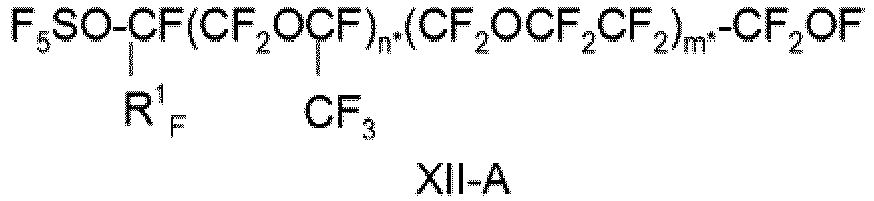
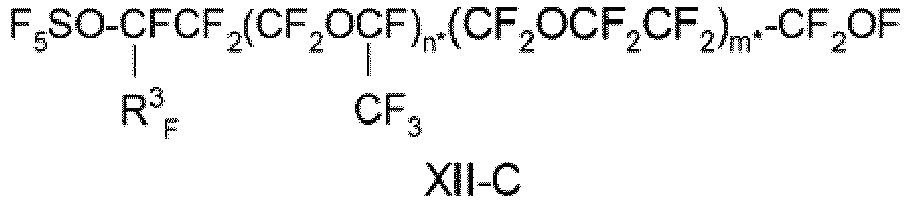
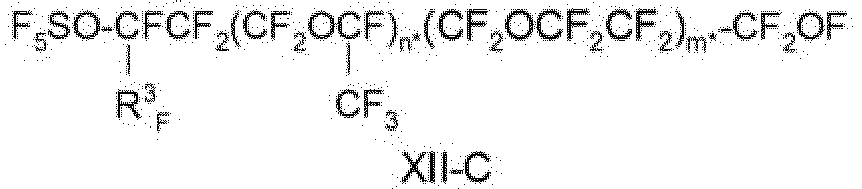
[0053] According to a further embodiment of the invention, the process further comprises reacting acyl fluorides of formula (VII-A) and (VII-C) with elemental fluorine in the presence of a fluoride catalyst to obtain the corresponding hypofluorites of formula (XII-A) and (XII-C):
wherein R1F, R3F, n* and m* are as above defined.
[0054] Fluoride catalysts suitable in the reaction are the same as those suitable for the addition of SOF4 to the fluorinated 3- or 4-membered cyclic ether.
[0055] Hypofluorites of formula (XII-A) and (XII-C) can be widely used as intermediates in fluorine chemistry as well known in the art.
[0056] In particular, the process according to a further embodiment can comprise reacting the hypofluorites of formula (XII-A) and (XII-C) with an olefin of formula (VIII) or (X) as above defined to yield the corresponding compounds of formulae (IX-A) and (IX-C) as above defined.
[0057] All these synthetic schemes are based on the surprising reactivity of SOF4 towards fluorinated 3- or 4-membered cyclic ethers as above described, which allows producing with high yields and selectivity fluorochemical synthons comprising -OSF5 moieties which are susceptible of further reactivity.
[0058] The compounds which can be manufactured with the process of the invention in all of its embodiments as described above are thus compounds of formula (XIII-A), (XIII-B) and (XIII-C) here below:
wherein -RA is equal to -RC or is -COR*2, with R*2 being a C1-C3 fluorinated alkyl, optionally containing Cl atoms and/or optionally containing etheric oxygen atoms in the chain; wherein -RB is selected from the group consisting of -[CF2OC(CF3)]n*(CF2OCH2CF2)m*COF, and -[CF2OC(CF3)]n-1CF2O-CF=CF2 wherein n is an integer from 1 to 15, and n* and m* are, independently from each other, equal to 0 or an integer from 1 to 15; and wherein -Rc is selected from the group consisting of - [CF2OC(CF3)]n*(CF2OCH2CF2)m*Q ; -(CF2OCH2CF2)mCOF, wherein n* and m*, independently of each other, are equal to 0 or an integer from 1 to 15; m is an integer from 1 to 15; and wherein -Q is selected from the group consisting of -COF, -CF2OF, -CF2OCA1A2-CFA3A4, -CF2OCA5=CFA6 and A1, A2, A3, A4, A5 and A6 and R1, R3 and R3F are as defined above.
[0059] In -RA, -RB or -RC n* and m*, independently of each other, are preferably equal to 0 or are an integer from 1 to 10, typically are equal to 0, 1, 2, 3 or 4; m and n, independently of each other, are preferably an integer from 1 to 10, typically 1, 2, 3 or 4.
[0060] In formula (XIII-A) R1 is selected from the group consisting of F, C1-C5 fluorinated alkyl, optionally containing Cl atoms and/or optionally containing etheric oxygen atoms in the chain.
[0061] -Preferably, R1 is selected from the group consisting of F and fluorinated C1-C3 alkyl, more preferably a fully fluorinated C1-C3 alkyl, even more preferably R1 is CF3.
[0062] In formula (XIII-B) R3 is selected from the group consisting of H, C1-C3 alkyl, optionally containing F and/or Cl atoms and/or optionally containing etheric oxygen atoms in the chain. Preferably, R3 is selected from the group consisting of H and C1-C3 alkyl. More preferably R3 is H.
[0063] In formula (XIII-C) R3F is selected from the group consisting of F, fully fluorinated C1-C3 alkyl, optionally containing Cl atoms and/or optionally containing etheric oxygen atoms in the chain. Preferably, R3F is selected from the group consisting of F and fully fluorinated C1-C3 alkyl. More preferably R3F is F.
[0064] Compounds of anyone of formula (XIII-A), (XIII-B) and (XIII-C) can be further used in the preparation of additional compounds containing the - OSF5 moiety.
[0065] For instance, vinyl ethers according to any one of formulae (IV-A), (IV-B), (XI-A) or (XI-C), as defined above, may be used as monomers in the preparation of polymers, typically fluorinated polymers.
[0066] The polymers preferably comprise recurring units deriving from at least one compound of formula (IV-A), (IV-B), (XI-A) or (XI-C) and recurring units deriving from at least one other ethylenically unsaturated monomer copolymerizable therewith, preferably at least one other ethylenycally unsaturated fluorinated monomer. Non-limiting examples of suitable ethylenically unsaturated fluorinated monomers are for instance:
- C2-C8 fluoroolefins, preferably tetrafluoroethylene and/or hexafluoropropylene;
- C2-C8 hydrogenated fluoroolefins, such as vinyl fluoride, 1,2-difluoroethylene, vinylidene fluoride and trifluoroethylene;
- chloro- and/or bromo- and/or iodo-C2-C6 fluoroolefins, like chlorotrifluoroethylene and/or bromotrifluoroethylene;
- fluoroalkylvinylethers of formula CF2=CFORf1 in which Rf1 is a C1-C6 fluoroalkyl, e.g. -CF3, -C2F5, -C3F7 ;
- fluoro-oxyalkylvinylethers of formula CF2=CFORo1, in which Ro1 is a C1-C12 fluoroalkyloxy having one or more ether groups.
[0067] The polymers can be prepared according to any one of the known processes for making fluorinated polymers.
EXAMPLES
Characterization
[0068] NMR: spectra were recorded on a Varian Mercury 300 spectrometer operating at 282.180 MHz for 19F and a Varian Inova 400 MHz spectrometer operating at 399.851 MHz for 1H. 19F NMR and 1H NMR spectra of the monomers were recorded in acetone at room temperature and the spectra were referenced to C6F6 (C6F6, -164.67ppm) and TMS.
EXAMPLE 1 - Synthesis of F5SOCF(CF3)COF (A-1) and F5SOCF(CF3)CF 2OCF(CF3)COF (A-2)
[0069] In an AISI-316 reactor having 50 ml volume, equipped with magnetic stirring and pressure transducer, 1.13 g of previously dried KF and 11.7 ml of anhydrous diethylenglycol dimethylether were charged. The reactor was evacuated at reduced pressure, cooled at -78°C then 6.5 g of SOF4 were introduced. The reactor was warmed at 0°C under stirring for two hours, cooled again at -78°C and 2.57 g of hexafluoropropylene oxide were charged. The reaction mixture was warmed at 75°C under vigorous stirring for 5 hours. The reactor was connected to two consecutive traps maintained at -78°C, opened and evacuated at reduced pressure. The crude products recovered in the traps were distilled in a Spalthror Fischer apparatus (60 plates efficiency) and two products were isolated: 3.2 g of F 5SOCF(CF3)COF (99% purity) and 0.3 g of F5SOCF(CF3)CF2OCF(CF3 )COF, the structure of which has been confirmed by GC-MS analysis.
[0070] F5SOCF(CF3)COF: 19F NMR (CFCl3 reference): +70 ppm (m; 4F; -FSF4); +61.6 ppm (m; 1 F; -FSF4); +26.1 ppm (m; 1 F; -COF-); -81.8 ppm (m; 3F; -CF3) -129.5 ppm (m; 1 F; -CF-).
EXAMPLE 2 - Synthesis of F5SOCH2CF2COF (B-1)
[0071] In an AISI-316 reactor having 50 ml volume, equipped with magnetic stirring and pressure transducer, 1.13 g of previously dried KF and 10.5 ml of anhydrous diethylenglycol dimethylether were charged. The reactor was evacuated at reduced pressure, cooled at -78°C then 5.9 g of SOF4 were introduced. The reactor was warmed at 0°C under stirring for two hours, cooled again at -78°C and 2.48 g of 2,2,3,3-tetrafluorooxethane were charged. The reaction mixture was warmed to 100°C under vigorous stirring for 5 hours. The reactor was connected to two consecutive traps maintained at -78°C, opened and evacuated at reduced pressure. The crude products recovered in the traps were distilled in a Spalthror Fischer apparatus (60 plates efficiency) and 3.6 g of F5SOCH2CF2COF were isolated with 99% purity.
19F NMR (CFCl3 reference): +72 ppm (m; 4F; -FSF4); +61.5 ppm (m; 1F; - FSF4); +21.5 ppm (s; 1 F; -COF-); -112 ppm (m; 2F; -CF2-).
1H NMR (TMS reference): 4.25 ppm (t; 2H; -CH2-).
1. A process for the preparation of fluorinated compounds having at least one - OSF5 group, said process comprising the step of reacting SOF4 with a fluorinated 3- or 4-membered cyclic ether in the presence of a fluoride catalyst.
2. The process of claim 1 wherein the fluorinated 3- or 4-membered cyclic ether is selected
from those of formula (I-A) or (I-B):
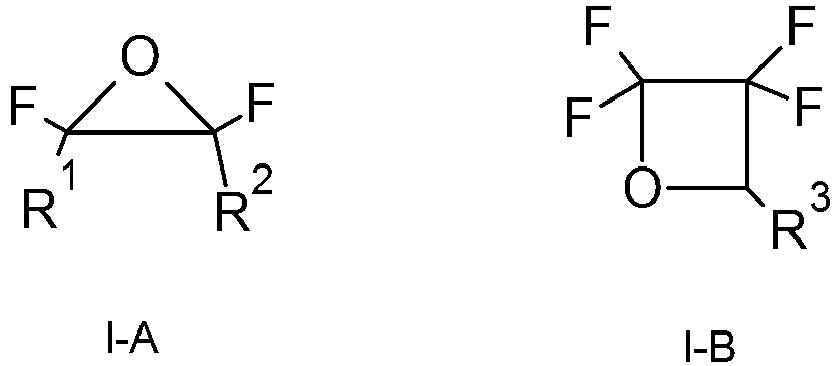
and the corresponding fluorinated compound having at least one -OSF5 group has formula (II-A) and (II-B):
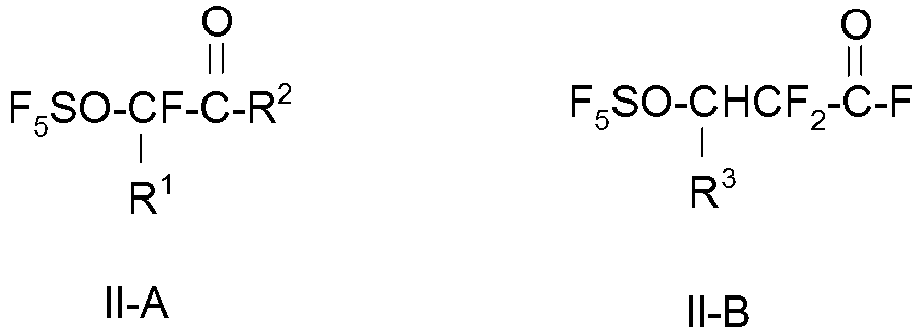
wherein R1 and R2, equal to or different from each other, are independently selected from the group consisting of F, C1-C5 fluorinated alkyl, optionally containing Cl atoms and/or optionally containing etheric oxygen atoms in the chain; and wherein R3 is selected from the group consisting of H, C1-C3 alkyl, optionally containing F and/or Cl atoms and/or optionally containing etheric oxygen atoms in the chain.
and the corresponding fluorinated compound having at least one -OSF5 group has formula (II-A) and (II-B):
wherein R1 and R2, equal to or different from each other, are independently selected from the group consisting of F, C1-C5 fluorinated alkyl, optionally containing Cl atoms and/or optionally containing etheric oxygen atoms in the chain; and wherein R3 is selected from the group consisting of H, C1-C3 alkyl, optionally containing F and/or Cl atoms and/or optionally containing etheric oxygen atoms in the chain.
3. The process of claim 2, said process further comprising the step of reacting the acyl
fluoride of formula (II-B) with fluorine to obtain acyl fluoride of formula (II-C):
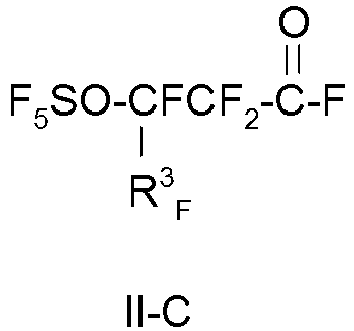
wherein R3F is the fully fluorinated analogue of group R3 in formula (II-B).
wherein R3F is the fully fluorinated analogue of group R3 in formula (II-B).
4. The process according to anyone of the preceding claims comprising the step of reacting
an acyl fluoride of formula (II-A) wherein R2=F, (II-B) or (II-C) with hexafluoropropylene oxide and/or 2,2,3,3-tetrafluorooxethane
in the presence of a catalyst, to obtain compounds of formula (VI-A), (VI-B) or (VI-C):
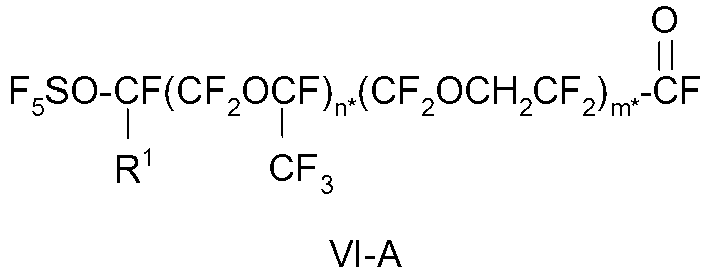
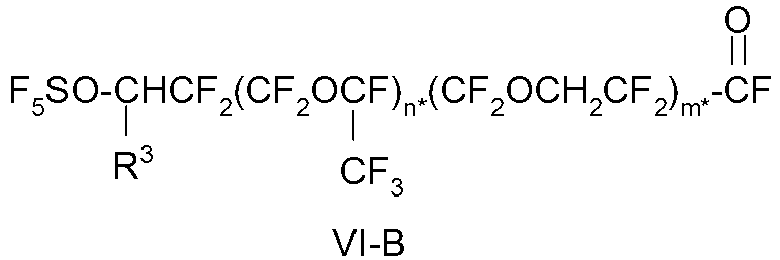
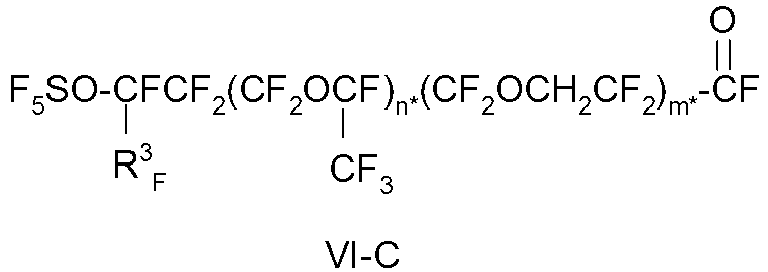
wherein R1, R3 and R3F are as defined in claims 2 and 3; n* is equal to 0 or is an integer from 1 to 15; and m* is equal to 0 or is an integer from 1 to 15.
wherein R1, R3 and R3F are as defined in claims 2 and 3; n* is equal to 0 or is an integer from 1 to 15; and m* is equal to 0 or is an integer from 1 to 15.
5. The process of claim 4, further comprising the step of pyrolyzing an acyl fluoride
of formula (VI-A), (VI-B) or (VI-C) wherein m* is 0 and n*=n is an integer from 1
to 15, to give the corresponding fluorovinyl ethers of formula (IV-A), (IV-B) and
(IV-C):
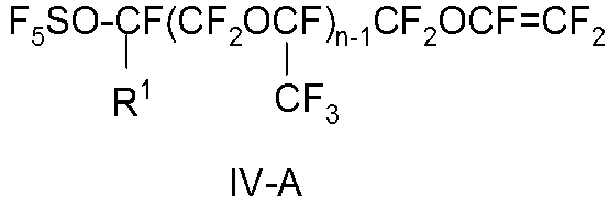
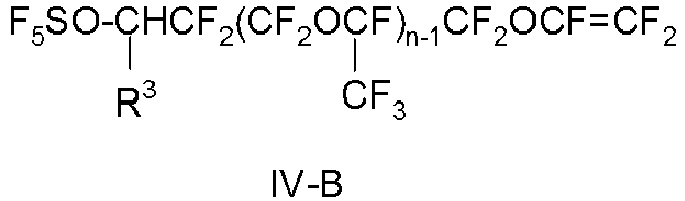
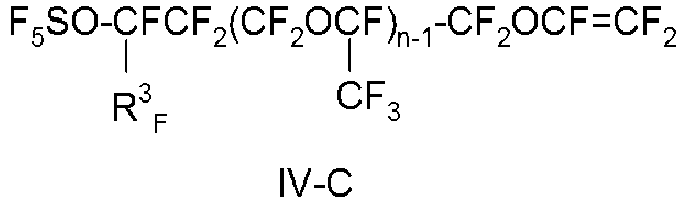
wherein R1, R3 and R3F are as defined in claims 2 and 3.
wherein R1, R3 and R3F are as defined in claims 2 and 3.
6. The process of claim 4 further comprising the step of fluorinating the acyl fluoride
of any one of formula (VI-A), (VI-B) or (VI-C) to the corresponding fully fluorinated
analogue of formula (VII-A) and (VII-C):

wherein R1F is the fully fluorinated analogue of group R1 in formula (IV-A), R3F, n* and m* are as defined in claim 4.
wherein R1F is the fully fluorinated analogue of group R1 in formula (IV-A), R3F, n* and m* are as defined in claim 4.
7. The process of claim 6 further comprising the step of reacting the acyl fluoride of
any one of formula (VII-A) or (VII-C), in the liquid phase at a temperature of from
-150°C to 0°C, with elemental fluorine and with at least one olefin of formula (VIII)
:
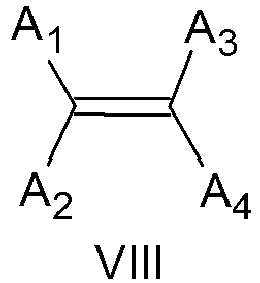
wherein A1, A2, A3, and A4, equal to or different from each other, are independently selected from the group consisting of H, F, Cl, Br, to obtain compounds of formula (IX-A) and (IX-C):


wherein R1F, R3F, n*, m* are as defined in claim 6 and A1, A2, A3, and A4 are as above defined.
wherein A1, A2, A3, and A4, equal to or different from each other, are independently selected from the group consisting of H, F, Cl, Br, to obtain compounds of formula (IX-A) and (IX-C):
wherein R1F, R3F, n*, m* are as defined in claim 6 and A1, A2, A3, and A4 are as above defined.
8. The process of claim 7, further comprising the step of further reacting by dehalogenation
or dehydrohalogenation the compounds of formula (IX-A) and (IX-C) to obtain corresponding
vinyl ethers of formula (XI-A) and (XI-C):


wherein A5 and A6, equal to or different from each other, are independently selected from the group consisting of H, F, Cl, Br.
wherein A5 and A6, equal to or different from each other, are independently selected from the group consisting of H, F, Cl, Br.
9. The process of anyone of claim 6, said process further comprising the step of reacting
the acyl fluoride of formula (VII-A) and (VII-C) with elemental fluorine in the presence
of a fluoride catalyst to obtain the corresponding hypofluorites of formula (XII-A)
and (XII-C):
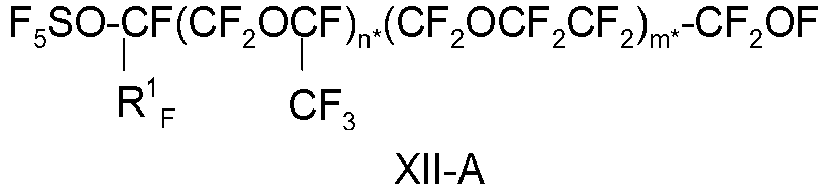
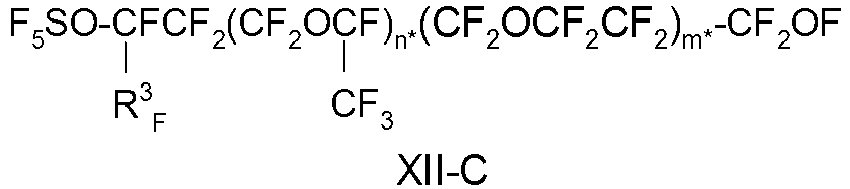
wherein R1F, R3F, n* and m* are as defined in claim 6.
wherein R1F, R3F, n* and m* are as defined in claim 6.
10. The process of claim 9, said process further comprising the step of reacting the hypofluorites
of formula (XII-A) and (XII-C) with one olefin of formula (VIII) to obtain compounds
of formulae (IX-A) and (IX-C).
11. The process of anyone of the preceding claims wherein the fluoride catalyst is selected
from the group consisting of the alkali metal fluorides, the alkali-earth metal fluorides,
the quaternary ammonium fluorides and silver fluoride.
1. Verfahren zur Herstellung von fluorierten Verbindungen mit mindestens einer -OSF5-Gruppe, bei dem man SOF4 in Gegenwart eines Fluorid-Katalysators mit einem fluorierten 3- oder 4-gliedrigen
cyclischen Ether umsetzt.
2. Verfahren nach Anspruch 1, bei dem man den fluorierten 3- oder 4-gliedrigen cyclischen
Ether aus denjenigen der Formel (I-A) oder (I-B) :
auswählt und die entsprechende fluorierte Verbindung mit mindestens einer -OSF5-Gruppe die Formel (II-A) und Formel (II-B) aufweist:
wobei R1 und R2, die gleich oder voneinander verschieden sind, unabhängig aus der Gruppe bestehend aus F, fluoriertem C1-C5-Alkyl, das gegebenenfalls Cl-Atome enthält und/oder gegebenenfalls Ether-Sauerstoffatome in der Kette enthält, ausgewählt sind und wobei R3 aus der Gruppe bestehend aus H, C1-C3-Alkyl, das gegebenenfalls F- und/oder Cl-Atome enthält und/oder gegebenenfalls Ether-Sauerstoffatome in der Kette enthält, ausgewählt ist.
auswählt und die entsprechende fluorierte Verbindung mit mindestens einer -OSF5-Gruppe die Formel (II-A) und Formel (II-B) aufweist:
wobei R1 und R2, die gleich oder voneinander verschieden sind, unabhängig aus der Gruppe bestehend aus F, fluoriertem C1-C5-Alkyl, das gegebenenfalls Cl-Atome enthält und/oder gegebenenfalls Ether-Sauerstoffatome in der Kette enthält, ausgewählt sind und wobei R3 aus der Gruppe bestehend aus H, C1-C3-Alkyl, das gegebenenfalls F- und/oder Cl-Atome enthält und/oder gegebenenfalls Ether-Sauerstoffatome in der Kette enthält, ausgewählt ist.
3. Verfahren nach Anspruch 2, bei dem man ferner das Acylfluorid der Formel (II-B) mit
Fluor zu dem Acylfluorid der Formel (II-C) umsetzt:
wobei R3F für das vollfluorierte Analogon von Gruppe R3 in Formel (II-B) steht.
wobei R3F für das vollfluorierte Analogon von Gruppe R3 in Formel (II-B) steht.
4. Verfahren nach einem der vorhergehenden Ansprüche, bei dem man ein Acylfluorid der
Formel (II-A) mit R2 = F, (II-B) oder (II-C) in Gegenwart eines Katalysators mit Hexafluorpropylenoxid
und/oder 2,2,3,3-Tetrafluoroxethan zu Verbindungen der Formel (VI-A), (VI-B) bzw.
(VI-C) umsetzt:
wobei R1, R3 und R3F wie in den Ansprüchen 2 und 3 definiert sind; n* gleich 0 ist oder für eine ganze Zahl von 1 bis 15 steht und m* gleich 0 ist oder für eine ganze Zahl von 1 bis 15 steht.
wobei R1, R3 und R3F wie in den Ansprüchen 2 und 3 definiert sind; n* gleich 0 ist oder für eine ganze Zahl von 1 bis 15 steht und m* gleich 0 ist oder für eine ganze Zahl von 1 bis 15 steht.
5. Verfahren nach Anspruch 4, bei dem man ferner ein Acylfluorid der Formel (VI-A), (VI-B)
oder (VI-C), wobei m* für 0 steht und n* = n für eine ganze Zahl von 1 bis 15 steht,
zu den entsprechenden Fluorvinylethern der Formel (IV-A), (IV-B) und (IV-C) pyrolysiert:
wobei R1, R3 und R3F wie in den Ansprüchen 2 und 3 definiert sind.
wobei R1, R3 und R3F wie in den Ansprüchen 2 und 3 definiert sind.
6. Verfahren nach Anspruch 4, bei dem man ferner das Acylfluorid einer der Formeln (VI-A),
(VI-B) oder (VI-C) zu dem entsprechenden vollfluorierten Analogon der Formel (VII-A)
und (VII-C) fluoriert:

wobei R1F für das vollfluorierte Analogon von Gruppe R1 in Formel (IV-A) steht und R3F, n* und m* wie in Anspruch 4 definiert sind.
wobei R1F für das vollfluorierte Analogon von Gruppe R1 in Formel (IV-A) steht und R3F, n* und m* wie in Anspruch 4 definiert sind.
7. Verfahren nach Anspruch 6, bei dem man ferner das Acylfluorid einer der Formeln (VII-A)
oder (VII-C) in der Flüssigphase bei der Temperatur von -150°C bis 0°C mit elementarem
Fluor und mit mindestens einem Olefin der Formel (VIII) :
wobei A1, A2, A3 und A4, die gleich oder voneinander verschieden sind, unabhängig aus der Gruppe bestehend aus H, F, Cl und Br ausgewählt sind, zu Verbindungen der Formel (IX-A) und (IX-C) umsetzt:


wobei R1F, R3F, n* und m* wie in Anspruch 6 definiert sind und A1, A2, A3 und A4 wie oben definiert sind.
wobei A1, A2, A3 und A4, die gleich oder voneinander verschieden sind, unabhängig aus der Gruppe bestehend aus H, F, Cl und Br ausgewählt sind, zu Verbindungen der Formel (IX-A) und (IX-C) umsetzt:
wobei R1F, R3F, n* und m* wie in Anspruch 6 definiert sind und A1, A2, A3 und A4 wie oben definiert sind.
8. Verfahren nach Anspruch 7, bei dem man ferner die Verbindungen der Formel (IX-A) und
(IX-C) durch Dehalogenierung oder Dehydrohalogenierung weiter zu entsprechenden Vinylethern
der Formel (XI-A) und (XI-C) umsetzt:


wobei A5 und A6, die gleich oder voneinander verschieden sind, unabhängig aus der Gruppe bestehend aus H, F, Cl und Br ausgewählt sind.
wobei A5 und A6, die gleich oder voneinander verschieden sind, unabhängig aus der Gruppe bestehend aus H, F, Cl und Br ausgewählt sind.
9. Verfahren nach Anspruch 6, bei dem man ferner das Acylfluorid der Formel (VII-A) und
(VII-C) in Gegenwart eines Fluorid-Katalysators mit elementarem Fluor zu den entsprechenden
Hypofluoriten der Formel (XII-A) und (XII-C) umsetzt:
wobei R1F, R3F, n* und m* wie in Anspruch 6 definiert sind.
wobei R1F, R3F, n* und m* wie in Anspruch 6 definiert sind.
10. Verfahren nach Anspruch 9, bei dem man ferner die Hypofluorite der Formel (XII-A)
und (XII-C) mit einem Olefin der Formel (VIII) zu Verbindungen der Formel (IX-A) und
(IX-C) umsetzt.
11. Verfahren nach einem der vorhergehenden Ansprüche, bei dem man den Fluorid-Katalysator
aus der Gruppe bestehend aus den Alkalimetallfluoriden, den Erdalkalimetallfluoriden,
den quaternären Ammoniumfluoriden und Silberfluorid auswählt.
1. Procédé de préparation de composés fluorés ayant au moins un groupe -OSF5, ledit procédé comprenant l'étape de réaction de SOF4 avec un éther cyclique de 3 ou 4 chaînons fluoré en présence d'un catalyseur à fluorure.
2. Procédé de la revendication 1 dans lequel l'éther cyclique de 3 ou 4 chaînons fluoré
est choisi parmi ceux de formule (I-A) ou (I-B) :
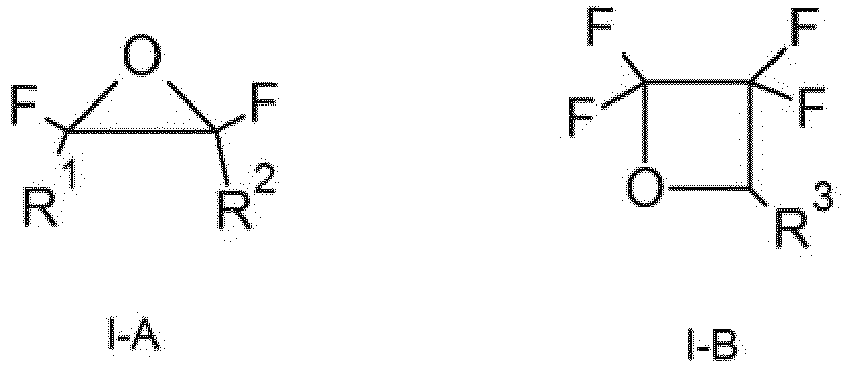
et le composé fluoré correspondant ayant au moins un groupe -OSF5 a les formules (II-A) et (II-B) :
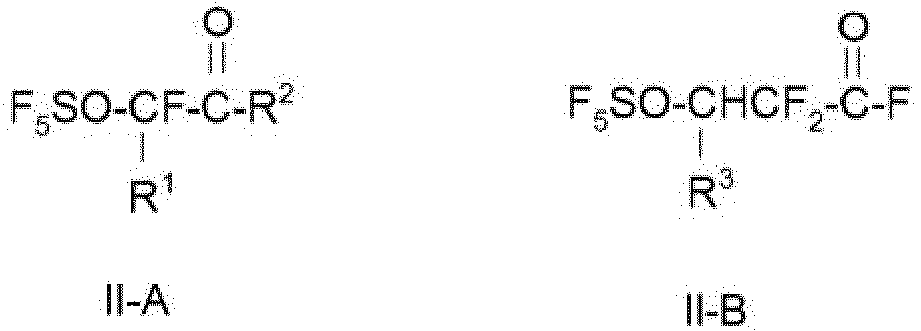
dans lesquelles R1 et R2, identiques ou différents l'un de l'autre, sont indépendamment choisis dans le groupe constitué de F, alkyle fluoré en C1-C5,
contenant facultativement des atomes de Cl et/ou contenant facultativement des atomes d'oxygène éthériques dans la chaîne ; et dans lesquelles R3 est choisi dans le groupe constitué de H, alkyle en C1-C3, contenant facultativement des atomes de F et/ou Cl et/ou contenant facultativement des atomes d'oxygène éthériques dans la chaîne.
et le composé fluoré correspondant ayant au moins un groupe -OSF5 a les formules (II-A) et (II-B) :
dans lesquelles R1 et R2, identiques ou différents l'un de l'autre, sont indépendamment choisis dans le groupe constitué de F, alkyle fluoré en C1-C5,
contenant facultativement des atomes de Cl et/ou contenant facultativement des atomes d'oxygène éthériques dans la chaîne ; et dans lesquelles R3 est choisi dans le groupe constitué de H, alkyle en C1-C3, contenant facultativement des atomes de F et/ou Cl et/ou contenant facultativement des atomes d'oxygène éthériques dans la chaîne.
3. Procédé de la revendication 2, ledit procédé comprenant en outre l'étape de réaction
du fluorure d'acyle de formule (II-B) avec du fluor pour obtenir le fluorure d'acyle
de formule (II-C) :
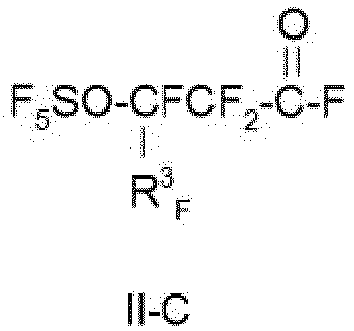
dans laquelle R3F est l'analogue totalement fluoré du groupe R3 dans la formule (II-B).
dans laquelle R3F est l'analogue totalement fluoré du groupe R3 dans la formule (II-B).
4. Procédé selon l'une quelconque des revendications précédentes comprenant l'étape de
réaction d'un fluorure d'acyle de formule (II-A) dans laquelle R2 = F, (II-B) ou (II-C) avec l'oxyde d'hexafluoropropylène et/ou le 2,2,3,3-tétrafluorooxéthane
en présence d'un catalyseur, pour obtenir des composés de formules (VI-A), (VI-B)
ou (VI-C) :
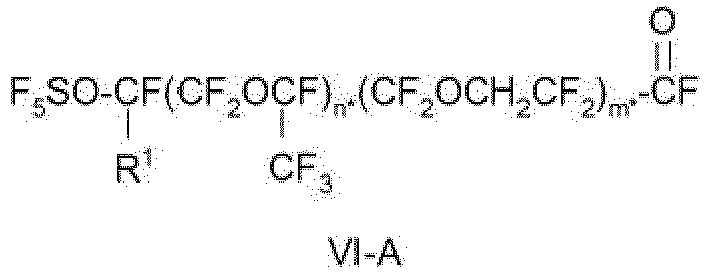
dans lesquelles R1, R3 et R3F sont tels que définis dans les revendications 2 et 3 ; n* est égal à 0 ou est un entier de 1 à 15 ; et m* est égal à 0 ou est un entier de 1 à 15.
dans lesquelles R1, R3 et R3F sont tels que définis dans les revendications 2 et 3 ; n* est égal à 0 ou est un entier de 1 à 15 ; et m* est égal à 0 ou est un entier de 1 à 15.
5. Procédé de la revendication 4, comprenant en outre l'étape de pyrolyse d'un fluorure
d'acyle de formules (VI-A), (VI-B) ou (VI-C) dans lesquelles m* est 0 et n* = n est
un entier de 1 à 15, pour obtenir les éthers de fluorovinyle correspondants de formules
(IV- A), (IV-B) et (IV-C) :
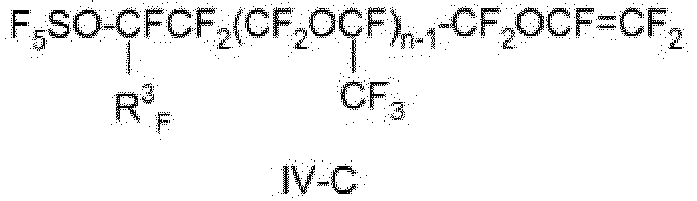
dans lesquelles R1, R3 et R3F sont tels que définis dans les revendications 2 et 3.
dans lesquelles R1, R3 et R3F sont tels que définis dans les revendications 2 et 3.
6. Procédé de la revendication 4 comprenant en outre l'étape de fluoration du fluorure
d'acyle de l'une quelconque des formules (VI-A), (VI-B) ou (VI-C) pour obtenir l'analogue
totalement fluoré correspondant de formules (VII-A) et (VII-C) :

dans lesquelles R1F est l'analogue totalement fluoré du groupe R1 dans la formule (IV-A), R3F, n* et m* sont tels que définis dans la revendication 4.
dans lesquelles R1F est l'analogue totalement fluoré du groupe R1 dans la formule (IV-A), R3F, n* et m* sont tels que définis dans la revendication 4.
7. Procédé de la revendication 6 comprenant en outre l'étape de réaction du fluorure
d'acyle de l'une quelconque des formules (VII-A) ou (VII-C), dans la phase liquide
à une température de -150°C à 0°C, avec du fluor élémentaire et avec au moins une
oléfine de formule (VIII) :
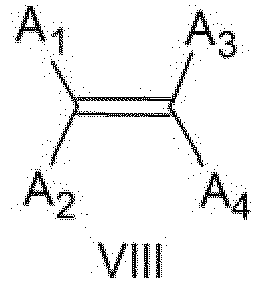
dans laquelle A1, A2, A3 et A4, identiques ou différents les uns des autres, sont indépendamment choisis dans le groupe constitué de H, F, Cl, Br, pour obtenir des composés de formule (IX-A) et (IX-C) :


dans lesquelles R1F, R3F, n*, m* sont tels que définis dans la revendication 6 et A1, A2, A3 et A4 sont tels que définis ci-dessus.
dans laquelle A1, A2, A3 et A4, identiques ou différents les uns des autres, sont indépendamment choisis dans le groupe constitué de H, F, Cl, Br, pour obtenir des composés de formule (IX-A) et (IX-C) :
dans lesquelles R1F, R3F, n*, m* sont tels que définis dans la revendication 6 et A1, A2, A3 et A4 sont tels que définis ci-dessus.
8. Procédé de la revendication 7, comprenant en outre l'étape de réaction supplémentaire
par déshalogénation ou déshydrohalogénation des composés de formules (IX-A) et (IX-C)
pour obtenir les éthers vinyliques correspondants de formules (XI-A) et (XI-C) :
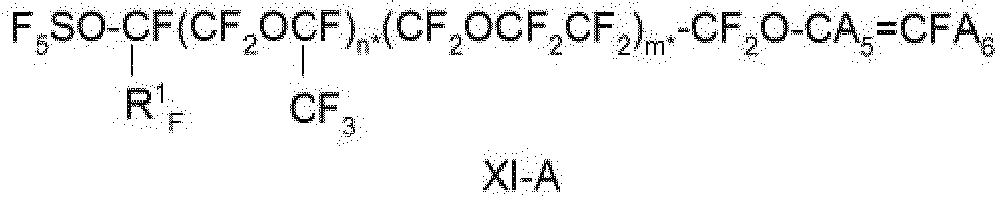

dans lesquelles A5 et A6, identiques ou différents l'un de l'autre, sont indépendamment choisis dans le groupe constitué de H, F, Cl, Br.
dans lesquelles A5 et A6, identiques ou différents l'un de l'autre, sont indépendamment choisis dans le groupe constitué de H, F, Cl, Br.
9. Procédé de la revendication 6, ledit procédé comprenant en outre l'étape de réaction
du fluorure d'acyle de formule (VII-A) et (VII-C) avec du fluor élémentaire en présence
d'un catalyseur à fluorure pour obtenir les hypofluorites correspondants de formules
(XII-A) et (XII-C) :
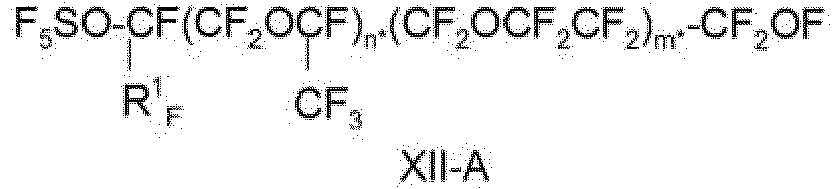
dans lesquelles R1F, R3F, n* et m* sont tels que définis dans la revendication 6.
dans lesquelles R1F, R3F, n* et m* sont tels que définis dans la revendication 6.
10. Procédé de la revendication 9, ledit procédé comprenant en outre l'étape de réaction
des hypofluorites de formules (XII-A) et (XII-C) avec une oléfine de formule (VIII)
pour obtenir des composés de formules (IX-A) et (IX-C).
11. Procédé de l'une quelconque des revendications précédentes dans lequel le catalyseur
à fluorure est choisi dans le groupe constitué des fluorures de métal alcalin, des
fluorures de métal alcalino-terreux, des fluorures d'ammonium quaternaire et du fluorure
d'argent.
REFERENCES CITED IN THE DESCRIPTION
This list of references cited by the applicant is for the reader's convenience only. It does not form part of the European patent document. Even though great care has been taken in compiling the references, errors or omissions cannot be excluded and the EPO disclaims all liability in this regard.
Patent documents cited in the description
- WO2013000735A [0004]
- EP1889832A [0008]
- DE102011114650 [0009]
- WO2012007310A [0031]
- US3114778A [0041]
- EP1388531A [0052]
Non-patent literature cited in the description
- Organic FluoropolymersCARLSON, PETER et al.Ullmann's Encyclopedia of Industial ChemistryWiley-VCH Verlag20000000495-533 [0002]
- DU, L. et al.Synthesis of pentafluorosulfanyl trifluorovinyl ether and its facile rearrangement to difluoro(pentafluorosulfanyl)acetyl fluorideAngew. Chem., Int. Ed. Engl., 2007, vol. 46, 6626-6628 [0005]
- MARCELLIS, ALPHONSO W. et al.Synthesis of pentafluorosulfuroxydifluoroacetly fluorideJournal of Fluorine Chemistry, 1975, vol. 5, 71-75 [0006]
- SCHACK, CARL J. et al.Introduction of functional Groups into Some Chlorofluorocarbon EthersJournal of Fluorine Chemistry, 1979, vol. 14, 519-522 [0007]
- CASE, J.R. et al.Pentafluorosulpuroxy-derivatives of HexafluoropropeneJournal of the Chemical Society, 1964, 946-948 [0010]