| (19) |
 |
|
(11) |
EP 2 051 303 B1 |
| (12) |
EUROPEAN PATENT SPECIFICATION |
| (45) |
Mention of the grant of the patent: |
|
05.07.2017 Bulletin 2017/27 |
| (22) |
Date of filing: 24.07.2008 |
|
| (51) |
International Patent Classification (IPC):
|
|
| (54) |
Method to detect poor infrared rays, Microchip that is able to detect poor infrared
rays and apparatus working with these microchips
Verfahren zur Erkennung schwacher Infrarotstrahlen, zur Erkennung von schwachen Infrarotstrahlen
fähiger Mikrochip und Vorrichtung mit diesen Mikrochips
Procédé pour détecter les faibles rayons infrarouges, micro-puce qui est capable de
détecter les faibles rayons infrarouges et appareil fonctionnant avec ces micro-puces
|
| (84) |
Designated Contracting States: |
|
AT BE BG CH CY CZ DE DK EE ES FI FR GB GR HR HU IE IS IT LI LT LU LV MC MT NL NO PL
PT RO SE SI SK TR |
| (30) |
Priority: |
28.08.2007 US 895800
|
| (43) |
Date of publication of application: |
|
22.04.2009 Bulletin 2009/17 |
| (73) |
Proprietor: Biomimetics Technologies Inc. |
|
Toronto, ON M6S 2X4 (CA) |
|
| (72) |
Inventors: |
|
- Gille, Christoph
16540 Hohen Neuendorf (DE)
- Holmes, Chris
42105 Wuppertal (DE)
- Israelowitz, Meir
Toronto, Ontario M4K 2X4 (CA)
- Rizvi, Syed W. H.
Toronto, Ontario M6S 2X4 (CA)
- P.Von Schroeder, Herbert
Toronto, Ontario M6S 2X4 (CA)
|
| (74) |
Representative: Jabbusch, Matthias et al |
|
Jabbusch Siekmann & Wasiljeff
Patentanwälte
Roscherstrasse 12
30161 Hannover
30161 Hannover (DE) |
| (56) |
References cited: :
EP-A2- 1 267 399
US-A- 5 561 295
US-A- 5 900 631
|
GB-A- 1 568 958
US-A- 5 880 510
US-A1- 2007 213 617
|
|
| |
|
|
- J. F. SILIQUINI ET AL: "Two-dimensional infrared focale plane arrays based on HgCdTe
photoconductive detectors", SEMICONDUCTOR SCIENCE AND TECHNOLOGY, vol. 11, 30 August
1996 (1996-08-30), pages 1906-1911, XP002731480,
- NORTON P: "HgCdTe infrared detectors", OPTO-ELECTRONICS REVIEW, WARSZAWA, PL, [Online]
vol. 10, no. 3, 1 November 2002 (2002-11-01), pages 159-174, XP002599143, ISSN: 1230-3402
Retrieved from the Internet: URL:http://www.wat.edu.pl/review/optor/10( 3)159.pdf>
[retrieved on 2010-09-03]
|
|
| |
|
| Note: Within nine months from the publication of the mention of the grant of the European
patent, any person may give notice to the European Patent Office of opposition to
the European patent
granted. Notice of opposition shall be filed in a written reasoned statement. It shall
not be deemed to
have been filed until the opposition fee has been paid. (Art. 99(1) European Patent
Convention).
|
[0001] The invention relates to a method for the detection of poor rays of infrared wavelength,
to a microchip that is able to detect poor infrared rays and to an apparatus working
with these microchips.
[0002] In a closed body of a working machine or an electronic apparatus or a human or an
animal body is to detect a source of little higher temperature than normal, when defects
beginn to happen. In an electronic apparatus more warmth as usual can appear when
a resistance is stressed by a to high voltage, in a working machine is in the case
of a lack of oil more warmth on a place produced which breaks at first, in a human
or animal body arises the temperature where the body has to defend themselves against
a growing cancer.
[0003] In all these cases the beginning of a growing defect can be located when it is possible
to measure only a little higher temperature in a wide distance and to locate the place
of this higher temperature.
[0004] This invention gives a possibility to detect and to locate little growings cancers
and others hidden places of parts of a machine with increased temperature. The invention
does do it with a special microchip which is able to change photons in electrons.
US5561295 discloses such a detector in which a continuous film of light detecting material
is covered with a contact grid. This microchip of the invention consists of a plate
of glas or an other insulating material with a rough surface on the one side. The
front surface of this plate is rough by a plurality of blind holes, the ground of
each of theese blind holes is covered with a thin layer of metal, in each of the blind
holes are located little semiconducting crystals of a kind of material that emitts
one or more electrons by each hit of an infrared light beam, the surface of this plate
and the blind holes are covered with a net of very thin wires and the active part
of this net of very thin wires has on its ends rails of metal to collect and transmit
the electrons to a measuring instrument.
[0005] The blind holes can have the form of hemispheres, of cylindrical holes or honeycombs.
Each blind hole has an inner surface of a thin layer of metal to deduct electrons
from the surface or the edges of the cristals situated in the blind holes. From these
metal layers and from the free edges of the cristalls the thin wires covering the
surface of the glasplate deduct the electrons to the rails and to the measuring instrument
(to measure voltage differences).
[0006] The cristals put in the blind holes are semiconductors made from atoms of the group
VI elements such as
| < |
Cadmium selenide |
Cd Se |
| < |
Cadmium sulfide |
Cd Ss |
| < |
Cadmium telluride |
Cd Te |
| < |
Zinc oxide |
Zn O |
| < |
Zinc selenide |
Zn Se |
| < |
Zinc sulfide |
Zn S |
| < |
Zinc telluride |
Zn Te |
and/or from II-VI ternary alloy semiconductos
| < |
Cadmium zinc telluride |
Cd Zn Te |
| < |
Mercury cadmium telluride |
Hg Cd Te |
| < |
Mercury zink telluride |
Hg Zn Te |
| < |
Mercury zink selenide |
Hg Zn Se |
and/or from a I-VII semiconductor
and/or from IV - IV semiconductors
| < |
Lead selenide |
Pb Se |
| < |
Lead sulfide |
Pb S |
| < |
Lead telluride |
Pb Te |
| < |
Tin sulfide |
Sn S |
| < |
Tin telluride |
Sn Te |
and/or from IV - IV ternary semiconductors
| < |
Lead tin telluride |
Pb Sn Te |
| < |
Thallium tin telluride |
Tl Sn Te |
| < |
Thallium germanium telluride |
TI Ge Te |
and/or from V - VI semiconductors
| < |
Bismuth telluride |
Bi Te |
| < |
II - V semiconductors |
|
| < |
Cadmium phosphide |
Cd P |
and/or from II - V semiconductors
| < |
Cadmium phosphide |
Cd P |
| < |
Cadmium arsenide |
Cd As |
| < |
Cadmium antimonide |
Cd Sb |
| < |
Zinc phosphide |
Zn P |
| < |
Zinc arsenide |
Zn As |
| < |
Zinc antimonide |
Zn Sb |
[0007] For this method it is usefull if the cristals of the semiconductors are sourrounded
by a polymer which is grown in an acid fluid.
[0008] This polymer should be a good conductor of electrons like dendrimers and nanocarbon
tube,
especially
| < |
Poly-acethylene |
| < |
Fullerenes |
| < |
Melamine |
| |
Poly-amidoamine |
| < |
non-polar polymers |
| < |
Fluoropolymers |
| < |
Fluorocarbons |
| < |
Polytetrafluoroethylene. |
[0009] This invention relates also to a microchip that is able to detect poor infrared rays.
This microchip consists of a thin plate of glas, silicon or another hard electrical
insulating material, the front surface of this glas plate is rough by a plurality
of blind holes, the ground of the blind holes is covered with a thin layer of metal,
in the blind holes are situated little crystals of a kind of material that that is
an infrared absorber and emitts one or more electrons by each hit of an infrared light
beam, the surface of this plate of glas and the blind holes is covered with a net
of very thin wires and the active part of this net of very thin wires has on its ends
rails to collect the electrons.
[0010] This microchip is able to detect poor infrared reys and to change whose energy in
electrons. That makes it possible to find out the presence and the power of a infrared
radiation also in the case that this radiation is poor.
[0011] The microchip of the invention can have a front surface of grooves in form of a regular
shape like little honeycombs.
[0012] It is advantageous if the crystals of this microchip located in the blind holes are
surrounded by a polymer with electrical conductivity and/or some metal coating.
[0013] Because heat can be generated in the microchip of this invention the semiconductors
or the theese semiconductor carrying glas plate can be attached to or embedded in
a heat deducting material.
[0014] It is advantageous for the construction of this microchip if the net of thin wires
over the semiconductor cristals is so situated that they let through infrared light
and catch the most of the in the semiconductors produced electrons.
[0015] To hinder a demolation of the microchip by sweat of a human body or oil of a machine
or other influences it is advantageous to have a protection layer over the web of
thin wires against a direct connection of the thin wires with the investigated body.
[0016] Theese microchips can be part of an apparatus for the detection of a source of poor
infrared rays in a body consisting of one or more microchips und a device for the
comparison the output of electrons of the microchip(s) on diverse locations of the
surface of the body, par example in an apparatus with one microchip to measure the
ground-radiation of the body and another microchip to measure the soft increased radiation
of a defect.
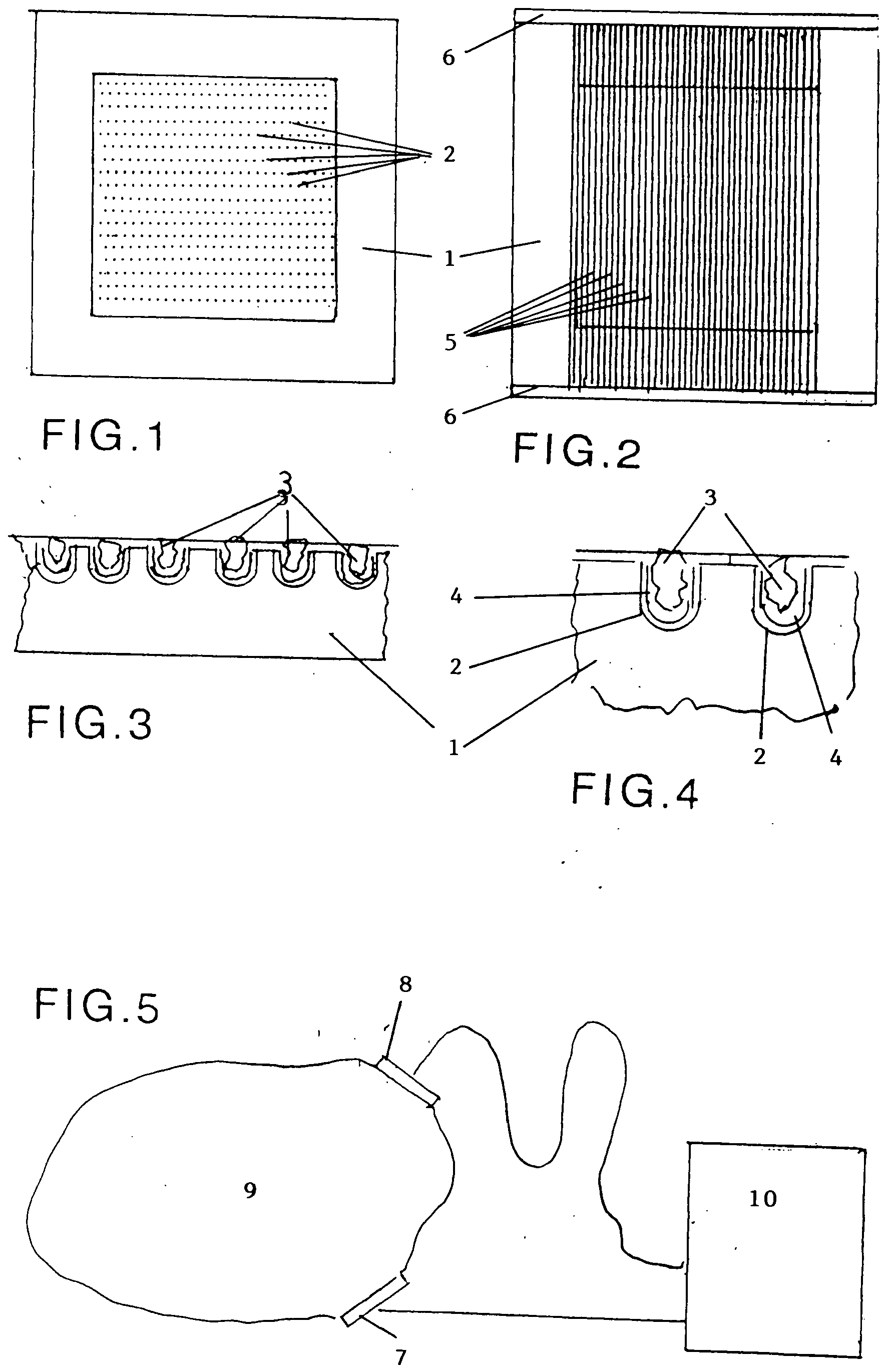
[0017] The enclosed drawing shows in
- Fig.1
- a view of the surface of the microchip.
- Fig.2
- a crossection through the microchip.
- Fig.3
- an enlarged part of the crossection.
- Fig.4
- a wiring diagramm of the apparatus using the microchips.
[0018] The microchip consists of a glas plate 1 with a rough surface on its front side,
because there are many blind holes 2. In theese blind holes 2 are embedded cristals
3 of semiconductos surrounded by an acid polymer solution. The ground and the walls
of the blind holes 2 are covered with a thin layer 4 of metal. Over the whole glas
plate 1 with the cristals is laid a web of thin wires leading the electrons in the
cristals produced electrons to the rails 5 acting as electrodes.
[0019] The apparatus 6 works with two microchips 7,8 on a body 9 to investigate. Microchip
7 is fastend on the body to ascertain the ground-radiation, microchip 8 is movable
to find out a location with encreased radiation.
1. Method for producing a microchip that is able to detect poor rays of infrared wavelength
by taking a thin plate of glass (1) or another hard electrical insulating material,
the front surface is rough by a plurality of blind holes, (2) by covering the blind
holes with a thin layer of metal, (4) by bringing in in the holes little crystals
(3) of a kind of material that emits one or more electrons by each hit of an infrared
light beam, by covering the surface of the plate and the blind holes with a net of
very thin wires (5) and by collecting the electrons in rails (6) at the ends of the
active part of the net of very thin wires and with semiconductors as crystals of a
kind of material that emits one or more electrons by each hit of an infrared light
beam.
2. Method for producing a microchip according claim 1 using crystals in the blind holes
as
| < |
Cadmium selenide |
Cd Se |
| < |
Cadmium sulfide |
Cd S |
| < |
Cadmium telluride |
Cd Te |
| < |
Zinc oxide |
Zn O |
| < |
Zinc selenide |
Zn Se |
| < |
Zinc sulfide |
Zn S |
| < |
Zinc telluride |
Zn Te |
and/or from II - VI ternary alloy semiconductors
| < |
Cadmium zinc telluride |
Cd Zn Te |
| < |
Mercury cadmium telluride |
Hg Cd Te |
| < |
Mercury zinc telluride |
Hg Zn Te |
| < |
Mercury zinc selenide |
Hg Zn Se |
and/or from a I - VII semiconductor
and/or from IV - IV semiconductors
| < |
Lead selenide |
Pb Se |
| < |
Lead sulfide |
Pb S |
| < |
Lead telluride |
Pb Te |
| < |
Tin sulfide |
Sn S |
| < |
Tin telluride |
Sn Te |
and/or from IV - IV ternary semiconductors
| < |
Lead tin telluride |
Pb Sn Te |
| < |
Thallium tin telluride |
TI Sn Te |
| < |
Thallium germanium telluride |
Tl Ge Te |
and/or from V - VI semiconductors
| < |
Bismuth telluride |
Bi Te |
| < |
II - V semiconductors |
|
| < |
Cadmium phosphide |
Cd P |
and/or from II - V semiconductors
| < |
Cadmium phosphide |
Cd P |
| < |
Cadmium arsenide |
Cd As |
| < |
Cadmium antimonide |
Cd Sb |
| < |
Zinc phosphide |
Zn P |
| < |
Zinc arsenide |
Zn As |
| < |
Zinc antimonide |
Zn Sb |
3. Method according claims 1 and 2 with semiconductors surrounded by a polymer which
is grown in a acid fluid.
4. Method according claim 1 to 3 using a polymer which should be a good conductor of
electrons like dendrimers and nanocarbon tube, especially
| < |
Poly-acetylene |
| < |
Fullerenes |
| < |
Melamine |
| < |
Poly-amidoamine |
| < |
non-polar polymers |
| < |
Fluoropolymers |
| < |
Fluorocarbons |
| < |
Polytetrafluoroethylene. |
5. Microchip
that is able to detect poor infrared rays consisting of a thin plate of glass (1)
or another hard electrical insulating material, the front surface of this glass plate
is rough by a plurality of blind holes, (2) the ground of the blind holes is covered
with a thin layer of metal, (4) in the blind holes are situated little semiconductors
crystals (3) of a kind of material that that is an infrared absorber and emits one
or more electrons by each hit of an infrared light beam, the surface of this plate
of glass and the blind holes is covered with a net of very thin wires (5) and the
active part of this net of very thin wires has on its ends rails (6) to collect the
electrons.
6. Microchip according claim 5
with a front surface of grooves in form of a regular shape like little honeycombs.
7. Microchip according claim 5
with crystals situated in the blind holes surrounded by a polymer with electrical
conductivity.
8. Microchip according claim 5
whose semiconductors or glass plate are attached to or embedded in a heat deducted
material.
9. Microchip according claim 7
with a net of thin wires over the semiconductor crystals so situated that they let
through infrared light and catch the most of the in the semiconductors produced electrons.
10. Microchip according claim 5
with a protection layer over the web of thin wires against a direct connection of
the thin wires with a investigated body.
11. Apparatus for the detection of a source of poor rays of infrared wavelength in a body
consisting of one or more microchips according claim 5 and device for the comparison
the output of electrons of the microchip(s) on diverse locations of the surface of
the body.
1. Verfahren zur Herstellung eines Mikrochip, der in der Lage ist, schwache Strahlen
von Infrarotwellenlänge zu erkennen, durch Verwenden einer dünnen Glasplatte (1) oder
eines anderen harten elektrischen Isoliermaterials, dessen vordere Fläche durch eine
Mehrzahl von Blindlöchern (2) aufgeraut ist, durch Bedecken der Blindlöcher mit einer
dünnen Metallschicht (4), durch Einführen in die Löcher kleiner Kristalle (3) einer
Art Material, das ein oder mehrere Elektronen durch jeden Treffer eines Infrarotlichtstrahls
emittiert, durch Bedecken der Oberfläche der Platte und der Blindlöcher mit einem
Netz aus sehr dünnen Drähten (5) und durch Auffangen der Elektronen in Schienen (6)
an den Enden jedes aktive Teils des Netzes von sehr dünnen Drähten und mit Halbleitern
als Kristallen irgendeiner Art Material, das ein oder mehrere Elektronen durch jeden
Treffer eines Infrarotlichtstrahls emittiert.
2. Verfahren zur Herstellung eines Mikrochip nach Anspruch 1 unter Verwendung von Kristallen
in den Blindlöchern als
| < |
Cadmiumselenid |
Cd Se |
| < |
Cadmiumsulfid |
Cd S |
| < |
Cadmiumtellurid |
Cd Te |
| < |
Zinkoxid |
Zn 0 |
| < |
Zinkselenid |
Zn Se |
| < |
Zinksulfid |
Zn S |
| < |
Zinktellurid |
Zn Te |
und/oder ternäre Legierungs-II - VI-Halbleiter
| < |
Cadmiumzinktellurid |
Cd Zn Te |
| < |
Quecksilbercadmiumtellurid |
Hg Cd Te |
| < |
Quecksilberzinktellurid |
Hg Zn Te |
| < |
Quecksilberzinkselenid |
Hg Zn Se |
und/oder I - VII-Halbleiter
und/oder IV - IV-Halbleiter
| < |
Bleiselenid |
Pb Se |
| < |
Bleisulfid |
Pb S |
| < |
Bleitellurid |
Pb Te |
| < |
Zinnsulfid |
Sn S |
| < |
Zinntellurid |
Sn Te |
und/oder ternäre IV - IV-Halbleiter
| < |
Bleizinntellurid |
Pb Sn Te |
| < |
Thalliumzinntellurid |
Ti Sn Te |
| < |
Thalliumgermaniumtellurid |
Tl Ge Te |
und/oder V - VI-Halbleiter
| < |
Wismuttellurid |
Bi Te |
| < |
II - V-Halbleiter |
|
| < |
Cadmiumphosphid |
Cd P |
und/oder II - V-Halbleiter
| < |
Cadmiumphosphid |
Cd P |
| < |
Cadmiumarsenid |
Cd As |
| < |
Cadmiumantimonid |
Cd Sb |
| < |
Zinkphosphid |
Zn P |
| < |
Zinkarsenid |
Zn As |
| < |
Zinkantimonid |
Zn Sb |
3. Verfahren nach den Ansprüchen 1 und 2 mit Halbleitern, die von einem Polymer umgeben
sind, das in einem sauren Fluid gezüchtet wird.
4. Verfahren nach Anspruch 1 bis 3, bei dem ein Polymer verwendet wird, das ein guter
Leiter von Elektronen sein sollte, wie Dendrimere und Nanokohlenstoffröhren, insbesondere
| < |
Polyacetylen |
| < |
Fullerene |
| < |
Melamin |
| < |
Polyamidoamin |
| < |
nichtpolare Polymere |
| < |
Fluorpolymere |
| < |
Fluorkohlenstoffe |
| < |
Polytetrafluorethylen. |
5. Mikrochip, der in der Lage ist, schwache Infrarotstrahlen zu erkennen, bestehend aus
einer dünnen Glasplatte (1) oder einem anderen harten elektrischen Isoliermaterial,
wobei die vordere Fläche dieser Glasplatte durch eine Mehrzahl von Blindlöchern (2)
aufgeraut ist, wobei der Boden der Blindlöcher mit einer dünnen Metallschicht (4)
bedeckt ist, in den Blindlöchern sich kleine Halbleiterkristalle (3) einer Art Material
befinden, das ein Infrarotabsorptionsmittel ist und ein oder mehrere Elektronen durch
jeden Treffer eines Infrarotlichtstrahls emittiert, die Oberfläche dieser Glasplatte
und die Blindlöcher mit einem Netz aus sehr dünnen Drähten (5) bedeckt sind und der
aktive Teil dieses Netzes von sehr dünnen Drähten Schienen (6) an seinen Enden zum
Auffangen der Elektronen aufweist.
6. Mikrochip nach Anspruch 5 mit einer vorderen Oberfläche von Vertiefungen in Form einer
regelmäßigen Gestalt wie kleiner Waben.
7. Mikrochip nach Anspruch 5 mit Kristallen, die sich in den Blindlöchern befinden und
von einem Polymer mit elektrischer Leitfähigkeit umgeben sind.
8. Mikrochip nach Anspruch 5 dessen Halbleiter oder Glasplatte an einem wärmeabgezogenen
Material befestigt oder darin eingebettet sind.
9. Mikrochip nach Anspruch 7 mit einem Netz dünner Drähte über den Halbleiterkristallen,
die so positioniert sind, dass sie Infrarotlicht hindurchlassen und den Hauptteil
der in den Halbleitern erzeugten Elektronen auffangen.
10. Mikrochip nach Anspruch 5 mit einer Schutzschicht über dem Netzwerk dünner Drähte
gegen eine direkte Verbindung der dünnen Drähte mit einem untersuchten Körper.
11. Apparat zur Erkennung einer Quelle schlechter Strahlen einer Infrarotwellenlänge in
einem Körper, bestehend aus einem oder mehreren Mikrochip nach Anspruch 5 und Vorrichtung
zum Vergleichen der Abgabe von Elektronen des/der Mikrochip an verschiedenen Stellen
der Oberfläche des Körpers.
1. Procédé de production d'une micropuce qui est capable de détecter les faibles rayons
de longueur d'onde infrarouge en utilisant une plaque mince de verre (1) ou un autre
matériau isolant électrique dur, la surface avant est rendue rugueuse par une pluralité
de trous borgnes (2), en recouvrant les trous borgnes avec une couche mince de métal
(4), en amenant dans les trous de petits cristaux (3) d'un type de matériau qui émet
un ou plusieurs électrons à chaque atteinte d'un faisceau de lumière infrarouge, en
recouvrant la surface de la plaque et les trous borgnes d'un réseau de fils très minces
(5) et en recueillant les électrons dans des rails (6) aux extrémités de la partie
active du réseau de fils très minces et avec des semi-conducteurs en tant que cristaux
d'un type de matériau qui émet un ou plusieurs électrons à chaque atteinte d'un faisceau
de lumière infrarouge.
2. Procédé de production d'une micropuce selon la revendication 1 utilisant des cristaux
dans les trous borgnes sous forme de
| < |
séléniure de cadmium |
Cd Se |
| < |
sulfure de cadmium |
Cd S |
| < |
tellurure de cadmium |
Ce Te |
| < |
oxyde de zinc |
Zn O |
| < |
séléniure de zinc |
Zn Se |
| < |
sulfure de zinc |
Zn S |
| < |
tellurure de zinc |
Zn Te |
et/ou de semi-conducteurs d'alliages ternaires II - VI
| < |
tellurure de zinc-cadmium |
Cd Zn Te |
| < |
tellurure de mercure-cadmium |
Hg Cd Te |
| < |
tellurure de mercure-zinc |
Hg Zn Te |
| < |
séléniure de mercure-zinc |
Hg Zn Se |
et/ou de semi-conducteurs I - VII
| < |
chlorure de cuivre |
Cu Cl |
et/ou de semi-conducteurs IV - IV
| < |
séléniure de plomb |
Pb Se |
| < |
sulfure de plomb |
Pb S |
| < |
tellurure de plomb |
Pb Te |
| < |
sulfure d'étain |
Sn S |
| < |
tellurure d'étain |
Sn Te |
et/ou de semi-conducteurs d'alliages ternaires IV - IV
| < |
tellurure de plomb-étain |
Pb Sn Te |
| < |
tellurure de thallium-étain |
Tl Sn Te |
| < |
tellurure de thallium-germanium |
Tl Ge Te |
et/ou de semi-conducteurs V - VI
| < |
tellurure de bismuth |
Bi Te |
| < |
semi-conducteurs II - V |
|
| < |
phosphure de cadmium |
Cd P |
et/ou de semi-conducteurs II - V
| < |
phosphure de cadmium |
Cd P |
| < |
arséniure de cadmium |
Cd As |
| < |
antimoine de cadmium |
Cd Sb |
| < |
phosphure de zinc |
Zn P |
| < |
arséniure de zinc |
Zn As |
| < |
antimoine de zinc |
Zn Sb. |
3. Procédé selon les revendications 1 et 2 avec des semi-conducteurs entourés par un
polymère qui est développé dans un fluide acide.
4. Procédé selon les revendications 1 à 3 utilisant un polymère qui doit être un bon
conducteur pour les électrons tels que les dendrimères et un nanotube de carbone,
en particulier
| < |
un polyacétylène |
| < |
les fullerènes |
| < |
une mélamine |
| < |
une polyamidoamine |
| < |
des polymères non polaires |
| < |
des polymères fluorés |
| < |
des hydrocarburesfluorés |
| < |
un polytétrafluoroéthylène. |
5. Micropuce qui est capable de détecter les faibles rayons de longueur d'onde infrarouge
en utilisant une plaque mince de verre (1) ou un autre matériau isolant électrique
dur, la surface avant est rendue rugueuse par une pluralité de trous borgnes (2),
la zone des trous borgnes est recouverte d'une couche mince de métal (4), dans les
trous borgnes sont situés de petits cristaux de semi-conducteurs (3) d'un type de
matériau qui est un absorbeur d'infrarouge et émet un ou plus électrons à chaque atteinte
d'un faisceau de lumière infrarouge, la surface de cette plaque de verre et des trous
borgnes est recouverte d'un réseau de fils très minces (5) et la partie réactive de
ce réseau de fils très minces a sur ses extrémités des rails qui recueillent les électrons.
6. Micropuce selon la revendication 5 ayant une surface avant constituée de rainures
sous la forme d'une forme régulière telle que de petits nids d'abeilles.
7. Micropuce selon la revendication 5 ayant des cristaux situés dans les trous borgnes
entourés par un polymère ayant une conductivité électrique.
8. Micropuce selon la revendication 5 dont les semi-conducteurs ou la plaque de verre
sont attachés à ou ancrés dans un matériau déduit par la chaleur.
9. Micropuce selon la revendication 7 ayant un réseau de fils minces sur les cristaux
de semi-conducteurs placés de telle sorte qu'ils laissent passer la lumière infrarouge
et attrapent la plupart des électrons produits par les semi-conducteurs.
10. Micropuce selon la revendication 5 ayant une couche de protection sur le réseau de
fils minces empêchant une connexion directe des fils minces avec un corps étudié.
11. Appareil de détection d'une source de faibles rayons de longueur d'onde infrarouge
dans un corps constitué par une ou plusieurs micropuces selon la revendication 5 et
un dispositif permettant la comparaison de la sortie des électrons de la ou des micropuces
en divers endroits de la surface du corps.
REFERENCES CITED IN THE DESCRIPTION
This list of references cited by the applicant is for the reader's convenience only.
It does not form part of the European patent document. Even though great care has
been taken in compiling the references, errors or omissions cannot be excluded and
the EPO disclaims all liability in this regard.
Patent documents cited in the description