|
(11) | EP 2 998 306 B1 |

| (12) | EUROPEAN PATENT SPECIFICATION |
|
|
| (54) |
NOVEL TETRAARYL BORATE COMPOUND AND METHOD FOR PRODUCING SAME NEUARTIGE TETRAARYLBORATVERBINDUNG UND VERFAHREN ZUR HERSTELLUNG DAVON NOUVEAU COMPOSÉ BORATE DE TÉTRAARYLE ET SON PROCÉDÉ DE FABRICATION |
|
|
|||||||||||||||||||||||||||||||
| Note: Within nine months from the publication of the mention of the grant of the European patent, any person may give notice to the European Patent Office of opposition to the European patent granted. Notice of opposition shall be filed in a written reasoned statement. It shall not be deemed to have been filed until the opposition fee has been paid. (Art. 99(1) European Patent Convention). |
Technical Field
Background Art
[0002] Trialkylammonium tetrakis(pentafluorophenyl) borate and (aryl)dialkylammonium tetrakis(pentafluorophenyl) borate are used as co-catalysts for a polymerization reaction using a metallocene catalyst. Examples of known methods for producing the borates include the following methods (i) and (ii) (refer to Patent Literature 1).
- (i) Method for producing di(tallow-alkyl)methylammonium tetrakis(pentafluorophenyl) borate bromo magnesium tetrakis(pentafluorophenyl) borate → magnesium di[tetrakis(pentafluorophenyl) borate] magnesium di[tetrakis(pentafluorophenyl) borate] + di(tallow-alkyl)methylamine + hydrogen chloride → di(tallow-alkyl)ethylammonium tetrakis(pentafluorophenyl) borate
- (ii) Method for producing dimethylanilinium tetrakis(pentafluorophenyl) borate
potassium tetrakis(pentafluorophenyl) borate + N, N-dimethylaniline + hydrogen chloride → dimethylanilinium tetrakis(pentafluorophenyl) borate.
[0003] WO2005/105816A1 (Patent Literature 2) discloses a process for producing tetrakis (fluoraryl) borate alkali metal salts.
Citation List
Patent Literature
Summary of Invention
Technical Problem
[0005] In the production method of (i), it is difficult to produce high purity magnesium di[tetrakis(pentafluorophenyl) borate]. As a result, it is difficult to obtain high purity di(tallow-alkyl)methylammonium tetrakis(pentafluorophenyl) borate (a purity of di(tallow-alkyl)methylammonium tetrakis(pentafluorophenyl) borate described in Patent Literature 1 is 88.6 to 89.99%). The production method of (ii) uses potassium tetrakis(pentafluorophenyl)borate, which is an alkali metal salt of tetrakis(pentafluorophenyl) borate. The alkali metal salt of tetrakis(pentafluorophenyl) borate does not have sufficient thermal stability in comparison with the tetraaryl borate compound of the present invention, represented by formula (1). Thus the alkali metal salt of tetrakis(pentafluorophenyl) borate is not suitable for industrial use in view of safe handling (see differential scanning calorimetry results of Examples described later).
Solution to Problem
[0006] The present invention provides a method for producing a tetraaryl borate compound (hereinafter, referred to as tetraaryl borate compound (5)) represented by formula (5):
wherein R1 to R3 each represents an alkyl group having 1 to 30 carbon atoms or an aryl group having 6 to 30 carbon atoms,
in which the tetraaryl borate compound (1)
wherein M+ represents NH4+,
and an amine compound (hereinafter, referred to as amine compound (4)) are reacted, wherein the amine compound is represented by formula (4):
wherein R1 to R3 are the same as above.
Advantageous Effects of Invention
[0007] The present invention can provide the tetraaryl borate compound (1) which has high thermal stability and is suitable for industrial use. By using the tetraaryl borate compound (1) as an intermediate, the high purity tetraaryl borate compound (5) can be produced. Therefore, the present invention is very useful industrially.
Description of Embodiments
[0008] The tetraaryl borate compound (1) is usually used for the following reaction as an aqueous solution.
[0009] The tetraaryl borate compound (1) and the amine compound (4) are reacted to produce the tetraaryl borate compound (5) (hereinafter, this reaction is referred to as second reaction).
[0010] In formula (4), R1 to R3 each represents an alkyl group having 1 to 30 carbon atoms or an aryl group having 6 to 30 carbon atoms. Specific examples of the alkyl group having 1 to 30 carbon atoms include a methyl group, an ethyl group, a propyl group, a butyl group, a pentyl group, a hexyl group, a heptyl group, an octyl group, a nonyl group, a decyl group, an undecyl group, a dodecyl group, a tridecyl group, a tetradecyl group, a pentadecyl group, a hexadecyl group, a heptadecyl group, an octadecyl group, a nonadecyl group, an icosyl group, a beef-tallow-alkyl group, and a hardened-beef-tallow-alkyl group. Preferable examples thereof include a methyl group, a beef-tallow-alkyl group, and a hardened-beef-tallow-alkyl group. Specific examples of the aryl group having 6 to 30 carbon atoms include a phenyl group, a benzyl group, a phenethyl group, a methylphenyl group, and a dimethylphenyl group. Preferable examples thereof include a phenyl group.
[0011] Specific examples of the amine compound (4) include trimethylamine, triethylamine, tripropylamine, tributylamine, tripentylamine, trihexylamine, triheptylamine, trioctylamine, trinonylamine, tridecylamine, triundecylamine, tridodecylamine, tritridecylamine, tritetradecylamine, tripentadecylamine, trihexadecylamine, triheptadecylamine, trioctadecylamine, trinonadecylamine, trieicosylamine, triheneicosylamine, tridocosylamine, tritricosylamine, tritetracosylamine, tripentacosylamine, trihexacosylamine, triheptacosylamine, trioctacosylamine, trinonacosylamine, tritriacontylamine, diethylmethylamine, dipropylmethylamine, dibutylmethylamine, dipentylmethylamine, dihexylmethylamine, diheptylmethylamine, dioctylmethylamine, dinonylmethylamine, didecylmethylamine, diundecylmethylamine, didodecylmethylamine, ditridecylmethylamine, ditetradecylmethylamine, dipentadecylmethylamine, dihexadecylmethylamine, diheptadecylmethylamine, dioctadecylmethylamine, dinonadecylmethylamine, dieicosylmethylamine, diheneicosylmethylamine, didocosylmethylamine, ditricosylmethylamine, ditetracosylmethylamine, dipentacosylmethylamine, dihexacosylmethylamine, diheptacosylmethylamine, dioctacosylmethylamine, dinonacosylmethylamine, ditriacontylmethylamine, di-beef-tallow-alkylmethylamine, di-hardened-beef-tallow-alkylmethylamine, N, N-dimethylaniline, and N, N-diethylaniline. Preferable examples thereof include dihexadecylmethylamine, diheptadecylmethylamine, dioctadecylmethylamine, dinonadecylmethylamine, dieicosylmethylamine, diheneicosylmethylamine, didocosylmethylamine, ditricosylmethylamine, ditetracosylmethylamine, dipentacosylmethylamine, di-beef-tallow-alkylmethylamine, di-hardened-beef-tallow-alkylmethylamine, N, N-dimethylaniline, and N, N-diethylaniline. More preferable examples thereof include di-beef tallow-alkyl-methylamine, di-hardened-beef-tallow-alkylmethylamine, and N, N-dimethylaniline.
[0012] The reaction is usually performed in an organic solvent. The kind of the organic solvent is not particularly limited, but is preferably a hydrocarbon solvent, an aromatic hydrocarbon solvent, an open-chain ether solvent, or a mixed solvent thereof. A use amount of the solvent is not particularly limited, but is usually 20 parts by weight or less, preferably 1 to 10 parts by weight, particularly preferably 2 to 6 parts by weight, with respect to one part by weight of the tetraaryl borate compound (1).
[0013] A use amount of the amine compound (4) in the second reaction is not particularly limited, but is usually 0.6 moles or more, preferably 0.8 to 1.5 moles, more preferably 0.9 to 1.1 moles, with respect to one mole of the tetraaryl borate compound (1).
[0014] The reaction temperature of the second reaction is usually 20°C or higher, preferably 20 to 100°C. The reaction pressure of the second reaction is not particularly limited. The reaction may be performed under an atmospheric pressure, or if necessary, under an increased pressure or a reduced pressure. In order to remove ammonia generated as a byproduct during the reaction, the reaction is preferably performed under the atmospheric pressure or less. The reaction time of the second reaction is usually one minute or more. An upper limit of the reaction time is not particularly limited.
[0015] As a method for taking out the tetraaryl borate compound (5) as a product from a resulting reaction mixture after the second reaction is finished, for example, an organic solvent is distilled off from the reaction mixture to obtain the tetraaryl borate compound (5) as a residue. When the tetraaryl borate compound (5) as a product precipitates as a crystal in the reaction mixture, the reaction mixture is filtered to obtain the tetraaryl borate compound (5).
[0016] Specific examples of the thus obtainable tetraaryl borate compound (5) include dihexadecylmethylammonium tetrakis(pentafluorophenyl) borate, diheptadecylmethylammonium tetrakis(pentafluorophenyl) borate, dioctadecylmethylammonium tetrakis(pentafluorophenyl) borate, dinonadecylmethylammonium tetrakis(pentafluorophenyl) borate, dieicosylmethylammonium tetrakis(pentafluorophenyl) borate, diheneicosylmethylammonium tetrakis(pentafluorophenyl) borate, didocosylmethylammonium tetrakis(pentafluorophenyl) borate, ditricosylmethylammonium tetrakis(pentafluorophenyl) borate, ditetracosylmethylammonium tetrakis(pentafluorophenyl) borate, dipentacosylmethylammonium tetrakis(pentafluorophenyl) borate, di-beef-tallow-alkylmethylammonium tetrakis(pentafluorophenyl) borate, di-hardened-beef-tallow-alkylmethylammonium tetrakis(pentafluorophenyl) borate, and N, N-dimethylanilinium tetrakis(pentafluorophenyl) borate.
[0017] Hereinafter, the present invention will be described specifically based on Examples. In the following Examples, 1H-NMR and 19F-NMR were measured at 400 MHz using a nuclear magnetic resonance apparatus AL-400 manufactured by JEOL Ltd. and using CD3OD or CDCl3 as a solvent.
Examples
Example 1 (preparation of the starting material; not according to this invention).
[0018] Into a flask filled with nitrogen, 6.00 g (42.3 mmol) of boron trifluoride diethyl ether complex and 30 mL of toluene were placed. The resulting mixture was cooled in an ice bath such that the temperature was lowered to 0°C. Then, to the mixture, 140 mL (154.0 mmol) of a 1.1 mol/L pentafluorophenyl magnesium bromide solution was dropwise added over 30 minutes. Thereafter, the temperature was raised to 80°C, and the reaction was performed for 3 hours. The resulting reaction mixture was cooled in an ice bath such that the temperature was lowered to 0°C, and then water was added thereto. The mixture was separated into an organic layer and an aqueous layer to obtain the organic layer containing magnesium bromide tetrakis(pentafluorophenyl) borate. To the resulting organic layer, 60 mL of a saturated aqueous solution of ammonium chloride was added, and the resulting mixture was stirred. Thereafter, the resulting mixture was separated into an aqueous layer and an organic layer to obtain the organic layer containing ammonium tetrakis(pentafluorophenyl) borate. The resulting organic layer was concentrated under reduced pressure. Thereafter, 160 mL of methylcyclohexane and 160 mL of water were added to the residue, and the resulting mixture was stirred at 70°C for 2 hours. The resulting mixture was separated into an organic layer and an aqueous layer to obtain 170.0 g of an aqueous solution containing ammonium tetrakis(pentafluorophenyl) borate. A 19F-NMR analysis of the obtained aqueous solution was performed. A concentration of ammonium tetrakis(pentafluorophenyl) borate in the aqueous solution was 8.6% by weight, and a yield thereof was 49.6%. A purity of ammonium tetrakis(pentafluorophenyl) borate was 99.1%.
[0019] The following is 19F-NMR analysis data of ammonium tetrakis(pentafluorophenyl) borate.
19F-NMR(CD3OD) δ(ppm): -55.5(d,8F), -87.2(t, 4F), -91.1(t, 8F)
Example 2
[0020] Methylcyclohexane and 145.6 g (pure content 12.52 g, 18.0 mmol) of the 8.6 % by weight ammonium tetrakis(pentafluorophenyl) borate aqueous solution obtained in Example 1 were mixed. Thereafter, 9.4 g (18.0 mmol) of ARMEEN (registered trademark) M2HT (di-hardened-beef-tallow-alkylmethylamine manufactured by Lion Akzo Co., Ltd.) was dropwise added to the resulting mixture over 10 minutes. The reaction was performed for 2 hours at 40°C after the completion of the dropwise addition. The resulting reaction mixture was separated into an aqueous layer and an organic layer. The obtained organic layer was filtered to remove insolubles. The obtained filtrate was concentrated to obtain 21.0 g of oily di-hardened-beef-tallow-alkylmethylammonium tetrakis(pentafluorophenyl) borate (yield 97.0%). A 19F-NMR analysis of the obtained di-hardened-beef-tallow-alkylmethylammonium tetrakis(pentafluorophenyl) borate was performed. As a result, a purity thereof was 99.2%.
[0021] The following is 1H-NMR analysis data and 19F-NMR analysis data of di-hardened-beef-tallow-alkylmethylammonium tetrakis(pentafluorophenyl) borate.
1H-NMR(CDCl3) δ(ppm): 3.03(m, 4H), 2.79(s, 3H), 1.66(m, 4H), 1.26(m, 63H), 0.89(s, 6H)
19F-NMR(CDCl3) δ(ppm): -55.2(d, 8F), -84.7(t, 3F), -88.9(t, 6F)
Example 3
[0022] Sodium tetrakis(pentafluorophenyl) borate, which is an alkali metal salt of tetrakis(pentafluoro) borate, was subjected to differential scanning calorimetry using a differential scanning calorimeter (DSC-60A manufactured by Shimadzu Corporation). Further, ammonium tetrakis(pentafluorophenyl) borate of the present invention was subjected to differential scanning calorimetry in a similar manner. Measurement results thereof are shown in Table 1. As a result of the measurements, a large amount of heat generation (1.74 kJ/g) was observed at 315°C in sodium tetrakis(pentafluorophenyl) borate. On the other hand, an exothermic peak was not observed in ammonium tetrakis(pentafluorophenyl) borate.
Conditions for differential scanning calorimetry
[0023]
Sample pan: gold-plated
Rate of temperature rise: 10°C/min
[Table 1]
| heat generation starting temperature | amount of heat generation | |
| sodium tetrakis(pentafluorophenyl) borate | 315°C | 1.74 kJ/g |
| ammonium tetrakis(pentafluorophenyl) borate | no exothermic peak | - |
Example 4
[0024] 128.1 g (pure content 11.0 g, 15.8 mmol) of the 8.6 % by weight ammonium tetrakis(pentafluorophenyl) borate aqueous solution obtained in Example 1 and 1.9 g of N, N-dimethylaniline (15.8 mmol) were mixed at 50°C. Thereafter, the resulting mixture was reacted at 50°C for 5 hours. The resulting reaction mixture was a slurry. The reaction mixture was filtered at 25°C, and the resulting crystal was washed with 11 mL of water. The washed crystal was dried to obtain 12.2 g (yield 96.2%) of N, N-dimethylanilinium tetrakis(pentafluorophenyl) borate. A 19F-NMR analysis of the resulting N, N-dimethylanilinium tetrakis(pentafluorophenyl) borate was performed. As a result, a purity thereof was 100.0%.
[0025] The following is 1H-NMR analysis data and 19F-NMR analysis data of N, N-dimethylanilinium tetrakis(pentafluorophenyl) borate.
1H-NMR(CD3OD) δ(ppm): 7.41(t, 2H), 7.22(d, 2H), 7.15(t, 1H), 3.12(s, 6H)
19F-NMR(CD3OD) δ(ppm): -56.1(s, 8F), -88.0(t, 4F), -91.9(s, 8F)
Industrial Applicability
1. A method for producing a tetraaryl borate compound represented by formula (5):
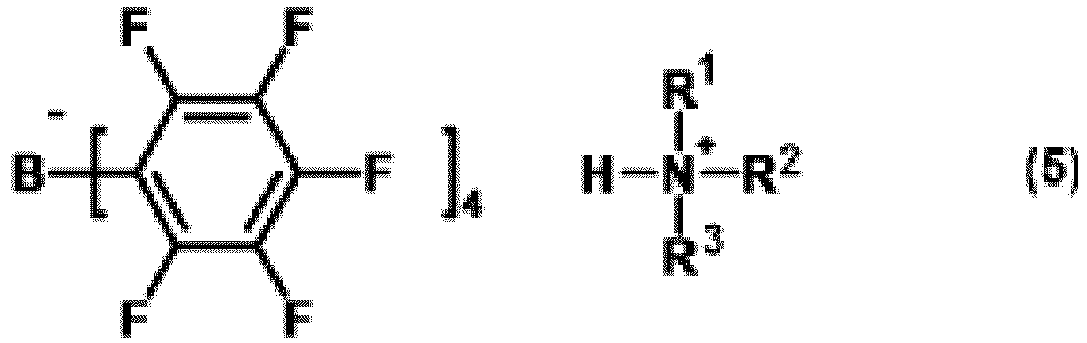
wherein R1 to R3 each represent an alkyl group having 1 to 30 carbon atoms or an aryl group having 6 to 30 carbon atoms, wherein
the tetraaryl borate compound represented by formula (1)
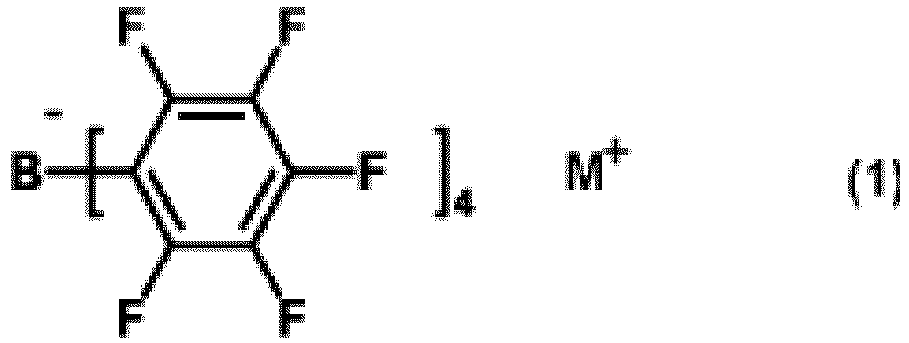
wherein M+ represents NH4+,
and an amine compound are reacted, wherein the amine compound is represented by formula (4):
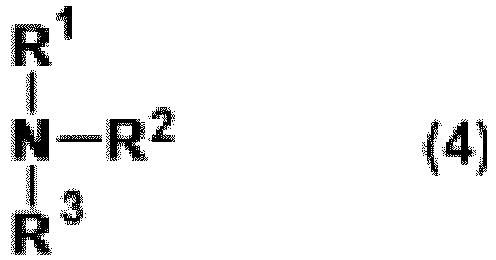
wherein R1 to R3 are the same as above.
wherein R1 to R3 each represent an alkyl group having 1 to 30 carbon atoms or an aryl group having 6 to 30 carbon atoms, wherein
the tetraaryl borate compound represented by formula (1)
wherein M+ represents NH4+,
and an amine compound are reacted, wherein the amine compound is represented by formula (4):
wherein R1 to R3 are the same as above.
2. The method for producing the tetraaryl borate compound according to claim 1, wherein
R1 and R2 each represents a methyl group, an octyl group, a decyl group, a dodecyl group, a
tetradecyl group, a hexadecyl group, an octadecyl group, an oleyl group, a beef-tallow-alkyl
group, or a hardened-beef-tallow alkyl group.
3. The method for producing the tetraaryl borate compound according to claim 1 or 2,
wherein R3 represents a methyl group or a phenyl group.
1. Verfahren zum Herstellen einer Tetraarylboratverbindung, dargestellt durch folgende
Formel (5):
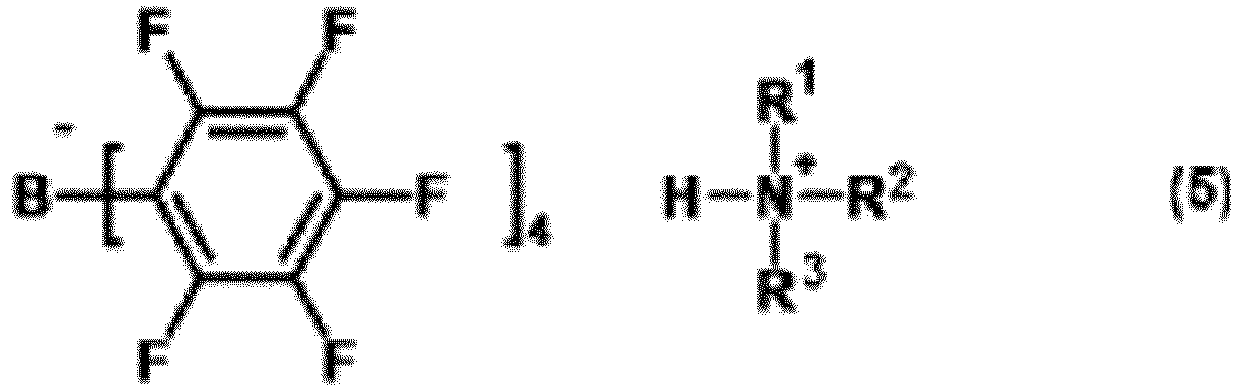
wobei R1 bis R3 jeweils für eine Alkylgruppe mit 1 bis 30 Kohlenstoffatomen oder eine Arylgruppe mit 6 bis 30 Kohlenstoffatomen stehen, wobei
die Tetraarylboratverbindung, dargestellt durch die folgende Formel (1)
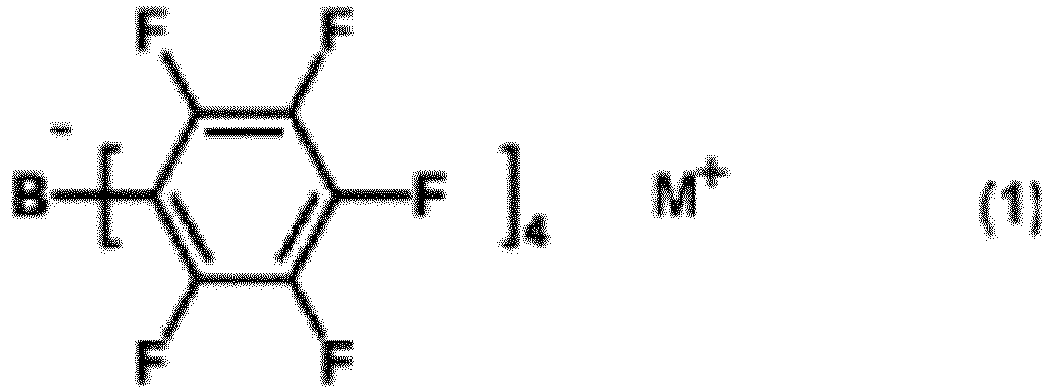
wobei M+ für NH4+ steht,
und eine Aminverbindung umgesetzt werden, wobei die Aminverbindung durch die folgende Formel (4)dargestellt wird:
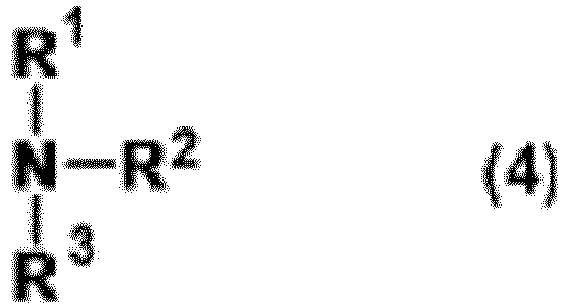
wobei R1 bis R3 die gleichen wie oben sind.
wobei R1 bis R3 jeweils für eine Alkylgruppe mit 1 bis 30 Kohlenstoffatomen oder eine Arylgruppe mit 6 bis 30 Kohlenstoffatomen stehen, wobei
die Tetraarylboratverbindung, dargestellt durch die folgende Formel (1)
wobei M+ für NH4+ steht,
und eine Aminverbindung umgesetzt werden, wobei die Aminverbindung durch die folgende Formel (4)dargestellt wird:
wobei R1 bis R3 die gleichen wie oben sind.
2. Verfahren zum Herstellen der Tetraarylboratverbindung nach Anspruch 1, wobei R1 und R2 jeweils für eine Methylgruppe, eine Octylgruppe, eine Decylgruppe, eine Dodecylgruppe,
eine Tetradecylgruppe, eine Hexadecylgruppe, eine Octadecylgruppe, eine Gruppe Oleylgruppe,
eine Rinder-Talg-Alkylgruppe oder eine gehärtete Rinder-Talg-Alkylgruppe stehen.
3. Verfahren zum Herstellen der Tetraarylboratverbindung nach Anspruch 1 oder 2, wobei
R3 für eine Methylgruppe oder eine Phenylgruppe steht.
1. Procédé de production d'un composé borate de tétraaryle représenté par la formule
(5) :
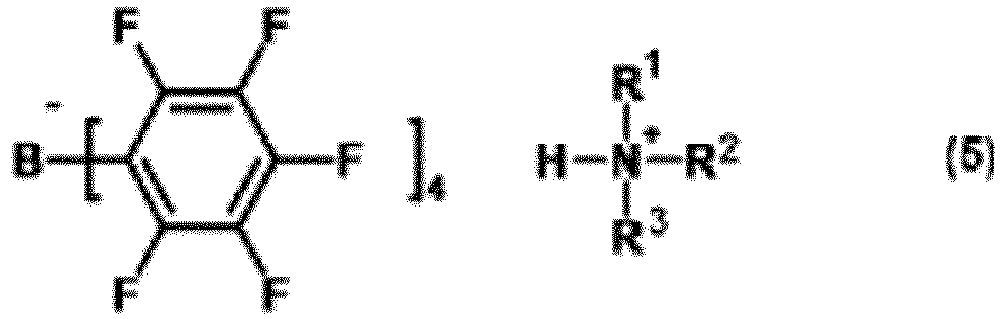
dans lequel R1 à R3 représentent chacun un groupe alkyle ayant 1 à 30 atomes de carbone et un groupe aryle ayant 6 à 30 atomes de carbone, dans lequel
le borate de tétraaryle est représenté par la formule (1)
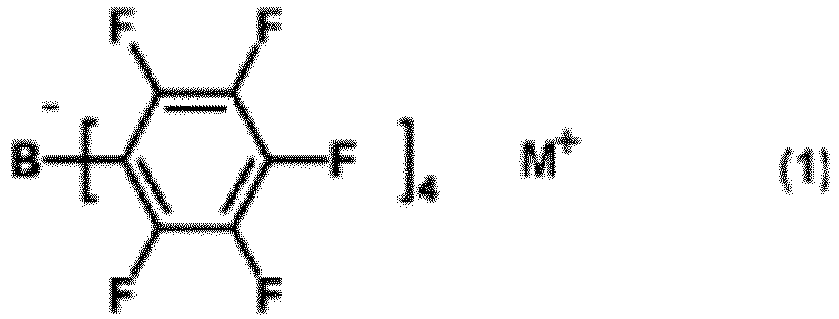
dans lequel M+ représente NH4+,
et un composé amine sont mis à réagir, dans lequel le composé amine est représenté par la formule (4) :
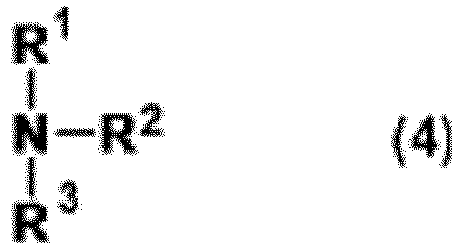
dans lequel R1 à R3 sont les mêmes que ci-dessus.
dans lequel R1 à R3 représentent chacun un groupe alkyle ayant 1 à 30 atomes de carbone et un groupe aryle ayant 6 à 30 atomes de carbone, dans lequel
le borate de tétraaryle est représenté par la formule (1)
dans lequel M+ représente NH4+,
et un composé amine sont mis à réagir, dans lequel le composé amine est représenté par la formule (4) :
dans lequel R1 à R3 sont les mêmes que ci-dessus.
2. Procédé de production du composé borate de tétraaryle selon la revendication 1, dans
lequel R1 et R2 représentent chacun un groupe méthyle, un groupe octyle, un groupe décyle, un groupe
dodécyle, un groupe tétratdécyle, un groupe hexadécyle, un groupe octadécyle, un groupe
oléyle, un groupe alkyle de suif de boeuf ou un groupe alkyle de suif de boeuf durci.
3. Procédé de production du composé borate de tétraaryle selon la revendication 1 ou
2, dans lequel R3 représente un groupe méthyle ou un groupe phényle.
REFERENCES CITED IN THE DESCRIPTION
This list of references cited by the applicant is for the reader's convenience only. It does not form part of the European patent document. Even though great care has been taken in compiling the references, errors or omissions cannot be excluded and the EPO disclaims all liability in this regard.
Patent documents cited in the description