|
(11) | EP 2 717 848 B1 |

| (12) | EUROPEAN PATENT SPECIFICATION |
|
|
| (54) |
HAIR COLOURING COMPOSITION HAARFÄRBEZUSAMMENSETZUNG COMPOSITION DE COLORATION DES CHEVEUX |
|
|
|||||||||||||||||||||||||||
|
||||||||||||||||||||||||||||
| Note: Within nine months from the publication of the mention of the grant of the European patent, any person may give notice to the European Patent Office of opposition to the European patent granted. Notice of opposition shall be filed in a written reasoned statement. It shall not be deemed to have been filed until the opposition fee has been paid. (Art. 99(1) European Patent Convention). |
[0001] Present invention is related to an aqueous oxidative colouring composition for keratin fibres especially human hair.
[0002] Hair colouring has been widely practiced for ages. The colorations are divided into two main groups, the first being permanent colouration based on mainly oxidative hair dyes which penetrate into hair and polymerize, and the second is based on direct dyes which is, without excluding any penetration, mainly adsorbed onto hair and widely based on cationic and neutral dyes. In the latter, recently compositions based on anionic direct dyes have also been made available by the applicant which deliver brilliant, shiny and long lasting colours.
[0003] In hair colouration, one of the purposes is certainly change the hair colour and/or cover any inhomogeneous hair colours in particular grey hair. Another purpose is to refresh shine, brilliance and vibrancy of hair colour. Especially in hair shine wide variability has been observed and there is, therefore, need for further improvements.
[0004] Hair colouration, especially oxidative hair colouring may damage the hair which may further cause that hair becomes difficult to comb through, is not smooth, difficult to manage and has too many fly-aways. It is therefore, desirable to have hair colouring compositions which does not have at least one of these disadvantages and optimally none of these disadvantages.
[0005] EP 2022490 discloses hair dyeing composition comprising silicones. The use of silicones in hair dyeing compositions is disclosed in a publication from Dow Corning Company. Both documents do no disclose any composition within the scope of present invention.
[0006] Present invention starts with the above mentioned problems of hair shine, unsatisfactory hair condition after hair colouring especially oxidative one and aims at providing an oxidative hair colouring composition which provides intensive colouring and does not show at least one of the above mentioned disadvantages.
[0007] The inventors of the present invention have surprisingly found out that an aqueous composition comprising at least one oxidative dye precursor and optionally at least one coupling agent and at least one alkyl methicone colours hair excellently intensively and improves hair shine, combability and manageability. Additionally it has been observed that hair comprising parts with various levels of damage coloured homogeneously.
[0008] Accordingly, the object of the present invention is an aqueous hair colouring composition comprising at least one oxidative dye precursor, optionally at least one coupling agent, and an alkyl methicone selected from caprylyl methicone, cetearyl methicone, ethyl methicone, hexyl methicone, lauryl methicone, myristyl methicone and stearyl methicone. The most preferred is caprylyl methicone.
[0009] Another object of the present invention is use of the composition for colouring keratin fibres especially hair and furthermore for enhancing shine, brilliance and vibrancy of hair.
[0010] Further object of the present invention is the use of alkyl methicone in dyeing compositions comprising at least one oxidative dye precursor, optionally at least one coupling agent.
[0011] The compositions of the present invention comprises at least one alkyl methicone at a concentration range of 0.01 to 15%, preferably 0.05 to 12.5% more preferably 0.1 to 10% and most preferably 0.1 to 7.5% by weight calculated to total composition.
[0012] Composition of the present invention comprises at least one oxidative dye precursor. In principal all oxidative dyes available for hair colouring purposes are suitable within the meaning of the present invention.
[0013] As a rule, it is possible to incorporate any developing substances known in the art. Special mention is made of p-phenylenediamine, p-aminophenol and substituted p-phenylenediamines such as 2,5-diamino-toluene, 2-n-propyl or 2-ethyl-p-phenylenediamine, 2,6-di-methyl-p-phenylene- diamine, 2-(2,5-diaminophenyl) ethanol, 1-amino-4-bis-(2'-hydroxy-ethyl)amino- benzene, 2-(2-hydroxyethyl amino)-5-aminotoluene, 4,4'-diaminodiphenylamine, 4-aminodiphenylamine, 2-amino-5-N,N-diethyl aminotoluene, 4-amino-N-ethyl-N-isopropyl aniline, 2-chloro-p-phenylenediamine, 1-β-hydroxyethyl-2,5-diamino-4-chlorobenzene, 1-β-hydroxyethyl-2,5-diamino-4-methyl benzene, 2-methoxy-p-phenylenediamine, N,N-diethyl-p-phenylenediamine, 1-amino-4-β-methoxyethyl aminobenzene, 1-dimethyl-amino-4-aminobenzene, 1-hydroxy-2,5-diamino-4-methyl benzene, 1-hydroxymethyl-2,5-diaminobenzene, 1,3-dimethyl-2,5-diaminobenzene, 1,4-diamino isopropyl benzene and/or 1-amino-4-β-hydroxypropyl aminobenzene, pyrazole and the derivatives thereof such as 1-hydroxyethyl-4,5-diaminopyrazole, 3,4-diamino-5-hydroxypyrazole, 3,5-diaminopyrazole, 3,5-diamino pyrazol-1-carboxamide, 3-amino-5-hydroxypyrazole, 1-phenyl-2-methylpyrazole, 1-phenyl-3-methylpyrazole-5-one, 3,5-dimethylpyrazole, 3,5-dimethylpyrazole-1-methanol, 3,5-diamino-1,2,4-triazole, 4-aminophenol and the derivatives thereof such as 4-amino-3-methylphenol, 2-chloro-4-aminophenol, 2,6-dichloro-4-aminophenol, 2,4-diamino-phenol, 2,6-dibromo-4-aminophenol, tetraamino pyrimidines, triaminohydroxy pyrimidines, diaminomono- and -dihydroxy pyrimidines, aminotriazines, 5-amino salicylic acid and/or 1,2,4-triamino benzene or the water-soluble salts thereof.
[0014] Further suitable ones aminopyridines are 2,5-diaminopyridine, 2,3-diaminopyridine, 2,6-diaminopyridine, 3-amino-2-methyl amino-6-methoxypyridine, 2-dimethyl-5-aminopyridine, 2-dimethyl aminoethyl-3-hydroxypyridine, 2-amino-4,6-dimethyl pyridine, 2-amino-3-hydroxypyridine, 3-amino-2(β-hydroxyethyl amino)-6-methoxy-pyridine, 2,6-dimethyl amino-5-aminopyridine, 2-di(hydroxyethyl) amino-5-aminopyridine, 2-hydroxyethyl amino-5-aminopyridine, 4-hydroxy-2,5,6-triaminopyrimidine and/or the water-soluble salts thereof.
[0015] Within the meaning of the present invention above mentioned developers can as well be present as a mixture of each other.
[0016] The total concentration of the dye precursors (developing substances) customarily ranges between 0.001 to 5%, preferably 0.01 to 4% and more preferably 0.05 to 3%, and most preferably 0.1 to 2% by weight, calculated to the total composition.
[0017] In a further embodiment of the present invention compositions comprise in addition to at least one oxidative dye precursor at least one coupling substance. As a rule any coupling substance customarily used in oxidative hair colouration area is suitable within the meaning of the present invention. Non-limiting coupling substances, are 5-amino-2-methylphenol, 2-methyl-5-hydroxyethylaminophenol, 2,4,-diamnophenoxyehanol, 2-amino-4-hydroxyethylaminoanisol, 2-methyl-5-amino-6-chlorphenol, 1,3-bis(2,4-diaminophenoxy)propane, 2-bis(2-hydroxyethyl)aminotoluene, 2-amino-5-methylphenol, resorcinol, 2-methyl-resorcinol, 4-chlororesorcinol, 2-amino-4-chlorophenol, 5-amino-4-methoxy-2-methylphenol, 2-aminophenol, 3-amino-phenol, 1-methyl-2-hydroxy-4-aminobenzene, 3-N,N-dimethyl aminophenol, 2,6-dihydroxy-3,5-dimethoxypyridine, 5-amino-3-methylphenol, 6-amino-3-methylphenol, 1,3-diamino- benzene, 1-amino-3-(2'-hydroxyethylamino)benzene, 1-amino-3-[bis(2'-hydroxy-ethyl) amino]benzene, α-naphthol, 4,6-dichlororesorcinol, 1,3-diamino-toluene, 4-hydroxy-1,2-methylenedioxy benzene, 1,5-dihydroxy naphthalene, 1,6-dihydroxy naphthalene, 1,7-dihydroxy naphthalene, 2,7-dihydroxy naphthalene, 1-hydroxy-2-methyl naphthalene, 4-hydroxy-1,2-methyldioxy benzene, 2,4-diamino-3-chlorophenol, 5-amino-2-methoxyphenol and/or 1-methoxy-2-amino-4-(2'-hydroxyethyl amino)benzene or the water-soluble salts thereof. One or more of the above mentioned coupler can also be used in a mixture.
[0018] In the hair dyeing compositions according to the invention, the coupling substance(s) as reaction partners of the developing substance(s) are present in approximately the same molecular proportions as the developing substances, i.e. in amounts from 0.001 to 5%, preferably 0.01 to 4% and more preferably 0.05 to 3%, and most preferably 0.1 to 2% by weight, calculated to the total composition.
[0019] Further, Indole and indoline derivatives can as well be contained in the colouring composition of the present invention. Examples to those are: 6-aminoindol, 6-hydroxyindole, 1-ethyl-6-hydroxyindole, 1-methyl-4-hydroxyindol, 1-methyl-6-hydroxyindole, 2-methyl-6-hydroxyindole, 5-hydroxyindol, 4-hydroxyindol, 5,6-dihydroxyindole, 6-aminoindoline, 6-hydroxyindoline, 1-ethyl-6-hydroxyindoline, 1-methyl-4-hydroxyindoline, 1-methyl-6-hydroxyindoline, 2-methyl-6-hydroxyindoline, 5-hydroxyindoline, 4-hydroxyindoline, 5,6-dihydroxyindoline and their respective salts. Further additionally and in a preferred embodiment of the present invention, compositions can comprise at least one direct dye. Suitable direct dyes are cationic, anionic, neutral dyes and mixtures thereof as available commercially from various suppliers and used mainly in semi-permanent hair coloration.
[0020] One of the suitable direct dyes are cationic dyes. Non-limiting examples are Basic Blue 6, Basic Blue 7, Basic Blue 9, Basic Blue 26, Basic Blue 41, Basic Blue 99, Basic Brown 4, Basic Brown 16, Basic Brown 17, Basic Orange 31, Natural Brown 7, Basic Green 1, Basic Red 2, Basic Red 12 Basic Red 22, Basic Red 51, Basic Red 76, Basic Violet 1, Basic Violet 2, Basic Violet 3, Basic Violet 10, Basic Violet 14, Basic Yellow 57 and Basic Yellow 87, and their salts such as chloride, methosulfate, bromide etc. and mixtures thereof.
[0021] Further suitable direct dyes are anionic dyes. Suitable non-limiting examples are Acid Black 1, Acid Blue 1, Acid Blue 3, Food Blue 5, Acid Blue 7, Acid Blue 9, Acid Blue 74, Acid Orange 3, Acid Orange 6, Acid Orange 7, Acid Orange 10, Acid Red 1, Acid Red 14, Acid Red 18, Acid Red 27, Acid Red 50, Acid Red 52, Acid Red 73, Acid Red 87, Acid Red 88, Acid Red 92, Acid Red 155, Acid Red 180, Acid Violet 9, Acid Violet 43, Acid Violet 49, Acid Yellow 1, Acid Yellow 23, Acid Yellow 3, Food Yellow No. 8, D&C Brown No. 1, D&C Green No. 5, D&C Green No. 8, D&C Orange No. 4, D&C Orange No. 10, D&C Orange No. 11, D&C Red No. 21, D&C Red No. 27, D&C Red No. 33, D&C Violet 2, D&C Yellow No. 7, D&C Yellow No. 8, D&C Yellow No. 10, FD&C Red 2, FD&C Red 40, FD&C Red No. 4, FD&C Yellow No. 6, FD&C Blue 1, Food Black 1, Food Black 2, Disperse Black 9 and Disperse Violet 1 and their alkali metal salts such as sodium, potassium, and their mixtures.
[0022] Further suitable dyes for colouring hair within the meaning of the present invention are those of neutral nitro dyes. Suitable non-limiting examples are HC Blue No.2, HC Blue No.4, HC Blue No.5, HC Blue No.6, HC Blue No.7, HC Blue No.8, HC Blue No.9, HC Blue No.10, HC Blue No.11, HC Blue No.12, HC Blue No.13, HC Brown No.1, HC Brown No.2, HC Green No.1, HC Orange No.1, HC Orange No.2, HC Orange No.3, HC Orange No.5, HC Red BN, HC Red No.1, HC Red No.3, HC Red No.7, HC Red No.8, HC Red No.9, HC Red No.10, HC Red No.11, HC Red No.13, HC Red No.54, HC Red No.14, HC Violet BS, HC Violet No.1, HC Violet No.2, HC Yellow No.2, HC Yellow No.4, HC Yellow No.5, HC Yellow No.6, HC Yellow No.7, HC Yellow No.8, HC Yellow No.9, HC Yellow No.10, HC Yellow No.11, HC Yellow No.12, HC Yellow No.13, HC Yellow No.14, HC Yellow No.15, 2- Amino-6-chloro-4-nitrophenol, picramic acid, 1,2-Diamino-4-nitrobenzol, 1,4-Diamino-2-nitrobenzol, 3-Nitro-4-aminophenol, 1-Hydroxy-2-amino-3-nitrobenzol and 2-hydroxyethylpicramic acid, and their mixtures.
[0023] Plant dyestuffs may also be used as hair colorant within the meaning of the present invention for example henna (red or black), alkanna root, laccaic acid, indigo, logwood powder, madder root and rhubarb powder, etc.
[0024] It should be noted that the above dyestuffs are also suitable for use in mixture. In other words, cationic, anionic and nitro dyes are used in mixture within the meaning of the present invention. When using direct dyes of various categories, their compatibility must be taken into account.
[0025] Among the direct dyes cationic and nitro dyes are preferred ones. Most preferred ones are cationic direct dyes.
[0026] Concentration of direct dyes in the compositions of the present invention is within the range of 0.001 to 5%, preferably 0.01 to 4% and more preferably 0.05 to 3%, and most preferably 0.1 to 2% by weight, calculated to total composition.
[0027] In further embodiment of the present invention, compositions comprise mixtures of the hair dyes mentioned above. In other words, a hair dyeing composition comprises at least one direct dye and at least one oxidative dye precursor, optionally at least one coupling substance. Direct dyes are here as well selected from cationic, anionic and nitro dyes. Above mentioned concentration for each class of dyestuff are also valid here.
[0028] Colouring compositions according to the present invention can be in the form of emulsion, solution, dispersion, thickened liquid and/or gel. Emulsion form is preferred.
[0029] With the term thickened liquid, it is meant that the compositions comprise additionally a thickening agent.
[0030] With the term gel it is meant that the compositions comprise additionally a gelling agent and the gelling agent is a polymer forming a shear thinning gel.
[0031] The thickening agents include any polymer either natural or synthetic thickening aqueous composition. Examples are cellulose and its derivatives such as hydroxyethylcellulose, guar and its derivatives such as hydroxypropyl guar. In the selection of the thickening agent compatibility with any other components of the formulation should carefully be examined.
[0032] The gelling agents include polymers either synthetic or natural forming shear thinning compositions. Examples to the natural polymers are xanthan gum and its derivatives. Synthetic shear thinning polymers may be those of acrylate polymers commercially available for example under trade name Carbopol. In the selection of the geling agent compatibility with any other components of the formulation should carefully be examined.
[0033] It should be noted that gelling and thickening agents can also be used in mixture. Concentration of the thickening and/or gelling agents should be in the range of 0.05 to 5%, preferably 0.1 to 2.5% by weight calculated to total content.
[0034] Compositions of the present invention further comprise at least one surfactant selected from non-ionic, cationic, anionic and amphoteric ones and their mixtures. Preferred surfactants are non-ionic, cationic and amphoteric ones and their mixtures. Most preferred are non-ionic and cationic surfactants and their mixtures.
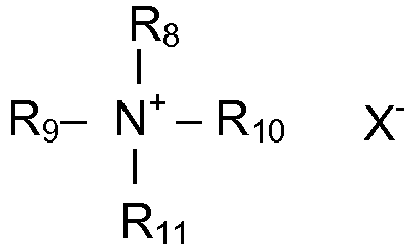
[0035] Further according to a further preferred embodiment, oxidative colouring compositions comprise additionally at least one cationic surfactant according to general formula
where R8 is saturated or unsaturated, branched or non-branched alkyl chain with 8-22 C atoms or
R12CONH(CH2)n
where R12 is saturated or unsaturated, branched or non-branched alkyl chain with 7-21 C atoms and n has typical value of 0 - 4 or
R13COO(CH2)n
where R13 is saturated or unsaturated, branched or non-branched alkyl chain with 7-21 C atoms and n has typical value of 0 - 4, and
R9 is a saturated or unsaturated, branched or non-branched alkyl chain with 1-22 C atoms or
R12CONH(CH2)n
where R12 is saturated or unsaturated, branched or non-branched alkyl chain with 7-21 C atoms and n has typical value of 0 - 4 or
R13COO(CH2)n
where R13 is saturated or unsaturated, branched or non-branched alkyl chain with 7-21 C atoms and n has typical value of 0 - 4,
and R10 and R11 are independent from each other lower alkyl chain with 1 to 4 carbon atoms or ethoxy or propoxy group with number of ethoxy or propoxy groups varying in the range of 0 to 4, and X is chloride, bromide or methosulfate.
[0036] Concantration of cationic surfactant is in the range from 0.05 % to 10 %, preferably 0.1% to 7.5 % by weight, calculated to total composition.
[0037] Suitable cationic surfactants are, for example, long-chain quaternary ammonium compounds which can be used alone or in mixture with each other, such as cetyl trimethyl ammonium chloride, myristoyl trimethyl ammonium chloride, behentrimonium chloride, trimethyl cetyl ammonium bromide, stearyl trimethyl ammonium chloride, dimethyl stearyl ammonium chloride, dimethyl dihydrogenated tallow ammonium chloride, stear trimonium chloride, stearamidopropyldimethylamoonium chloride, dipalmitoyl dimonium chloride, distearyl dimethyl ammonium chloride, stearamidopropyl trimonuim chloride.
[0038] Further examples to the cationic surfactants are so called esterquats available on the market, for example, under the trade names "Schercoquat®", "Dehyquart®L80" and "Tetranyl®". Still further examples are so called amidoquats again available on the market, for example, under the trade name "INCROQUATâ HO" or "OCS".
[0039] Suitable non-ionic surfactants are alkyl polyglucosides of the general formula
R7-O-(R8O)nO-Zx
wherein R7 is an alkyl group with 8 to 18 carbon atoms, R8 is an ethylene or propylene group, Z is a saccharide group with 5 to 6 carbon atoms, n is a number from 0 to 10 and x is a number between 1 and 5. Examples are decyl polyglucoside, cocoyl polyglucoside both are commercially available.
[0040] Further nonionic surfactant components are, for example, long-chain fatty acid mono- and dialkanolamides, such as coco fatty acid monoethanolamide and myristic fatty acid monoethanolamide.
[0041] Further additionally useful nonionic surfactants are, for example, the various sorbitan esters, such as polyethylene glycol sorbitan stearic acid ester, fatty acid polyglycol esters or poly-condensates of ethyleneoxide and propyleneoxide, as they are on the market, for example, under the trade name "PluronicsR".
[0042] Further nonionic surfactants as emulsifiers useful in the compositions according to invention are C10-C22-fatty alcohol ethoxylates. Especially suited are C10-C22-fatty alcohol ethers, the alkyl polyglycol ethers known by the generic terms "Laureth", "Myristeth", "Oleth", "Ceteth", "Deceth", "Steareth" and "Ceteareth" according to the CTFA nomenclature, including addition of the number of ethylene oxide molecules, e.g., "Laureth-16":
[0043] The average degree of ethoxylation thereby ranges between about 2.5 and about 50, preferably about 10 and about 30.
[0044] Among the non-ionic surfactants mentioned above fatty alcohol ethoxylates are the most preferred ones. Above mentioned non-ionic surfactants can also be used as mixture of one category such as several ethoxylated fatty alcohols or several categories such as mixture of alkyl polyglucoside and ethoxylated fatty alcohol.
[0045] As further surfactant suitable for the compositions according to the present invention are amphoteric or zwitterionic surfactants. Useful as such are in particular the various known betaines such as alkyl betaines, fatty acid amidoalkyl betaines and sulfobetaines, for example, lauryl hydroxysulfobetaine; long-chain alkyl amino acids, such as cocoaminoacetate, cocoaminopropionate and sodium cocoamphopropionate and -acetate.
[0046] Further surfactants suitable within the meaning of the present invention are anionic surfactants of the sulfate, sulfonate, carboxylate and alkyl phosphate type, for example, the known C10-C18-alkyl sulfates, and in particular the respective ether sulfates, for example, C12-C14-alkyl ether sulfate, lauryl ether sulfate, especially with 1 to 4 ethylene oxide groups in the molecule, monoglyceride (ether) sulfates, fatty acid amide sulfates obtained by ethoxylation and subsequent sulfatation of fatty acid alkanolamides, and the alkali salts thereof.
[0047] Additional anionic surfactants useful are α-olefin sulfonates or the salts thereof, and in particular alkali salts of sulfosuccinic acid semiesters, for example, the disodium salt of monooctyl sulfosuccinate and alkali salts of long-chain monoalkyl ethoxysulfosuccinates.
[0048] Suitable surfactants of the carboxylate type are alkyl polyether carboxylic acids and the salts thereof of the formula
R9-(C2H4O)n-O-CH2COOX,
wherein R9 is a C8-C20-alkyl group, preferably a C12-C14-alkyl group, n is a number from 1 to 20, preferably 2 to 17, and X is H or preferably a cation of the group sodium, potassium, magnesium and ammonium, which can optionally be hydroxyalkyl-substituted.
[0049] Further suitable anionic surfactants are also C8-C22-acyl aminocarboxylic acids or the water-soluble salts thereof, such as N-lauroyl glutamate, in particular as sodium salt, as well as, for example, N-lauroyl sarcosinate, N-C12-C18-acyl asparaginic acid, N-myristoyl sarcosinate, N-oleoyl sarcosinate, N-lauroyl methylalanine, N-lauroyl lysine and N-lauroyl aminopropyl glycine, preferably in form of the water-soluble alkali or ammonium, in particular the sodium salts thereof, preferably in mixture with the above-named anionic surfactants.
[0050] Total surfactant concentration varies between 0.1 and 15%, preferably 0.5 and 10%, and more preferably 1 to 7.5% by weight calculated to total composition.
[0051] Compositions of the present invention can be in the form of emulsion especially oil in water (O/W) emulsion. Emulsions according to the present invention preferably comprise at least one fatty alcohol with linear of branched alkyl chain. Suitable ones are fatty alcohols having 12 to 22 C atoms in its alkyl chain. Examples are myristyl alcohol, cetyl alcohol, stearyl alcohol, behenyl alcohol and their mixtures. Preferred are cetyl, stearyl and behenyl alcohol and their mixtures i.e. cetearyl alcohol. Fatty alcohols may be included into the compositions of the present invention at a concentration of 0.1 to 20%, preferably 0.5 to 15% and more preferably 1 to 10% by weight calculated to total composition.
[0052] Emulsions should also comprise at least one emulsifier. Suitable emulsifiers are those surfactants mentioned above. Preferred emulsifiers are non-ionic, cationic and anionic surfactant mentioned above. Among the non-ionic surfactant fatty alcohol ethoxylates are the most proffered ones. Among cationic surfactants any cationic surfactant with a single alkyl chain is suitable. Sulfate types of anionic surfactants are the preferred anionic surfactants. The above mentioned concentrations are also suitable for the emulsifiers mentioned here.
[0053] Colouring composition of present invention can comprise additionally fatty acids with 0 to 3 ethylenic bonds and with fatty acyl chain length of 12 to 22 C atom. Concentration of the fatty acids can be in the range of 0.1 to 10%, preferably 0.1 to 7.5% and most preferably 0.2 to 5% by weight calculated to the total composition. Fatty acid examples, without limiting the choice, suitable for colouring compositions are myristic acid, palmitic acid, behenic acid, steraic acid, oleic acid, linoleic acid. The most preferred fatty acid is oleic acid.
[0054] Compositions of the present invention can comprise additionally hair conditioning compounds such as oily compounds, cationic polymers, non-ionic substances. Oily compounds as conditioners according to the present invention are selected from silicone oils either volatile or non-volatile, natural and synthetic oils. Among silicone oils those can be added to the compositions include either volatile or non-volatile dimethicone, dimethiconol, polydimethylsiloxane, DC fluid ranges from Dow Corning, cyclosiloxanes such as DC 245 and arylated silicones such as phenyl methicone, phenyl trimethicone, diphenyl dimethicone, diphenylsiloxy phenyl trimethicone, tetramethyl tetraphenyl trisiloxane, triphenyl trimethicone, tetramethly tetraphenyl trisiloxane and trimethyl pentaphenyl trisiloxane. Synthetic oils include mineral oil such as paraffin oil and petrolatum.
[0055] Natural oils suitable are such as olive oil, almond oil, avocado oil, ricinus oil, coconut oil, palm oil, sesame oil, peanut oil, whale oil, sunflower oil, peach kernel oil, wheat germ oil, macadamia nut oil, night primrose oil, jojoba oil, castor oil, or soya oil, lanolin and the derivatives thereof.
[0056] Lipophilic oily compounds such as fatty acid esters are also suitable for the composition of the present invention. Examples are such as isopropyl myristate, palmitate, stearate and isostearate, oleyl oleate, isocetyl stearate, hexyl laurate, dibutyl adipate, dioctyl adipate, myristyl myristate, oleyl erucate, cetyl palmitate, etc. Non-ionic conditioning agents may be polyols such as glycerin, glycol and derivatives, polyethyleneglycoles known with trade names Carbowax PEG from Union Carbide and Polyox WSR range from Amerchol, polyglycerin, polyethyleneglycol mono or di fatty acid esters having general formula
R9CO(OCH2CH2)nOH
R9CO(OCH2CH2)nOOCR10
where R9 and R10 are independent from each other saturated, unsaturated or branched or non-branched alkyl chain with 7 to 21 C atoms and n is typically 2 - 100.
[0057] Composition of the present invention can comprises cationic polymers as conditioning agents. Those are cationic cellulose type polymers know as Polymer JR type from Amerchol such as Polyquaternium 10 or cationic guar gum known with trade name Jaguar from Rhône-Poulenc and chemically for example Guar hydroxypropyl trimonium chloride. Furthermore, chitosan and chitin can also be included in the compositions as cationic natural polymers.
[0058] Furthermore, it has especially been found suitable those cationic polymers known with their CTFA category name Polyquaternium. Typical examples of those Polyquaternium 6, Polyquaternium 7, Polyquaternium 10, Polyquaternium 11, Polyquaternium 16, Polyquaternium 22 and Polyquaternium 28, Polyquaternium 30, Polyquaternium 37, Polyquaternium 36, Polyquaternium 46, Polyquaternium 67 and Polyquaternium 87.
[0059] As well those polymers known with their CTFA category name Quaternium are suitable. Those are for example Quaternium-8, Quaternium-14, Quaternium-15, Quaternium-18, Quaternium-22, Quaternium-24, Quaternium-26, Quaternium-27, Quaternium-30, Quaternium-33, Quaternium-53, Quaternium-60, Quaternium-61, Quaternium-72, Quaternium-78, Quaternium-80, Quaternium-81, Quaternium-82, Quaternium-83 and Quaternium-84.
[0060] Further cationic polymers are so called aminated silicones such as amodimethicone. The cationic polymers also include the quaternized products of graft polymers from organopolysiloxanes and polyethyl oxazolines described in EP-A 524 612 and EP-A 640 643.
[0061] Concentration range for any of the additional conditioners mentioned above is in the range of 0.01 to 10% by weight, preferably 0.05 - 7.5% by weight, more preferably 0.1 - 5% by weight calculated to the total composition.
[0062] The compositions according to the present invention can also comprise further agents, such as protein hydrolyzates and polypeptides, e.g. keratin hydrolyzates, collagen hydrolyzates of the type "Nutrilan" or elastin hydrolyzates, as well as, in particular vegetable, optionally cationized protein hydrolyzates, for example "Gluadin".
[0063] Additional natural plant extracts can as well form part of the compositions of the present invention. Those are incorporated usually in an amount of about 0.01 % to about 10 %, preferably 0.05 % to 7.5 %, in particular 0.1 % to 5 % by weight, calculated as dry residue thereof to the total composition. Suitable aqueous (e.g. steam-distilled) alcoholic or hydro-alcoholic plant extracts known per se are in particular extracts from leaves, fruits, blossoms, roots, rinds or stems of aloe, pineapple, artichoke, arnica, avocado, valerian, bamboo, green tea, blue lotus flower, henbane, birch, stinging nettle, echinacea, ivy, wild angelica, gentian, ferns, pine needles, silver weed, ginseng, broom, oat, rose hip, hamamelis, hay flowers, elderberry, hop, coltsfoot, currants, chamomile, carrots, chestnuts, clover, burr root, cocoanut, cornflower, lime blossom, lily of the valley, marine algae, balm, mistletoe, passion flower, ratanhia, marigold, rosemary, horse chestnut, pink hawthorn, sage, horsetail, yarrow, primrose, nettle, thyme, walnut, wine leaves, white hawthorn, etc.
[0064] Suitable trade products are, for example, the various "Extrapone" products and "HerbasolR". Extracts and the preparation thereof are also described in "Hagers Handbuch der pharmazeutischen Praxis", 4th Ed.
[0065] The compositions can contain one or more organic solvents such as ethanol. propanol, isopropanol, benzyl alcohol, benzyloxyethanol, alkylene carbonates such as ethylene carbonate and propylene carbonate, phenoxyethanol, butanol, isobutanol, cyclohexane, cyclohexanol, hexyleneglycol, ethylenecarbonate, ethyleneglycol monoethylether, ethylene glycol monobutyl ether, ethylene glycol monophenyl ether, 1-phenylethylalcohol, 2-phenylethylalcohol, o-methoxyphenol. Concentration of organic solvent can be in the range of 1 to 40%, preferably 1 to 25% by weight, calculated to total composition.
[0066] Compositions of the present invention can comprise UV filters for protection of hair from environmental influences such as loss of elasticity, loss of hair colour (bleaching effect of sun light). The UV-absorbing substance is preferably selected from the following compounds: 4-Aminobenzoic acid and the esters and salts thereof, 2-phenyl benzimidazole-5-sulfonic acid and the alkali and amine salts thereof, 4-dimethyl aminobenzoic acid and the esters and salts thereof, cinnamic acid and the esters and salts thereof, 4-methoxycinnamic acid and the esters and salts thereof, salicylic acid and the esters and salts thereof, 2.4-dihydroxybenzophenone, 2.2'.4.4'-tetrahydroxy- benzophenone, 2-hydroxy-4-methoxybenzophenone and its 5-sulfonic acid or the sodium salt thereof, 2,2'-dihydroxy-4,4'-dimethoxybenzophenone, 2-hydroxy-5-chlorobenzophenone, 2,2'-dihydroxy-4-methoxybenzophenone, 2.2'-dihydroxy-4.4'-dimethoxy-5.5'-disulfobenzo-phenone or the sodium salt thereof, 2-hydroxy-4-octyloxybenzophenone, 2-hydroxy-4-methoxy-4'-methylbenzophenone, 3-benzyl-idenecampher, 3-(4'-sulfo)-benzyl-idenebornane-2-one and the salts thereof and/or 3-(4'-methyl benzylidene)-DL-campher, polysilicone-15. The preferred amount of the UV-absorber ranges from about 0.01 % to 2.5%, more preferably from 0.05 % to 1 % by weight, calculated to the total composition.
[0067] The compositions of the present invention can comprise one or more hair-restructuring agents. The hair restructuring agents preferred are especially the ones disclosed in the German patent DE 197 51 550 C2. Namely they are ceramide type of compounds, fatty acids and phytosterol or their mixtures.
[0069] Preferred fatty acids are those with 10 to 24 carbon atoms and especially with 16 to 24 carbon atoms.
[0070] Sterols,especially the phytosterols, are as well preferred hair restructuring agents as disclosed in the above mentioned german patent. Especially preferred ones are of plant origin for example ergosterol, sitosterol, stigmasterol, fucosterol, brassicasterol, fungisterol, campesterol, zymosterol, ascosterol, cerevisterol, episterol, faecosterol, spinasterol. Among those phytosterols, the ones found in "Avocadin" which is the unsaponified fraction of the avocado oil is more preferred.
[0071] The concentration of ceramide in the compositions of the present invention can be in the range of 0.01 to 2% and especially 0.01 to 1% by weight calculated to the total weight of the composition. The fatty acids may be contained at a level of 0.01 to 2.5% and especially 0.01 to 1% by weight calculated to the total weight of the composition. Phytosterol concentration of the conditioners is less than 1% and preferably in the range of 0.01 to 0.5% by weight calculated to the total weight of the composition. It should be noted without limiting the use of those ingredients the effect of those hair restructuring ingredients is especially elevated when used in combination with penetration enhancers.
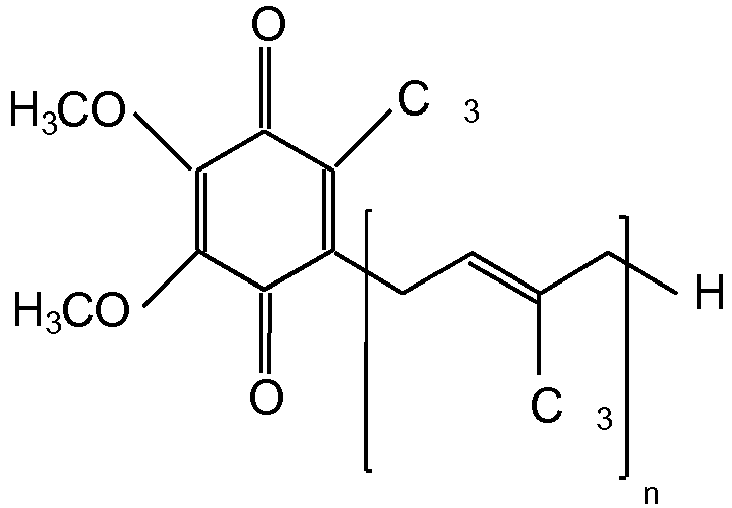
[0072] Compositions of the present invention may comprise further at least one compound according to the formula
where n is a number from 1 to 10.
[0073] The compounds of the above formula are known as Ubiquinone, and also are known as Coenzyme. It should be noted that the compositions of the present invention can certainly comprise more than one ubichinone. Preferred ubichinones are the ones where n is a number between 6 and 10 and especially preferred is Ubichinone 50 where n is 10, also known as Coenzyme Q10. Concentration ubichinone of the above formula in the compositions is from 0.0001 to 1%, preferably from 0.0002 to 0.75%, more preferably from 0.0002 to 0.5% and most preferably from 0.0005 to 0.5% by weight, calculated to total composition.
[0074] The pH of the compositions according to the invention is in the range of 2 to 11 preferably 5 to 11, more preferably 6 to 11, most preferably 6.8 to 10. pH of the compositions can be adjusted by using any organic and/or inorganic acids and alkalizing agents such as ammonium hydroxide and alkanol amines such as monoethanolamine or their mixtures.
[0075] Composition of the present invention can be used after mixing with an oxidizing agent. The oxidizing agents suitable are hydrogen peroxide, urea peroxide, melamin peroxide or perborate salts. The most preferred is hydrogen peroxide, which is used as a lotion containing 2 to 12% by weight, calculated to composition only comprising hydrogen peroxide.
[0076] The new composition as a result of mixing colouring and oxidizing composition allows achieving simultaneous lightening and coloring. The mixing ratio of the colouring composition and oxidizing composition should be in the range of 4:1 to 1:4, by weight, preferably 2:1 to 1:3 by weight.
[0077] Accordinly, further object of the present invention is a process for oxidative colouring hair wherein the composition of the present invention is mixed with a composition comprising at least one oxidizing agent and applied onto hair and rinsed off from hair after processing of 1 to 45 min.
[0078] Further object of the present invention is a kit for hair comprising at least two composition wherein the first composition is a composition comprising at least oen oxidative dye precursor and optionally at least one coupling agent and the second composition comprising at least one oxidizing agent.
[0079] Furthermore, compositions of the present invention can comprise all substances customarily found in such preparations. Examples of such substances are complexing agents, preservatives, fragrances, and antioxidants such as sodium sulfit.
Example 1
[0081]
| % by weight | |
| Cetearyl alcohol | 10.0 |
| Cocamide MEA | 4.0 |
| Sodium lauryl sulphate | 1.5 |
| Propylene glycol | 2.0 |
| Caprylyl methicone | 3.0 |
| Stearamidopropyl trimonium chloride | 0.5 |
| 2,5,6-Triamino-4-hydroxypyrimidine sulphate | 0.01 |
| 2,5-Diaminotoluene sulphate | 0.55 |
| 4-Chlorresorcinol | 0.17 |
| Resorcinol | 0.05 |
| 3-Aminophenol | 0.03 |
| Sodium sulfite | 1.0 |
| Ammonium hydroxide | q.s. to pH 10.0 |
| Fragrance, preservative | q.s. |
| Water | to 100 |
[0083] The above composition was tested in a half side test against the comparative composition with 10 consumers having shoulder length hair. The above composition was mixed with a composition comprising 6% hydrogen peroxide at a weight ratio of 1 to 1 and applied onto hair and processed for 30 min at a temperature of 40°C and rinsed off. Comments from the consumer were that both sides felt soft and easily combable and the colour achieved with the inventive composition was significantly more intensive and had significantly more shine, brilliance and vibrancy than the side treated with the comparative composition. 9 volunteers preferred the side according to the invention and 1 could not see any difference.
Example 2
[0084]
| % by weight | |
| Cetearyl alcohol | 10.0 |
| Cocamide MEA | 4.0 |
| Sodium lauryl sulphate | 1.5 |
| Ceteareth-20 | 1.0 |
| Propylene glycol | 2.0 |
| Caprylyl methicone | 2.9 |
| 2,5,6-Triamino-4-hydroxypyrimidine sulphate | 1.05 |
| 4-amino-hydroxytoluene | 0.55 |
| Basic red 51 | 0.10 |
| Acid red 52 | 0.05 |
| Sodium sulfite | 1.0 |
| Monoethanolamine | 2.5 |
| Ammonium hydroxide | q.s. to pH 10.0 |
| Fragrance, preservative | q.s. |
| Water | to 100 |
Example 3
[0086]
| % by weight | |
| Cetearyl alcohol | 10.0 |
| Cocamide MEA | 4.0 |
| Sodium lauryl sulphate | 1.5 |
| Propylene glycol | 2.0 |
| Caprylyl methicone | 2.0 |
| Phenyl trimethicone | 0.5 |
| 2,5,6-Triamino-4-hydroxypyrimidine sulphate | 0.02 |
| 2,5-Diaminotoluene sulphate | 0.43 |
| HC Yellow 5 | 0.10 |
| 4-amino hydroxytoluene | 0.02 |
| Resorcinol | 0.10 |
| m-aminophenol | 0.07 |
| Sodium sulfite | 1.0 |
| Monoethanolamine | q.s. to pH 10.0 |
| Fragrance, preservative | q.s. |
| Water | to 100 |
Example 4
[0088]
| % by weight | |
| Cetearyl alcohol | 10.0 |
| Cocamide MEA | 4.0 |
| Cetrimonium chloride | 2.0 |
| Propylene glycol | 2.0 |
| Caprylyl methicone | 2.0 |
| Trimethyl pentaphenyl trisiloxane | 0.5 |
| 2,5,6-Triamino-4-hydroxypyrimidine sulphate | 0.01 |
| 2,5-Diaminotoluene sulphate | 0.55 |
| 4-Chlorresorcinol | 0.17 |
| Resorcinol | 0.05 |
| 3-Aminophenol | 0.03 |
| Sodium sulfite | 1.0 |
| Monoethanolamine | q.s. to pH 10.0 |
| Fragrance, preservative | q.s. |
| Water | to 100 |
Example 5
[0090]
| % by weight | |
| Cetearyl alcohol | 10.0 |
| Cocamide MEA | 4.0 |
| Sodium lauryl sulphate | 1.5 |
| Propylene glycol | 2.0 |
| Caprylyl methicone | 1.0 |
| Cetylamidopropyltrimonium chloride | 0.5 |
| Trimethyl pentaphenyl trisiloxane | 0.5 |
| Tetraaminopyrimidine sulphate | 0.01 |
| 2,5-Diaminotoluene sulphate | 0.55 |
| 4-Chlorresorcinol | 0.17 |
| Resorcinol | 0.05 |
| 3-Aminophenol | 0.03 |
| Acid red 52 | 0.1 |
| Sodium sulfite | 1.0 |
| Monoethanolamine | q.s. to pH 10.0 |
| Fragrance, preservative | q.s. |
| Water | to 100 |
Example 6
[0092]
| % by weight | |
| Cetearyl alcohol | 10.0 |
| Cocamide MEA | 4.0 |
| Sodium lauryl sulphate | 1.5 |
| Ceteareth-20 | 1.5 |
| Propylene glycol | 2.0 |
| Caprylyl methicone | 2.5 |
| 2,5 diaminopyrazol | 0.01 |
| 2,5-Diaminotoluene sulphate | 0.55 |
| 4-Chlorresorcinol | 0.17 |
| Resorcinol | 0.05 |
| 3-Aminophenol | 0.03 |
| Basic red 51 | 0.05 |
| Basic yellow 87 | 0.06 |
| Basic orange 31 | 0.10 |
| Sodium sulfite | 1.0 |
| Monoethanolamine | q.s. to pH 10.0 |
| Fragrance, preservative | q.s. |
| Water | to 100 |
1. Aqueous composition for colouring keratin fibres especially human hair characterised in that it comprises at least one oxidative dye precursor, optionally at least one coupling
agent and at least one alkyl methicone selected from caprylyl methicone, cetearyl
methicone, ethyl methicone, hexyl methicone, lauryl methicone, myristyl methicone
and stearyl methicone.
2. The composition according to claims 1 and 2 characterised in that at least one alkyl methicone is caprylyl methicone.
3. The composition according to any of the preceding claims characterised in that at least one alkyl methicone is comprised in the compositions at a concentration
in the range of 0.01 to 15% by weight calculated to the total composition.
4. The composition according to any of the preceding claims characterised in that it comprises at least one direct dye.
5. The composition according to any of the preceding claims characterised in that at least one direct dye is selected from cationic and/or anionic and/or non-ionic
nitro dyes.
6. The composition according to any of the preceding claims characterised in that at least one direct dye is comprised at a concentration of 0.001 to 5% by weight,
calculated to total composition.
7. The composition according to any of the preceding claims characterised in that it comprises at least one surfactant.
8. The composition according to any of the preceding claims characterised in that it comprises at least one cationic surfactant selected from the general structure
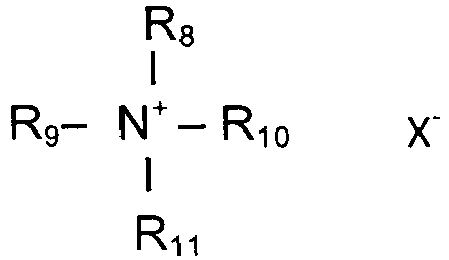
where R8 is saturated or unsaturated, branched or non-branched alkyl chain with 8-22 C atoms or
R12CONH (CH2)n
where R12 is saturated or unsaturated, branched or non-branched alkyl chain with 7-21 C atoms and n has typical value of 0 - 4 or
R13COO(CH2)n
where R13 is saturated or unsaturated, branched or non-branched alkyl chain with 7-21 C atoms and n has typical value of 0 - 4, and
R9 is a saturated or unsaturated, branched or non-branched alkyl chain with 1-22 C atoms or
R12CONH(CH2)n
where R12 is saturated or unsaturated, branched or non-branched alkyl chain with 7-21 C atoms and n has typical value of 0 - 4 or
R13COO(CH2)n
where R13 is saturated or unsaturated, branched or non-branched alkyl chain with 7-21 C atoms and n has typical value of 0 - 4,
and R10 and R11 are independent from each other lower alkyl chain with 1 to 4 carbon atoms or ethoxy or propoxy group with number of ethoxy or propoxy groups varying in the range of 0 to 4, and X is chloride, bromide or methosulfate.
where R8 is saturated or unsaturated, branched or non-branched alkyl chain with 8-22 C atoms or
R12CONH (CH2)n
where R12 is saturated or unsaturated, branched or non-branched alkyl chain with 7-21 C atoms and n has typical value of 0 - 4 or
R13COO(CH2)n
where R13 is saturated or unsaturated, branched or non-branched alkyl chain with 7-21 C atoms and n has typical value of 0 - 4, and
R9 is a saturated or unsaturated, branched or non-branched alkyl chain with 1-22 C atoms or
R12CONH(CH2)n
where R12 is saturated or unsaturated, branched or non-branched alkyl chain with 7-21 C atoms and n has typical value of 0 - 4 or
R13COO(CH2)n
where R13 is saturated or unsaturated, branched or non-branched alkyl chain with 7-21 C atoms and n has typical value of 0 - 4,
and R10 and R11 are independent from each other lower alkyl chain with 1 to 4 carbon atoms or ethoxy or propoxy group with number of ethoxy or propoxy groups varying in the range of 0 to 4, and X is chloride, bromide or methosulfate.
9. The composition according to claim 6 characterised in that it further comprises at least one fatty alcohol.
10. The composition according to any of the preceding claims characterised in that comprises at least one conditioning agent.
11. The composition according to any of the preceding claims characterised in that comprises one or more organic solvent(s) and/or at least one compound according to
the formula
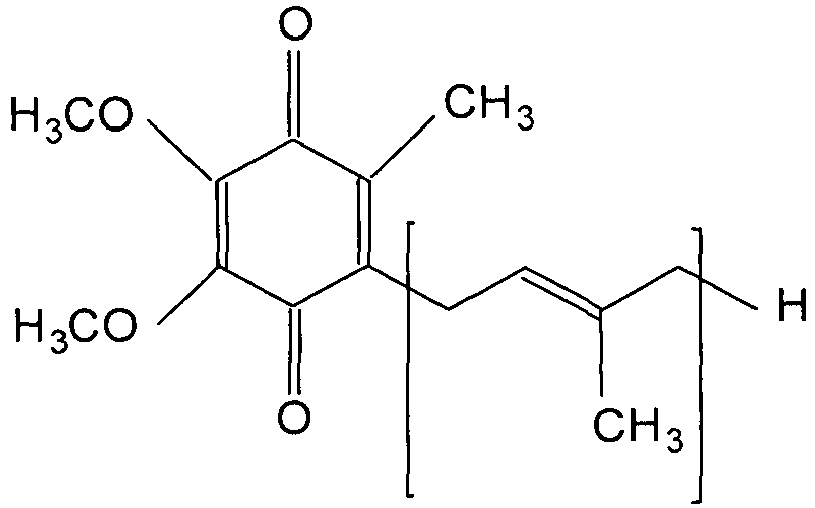
where n is a number from 1 to 10.
where n is a number from 1 to 10.
12. The composition according to any of the preceding claims characterised in that it has a pH between 2 and 11.
13. Use of a composition according to claims 1 to 12 for colouring hair.
14. Process for oxidative colouring hair characterised in that a composition according to claims 1 to 12 is mixed with a composition comprising
at least one oxidizing agent and applied onto hair and rinsed off from hair after
processing of 1 to 45 min.
15. Kit for hair comprising at least two compositions wherein the first composition is
a composition according to claims 1 to 12 and the second composition is a composition
comprising at least one oxidizing agent.
1. Wässrige Zusammensetzung zum Färben von Keratinfasern, insbesondere menschlichen Haaren,
dadurch gekennzeichnet, dass sie mindestens eine Oxidativfarbstoff-Vorstufe, gegebenenfalls mindestens ein Bindemittel
und mindestens ein Alkylmethicon aufweist, ausgewählt aus Caprylylmethicon, Cetearylmethicon,
Ethylmethicon, Hexylmethicon, Laurylmethicon, Myristylmethicon und Stearylmethicon.
2. Zusammensetzung nach Anspruch 1 und 2, dadurch gekennzeichnet, dass mindestens ein Alkylmethicon Caprylylmethicon ist.
3. Zusammensetzung nach einem der vorhergehenden Ansprüche, dadurch gekennzeichnet, dass mindestens ein Alkylmethicon in den Zusammensetzungen in einer Konzentration im Bereich
von 0,01 Gewichts-% bis 15 Gewichts-% enthalten ist, bezogen auf die Gesamtzusammensetzung.
4. Zusammensetzung nach einem der vorhergehenden Ansprüche, dadurch gekennzeichnet, dass sie mindestens einen Direktfarbstoff aufweist.
5. Zusammensetzung nach einem der vorhergehenden Ansprüche, dadurch gekennzeichnet, dass mindestens ein Direktfarbstoff aus kationischen und/oder anionischen und/oder nichtionischen
Nitrofarbstoffen ausgewählt ist.
6. Zusammensetzung nach einem der vorhergehenden Ansprüche, dadurch gekennzeichnet, dass mindestens ein Direktfarbstoff in einer Konzentration von 0,001 Gewichts-% bis 5
Gewichts-% enthalten ist, bezogen auf die Gesamtzusammensetzung.
7. Zusammensetzung nach einem der vorhergehenden Ansprüche, dadurch gekennzeichnet, dass sie mindestens ein Tensid aufweist.
8. Zusammensetzung nach einem der vorhergehenden Ansprüche, dadurch gekennzeichnet, dass sie mindestens ein kationisches Tensid aufweist, ausgewählt aus solchen der allgemeinen
Struktur
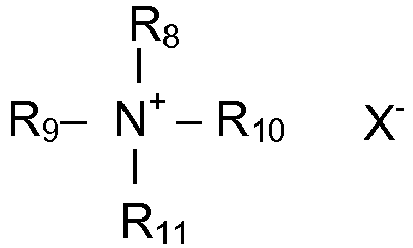
wobei R8 für eine gesättigte oder ungesättigte, verzweigte oder unverzweigte Alkylkette mit 8 bis 22 C-Atomen oder
R12CONH(CH2)n,
wobei R12 für eine gesättigte oder ungesättigte, verzweigte oder unverzweigte Alkylkette mit 7 bis 21 C-Atomen steht und n einen typischen Wert von 0 bis 4 aufweist, oder
R13COO(CH2)n
steht, wobei R13 für eine gesättigte oder ungesättigte, verzweigte oder unverzweigte Alkylkette mit 7 bis 21 C-Atomen steht und n einen typischen Wert von 0 bis 4 aufweist, und
R9 für eine gesättigte oder ungesättigte, verzweigte oder unverzweigte Alkylkette mit 1 bis 22 C-Atomen oder
R12CONH(CH2)n,
wobei R12 für eine gesättigte oder ungesättigte, verzweigte oder unverzweigte Alkylkette mit 7 bis 21 C-Atomen steht und n einen typischen Wert von 0 bis 4 aufweist, oder
R13COO(CH2)n
steht, wobei R13 für eine gesättigte oder ungesättigte, verzweigte oder unverzweigte Alkylkette mit 7 bis 21 C-Atomen steht und n einen typischen Wert von 0 bis 4 aufweist,
und R10 und R11 unabhängig voneinander für eine niedere Alkylkette mit 1 bis 4 Kohlenstoffatomen oder eine Ethoxy- oder Propoxygruppe mit einer Anzahl an Ethoxy- oder Propoxygruppen stehen, die im Bereich von 0 bis 4 variiert, und X für Chlorid, Bromid oder Methosulfat steht.
wobei R8 für eine gesättigte oder ungesättigte, verzweigte oder unverzweigte Alkylkette mit 8 bis 22 C-Atomen oder
R12CONH(CH2)n,
wobei R12 für eine gesättigte oder ungesättigte, verzweigte oder unverzweigte Alkylkette mit 7 bis 21 C-Atomen steht und n einen typischen Wert von 0 bis 4 aufweist, oder
R13COO(CH2)n
steht, wobei R13 für eine gesättigte oder ungesättigte, verzweigte oder unverzweigte Alkylkette mit 7 bis 21 C-Atomen steht und n einen typischen Wert von 0 bis 4 aufweist, und
R9 für eine gesättigte oder ungesättigte, verzweigte oder unverzweigte Alkylkette mit 1 bis 22 C-Atomen oder
R12CONH(CH2)n,
wobei R12 für eine gesättigte oder ungesättigte, verzweigte oder unverzweigte Alkylkette mit 7 bis 21 C-Atomen steht und n einen typischen Wert von 0 bis 4 aufweist, oder
R13COO(CH2)n
steht, wobei R13 für eine gesättigte oder ungesättigte, verzweigte oder unverzweigte Alkylkette mit 7 bis 21 C-Atomen steht und n einen typischen Wert von 0 bis 4 aufweist,
und R10 und R11 unabhängig voneinander für eine niedere Alkylkette mit 1 bis 4 Kohlenstoffatomen oder eine Ethoxy- oder Propoxygruppe mit einer Anzahl an Ethoxy- oder Propoxygruppen stehen, die im Bereich von 0 bis 4 variiert, und X für Chlorid, Bromid oder Methosulfat steht.
9. Zusammensetzung nach Anspruch 6, dadurch gekennzeichnet, dass sie ferner mindestens einen Fettalkohol aufweist.
10. Zusammensetzung nach einem der vorhergehenden Ansprüche, dadurch gekennzeichnet, dass sie mindestens ein Konditionierungsmittel aufweist.
11. Zusammensetzung nach einem der vorhergehenden Ansprüche, dadurch gekennzeichnet, dass sie ein oder mehrere organische(s) Lösungsmittel und/oder mindestens eine Verbindung
gemäß der Formel
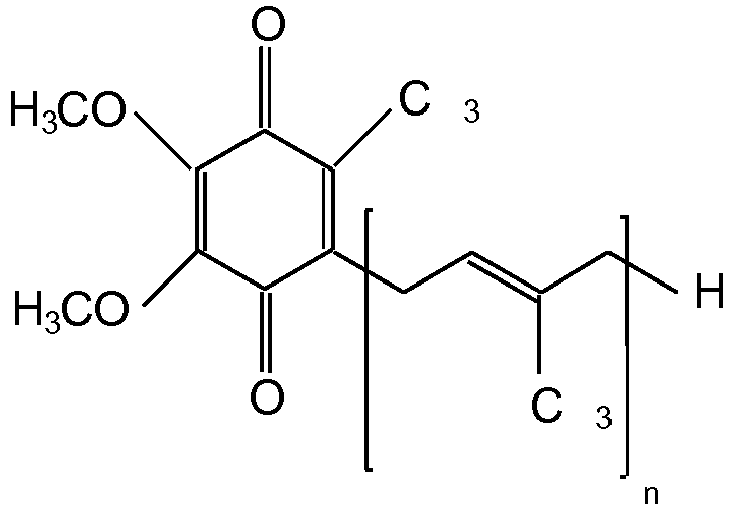
aufweist, wobei n eine Zahl von 1 bis 10 ist.
aufweist, wobei n eine Zahl von 1 bis 10 ist.
12. Zusammensetzung nach einem der vorhergehenden Ansprüche, dadurch gekennzeichnet, dass sie einen pH-Wert von 2 bis 11 aufweist.
13. Verwendung einer Zusammensetzung nach Anspruch 1 bis 12 zum Färben von Haaren.
14. Verfahren zum oxidativen Färben von Haaren, dadurch gekennzeichnet, dass eine Zusammensetzung nach Anspruch 1 bis 12 mit einer Zusammensetzung vermischt wird,
welche mindestens ein Oxidationsmittel aufweist, und auf die Haare aufgebracht wird
und nach einem Einwirken von 1 min bis 45 min aus den Haaren ausgespült wird.
15. Kit für Haare, welches mindestens zwei Zusammensetzungen aufweist, wobei die erste
Zusammensetzung eine Zusammensetzung nach Anspruch 1 bis 12 ist und die zweite Zusammensetzung
eine Zusammensetzung ist, welche mindestens ein Oxidationsmittel aufweist.
1. Composition aqueuse destinée à la coloration de fibres de kératine, en particulier
des cheveux humains, caractérisée en ce qu'elle comprend au moins un précurseur de colorant oxydatif, éventuellement au moins
un agent de couplage et au moins un alklyl méthicone choisi à partir du caprylyl méthicone,
du cétéaryl méthicone, de l'éthyl méthicone, de l'hexyl méthicone, du lauryl méthicone,
du myristyl méthicone et du stéaryl méthicone.
2. Composition selon les revendications 1 et 2, caractérisée en ce qu'au moins un alkyl méthicone est le caprylyl méthicone.
3. Composition selon l'une quelconque des revendications précédentes, caractérisée en ce qu'au moins un alkyl méthicone est compris dans la composition à une concentration en
poids dans une plage de 0,01 à 15 % calculée par rapport à la composition totale.
4. Composition selon l'une quelconque des revendications précédentes, caractérisée en ce qu'elle comprend au moins un colorant direct.
5. Composition selon l'une quelconque des revendications précédentes, caractérisée en ce qu'au moins un colorant direct est choisi à partir de colorants nitrés cationiques, et/ou
anioniques, et/ou non ioniques.
6. Composition selon l'une quelconque des revendications précédentes, caractérisée en ce qu'au moins un colorant direct est compris à une concentration en poids de 0,001 à 5
%, calculée par rapport à la composition totale.
7. Composition selon l'une quelconque des revendications précédentes, caractérisée en ce qu'elle comprend au moins un tensioactif.
8. Composition selon l'une quelconque des revendications précédentes, caractérisée en ce qu'elle comprend au moins un tensioactif cationique choisi à partir de la structure générale
où R8 est une chaîne alkyle saturée ou non saturée, ramifiée ou non ramifiée, avec de 8 à 22 atomes C ou
R12CONH(CH2)n
où R12 est une chaîne alkyle saturée ou non saturée, ramifiée ou non ramifiée avec de 7 à 21 atomes C et n a une valeur caractéristique entre 0 et 4, ou
R13COO(CH2)n
où R13 est une chaîne alkyle saturée ou non saturée, ramifiée ou non ramifiée, avec de 7 à 21 atomes C et n a une valeur caractéristique entre 0 et 4, et
R9 est une chaîne alkyle saturée ou non saturée, ramifiée ou non ramifiée, avec de 1 à 22 atomes C ou
R12CONH(CH2)n
où R12 est une chaîne alkyle saturée ou non saturée, ramifiée ou non ramifiée, avec de 7 à 21 atomes C et n a une valeur caractéristique entre 0 et 4 ou
R13COO(CH2)n
où R13 est une chaîne alkyle saturée ou non saturée, ramifiée ou non ramifiée, avec de 7 à 21 atomes C et n a une valeur caractéristique entre 0 et 4,
et R10 et R11 sont indépendamment l'un de l'autre une chaîne alkyle courte de 1 à 4 atomes de carbone ou un groupement éthoxy ou propoxy avec un nombre de groupements éthoxy ou propoxy variant dans la plage de 0 à 4, et X représente un chlorure, un bromure ou un méthosulfate.
où R8 est une chaîne alkyle saturée ou non saturée, ramifiée ou non ramifiée, avec de 8 à 22 atomes C ou
R12CONH(CH2)n
où R12 est une chaîne alkyle saturée ou non saturée, ramifiée ou non ramifiée avec de 7 à 21 atomes C et n a une valeur caractéristique entre 0 et 4, ou
R13COO(CH2)n
où R13 est une chaîne alkyle saturée ou non saturée, ramifiée ou non ramifiée, avec de 7 à 21 atomes C et n a une valeur caractéristique entre 0 et 4, et
R9 est une chaîne alkyle saturée ou non saturée, ramifiée ou non ramifiée, avec de 1 à 22 atomes C ou
R12CONH(CH2)n
où R12 est une chaîne alkyle saturée ou non saturée, ramifiée ou non ramifiée, avec de 7 à 21 atomes C et n a une valeur caractéristique entre 0 et 4 ou
R13COO(CH2)n
où R13 est une chaîne alkyle saturée ou non saturée, ramifiée ou non ramifiée, avec de 7 à 21 atomes C et n a une valeur caractéristique entre 0 et 4,
et R10 et R11 sont indépendamment l'un de l'autre une chaîne alkyle courte de 1 à 4 atomes de carbone ou un groupement éthoxy ou propoxy avec un nombre de groupements éthoxy ou propoxy variant dans la plage de 0 à 4, et X représente un chlorure, un bromure ou un méthosulfate.
9. Composition selon la revendication 6, caractérisée en ce qu'elle comprend en outre au moins un alcool gras.
10. Composition selon l'une quelconque des revendications précédentes, caractérisée en ce qu'elle comprend au moins un agent de conditionnement.
11. Composition selon l'une quelconque des revendications précédentes, caractérisée en ce qu'elle comprend un ou plusieurs solvants organiques et/ou au moins un composé selon
la formule
où n est un nombre entier entre 1 et 10.
où n est un nombre entier entre 1 et 10.
12. Composition selon l'une quelconque des revendications précédentes, caractérisée en ce qu'elle a un pH entre 2 et 11.
13. Utilisation d'une composition selon les revendications 1 à 12 pour la coloration des
cheveux.
14. Procédé de coloration oxydante des cheveux caractérisé en ce qu'une composition selon les revendications 1 à 12 est mélangée avec une composition
comprenant au moins un agent oxydant et est appliquée sur les cheveux, et est éliminée
des cheveux par rinçage après un traitement de 1 à 45 minutes.
15. Kit pour cheveux comprenant au moins deux compositions, où la première composition
est une composition selon les revendications 1 à 12 et la seconde composition est
une composition comprenant au moins un agent d'oxydation.
REFERENCES CITED IN THE DESCRIPTION
This list of references cited by the applicant is for the reader's convenience only. It does not form part of the European patent document. Even though great care has been taken in compiling the references, errors or omissions cannot be excluded and the EPO disclaims all liability in this regard.
Patent documents cited in the description
Non-patent literature cited in the description
- Hagers Handbuch der pharmazeutischen Praxis [0064]