|
(11) | EP 2 320 857 B1 |

| (12) | EUROPEAN PATENT SPECIFICATION |
|
|
| (54) |
SOLID ANHYDROUS COMPOSITION FOR KERATIN FIBRES FESTE WASSERFREIE ZUSAMMENSETZUNG FÜR KERATINFASERN COMPOSITION SOLIDE, ANHYDRE POUR LES FIBRES KÉRATINIQUES |
|
|
|||||||||||||||||||||||||||
|
||||||||||||||||||||||||||||
| Note: Within nine months from the publication of the mention of the grant of the European patent, any person may give notice to the European Patent Office of opposition to the European patent granted. Notice of opposition shall be filed in a written reasoned statement. It shall not be deemed to have been filed until the opposition fee has been paid. (Art. 99(1) European Patent Convention). |
[0001] Present invention is on an anhydrous solid conditioning and styling composition for keratin fibres, especially human hair.
[0002] Solid conditioning in particular styling compositions are available on the market. Generally they are aqueous compositions and/or comprising water at certain level and additionally comprising volatile organic solvents in particular lower aliphatic alcohols and especially C1 to C4 aliphatic alcohols.
[0003] These compositions are not satisfactorily stable as shrinkage occurs because of evaporation of water and other volatile solvents takes place during longer storage periods even at ambient and lower temperature ranges. Solid compositions are often suitably packed in a stick-form into a holder which is necessarily air-tight. Therefore, there is a great need for improvement and especially eliminating such kind of stability problem in order to achieve long living products at the market place.
[0004] US2002/0076424 A1 discloses solid styling sticks based on polyethyleneglycols. The document does not disclose a composition comprising fatty acid soap.
[0005] US 6,090,375 discloses solid conditioning sticks with volatile organic solvents at a considerable high concentration.
[0007] Accordingly, the first objective of the present invention is to provide a solid conditioning and especially styling composition for keratin fibres, especially human hair with improved stability.
[0008] The second object of the present invention is to provide a composition in solid form to be used for styling hair and especially for improving shine, preventing fly-away and for anti-frizzy effect.
[0009] The inventors have surprisingly found out that a solid anhydrous composition comprising at least one polyol liquid at 20°C and at least one fatty acid soap has improved stability properties over a long storage period and improves hair shine, prevents fly-away and shows excellent anti-frizz effect.
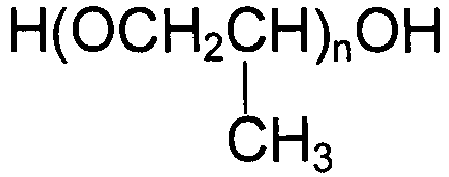
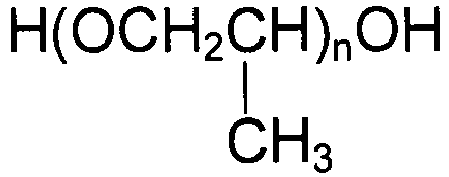
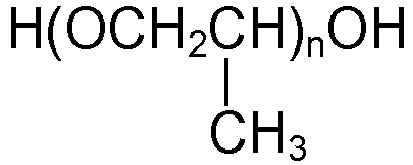
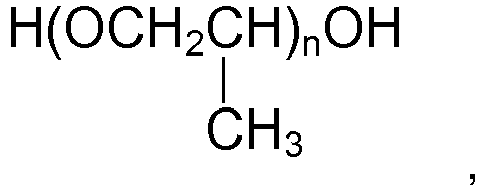
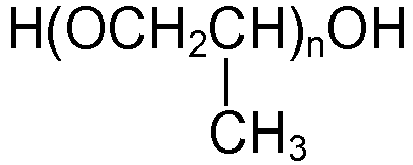
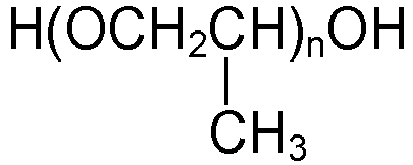
[0010] Accordingly, the first object of the present invention is a solid anhydrous composition for keratin fibres, especially for human hair, comprising at least one polyol liquid at 20°C selected from the compounds according to the general formula
and
H(OCH2CH2)nOH
wherein n is a number between 1 and 20 at a concentration 70% or more by weight and at least one fatty acid soap at a concentration of 5 % or more by weight, all values calculated to total composition, wherein the composition is free of volatile organic solvents, said volatile organic solvents comprising C1-C4 aliphatic alcohol.
[0011] Further object of the present invention is the use of the solid anhydrous composition of the present invention for conditioning and styling keratin fibres, especially human hair and especially for improving hair shine and preventing fly-away.
[0012] Still further object of the present invention is a process for conditioning and styling keratin fibres, especially human hair, wherein a composition according to present invention is applied onto wet or dry keratin fibres, especially human hair and not rinsed off.
[0013] With the term polyol it is meant any compound, preferably aliphatic compounds, having 2 or more hydroxyl groups in its molecule.
[0014] With the term anhydrous it is meant that compositions do not comprise any water and other volatile solvents as added. However it is possible that water and other volatile organic solvents are incorporated into the compositions at minor concentrations due to use of raw materials which comprise such compounds.
[0015] The term liquid means that polyol compound is free flowing and can comprise unmelted parts dispersed in it.
[0016] Suitable polyols are of according to above general formula wherein n is preferably between 1 and 16 and more preferably between 1 and 13 and most preferably between 1 and 10.
[0017] Examples to (poly)propylene glycols suitable are propylene glycol, PPG-3, PPG-7, PPG-9, PPG-12, PPG-13, PPG-15, PPG-16, PPG-17, and PPG-20. Preferred are propylene glycol, PPG-3, PPG-7, PPG-9, PPG-12, PPG-13, PPG-15, and PPG-16. More preferred are propylene glycol, PPG-3, PPG-7, PPG-9, PPG-12, and PPG-13. Most preferred are propylene glycol, PPG-3, PPG-7, and PPG-9. In particular, propylene glycol is found to be excellently suitable.
[0018] Examples to (poly)ethyleneglycols are PEG-4, PEG-6, PEG-7, PEG-8, PEG-9, PEG-10, PEG-12, PEG-14, PEG-16, PEG-18, and PEG-20. Preferred are PEG-4, PEG-6, PEG-7, PEG-8, PEG-9, PEG-10, PEG-12, PEG-14, and PEG-16. More preferred are PEG-4, PEG-6, PEG-7, PEG-8, PEG-9, PEG-10, and PEG-12. Most preferred are PEG-4, PEG-6, PEG-7, PEG-8, PEG-9, and PEG-10. In particular, PEG-8 is found to be excellently suitable.
[0019] In a preferred embodiment of the present invention, composition comprises at least one (poly)propylene glycol according to the general formula give above and at least one (poly)ethyleneglycol at a (poly)propylene glycol to (poly)ethyleneglycol weight ratio of 10:1 to 1:10, preferably 5:1 to 1:5 and more preferably 3:1 to 1:3 and most preferably 1:1.
[0020] Composition of the present invention comprise at least one fatty acid soap at a concentration of 5% by weight or more, preferably 5 to 20%, more preferably 5 to 15% and most preferably 7.5 to 12.5% by weight calculated to total composition.
[0022] Composition of present invention is preferably semi-transparent and more preferably transparent. Transparency is judged macroscopically at a composition thickness of approximately 1 cm either in a transparent vessel or as it is.
[0023] Composition comprises preferably at least one film forming - styling polymer soluble in the composition. Preferred are non-ionic polymers.
[0024] With the term solubility it is meant that at the concentration polymer used in the composition it is dissolved without leaving any remains at ambient temperature which is approximately 20°C.
[0025] Non-limiting examples to suitable non-ionic polymers are vinylpyrrolidon polymers either homopolymers or copolymers with, especially, vinylacetate. Those are known with the trade name "Luviskol" as homopolymers Luviskol K 30, K 60 or K 90 as well copolymers Luviskol VA 64 from BASF AG.
[0026] Natural non-ionic polymers are as well suitable for the composition of the present invention. Those are such as cellulose, chitosan, guar gum and their derivatives. Film forming styling polymers are comprised in the compositions of the present invention at a concentration of 0.1 to 10%, preferably 0.25 to 7.5% and more preferably 0.5 to 5% by weight calculated to total composition.
[0027] Composition can comprise silicone compounds. It is the preferred embodiment that the compositions comprise at least one silicone compound. The silicone compound is preferably soluble in the remaining of the composition. Suitable ones are dimethicone, dimethiconol, cyclic silicones, arylated silicone and amino silicones. Preferably, useful silicones are non volatile silicones, however volatile ones can also be comprised at concentration that does not cause any instability. Another condition is that the silicone used in the compositions must be full soluble and/or miscible with the other parts of the composition. Nonlimition examples are dimethicones as available from Dow Corning with various viscosities, cyclosiloxanes such as cyclopantasilocane, cyclotetrasiloxane and cyclotrisiloxane, arylated silicones such as phenyl trimethicone, phenyl methicone, trimethyl pentaphenyl trisiloxane, aminated silicones suc as quaternium-80, amodimethicone and polysilicone-9. With the the term aminated silicone it is meant that silicone compounds comprising at least one secondary, tertiary or quaternary amino group. Concentration of any of the silicone compounds is in the range of 0.01 to 5%, preferably 0.1 to 4% and more preferably 0.25 to 2.5% by weight calculated to total composition.
[0028] In a preferred form of the invention, composition comprises at least one fatty acid fatty alcohol ester according to general formula
R1-C(O)-O-R2
wherein R1 is straight or branched, saturated or unsaturated with 8 to 22 C atoms, preferably 12 to 18 C atoms and R2 is straight or branched, saturated or unsaturated 1 to 6 C atoms, preferably 2 to 4 C atoms.
[0029] Non-limiting suitable examples are isopropyl palmitate, ethyl palmitate, butyl palmitate, isobutyl palmitate, methyl palmitate, hexyl palmitate, isohexyl palmitate, methyl myristate, isopropyl myristate, butyl myristate, ethyl myristate, isobutyl myristate, isopropyl laurate, ethyl laurate, butyl laurate, isobutyl laurate, methyl laurate, hexyl laurate, isohexyl laurate, isopropyl stearate, ethyl stearate, butyl stearate, isobutyl stearate, methyl stearate, hexyl stearate and isohexyl stearate. Fatty acid fatty alcohol ester is comprised in the compositions at a concentration of 0.01 to 2%, preferably 0.1 to 1% by weight calculated to total composition.
[0030] Composition of the present invention may comprise surfactants of anionic, non-ionic or amphoteric character. Nonionic surfactants are the most preferred ones. Preferred non-ionic surfactants are fatty alcohol ethoxylates such as Ceteareth-20, Ceteareth-30, Ceteareth-40, Ceteth-20, Ceteth-30, Ceteth-40, Steareth-20, Steareth-25 and Steareth-20.
[0031] Further preferred non-ionic surfactants are ethoxylated trigylcerides such as PEG-30 hydrogenated castor oil, PEG-35 hydrogenated castor oil, PEG-40 hydrogenated castor oil, PEG-45 hydrogenated castor oil, PEG-50 hydrogenated castor oil, PEG-55 hydrogenated castor oil, PEG-60 hydrogenated castor oil, PEG-65 hydrogenated castor oil, PEG-80 hydrogenated castor oil, PEG-100 hydrogenated castor oil, PEG-200 hydrogenated castor oil, PEG-35 castor oil, PEG-50 castor oil, PEG-55 castor oil, PEG-60 castor oil, PEG-80 castor oil, PEG-100 castor oil, PEG-200 castor oil.
[0032] Total surfactant concentration of the compositions other than fatty acid soap is in the range of 0.1 to 10%, preferably 0.25 to 7.5% by weight calculated to total composition.
[0033] Composition of the present invention preferably comprises at least one UV filter. Concentration of UV filter is in the range of 0.1 to 5%, preferably 0.25 to 4% by weight calculated to total composition. Non-limiting suitable examples are are 4-Aminobenzoic acid and the esters and salts thereof, 2-phenyl benzimidazole-5-sulfonic acid and the alkali and amine salts thereof, 4-dimethyl aminobenzoic acid and the esters and salts thereof, cinnamic acid and the esters and salts thereof, 4-methoxycinnamic acid and the esters and salts thereof, salicylic acid and the esters and salts thereof, 2,4-dihydroxybenzophenone, 2,2',4,4'-tetrahydroxybenzophenone, 2-hydroxy-4-methoxybenzophenone and its 5-sulfonic acid or the sodium salt thereof, 2,2'-dihydroxy-4,4'-dimethoxybenzophenone, 2-hydroxy-5-chlorobenzophenone, 2,2'-dihydroxy-4-methoxybenzophenone, 2,2'-dihydroxy-4,4'-dimethoxy-5,5'-disulfobenzo-phenone or the sodium salt thereof, 2-hydroxy-4-octyloxybenzophenone, 2-hydroxy-4-methoxy-4'-methylbenzophenone, 3-benzyl-idenecampher, 3-(4'-sulfo)-benzyl-idenebornane-2-one and the salts thereof and/or 3-(4'-methyl benzylidene)-DL-campher.
[0034] Direct dyes of anionic, cationic, and/or nonionic character can be comprised in the compositions of the present invention. Preferred direct dyes are of cationic direct dyes for hair colouring purposes. In the case of product colouring anionic dyes are more preferred. Concentration is in the range of 0.0001 to 1% by weight, calculated to total composition.
[0035] In the selection of direct dyes, compatibility of the dye with the rest of the composition must be taken into account.
[0036] Suitable cationic direct dyes are Basic Blue 6, Basic Blue 7, Basic Blue 9, Basic Blue 26, Basic Blue 41, Basic Blue 99, Basic Brown 4, Basic Brown 16, Basic Brown 17, Natural Brown 7, Basic Green 1, Basic Orange 31, Basic Red 2, Basic Red 12 Basic Red 22, Basic Red 51, Basic Red 76, Basic Violet 1, Basic Violet 2, Basic Violet 3, Basic Violet 10, Basic Violet 14, Basic Yellow 57 and Basic Yellow 87, and mixtures thereof
[0037] Any anionic dye is in principal suitable for the compositions, especially for giving compositions an attractive colour. Suitable examples are such as Acid Black 1, Acid Blue 1, Acid Blue 3, Food Blue 5, Acid Blue 7, Acid Blue 9, Acid Blue 74, Acid Orange 3, Acid Orange 6, Acid Orange 7, Acid Orange 10, Acid Red 1, Acid Red 14, Acid Red 18, Acid Red 27, Acid Red 50, Acid Red 52, Acid Red 73, Acid Red 87, Acid Red 88, Acid Red 92, Acid Red 155, Acid Red 180, Acid Violet 9, Acid Violet 43, Acid Violet 49, Acid Yellow 1, Acid Yellow 23, Acid Yellow 3, Food Yellow No. 8, D&C Brown No. 1, D&C Green No. 5, D&C Green No. 8, D&C Orange No. 4, D&C Orange No. 10, D&C Orange No. 11, D&C Red No. 21, D&C Red No. 27, D&C Red No. 33, D&C Violet 2, D&C Yellow No. 7, D&C Yellow No. 8, D&C Yellow No. 10, FD&C Green 3, FD&C Red 2, FD&C Red 40, FD&C Red No. 4, FD&C Yellow No. 6, FD&C Blue 1, Food Black 1, Food Black 2, Disperse Black 9 and Disperse Violet 1 and their alkali metal salts such as sodium, potassium, and mixtures thereof.
[0038] Neutral dyes, so called nitro dyes for hair colouring purposes can also be contained in the compositions. Suitable ones are HC Blue No.2, HC Blue No.4, HC Blue No.5, HC Blue No.6, HC Blue No.7, HC Blue No.8, HC Blue No.9, HC Blue No.10, HC Blue No.11, HC Blue No.12, HC Blue No.13, HC Brown No.1, HC Brown No.2, HC Green No.1, HC Orange No.1, HC Orange No.2, HC Orange No.3, HC Orange No.5, HC Red BN, HC Red No.1, HC Red No.3, HC Red No.7, HC Red No.8, HC Red No.9, HC Red No.10, HC Red No.11, HC Red No.13, HC Red No.54, HC Red No.14, HC Violet BS, HC Violet No.1, HC Violet No.2, HC Yellow No.2, HC Yellow No.4, HC Yellow No.5, HC Yellow No.6, HC Yellow No.7, HC Yellow No.8, HC Yellow No.9, HC Yellow No.10, HC Yellow No.11, HC Yellow No.12, HC Yellow No.13, HC Yellow No.14, HC Yellow No.15, 2- Amino-6-chloro-4-nitrophenol, picramic acid, 1,2-Diamino-4-nitrobenzol, 1,4-Diamino-2-nitrobenzol, 3-Nitro-4-aminophenol, 1-Hydroxy-2-amino-3-nitrobenzol and 2-hydroxyethylpicramic acid, and mixtures thereof.
[0039] Hardness of the solid conditioning compositions of the present invention can be characterised with a penetration value. The penetration value can be determined with a commercially available penetrometer (SUR Berlin PNR 10) at 20°C. In the preferred embodiment of the present invention, composition has a penetration value between 1 and 30 mm, preferably between 2 and 20 mm, more preferably between 5 and 20 mm determined at 20°C.
[0040] Composition of the present invention further comprises ingredients common to the any cosmetic compositions, such as fragrance, preservatives, acids and/or basis for adjusting pH, etc.
Example 1
[0043] The composition was prepared by dissolving sodium stearate in propylene glycol with the use of heat. After cooling at approximately room temperatue fragrance was added and further mixed to homogeneity. The resulting solid composition had a penetration depth of 6.7 mm measured at 20°C with above mentioned equipment. The resulting composition is transparent and stable over 6 months in a temperature range of 5 to 40°C (isotherm storage).
[0044] The composition was applied on dry hair and was observed that hair became more shine, easily stylable and had less flay-aways.
Example 2
[0046] The composition was prepared in the same way as in example 1. The resulting composition was transparent and was stable over 6 months in a temperature range of 5 to 40°C (isotherm storage).
[0047] The composition was applied on dry hair and was observed that hair became more shine and fly-aways were reduced dramatically, at the same time hair was styled very easily.
Example 3
[0049] The composition was prepared by dissolving sodium stearate and Luviskol VA 64 in propylene glycol and PEG-8 mixture in presence of heat. After cooling at approximately room temperatue fragrance was added and further mixed to homogeneity. The resulting composition was transparent and was stable over 6 months in a temperature range of 5 to 40°C (isotherm storage).
[0050] The composition was applied on wet hair and was observed that hair was easily styled and became more shine, less fly-aways.
Example 4
[0051]
| % by weight | |
| Propylene glycol | 45 |
| PEG-8 | 42 |
| Sodium stearate | 9.5 |
| Luviskol VA 64 | 2.5 |
| Benzophenone-3 | 0.5 |
| Fragrance | 0.5 |
[0052] The composition was prepared by dissolving sodium stearate and Luviskol VA 64 in propylene glycol and PEG-8 mixture in presence of heat and combining it with Benzophenone-3. The resulting composition was transparent and was stable over 6 months in a temperature range of 5 to 40°C (isotherm storage).
[0053] The composition was applied on wet hair and was observed that hair was easily styled and became more shine, less fly-aways. The composition provided particular UV protection.
Example 5
[0054]
| % by weight | |
| Propylene glycol | 45 |
| PEG-8 | 42 |
| Sodium stearate | 11.5 |
| Isoproypl palmitate | 0.5 |
| Benzophenone-3 | 0.5 |
| Fragrance | 0.5 |
[0055] The composition was prepared by dissolving sodium stearate in propylene glycol and PEG-8 mixture in presence of heat and remaining ingredients are combined subsequently. Fragrance was added after cooling the composition down to below 40°C. The resulting composition was transparent and was stable over 6 months in a temperature range of 5 to 40°C (isotherm storage).
[0056] The composition was applied on wet hair and was observed that hair was easily styled and became more shine, less fly-aways. The composition provided particular UV protection.
Example 6
[0057]
| % by weight | |
| Propylene glycol | 41 |
| PEG-8 | 41 |
| Sodium stearate | 11.5 |
| Luviskol VA 64 | 5 |
| Phenyl methicone | 0.5 |
| Benzophenone-3 | 0.5 |
| Fragrance | 0.5 |
[0058] The composition was prepared in the same way as in Example 4. The resulting composition was transparent and was stable over 6 months in a temperature range of 5 to 40°C (isotherm storage).
[0059] The composition was applied on wet hair and was observed that hair was easily styled and became more shine, less fly-aways and also provided UV protection.
Example 7
[0060]
| % by weight | |
| Propylene glycol | 43 |
| PEG-8 | 43 |
| Sodium stearate | 7.5 |
| Luviskol VA 64 | 5 |
| Isopropyl palmitate | 0.5 |
| Basic red 51 | 0.1 |
| Benzophenone-3 | 0.5 |
| Fragrance | 0.4 |
[0061] The composition was prepared in the same way as in example 6. The resulting composition was transparent and was stable over 6 months in a temperature range of 5 to 40°C (isotherm storage).
[0062] The composition was applied on wet hair and was observed that hair was easily styled and had red shimmery shine.
Example 8
[0063]
| % by weight | |
| Propylene glycol | 46 |
| PEG-8 | 40 |
| Sodium stearate | 7.5 |
| Luviskol VA 64 | 5 |
| Polysilicone-9 | 0.5 |
| Basic blue 99 | 0.01 |
| Benzophenone-3 | 0.5 |
| Fragrance | 0.49 |
[0064] The composition was prepared in the same way as in example 7. The resulting composition was transparent and was stable over 6 months in a temperature range of 5 to 40°C (isotherm storage).
[0065] The composition was applied on wet hair and was observed that hair was easily styled and had less fly-away. Excellent anti-yellowing effect was observed on gray hair.
Example 9
[0066]
| % by weight | |
| Propylene glycol | 43 |
| PEG-8 | 43 |
| Sodium stearate | 7.5 |
| Luviskol VA 64 | 5 |
| Dimethicone | 0.5 |
| Benzophenone-3 | 0.5 |
| Basic red 51 | 0.05 |
| Basic yellow 87 | 0.02 |
| Basic orange | 0.02 |
| Fragrance | 0.41 |
[0067] The composition was prepared in the same way as in example 7. The resulting composition was transparent and was stable over 6 months in a temperature range of 5 to 40°C (isotherm storage).
[0068] The composition was applied on wet hair and was observed that hair was easily styled, had excellent blond shine and had less fly-aways.
Example 10
[0069]
| % by weight | |
| Propylene glycol | 42 |
| PEG-8 | 42 |
| Sodium stearate | 9.5 |
| Luviskol VA 64 | 5 |
| Trimethyl pentaphenyl trisiloxane | 0.5 |
| Benzophenone-3 | 0.5 |
| Acid red 52 | 0.001 |
| Cl 47005 | 0.002 |
| Fragrance | 0.497 |
1. Solid anhydrous composition for keratin fibres, especially human hair, characterised in that it comprises at least one polyol liquid at 20°C selected from compounds according
to the general formula
and
H(OCH2CH2)nOH
wherein n is a number between 1 and 20 at a concentration of 70% or more by weight and at least one fatty acid soap at a concentration of 5% or more, all values are calculated to total composition, wherein composition is free of volatile organic solvents said volatile organic solvent comprising C1-C4 aliphatic alcohol.
and
H(OCH2CH2)nOH
wherein n is a number between 1 and 20 at a concentration of 70% or more by weight and at least one fatty acid soap at a concentration of 5% or more, all values are calculated to total composition, wherein composition is free of volatile organic solvents said volatile organic solvent comprising C1-C4 aliphatic alcohol.
2. Composition according to claim 1 characterised in that composition comprises at least one polyol according to general formula
wherein n is a number between 1 and 20, and at least one another polyol according to general formula
H(OCH2CH2)nOH
wherein n is a number between 1 and 20 at a weight ratio between 10:1 to 1:10.
wherein n is a number between 1 and 20, and at least one another polyol according to general formula
H(OCH2CH2)nOH
wherein n is a number between 1 and 20 at a weight ratio between 10:1 to 1:10.
3. Composition according to any of the preceding claims characterised in that it comprises at least one fatty acid sodium soap, preferably sodium stearate.
4. Composition according to any of the preceding claims characterised in that the composition is semi-transparent or transparent wherein transparency is judged
macroscopically at a composition thickness of 1 cm.
5. Composition according to any of the preceding claims characterised in that it comprises at least one film forming styling polymer soluble in the composition
at 20°C at a concentration of 0.1 to 10% by weight calculated to total composition.
6. Composition according to any of the preceding claims characterised in that it comprises at least one silicone compound.
7. Composition according to any of the preceding claims characterised in that it comprises at least one fatty acid fatty alcohol ester according to general formula
R1-C(O)-O-R2
wherein R1 is straight or branched, saturated or unsaturated with 8 to 22 C atoms, preferably 12 to 18 C atoms and R2 is straight or branched, saturated or unsaturated 1 to 6 C atoms, preferably 2 to 4 C atoms.
R1-C(O)-O-R2
wherein R1 is straight or branched, saturated or unsaturated with 8 to 22 C atoms, preferably 12 to 18 C atoms and R2 is straight or branched, saturated or unsaturated 1 to 6 C atoms, preferably 2 to 4 C atoms.
8. Composition according to any of the preceding claims characterised in that it comprises at least one surfactant selected from non-ionic, anionic and amphoteric
ones.
9. Composition according to claim 9 characterised in that it comprises at least non-ionic and/or anionic surfactant.
10. Composition according to any of the preceding claims characterised in that it comprises at least one UV filter.
11. Composition according to any of the preceding claims characterised in that it comprises at least one direct dye.
12. Composition according to any of the preceding claims characterised in that it has a penetration value between 1 and 30 mm determined with a penetrometer at
20°C.
13. Use of a composition according to any of the preceding claims for conditioning and
styling keratin fibres, especially human hair.
14. Process for conditioning and styling keratin fibres, especially human hair wherein
a composition according to claims 1 to 12 is applied onto wet or dry keratin fibres,
especially human hair and not rinsed off.
1. Feste wasserfreie Zusammensetzung für Keratinfasern, insbesondere menschliche Haare,
dadurch gekennzeichnet, dass sie mindestens ein bei 20 °C flüssiges Polyol, ausgewählt aus Verbindungen der allgemeinen
Formel
und
H(OCH2CH2)nOH,
wobei n eine Zahl von 1 bis 20 ist, in einer Konzentration von 70 Gewichts-% oder mehr und mindestens eine Fettsäureseife in einer Konzentration von 5 % oder mehr aufweist, wobei alle Werte auf die Gesamtzusammensetzung bezogen sind, wobei die Zusammensetzung frei von flüchtigen organischen Lösungsmitteln ist, wobei das flüchtige organische Lösungsmittel aliphatischen C1-4-Alkohol aufweist.
und
H(OCH2CH2)nOH,
wobei n eine Zahl von 1 bis 20 ist, in einer Konzentration von 70 Gewichts-% oder mehr und mindestens eine Fettsäureseife in einer Konzentration von 5 % oder mehr aufweist, wobei alle Werte auf die Gesamtzusammensetzung bezogen sind, wobei die Zusammensetzung frei von flüchtigen organischen Lösungsmitteln ist, wobei das flüchtige organische Lösungsmittel aliphatischen C1-4-Alkohol aufweist.
2. Zusammensetzung nach Anspruch 1, dadurch gekennzeichnet, dass die Zusammensetzung mindestens ein Polyol der allgemeinen Formel
wobei n eine Zahl von 1 bis 20 ist, und mindestens ein anderes Polyol der allgemeinen Formel
H(OCH2CH2)nOH,
wobei n eine Zahl von 1 bis 20 ist, in einem Gewichtsverhältnis von 10:1 bis 1:10 aufweist.
wobei n eine Zahl von 1 bis 20 ist, und mindestens ein anderes Polyol der allgemeinen Formel
H(OCH2CH2)nOH,
wobei n eine Zahl von 1 bis 20 ist, in einem Gewichtsverhältnis von 10:1 bis 1:10 aufweist.
3. Zusammensetzung nach einem der vorhergehenden Ansprüche, dadurch gekennzeichnet, dass sie mindestens eine Fettsäure-Natrium-Seife aufweist, vorzugsweise Natriumstearat.
4. Zusammensetzung nach einem der vorhergehenden Ansprüche, dadurch gekennzeichnet, dass die Zusammensetzung semitransparent oder transparent ist, wobei die Transparenz makroskopisch
bei einer Zusammensetzungsdicke von 1 cm beurteilt wird.
5. Zusammensetzung nach einem der vorhergehenden Ansprüche, dadurch gekennzeichnet, dass sie mindestens ein dünnschichtbildendes Styling-Polymer, welches bei 20 °C in der
Zusammensetzung löslich ist, in einer Konzentration von 0,1 Gewichts-% bis 10 Gewichts-%
aufweist, bezogen auf die Gesamtzusammensetzung.
6. Zusammensetzung nach einem der vorhergehenden Ansprüche, dadurch gekennzeichnet, dass sie mindestens eine Silikonverbindung aufweist.
7. Zusammensetzung nach einem der vorhergehenden Ansprüche, dadurch gekennzeichnet, dass sie mindestens einen Fettsäure-Fettalkohol-Ester der allgemeinen Formel
R1-C(O)-O-R2
aufweist, wobei R1 linear oder verzweigt, gesättigt oder ungesättigt ist, mit 8 bis 22 C-Atomen, vorzugsweise 12 bis 18 C-Atomen, und R2 linear oder verzweigt, gesättigt oder ungesättigt ist mit 1 bis 6 C-Atomen, vorzugsweise 2 bis 4 C-Atomen.
R1-C(O)-O-R2
aufweist, wobei R1 linear oder verzweigt, gesättigt oder ungesättigt ist, mit 8 bis 22 C-Atomen, vorzugsweise 12 bis 18 C-Atomen, und R2 linear oder verzweigt, gesättigt oder ungesättigt ist mit 1 bis 6 C-Atomen, vorzugsweise 2 bis 4 C-Atomen.
8. Zusammensetzung nach einem der vorhergehenden Ansprüche, dadurch gekennzeichnet, dass sie mindestens ein Tensid aufweist, ausgewählt aus nichtionischen, anionischen und
amphoteren.
9. Zusammensetzung nach Anspruch 9, dadurch gekennzeichnet, dass sie wenigstens nichtionisches und/oder anionisches Tensid aufweist.
10. Zusammensetzung nach einem der vorhergehenden Ansprüche, dadurch gekennzeichnet, dass sie mindestens einen UV-Filter aufweist.
11. Zusammensetzung nach einem der vorhergehenden Ansprüche, dadurch gekennzeichnet, dass sie mindestens einen Direktfarbstoff aufweist.
12. Zusammensetzung nach einem der vorhergehenden Ansprüche, dadurch gekennzeichnet, dass sie einen Penetrationswert von 1 mm bis 30 mm aufweist, bestimmt mit einem Penetrometer
bei 20 °C.
13. Verwendung einer Zusammensetzung nach einem der vorhergehenden Ansprüche zum Konditionieren
und Styling von Keratinfasern, insbesondere menschlichen Haaren.
14. Verfahren zum Konditionieren und Styling von Keratinfasern, insbesondere menschlichen
Haaren, wobei eine Zusammensetzung nach Anspruch 1 bis 12 auf feuchte oder trockene
Keratinfasern, insbesondere menschliche Haare, aufgebracht und nicht ausgespült wird.
1. Composition solide anhydre destinée aux fibres de kératine, en particulier aux cheveux
humains, caractérisée en ce qu'elle comprend au moins un polyol liquide à 20° C choisi parmi les composés selon les
formules générales
et
H(OCH2CH2)nOH
où n représente un nombre entre 1 et 20, à une concentration égale ou supérieure à 70 % en poids, et au moins un savon d'acide gras à une concentration égale ou supérieure à 5 %, toutes les valeurs sont calculées par rapport à la composition totale, où la composition est exempte de solvants organiques volatils, ledit solvant organique volatil comprenant un alcool aliphatique en C1 à C4.
et
H(OCH2CH2)nOH
où n représente un nombre entre 1 et 20, à une concentration égale ou supérieure à 70 % en poids, et au moins un savon d'acide gras à une concentration égale ou supérieure à 5 %, toutes les valeurs sont calculées par rapport à la composition totale, où la composition est exempte de solvants organiques volatils, ledit solvant organique volatil comprenant un alcool aliphatique en C1 à C4.
2. Composition selon la revendication 1, caractérisée en ce que la composition comprend au moins un polyol selon la formule générale
où n représente un nombre entre 1 et 20, et au moins un autre polyol selon la formule générale
H(OCH2CH2)nOH
où n représente un nombre entre 1 et 20, à un ratio pondéral entre 10 : 1 et 1 : 10.
où n représente un nombre entre 1 et 20, et au moins un autre polyol selon la formule générale
H(OCH2CH2)nOH
où n représente un nombre entre 1 et 20, à un ratio pondéral entre 10 : 1 et 1 : 10.
3. Composition selon l'une quelconque des revendications précédentes, caractérisée en ce qu'elle comprend au moins un savon d'acide gras et de sodium, de préférence de stéarate
de sodium.
4. Composition selon l'une quelconque des revendications précédentes, caractérisée en ce que la composition est semi transparente ou transparente, où la transparence est déterminée
de manière macroscopique à une épaisseur de composition de 1 cm.
5. Composition selon l'une quelconque des revendications précédentes, caractérisée en ce qu'elle comprend au moins un polymère filmogène de coiffage, soluble dans la composition
à 20° C, à une concentration entre 0,1 et 10 % en poids calculée par rapport à la
composition totale.
6. Composition selon l'une quelconque des revendications précédentes, caractérisée en ce qu'elle comprend au moins un composé de silicone.
7. Composition selon l'une quelconque des revendications précédentes, caractérisée en ce qu'elle comprend au moins un ester d'alcool gras et d'acide gras selon la formule générale
R1-C(O)-O-R2
où R1 est linéaire ou ramifié, saturé ou non saturé, avec 8 à 22 atomes C, de préférence 12 à 18 atomes C, et R2 est linéaire ou ramifié, saturé ou non saturé, avec 1 à 6 atomes C, de préférence 2 à 4 atomes C.
R1-C(O)-O-R2
où R1 est linéaire ou ramifié, saturé ou non saturé, avec 8 à 22 atomes C, de préférence 12 à 18 atomes C, et R2 est linéaire ou ramifié, saturé ou non saturé, avec 1 à 6 atomes C, de préférence 2 à 4 atomes C.
8. Composition selon l'une quelconque des revendications précédentes, caractérisée en ce qu'elle comprend au moins un tensioactif choisi parmi les tensioactifs non ioniques,
anioniques et amphotères.
9. Composition selon la revendication 9, caractérisée en ce qu'elle comprend au moins un tensioactif non ionique et/ou anionique.
10. Composition selon l'une quelconque des revendications précédentes, caractérisée en ce qu'elle comprend au moins un filtre UV.
11. Composition selon l'une quelconque des revendications précédentes, caractérisée en ce qu'elle comprend au moins un colorant direct.
12. Composition selon l'une quelconque des revendications précédentes, caractérisée en ce qu'elle a une valeur de pénétration comprise entre 1 et 30 mm, déterminée à l'aide d'un
pénétromètre à 20° C.
13. Utilisation d'une composition selon l'une quelconque des revendications précédentes
pour le conditionnement et le coiffage des fibres de kératine, en particulier des
cheveux humains.
14. Procédé de conditionnement et de coiffage des fibres de kératine, en particulier des
cheveux humains, dans lequel une composition selon les revendications 1 à 12 est appliquée
sur les fibres de kératine sèches ou humides, en particulier sur les cheveux humains,
et n'est pas éliminée par rinçage.
REFERENCES CITED IN THE DESCRIPTION
This list of references cited by the applicant is for the reader's convenience only. It does not form part of the European patent document. Even though great care has been taken in compiling the references, errors or omissions cannot be excluded and the EPO disclaims all liability in this regard.
Patent documents cited in the description