|
(11) | EP 3 569 638 A1 |

| (12) | EUROPEAN PATENT APPLICATION |
|
|
|
|
|||||||||||||||||||||||||||
| (54) | POLYMER CONTAINING SILPHENYLENE AND POLYETHER STRUCTURES |
| (57) A novel polymer containing silphenylene and polyether structures in the backbone
is used to formulate a photosensitive composition having improved reliability. |
CROSS-REFERENCE TO RELATED APPLICATION
[0001] This non-provisional application claims priority under 35 U.S.C. §119(a) on Patent Application No. 2018-095338 filed in Japan on May 17, 2018, the entire contents of which are hereby incorporated by reference.
TECHNICAL FIELD
BACKGROUND ART
[0003] In the prior art, photosensitive protective films for semiconductor devices and photosensitive dielectric films for multilayer printed circuit boards are formed of photosensitive polyimide, epoxy resin, and silicone compositions. While many photosensitive materials are known for the protection of such substrates and circuit boards, Patent Document 1 discloses a photosensitive silicone composition having improved flexibility.
[0004] Patent Document 2 discloses a photosensitive silicone composition based on a silphenylene structure-containing silicone polymer. Although this photosensitive silicone composition has improved chemical resistance to liquid photoresist strippers, the cured product can spall off from the substrate or crack during a thermal cycle test (repetitive 1,000 cycles of -25°C/10 min holding and 125°C/10 min holding). A further improvement in reliability is desired.
Citation List
[0005]
Patent Document 1: JP-A 2002-088158 (USP 6,590,010, EP 1186624)
Patent Document 2: JP-A 2008-184571 (USP 7,785,766, EP 1953183)
SUMMARY OF INVENTION
[0006] An object of the invention is to provide a novel polymer which may be used to formulate a photosensitive composition having improved reliability.
[0007] The inventors have found that the outstanding problem is solved by a polymer containing a silphenylene structure and a polyether structure.
[0008] According to the invention, there is provided a polymer containing a silphenylene structure and a polyether structure in the backbone.
[0011] Specifically, the polymer is defined as comprising repeating units having the following formulae (1) to (4).
Herein X1 is a divalent group having the following formula (X1), X2 is a divalent group having the following formula (X2), X3 is a divalent group having the following formula (X3), X4 is a divalent group having the following formula (X4), and p, q, r and s are numbers in the range: 0 < p < 1, 0 ≤ q < 1, 0 ≤ r < 1, 0 ≤ s < 1, 0 < q+r+s < 1, and p+q+r+s = 1.
Herein R1 and R2 are each independently hydrogen or a C1-C8 monovalent hydrocarbon group, R3 and R4 are each independently hydrogen or methyl, a1 and a2 are each independently an integer of 1 to 6, and n is an integer of 0 to 100.
Herein Y1 is a single bond, methylene, propane-2,2-diyl, 1,1,1,3,3,3-hexafluoropropane-2,2-diyl or fluorene-9,9-diyl, R11 and R12 are each independently hydrogen or methyl, R13 and R14 are each independently a C1-C4 alkyl or alkoxy group, b1 and b2 are each independently an integer of 0 to 7, and c1 and c2 are each independently an integer of 0 to 2.
Herein Y2 is a single bond, methylene, propane-2,2-diyl, 1,1,1,3,3,3-hexafluoropropane-2,2-diyl or fluorene-9,9-diyl, R21 and R22 are each independently hydrogen or methyl, R23 and R24 are each independently a C1-C4 alkyl or alkoxy group, d1 and d2 are each independently an integer of 0 to 7, and e1 and e2 are each independently an integer of 0 to 2.
Herein R31 and R32 are each independently hydrogen or methyl, and f1 and f2 are each independently an integer of 0 to 7.
ADVANTAGEOUS EFFECTS OF INVENTION
[0013] The inventive polymer is readily synthesizable and used to formulate a photosensitive composition having improved reliability.
DESCRIPTION OF PREFERRED EMBODIMENTS
[0014] As used herein, the notation (Cn-Cm) means a group containing from n to m carbon atoms per group.
Polymer containing silphenylene and polyether structures
[0015] The invention provides a polymer containing a silphenylene structure and a polyether structure in the backbone. The polymer preferably has an epoxy group and/or phenolic hydroxyl group.
[0016] The polymer preferably comprises repeating units having the following formulae (1) to (4), which are sometimes designated repeating units (1) to (4), hereinafter.
[0017] In formula (1), X1 is a divalent group having the formula (X1).
In formula (X1), R1 and R2 are each independently hydrogen or a C1-C8 monovalent hydrocarbon group, R3 and R4 are each independently hydrogen or methyl, a1 and a2 are each independently an integer of 1 to 6, preferably 1 to 4, and more preferably 1 or 2, and n is an integer of 0 to 100, preferably 1 to 50, and more preferably 5 to 20.
[0018] The C1-C8 monovalent hydrocarbon groups may be straight, branched or cyclic, and include, for example, monovalent aliphatic hydrocarbon groups such as C1-C8 alkyl groups and C2-C8 alkenyl groups and monovalent aromatic hydrocarbon groups such as C6-C8 aryl groups and C7 or C8 aralkyl groups.
[0019] Examples of the C1-C8 alkyl group include methyl, ethyl, n-propyl, isopropyl, cyclopropyl, n-butyl, isobutyl, sec-butyl, tert-butyl, cyclobutyl, n-pentyl, cyclopentyl, n-hexyl, cyclohexyl, n-heptyl, and n-octyl. Examples of the alkenyl group include vinyl, propenyl, butenyl, and pentenyl. Examples of the aryl group include phenyl, 2-methylphenyl, 3-methylphenyl, 4-methylphenyl, 2-ethylphenyl, 3-ethylphenyl, 4-ethylphenyl, and dimethylphenyl. Examples of the aralkyl group include benzyl and phenethyl.
[0021] In formula (X1), the alkylene oxide units with subscript n may be randomly or alternately arranged, or plural blocks of the same alkylene oxide units may be included.
[0022] In formula (2), X2 is a divalent group having the formula (X2).
In formula (X2), Y1 is a single bond, methylene, propane-2,2-diyl, 1,1,1,3,3,3-hexafluoropropane-2,2-diyl or fluorene-9,9-diyl, R1 and R12 are each independently hydrogen or methyl, R13 and R14 are each independently a C1-C4 alkyl or alkoxy group, b1 and b2 are each independently an integer of 0 to 7, and c1 and c2 are each independently an integer of 0 to 2.
[0023] The C1-C4 alkyl group may be straight, branched or cyclic, and examples thereof include methyl, ethyl, n-propyl, isopropyl, cyclopropyl, n-butyl, isobutyl, sec-butyl, tert-butyl, and cyclobutyl. The C1-C4 alkoxy group may be straight, branched or cyclic, and examples thereof include methoxy, ethoxy, n-propyloxy, isopropyloxy, cyclopropyloxy, n-butyloxy, isobutyloxy, sec-butyloxy, tert-butyloxy, and cyclobutyloxy.
[0024] In formula (3), X3 is a divalent group having the formula (X3).
In formula (X3), Y2 is a single bond, methylene, propane-2,2-diyl, 1,1,1,3,3,3-hexafluoropropane-2,2-diyl or fluorene-9,9-diyl, R21 and R22 are each independently hydrogen or methyl, R23 and R24 are each independently a C1-C4 alkyl or alkoxy group, d1 and d2 are each independently an integer of 0 to 7, and e1 and e2 are each independently an integer of 0, 1 or 2. Examples of the C1-C4 alkyl or alkoxy group are as exemplified in the description of formula (X2).
[0025] In formula (4), X4 is a divalent group having the formula (X4).
In formula (X4), R31 and R32 are each independently hydrogen or methyl, and f1 and f2 are each independently an integer of 0 to 7.
[0026] In formulae (1) to (4), p, q, r and s indicative of contents (molar fractions) of repeating units (1), (2), (3), and (4) in the polymer, respectively, are numbers in the range: 0 < p < 1, 0 ≤ q < 1, 0 ≤ r < 1, 0 ≤ s < 1,0 < q+r+s < 1, and p+q+r+s = 1. From the aspects of film formation or handling, p, q, r and s are preferably numbers in the range: 0.1 ≤ p ≤ 0.9, 0 ≤ q ≤ 0.9, 0 ≤ r ≤ 0.9, 0 ≤ s ≤ 0.9, and 0.1 ≤ q+r+s ≤ 0.9, more preferably 0.2 ≤ p ≤ 0.8, 0 ≤ q ≤ 0.8, 0 ≤ r ≤ 0.8, 0 ≤ s ≤ 0.8, and 0.2 ≤ q+r+s ≤ 0.8, with the proviso that p+q+r+s = 1. The repeating units (1) to (4) may be arranged either randomly or blockwise.
[0027] The inventive polymer preferably has a weight average molecular weight (Mw) of 3,000 to 500,000, more preferably 5,000 to 200,000. Polymers with Mw in the range are fully soluble in most common organic solvents. It is noted throughout the disclosure that Mw is measured by gel permeation chromatography (GPC) versus polystyrene standards using tetrahydrofuran as the elute.
[0028] The polymer may be composed of randomly or alternately arranged repeating units (1) to (4) or plural blocks each consisting of units of the same type.
Method of preparing polymer containing silphenylene and polyether structures
[0029] The polymer may be prepared by addition polymerization of a compound having the formula (5), a compound having the formula (X1'), and at least one compound selected from a compound having the formula (X2'), a compound having the formula (X3'), and a compound having the formula (X4'), all shown below, in the presence of a metal catalyst.
Herein Y1, Y2, R1 to R4, R11 to R14, R21 to R24, R31, R32, a1, a2, b1, b2, c1, c2, d1, d2, e1, e2, f1, f2 and n are as defined above.
[0030] Examples of the metal catalyst used herein include platinum group metals alone such as platinum (including platinum black), rhodium and palladium; platinum chlorides, chloroplatinic acids and chloroplatinates such as H2PtCl4·xH2O, H2PtCl6·xH2O, NaHPtCl6·xH2O, KHPtCl6·xH2O, Na2PtCl6·xH2O, K2PtCl4·xH2O, PtCl4·xH2O, PtCl2 and Na2HPtCl4·xH2O, wherein x is preferably an integer of 0 to 6, more preferably 0 or 6; alcohol-modified chloroplatinic acids as described in USP 3,220,972; chloroplatinic acid-olefin complexes as described in USP 3,159,601, USP 3,159,662 and USP 3,775,452; supported catalysts comprising platinum group metals such as platinum black and palladium on supports of alumina, silica and carbon; rhodium-olefin complexes; chlorotris(triphenylphosphine)rhodium (known as Wilkinson's catalyst); and complexes of platinum chlorides, chloroplatinic acids and chloroplatinates with vinyl-containing siloxanes, specifically vinyl-containing cyclosiloxanes.
[0031] The catalyst is used in a catalytic amount, which is preferably 0.001 to 0.1% by weight of platinum group metal based on the total weight of the reactants for polymerization reaction. In the polymerization reaction, a solvent may be used if desired. Suitable solvents are hydrocarbon solvents such as toluene and xylene. With respect to polymerization conditions, the polymerization temperature is preferably selected in a range of 40 to 150°C, more preferably 60 to 120°C, such that the catalyst may not be deactivated and the polymerization be completed within a short time. While the polymerization time varies with the type and amount of monomers, the polymerization reaction is preferably completed within about 0.5 to about 100 hours, more preferably about 0.5 to about 30 hours for preventing moisture entry into the polymerization system. After the completion of polymerization reaction, the solvent if any is distilled off, obtaining the desired polymer.
[0032] The reaction procedure is not particularly limited. The preferred procedure is by first mixing a compound having formula (X1') with one or more compounds selected from a compound having formula (X2'), a compound having formula (X3'), and a compound having formula (X4'), heating the mixture, adding a metal catalyst to the mixture, and then adding a compound having formula (5) dropwise over 0.1 to 5 hours.
[0033] The reactants are preferably combined in such amounts that a molar ratio of hydrosilyl groups on the compound having formula (5) to the total of alkenyl groups on the compounds having formulae (X1'), (X2'), (X3'), and (X4') may range from 0.67/1 to 1.67/1, more preferably from 0.83/1 to 1.25/1. The Mw of the polymer may be controlled using a molecular weight control agent such as a monoallyl compound (e.g., o-allylphenol), monohydrosilane (e.g., triethylhydrosilane) or monohydrosiloxane.
EXAMPLES
[0034] Examples of the invention are given below by way of illustration and not by way of limitation. In Examples, the weight average molecular weight (Mw) is measured by gel permeation chromatography (GPC) versus monodisperse polystyrene standards using GPC columns TSKGEL Super HZM-H (Tosoh Corp.) under analytical conditions: flow rate 0.6 mL/min, tetrahydrofuran elute, and column temperature 40°C.
Example 1
Synthesis of Resin 1
[0036] A 3-L flask equipped with a stirrer, thermometer, nitrogen purge line and reflux condenser was charged with 156.8 g (0.40 mol) of the compound having formula (S-1), 53.9 g (0.10 mol) of the compound having formula (S-3a) (UNIOX from NOF Corp.), and 2,000 g of toluene and heated at 70°C. Thereafter, 1.0 g of a toluene solution of chloroplatinic acid (platinum concentration 0.5 wt%) was added, and 97.0 g (0.50 mol) of the compound having formula (S-5) was added dropwise over 1 hour. The ratio of the total moles of hydrosilyl groups to the total moles of alkenyl groups was 1/1. At the end of dropwise addition, the reaction solution was heated at 100°C and aged for 6 hours. Toluene was distilled off in vacuum from the reaction solution, yielding Resin 1. Resin 1 had a Mw of 43,000. On 1H-NMR spectroscopy (Bruker Corp.), Resin 1 was identified to be a polymer containing repeating units (1) and (2).
Example 2
Synthesis of Resin 2
[0037] A 3-L flask equipped with a stirrer, thermometer, nitrogen purge line and reflux condenser was charged with 172.0 g (0.40 mol) of the compound having formula (S-7), 53.9 g (0.10 mol) of the compound having formula (S-3a), and 2,000 g of toluene and heated at 70°C. Thereafter, 1.0 g of a toluene solution of chloroplatinic acid (platinum concentration 0.5 wt%) was added, and 97.0 g (0.50 mol) of the compound having formula (S-5) was added dropwise over 1 hour. The ratio of the total moles of hydrosilyl groups to the total moles of alkenyl groups was 1/1. At the end of dropwise addition, the reaction solution was heated at 100°C and aged for 6 hours. Toluene was distilled off in vacuum from the reaction solution, yielding Resin 2. Resin 2 had a Mw of 25,000. On 1H-NMR spectroscopy (Bruker Corp.), Resin 2 was identified to be a polymer containing repeating units (1) and (3).
Example 3
Synthesis of Resin 3
[0038] A 3-L flask equipped with a stirrer, thermometer, nitrogen purge line and reflux condenser was charged with 106.0 g (0.40 mol) of the compound having formula (S-2), 53.9 g (0.10 mol) of the compound having formula (S-3a), and 2,000 g of toluene and heated at 70°C. Thereafter, 1.0 g of a toluene solution of chloroplatinic acid (platinum concentration 0.5 wt%) was added, and 97.0 g (0.50 mol) of the compound having formula (S-5) was added dropwise over 1 hour. The ratio of the total moles of hydrosilyl groups to the total moles of alkenyl groups was 1/1. At the end of dropwise addition, the reaction solution was heated at 100°C and aged for 6 hours. Toluene was distilled off in vacuum from the reaction solution, yielding Resin 3. Resin 3 had a Mw of 34,000. On 1H-NMR spectroscopy (Bruker Corp.), Resin 3 was identified to be a polymer containing repeating units (1) and (4).
Example 4
Synthesis of Resin 4
[0039] A 3-L flask equipped with a stirrer, thermometer, nitrogen purge line and reflux condenser was charged with 9.8 g (0.025 mol) of the compound having formula (S-1), 10.8 g (0.025 mol) of the compound having formula (S-7), 13.3 g (0.05 mol) of the compound having formula (S-2), 215.6 g (0.40 mol) of the compound having formula (S-3a), and 2,000 g of toluene and heated at 70°C. Thereafter, 1.0 g of a toluene solution of chloroplatinic acid (platinum concentration 0.5 wt%) was added, and 97.0 g (0.50 mol) of the compound having formula (S-5) was added dropwise over 1 hour. The ratio of the total moles of hydrosilyl groups to the total moles of alkenyl groups was 1/1. At the end of dropwise addition, the reaction solution was heated at 100°C and aged for 6 hours. Toluene was distilled off in vacuum from the reaction solution, yielding Resin 4. Resin 4 had a Mw of 50,000. On 1H-NMR spectroscopy (Bruker Corp.), Resin 4 was identified to be a polymer containing repeating units (1), (2), (3), and (4).
Example 5
Synthesis of Resin 5
[0040] A 3-L flask equipped with a stirrer, thermometer, nitrogen purge line and reflux condenser was charged with 9.8 g (0.025 mol) of the compound having formula (S-1), 10.8 g (0.025 mol) of the compound having formula (S-7), 13.3 g (0.05 mol) of the compound having formula (S-2), 327.2 g (0.40 mol) of the compound having formula (S-3b), and 2,000 g of toluene and heated at 70°C. Thereafter, 1.0 g of a toluene solution of chloroplatinic acid (platinum concentration 0.5 wt%) was added, and 97.0 g (0.50 mol) of the compound having formula (S-5) was added dropwise over 1 hour. The ratio of the total moles of hydrosilyl groups to the total moles of alkenyl groups was 1/1. At the end of dropwise addition, the reaction solution was heated at 100°C and aged for 6 hours. Toluene was distilled off in vacuum from the reaction solution, yielding Resin 5. Resin 5 had a Mw of 58,000. On 1H-NMR spectroscopy (Bruker Corp.), Resin 5 was identified to be a polymer containing repeating units (1), (2), (3), and (4).
[0041] Resins 1 to 5 are synthesized above, demonstrating that novel polymers containing a silphenylene structure and a polyether structure in the backbone are provided.
[0043] Although some preferred embodiments have been described, many modifications and variations may be made thereto in light of the above teachings. It is therefore to be understood that the invention may be practiced otherwise than as specifically described without departing from the scope of the appended claims.
1. A polymer containing a silphenylene structure and a polyether structure in the backbone.
2. The polymer of claim 1, having an epoxy group and/or phenolic hydroxyl group.
3. The polymer of claim 1 or 2, having a weight average molecular weight of 3,000 to
500,000.
4. The polymer of any one of claims 1 to 3, comprising repeating units having the following
formulae (1) to (4):
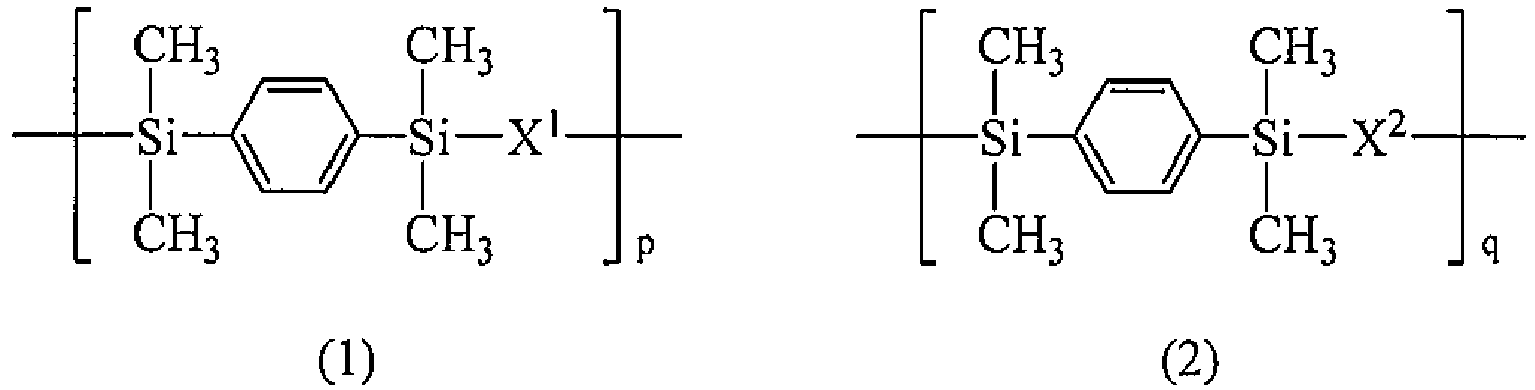
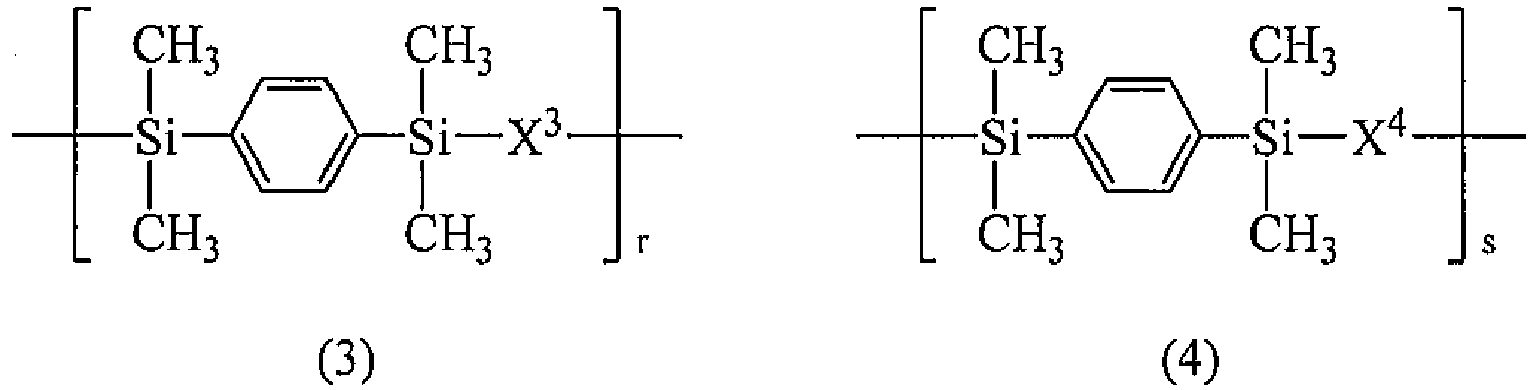
wherein X1 is a divalent group having the following formula (X1), X2 is a divalent group having the following formula (X2), X3 is a divalent group having the following formula (X3), X4 is a divalent group having the following formula (X4), and p, q, r and s are numbers in the range: 0 < p < 1, 0 ≤ q < 1, 0 ≤ r < 1, 0 ≤ s < 1, 0 < q+r+s < 1, and p+q+r+s = 1,

wherein R1 and R2 are each independently hydrogen or a C1-C8 monovalent hydrocarbon group, R3 and R4 are each independently hydrogen or methyl, a1 and a2 are each independently an integer of 1 to 6, and n is an integer of 0 to 100,
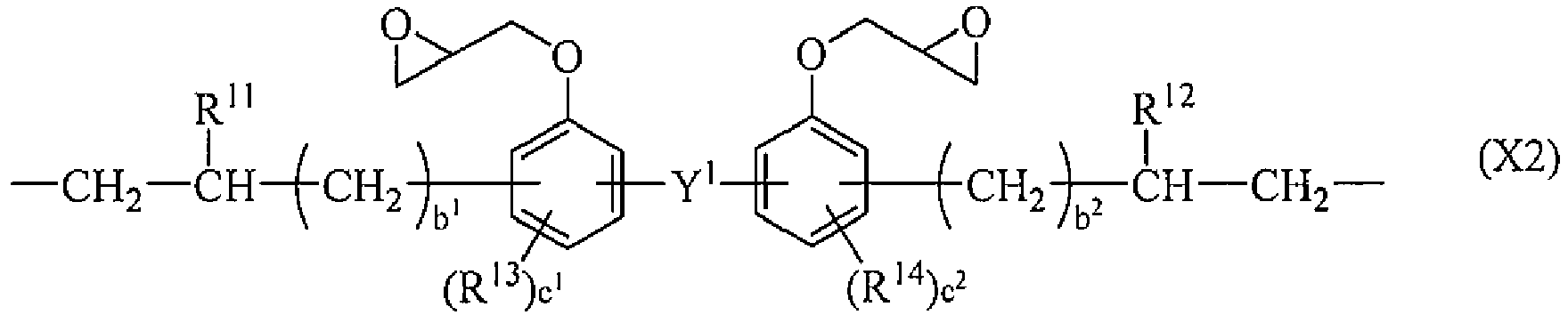
wherein Y1 is a single bond, methylene, propane-2,2-diyl, 1,1,1,3,3,3-hexafluoropropane-2,2-diyl or fluorene-9,9-diyl, R11 and R12 are each independently hydrogen or methyl, R13 and R14 are each independently a C1-C4 alkyl or alkoxy group, b1 and b2 are each independently an integer of 0 to 7, and c1 and c2 are each independently an integer of 0 to 2,

wherein Y2 is a single bond, methylene, propane-2,2-diyl, 1,1,1,3,3,3-hexafluoropropane-2,2-diyl or fluorene-9,9-diyl, R21 and R22 are each independently hydrogen or methyl, R23 and R24 are each independently a C1-C4 alkyl or alkoxy group, d1 and d2 are each independently an integer of 0 to 7, and e1 and e2 are each independently an integer of 0 to 2,
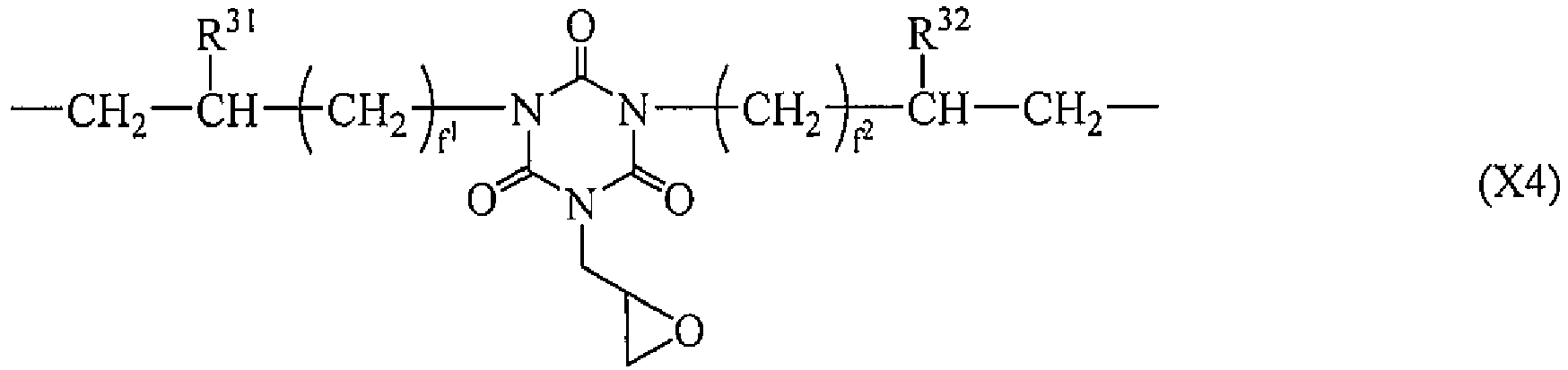
wherein R31 and R32 are each independently hydrogen or methyl, and f1 and f2 are each independently an integer of 0 to 7.
wherein X1 is a divalent group having the following formula (X1), X2 is a divalent group having the following formula (X2), X3 is a divalent group having the following formula (X3), X4 is a divalent group having the following formula (X4), and p, q, r and s are numbers in the range: 0 < p < 1, 0 ≤ q < 1, 0 ≤ r < 1, 0 ≤ s < 1, 0 < q+r+s < 1, and p+q+r+s = 1,
wherein R1 and R2 are each independently hydrogen or a C1-C8 monovalent hydrocarbon group, R3 and R4 are each independently hydrogen or methyl, a1 and a2 are each independently an integer of 1 to 6, and n is an integer of 0 to 100,
wherein Y1 is a single bond, methylene, propane-2,2-diyl, 1,1,1,3,3,3-hexafluoropropane-2,2-diyl or fluorene-9,9-diyl, R11 and R12 are each independently hydrogen or methyl, R13 and R14 are each independently a C1-C4 alkyl or alkoxy group, b1 and b2 are each independently an integer of 0 to 7, and c1 and c2 are each independently an integer of 0 to 2,
wherein Y2 is a single bond, methylene, propane-2,2-diyl, 1,1,1,3,3,3-hexafluoropropane-2,2-diyl or fluorene-9,9-diyl, R21 and R22 are each independently hydrogen or methyl, R23 and R24 are each independently a C1-C4 alkyl or alkoxy group, d1 and d2 are each independently an integer of 0 to 7, and e1 and e2 are each independently an integer of 0 to 2,
wherein R31 and R32 are each independently hydrogen or methyl, and f1 and f2 are each independently an integer of 0 to 7.
5. The polymer of claim 4 wherein R1 and R2 each are hydrogen.
6. The polymer of claim 4 or 5 wherein n is an integer of 5 to 20.
REFERENCES CITED IN THE DESCRIPTION
This list of references cited by the applicant is for the reader's convenience only. It does not form part of the European patent document. Even though great care has been taken in compiling the references, errors or omissions cannot be excluded and the EPO disclaims all liability in this regard.
Patent documents cited in the description
- JP2018095338A [0001] [0042]
- JP2002088158A [0005]
- US6590010B [0005]
- EP1186624A [0005]
- JP2008184571A [0005]
- US7785766B [0005]
- EP1953183A [0005]
- USP3220972A [0030]
- USP3159601A [0030]
- USP3159662A [0030]
- USP3775452A [0030]