|
(11) | EP 4 047 445 A1 |

| (12) | EUROPEAN PATENT APPLICATION |
| published in accordance with Art. 153(4) EPC |
|
|
|
|
|||||||||||||||||||||||||||
| (54) | SAFETY LOOP VOLTAGE REGULATING CIRCUIT |
| (57) A safety loop voltage regulating circuit includes a power regulation chip (1), and
a safety loop (2) and contactor (KM) that are connected with the power regulation
chip (1). A plurality of safety switches (S1, S2, ..., S(n)) are arranged in the safety
loop (2). A starting end of the safety loop (2) is connected to a power supply terminal
(SVCC) of the power regulation chip (1), and a tail end of the safety loop (2) is
connected to a grounding end (SGND) of the power regulation chip (1) through the contactor
(KM). The power regulation chip (1) further includes a feedback terminal (FB) connected
to the tail end of the safety loop (2). |
CROSS-REFERENCE TO RELATED APPLICATION
[0001] The present application claims priority to Chinese Patent Application No. 202011108566.8, entitled "Safety Loop Voltage Regulation Circuit" and filed on October 16, 2020, which is hereby incorporated by reference in its entirety.
TECHNICAL FIELD
[0002] The present application relates to the field of elevators, and in particular, to a safety loop voltage regulation circuit.
BACKGROUND
[0003] In the related art, safety switches and a contactor are installed in the safety loop of the elevator, all the safety switches are connected in series, and only when all the safety switches are turned on, the contactor is actuated and closed and the elevator can be continuously operated. The contactors are divided into direct current (DC) and alternating current (AC), and for different contactors, the power supply of the safety loop usually adopts three ways of 220 V AC, 110 V AC, and 24 V DC. In addition, the AC-powered contactor is small in reactance and large in starting current, and therefore is not suitable for occasions with frequent actuation and frequent disconnection, and eddy current and hysteresis loss exist during operation, resulting in overheating of the iron core, and there are few coil turns, and the coil is easily burnt once being stuck. Compared with the AC-powered contactor, the DC contactor has a small current and is suitable for occasions with frequent actuation and frequent disconnection, and for the DC power supply is adopted, no vibration and noise are generated by the electromagnet. As the demand for high-floor elevators and the comfort requirements for elevator muting increase, the DC contactors gradually replaces the AC contactors.
[0004] However, the power supply voltage of the DC contactor adopted in the safety loop is lower than that of the AC contactor, when the number of safety switches in the high-floor elevator system increases, or when the impedances of the contact points of the safety switches become larger because of the long-time operation of the elevator, the voltage drop on the safety loop becomes large, thus the voltage at the tail end of the safety loop is insufficient to drive the safety contactor, and the elevator cannot operate normally.
[0005] Therefore, a safety loop voltage regulation circuit for an elevator that can regulate voltage is needed.
SUMMARY
[0006] In order to solve one of the above problems, the present application provides a safety loop voltage regulation circuit, which includes a power regulation chip, a safety loop and a contactor, the safety loop and the contactor are connected with the power regulation chip, and a plurality of safety switches are arranged in the safety loop. A starting end of the safety loop is connected with a power supply terminal of the power regulation chip, and a tail end of the safety loop is connected to a grounding end of the power regulation chip through the contactor. The power regulation chip further includes a feedback terminal connected to the tail end of the safety loop.
[0007] In one embodiment, the safety loop voltage regulation circuit further includes a voltage division branch, and the tail end of the safety loop is connected to the feedback terminal through the voltage division branch.
[0008] In one embodiment, the voltage division branch includes a first resistor and a second resistor connected in series, another terminal of the first resistor is connected to the tail end of the safety loop, another terminal of the second resistor is connected to the ground terminal of the power regulation chip, and the feedback terminal is connected between the first resistor and the second resistor.
[0009] In one embodiment, the safety loop voltage regulation circuit further includes an adaptive regulation branch connected between the tail end of the safety loop and the feedback terminal.
[0010] In one embodiment, the regulation branch includes a voltage sampler and an MCU controller connected in series, and the voltage sampler is connected to the tail end of the safety loop.
[0011] In one embodiment, the safety loop voltage regulation circuit further includes a third resistor connected in series with the regulation branch, and the regulation branch is connected to the feedback terminal through the third resistor.
[0012] In one embodiment, a voltage Vs at the tail end of the safety loop satisfies a formula:
wherein VFB is a voltage at the feedback terminal, and VM is a voltage at an output terminal of the regulation branch.
[0013] In one embodiment, the regulation branch further includes a voltage follower connected in series between an output terminal of the MCU controller and the third resistor.
[0014] In one embodiment, the safety loop voltage regulation circuit includes two isolation branches distributed at an output terminal and an input terminal of the regulation branch.
[0016] Compared with the related art, in the present application, the power regulation chip can adjust the voltage of the power supply terminal of the power regulation chip according to the voltage signal input by the feedback terminal, thereby ensuring that the voltage at the tail end of the safety loop can reach the working voltage of the contactor, ensuring the stable operation of the contactor, and further ensuring the stability of the safety loop and the elevator system.
BRIEF DESCRIPTION OF THE DRAWINGS
[0017]
FIG. 1 is a circuit diagram of a safety loop voltage regulation circuit of the present application.
FIG. 2 is a circuit diagram of another embodiment of the safety loop voltage regulation circuit of the present application.
DETAILED DESCRIPTION OF THE EMBODIMENTS
[0018] In order to enable a person skilled in the art to better understand the embodiments in the present application, the embodiments of the present application will be clearly and completely described below with reference to the accompanying drawings in the embodiments of the present application, and obviously, the described embodiments are merely a part and not all of the embodiments of the present application. All other embodiments obtained by a person of ordinary skill in the art based on the embodiments of the present application without creative efforts shall fall within the claimed scope of the present application.
[0019] As shown in FIG. 1 and FIG. 2, the present application provides a safety loop voltage regulation circuit including a power regulation chip 1, a safety loop 2 and a contactor KM both connected with the power regulation chip 1, a plurality of safety switches S1, S2 to S(n) are arranged in the safety loop 2, the contactor KM is a direct current contactor and is only one, and the safety switches are connected in series. The power regulation chip 1 is a DC/DC regulation chip, the DC/DC regulation chip receives an input voltage, and has a power supply terminal SVCC and a ground terminal SGND which are connected with the safety loop 2 and provides a direct current to the safety loop 2. Specifically, a starting end of the safety loop 2 is connected with the power supply terminal SVCC of the power regulation chip 1, and a tail end of the safety loop 2 is connected to the ground terminal SGND of the power regulation chip 1 through the contactor KM. Thus, a complete power supply loop of the safety loop 2 is formed.
[0020] The power regulation chip 1 further includes a feedback terminal FB, and the feedback terminal FB is connected to the tail end of the safety loop 2.
[0021] In a typical existing design, the feedback terminal FB of the power regulation chip 1 is usually connected to the power supply terminal SVCC of the power regulation chip 1, which means that the feedback terminal FB is equivalent to the starting end of the safety loop 2. In this way, a feedback voltage is obtained at the starting end of the safety loop 2 to adjust a voltage at the starting end of the safety loop 2. However, in this case, since there is a voltage drop on the safety loop 2, a voltage at the tail end of the safety loop 2, i.e., the voltage to the contactor KM, can not be controlled, resulting in a lower voltage at the tail end of the safety loop 2, which may be lower than a working voltage of the contactor KM and cause that the contactor KM cannot work.
[0022] Therefore, in the present application, the feedback terminal FB of the power regulation chip 1 is connected to the tail end of the safety loop 2, so that a voltage signal of the voltage at the tail end of the safety loop 2 is fed back to the power regulation chip 1, and the power regulation chip 1 can adjust a voltage at the power supply terminal SVCC of the power regulation chip 1 according to the voltage signal input through the feedback terminal FB, thereby ensuring that the voltage at the tail end of the safety loop 2 can reach the working voltage of the contactor KM, ensuring the stable operation of the contactor KM, and further ensuring the stability of the safety loop 2 and the elevator system.
[0023] As shown in FIG. 1, the safety loop voltage regulation circuit further includes a voltage division branch, and the tail end of the safety loop 2 is connected to the feedback terminal FB through the voltage division branch. Since the voltage at the tail end of the safety loop 2 may be large and may not fall in an input voltage range of the feedback terminal FB of the power regulation chip 1, thus the voltage at the tail end of the safety loop 2 needs to be divided using the voltage division branch.
[0024] Specifically, the voltage division branch includes a first resistor R1 and a second resistor R2 connected in series. Another terminal of the first resistor R1 is connected to the tail end of the safety loop 2, and another end of the second resistor R2 is connected to the ground terminal SGND of the power regulation chip 1. The feedback terminal FB is connected between the first resistor R1 and the second resistor R2.
[0025] The ground terminal SGND of the power regulation chip 1 is connected to the contactor KM, thus the another end of the second resistor R2 is equivalent to be connected to a terminal of the contactor KM, and the another end of the first resistor R1 is equivalent to be connected to another terminal of the contactor KM. If the voltage at the tail end of the safety loop 2 is Vs, the voltage at the feedback terminal FB of the power regulation chip 1 is VFB, then after being divided by the first resistor R1 and the second resistor R2, the following formula is satisfied:
[0026] Of course, with the continuous operation of the circuit, in the present application, the voltage VFB at the feedback terminal FB can be input into the power regulation chip 1, thus the power regulation chip 1 can adjust the voltage at the power supply terminal SVCC according to the voltage VFB at the feedback terminal FB, thereby the voltage at the power supply terminal SVCC and the voltage Vs at the tail end of the safety loop 2 tend to be stable, and the voltage VFB at the feedback term inal FB also tends to be stable.
[0027] The above introduces the method for the power regulation chip 1 to adaptively regulate the voltage at the power supply terminal of the power regulation chip 1 by inputting the voltage VFB at the feedback terminal FB into the power regulation chip 1. In the present application, another method is also provided to adaptively regulate the voltage at the power supply terminal SVCC of the power regulation chip 1.
[0028] The safety loop voltage regulation circuit further includes an adaptive regulation branch 3, and the adaptive regulation branch 3 is connected between the tail end of the safety loop 2 and the feedback terminal FB. The adaptive regulation branch 3 being connected between the tail end of the safety loop 2 and the feedback terminal FB is equivalent to that the adpative regulation branch 3 is connected in parallel with the first resistor R1. Therefore, the adaptive regulation branch 3 can also obtain the voltage Vs at the tail end of the safety loop 2, and can input a regulation result of the adaptive regulation branch 3 into the power regulation chip 1.
[0029] Specifically, the regulation branch 3 includes a voltage sampler 31 and an MCU controller 32 connected in series, and the voltage sampler 31 is connected to the tail end of the safety loop 2. For the voltage sampler 31 is connected to the tail end of the safety loop 2, the voltage Vs at the tail end of the safety loop 2 can be directly sampled and sent to the MCU controller 32 for analysis. After the MCU controller 32 analyzes samples of the voltage Vs at the tail end of the safety loop 2, an output terminal of the MCU controller 32 outputs a voltage analysis result and feeds back the voltage analysis result to the power regulation chip 1, so that the power regulation chip 1 adaptively modifies the voltage at the power supply terminal SVCC of the power regulation chip 1 according to the voltage analysis result from the output terminal of the MCU controller 32.
[0030] Moreover, the safety loop voltage regulation circuit further includes a third resistor R3 connected in series with the regulation branch 3, and the regulation branch 3 is connected to the feedback terminal FB through the third resistor R3. A voltage at the output terminal of the regulation branch 3 is preset as VM, a current on the second resistor R2 is equal to the sum of a current on the first resistor R1 and a current on the third resistor R3 according to the flow direction in the circuit and the equivalent circuit.
[0032] Due to the long-time operation, the voltage at the power supply terminal SVCC of the power regulation chip 1 can be adaptively regulated, so that the voltage VFB of the feedback terminal FB gradually tends to be stable. Therefore, according to the above formula, it can be seen that, in this embodiment, if the voltage Vs at the tail end of the safety loop 2 is needed to be regulated to meet the requirement of the contactor KM, it only needs to regulate the voltage VM at the output terminal of the regulation branch 3. The voltage VM at the output terminal of the regulation branch 3 can be changed through the MCU controller 32. Specifically, if Vs is to be increased, it only needs to reduce VM, and vice versa, and details are not described here again.
[0033] In addition, in the present application, the regulation branch 3 further includes a voltage follower 33, which is used to stably follow the voltage output by the MCU controller 32. Specifically, the voltage follower 33 is connected in series between the output terminal of the MCU controller 32 and the third resistor R3. Therefore, the voltage VM at the output terminal of the regulation branch 3 is a voltage at an output terminal of the voltage follower 33.
[0034] Moreover, in another embodiment, as shown in FIG. 2, the MCU controller 32 and the safety loop 2 and the power regulation chip 1 are not in the same power system, thus an isolation branch 34 needs to be provided near the MCU controller 32. There are two isolation branches 34 and the two isolation branches are distributed at the output terminal and an input terminal of the regulation branch 3. In this embodiment, the isolation branches 34 are distributed at an input terminal of the voltage sampler 31 and the output terminal of the voltage follower 33, and the isolation branches 34 are linear optocouplers, thereby ensuring the linearity of the terminal sampling voltage of the voltage sampler 31 and the following output voltage of the voltage follower 33 before and after isolation.
[0035] Therefore, in the present application, the feedback terminal FB of the power regulation chip 1 is connected to the tail end of the safety loop 2, so that the voltage signal of the voltage at the tail end of the safety loop 2 is fed back to the power regulation chip 1, and the power regulation chip 1 can regulate the voltage at the power supply terminal SVCC of the power regulation chip 1 according to the voltage signal input through the feedback terminal FB, thereby ensuring that the voltage at the tail end of the safety loop 2 can reach the working voltage of the contactor KM, ensuring the stable operation of the contactor KM, and further ensuring the stability of the safety loop 2 and the elevator system.
[0036] Moreover, through that the feedback terminal FB of the power regulation chip 1 receives the feedback voltage VFB and the voltage VM at the output terminal of the regulation branch 3, the voltage SVCC of the power supply terminal of the power regulation chip 1 is adaptively modified and tends to be stable.
[0037] In addition, it should be understood that, although the present specification is described in terms of embodiments, not every embodiment includes only one independent technical solution, and this description of the specification is merely for the sake of clarity, and those skilled in the art should understand the specification as a whole, and the technical solutions in various embodiments may also be appropriately combined to form other embodiments that can be understood by a person skilled in the art.
[0038] The detailed description set forth above is only for the description of the feasibility embodiments of the present application, and is not intended to limit the claimed scope of the present application, any equivalent implementation or change made without departing from the spirit of the present application shall fall within the claimed scope of the present application.
1. A safety loop voltage regulation circuit characterized by comprising a power regulation chip, a safety loop and a contactor, wherein the safety
loop and the contactor are connected with the power regulation chip, a plurality of
safety switches are arranged in the safety loop, a starting end of the safety loop
is connected with a power supply terminal of the power regulation chip, and a tail
end of the safety loop is connected to a grounding terminal of the power regulation
chip through the contactor, the power regulation chip further comprises a feedback
terminal connected to the tail end of the safety loop.
2. The safety loop voltage regulation circuit as claimed in claim 1, wherein the safety
loop voltage regulation circuit further comprises a voltage division branch, and the
tail end of the safety loop is connected to the feedback terminal through the voltage
division branch.
3. The safety loop voltage regulation circuit as claimed in claim 2, wherein the voltage
division branch comprises a first resistor and a second resistor connected in series,
another terminal of the first resistor is connected to the tail end of the safety
loop, another terminal of the second resistor is connected to the ground terminal
of the power regulation chip, and the feedback terminal is connected between the first
resistor and the second resistor.
4. The safety loop voltage regulation circuit as claimed in claim 3, wherein the safety
loop voltage regulation circuit further comprises an adaptive regulation branch connected
between the tail end of the safety loop and the feedback terminal.
5. The safety loop voltage regulation circuit as claimed in claim 4, wherein the regulation
branch comprises a voltage sampler and an MCU controller connected in series, and
the voltage sampler is connected to the tail end of the safety loop.
6. The safety loop voltage regulation circuit as claimed in claim 5, wherein the safety
loop voltage regulation circuit further comprises a third resistor connected in series
with the regulation branch, and the regulation branch is connected to the feedback
terminal through the third resistor.
7. The safety loop voltage regulation circuit as claimed in claim 6, wherein a voltage
Vs at the tail end of the safety loop satisfies a formula:
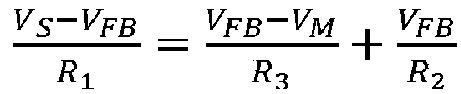
, wherein VFB is a voltage at the feedback terminal, and VM is a voltage at an output terminal of the regulation branch.
, wherein VFB is a voltage at the feedback terminal, and VM is a voltage at an output terminal of the regulation branch.
8. The safety loop voltage regulation circuit as claimed in claim 6, wherein the regulation
branch further comprises a voltage follower connected in series between an output
terminal of the MCU controller and the third resistor.
9. The safety loop voltage regulation circuit as claimed in claim 6, wherein the safety
loop voltage regulation circuit comprises two isolation branches distributed at an
output terminal and an input terminal of the regulation branch.
10. The safety loop voltage regulation circuit as claimed in claim 9, wherein the isolation
branches are linear optocouplers.
REFERENCES CITED IN THE DESCRIPTION
This list of references cited by the applicant is for the reader's convenience only. It does not form part of the European patent document. Even though great care has been taken in compiling the references, errors or omissions cannot be excluded and the EPO disclaims all liability in this regard.
Patent documents cited in the description